

ASTM D8373-21
(Guide)Standard Guide for Cannabis/Hemp Flower Vaporizers
General Information
- Abstract
SIGNIFICANCE AND USE
4.1 This guide is intended to educate new and experienced users of cannabis flower vaporizers on the various characteristics that can be available in cannabis flower vaporizers.
4.2 This guide will outline characteristics of cannabis flower vaporizers, which include individual components, design elements, and basic universal functions.
4.3 This guide will categorize common characteristics using categories based on different technologies and describe in simple terms the details attributable to each category, but is not intended to be all inclusive.
4.4 The categories outlined in this guide are intended to identify, list, and group the characteristics germane to cannabis flower vaporizers. This guide and the categories created within will be used by subcommittee members of cannabis devices and appliances to further develop standards in the field of cannabis devices.
4.5 This standard guide will serve to provide clarity to industry, government, consumers and the public on terminology, and universal functions of cannabis flower vaporizers.
4.6 Reference to a type characteristic in this guide is not intended in any manner to denote endorsement or approval of said type by ASTM International.
SCOPE
1.1 This guide is intended to define characteristics, functions, and technologies commonly present in cannabis/hemp flower vaporizers.
1.2 This guide shall apply to vaporizers used to consume the flowers of a cannabis plant regardless of the type of cannabis plant from which they where derived. For the sake of brevity, the term “cannabis” shall be used from now on to refer to any type of cannabis plant (cannabis/hemp).
1.3 This guide will provide clarity to the industry, government, consumers and the public to understand what different features and technologies can be present in cannabis flower vaporizers
1.4 This guide shall be used in conjunction with Classification D8357.
1.5 This standard does not purport to address all of the safety concerns, if any, associated with its use. It is the responsibility of the user of this standard to establish appropriate safety, health, and environmental practices and determine the applicability of regulatory limitations prior to use.
1.6 This international standard was developed in accordance with internationally recognized principles on standardization established in the Decision on Principles for the Development of International Standards, Guides and Recommendations issued by the World Trade Organization Technical Barriers to Trade (TBT) Committee.
- Status
- Published
- Publication Date
- 31-Jan-2021
- Technical Committee
- D37 - Cannabis
- Drafting Committee
- D37.08 - Personal/Household-Use Cannabis Devices and Appliances

Overview
ASTM D8373-21 - Standard Guide for Cannabis/Hemp Flower Vaporizers provides comprehensive guidance on the characteristics, components, and key technologies found in cannabis and hemp flower vaporizers. Developed by ASTM International, this standard aims to educate both new and experienced users about the design, function, and terminology related to these devices. The guide is an essential resource for manufacturers, industry professionals, regulators, and consumers seeking clarity on the fundamental aspects of cannabis vaporizers.
Key Topics
Core Characteristics of Cannabis Flower Vaporizers
Device Configuration
- Handheld: Personal, portable vaporizers powered by rechargeable batteries.
- Desktop: Stationary units designed for use on flat surfaces; typically powered by an A/C source.
- Other Innovations: Devices outside standard handheld or desktop categories, potentially including new or hybrid designs.
Temperature/Wattage Setting
- Precise Control: Allows users to set exact temperature or wattage.
- Rough Control: Features pre-set selectable temperature or wattage settings.
- Hybrid Control: Offers both precise and rough controls via manual settings or connected applications.
- No Control: Factory-set temperature or wattage with no user adjustment.
Information Readout
- Digital Displays: Electronic screens or app-based controls.
- Analog Indicators: Visual cues like labels, lights, or numbered dials.
- Haptic Feedback: Vibration or tactile cues indicating device status.
- No Readout: Devices without any visual or tactile feedback mechanism.
Design Intent
- Built for Purpose: Devices designed for a single cannabis input.
- Adaptive: Multi-purpose devices supporting various cannabis forms.
Oven Material
- Single Material: Oven constructed from stainless steel, ceramic, etc.
- Combination Materials: Multi-material ovens, such as ceramic-coated steel.
Activation Method
- Manual: Activated by a physical button or mechanism.
- Digital: Activation via electronic signals, including remote or biometric controls.
- Sequence-Based: Requires a series of actions, such as multiple button presses.
- Inhalation-Based: Activates when the user inhales through the mouthpiece.
Heating Type
- Conduction: Heats cannabis through direct contact.
- Convection: Uses heated air to vaporize cannabis.
- Induction: Employs magnetic fields and metal components for heating.
- Radiant: Utilizes radiant heat sources.
- Combination: Incorporates multiple heating methods.
Applications
The guide has wide-ranging practical applications:
- Manufacturers: Enables the development of cannabis vaporizers with clearly defined features and design elements, ensuring consistency and quality.
- Industry Professionals: Provides standardized terminology for product development, comparison, and improvement.
- Regulators and Policymakers: Assists in drafting regulations and policies by offering clarity on universal functions and safety considerations.
- Retailers and Consumers: Educates users about the differences among devices, enhancing informed purchasing decisions and safe usage.
- Standardization Committees: Serves as a foundational document for further developing cannabis device standards.
ASTM D8373-21 emphasizes safety, user experience, and device longevity, advocating for designs that allow easy cleaning and consistent performance. It also helps classify and group vaporizer characteristics, fostering transparency in the rapidly evolving cannabis technology landscape.
Related Standards
- ASTM D8357: Classification for Cannabis/Hemp Flower Vaporizers - to be used in conjunction with this guide for further classification and specification.
- ASTM D8270: Terminology Relating to Cannabis - referenced for a comprehensive understanding of cannabis terminology.
Keywords
cannabis flower vaporizer, hemp flower vaporizer, vaporization, vaporizer characteristics, cannabis devices, ASTM D8373, device categories, temperature control, heating technology, cannabis consumption, vaporizer standards, industry terminology
Get Certified
Connect with accredited certification bodies for this standard

Control Union Certifications
Global certification for agriculture and sustainability.

ECOCERT
Organic and sustainability certification.

FSC International
Forest Stewardship Council certification.
Sponsored listings
Frequently Asked Questions
ASTM D8373-21 is a guide published by ASTM International. Its full title is "Standard Guide for Cannabis/Hemp Flower Vaporizers". This standard covers: SIGNIFICANCE AND USE 4.1 This guide is intended to educate new and experienced users of cannabis flower vaporizers on the various characteristics that can be available in cannabis flower vaporizers. 4.2 This guide will outline characteristics of cannabis flower vaporizers, which include individual components, design elements, and basic universal functions. 4.3 This guide will categorize common characteristics using categories based on different technologies and describe in simple terms the details attributable to each category, but is not intended to be all inclusive. 4.4 The categories outlined in this guide are intended to identify, list, and group the characteristics germane to cannabis flower vaporizers. This guide and the categories created within will be used by subcommittee members of cannabis devices and appliances to further develop standards in the field of cannabis devices. 4.5 This standard guide will serve to provide clarity to industry, government, consumers and the public on terminology, and universal functions of cannabis flower vaporizers. 4.6 Reference to a type characteristic in this guide is not intended in any manner to denote endorsement or approval of said type by ASTM International. SCOPE 1.1 This guide is intended to define characteristics, functions, and technologies commonly present in cannabis/hemp flower vaporizers. 1.2 This guide shall apply to vaporizers used to consume the flowers of a cannabis plant regardless of the type of cannabis plant from which they where derived. For the sake of brevity, the term “cannabis” shall be used from now on to refer to any type of cannabis plant (cannabis/hemp). 1.3 This guide will provide clarity to the industry, government, consumers and the public to understand what different features and technologies can be present in cannabis flower vaporizers 1.4 This guide shall be used in conjunction with Classification D8357. 1.5 This standard does not purport to address all of the safety concerns, if any, associated with its use. It is the responsibility of the user of this standard to establish appropriate safety, health, and environmental practices and determine the applicability of regulatory limitations prior to use. 1.6 This international standard was developed in accordance with internationally recognized principles on standardization established in the Decision on Principles for the Development of International Standards, Guides and Recommendations issued by the World Trade Organization Technical Barriers to Trade (TBT) Committee.
SIGNIFICANCE AND USE 4.1 This guide is intended to educate new and experienced users of cannabis flower vaporizers on the various characteristics that can be available in cannabis flower vaporizers. 4.2 This guide will outline characteristics of cannabis flower vaporizers, which include individual components, design elements, and basic universal functions. 4.3 This guide will categorize common characteristics using categories based on different technologies and describe in simple terms the details attributable to each category, but is not intended to be all inclusive. 4.4 The categories outlined in this guide are intended to identify, list, and group the characteristics germane to cannabis flower vaporizers. This guide and the categories created within will be used by subcommittee members of cannabis devices and appliances to further develop standards in the field of cannabis devices. 4.5 This standard guide will serve to provide clarity to industry, government, consumers and the public on terminology, and universal functions of cannabis flower vaporizers. 4.6 Reference to a type characteristic in this guide is not intended in any manner to denote endorsement or approval of said type by ASTM International. SCOPE 1.1 This guide is intended to define characteristics, functions, and technologies commonly present in cannabis/hemp flower vaporizers. 1.2 This guide shall apply to vaporizers used to consume the flowers of a cannabis plant regardless of the type of cannabis plant from which they where derived. For the sake of brevity, the term “cannabis” shall be used from now on to refer to any type of cannabis plant (cannabis/hemp). 1.3 This guide will provide clarity to the industry, government, consumers and the public to understand what different features and technologies can be present in cannabis flower vaporizers 1.4 This guide shall be used in conjunction with Classification D8357. 1.5 This standard does not purport to address all of the safety concerns, if any, associated with its use. It is the responsibility of the user of this standard to establish appropriate safety, health, and environmental practices and determine the applicability of regulatory limitations prior to use. 1.6 This international standard was developed in accordance with internationally recognized principles on standardization established in the Decision on Principles for the Development of International Standards, Guides and Recommendations issued by the World Trade Organization Technical Barriers to Trade (TBT) Committee.
ASTM D8373-21 is classified under the following ICS (International Classification for Standards) categories: 65.160 - Tobacco, tobacco products and related equipment. The ICS classification helps identify the subject area and facilitates finding related standards.
ASTM D8373-21 is available in PDF format for immediate download after purchase. The document can be added to your cart and obtained through the secure checkout process. Digital delivery ensures instant access to the complete standard document.
Standards Content (Sample)
This international standard was developed in accordance with internationally recognized principles on standardization established in the Decision on Principles for the
Development of International Standards, Guides and Recommendations issued by the World Trade Organization Technical Barriers to Trade (TBT) Committee.
Designation: D8373 − 21
Standard Guide for
Cannabis/Hemp Flower Vaporizers
This standard is issued under the fixed designation D8373; the number immediately following the designation indicates the year of
original adoption or, in the case of revision, the year of last revision. A number in parentheses indicates the year of last reapproval. A
superscript epsilon (´) indicates an editorial change since the last revision or reapproval.
1. Scope 3.1.1 For definitions of terms used in this guide, refer to
TerminologyD8270andthetermsdevelopedbySubcommittee
1.1 This guide is intended to define characteristics,
D37.91 on Terminology.
functions, and technologies commonly present in cannabis/
hemp flower vaporizers. 3.2 Definitions of Terms Specific to This Standard:
3.2.1 activation method, n—a physical, mechanical,
1.2 Thisguideshallapplytovaporizersusedtoconsumethe
electrical, or personal means for turning on a device.
flowers of a cannabis plant regardless of the type of cannabis
plant from which they where derived. For the sake of brevity,
3.2.1.1 Discussion—Activation methods include pushing a
the term “cannabis” shall be used from now on to refer to any
physical button on a device, engaging a mechanism on a
type of cannabis plant (cannabis/hemp).
device, sending an electrical signal from another device, or
drawing air from the device with the mouth.
1.3 This guide will provide clarity to the industry,
3.2.2 air path, n—the air intake pathway leading to the oven
government, consumers and the public to understand what
or vaporization chamber.
different features and technologies can be present in cannabis
flower vaporizers
3.2.3 contact material, n—any material in the device that
comes into direct contact with the product.
1.4 This guide shall be used in conjunction with Classifica-
tion D8357.
3.2.3.1 Discussion—The contact surface is any boundary of
1.5 This standard does not purport to address all of the
the contact material that touches the cannabis flower.
safety concerns, if any, associated with its use. It is the
3.2.3.2 Discussion—For example, glass stem airpaths and
responsibility of the user of this standard to establish appro-
quartz heating sources.
priate safety, health, and environmental practices and deter-
3.2.4 desktop, n—any personal consumption device that is
mine the applicability of regulatory limitations prior to use.
designed to rest on a stable horizontal surface while in use.
1.6 This international standard was developed in accor-
3.2.5 handheld, n—any personal consumption device that is
dance with internationally recognized principles on standard-
explicitly designed to be held in the user’s hand.
ization established in the Decision on Principles for the
3.2.6 mouthpiece, n—a component in the cannabis device
Development of International Standards, Guides and Recom-
that touches the end user and marks the end of the vapour path.
mendations issued by the World Trade Organization Technical
Barriers to Trade (TBT) Committee.
3.2.7 oven, n—a chamber integrated into or along with a
cannabis device in which the desired material intended for
2. Referenced Documents
vaporization is placed for heating.
2.1 ASTM Standards:
3.2.7.1 Discussion—It is also known as the vaporization
D8270 Terminology Relating to Cannabis
chamber or the heating chamber.
D8357 Classification for Cannabis/Hemp Flower Vaporizers
3.2.7.2 Discussion—For the basis of this guide, the material
3. Terminology intended for vaporization is ground dried cannabis flower, or
dried cannabis flower, or cannabis flower, or combination
3.1 Definitions:
thereof.
3.2.8 other “X”, n—any personal consumption device that
This guide is under the jurisdiction ofASTM Committee D37 on Cannabis and
is not handheld or desktop.
is the direct responsibility of Subcommittee D37.08 on Cannabis Devices and
Appliances.
3.2.9 vapour, n—a substance or material which has experi-
Current edition approved Feb. 1, 2021. Published June 2021. DOI: 10.1520/
enced a phase change above its boiling point and is suspended
D8373-21.
2 or dispersed in the air.
For referenced ASTM standards, visit the ASTM website, www.astm.org, or
contact ASTM Customer Service at service@astm.org. For Annual Book of ASTM
3.2.9.1 Discussion—For the context of this guide, aerosol
Standards volume information, refer to the standard’s Document Summary page on
the ASTM website. and vapour are synonymous
Copyright © ASTM International, 100 Barr Harbor Drive, PO Box C700, West Conshohocken, PA 19428-2959. United States
D8373 − 21
3.2.9.2 Discussion—Vapour (as it pertains to cannabis) is an 4.4 The categories outlined in this guide are intended to
aerosol consisting of cannabinoids in the particulate phase of identify, list, and group the characteristics germane to cannabis
the aerosol. The gas phase of the aerosol consists of some flower vaporizers. This guide and the categories created within
terpenes (the balance being in the particulate phase) as well as will be used by subcommittee members of cannabis devices
other minor plant constituents and thermal degradation prod- and appliances to further develop standards in the field of
ucts produced as a result of the heating process. cannabis devices.
3.2.10 vapour path, n—the pathway leading from the vapor-
4.5 This standard guide will serve to provide clarity to
ization chamber to the end user or open-air environment.
industry, government, consumers and the public on
3.2.11 vaporization, n—the conversion of a solid or liquid
terminology, and universal functions of cannabis flower vapor-
into a vapour.
izers.
3.2.11.1 Discussion—Vaporization, (as it pertains to 4.6 Reference to a type characteristic in this guide is not
cannabis), is the state change of the principal constituents of intended in any manner to denote endorsement or approval of
interest, namely cannabinoids, terpenes, and other constituents, said type by ASTM International.
present in cannabis flower, induced by heating the material
until evaporation and formation into a suspension, referred to
5. Characteristics
as vapour, occurs.
5.1 The various characteristics of cannabis flower vaporiz-
3.2.11.2 Discussion—Vaporization temperatures play a cru-
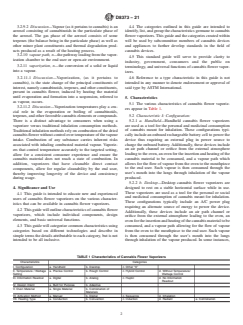
ers appear in Table 1.
cial role in the evaporation or boiling of cannabinoids,
5.2 Characteristic I: Configuration:
terpenes,andotherfavorablecannabiselementsorcompounds.
5.2.1 a. Handheld—Handheld cannabis flower vaporizers
There is a distinct advantage to consumers when using a
are used as a tool for the personal and medicinal consumption
vaporizer versus traditional inhalation consumption methods.
of cannabis meant for inhalation. These configurations typi-
Traditional inhalation methods rely on combustion of the dried
cally include an onboard rechargeable battery cell to power the
cannabis flower without control over temperature of the vapour
device thus requiring an external plug in power source to
intake. Combustion of any substance carries inherent risks
charge the onboard battery.Additionally, these devices include
associated with inhaling combusted material vapour. Vaporiz-
an air path channel or orifice from the external atmosphere
ers that control temperature accurately to the targeted setting,
leading to the oven, an oven for the insertion and heating of the
allow for a consistent consumer experience and ensure the
cannabis material to be consumed, and a vapour path which
cannabis material does not reach a state of combustion. In
allows for the flow of vapour from the oven to the mouthpiece
addition, vaporizers that have cleanable direct contact
to the end user. Such vapour is then consumed through the
components, allow for regular cleanability by the end user,
user’s mouth into the lungs through inhalation of the vapour
thereby improving longevity of the device and consistency
produced.
during usage.
5.2.2 b. Desktop—Desktop cannabis flower vaporizers are
4. Significance and Use
designed to rest on a stable horizontal surface while in use.
These vaporizers are used as a tool for the personal or social
4.1 This guide is intended to educate new and experienced
and medicinal consumption of cannabis meant for inhalation.
users of cannabis flower vaporizers on the various character-
These configurations typically include an A/C power plug
istics that can be available in cannabis flower vaporizers.
requiring an alternate source of energy to power the device.
4.2 Thisguidewilloutlinecharacteristicsofcannabisflower
Additionally, these devices include an air path channel or
vaporizers, which include individual components, design
orifice from the external atmosphere leading to the oven, an
elements, and basic universal functions.
ovenfortheinsertionandheatingofthecannabismaterialtobe
4.3 This guide will categorize common characteristics using consumed, and a vapour path allowing for the flow of vapour
categories based on different technologies and describe in from the oven to the mouthpiece to the end user.
...