

ASTM F3637-23
(Guide)Standard Guide for Additive Manufacturing of Metal - Finished Part Properties - Methods for Relative Density Measurement
General Information
- Abstract
SIGNIFICANCE AND USE
5.1 General:
5.1.1 This guide is intended to support PBF-LB process and parameter development, part acceptance criteria, and process control tests.
5.1.2 Flaws and Defects-Fabricating fully dense parts continues to be a challenge in AM as the process intrinsically introduces volumetric flaws into a part reducing the part relative density (that is, increasing porosity or the presence of small voids in a part making it less than fully dense) and mechanical performance.
5.1.2.1 When a flaw reaches a size, shape, location, or criticality that makes it becomes unacceptable for part acceptance, it will be referred to as a defect.
5.1.2.2 Flaw or defect formation is governed by the manufacturing process, build parameters, feedstock, and geometric factors. Therefore, accurate measurement of fabricated part relative density is an important initial step in determining part and process quality.
5.1.2.3 The quantity, size, and shape of the volumetric flaws influences mechanical performance of a part, particularly under cyclic loading. These data could indicate irregularly shaped (for example, LOF pores or microcracking) or spherical porosity (for example, keyhole or entrapped gas porosity) and determine acceptability by assigning criteria. While these metrics can be quantified, in this guide, the general capabilities of each method to capture this data will be highlighted, but detailed recommendations on these data types will not be made and rather the focus will be on relative density measurements.
5.1.3 Uncertainty and Error-Users should consider that each measurement technique considered in this guide has differing sensitivities to various sized features. The measurement methods will also have different potential systematic errors or measurement uncertainties due to sampling sizes, detection resolution, effect of surface condition, experimental set-up, or reliance on a theoretical material density. It is important that these effects are taken into considerati...
SCOPE
1.1 In this standard, guidelines for measuring post-manufacturing relative density of metallic additive manufactured (AM) parts and density assessment test specimens are given.
1.2 In this guide, standard test methods commonly used to measure part relative density and details any procedural changes or recommendations for use with PBF-LB parts are referenced. Extensibility to other types of metallic AM processes may be considered on a case-by-case basis with user discretion.
1.3 This guide is intended to be applied during the selection process of methods to measure the relative density of AM parts to balance cost, accuracy, complexity, part destruction, and part size concerns.
1.4 Pore size, shape, and distribution and their implications relative to the AM process and material are beyond the scope of this guide; however, each method’s ability to obtain these metrics is discussed in the context of the various density measurement methods.
1.5 Units-The values stated in SI units are to be regarded as the standard. No other units of measurement are included in this standard.
1.6 This standard does not purport to address all of the safety concerns, if any, associated with its use. It is the responsibility of the user of this standard to establish appropriate safety, health, and environmental practices and determine the applicability of regulatory limitations prior to use.
1.7 This international standard was developed in accordance with internationally recognized principles on standardization established in the Decision on Principles for the Development of International Standards, Guides and Recommendations issued by the World Trade Organization Technical Barriers to Trade (TBT) Committee.
- Status
- Published
- Publication Date
- 14-May-2023
- Technical Committee
- F42 - Additive Manufacturing Technologies
- Drafting Committee
- F42.01 - Test Methods
Overview
ASTM F3637-23 is a standard guide developed by ASTM International for assessing the relative density of finished metal parts produced by additive manufacturing (AM), with a focus on Powder Bed Fusion-Laser Beam (PBF-LB) processes. This guide details methods, procedural considerations, and best practices for measuring and reporting the relative density of metallic AM parts and associated test specimens. High relative density is essential for mechanical performance in metal AM parts, since the presence of pores or flaws can compromise structural integrity and product quality.
Key Topics
- Purpose: The guide aids in PBF-LB process development, acceptance criteria, and process control by providing reliable techniques to measure relative density.
- Flaws and Defects: Additive manufacturing often introduces volumetric flaws (such as porosity or voids) that affect part density and performance. Measurement helps distinguish between acceptable flaws and critical defects.
- Methodologies: The guide covers several measurement techniques, including:
- Archimedes Method: Uses fluid displacement to determine density; cost-effective but sensitive to operator variability and part design.
- Gas Pycnometry: Measures density using gas displacement; suitable for high-density parts and smaller volumes.
- X-ray Computed Tomography (XCT): Non-destructive and provides detailed insight into internal flaws, but requires expensive equipment.
- Ultrasonic Testing: Based on wave velocity through the part; best for simple geometries and larger specimens.
- Metallographic Analysis: Involves destructive sectioning and imaging, useful for detailed pore analysis on test specimens.
- Uncertainty and Error: Each technique carries specific limitations regarding accuracy, sample suitability, surface effects, and operator consistency.
Applications
ASTM F3637-23 is useful throughout the additive manufacturing workflow:
- Process & Parameter Development: Helps manufacturers fine-tune build parameters to achieve optimal part density and material properties.
- Quality Control & Part Acceptance: Provides standardized methods for verifying whether a part meets customer and industry requirements, especially in critical applications.
- Test Method Selection: Assists users in balancing factors such as cost, accuracy, part size, destruction, and complexity when choosing a measurement technique.
- Statistical Process Control: Routine measurements can be used to monitor production consistency and detect process drifts.
- Research & Development: Supports studies on the relationships between process parameters, flaw formation, density, and mechanical performance in metal AM.
The guide is relevant for manufacturers of metal components in aerospace, automotive, medical, energy, and industrial sectors seeking to ensure product consistency, safety, and performance.
Related Standards
Referencing both ASTM and ISO standards, ASTM F3637-23 integrates established protocols:
- ASTM B311 & B962: Test methods for density measurement, pertinent to both dense and porous parts.
- ASTM B923: Skeletal density measurement via gas pycnometry.
- ASTM E3, E494, E1245, E1935, E2782, F2971: Covering specimen preparation, ultrasonic methods, image analysis, CT calibration, measurement systems analysis, and AM data reporting.
- ISO/ASTM 52900: General principles and vocabulary for additive manufacturing.
These standards enable best practices for consistent, repeatable density measurements in additive manufacturing workflows. For comprehensive quality assurance and regulatory compliance, organizations are encouraged to apply these reference documents in conjunction with ASTM F3637-23.
Keywords: additive manufacturing, relative density measurement, metallic AM parts, Powder Bed Fusion-Laser Beam, porosity, flaws, defects, quality control, process validation, ASTM F3637-23, Archimedes method, gas pycnometry, XCT, ultrasonic testing, metallography, AM standards.
Relations
- Effective Date
- 15-Nov-2023
- Effective Date
- 01-Dec-2019
- Effective Date
- 01-Oct-2016
- Effective Date
- 01-Apr-2015
- Effective Date
- 01-Sep-2014
- Effective Date
- 01-Jun-2013
- Effective Date
- 01-Apr-2013
- Effective Date
- 01-Apr-2013
- Effective Date
- 15-Nov-2011
- Effective Date
- 15-Nov-2011
- Effective Date
- 01-Oct-2010
- Effective Date
- 01-Sep-2010
- Effective Date
- 01-May-2010
- Effective Date
- 15-Dec-2008
- Effective Date
- 01-Dec-2008
Get Certified
Connect with accredited certification bodies for this standard

DVS-ZERT GmbH
German welding certification society.
CARES (UK Certification Authority for Reinforcing Steels)
UK certification for reinforcing steels and construction.
EWF/IIW (European/International Welding Federation)
International welding personnel certification.
Sponsored listings
Frequently Asked Questions
ASTM F3637-23 is a guide published by ASTM International. Its full title is "Standard Guide for Additive Manufacturing of Metal - Finished Part Properties - Methods for Relative Density Measurement". This standard covers: SIGNIFICANCE AND USE 5.1 General: 5.1.1 This guide is intended to support PBF-LB process and parameter development, part acceptance criteria, and process control tests. 5.1.2 Flaws and Defects-Fabricating fully dense parts continues to be a challenge in AM as the process intrinsically introduces volumetric flaws into a part reducing the part relative density (that is, increasing porosity or the presence of small voids in a part making it less than fully dense) and mechanical performance. 5.1.2.1 When a flaw reaches a size, shape, location, or criticality that makes it becomes unacceptable for part acceptance, it will be referred to as a defect. 5.1.2.2 Flaw or defect formation is governed by the manufacturing process, build parameters, feedstock, and geometric factors. Therefore, accurate measurement of fabricated part relative density is an important initial step in determining part and process quality. 5.1.2.3 The quantity, size, and shape of the volumetric flaws influences mechanical performance of a part, particularly under cyclic loading. These data could indicate irregularly shaped (for example, LOF pores or microcracking) or spherical porosity (for example, keyhole or entrapped gas porosity) and determine acceptability by assigning criteria. While these metrics can be quantified, in this guide, the general capabilities of each method to capture this data will be highlighted, but detailed recommendations on these data types will not be made and rather the focus will be on relative density measurements. 5.1.3 Uncertainty and Error-Users should consider that each measurement technique considered in this guide has differing sensitivities to various sized features. The measurement methods will also have different potential systematic errors or measurement uncertainties due to sampling sizes, detection resolution, effect of surface condition, experimental set-up, or reliance on a theoretical material density. It is important that these effects are taken into considerati... SCOPE 1.1 In this standard, guidelines for measuring post-manufacturing relative density of metallic additive manufactured (AM) parts and density assessment test specimens are given. 1.2 In this guide, standard test methods commonly used to measure part relative density and details any procedural changes or recommendations for use with PBF-LB parts are referenced. Extensibility to other types of metallic AM processes may be considered on a case-by-case basis with user discretion. 1.3 This guide is intended to be applied during the selection process of methods to measure the relative density of AM parts to balance cost, accuracy, complexity, part destruction, and part size concerns. 1.4 Pore size, shape, and distribution and their implications relative to the AM process and material are beyond the scope of this guide; however, each method’s ability to obtain these metrics is discussed in the context of the various density measurement methods. 1.5 Units-The values stated in SI units are to be regarded as the standard. No other units of measurement are included in this standard. 1.6 This standard does not purport to address all of the safety concerns, if any, associated with its use. It is the responsibility of the user of this standard to establish appropriate safety, health, and environmental practices and determine the applicability of regulatory limitations prior to use. 1.7 This international standard was developed in accordance with internationally recognized principles on standardization established in the Decision on Principles for the Development of International Standards, Guides and Recommendations issued by the World Trade Organization Technical Barriers to Trade (TBT) Committee.
SIGNIFICANCE AND USE 5.1 General: 5.1.1 This guide is intended to support PBF-LB process and parameter development, part acceptance criteria, and process control tests. 5.1.2 Flaws and Defects-Fabricating fully dense parts continues to be a challenge in AM as the process intrinsically introduces volumetric flaws into a part reducing the part relative density (that is, increasing porosity or the presence of small voids in a part making it less than fully dense) and mechanical performance. 5.1.2.1 When a flaw reaches a size, shape, location, or criticality that makes it becomes unacceptable for part acceptance, it will be referred to as a defect. 5.1.2.2 Flaw or defect formation is governed by the manufacturing process, build parameters, feedstock, and geometric factors. Therefore, accurate measurement of fabricated part relative density is an important initial step in determining part and process quality. 5.1.2.3 The quantity, size, and shape of the volumetric flaws influences mechanical performance of a part, particularly under cyclic loading. These data could indicate irregularly shaped (for example, LOF pores or microcracking) or spherical porosity (for example, keyhole or entrapped gas porosity) and determine acceptability by assigning criteria. While these metrics can be quantified, in this guide, the general capabilities of each method to capture this data will be highlighted, but detailed recommendations on these data types will not be made and rather the focus will be on relative density measurements. 5.1.3 Uncertainty and Error-Users should consider that each measurement technique considered in this guide has differing sensitivities to various sized features. The measurement methods will also have different potential systematic errors or measurement uncertainties due to sampling sizes, detection resolution, effect of surface condition, experimental set-up, or reliance on a theoretical material density. It is important that these effects are taken into considerati... SCOPE 1.1 In this standard, guidelines for measuring post-manufacturing relative density of metallic additive manufactured (AM) parts and density assessment test specimens are given. 1.2 In this guide, standard test methods commonly used to measure part relative density and details any procedural changes or recommendations for use with PBF-LB parts are referenced. Extensibility to other types of metallic AM processes may be considered on a case-by-case basis with user discretion. 1.3 This guide is intended to be applied during the selection process of methods to measure the relative density of AM parts to balance cost, accuracy, complexity, part destruction, and part size concerns. 1.4 Pore size, shape, and distribution and their implications relative to the AM process and material are beyond the scope of this guide; however, each method’s ability to obtain these metrics is discussed in the context of the various density measurement methods. 1.5 Units-The values stated in SI units are to be regarded as the standard. No other units of measurement are included in this standard. 1.6 This standard does not purport to address all of the safety concerns, if any, associated with its use. It is the responsibility of the user of this standard to establish appropriate safety, health, and environmental practices and determine the applicability of regulatory limitations prior to use. 1.7 This international standard was developed in accordance with internationally recognized principles on standardization established in the Decision on Principles for the Development of International Standards, Guides and Recommendations issued by the World Trade Organization Technical Barriers to Trade (TBT) Committee.
ASTM F3637-23 is classified under the following ICS (International Classification for Standards) categories: 25.030 - Additive manufacturing. The ICS classification helps identify the subject area and facilitates finding related standards.
ASTM F3637-23 has the following relationships with other standards: It is inter standard links to ASTM B923-23, ASTM E1935-97(2019), ASTM B923-16, ASTM B962-15, ASTM B962-14, ASTM E1935-97(2013), ASTM B311-13, ASTM B962-13, ASTM E2782-11, ASTM E2782-11e1, ASTM E2782-10, ASTM E494-10, ASTM B923-10, ASTM E1935-97(2008), ASTM B311-08. Understanding these relationships helps ensure you are using the most current and applicable version of the standard.
ASTM F3637-23 is available in PDF format for immediate download after purchase. The document can be added to your cart and obtained through the secure checkout process. Digital delivery ensures instant access to the complete standard document.
Standards Content (Sample)
This international standard was developed in accordance with internationally recognized principles on standardization established in the Decision on Principles for the
Development of International Standards, Guides and Recommendations issued by the World Trade Organization Technical Barriers to Trade (TBT) Committee.
Designation: F3637 − 23
Standard Guide for
Additive Manufacturing of Metal — Finished Part Properties
— Methods for Relative Density Measurement
This standard is issued under the fixed designation F3637; the number immediately following the designation indicates the year of
original adoption or, in the case of revision, the year of last revision. A number in parentheses indicates the year of last reapproval. A
superscript epsilon (´) indicates an editorial change since the last revision or reapproval.
1. Scope 2. Referenced Documents
2.1 ASTM Standards:
1.1 In this standard, guidelines for measuring post-
B311 Test Method for Density of Powder Metallurgy (PM)
manufacturing relative density of metallic additive manufac-
Materials Containing Less Than Two Percent Porosity
tured (AM) parts and density assessment test specimens are
B923 Test Method for Metal Powder Skeletal Density by
given.
Helium or Nitrogen Pycnometry
1.2 In this guide, standard test methods commonly used to
B962 Test Methods for Density of Compacted or Sintered
measure part relative density and details any procedural
Powder Metallurgy (PM) Products Using Archimedes’
changes or recommendations for use with PBF-LB parts are
Principle
referenced. Extensibility to other types of metallic AM pro-
E3 Guide for Preparation of Metallographic Specimens
cesses may be considered on a case-by-case basis with user
E494 Practice for Measuring Ultrasonic Velocity in Materi-
discretion.
als by Comparative Pulse-Echo Method
1.3 This guide is intended to be applied during the selection
E1245 Practice for Determining the Inclusion or Second-
process of methods to measure the relative density of AM parts
Phase Constituent Content of Metals by Automatic Image
to balance cost, accuracy, complexity, part destruction, and part
Analysis
size concerns.
E1935 Test Method for Calibrating and Measuring CT
Density
1.4 Pore size, shape, and distribution and their implications
E2782 Guide for Measurement Systems Analysis (MSA)
relative to the AM process and material are beyond the scope
F2971 Practice for Reporting Data for Test Specimens Pre-
of this guide; however, each method’s ability to obtain these
pared by Additive Manufacturing
metrics is discussed in the context of the various density
2.2 ISO Standard:
measurement methods.
ISO/ASTM 52900 Additive Manufacturing — General Prin-
1.5 Units—The values stated in SI units are to be regarded
ciples — Fundamentals and Vocabulary
as the standard. No other units of measurement are included in
this standard.
3. Terminology
1.6 This standard does not purport to address all of the
3.1 Definitions—Terminology relating to additive manufac-
safety concerns, if any, associated with its use. It is the
turing in ISO/ASTM 52900 shall apply.
responsibility of the user of this standard to establish appro-
3.2 Acronyms:
priate safety, health, and environmental practices and deter-
3.2.1 2D—Two-dimensional
mine the applicability of regulatory limitations prior to use.
3.2.2 3D—Three-dimensional
1.7 This international standard was developed in accor-
dance with internationally recognized principles on standard-
3.2.3 AM—Additive manufacturing
ization established in the Decision on Principles for the
3.2.4 CAD—Computer-aided design
Development of International Standards, Guides and Recom-
3.2.5 HIP—Hot isostatic pressing
mendations issued by the World Trade Organization Technical
Barriers to Trade (TBT) Committee. 3.2.6 LOF—Lack of fusion
3.2.7 NDT—Nondestructive testing
This guide is under the jurisdiction of ASTM Committee F42 on Additive
Manufacturing Technologies and is the direct responsibility of Subcommittee For referenced ASTM standards, visit the ASTM website, www.astm.org, or
F42.01 on Test Methods. contact ASTM Customer Service at service@astm.org. For Annual Book of ASTM
Current edition approved May 15, 2023. Published June 2023. DOI: 10.1520/ Standards volume information, refer to the standard’s Document Summary page on
F3637-23. the ASTM website.
Copyright © ASTM International, 100 Barr Harbor Drive, PO Box C700, West Conshohocken, PA 19428-2959. United States
F3637 − 23
3.2.8 PBF-LB—Powder bed fusion-laser beam 4.3.5 Metallography and serial sectioning are destructive
methods that captures 2D images of specimen sections. Rela-
3.2.9 XCT—X-ray computed tomography
tive density is calculated via area fraction of pores.
4. Summary of Guide
5. Significance and Use
4.1 The relative density of a PBF-LB part, in the context of
5.1 General:
this guide, is expressed as a percentage relative to 100 % dense
5.1.1 This guide is intended to support PBF-LB process and
material (for example, 99.5 % density refers to the presence of
parameter development, part acceptance criteria, and process
0.5 % observed porosity) or relative to a standard theoretical
control tests.
material density value (see 4.2 for further explanation). With
5.1.2 Flaws and Defects—Fabricating fully dense parts
respect to AM, relative density can be an indicator of process
continues to be a challenge in AM as the process intrinsically
capability and resultant material quality. Density of a part,
introduces volumetric flaws into a part reducing the part
expressed as a percentage, is referred to as relative density
relative density (that is, increasing porosity or the presence of
within this guide.
small voids in a part making it less than fully dense) and
4.1.1 Density traditionally takes on another meaning, spe-
mechanical performance.
cifically how much material, by mass, is contained within a
5.1.2.1 When a flaw reaches a size, shape, location, or
certain volume. Realize that there are many different material
criticality that makes it becomes unacceptable for part
density definitions, all of which are the mass of the material
acceptance, it will be referred to as a defect.
divided by its volume. It is the definition of the volume, and
5.1.2.2 Flaw or defect formation is governed by the manu-
what is included in the volume, which differentiates the
facturing process, build parameters, feedstock, and geometric
different material densities.
factors. Therefore, accurate measurement of fabricated part
4.2 Some relative density measurements in this document relative density is an important initial step in determining part
rely on comparing the measured material density of the part, and process quality.
with units g/cm , to the theoretical material density, the
5.1.2.3 The quantity, size, and shape of the volumetric flaws
standard measured value used to reference the true material
influences mechanical performance of a part, particularly under
density value. The intrinsic property of material density, with
cyclic loading. These data could indicate irregularly shaped
units g/cm will not be used. Instead, material density refer-
(for example, LOF pores or microcracking) or spherical
ences the measured material density of the part for the porosity (for example, keyhole or entrapped gas porosity) and
remainder of this document. Special care must be taken when
determine acceptability by assigning criteria. While these
selecting the theoretical material density value used in the metrics can be quantified, in this guide, the general capabilities
calculation of relative density. It is recommended to use a
of each method to capture this data will be highlighted, but
trusted source, such as verified database, where theoretical detailed recommendations on these data types will not be made
material density values of sufficient precision can be obtained.
and rather the focus will be on relative density measurements.
5.1.3 Uncertainty and Error—Users should consider that
4.3 Different methods can be used to measure the relative
each measurement technique considered in this guide has
density of finished AM parts. Relative density measurements
differing sensitivities to various sized features. The measure-
are crucial in evaluating fabrication quality, as low-relative
ment methods will also have different potential systematic
density values are indicative of process-related defects. In this
errors or measurement uncertainties due to sampling sizes,
guide, the following relative density measurement methods
detection resolution, effect of surface condition, experimental
will be discussed in detail.
set-up, or reliance on a theoretical material density. It is
4.3.1 The Archimedes method measures material density by
important that these effects are taken into consideration as well
comparing the dry mass of a part and the submerged mass of
as the natural statistical variability in the measurements.
the part. The measured material density is then compared with
Multiple measurements of nominally identical test specimens
the theoretical material density to determine relative density.
should be made to enable the quantification of statistical
4.3.2 Gas pycnometry measures the material density by the
uncertainty. Systematic uncertainty contributions will not be
volume of gas displaced by the solid part and divides the mass
reduced by greater numbers of repeated measurements. When
of the part, determined with a separate measuring device, by
measuring specimens with relative densities close to 100 %
the volume. This measurement is then compared to the
quantification of systematic uncertainty for the selected mea-
theoretical material density to determine relative density.
surement technique(s) becomes more critical to separate mea-
4.3.3 XCT captures data from X-ray measurements at dif-
surement and systematic variation from variation driven by the
ferent angles. These data are reconstructed to determine
AM process. Differing levels of rigor can be applied when
relative density by identifying the process-induced defects in
determining the role of uncertainty and variation depending on
grayscale images and quantifying them in terms of voxel size.
whether the measurement is in support of process development
4.3.4 Ultrasonic testing measures material density based on (for example, identifying appropriate fabrication parameters)
or part acceptance (for example, part qualification).
the velocity of ultrasonic waves passed through a part and
reflected to the transmitter. The velocity measurement is used 5.1.4 Repeatability and Reproducibility—As uncertainty
to calculate material density, which is then compared to and error can be introduced into the measurement process
theoretical material density to determine relative density. through operator variation. Performing gage repeatability and
F3637 − 23
reproducibility (Gage R&R), a process that determines a test Archimedes requires a much larger and dedicated setup for
method’s repeatability and reproducibility, is recommended for relative density calculation that can be expensive for the
methods that rely on significant manual specimen preparation
appropriate accuracy but remains the least cost-intensive
or operation such as Archimedes, pycnometry, ultrasonic, and
option, XCT and ultrasonic results are highly geometry and
metallography. Refer to Guide E2782 for guidance on perform-
size dependent, and many pycnometry devices cannot handle
ing this process evaluation.
larger part volumes (many pycnometers are equipped to handle
3 3
5.2 Method Selection: specimen volumes of 1 cm to 3.5 cm , however there are some
5.2.1 When evaluating methods, it may be beneficial to that can handle up to 10 cm ). While several of these methods
understand how the various attributes compare from method to
may not be suitable for characterizing larger part volumes, all
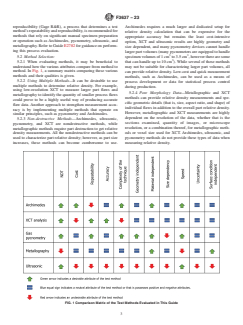
method. In Fig. 1, a summary matrix comparing these various
can provide relative density. Low-cost and quick measurement
methods and their qualities is given.
methods, such as Archimedes, can be used as a means of
5.2.2 Using Multiple Methods—It can be desirable to use
process development or data for statistical process control
multiple methods to determine relative density. For example,
during production.
using low-resolution XCT to measure larger part flaws and
5.2.4 Pore Morphology Data—Metallographic and XCT
metallography to identify the quantity of smaller process flaws
methods can provide relative density measurements and spe-
could prove to be a highly useful way of producing accurate
cific geometric details (that is, size, aspect ratio, and shape) of
flaw data. Another approach to strengthen measurement accu-
individual flaws in addition to the overall part relative density.
racy is by implementing multiple methods that operate on
However, metallographic and XCT measurements are highly
similar principles, such as pycnometry and Archimedes.
dependent on the resolution of the data, whether that is the
5.2.3 Non-destructive Methods—Archimedes, ultrasonic,
sections examined, quantity of images, or microscope
pycnometry, and XCT are nondestructive methods, while
resolution, or a combination thereof, for metallographic meth-
metallographic methods require part destruction to get relative
ods or voxel size used for XCT. Archimedes, ultrasonic, and
density measurements. All the nondestructive methods can be
used to characterize part relative density; however, as part size pycnometry methods do not provide these types of data when
increases, these methods can become cumbersome to use. measuring relative density.
FIG. 1 Comparison Matrix of the Test Methods Evaluated in This Guide
F3637 − 23
5.2.5 Relative Density Measurements Relying on Theoreti- porosity or interconnected pore structures (whether through
cal Material Density—Archimedes, ultrasonic, and gas process defect or by design) will measure the skeletal volume,
pycnometry methods rely on theoretical material density values
resulting in an inaccurate relative density measurement. This
in the calculation of relative density. The theoretical material method functions on similar principles to that of Archimedes;
density value selected is a possible source of systematic error.
however, it does not possess as many potential sources of error
Material density is composition dependent. Each material will related to using a liquid for volume displacement. Uncertainty
have a compositional specification and an allowable variation
in this method is a function of part size and equipment
of that composition. This combined with material vaporization capacity. There are several equations to calculate uncertainty
during fabrication could lead to a different material density
from the equipment manufacturer; however, it will be equip-
value than the reported value by a material vendor or online
ment and part specific. Note that pycnometry determines a
source. The user should use caution on the reliance of a
volume that can be compared directly to theoretical part
reported value and ensure the theoretical density is represen-
volume based upon CAD dimensions of the part being pro-
tative of the material (that is, from the specific material lot,
duced. Differences can point directly to the volume of closed
measured from final material, or from a reliable database such).
porosity in the produced part. Test Method B923 is used for
5.2.5.1 For methods relying on comparing the measured and
measurement of skeletal or material density. While this test
theoretical material densities to calculate the relative density of
method is primarily for determination of skeletal density of
the specimen, the following formula should be used:
metal powders, it
...