

ASTM F3522-22
(Guide)Standard Guide for Additive Manufacturing of Metals - Feedstock Materials - Assessment of Powder Spreadability
General Information
- Abstract
SIGNIFICANCE AND USE
4.1 The overall aim of this guide is to provide a common understanding of spreadability in relation to powder bed AM. This guide provides an overview of spreadability parameters and measurement methods that could be used to measure these parameters. These parameters could be used as the basis to develop process specifications for the powder bed.
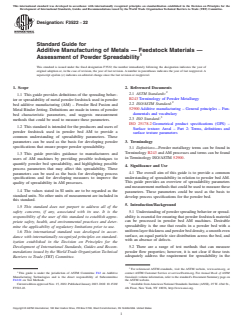
SCOPE
1.1 This guide provides definitions of the spreading behavior or spreadability of metal powder feedstock used in powder bed additive manufacturing (AM) – Powder Bed Fusion and Metal Binder Jetting. Definitions are made in terms of powder bed characteristic parameters, and suggests measurement methods that could be used to measure these parameters.
1.2 This standard is intended for the producers and users of powder feedstock used in powder bed AM to provide a common understanding of spreadability parameters. These parameters can be used as the basis for developing powder specifications that ensure proper powder spreadability.
1.3 This guide provides guidance to manufacturers and users of AM machines by providing possible techniques to quantify powder bed spreadability, and highlighting possible process parameters that may affect this spreadability. These parameters can be used as the basis for developing process specifications and for developing measures to improve the quality of spreadability in AM processes.
1.4 The values stated in SI units are to be regarded as the standard units. No other units of measurement are included in this standard.
1.5 This standard does not purport to address all of the safety concerns, if any, associated with its use. It is the responsibility of the user of this standard to establish appropriate safety, health, and environmental practices and determine the applicability of regulatory limitations prior to use.
1.6 This international standard was developed in accordance with internationally recognized principles on standardization established in the Decision on Principles for the Development of International Standards, Guides and Recommendations issued by the World Trade Organization Technical Barriers to Trade (TBT) Committee.
- Status
- Published
- Publication Date
- 14-Nov-2022
- Technical Committee
- F42 - Additive Manufacturing Technologies
- Drafting Committee
- F42.01 - Test Methods
Overview
ASTM F3522-22: Standard Guide for Additive Manufacturing of Metals – Feedstock Materials – Assessment of Powder Spreadability establishes a common understanding and guidance for evaluating the spreadability of metal powder feedstock in powder bed additive manufacturing (AM) processes, specifically Powder Bed Fusion and Metal Binder Jetting. This standard defines key parameters for spreadability, outlines measurement methods, and helps producers and users develop specifications that ensure the quality and consistency of powder spreading. Proper powder spreadability is crucial for producing uniform, high-quality AM parts and optimizing process efficiency.
Key Topics
- Spreadability Definition: The standard provides clear definitions of powder spreading behavior with reference to powder bed characteristic parameters such as layer thickness, uniformity, surface texture, and density.
- Measurement Methods: It outlines both non-contact and contact techniques to assess powder bed properties, including:
- Laser line scanning
- Fringe projection
- Laser scanning microscopy
- X-ray computed tomography (XCT)
- Camera imaging
- Optical profilometry
- Optical coherence tomography (OCT)
- Mass measurement (load cell and AM capsules)
- Spreadability Parameters: Key parameters include powder layer thickness and uniformity, powder bed density and its homogeneity, and surface roughness metrics as per ISO/ASTM 52900 and ISO 25178-2.
- Failure Modes & Process Variables: The standard identifies common powder spreading failure modes such as insufficient coverage, track lines, bed non-uniformity, and highlights factors affecting spreadability, including particle size distribution, particle shape, powder flowability, device design, material type, and operational parameters.
Applications
ASTM F3522-22 is essential for various stakeholders in additive manufacturing, including:
- Powder Feedstock Producers: Enables manufacturers to develop or refine powder specifications that guarantee optimal spreadability for powder bed AM processes, reducing batch rejections and improving end-user satisfaction.
- AM Machine Users & Operators: Assists in selecting powders and machine settings that optimize layer quality, leading to greater process repeatability, reduced defects, and enhanced mechanical properties in finished parts.
- Quality Assurance Teams: Provides guidelines and assessment techniques to verify powder batch suitability, support powder reuse strategies, and detect powder batches that may require reconditioning or quarantine.
- Process Developers: Offers a basis for developing process specifications, allowing users to correlate powder and process variables to part quality and establish best practices for AM operations.
Practical value includes minimizing defective builds, improving powder usage efficiency, supporting process standardization, and facilitating communication between powder suppliers and AM practitioners.
Related Standards
Professionals using ASTM F3522-22 should also consider the following standards for a comprehensive approach to powder bed additive manufacturing:
- ASTM B243: Terminology of Powder Metallurgy – provides terminology essential for understanding powder characteristics.
- ISO/ASTM 52900: Additive manufacturing – General principles – Fundamentals and vocabulary.
- ISO 25178-2: Geometrical product specifications (GPS) – Surface texture: Areal – Terms, definitions, and parameters.
These related standards enable harmonization of vocabulary, measurement techniques, and reporting practices across the AM industry.
Keywords: additive manufacturing, metal powder, powder bed fusion, binder jetting, powder spreadability, feedstock assessment, powder flowability, layer uniformity, powder bed AM, ASTM F3522-22, powder bed characteristic parameters
Relations
- Effective Date
- 01-Oct-2018
- Effective Date
- 01-Jul-2016
- Effective Date
- 01-Nov-2013
- Effective Date
- 15-Jul-2012
- Effective Date
- 15-Nov-2011
- Effective Date
- 15-Jan-2010
- Effective Date
- 15-Dec-2009
- Effective Date
- 01-Jan-2009
- Effective Date
- 15-Mar-2008
- Effective Date
- 01-Feb-2008
- Effective Date
- 01-Nov-2006
- Effective Date
- 01-Oct-2005
- Effective Date
- 31-Mar-2005
- Effective Date
- 01-Feb-2005
- Effective Date
- 01-Dec-2004
Get Certified
Connect with accredited certification bodies for this standard

DVS-ZERT GmbH
German welding certification society.
CARES (UK Certification Authority for Reinforcing Steels)
UK certification for reinforcing steels and construction.
EWF/IIW (European/International Welding Federation)
International welding personnel certification.
Sponsored listings
Frequently Asked Questions
ASTM F3522-22 is a guide published by ASTM International. Its full title is "Standard Guide for Additive Manufacturing of Metals - Feedstock Materials - Assessment of Powder Spreadability". This standard covers: SIGNIFICANCE AND USE 4.1 The overall aim of this guide is to provide a common understanding of spreadability in relation to powder bed AM. This guide provides an overview of spreadability parameters and measurement methods that could be used to measure these parameters. These parameters could be used as the basis to develop process specifications for the powder bed. SCOPE 1.1 This guide provides definitions of the spreading behavior or spreadability of metal powder feedstock used in powder bed additive manufacturing (AM) – Powder Bed Fusion and Metal Binder Jetting. Definitions are made in terms of powder bed characteristic parameters, and suggests measurement methods that could be used to measure these parameters. 1.2 This standard is intended for the producers and users of powder feedstock used in powder bed AM to provide a common understanding of spreadability parameters. These parameters can be used as the basis for developing powder specifications that ensure proper powder spreadability. 1.3 This guide provides guidance to manufacturers and users of AM machines by providing possible techniques to quantify powder bed spreadability, and highlighting possible process parameters that may affect this spreadability. These parameters can be used as the basis for developing process specifications and for developing measures to improve the quality of spreadability in AM processes. 1.4 The values stated in SI units are to be regarded as the standard units. No other units of measurement are included in this standard. 1.5 This standard does not purport to address all of the safety concerns, if any, associated with its use. It is the responsibility of the user of this standard to establish appropriate safety, health, and environmental practices and determine the applicability of regulatory limitations prior to use. 1.6 This international standard was developed in accordance with internationally recognized principles on standardization established in the Decision on Principles for the Development of International Standards, Guides and Recommendations issued by the World Trade Organization Technical Barriers to Trade (TBT) Committee.
SIGNIFICANCE AND USE 4.1 The overall aim of this guide is to provide a common understanding of spreadability in relation to powder bed AM. This guide provides an overview of spreadability parameters and measurement methods that could be used to measure these parameters. These parameters could be used as the basis to develop process specifications for the powder bed. SCOPE 1.1 This guide provides definitions of the spreading behavior or spreadability of metal powder feedstock used in powder bed additive manufacturing (AM) – Powder Bed Fusion and Metal Binder Jetting. Definitions are made in terms of powder bed characteristic parameters, and suggests measurement methods that could be used to measure these parameters. 1.2 This standard is intended for the producers and users of powder feedstock used in powder bed AM to provide a common understanding of spreadability parameters. These parameters can be used as the basis for developing powder specifications that ensure proper powder spreadability. 1.3 This guide provides guidance to manufacturers and users of AM machines by providing possible techniques to quantify powder bed spreadability, and highlighting possible process parameters that may affect this spreadability. These parameters can be used as the basis for developing process specifications and for developing measures to improve the quality of spreadability in AM processes. 1.4 The values stated in SI units are to be regarded as the standard units. No other units of measurement are included in this standard. 1.5 This standard does not purport to address all of the safety concerns, if any, associated with its use. It is the responsibility of the user of this standard to establish appropriate safety, health, and environmental practices and determine the applicability of regulatory limitations prior to use. 1.6 This international standard was developed in accordance with internationally recognized principles on standardization established in the Decision on Principles for the Development of International Standards, Guides and Recommendations issued by the World Trade Organization Technical Barriers to Trade (TBT) Committee.
ASTM F3522-22 is classified under the following ICS (International Classification for Standards) categories: 25.030 - Additive manufacturing. The ICS classification helps identify the subject area and facilitates finding related standards.
ASTM F3522-22 has the following relationships with other standards: It is inter standard links to ASTM B243-18, ASTM B243-16, ASTM B243-13, ASTM B243-12, ASTM B243-11, ASTM B243-10, ASTM B243-09a, ASTM B243-09, ASTM B243-08a, ASTM B243-08, ASTM B243-06, ASTM B243-05b, ASTM B243-05a, ASTM B243-05, ASTM B243-04c. Understanding these relationships helps ensure you are using the most current and applicable version of the standard.
ASTM F3522-22 is available in PDF format for immediate download after purchase. The document can be added to your cart and obtained through the secure checkout process. Digital delivery ensures instant access to the complete standard document.
Standards Content (Sample)
This international standard was developed in accordance with internationally recognized principles on standardization established in the Decision on Principles for the
Development of International Standards, Guides and Recommendations issued by the World Trade Organization Technical Barriers to Trade (TBT) Committee.
Designation: F3522 − 22
Standard Guide for
Additive Manufacturing of Metals — Feedstock Materials —
Assessment of Powder Spreadability
This standard is issued under the fixed designation F3522; the number immediately following the designation indicates the year of
original adoption or, in the case of revision, the year of last revision.Anumber in parentheses indicates the year of last reapproval.A
superscript epsilon (´) indicates an editorial change since the last revision or reapproval.
1. Scope 2. Referenced Documents
2.1 ASTM Standards:
1.1 This guide provides definitions of the spreading behav-
B243Terminology of Powder Metallurgy
ior or spreadability of metal powder feedstock used in powder
2.2 ISO/ASTM Standard:
bed additive manufacturing (AM) – Powder Bed Fusion and
52900Additive manufacturing – General principles – Fun-
Metal Binder Jetting. Definitions are made in terms of powder
damentals and vocabulary
bed characteristic parameters, and suggests measurement
2.3 ISO Standard:
methods that could be used to measure these parameters.
ISO 25178-2Geometrical product specifications (GPS) –
1.2 This standard is intended for the producers and users of
Surface texture: Areal – Part 2: Terms, definitions and
powder feedstock used in powder bed AM to provide a
surface texture parameters
common understanding of spreadability parameters. These
parameters can be used as the basis for developing powder 3. Terminology
specifications that ensure proper powder spreadability.
3.1 Definitions—Powder metallurgy terms can be found in
Terminology B243 andAM processes and terms can be found
1.3 This guide provides guidance to manufacturers and
in Terminology ISO/ASTM 52900.
users of AM machines by providing possible techniques to
quantify powder bed spreadability, and highlighting possible
4. Significance and Use
process parameters that may affect this spreadability. These
4.1 The overall aim of this guide is to provide a common
parameters can be used as the basis for developing process
understanding of spreadability in relation to powder bed AM.
specifications and for developing measures to improve the
This guide provides an overview of spreadability parameters
quality of spreadability in AM processes.
and measurement methods that could be used to measure these
1.4 The values stated in SI units are to be regarded as the
parameters. These parameters could be used as the basis to
standard units. No other units of measurement are included in
develop process specifications for the powder bed.
this standard.
5. Introduction/Background
1.5 This standard does not purport to address all of the
5.1 Understanding of powder spreading behavior or spread-
safety concerns, if any, associated with its use. It is the
ability is essential for ensuring that powder feedstock material
responsibility of the user of this standard to establish appro-
can be processed in powder bed AM machines. Desirable
priate safety, health, and environmental practices and deter-
spreadability is the one that results in a powder bed with a
mine the applicability of regulatory limitations prior to use.
uniformlayerthicknessandpowderbeddensity,asmootheven
1.6 This international standard was developed in accor-
surface, an equal particle size distribution across the bed, and
dance with internationally recognized principles on standard-
with an absence of defects.
ization established in the Decision on Principles for the
Development of International Standards, Guides and Recom- 5.2 There are a range of test methods that can measure
powder flow properties; however, it is not clear if these tests
mendations issued by the World Trade Organization Technical
Barriers to Trade (TBT) Committee. adequately address the requirement for spreadability in the
For referenced ASTM standards, visit the ASTM website, www.astm.org, or
This guide is under the jurisdiction of ASTM Committee F42 on Additive contact ASTM Customer Service at service@astm.org. For Annual Book of ASTM
Manufacturing Technologies and is the direct responsibility of Subcommittee Standards volume information, refer to the standard’s Document Summary page on
F42.01 on Test Methods. the ASTM website.
CurrenteditionapprovedNov.15,2022.PublishedJanuary2023.DOI:10.1520/ Available fromAmerican National Standards Institute (ANSI), 25 W. 43rd St.,
F3522-22. 4th Floor, New York, NY 10036, http://www.ansi.org.
Copyright © ASTM International, 100 Barr Harbor Drive, PO Box C700, West Conshohocken, PA 19428-2959. United States
F3522 − 22
powder bedAM process. This challenge is exacerbated by the 6.3 The scope of spreadability relates to the process of
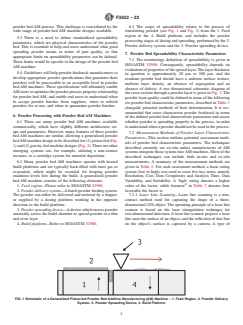
wide range of powder bed AM machine designs available. transferring powder (see Fig. 1 and Fig. 2) from the 1. Feed
region to the 4. Build platform, and includes the powder
5.3 There is a need to define standardized spreadability
processingstagesofdosingandspreading,performedbythe2.
parameters, which are physical characteristics of the powder
Powder delivery system and the 3. Powder spreading device.
bed. This is essential to help end users understand what good
spreading powder means in terms of part quality, so that
7. Powder Bed Spreadability Characteristic Parameters
appropriate limits on spreadability parameters can be defined.
7.1 The terminology definition of spreadability is given in
These limits would be specific to the design of the powder bed
ISO/ASTM 52900. Consequently, spreadability depends on
AM machine.
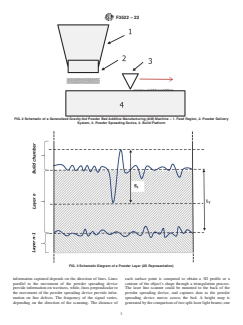
evaluationofpropertiesofthespreadlayer.Thelayerthickness
5.4 Guidelines will help powder feedstock manufacturers to
in question is approximately 20 µm to 300 µm, and the
develop appropriate powder specifications that guarantee their
resultant powder bed should have a uniform surface texture,
powders will be processable to an acceptable level in powder
uniform layer density, an absence of segregation and an
bedAM machines. These specifications will ultimately enable
absence of defects. A two dimensional schematic diagram of
AMuserstooptimizethepowder-processpropertyrelationship
thecross-sectionthroughapowderlayerisgiveninFig.3.The
for powder bedAM, and enable end users to understand when
powderlayerqualitycouldbedefinedintermsofthefollowing
to accept powder batches from suppliers, when to refresh
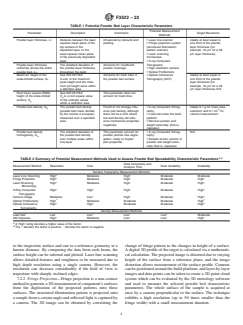
six powder bed characteristic parameters, described in Table 1
powders for re-use, and when to quarantine powder batches.
alongside potential methods of their determination. It is rec-
ommended that users characterize powder feedstock in terms
6. Powder Processing with Powder Bed AM Machines
of the defined powder bed characteristic parameters and assess
6.1 There are many powder bed AM machines available whether powder is spreading properly in the process, in order
commercially, which have slightly different architecture set- tounderstandwhenapowdershouldnotbeusedintheprocess.
ups and parameters. However, many features of these powder
7.2 Measurement Methods of Powder Layer Characteristic
bed AM machines are similar, allowing a generalized powder
Parameters—This section outlines potential assessment meth-
bedAMmachinedesigntobedescribedfor (1)piston-fed(Fig.
ods of powder bed characteristic parameters. The techniques
1)and (2)gravity-fedmachinedesigns(Fig.2).Thereareother
described currently are ex-situ unless manufacturers of AM
emerging systems too, for example, utilizing a non-contact
systems integrate those system intoAM machines. Most of the
recoater, or a cartridge system for material deposition.
described techniques can include both in-situ and ex-situ
6.2 Many powder bed AM machines operate with heated measurements. A summary of the measurement methods are
build platforms and are typically back-filled with inert gas or given in Table 2. For each assessment method, a basic rating
evacuated, which might be essential for keeping powder system (low to high) was used to score five key areas; namely
oxidation levels low during the build. A generalized powder Resolution, Cost, Data Complexity and Analysis Time, Data
bed AM machine consists of the following elements: Variability, and Suitability. A ‘high’ rating denotes a higher
B
1. Feed region—Please refer to ISO/ASTM 52900. value of the factor, while footnote in Table 2 denotes how
2. Powder delivery system—Abatchpowderfeedingsystem. favorable the factor is.
The powder can either be delivered and metered by a hopper, 7.2.1 Laser Line Scanning—Laser line scanning is a non-
or supplied by a dosing platform working in the opposite contact method used for capturing the shape of a three-
direction to the build platform. dimensional(3D)object.Theoperatingprincipleofalaserline
3. Powder spreading device—Adevicewhichmovespowder scanner is based on the laser triangulation technique for
uniaxially across the build chamber to spread powder in a thin two-dimensionaldetection.Alaserlinescannerprojectsalaser
and even layer. lineontothesurfaceofanobject,andthereflectionofthatline
4. Build platform—Refer to ISO/ASTM 52900. on the object’s surface is captured by a camera. A type of
FIG. 1 Schematic of a Generalized Piston-fed Powder Bed Additive Manufacturing (AM) Machine – 1. Feed Region, 2. Powder Delivery
System, 3. Powder Spreading Device, 4. Build Platform
F3522 − 22
FIG. 2 Schematic of a Generalized Gravity-fed Powder Bed Additive Manufacturing (AM) Machine – 1. Feed Region, 2. Powder Delivery
System, 3. Powder Spreading Device, 4. Build Platform
FIG. 3 Schematic Diagram of a Powder Layer (2D Representation)
information captured depends on the direction of lines. Lines each surface point is computed to obtain a 3D profile or a
parallel to the movement of the powder spreading device contour of the object’s shape through a triangulation process.
provide information on waviness, while, lines perpendicular to The laser line scanner could be mounted to the back of the
the movement of the powder spreading device provide infor- powder spreading device, and captures data as the powder
mation on line defects. The frequency of the signal varies, spreading device moves across the bed. A height map is
depending on the direction of the scanning. The distance of generatedbythecomparisonoftwosplitlaserlightbeams;one
F3522 − 22
TABLE 1 Potential Powder Bed Layer Characteristic Parameters
Potential Measurement
Parameter Description Comments Target Resolution
Methods
Powder layer thickness, L Distance between the least Influenced by rebound and • Laser line scanner Ideally at least equal to
T
squares mean plane of the packing • Fringe projection system one third of the powder
top surface of the (structured illumination layer thickness (for
deposited layer, to the pattern scanner) example, 10 µm for a 30
least squares mean plane • Laser scanning µm layer thickness)
of the previously deposited microscope
layer • X-ray Computed
Powder layer thickness The standard deviation of Accounts for insufficient Tomography
uniformity across the entire the powder layer thickness, powder coverage • High resolution camera
powder bed, L throughout the build • Optical Profilometry
U
Maximum height of the See ISO 25178-2 Accounts for track lines in • Optical Coherence Ideally at least equal to
scale-limited surface, S A sum of the maximum the powder bed surface Tomography (OCT) one third of the powder
z
peak height and the maxi- layer thickness (for
mum pit height value within example, 10 µm for a 30
a definition area µm layer thickness) N/A
Root mean square (RMS) See ISO 25178-2 This parameter does not
height of the scale-limited S is a root square value account for track lines
q
surface, S of the ordinate values
q
within a definition area
Powder bed density, D The powder bed density Found to not strongly influ- • X-ray Computed Tomog- Ideally 0.1 g for mass mea-
B
(powder bed mass divided ence part density, although raphy surement and 0.1 cm for
by the volume it occupies) there will be a limit where • Load cell under the build volume measurement
measured over a specified low bed density will influ- platform
area ence mechanical properties • Recover powder and
negatively weight externally (that is,
capsules)
Powder bed density The standard deviation of This parameter account for • X-ray Computed Tomog- N/A
homogeneity, D the powder bed density powder particle size segre- raphy
H
over multiple areas within gation. Likely to impact • Sample known volume of
one layer part properties powder and weight exter-
nally (that is, capsules)
A,B
TABLE 2 Summary of Potential Measurement Methods Used to Assess Powder Bed Spreadability Characteristic Parameters
Data Complexity and
Measurement Method Resolution Cost Data Variability Suitability
Analysis Time
Surface Topography Measurement Methods
+ –
Laser Line Scanning High Moderate High Moderate Moderate
+ – +
Fringe Projection High Moderate High Moderate High
+ – +
Laser Scanning High Moderate High Moderate High
Microscopy
+ – – +
X-Ray Computed High High High Moderate High
Tomography
+ – +
Camera Image Moderate Low High Moderate High
+ +
Optical Profilometry High Moderate Moderate Moderate High
+ – +
Optical Coherence High High Moderate Moderate High
Tomography
Density Measurement Method
...