

ASTM E3364-22
(Test Method)Standard Test Method for Evaluating the Performance of Antimicrobials in or on Polymeric Porous and Nonporous Materials Against Staining by Streptomyces species (A Pink Stain Organism)
General Information
- Abstract
SIGNIFICANCE AND USE
5.1 Methods such as D3273 Standard Test Method for Resistance to Growth of Mold on the Surface of Interior Coatings in an Environmental Chamber and D3274 Standard Test Method for Evaluating the Degree of Surface Disfigurement of Paint Films by Fungal or Algal Growth or Soil or Dirt Accumulation provide means for assessing mold and algal staining on paints. The Test Method E1428 Evaluating the Performance of Antimicrobials in or on Polymeric Solids Against Staining by Streptomyces species (A Pink Stain Organism) is used for solid polymeric materials, but is not appropriate for all antimicrobial technologies.
5.2 This test method provides a technique for evaluating antimicrobials in or on polymeric materials against staining by Streptomyces species and should assist in the prediction of performance of treated articles under actual field conditions.
SCOPE
1.1 This test method is intended to assess susceptibility of polymer materials, as well as products that may directly contact the treated polymer, to staining by the Actinomycete Streptomyces species.
1.2 This test method is also suitable for evaluating dark-pigmented test samples since the bacterial growth inhibition can be assessed.
1.3 Familiarity with microbiological techniques is required. This test method should not be used by persons without at least basic microbiological training.
1.4 The values stated in SI units are to be regarded as standard. No other units of measurement are included in this standard.
1.5 This standard does not purport to address all of the safety concerns, if any, associated with its use. It is the responsibility of the user of this standard to establish appropriate safety, health, and environmental practices and determine the applicability of regulatory limitations prior to use.
1.6 This international standard was developed in accordance with internationally recognized principles on standardization established in the Decision on Principles for the Development of International Standards, Guides and Recommendations issued by the World Trade Organization Technical Barriers to Trade (TBT) Committee.
- Status
- Published
- Publication Date
- 30-Sep-2022
- Technical Committee
- E35 - Pesticides, Antimicrobials, and Alternative Control Agents
- Drafting Committee
- E35.15 - Antimicrobial Agents

Overview
ASTM E3364-22 is a widely recognized international standard developed by ASTM International for evaluating the performance of antimicrobials incorporated in or on polymeric porous and nonporous materials. This test method is specifically designed to assess resistance to staining by Streptomyces species-often referred to as the “pink stain organism.” The standard is applicable to a broad range of polymeric materials and helps manufacturers and researchers determine whether their antimicrobial treatments effectively prevent unsightly pink, rose, or orange discolorations caused by microbial growth.
This standard assists in predicting field performance of treated articles and supports improved material durability, cleanliness, and consumer appeal, particularly in environments susceptible to microbial-induced stains.
Key Topics
- Antimicrobial Performance: Provides a controlled method to test the efficacy of antimicrobial agents within or on the surface of synthetic polymers against pink staining caused by Streptomyces species.
- Material Compatibility: Suitable for both porous and nonporous polymeric materials, including those with dark pigmentation, ensuring broad applicability across industries and products.
- Microbially Induced Staining: Addresses the need to minimize unwanted discoloration or surface disfigurement caused by bacterial colonization, a significant concern in maintaining the visual and functional quality of polymers.
- Standardized Methodology: Outlines sample preparation, inoculation with Streptomyces species, incubation, and visual rating of microbial growth and stain severity. Requirements for microbiological training and safe laboratory practices are emphasized.
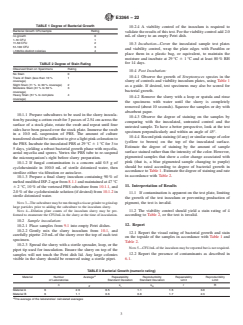
- Objective Assessment: Includes defined criteria and reference tables for rating bacterial growth (CFU/sample) and extent of staining to ensure consistent and reproducible results across laboratories.
Applications
The ASTM E3364-22 test method is vital for manufacturers, quality control labs, product developers, and materials scientists working with plastics, foams, coated fabrics, vinyl, and other polymeric products, especially those destined for environments prone to microbial contamination. Typical applications include:
- Consumer products: Such as footwear, upholstery, mattresses, and plastic furnishings, where clean appearance and stain resistance are critical.
- Building materials: Polymer-based wall panels, flooring, or insulation exposed to humid or high-traffic conditions.
- Automotive and transportation: Interior components like seats and paneling.
- Medical and hygienic environments: Where cleanliness and surface integrity are paramount.
- Industrial components: Gaskets, seals, protective coatings, and flexible polymer parts requiring maintained aesthetics and function.
By applying ASTM E3364-22, organizations can objectively compare the antimicrobial efficacy of treatments, improve product quality, and ensure regulatory and customer compliance.
Related Standards
For a comprehensive assessment of microbial resistance and surface integrity, ASTM E3364-22 references several related standards:
- ASTM D3273 - Standard Test Method for Resistance to Growth of Mold on the Surface of Interior Coatings in an Environmental Chamber
- ASTM D3274 - Evaluating Degree of Surface Disfigurement of Paint Films by Fungal or Algal Growth, or Soil or Dirt Accumulation
- ASTM E1428 - Evaluating the Performance of Antimicrobials in or on Polymeric Solids Against Staining by Streptomyces species
- ASTM E177 - Practice for Use of the Terms Precision and Bias in ASTM Test Methods
- ASTM E2756 - Terminology Relating to Antimicrobial and Antiviral Agents
These standards collectively address various aspects of microbial staining, mold resistance, and performance evaluation for coatings and polymeric materials, providing a robust framework for maintaining material performance and appearance.
Keywords: antimicrobial efficacy, pink stain, polymers, Streptomyces species, ASTM E3364-22, plastic testing, surface disfigurement, microbial resistance, standardized test method, material durability
Relations
- Effective Date
- 01-Nov-2019
- Effective Date
- 01-Apr-2018
- Effective Date
- 01-May-2015
- Effective Date
- 15-Feb-2015
- Effective Date
- 01-May-2014
- Effective Date
- 01-Oct-2013
- Effective Date
- 01-May-2013
- Effective Date
- 01-Feb-2012
- Effective Date
- 01-Feb-2012
- Effective Date
- 01-Oct-2010
- Effective Date
- 01-May-2010
- Effective Date
- 01-Oct-2009
- Effective Date
- 01-Mar-2009
- Effective Date
- 01-Mar-2009
- Effective Date
- 01-Oct-2008
Frequently Asked Questions
ASTM E3364-22 is a standard published by ASTM International. Its full title is "Standard Test Method for Evaluating the Performance of Antimicrobials in or on Polymeric Porous and Nonporous Materials Against Staining by <emph type="ital" >Streptomyces</emph> species (A Pink Stain Organism)". This standard covers: SIGNIFICANCE AND USE 5.1 Methods such as D3273 Standard Test Method for Resistance to Growth of Mold on the Surface of Interior Coatings in an Environmental Chamber and D3274 Standard Test Method for Evaluating the Degree of Surface Disfigurement of Paint Films by Fungal or Algal Growth or Soil or Dirt Accumulation provide means for assessing mold and algal staining on paints. The Test Method E1428 Evaluating the Performance of Antimicrobials in or on Polymeric Solids Against Staining by Streptomyces species (A Pink Stain Organism) is used for solid polymeric materials, but is not appropriate for all antimicrobial technologies. 5.2 This test method provides a technique for evaluating antimicrobials in or on polymeric materials against staining by Streptomyces species and should assist in the prediction of performance of treated articles under actual field conditions. SCOPE 1.1 This test method is intended to assess susceptibility of polymer materials, as well as products that may directly contact the treated polymer, to staining by the Actinomycete Streptomyces species. 1.2 This test method is also suitable for evaluating dark-pigmented test samples since the bacterial growth inhibition can be assessed. 1.3 Familiarity with microbiological techniques is required. This test method should not be used by persons without at least basic microbiological training. 1.4 The values stated in SI units are to be regarded as standard. No other units of measurement are included in this standard. 1.5 This standard does not purport to address all of the safety concerns, if any, associated with its use. It is the responsibility of the user of this standard to establish appropriate safety, health, and environmental practices and determine the applicability of regulatory limitations prior to use. 1.6 This international standard was developed in accordance with internationally recognized principles on standardization established in the Decision on Principles for the Development of International Standards, Guides and Recommendations issued by the World Trade Organization Technical Barriers to Trade (TBT) Committee.
SIGNIFICANCE AND USE 5.1 Methods such as D3273 Standard Test Method for Resistance to Growth of Mold on the Surface of Interior Coatings in an Environmental Chamber and D3274 Standard Test Method for Evaluating the Degree of Surface Disfigurement of Paint Films by Fungal or Algal Growth or Soil or Dirt Accumulation provide means for assessing mold and algal staining on paints. The Test Method E1428 Evaluating the Performance of Antimicrobials in or on Polymeric Solids Against Staining by Streptomyces species (A Pink Stain Organism) is used for solid polymeric materials, but is not appropriate for all antimicrobial technologies. 5.2 This test method provides a technique for evaluating antimicrobials in or on polymeric materials against staining by Streptomyces species and should assist in the prediction of performance of treated articles under actual field conditions. SCOPE 1.1 This test method is intended to assess susceptibility of polymer materials, as well as products that may directly contact the treated polymer, to staining by the Actinomycete Streptomyces species. 1.2 This test method is also suitable for evaluating dark-pigmented test samples since the bacterial growth inhibition can be assessed. 1.3 Familiarity with microbiological techniques is required. This test method should not be used by persons without at least basic microbiological training. 1.4 The values stated in SI units are to be regarded as standard. No other units of measurement are included in this standard. 1.5 This standard does not purport to address all of the safety concerns, if any, associated with its use. It is the responsibility of the user of this standard to establish appropriate safety, health, and environmental practices and determine the applicability of regulatory limitations prior to use. 1.6 This international standard was developed in accordance with internationally recognized principles on standardization established in the Decision on Principles for the Development of International Standards, Guides and Recommendations issued by the World Trade Organization Technical Barriers to Trade (TBT) Committee.
ASTM E3364-22 is classified under the following ICS (International Classification for Standards) categories: 07.100.99 - Other standards related to microbiology. The ICS classification helps identify the subject area and facilitates finding related standards.
ASTM E3364-22 has the following relationships with other standards: It is inter standard links to ASTM E2756-19, ASTM E2756-18, ASTM E1428-15a, ASTM E1428-15, ASTM E177-14, ASTM D3274-09(2013), ASTM E177-13, ASTM D3273-12, ASTM D3273-12e1, ASTM E177-10, ASTM E2756-10, ASTM E1428-99(2009), ASTM D3274-09e1, ASTM D3274-09, ASTM E177-08. Understanding these relationships helps ensure you are using the most current and applicable version of the standard.
ASTM E3364-22 is available in PDF format for immediate download after purchase. The document can be added to your cart and obtained through the secure checkout process. Digital delivery ensures instant access to the complete standard document.
Standards Content (Sample)
This international standard was developed in accordance with internationally recognized principles on standardization established in the Decision on Principles for the
Development of International Standards, Guides and Recommendations issued by the World Trade Organization Technical Barriers to Trade (TBT) Committee.
Designation: E3364 − 22
Standard Test Method for
Evaluating the Performance of Antimicrobials in or on
Polymeric Porous and Nonporous Materials Against
Staining by Streptomyces species (A Pink Stain Organism)
This standard is issued under the fixed designation E3364; the number immediately following the designation indicates the year of
original adoption or, in the case of revision, the year of last revision. A number in parentheses indicates the year of last reapproval. A
superscript epsilon (´) indicates an editorial change since the last revision or reapproval.
INTRODUCTION
When certain bacteria and mold species grow on the surface of non-rigid, flexible or “plasticized”
polymers, metabolites such as pigments in the case of certain bacteria and melanin (dark stains from
fungal growth) cause undesirable stains on the polymer surface. These stains may persist even after
the surface growth is removed.This test method is used to determine the performance of antimicrobial
agents used in or on synthetic polymeric porous and non-porous materials against staining by the
Actinomycete, Streptomyces species. This organism has been chosen as an indicator organism,
although other organisms have been known to cause undesirable staining in polymeric porous and
non-porous materials.
1. Scope mendations issued by the World Trade Organization Technical
Barriers to Trade (TBT) Committee.
1.1 This test method is intended to assess susceptibility of
polymer materials, as well as products that may directly
2. Referenced Documents
contact the treated polymer, to staining by the Actinomycete
Streptomyces species. 2.1 ASTM Standards:
D3273 TestMethodforResistancetoGrowthofMoldonthe
1.2 This test method is also suitable for evaluating dark-
Surface of Interior Coatings in an Environmental Cham-
pigmented test samples since the bacterial growth inhibition
ber
can be assessed.
D3274 Test Method for Evaluating Degree of Surface Dis-
1.3 Familiarity with microbiological techniques is required.
figurement of Paint Films by Fungal or Algal Growth, or
This test method should not be used by persons without at least
Soil and Dirt Accumulation
basic microbiological training.
E177 Practice for Use of the Terms Precision and Bias in
ASTM Test Methods
1.4 The values stated in SI units are to be regarded as
E2756 Terminology Relating to Antimicrobial and Antiviral
standard. No other units of measurement are included in this
Agents
standard.
E1428 Test Method for Evaluating the Performance of
1.5 This standard does not purport to address all of the
Antimicrobials in or on Polymeric SolidsAgainst Staining
safety concerns, if any, associated with its use. It is the
by Streptomyce species (A Pink Stain Organism)
responsibility of the user of this standard to establish appro-
priate safety, health, and environmental practices and deter-
3. Terminology
mine the applicability of regulatory limitations prior to use.
1.6 This international standard was developed in accor-
3.1 Defintions:
dance with internationally recognized principles on standard- 3.1.1 For definitions of terms used in this method, refer to
ization established in the Decision on Principles for the
Terminology E2756.
Development of International Standards, Guides and Recom-
3.2 Definitions of Terms Specific to This Standard:
This test method is under the jurisdiction of ASTM Committee E35 on
Pesticides, Antimicrobials, and Alternative Control Agents and is the direct For referenced ASTM standards, visit the ASTM website, www.astm.org, or
responsibility of Subcommittee E35.15 on Antimicrobial Agents. contact ASTM Customer Service at service@astm.org. For Annual Book of ASTM
Current edition approved Oct. 1, 2022. Published November 2022. DOI: Standards volume information, refer to the standard’s Document Summary page on
10.1520/E3364–22 the ASTM website.
Copyright © ASTM International, 100 Barr Harbor Drive, PO Box C700, West Conshohocken, PA 19428-2959. United States
E3364 − 22
3.2.1 microbially induced staining, n—undesirable pigmen- 7.5 Sterilizer, suitable for the substrate to be tested, that is,
tation or disfiguration of an object due to surface colonization 70 % isopropanol (optional).
by certain microorganisms. Both bacteria and fungi produce
7.6 Parafilm, sealable plastic bags or equivalent to prevent
metabolic pigments that can result in surface stains on suscep-
moisture loss.
tible objects.
7.7 Spreader, sterile.
3.2.2 pink stain organism, n—an Actinomycete such as
7.8 Waterbath, capable of maintaining water at 47 °C 6
Streptomyces species ATCC 25607 (deposited as Streptoverti-
2 °C.
cillium reticulum) that is capable of metabolically producing a
light rose to orange-colored discoloring pigment.
7.9 Pipette, capable of pipetting 2.0 mL.
4. Summary of Test Method
8. Reagents and Materials
4.1 Test specimens are challenged with slurry inoculated
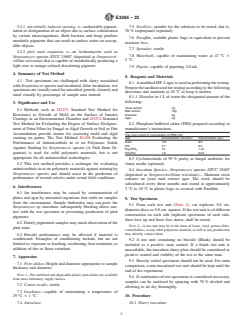
8.1 Amodified ISP-2 agar is used in performing the testing.
with Streptomyces species and incubated.After incubation, test
Prepare the medium used for testing according to the following
specimensarevisuallyratedformicrobialgrowth,cleaned,and
directions and maintain at 45 °C to keep it molten.
rated visually by percentage of sample area stained.
8.1.1 Dissolve in 1 L of water the designated amount of the
following:
5. Significance and Use
Yeast extract 4g
5.1 Methods such as D3273 Standard Test Method for
Malt extract 10g
Resistance to Growth of Mold on the Surface of Interior Dextrose 4g
Agar 4g
Coatings in an Environmental Chamber and D3274 Standard
8.2 Phosphate buffered saline (PBS) prepared according to
Test Method for Evaluating the Degree of Surface Disfigure-
ment of Paint Films by Fungal orAlgal Growth or Soil or Dirt manufacturer’s instructions.
Accumulation provide means for assessing mold and algal
The most common composition of PBS (1X)
staining on paints. The Test Method E1428 Evaluating the Salt Concentration (mmol/L) Concentration (g/L)
NaCl 137 8.0
Performance of Antimicrobials in or on Polymeric Solids
KCl 2.7 0.2
Against Staining by Streptomyces species (A Pink Stain Or-
Na HPO 10 1.42
2 4
ganism) is used for solid polymeric materials, but is not KH PO 1.8 0.24
2 4
appropriate for all antimicrobial technologies.
8.3 Cycloheximide of 95 % purity as fungal antibiotic for
slurry media (optional).
5.2 This test method provides a technique for evaluating
antimicrobials in or on polymeric materials against staining by
8.4 Inoculum Species—Streptomyces species ATCC 25607
Streptomyces species and should assist in the prediction of
(deposited as Streptoverticillium reticulum)— Maintain stock
performance of treated articles under actual field conditions.
cultures on yeast malt extract agar. The stock should be
subcultured every three months and stored at approximately
6. Interferences
3 °C to 10 °C in plastic bags or covered with Parafilm.
6.1 An interference may be caused by contamination of
plates and agar by unwanted organisms that settle on samples
9. Test Specimens
from the environment. Sample bioburden may out-grow the
9.1 From each test unit (Note 2), cut triplicate 5.0 cm.
Streptomyces sp. inoculum, subsequently blocking direct con-
diameter discs or 5.0 cm. squares. If the test unit is of different
tact with the test specimen or preventing production of pink
construction on each side triplicate specimens of each side,
pigments.
three face up and three face down, shall be tested.
6.2 Darkly pigmented samples may mask observation of the
NOTE 2—A test unit may be in the form of foam, vinyl, porous films,
pink stain.
coatedfabrics,oranyotherpolymericmaterial,aswellasanyproductthat
may directly contact them.
6.3 Biocide performance may be affected if material is
conditioned. Examples of conditioning include, but are not
9.2 A test unit containing no biocide (Blank) should be
limited to: exposure to leaching, weathering, heat treatment, or
included as a positive stain control. If a blank test unit is
addition of fire or flame retardant.
unavailable, the inoculum slurry plate should be considered as
positive control and viability of the test at the same time.
7. Apparatus
9.3 Heavily soiled specimens should not be used. For stain
7.1 Petri dishes, Height and diameter appropriate to sample
comparison, a non-inoculated test unit should be kept until the
thickness and diameter.
end of the experiment.
NOTE 1—Pre-sterilized and disposable plastic petri dishes are available
9.4 If sanitization of test specimens is considered necessary,
from most laboratory supply houses.
samples can be sanitized by spraying with 70 % alcohol and
7.2 Cotton swabs, sterile.
allowing to air dry thoroughly.
7.3 Incubator—capable of maintaining a temperature of
10. Procedure
29 °C 6 1 °C.
7.4 Autoclave. 10.1 Slurry inoculum:
E3364 − 22
TABLE 1 Degree of Bacterial Growth
10.2.4 A viability control of the inoculum is required to
Bacterial Growth CFU/sample Rating validate the results of this test
...