

ASTM E3218-21
(Test Method)Standard Test Method for Quantitative Method for Testing Antimicrobial Agents against Spores of C. difficile on Hard, Nonporous Surfaces
General Information
- Abstract
SIGNIFICANCE AND USE
5.1 The test method was designed to determine the LR in spores on a hard, non-porous surface after exposure to a test chemical in a closed system.
5.2 Each test includes three control carriers (exposed to phosphate buffered saline with Tween-80), three test system control carriers (exposed to 1500 ppm ± 150 ppm sodium hypochlorite), and ten treated carriers (per test chemical/concentration/contact time combination).
SCOPE
1.1 This test method covers a standardized approach to quantitatively determine the effectiveness of antimicrobial chemicals in treating hard, non-porous surfaces contaminated with spores of C. difficile (ATCC 43598) grown in accordance with Practice E2839.
1.2 This test method is based on principles established for Test Method E2197 and an Organisation for Economic Co-operation and Development Guidance Document.2
1.3 Training in basic microbiology and aseptic technique are required to perform this assay.
1.4 Units—The values stated in SI units are to be regarded as standard. No other units of measurement are included in this standard.
1.5 This standard does not purport to address all of the safety concerns, if any, associated with its use. It is the responsibility of the user of this standard to establish appropriate safety, health, and environmental practices and determine the applicability of regulatory limitations prior to use.
1.6 This international standard was developed in accordance with internationally recognized principles on standardization established in the Decision on Principles for the Development of International Standards, Guides and Recommendations issued by the World Trade Organization Technical Barriers to Trade (TBT) Committee.
- Status
- Published
- Publication Date
- 31-May-2021
- Technical Committee
- E35 - Pesticides, Antimicrobials, and Alternative Control Agents
- Drafting Committee
- E35.15 - Antimicrobial Agents
Buy Documents
ASTM E3218-21 - Standard Test Method for Quantitative Method for Testing Antimicrobial Agents against Spores of <emph type="ital">C. difficile</emph> on Hard, Nonporous Surfaces
REDLINE ASTM E3218-21 - Standard Test Method for Quantitative Method for Testing Antimicrobial Agents against Spores of <emph type="ital">C. difficile</emph> on Hard, Nonporous Surfaces
Overview
ASTM E3218-21 is the internationally recognized standard for quantitatively assessing the effectiveness of antimicrobial agents against spores of Clostridioides difficile (formerly Clostridium difficile) on hard, nonporous surfaces. Developed by ASTM Committee E35, this test method is crucial for evaluating and validating the performance of disinfectants and antimicrobial chemicals, particularly in healthcare and high-risk environments where C. difficile spores present significant infection control challenges.
This standard specifies procedures for preparing test surfaces, inoculating with C. difficile spores, applying test chemicals, and analyzing log reductions (LR) in viable spores. It promotes consistency and accuracy while requiring basic microbiology training and adherence to safety and regulatory requirements.
Key Topics
- Test Scope and Purpose
- Quantitative determination of antimicrobial efficacy on hard, nonporous surfaces contaminated with C. difficile spores (ATCC 43598).
- Follows principles from ASTM E2197 and OECD guidance for evaluating microbicidal activity.
- Testing Procedure
- Utilizes brushed stainless steel disks as standardized carriers for application of spores and test chemicals.
- Involves triplicate controls for both negative (phosphate buffered saline with Tween-80) and positive (1500 ppm sodium hypochlorite) systems.
- Ten carrier replicates are used per test chemical, concentration, and contact time.
- Outcome Measurement
- Log reduction (LR) in spore viability is calculated by comparison to control carriers, providing a quantitative assessment of disinfectant performance.
- Instrumentation and Materials
- Test method requires the use of positive displacement pipettes, anaerobic incubation systems, stainless steel disks, and validated neutralizers.
Applications
ASTM E3218-21 provides critical value across multiple industries, particularly in:
- Healthcare Facilities
- Supports infection control protocols by providing a validated method to screen and select surface disinfectants capable of inactivating resilient C. difficile spores.
- Promotes safer patient environments and aids in compliance with health regulations.
- Pharmaceutical and Disinfectant Manufacturers
- Offers a reproducible method for efficacy claims on product labels, facilitating regulatory approvals and market access.
- Research and Development
- Used in microbiological and infection control studies to compare disinfectant formulations, surface materials, and cleaning protocols.
- Regulatory Compliance
- Supports validation of antimicrobial chemicals for legal and market requirements, both in the United States and internationally.
Related Standards
ASTM E3218-21 is part of a comprehensive suite of antimicrobial testing standards, complementing and referencing:
- ASTM E2197: Quantitative Disk Carrier Test Method for Bactericidal, Virucidal, Fungicidal, Mycobactericidal, and Sporicidal Activities of Chemicals
- ASTM E2839: Practice for Production and Storage of C. difficile Spores for Efficacy Evaluation
- ASTM E2756: Terminology Relating to Antimicrobial and Antiviral Agents
- ASTM A967: Specification for Chemical Passivation Treatments for Stainless Steel Parts
- OECD Guidance Document (2013): Quantitative Method for Evaluating Bactericidal Activity of Microbicides Used on Hard Non-Porous Surfaces
By following ASTM E3218-21, organizations can ensure their antimicrobial efficacy testing is standardized, reproducible, and in line with global best practices-ultimately strengthening public health and regulatory compliance.
Keywords: ASTM E3218-21, C. difficile, spore efficacy, antimicrobial agents, disinfectant test method, quantitative assessment, hard nonporous surfaces, infection control, healthcare cleaning standards.
Relations
- Effective Date
- 01-Nov-2019
- Effective Date
- 01-Apr-2018
- Effective Date
- 01-Dec-2017
- Effective Date
- 01-Dec-2017
- Effective Date
- 01-Aug-2011
- Effective Date
- 01-Jan-2011
- Effective Date
- 01-May-2010
- Refers
ASTM A967-05 - Standard Specification for Chemical Passivation Treatments for Stainless Steel Parts - Effective Date
- 01-Sep-2005
- Effective Date
- 01-Sep-2005
- Effective Date
- 01-Sep-2005
- Effective Date
- 10-Apr-2002
- Effective Date
- 10-Oct-2001
- Refers
ASTM A967-01 - Standard Specification for Chemical Passivation Treatments for Stainless Steel Parts - Effective Date
- 10-Oct-2001
- Effective Date
- 10-Oct-2001
Buy Documents
ASTM E3218-21 - Standard Test Method for Quantitative Method for Testing Antimicrobial Agents against Spores of <emph type="ital">C. difficile</emph> on Hard, Nonporous Surfaces
REDLINE ASTM E3218-21 - Standard Test Method for Quantitative Method for Testing Antimicrobial Agents against Spores of <emph type="ital">C. difficile</emph> on Hard, Nonporous Surfaces
Frequently Asked Questions
ASTM E3218-21 is a standard published by ASTM International. Its full title is "Standard Test Method for Quantitative Method for Testing Antimicrobial Agents against Spores of <emph type="ital">C. difficile</emph> on Hard, Nonporous Surfaces". This standard covers: SIGNIFICANCE AND USE 5.1 The test method was designed to determine the LR in spores on a hard, non-porous surface after exposure to a test chemical in a closed system. 5.2 Each test includes three control carriers (exposed to phosphate buffered saline with Tween-80), three test system control carriers (exposed to 1500 ppm ± 150 ppm sodium hypochlorite), and ten treated carriers (per test chemical/concentration/contact time combination). SCOPE 1.1 This test method covers a standardized approach to quantitatively determine the effectiveness of antimicrobial chemicals in treating hard, non-porous surfaces contaminated with spores of C. difficile (ATCC 43598) grown in accordance with Practice E2839. 1.2 This test method is based on principles established for Test Method E2197 and an Organisation for Economic Co-operation and Development Guidance Document.2 1.3 Training in basic microbiology and aseptic technique are required to perform this assay. 1.4 Units—The values stated in SI units are to be regarded as standard. No other units of measurement are included in this standard. 1.5 This standard does not purport to address all of the safety concerns, if any, associated with its use. It is the responsibility of the user of this standard to establish appropriate safety, health, and environmental practices and determine the applicability of regulatory limitations prior to use. 1.6 This international standard was developed in accordance with internationally recognized principles on standardization established in the Decision on Principles for the Development of International Standards, Guides and Recommendations issued by the World Trade Organization Technical Barriers to Trade (TBT) Committee.
SIGNIFICANCE AND USE 5.1 The test method was designed to determine the LR in spores on a hard, non-porous surface after exposure to a test chemical in a closed system. 5.2 Each test includes three control carriers (exposed to phosphate buffered saline with Tween-80), three test system control carriers (exposed to 1500 ppm ± 150 ppm sodium hypochlorite), and ten treated carriers (per test chemical/concentration/contact time combination). SCOPE 1.1 This test method covers a standardized approach to quantitatively determine the effectiveness of antimicrobial chemicals in treating hard, non-porous surfaces contaminated with spores of C. difficile (ATCC 43598) grown in accordance with Practice E2839. 1.2 This test method is based on principles established for Test Method E2197 and an Organisation for Economic Co-operation and Development Guidance Document.2 1.3 Training in basic microbiology and aseptic technique are required to perform this assay. 1.4 Units—The values stated in SI units are to be regarded as standard. No other units of measurement are included in this standard. 1.5 This standard does not purport to address all of the safety concerns, if any, associated with its use. It is the responsibility of the user of this standard to establish appropriate safety, health, and environmental practices and determine the applicability of regulatory limitations prior to use. 1.6 This international standard was developed in accordance with internationally recognized principles on standardization established in the Decision on Principles for the Development of International Standards, Guides and Recommendations issued by the World Trade Organization Technical Barriers to Trade (TBT) Committee.
ASTM E3218-21 is classified under the following ICS (International Classification for Standards) categories: 07.100.99 - Other standards related to microbiology. The ICS classification helps identify the subject area and facilitates finding related standards.
ASTM E3218-21 has the following relationships with other standards: It is inter standard links to ASTM E2756-19, ASTM E2756-18, ASTM E2197-17e1, ASTM E2197-17, ASTM E2839-11, ASTM E2197-11, ASTM E2756-10, ASTM A967-05, ASTM A967-05e1, ASTM A967-05e2, ASTM E2197-02, ASTM A967-99e1, ASTM A967-01, ASTM A967-01e1. Understanding these relationships helps ensure you are using the most current and applicable version of the standard.
ASTM E3218-21 is available in PDF format for immediate download after purchase. The document can be added to your cart and obtained through the secure checkout process. Digital delivery ensures instant access to the complete standard document.
Standards Content (Sample)
This international standard was developed in accordance with internationally recognized principles on standardization established in the Decision on Principles for the
Development of International Standards, Guides and Recommendations issued by the World Trade Organization Technical Barriers to Trade (TBT) Committee.
Designation: E3218 − 21
Standard Test Method for
Quantitative Method for Testing Antimicrobial Agents
against Spores of C. difficile on Hard, Nonporous Surfaces
This standard is issued under the fixed designation E3218; the number immediately following the designation indicates the year of
original adoption or, in the case of revision, the year of last revision.Anumber in parentheses indicates the year of last reapproval.A
superscript epsilon (´) indicates an editorial change since the last revision or reapproval.
1. Scope* E2197Quantitative Disk Carrier Test Method for Determin-
ing Bactericidal, Virucidal, Fungicidal, Mycobactericidal,
1.1 This test method covers a standardized approach to
and Sporicidal Activities of Chemicals
quantitatively determine the effectiveness of antimicrobial
E2756Terminology Relating toAntimicrobial andAntiviral
chemicals in treating hard, non-porous surfaces contaminated
Agents
with spores of C. diffıcile (ATCC 43598) grown in accordance
E2839Practice for Production and Storage of Spores of C.
with Practice E2839.
difficile for Use in Efficacy Evaluation of Antimicrobial
1.2 This test method is based on principles established for
Agents
Test Method E2197 and an Organisation for Economic Co-
2 2.2 Other Standards
operation and Development Guidance Document.
OECD Guidance DocumentQuantitative Method for Evalu-
1.3 Traininginbasicmicrobiologyandaseptictechniqueare
ating Bactericidal Activity of Microbicides used on Hard
required to perform this assay.
Non-Porous Surfaces. Dated June 21, 2013.
1.4 Units—The values stated in SI units are to be regarded
asstandard.Nootherunitsofmeasurementareincludedinthis 3. Terminology
standard.
3.1 Definitions—For definition of terms used in this test
1.5 This standard does not purport to address all of the
method refer to Terminology E2756.
safety concerns, if any, associated with its use. It is the
3.2 Definitions of Terms Specific to This Standard:
responsibility of the user of this standard to establish appro-
3.2.1 frozen spore suspension, n—Apreparation of bacterial
priate safety, health, and environmental practices and deter-
endospores that is maintained at -80°C 65°C.
mine the applicability of regulatory limitations prior to use.
3.2.1.1 Discussion—For the purposes of this test method,
1.6 This international standard was developed in accor-
the definition applies to spore suspensions of C. diffıcile that
dance with internationally recognized principles on standard-
have been prepared and qualified in accordance with Practice
ization established in the Decision on Principles for the
E2839.
Development of International Standards, Guides and Recom-
3.2.1.2 Discussion—Spore suspensions of C. diffıcile used
mendations issued by the World Trade Organization Technical
in this test method may be stored for up to 90 days under the
Barriers to Trade (TBT) Committee.
conditions provided in the definition.
2. Referenced Documents
3.2.2 final test suspension, n—thawed frozen spore suspen-
sion (3.2.1) including the addition of a soil load.
2.1 ASTM Standards:
A967Specification for Chemical Passivation Treatments for
3.2.3 test system control, n—a solution of 1500ppm 6150
Stainless Steel Parts
ppm laboratory-grade sodium hypochlorite (NaOCl) used to
validate each efficacy test.
This test method is under the jurisdiction of ASTM Committee E35 on
3.3 Acronyms:
Pesticides, Antimicrobials, and Alternative Control Agents and is the direct
responsibility of Subcommittee E35.15 on Antimicrobial Agents.
AISI = American Iron and Steel Institute
CurrenteditionapprovedJune1,2021.PublishedJuly2021.Originallyapproved
CFU = Colony-forming unit
in 2019. Last previous edition approved in 2019 as E3218–19. DOI: 10.1520/
E3218–21
Available from the Organisation for Economic Co-operation (OECD) 2, rue
4. Summary of Test Method
André Pascal 75775 Paris Cedex 16, France, www.oecd.org
4.1 The method uses disks (1 cm in diameter) of brushed
For referenced ASTM standards, visit the ASTM website, www.astm.org, or
contact ASTM Customer Service at service@astm.org. For Annual Book of ASTM
stainless steel to represent hard, non-porous surfaces.
Standards volume information, refer to the standard’s Document Summary page on
the ASTM website. 4.2 Each disk receives 10 µL of the final test suspension.
*A Summary of Changes section appears at the end of this standard
Copyright © ASTM International, 100 Barr Harbor Drive, PO Box C700, West Conshohocken, PA 19428-2959. United States
E3218 − 21
4.3 The final test suspension is dried and exposed to 50 µL 7.7 Polyethersulfone membrane filter (PES),forrecoveryof
ofthetestchemical(treatedcarriers)or50µLofacontrolfluid test spores, 47 mm diameter and 0.2 µm pore size. Any
(control carriers).The contact time is allowed to elapse and an filtration apparatus may be used including filtration units
appropriate neutralizer is added at the end of the contact time. (reusable or disposable).
7.8 Vials with lids (plastic or comparable), sterile, flat-
4.4 The neutralized carriers are vortexed and the resulting
suspension is serially diluted and filtered to determine the bottomed, wide-mouthed (at least 25 mm diameter), approxi-
presence of spores. mately 20 mL capacity, for holding inoculated carriers to be
exposed to the test chemical and for accommodating neutral-
4.5 Basedonmeanlog densityvalues,thelog reduction
10 10
izer.
(LR) in the viability of the test organism on treated carriers is
calculated in relation to the viability count on the control 7.9 Vortex mixer, to vortex the fluid in the vials to ensure
efficient recovery of the test organism.
carriers.
4.6 With each efficacy test, three inoculated carriers are 7.10 Certified timer, readable in minutes and seconds.
exposedtoatreatmentconsistingof50µLof1500ppm 6150
7.11 Desiccator,(withgaugetomeasurevacuum)withfresh
ppm NaOCl.The mean LR (<3.0) in the viability of the spores
desiccant (for example, CaCO ), for drying the inoculum on
on test system control carriers ensures the validity of the data.
the carriers.
7.12 Vacuum source,in-houselineorsuitablevacuumpump
5. Significance and Use
(0.068 to 0.085 MPa) for drying carriers and for membrane
5.1 The test method was designed to determine the LR in
filtration.
spores on a hard, non-porous surface after exposure to a test
7.13 Microscope, with 10× eyepiece and 100× (oil) objec-
chemical in a closed system.
tive with phase contrast option. To examine spores.
5.2 Each test includes three control carriers (exposed to
7.14 Anaerobic chamber, supported by a gas mixture con-
phosphate buffered saline with Tween-80), three test system
taining at least 5% H with the balance comprising any inert
control carriers (exposed to 1500ppm 6150 ppm sodium
gas such as CO,N , or Ar; refer to chamber manufacturer’s
2 2
hypochlorite), and ten treated carriers (per test chemical/
recommendations. Use to ensure anaerobic environment.
concentration/contact time combination).
NOTE 2—An activated anaerobic jar or other chamber may be used
according to manufacturer’s instructions in place of the anaerobic cham-
6. Interferences
ber.
6.1 Clostridioides diffıcile (ATCC 43598), formerly known
7.15 Incubator, use an incubator at 36 61°C inside an
as Clostridium diffıcile, is an obligate anaerobe and must be
anaerobic chamber to support the growth of the organism.
incubatedunderstrictanaerobicconditions. C. diffıcilewillnot
Alternatively, place anaerobic jars in an incubator at
grow in the presence of oxygen. Verification of anaerobic
36°C 61°C.
conditions is required.
7.16 Digital titrator kit, to measure total chlorine and water
hardness. Alternate titration methods may be used.
7. Apparatus
7.17 Laboratory film or sterile bags (18 by 30 cm or
7.1 Carriers, flat disks (1 cm in diameter) made of AISI
equivalent), to retain the moisture in plates during prolonged
Type 304 Stainless Steel with 150 grit unidirectional finish on
incubation in an anaerobic chamber.
one side.
8. Reagents and Materials
NOTE 1—The precision and bias statement provided in Section 12 was
based on testing performed using AISI 430 stainless steel carriers; the
8.1 Culture Media:
precision statistics summarized in Section 12 do not apply for testing
8.1.1 Recovery medium—brain-heart infusion agar with
performed using other alloys.
yeast extract, horse blood and sodium taurocholate (BHIY-
7.1.1 The top of the carrier is brushed; only the top is 4
HT). For enumeration of spores, commercially available as
visually screened and inoculated. Carriers are single-use only.
pre-reduced.
See Annex A1 for carrier specifications.
8.2 Reagents:
7.2 Calibrated 10 µL positive displacement pipette with
8.2.1 Water—all references to water as diluent or reagent
corresponding 10 µL tips, for carrier inoculation.
shall mean de-ionized water or water of equal purity.
7.3 Calibrated micropipettes (for example, 200 µL) with 8.2.2 Phosphate buffered saline (PBS)—for use as a rinsing
10-100 or 20-200 µL tips, for preparing aliquots of soil and agent and to prepare PBS containing 0.1% (v⁄v) Tween-80
spores; for deposition of test chemical on carrier. (PBS-T) and PBS-T with 0.1% (w/v) sodium thiosulfate;
adjust pH to 7.0 60.5 if necessary.
7.4 Bottle-top dispensers, squirt bottles, pre-measured vol-
umes in tubes, or pipettes, for rinsing vials and filters.
The sole source of supply of the BHIY-HT (Cat. No. AS-6463) known to the
7.5 Sterile forceps, to pick up the carriers for placement in committee at this time isAnaerobe Systems, Morgan Hill, CA. If you are aware of
alternative suppliers, please provide this information to ASTM International
vials and to handle membrane filters.
Headquarters.Your comments will receive careful consideration at a meeting of the
7.6 Filter paper, 150 mm diameter, to line Petri plates. responsible technical committee, which you may attend.
E3218 − 21
8.2.3 PBS containing 0.1% (v/v) Tween 80 (PBS-T)— chipping, atypical brushed striations) and discard if observed;
diluting reagent; adjust pH to 7.2 60.2 if necessary. refer to A1.2 for examples of typical acceptable and unaccept-
able carriers.
8.2.4 PBS-T with 0.1 % (w/v) sodium thiosulfate—
neutralizerforthetestsystemcontrol(1500ppmNaOCl 6150 10.1.2 Soak visually screened carriers in a suitable labora-
ppm NaOCl); PBS-T with sodium thiosulfate pH is 7.2 60.2. tory detergent solution free from any antimicrobial activity for
2to4hto degrease and then rinse thoroughly in distilled or
8.2.4.1 Confirm the effectiveness of PBS-T with 0.1%
(w/v) sodium thiosulfate as a neutralizer for 1500ppm 6150 deionized water. Avoid extended soaking of the carriers in
water or detergent and prolonged rinsing to reduce risk of
ppm NaOCl using the procedure in Annex A2.
corrosion or rusting.
8.2.5 Neutralizer—specific to disinfectant test chemical be-
ing evaluated as determined for effectiveness and toxicity 10.1.3 Using gloved hands or forceps, place up to 20 clean
dry carriers on a piece of filter paper inside the bottom surface
according to Annex A2. Use a neutralizer containing 0.1%
(v/v) Tween 80 to reduce spore clumping. ofaglassPetridish(150mmindiameter),ensurecarrierswere
not damaged (scratched) during processing.
8.2.5.1 Conduct neutralization testing to confirm the neu-
tralizer’s effectiveness in accordance with Annex A2. 10.1.4 Cover the Petri dish with its lid and sterilize by
autoclaving for 45 min at 121°C on a gravity cycle.
8.2.6 Soil load, the standard soil load to be incorporated in
the qualified spore suspension is a mixture of the following
NOTE 5—Alternative validated sterilization cycles may be used to
stock solutions:
sterilize carriers.
8.2.6.1 Bovine serum albumin (BSA), Add 0.5 g BSA(radio
NOTE 6—Place Petri dish with carriers in autoclave pouch for steriliza-
tion.
immunoassay (RIA) grade or equivalent) to 10 mL of PBS,
mix, and pass through a 0.2 µm pore diameter membrane filter
10.1.5 Visually inspect carriers to ensure that they are dry
to sterilize.
following sterilization.
8.2.6.2 Yeast extract, Add 0.5 g yeast extract to 10 mL of
10.1.6 After sterilization, aseptically transfer carriers with
PBS, mix, and pass through a 0.2 µm pore diameter membrane
forceps to sterile plastic Petri dishes without filter paper for
filter to sterilize.
inoculation.
8.2.6.3 Mucin, Add 0.04 g mucin (from bovine submaxil-
10.2 Final Test Suspension Preparation:
lary gland or equivalent) to 10 mL of PBS, mix thoroughly
10.2.1 Defrost a cryovial of the qualified spore suspension
until dissolved, and pass through a 0.2 µm pore diameter
at room temperature. Each cryovial is single use only.
membrane filter.
10.2.2 Vortex the thawed spore suspension for 45s to 60 s
8.2.6.4 Aseptically aliquot soil stock solutions and store for
to resuspend the spores.
uptooneyearat-20°C 65°C.Thestocksolutionsofthesoil
10.2.3 Add the spore suspension to the three-part soil load.
load are single use only; do not refreeze once thawed.
10.2.3.1 To obtain 500 µL of the final test suspension,
NOTE 3—Intermittently vortex soil stock solutions while preparing
vortex each component and combine the following (or appro-
aliquots.
priate ratio): 25 µL BSAstock, 35 µL yeast extract stock, 100
NOTE 4—Other volumes of the stock solutions may be prepared
µL mucin stock, and 340 µL spore suspension.
following the same ratio.
10.3 Carrier Inoculation:
8.2.7 Test chemical, antimicrobial test solution.
10.3.1 Following the combination of the spore suspension
8.2.8 Reagent grade sodium hypochlorite (NaOCl) with
and the soil load, vortex-mix the final test suspension for
total chlorine ≥4%, to prepare 1500ppm 6150 ppm total
approximately 10 s; use within 30 min for carrier inoculation.
chlorine for test system control.
10.3.2 For carrier inoculation:
8.2.9 Tween-80 (polysorbate 80), to make dilution blanks
10.3.2.1 Withdraw 10 µLof the final test suspension with a
and neutralizers.
calibrated positive-displacement pipette (with a 10 µL pipette
8.2.10 Laboratory detergent (1 % solution), to clean carri-
tip) and deposit the final test suspension in the center of each
ers.
carrier.
10.3.2.2 Inoculate a sufficient number of carriers for testing
9. Culture/Inoculum Preparation
(for example, ten carriers exposed per test chemical/
9.1 PreparesporesofC.diffıcile(ATCC43598)accordingto
concentration/contact time combination, three exposed to the
Practice E2839.
test system control, three control carriers, plus extras (for
9.1.1 Spores may be stored at -80°C 65°C for up to 90
example, three extra carriers)).
days prior to use.
10.3.2.3 Vortex-mix the final test suspension for approxi-
9.1.2 The mean log density (LD) of spores for control
mately 5s after inoculating every 5 carriers.
carriers is 6.0 to 7.0 spores/carrier, with each control carrier
10.3.2.4 When inoculating, avoid contact of pipette tip with
exhibiting a LD of 6.0 to 7.0.
the carrier; do not spread the final test suspension with the
pipette tip.
10. Procedure
10.3.2.5 Thesamepipettetipmaybeusedtoinoculateeach
10.1 Preparation and Sterilization of Carriers: batch of carriers.
10.1.1 Without magnification, visually check the brushed 10.3.2.6 Discard any inoculated carrier where the final test
top surface of the carriers for abnormalities (for example, rust, suspension has run over the edge of the carrier.
E3218 − 21
10.3.3 Dry the carriers inside a plastic Petri plate (up to 15 10.5.2.3 Do not cap the vials.
carriers/Petri plate) with the lid off in a biological safety
10.5.3 Hold carriers at 22°C 62°C for specified contact
cabinet (BSC) (up to 60 min or until the inoculum is visibly
time.
dry).
10.5.4 Within 63 s of the end of the contact period, add
10.3.4 After the inoculum has dried, place the Petri plate
10mL of neutralizer at room temperature to each vial in the
without the lid in a desiccator connected to a vacuum line.
specified order according to the predetermined staggered
10.3.4.1 Cover the desiccator and make sure that it is
intervals.
properly sealed.
10.5.5 Cap the vial and briefly vortex (2s to 3 s). The
10.3.4.2 Continue drying the carriers (with the lid off the
neutralized vial is the 10 dilution.
Petri plate) under vacuum maintained at 0.068 MPa to 0.085
10.5.6 Following the neutralization of the entire set of
MPa for 120min 65 min at room temperature.
carriers, vortex each vial for 30 65 s at high speed to recover
10.3.5 At the end of the drying period, turn off the vacuum,
theinoculum;ensurethatthecarrierisvortexingalongwiththe
and cover the plate. Observe the dried inoculum on each
liquid in the vial.
carrier.RefertoFig.1foranexampleofatypicaldriedcarrier.
10.3.5.1 Discard any carrier on which the inoculum has 10.5.7 Visually examine each carrier (that is, look at the
dried near the edge of the carrier or has run off of the surface. carrier through the bottom of the vial) and, in case of
10.3.5.2 Use inoculated carriers immediately or store the incomplete inoculum removal, perform further vortexing (for
inoculated carriers in the desiccator without vacuum. example, 30 65 s) to remove inoculum. Do not remove the
10.3.5.3 Use dried carriers within 24 h of inoculation. carrier from the vial.
10.4 Prepare Test Chemical:
10.6 Dilution and Recovery:
10.4.1 Whenpreparingthetestchemical,ensurethatthetest
10.6.1 Vortex-mix the vial (10 dilution) for approximately
chemicalisadequatelymixed.Usewithin3hofpreparationor
5 s and prepare serial ten-fold dilutions in PBS-T as necessary
as specified in the manufacturer’s instructions.
to achieve countable colonies in the target range of 20CFU to
200 CFU on the filters. Initiate dilutions within 30 min of
NOTE 7—Measuring error increases as delivery volume decreases. To
minimize variability due to measuring error, a minimum of 1.0 mLor 1.0 neutralization.
g of concentrated test chemical should be used when preparing use-
10.6.2 For treated carriers, filter the entire contents of the
dilutions for testing. Use v/v dilutions for liquid test chemicals and w/v
vial (10 dilution) through a 0.2 µm PES membrane filter; the
dilutions for s
...
This document is not an ASTM standard and is intended only to provide the user of an ASTM standard an indication of what changes have been made to the previous version. Because
it may not be technically possible to adequately depict all changes accurately, ASTM recommends that users consult prior editions as appropriate. In all cases only the current version
of the standard as published by ASTM is to be considered the official document.
Designation: E3218 − 19 E3218 − 21
Standard Test Method for
Quantitative Method for Testing Antimicrobial Agents
against Spores of C. difficile on Hard, Nonporous Surfaces
This standard is issued under the fixed designation E3218; the number immediately following the designation indicates the year of
original adoption or, in the case of revision, the year of last revision. A number in parentheses indicates the year of last reapproval. A
superscript epsilon (´) indicates an editorial change since the last revision or reapproval.
1. Scope Scope*
1.1 This test method covers a standardized approach to quantitatively determine the effectiveness of antimicrobial chemicals in
treating hard, non-porous surfaces contaminated with spores of C. diffıcile (ATCC 43598) grown in accordance with Practice
E2839.
1.2 This test method is based on principles established for Test Method E2197 and an Organisation for Economic Co-operation
and Development Guidance Document.
1.3 Training in basic microbiology and aseptic technique are required to perform this assay.
1.4 Units—The values stated in SI units are to be regarded as standard. No other units of measurement are included in this
standard.
1.5 This standard does not purport to address all of the safety concerns, if any, associated with its use. It is the responsibility
of the user of this standard to establish appropriate safety, health, and environmental practices and determine the applicability of
regulatory limitations prior to use.
1.6 This international standard was developed in accordance with internationally recognized principles on standardization
established in the Decision on Principles for the Development of International Standards, Guides and Recommendations issued
by the World Trade Organization Technical Barriers to Trade (TBT) Committee.
2. Referenced Documents
2.1 ASTM Standards:
A967 Specification for Chemical Passivation Treatments for Stainless Steel Parts
E2197 Quantitative Disk Carrier Test Method for Determining Bactericidal, Virucidal, Fungicidal, Mycobactericidal, and
Sporicidal Activities of Chemicals
E2756 Terminology Relating to Antimicrobial and Antiviral Agents
E2839 Practice for Production and Storage of Spores of C. difficile for Use in Efficacy Evaluation of Antimicrobial Agents
2.2 Other Standards
OECD Guidance Document Quantitative Method for Evaluating Bactericidal Activity of Microbicides used on Hard Non-Porous
Surfaces. Dated June 21, 2013.
This test method is under the jurisdiction of ASTM Committee E35 on Pesticides, Antimicrobials, and Alternative Control Agents and is the direct responsibility of
Subcommittee E35.15 on Antimicrobial Agents.
Current edition approved Aug. 15, 2019June 1, 2021. Published September 2019July 2021. Originally approved in 2019. Last previous edition approved in 2019 as
E3218–19. DOI: 10.1520/E3218–1910.1520/E3218–21
Available from the Organisation for Economic Co-operation (OECD) 2, rue André Pascal 75775 Paris Cedex 16, France, www.oecd.org
For referenced ASTM standards, visit the ASTM website, www.astm.org, or contact ASTM Customer Service at service@astm.org. For Annual Book of ASTM Standards
volume information, refer to the standard’s Document Summary page on the ASTM website.
*A Summary of Changes section appears at the end of this standard
Copyright © ASTM International, 100 Barr Harbor Drive, PO Box C700, West Conshohocken, PA 19428-2959. United States
E3218 − 21
3. Terminology
3.1 Definitions—For definition of terms used in this test method refer to Terminology E2756.
3.2 Definitions of Terms Specific to This Standard:
3.2.1 frozen spore suspension, n—A preparation of bacterial endospores that is maintained at -80 6 5 °C.-80 °C 6 5 °C.
3.2.1.1 Discussion—
For the purposes of this test method, the definition applies to spore suspensions of C. diffıcile that have been prepared and qualified
in accordance with Practice E2839.
3.2.1.2 Discussion—
Spore suspensions of C. diffıcile used in this test method may be stored for up to 90 days under the conditions provided in the
definition.
3.2.2 final test suspension, n—thawed frozen spore suspension (3.2.1) including the addition of a soil load.
3.2.3 test system control, n—a solution of 1500 6 150 1500 ppm 6 150 ppm laboratory-grade sodium hypochlorite (NaOCl) used
to validate each efficacy test.
3.3 Acronyms:
AISI = American Iron and Steel Institute
CFU = Colony-forming unit
4. Summary of Test Method
4.1 The method uses disks (1 cm in diameter) of brushed stainless steel to represent hard, non-porous surfaces.
4.2 Each disk receives 10 μL of the final test suspension.
4.3 The final test suspension is dried and exposed to 50 μL of the test chemical (treated carriers) or 50 μL of a control fluid (control
carriers). The contact time is allowed to elapse and an appropriate neutralizer is added at the end of the contact time.
4.4 The neutralized carriers are vortexed and the resulting suspension is serially diluted and filtered to determine the presence of
spores.
4.5 Based on mean log density values, the log reduction (LR) in the viability of the test organism on treated carriers is
10 10
calculated in relation to the viability count on the control carriers.
4.6 With each efficacy test, three inoculated carriers are exposed to a treatment consisting of 50 μL of 1500 6 150 1500 ppm
6 150 ppm NaOCl. The mean LR (<3.0) in the viability of the spores on test system control carriers ensures the validity of the
data.
5. Significance and Use
5.1 The test method was designed to determine the LR in spores on a hard, non-porous surface after exposure to a test chemical
in a closed system.
5.2 Each test includes three control carriers (exposed to phosphate buffered saline with Tween-80), three test system control
carriers (exposed to 1500 6 150 1500 ppm 6 150 ppm sodium hypochlorite), and ten treated carriers (per test chemical/
concentration/contact time combination).
E3218 − 21
6. Interferences
6.1 Clostridioides diffıcile (ATCC 43598), formerly known as Clostridium diffıcile, is an obligate anaerobe and must be incubated
under strict anaerobic conditions. C. diffıcile will not grow in the presence of oxygen. Verification of anaerobic conditions is
required.
7. Apparatus
7.1 Carriers, flat disks (1 cm in diameter) made from approximately 0.8 mm thick sheets of brushed and magnetized stainless steel
(AISI 430).of AISI Type 304 Stainless Steel with 150 grit unidirectional finish on one side.
NOTE 1—The precision and bias statement provided in Section 12 was based on testing performed using AISI 430 stainless steel carriers; the precision
statistics summarized in Section 12 do not apply for testing performed using other alloys.
7.1.1 Disks (1 cm in diameter) made from approximately 0.8 mm thick sheets of brushed stainless steel (AISI 304) may be used
instead of 430 stainless steel carriers for testing oxidative chemistries such as peracetic acid, peroxides, or other oxidizing
chemistries.
NOTE 1—The precision and bias statement provided in Section 12 was based on testing performed using AISI 430 stainless steel carriers; the precision
statistics summarized in Section 12 do not apply for testing performed using other alloys.
7.1.1 The top of the carrier is brushed; only the top is visually screened and inoculated. Carriers are single-use only. See Annex
A1 for carrier specifications.
7.2 Calibrated 10 μL positive displacement pipette with corresponding 10 μL tips, for carrier inoculation.
7.3 Calibrated micropipettes (for example, 200 μL) with 10-100 or 20-200 μL tips, for preparing aliquots of soil and spores; for
deposition of test chemical on carrier.
7.4 Bottle-top dispensers, squirt bottles, pre-measured volumes in tubes, or pipettes, for rinsing vials and filters.
7.5 Sterile forceps, to pick up the carriers for placement in vials and to handle membrane filters.
7.6 Filter paper, 150 mm diameter, to line Petri plates.
7.7 Magnet, use to hold magnetized carriers in place in the vial while the liquid is being dispensed poured into filter unit.
7.7 Polyethersulfone membrane filter (PES), for recovery of test spores, 47 mm diameter and 0.2 μm pore size. Any filtration
apparatus may be used including filtration units (reusable or disposable).
7.8 Vials with lids (plastic or comparable), sterile, flat-bottomed, wide-mouthed (at least 25 mm diameter), approximately 20 mL
capacity, for holding inoculated carriers to be exposed to the test chemical and for accommodating neutralizer.
7.9 Vortex mixer, to vortex the fluid in the vials to ensure efficient recovery of the test organism.
7.10 Certified timer, readable in minutes and seconds.
7.11 Desiccator, (with gauge to measure vacuum) with fresh desiccant (for example, CaCO ), for drying the inoculum on the
carriers.
7.12 Vacuum source, in-house line or suitable vacuum pump (0.068 to 0.085 MPa) for drying carriers and for membrane filtration.
7.13 Microscope, with 10× eyepiece and 100× (oil) objective with phase contrast option. To examine spores.
E3218 − 21
7.14 Anaerobic chamber, supported by a gas mixture containing at least 5 % H with the balance comprising any inert gas such
as CO , N , or Ar; refer to chamber manufacturer’s recommendations. Use to ensure anaerobic environment.
2 2
NOTE 2—An activated anaerobic jar or other chamber may be used according to manufacturer’s instructions in place of the anaerobic chamber.
7.15 Incubator, use an incubator at 36 6 1 °C inside an anaerobic chamber to support the growth of the organism. Alternatively,
place anaerobic jars in an incubator at 36 6 1 °C.36 °C 6 1 °C.
7.16 Digital titrator kit, to measure total chlorine and water hardness. Alternate titration methods may be used.
7.17 Laboratory film or sterile bags (18 by 30 cm or equivalent), to retain the moisture in plates during prolonged incubation in
an anaerobic chamber.
8. Reagents and Materials
8.1 Culture Media:
8.1.1 Recovery medium—brain-heart infusion agar with yeast extract, horse blood and sodium taurocholate (BHIY-HT). For
enumeration of spores, commercially available as pre-reduced.
8.2 Reagents:
8.2.1 Water—all references to water as diluent or reagent shall mean de-ionized water or water of equal purity.
8.2.2 Phosphate buffered saline (PBS)—for use as a rinsing agent and to prepare PBS containing 0.1 % (v ⁄v) Tween-80 (PBS-T)
and PBS-T with 0.1 % (w/v) sodium thiosulfate; adjust pH to 7.0 6 0.5 if necessary.
8.2.3 PBS containing 0.1% (v/v) Tween 80 (PBS-T)—diluting reagent; adjust pH to 7.2 6 0.2 if necessary.
8.2.4 PBS-T with 0.1 % (w/v) sodium thiosulfate—neutralizer for the test system control (1500 6 150(1500 ppm NaOCl 6 150
ppm NaOCl); PBS-T with sodium thiosulfate pH is 7.2 6 0.2.
8.2.4.1 Confirm the effectiveness of PBS-T with 0.1 % (w/v) sodium thiosulfate as a neutralizer for 1500 6 1501500 ppm 6 150
ppm NaOCl using the procedure in Annex A2.
8.2.5 Neutralizer—specific to disinfectant test chemical being evaluated as determined for effectiveness and toxicity according to
Annex A2. Use a neutralizer containing 0.1 % (v/v) Tween 80 to reduce spore clumping.
8.2.5.1 Conduct neutralization testing to confirm the neutralizer’s effectiveness in accordance with Annex A2.
8.2.6 Soil load, the standard soil load to be incorporated in the qualified spore suspension is a mixture of the following stock
solutions:
8.2.6.1 Bovine serum albumin (BSA), Add 0.5 g BSA (radio immunoassay (RIA) grade or equivalent) to 10 mL of PBS, mix, and
pass through a 0.2 μm pore diameter membrane filter to sterilize.
8.2.6.2 Yeast extract, Add 0.5 g yeast extract to 10 mL of PBS, mix, and pass through a 0.2 μm pore diameter membrane filter
to sterilize.
8.2.6.3 Mucin, Add 0.04 g mucin (from bovine submaxillary gland or equivalent) to 10 mL of PBS, mix thoroughly until
dissolved, and autoclave (15 min at 121 °C).pass through a 0.2 μm pore diameter membrane filter.
The sole source of supply of the BHIY-HT (Cat. No. AS-6463) known to the committee at this time is Anaerobe Systems, Morgan Hill, CA. If you are aware of alternative
suppliers, please provide this information to ASTM International Headquarters. Your comments will receive careful consideration at a meeting of the responsible technical
committee, which you may attend.
E3218 − 21
8.2.6.4 Aseptically aliquot soil stock solutions and store for up to one year at -20 6 5 °C.-20 °C 6 5 °C. The stock solutions of
the soil load are single use only; do not refreeze once thawed.
NOTE 3—Intermittently vortex soil stock solutions while preparing aliquots.
NOTE 4—Other volumes of the stock solutions may be prepared following the same ratio.
8.2.7 Test chemical, antimicrobial test solution.
8.2.8 Reagent grade sodium hypochlorite (NaOCl) with total chlorine ≥4%, to prepare 1500 6 1501500 ppm 6 150 ppm total
chlorine for test system control.
8.2.9 Tween-80 (polysorbate 80), to make dilution blanks and neutralizers.
8.2.10 Laboratory detergent (1 % solution), to clean carriers.
9. Culture/Inoculum Preparation
9.1 Prepare spores of C. diffıcile (ATCC 43598) according to Practice E2839.
9.1.1 Spores may be stored at -80 6 5 °C-80 °C 6 5 °C for up to 90 days prior to use.
9.1.2 The mean log density (LD) of spores for control carriers is 6.0 to 7.0 spores/carrier, with each control carrier exhibiting
a LD of 6.0 to 7.0.
10. Procedure
10.1 Preparation and Sterilization of Carriers:
10.1.1 Without magnification, visually check the brushed top surface of the carriers for abnormalities (for example, rust, chipping,
atypical brushed striations) and discard if observed; refer to A1.3A1.2 for examples of typical acceptable and unacceptable carriers.
10.1.2 Soak visually screened carriers in a suitable laboratory detergent solution free from any antimicrobial activity for 2 to 4
h to degrease and then rinse thoroughly in distilled or deionized water. Avoid extended soaking of the carriers in water or detergent
and prolonged rinsing to reduce risk of corrosion or rusting.
10.1.3 Using gloved hands or forceps, place up to 20 clean dry carriers on a piece of filter paper inside the bottom surface of a
glass Petri dish (150 mm in diameter), ensure carriers were not damaged (scratched) during processing.
10.1.4 Cover the Petri dish with its lid and sterilize by autoclaving for 45 min at 121 °C on a gravity cycle.
NOTE 5—Alternative validated sterilization cycles may be used to sterilize carriers.
NOTE 6—Place Petri dish with carriers in autoclave pouch for sterilization.
10.1.5 Visually inspect carriers to ensure that they are dry following sterilization.
10.1.6 After sterilization, aseptically transfer carriers with forceps to sterile plastic Petri dishes without filter paper for inoculation.
10.2 Final Test Suspension Preparation:
10.2.1 Defrost a cryovial of the qualified spore suspension at room temperature. Each cryovial is single use only.
10.2.2 Vortex the thawed spore suspension for 4545 s to 60 s to resuspend the spores.
10.2.3 Add the spore suspension to the three-part soil load.
E3218 − 21
10.2.3.1 To obtain 500 μL of the final test suspension, vortex each component and combine the following (or appropriate ratio):
25 μL BSA stock, 35 μL yeast extract stock, 100 μL mucin stock, and 340 μL spore suspension.
10.3 Carrier Inoculation:
10.3.1 Following the combination of the spore suspension and the soil load, vortex-mix the final test suspension for approximately
10 s; use within 30 min for carrier inoculation.
10.3.2 For carrier inoculation:
10.3.2.1 Withdraw 10 μL of the final test suspension with a calibrated positive-displacement pipette (with a 10 μL pipette tip) and
deposit the final test suspension in the center of each carrier.
10.3.2.2 Inoculate a sufficient number of carriers for testing (for example, ten carriers exposed per test chemical/concentration/
contact time combination, three exposed to the test system control, three control carriers, plus extras (for example, three extra
carriers)).
10.3.2.3 Vortex-mix the final test suspension for approximately 5 s after inoculating every 5 carriers.
10.3.2.4 When inoculating, avoid contact of pipette tip with the carrier; do not spread the final test suspension with the pipette
tip.
10.3.2.5 The same pipette tip may be used to inoculate each batch of carriers.
10.3.2.6 Discard any inoculated carrier where the final test suspension has run over the edge of the carrier.
10.3.3 Dry the carriers inside a plastic Petri plate (up to 15 carriers/Petri plate) with the lid off in a biological safety cabinet (BSC)
(up to 60 min or until the inoculum is visibly dry).
10.3.4 After the inoculum has dried, place the Petri plate without the lid in a desiccator connected to a vacuum line.
10.3.4.1 Cover the desiccator and make sure that it is properly sealed.
10.3.4.2 Continue drying the carriers (with the lid off the Petri plate) under vacuum maintained at 0.068 MPa to 0.085 MPa for
120 6 5120 min 6 5 min at room temperature.
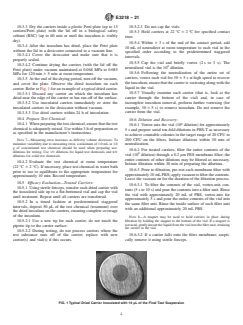
10.3.5 At the end of the drying period, turn off the vacuum, and cover the plate. Observe the dried inoculum on each carrier. Refer
to Fig. 1 for an example of a typical dried carrier.
10.3.5.1 Discard any carrier on which the inoculum has dried near the edge of the carrier or has run off of the surface.
10.3.5.2 Use inoculated carriers immediately or store the inoculated carriers in the desiccator without vacuum.
10.3.5.3 Use dried carriers within 24 h of inoculation.
FIG. 1 Typical Dried Carrier Inoculated with 10 μL of the Final Test Suspension
E3218 − 21
10.4 Prepare Test Chemical:
10.4.1 When preparing the test chemical, ensure that the test chemical is adequately mixed. Use within 3 h of preparation or as
specified in the manufacturer’s instructions.
NOTE 7—Measuring error increases as delivery volume decreases. To minimize variability due to measuring error, a minimum of 1.0 mL or 1.0 g of
concentrated test chemical should be used when preparing use-dilutions for testing. Use v/v dilutions for liquid test chemicals and w/v dilutions for solid
test chemicals.
10.4.2 Evaluate the test chemical at room temperature (22 6 2 °C).(22 °C 6 2 °C). If necessary, place test chemical in water bath
prior to use to equilibrate to the appropriate temperature for approximately 10 min. Record temperature.
10.5 Effıcacy Evaluation—Treated Carriers:
10.5.1 Using sterile forceps, transfer each dried carrier with the inoculated side up to a flat-bottomed vial and cap the vial until
treatment. Repeat until all carriers are transferred.
10.5.2 In a timed fashion at predetermined staggered intervals, deposit 50 μL of the test chemical (treatment) over the dried
inoculum on the carriers, ensuring complete coverage of the inoculum.
10.5.2.1 Use a new tip for each carrier; do not touch the pipette tip to the carrier surface.
10.5.2.2 During testing, do not process carriers where the test substance runs off of the carrier; replace with new carrier(s) and
vial(s) if this occurs.
10.5.2.3 Do not cap the vials.
10.5.3 Hold carriers at 22 6 2 °C22 °C 6 2 °C for specified contact time.
10.5.4 Within 6 3 s of the end of the contact period, add 10 mL of neutralizer at room temperature to each vial in the specified
order according to the predetermined staggered intervals.
10.5.5 Cap the vial and briefly vortex (2(2 s to 3 s). The neutralized vial is the 10 dilution.
10.5.6 Following the neutralization of the entire set of carriers, vortex each vial for 30 6 5 s at high speed to recover the inoculum;
ensure that the carrier is vortexing along with the liquid in the vial.
10.5.7 Visually examine each carrier (that is, look at the carrier through the bottom of the vial) and, in case of incomplete inoculum
removal, perform further vortexing (for example, 30 6 5 s) to remove inoculum. Do not remove the carrier from the vial.
10.6 Dilution and Recovery:
10.6.1 Vortex-mix the vial (10 dilution) for approximately 5 s and prepare
...