

ASTM D5001-23
(Test Method)Standard Test Method for Measurement of Lubricity of Aviation Turbine Fuels by the Ball-on-Cylinder Lubricity Evaluator (BOCLE)
General Information
- Abstract
SIGNIFICANCE AND USE
5.1 Wear due to excessive friction resulting in shortened life of engine components such as fuel pumps and fuel controls has sometimes been ascribed to lack of lubricity in an aviation fuel.
5.2 The relationship of test results to aviation fuel system component distress due to wear has been demonstrated for some fuel/hardware combinations where boundary lubrication is a factor in the operation of the component.
5.3 The wear scar generated in the ball-on-cylinder lubricity evaluator (BOCLE) test is sensitive to contamination of the fluids and test materials, the presence of oxygen and water in the atmosphere, and the temperature of the test. Lubricity measurements are also sensitive to trace materials acquired during sampling and storage. Containers specified in Practice D4306 shall be used.
5.4 The BOCLE test method may not directly reflect operating conditions of engine hardware. For example, some fuels that contain a high content of certain sulfur compounds can give anomalous test results.
SCOPE
1.1 This test method covers assessment of the wear aspects of the boundary lubrication properties of aviation turbine fuels on rubbing steel surfaces.
1.1.1 This test method incorporates two procedures, one using a semi-automated instrument and the second a fully automated instrument. Either of the two instruments may be used to carry out the test.
1.2 The values stated in SI units are to be regarded as standard. No other units of measurement are included in this standard.
1.3 This standard does not purport to address the safety concerns, if any, associated with its use. It is the responsibility of the user of this standard to establish appropriate safety, health, and environmental practices and determine the applicability of regulatory limitations prior to use.
1.4 This international standard was developed in accordance with internationally recognized principles on standardization established in the Decision on Principles for the Development of International Standards, Guides and Recommendations issued by the World Trade Organization Technical Barriers to Trade (TBT) Committee.
- Status
- Published
- Publication Date
- 31-Oct-2023
- Technical Committee
- D02 - Petroleum Products, Liquid Fuels, and Lubricants
- Drafting Committee
- D02.J0.04 - Additives and Electrical Properties
Buy Documents
ASTM D5001-23 - Standard Test Method for Measurement of Lubricity of Aviation Turbine Fuels by the Ball-on-Cylinder Lubricity Evaluator (BOCLE)
REDLINE ASTM D5001-23 - Standard Test Method for Measurement of Lubricity of Aviation Turbine Fuels by the Ball-on-Cylinder Lubricity Evaluator (BOCLE)
Overview
ASTM D5001-23 is the internationally recognized standard test method for the measurement of lubricity in aviation turbine fuels, employing the Ball-on-Cylinder Lubricity Evaluator (BOCLE). Developed by ASTM International, this standard is crucial for assessing the wear-related boundary lubrication properties of jet fuels on steel surfaces. Ensuring adequate lubricity in aviation fuels is vital because wear from excessive friction can shorten the lifespan of critical engine components such as fuel pumps and controls.
ASTM D5001-23 details two test procedures: one using a semi-automated BOCLE instrument and another using a fully automated system. The methodology focuses on measuring the size of the wear scar generated on a stationary ball as it contacts a rotating, fluid-wetted cylinder. This wear scar serves as an indicator of the lubricating property of the aviation fuel sample under controlled conditions.
Key Topics
- Lubricity Assessment: The standard evaluates the ability of aviation fuel to minimize friction and prevent wear between moving metal parts, using the BOCLE method.
- Wear Scar Measurement: The primary test result is the wear scar diameter (WSD), measured to the nearest 0.01 mm, providing a quantitative assessment of fuel lubricity.
- Test Sensitivities: Test results are influenced by several factors, including fluid contamination, test material cleanliness, the presence of oxygen and water, and temperature stability. Compliance with sampling and storage procedures, especially the use of containers as specified in ASTM D4306, is essential.
- Calibration and Reference Fluids: Regular calibration using defined reference fluids ensures data reliability and consistency across laboratories.
- Test Apparatus: The standard specifies the use of a BOCLE device, precision microscope, cleaning bath, and related accessories, with detailed procedures for both manual and automated tests.
- Result Interpretation: While the test provides valuable insight into boundary lubrication, test outcomes may not always directly reflect real-world engine operating conditions, especially for fuels with high sulfur content.
Applications
- Aviation Industry Quality Control: ASTM D5001-23 is routinely used by fuel manufacturers, refineries, and aviation operators for quality assurance, helping to prevent premature wear of jet engine components by assessing and monitoring fuel lubricity.
- Fuel System Component Evaluation: The method supports the investigation of component wear in specific fuel/hardware combinations where boundary lubrication is a factor, aiding manufacturers in material selection and design.
- Regulatory Compliance: Many aviation authorities and military organizations reference this standard for certifying jet fuel specifications, making it a critical tool for meeting global aviation safety and performance requirements.
- R&D in Fuel Additives: Researchers and formulation chemists utilize the BOCLE test to evaluate the effectiveness of lubricity-improving fuel additives, optimizing formulations for enhanced engine protection.
Related Standards
- ASTM D4175: Terminology Relating to Petroleum Products, Liquid Fuels, and Lubricants - provides definitions for terms used in lubricity testing.
- ASTM D4306: Practice for Aviation Fuel Sample Containers - ensures proper handling and storage to avoid contamination affecting lubricity measurements.
- ASTM D6708: Practice for Statistical Assessment - guides comparison and improvement of agreement between different test methods.
- ISO 3290-1: Rolling Bearings - Balls - defines specifications for steel balls used in lubricity testers.
- SAE 8720 and AISI E-52100: Material standards for test rings and balls, ensuring test reproducibility and consistency.
Keywords: ASTM D5001, lubricity, aviation turbine fuel, BOCLE, ball-on-cylinder, wear scar diameter, boundary lubrication, jet fuel quality, engine wear, aviation fuel testing, fuel system protection.
Relations
- Effective Date
- 01-Nov-2023
- Effective Date
- 01-Mar-2024
- Refers
ASTM D4175-23a - Standard Terminology Relating to Petroleum Products, Liquid Fuels, and Lubricants - Effective Date
- 15-Dec-2023
- Refers
ASTM D4175-23e1 - Standard Terminology Relating to Petroleum Products, Liquid Fuels, and Lubricants - Effective Date
- 01-Jul-2023
- Refers
ASTM D4175-23 - Standard Terminology Relating to Petroleum Products, Liquid Fuels, and Lubricants - Effective Date
- 01-Jul-2023
- Effective Date
- 01-May-2021
- Effective Date
- 01-Nov-2023
- Referred By
ASTM D4054-23 - Standard Practice for Evaluation of New Aviation Turbine Fuels and Fuel Additives - Effective Date
- 01-Nov-2023
- Effective Date
- 01-Nov-2023
- Effective Date
- 01-Nov-2023
- Effective Date
- 01-Nov-2023
Buy Documents
ASTM D5001-23 - Standard Test Method for Measurement of Lubricity of Aviation Turbine Fuels by the Ball-on-Cylinder Lubricity Evaluator (BOCLE)
REDLINE ASTM D5001-23 - Standard Test Method for Measurement of Lubricity of Aviation Turbine Fuels by the Ball-on-Cylinder Lubricity Evaluator (BOCLE)
Get Certified
Connect with accredited certification bodies for this standard

Element Materials Technology
Materials testing and product certification.

ABS Group Brazil
ABS Group certification services in Brazil.

ABS Quality Evaluations Inc.
American Bureau of Shipping quality certification.
Sponsored listings
Frequently Asked Questions
ASTM D5001-23 is a standard published by ASTM International. Its full title is "Standard Test Method for Measurement of Lubricity of Aviation Turbine Fuels by the Ball-on-Cylinder Lubricity Evaluator (BOCLE)". This standard covers: SIGNIFICANCE AND USE 5.1 Wear due to excessive friction resulting in shortened life of engine components such as fuel pumps and fuel controls has sometimes been ascribed to lack of lubricity in an aviation fuel. 5.2 The relationship of test results to aviation fuel system component distress due to wear has been demonstrated for some fuel/hardware combinations where boundary lubrication is a factor in the operation of the component. 5.3 The wear scar generated in the ball-on-cylinder lubricity evaluator (BOCLE) test is sensitive to contamination of the fluids and test materials, the presence of oxygen and water in the atmosphere, and the temperature of the test. Lubricity measurements are also sensitive to trace materials acquired during sampling and storage. Containers specified in Practice D4306 shall be used. 5.4 The BOCLE test method may not directly reflect operating conditions of engine hardware. For example, some fuels that contain a high content of certain sulfur compounds can give anomalous test results. SCOPE 1.1 This test method covers assessment of the wear aspects of the boundary lubrication properties of aviation turbine fuels on rubbing steel surfaces. 1.1.1 This test method incorporates two procedures, one using a semi-automated instrument and the second a fully automated instrument. Either of the two instruments may be used to carry out the test. 1.2 The values stated in SI units are to be regarded as standard. No other units of measurement are included in this standard. 1.3 This standard does not purport to address the safety concerns, if any, associated with its use. It is the responsibility of the user of this standard to establish appropriate safety, health, and environmental practices and determine the applicability of regulatory limitations prior to use. 1.4 This international standard was developed in accordance with internationally recognized principles on standardization established in the Decision on Principles for the Development of International Standards, Guides and Recommendations issued by the World Trade Organization Technical Barriers to Trade (TBT) Committee.
SIGNIFICANCE AND USE 5.1 Wear due to excessive friction resulting in shortened life of engine components such as fuel pumps and fuel controls has sometimes been ascribed to lack of lubricity in an aviation fuel. 5.2 The relationship of test results to aviation fuel system component distress due to wear has been demonstrated for some fuel/hardware combinations where boundary lubrication is a factor in the operation of the component. 5.3 The wear scar generated in the ball-on-cylinder lubricity evaluator (BOCLE) test is sensitive to contamination of the fluids and test materials, the presence of oxygen and water in the atmosphere, and the temperature of the test. Lubricity measurements are also sensitive to trace materials acquired during sampling and storage. Containers specified in Practice D4306 shall be used. 5.4 The BOCLE test method may not directly reflect operating conditions of engine hardware. For example, some fuels that contain a high content of certain sulfur compounds can give anomalous test results. SCOPE 1.1 This test method covers assessment of the wear aspects of the boundary lubrication properties of aviation turbine fuels on rubbing steel surfaces. 1.1.1 This test method incorporates two procedures, one using a semi-automated instrument and the second a fully automated instrument. Either of the two instruments may be used to carry out the test. 1.2 The values stated in SI units are to be regarded as standard. No other units of measurement are included in this standard. 1.3 This standard does not purport to address the safety concerns, if any, associated with its use. It is the responsibility of the user of this standard to establish appropriate safety, health, and environmental practices and determine the applicability of regulatory limitations prior to use. 1.4 This international standard was developed in accordance with internationally recognized principles on standardization established in the Decision on Principles for the Development of International Standards, Guides and Recommendations issued by the World Trade Organization Technical Barriers to Trade (TBT) Committee.
ASTM D5001-23 is classified under the following ICS (International Classification for Standards) categories: 75.160.20 - Liquid fuels. The ICS classification helps identify the subject area and facilitates finding related standards.
ASTM D5001-23 has the following relationships with other standards: It is inter standard links to ASTM D5001-19e1, ASTM D6708-24, ASTM D4175-23a, ASTM D4175-23e1, ASTM D4175-23, ASTM D6708-21, ASTM D7566-23a, ASTM D4054-23, ASTM D7223-21, ASTM D6615-22, ASTM D1655-23a. Understanding these relationships helps ensure you are using the most current and applicable version of the standard.
ASTM D5001-23 is available in PDF format for immediate download after purchase. The document can be added to your cart and obtained through the secure checkout process. Digital delivery ensures instant access to the complete standard document.
Standards Content (Sample)
This international standard was developed in accordance with internationally recognized principles on standardization established in the Decision on Principles for the
Development of International Standards, Guides and Recommendations issued by the World Trade Organization Technical Barriers to Trade (TBT) Committee.
Designation: D5001 − 23
Standard Test Method for
Measurement of Lubricity of Aviation Turbine Fuels by the
Ball-on-Cylinder Lubricity Evaluator (BOCLE)
This standard is issued under the fixed designation D5001; the number immediately following the designation indicates the year of
original adoption or, in the case of revision, the year of last revision. A number in parentheses indicates the year of last reapproval. A
superscript epsilon (´) indicates an editorial change since the last revision or reapproval.
This standard has been approved for use by agencies of the U.S. Department of Defense.
1. Scope* Purport to Measure the Same Property of a Material
1.1 This test method covers assessment of the wear aspects 2.2 American Iron and Steel Institute Standard:
of the boundary lubrication properties of aviation turbine fuels AISI E-52100 Chromium Alloy Steel
on rubbing steel surfaces. 4
2.3 ISO Standard:
1.1.1 This test method incorporates two procedures, one
ISO 3290-1 Rolling bearings -- Balls -- Part 1: Steel balls
using a semi-automated instrument and the second a fully
2.4 Society of Automotive Engineers Standard:
automated instrument. Either of the two instruments may be
SAE 8720 Steel
used to carry out the test.
1.2 The values stated in SI units are to be regarded as
3. Terminology
standard. No other units of measurement are included in this
3.1 Definitions:
standard.
3.1.1 For definitions of terms used in this test method, refer
1.3 This standard does not purport to address the safety
to Terminology D4175.
concerns, if any, associated with its use. It is the responsibility
3.2 Definitions of Terms Specific to This Standard:
of the user of this standard to establish appropriate safety,
3.2.1 lubricity, n—qualitative term describing the ability of
health, and environmental practices and determine the appli-
a fluid to minimize friction between, and damage to, surfaces
cability of regulatory limitations prior to use.
in relative motion under load.
1.4 This international standard was developed in accor-
3.2.1.1 Discussion—In this test method, the lubricity of a
dance with internationally recognized principles on standard-
fluid is defined in terms of a wear scar, in millimeters,
ization established in the Decision on Principles for the
produced on a loaded stationary ball from contact with a
Development of International Standards, Guides and Recom-
fluid-wetted rotating cylindrical test ring operating under
mendations issued by the World Trade Organization Technical
closely defined and controlled conditions.
Barriers to Trade (TBT) Committee.
3.2.2 wear scar, n—in the liquid fuels industry, average
2. Referenced Documents diameter of a worn and abraded area, measured in two
2 specified directions, produced on a test ball under defined
2.1 ASTM Standards:
conditions.
D4175 Terminology Relating to Petroleum Products, Liquid
3.2.2.1 Discussion—The wear scar generated by Test
Fuels, and Lubricants
Method D5001 is often referred to as the BOCLE wear scar.
D4306 Practice for Aviation Fuel Sample Containers for
Tests Affected by Trace Contamination 3.3 Abbreviations:
D6708 Practice for Statistical Assessment and Improvement 3.3.1 BOCLE—Ball On Cylinder Lubricity Evaluator
of Expected Agreement Between Two Test Methods that
3.3.2 HRC—Rockwell Hardness “C” scale.
3.3.3 WSD—Wear Scar Diameter
This test method is under the jurisdiction of ASTM Committee D02 on
Petroleum Products, Liquid Fuels, and Lubricants and is the direct responsibility of
Subcommittee D02.J0.04 on Additives and Electrical Properties.
Current edition approved Nov. 1, 2023. Published November 2023. Originally Available from American Iron and Steel Institute (AISI), 1140 Connecticut
ɛ1
approved in 1989. Last previous edition approved in 2019 as D5001 – 19 . DOI: Ave., NW, Suite 705, Washington, DC 20036, http://www.steel.org.
10.1520/D5001-23. Available from International Organization for Standardization (ISO), 1, ch. de
For referenced ASTM standards, visit the ASTM website, www.astm.org, or la Voie-Creuse, Case postale 56, CH-1211, Geneva 20, Switzerland, http://
contact ASTM Customer Service at service@astm.org. For Annual Book of ASTM www.iso.ch.
Standards volume information, refer to the standard’s Document Summary page on Available from Society of Automotive Engineers (SAE), 400 Commonwealth
the ASTM website. Dr., Warrendale, PA 15096-0001, http://www.sae.org.
*A Summary of Changes section appears at the end of this standard
Copyright © ASTM International, 100 Barr Harbor Drive, PO Box C700, West Conshohocken, PA 19428-2959. United States
D5001 − 23
TABLE 1 Standard Operating Conditions
4. Summary of Test Method
Fluid Volume 50 mL ± 1.0 mL
4.1 The fluid under test is placed in a test reservoir in which
Fluid Temperature 25 °C ± 1 °C
atmospheric air is maintained at 10 % relative humidity. A
Conditioned Air 10 % ± 0.2 % relative humidity at 25 °C ±
1 °C
non-rotating steel ball is held in a vertically mounted chuck and
Fluid pretreatment 0.50 L ⁄min flowing through and 3.3 L ⁄min
forced against the outside diameter of an axially mounted
over the fluid for 15 min
cylindrical steel ring with an applied load. The test ring is
Fluid test conditions 3.8 L ⁄min flowing over the fluid
Applied Load 1000 g (500 g weight) (± l g)
rotated at a fixed speed while being partially immersed in the
Cylinder Rotational 240 rpm ± 1 rpm
fluid reservoir. This maintains the ring in a wet condition and
Speed
continuously transports the test fluid to the ball/ring interface. Test Duration 30 min ± 0.1 min
The wear scar generated on the test ball is a measure of the
lubricating property of the fluid. For wear scar diameter (WSD)
calibration and standardization, see Section 10.
7. Reagents and Materials
7.1 Test Ring, of SAE 8720 steel, having a Rockwell
5. Significance and Use
hardness “C” scale, (HRC) number of 58 to 62 and a surface
5.1 Wear due to excessive friction resulting in shortened life
6,8
finish of 0.56 μm to 0.71 μm root mean square. The
of engine components such as fuel pumps and fuel controls has
dimensions are given in Fig. 1.
sometimes been ascribed to lack of lubricity in an aviation fuel.
7.2 Test Balls, chrome alloy steel, made from AISI standard
5.2 The relationship of test results to aviation fuel system
steel No. E-52100, with a diameter of 12.7 mm, Grade 5 to 10.
component distress due to wear has been demonstrated for
The balls are described in ISO 3290-1. The HRC shall be 64 to
some fuel/hardware combinations where boundary lubrication
66, a closer limit than is found in the ISO requirement.
is a factor in the operation of the component.
7.3 Additional Equipment—Details of additional items of
5.3 The wear scar generated in the ball-on-cylinder lubricity
test equipment specific to each test method are given in the
evaluator (BOCLE) test is sensitive to contamination of the
appropriate annex.
fluids and test materials, the presence of oxygen and water in
7.4 Compressed Air (Warning—Compressed gas under
the atmosphere, and the temperature of the test. Lubricity
high pressure. Use with extreme caution in the presence of
measurements are also sensitive to trace materials acquired
combustible material, since the autoignition temperatures of
during sampling and storage. Containers specified in Practice
most organic compounds in air are drastically reduced at
D4306 shall be used.
5.4 The BOCLE test method may not directly reflect oper-
ating conditions of engine hardware. For example, some fuels
The sole source of supply of the apparatus known to the committee at this time
that contain a high content of certain sulfur compounds can
is (for the semi-automatic method) Test Rings Part No. F25061, Falex Corp., 2055
give anomalous test results.
Comprehensive Drive, Aurora, IL 60505 and (for the fully automatic method) Test
Rings, Part No. ABSRING, PCS Instruments, 78 Stanley Gardens, London, W3
7SZ, U.K.
6. Apparatus
6.1 For details of the Ball-On-Cylinder Lubricity Evaluator
(BOCLE), apparatus required for each method see: Annex A1
for the semi-automatic method, Annex A2 for the fully
automatic method.
6.2 Microscope, capable of 100× magnification and suitable
of measuring the wear scar on the ball to the nearest 0.01 mm.
6.2.1 Method of Measuring the Wear Scar—This may be
either a Glass Slide Micrometer, with a scale ruled in 0.01 mm
divisions, or a digital micrometer and slide assembly, having a
6,7
resolution of at least 0.01 mm.
6.3 Cleaning Bath—Ultrasonic seamless stainless steel tank
with a capacity of 1.9 L and a cleaning power of 40W.
6.4 The test requirements are listed in Table 1.
If you are aware of alternative suppliers, please provide this information to
ASTM International Headquarters. Your comments will receive careful consider-
ation at a meeting of the responsible technical committee, which you may attend.
The sole source of supply of the apparatus known to the committee at this time
is Microscope part number ABSMIC from PCS Instruments, 78 Stanley Gardens,
London, W3 7SZ, U.K. A certificate of traceability from the National Institute of
Standards and Technology is available. FIG. 1 Ball-on-Cylinder Test Ring
D5001 − 23
NOTE 1—Drying operations can be accomplished using a compressed
elevated pressures. See A3.1.), containing less than 0.1 ppm
air jet at 140 kPa to 210 kPa pressure.
hydrocarbons and 50 ppm water.
8.1.1.6 Dry and store in a desiccator.
7.5 Desiccator, containing a non-indicating drying agent,
8.1.2 Test Balls, as Received.
capable of storing test rings, balls, and hardware.
8.1.2.1 Place balls in 300 mL beaker. Transfer a sufficient
7.6 Gloves, clean, lint-free, cotton, disposable.
volume of a 1 to 1 mixture of isooctane and isopropyl alcohol
7.7 Wiper, wiping tissue, light duty, lint free, hydrocarbon
to the beaker such that the test balls are completely covered by
free, disposable.
the cleaning solvent.
7.8 Isooctane (Warning—Extremely flammable. Harmful
NOTE 2—Approximately a five-day supply can be processed at one
if inhaled. Vapors may cause flash fires. See A3.2.), conform-
time.
ing to American Chemical Society (ACS) Reagent/General
8.1.2.2 Place beaker in ultrasonic cleaner and turn on for
Purpose Reagent (GPR) grade standards, 95 % purity
15 min.
minimum, 2,2,4-trimethylpentane.
8.1.2.3 Repeat the cleaning cycle of 8.1.2.2 with a clean
7.9 Isopropyl Alcohol (Warning—Flammable. See A3.3.),
beaker and fresh solvent.
conforming to ACS Reagent/GPR grade standards.
8.1.2.4 Remove and rinse with isooctane, dry, and rinse with
7.10 Acetone (Warning—Extremely flammable. Vapors
acetone.
may cause flash fire. See A3.4.), conforming to ACS Reagent/
8.1.2.5 Dry and store in a desiccator.
GPR grade standards.
8.1.3 Reservoir, Reservoir Cover, Ball Chuck, Lock Ring,
7.11 Reference Fluids:
Mandrel Assembly (Method A, Semi Automatic Method) Test
7.11.1 Fluid JFA —High lubricity reference (Warning—
Ring Assembly (Method B, Fully Automatic Method), and all
Flammable). The URL of this webpage is http://
other parts which come into direct contact with the test fuel
webstore.astmtmc.cmu.edu/webstore/
(refer to the appropriate annex).
ProductDetail.aspx?ProductID=50. Store in clean, borosilicate
8.1.3.1 Rinse with isooctane.
glass with an aluminum foil-lined insert cap or a fully
8.1.3.2 Clean in an ultrasonic cleaner with a 1:1 mixture of
epoxy-lined metal container. Store in dark area.
isooctane and isopropyl alcohol for 5 min.
7.11.2 Fluid JFB —Low lubricity reference (Warning—
8.1.3.3 Remove and rinse with isooctane, dry, and rinse with
Flammable. Vapor harmful). The URL of this webpage is
acetone.
https://www.astmtmc.org/ftp/docs/sds/fuel/JFB10_CofA.pdf.
8.1.3.4 Store in a desiccator until required.
Store in clean, borosilicate glass with an aluminum foil-lined
8.1.4 Hardware:
insert cap or a fully epoxy-lined metal container. Store in a
8.1.4.1 The hardware and utensils, that is, any part that
dark area.
comes in contact with the test fluid shall be cleaned by washing
7.11.3 The reference fluids shall be stored in epoxy lined
thoroughly with isooctane and wiped with a wiper.
containers or borosilicate glass bottles with aluminum foil or
PTFE lined insert caps. Borosilicate glass bottles shall be
8.1.4.2 Store parts in desiccator when not in use.
stored in a dark area.
8.1.5 After Test:
8.1.5.1 Remove reservoir and test ring.
8. Sampling, Test Specimens, and Test Units
8.1.5.2 Disassemble components and clean in an ultrasonic
8.1 Cleaning of Apparatus and Test Components:
cleaner using a 1 to 1 mixture of isooctane and isopropyl
8.1.1 Test Rings, as Received: alcohol for 5 min. Rinse with isooctane, dry, and rinse with
8.1.1.1 The test rings shall be partially stripped of any
acetone. Reassemble components.
protective coatings by manually rubbing them with rags or
8.1.5.3 Dry and store in a desiccator.
paper towels saturated with isooctane.
NOTE 3—When testing the same fluid, it is permissible to clean the
8.1.1.2 Place partially cleaned rings in a clean 500 mL
reservoir by hand. The reservoir is rinsed with isooctane. Wipe with
beaker. Transfer a sufficient volume of a 1 to 1 mixture of
disposable wiper to remove residual fuel related deposits and test debris.
isooctane (2,2,4-trimethyl pentane) and isopropyl alcohol to
The reservoir is rinsed again with isooctane. Dry and final rinse with
the beaker such that the test rings are completely covered. acetone, dry.
8.1.1.3 Place beaker in ultrasonic cleaner and turn on for
8.1.5.4 Store parts in desiccator when not in use.
15 min.
8.1.5.5 Semi-Automatic (Method A) Only—Care shall be
8.1.1.4 Remove test rings and repeat ultrasonic cleaning
taken to ensure that the fuel aeration tube is rinsed and dried
cycle of 8.1.1.3 with a clean beaker and fresh solvents.
during the cleaning procedure. Store parts in desiccator when
8.1.1.5 Handle all clean test rings with clean forceps or
not in use.
disposable gloves. Remove test rings from beaker and rinse
with isooctane, dry, and rinse with acetone.
9. Preparation of Apparatus
9.1 Use the following procedures, where applicable:
Annex A1 for the semi-automatic method.
Reference Fluids JFA and JFB are available from ASTM Test Monitoring
Center, 203 Armstrong Dr., Freeport, PA 16229. Annex A2 for the fully automatic method.
D5001 − 23
10. Calibration and Standardization 11.2 The procedure for testing using the fully automatic
method is described in Annex A2.
10.1 Visually inspect test balls before each test. Discard
balls that exhibit pits, corrosion, or surface abnormalities.
12. Calculation and Interpretation of Results
10.2 Reference Fluids:
12.1 Wear Scar Measurement:
10.2.1 Conduct three tests on each new batch of the refer-
12.1.1 Turn on the microscope light and position test ball
ence fluids in accordance with Section 11 using a test ring
under the microscope at 100× magnification.
previously standardized by reference fluid testing.
12.1.2 Focus the microscope and adjust the stage such that
10.2.2 Repeat the three tests if the wear scar diameters differ
wear scar is centered within the field of view.
by more than 0.04 mm for Reference Fluid A or by more than
12.1.3 Align the wear scar to either a divisional point of
0.08 mm for Reference Fluid B.
reference on the numerical scale with the mechanical stage
10.2.3 Reject the reference fluid concerned if the wear scar controls, or the cross hair graticule. Measure the major axis to
diameters for the repeat tests (10.2.2) again differ by more than
the nearest 0.01 mm. Ensure that the measurement is taken to
the values obtained in 10.2.1.
include the outermost edge of the wear scar (i.e. include all the
10.2.4 Calculate the average wear scar for the three results wear scar region). Repeat the procedure for the minor axis.
that are within the values of 10.2.2 for the appropriate Record the readings on the data sheet. Typical wear scars are
Reference Fluid. illustrated in Fig. 2 showing the measurement points.
12.1.4 Record condition of wear area if different from the
10.2.5 Compare the average results with the WSD of the
Reference Fluid values provided by the ASTM Test Monitoring reference standard test, that is, debris color, unusual particles or
wear pattern, visible galling, etc., and presence of particles in
Center Certificate of Analysis. The TMC issues COAs for both
JFA and JFB posted on the website: https://www.astmtmc.org/ the reservoir.
ftp/docs/sds/
12.2 Wear Scar Calculation:
10.2.6 Reject the new Reference Fluid batch if the average
12.2.1 Calculate the wear scar diameter as follows:
results obtained at 10.2.4 differ by more than 0.04 mm for
WSD 5 ~M1N!/2 (1)
Reference Fluid A or by more than 0.08 mm for Reference
Fluid B from the Reference Fluid values given in 10.2.5.
where:
WSD = wear scar diameter, mm,
10.3 Test Ring Calibration:
M = major axis, mm, and
10.3.1 Test each new ring with Reference Fluid A as per
N = minor axis, mm.
Section 11.
10.3.2 The ring is acceptable if the wear scar diameter result
13. Report
is within 0.04 mm WSD of the Reference Fluid A value shown
13.1 Report the following information:
in 10.2.5.
13.1.1 Wear scar diameter to the nearest 0.01 mm (from
10.3.3 Repeat the test if the wear scar diameter does not
12.2),
agree within 0.04 mm WSD of the Reference Fluid A value
13.1.2 Description of the wear scar area, and
shown in 10.2.5.
13.1.3 Deviations from the standard conditions of the test
10.3.4 Reject the ring if the two values obtained in 10.3.1
load, relative humidity, a
...
This document is not an ASTM standard and is intended only to provide the user of an ASTM standard an indication of what changes have been made to the previous version. Because
it may not be technically possible to adequately depict all changes accurately, ASTM recommends that users consult prior editions as appropriate. In all cases only the current version
of the standard as published by ASTM is to be considered the official document.
´1
Designation: D5001 − 19 D5001 − 23
Standard Test Method for
Measurement of Lubricity of Aviation Turbine Fuels by the
Ball-on-Cylinder Lubricity Evaluator (BOCLE)
This standard is issued under the fixed designation D5001; the number immediately following the designation indicates the year of
original adoption or, in the case of revision, the year of last revision. A number in parentheses indicates the year of last reapproval. A
superscript epsilon (´) indicates an editorial change since the last revision or reapproval.
This standard has been approved for use by agencies of the U.S. Department of Defense.
ε NOTE—Editorially corrected Fig. 3 in July 2020.
1. Scope*
1.1 This test method covers assessment of the wear aspects of the boundary lubrication properties of aviation turbine fuels on
rubbing steel surfaces.
1.1.1 This test method incorporates two procedures, one using a semi-automated instrument and the second a fully automated
instrument. Either of the two instruments may be used to carry out the test.
1.2 The values stated in SI units are to be regarded as standard. No other units of measurement are included in this standard.
1.3 This standard does not purport to address the safety concerns, if any, associated with its use. It is the responsibility of the
user of this standard to establish appropriate safety, health, and environmental practices and determine the applicability of
regulatory limitations prior to use.
1.4 This international standard was developed in accordance with internationally recognized principles on standardization
established in the Decision on Principles for the Development of International Standards, Guides and Recommendations issued
by the World Trade Organization Technical Barriers to Trade (TBT) Committee.
2. Referenced Documents
2.1 ASTM Standards:
D4175 Terminology Relating to Petroleum Products, Liquid Fuels, and Lubricants
D4306 Practice for Aviation Fuel Sample Containers for Tests Affected by Trace Contamination
D6708 Practice for Statistical Assessment and Improvement of Expected Agreement Between Two Test Methods that Purport
to Measure the Same Property of a Material
2.2 American Iron and Steel Institute Standard:
AISI E-52100 Chromium Alloy Steel
2.3 ISO Standard:
ISO 3290-1 Rolling bearings -- Balls -- Part 1: Steel balls
This test method is under the jurisdiction of ASTM Committee D02 on Petroleum Products, Liquid Fuels, and Lubricants and is the direct responsibility of Subcommittee
D02.J0.04 on Additives and Electrical Properties.
Current edition approved Dec. 1, 2019Nov. 1, 2023. Published January 2020November 2023. Originally approved in 1989. Last previous edition approved in 20142019
ɛ1
as D5001 – 10 (2014).D5001 – 19 . DOI: 10.1520/D5001-19E01.10.1520/D5001-23.
For referenced ASTM standards, visit the ASTM website, www.astm.org, or contact ASTM Customer Service at service@astm.org. For Annual Book of ASTM Standards
volume information, refer to the standard’s Document Summary page on the ASTM website.
Available from American Iron and Steel Institute (AISI), 1140 Connecticut Ave., NW, Suite 705, Washington, DC 20036, http://www.steel.org.
Available from International Organization for Standardization (ISO), 1, ch. de la Voie-Creuse, Case postale 56, CH-1211, Geneva 20, Switzerland, http://www.iso.ch.
*A Summary of Changes section appears at the end of this standard
Copyright © ASTM International, 100 Barr Harbor Drive, PO Box C700, West Conshohocken, PA 19428-2959. United States
D5001 − 23
2.4 Society of Automotive Engineers Standard:
SAE 8720 Steel
3. Terminology
3.1 Definitions:
3.1.1 For definitions of terms used in this test method, refer to Terminology D4175.
3.2 Definitions:Definitions of Terms Specific to This Standard:
3.2.1 lubricity, n—qualitative term describing the ability of a fluid to minimize friction between, and damage to, surfaces in
relative motion under load.
3.2.1.1 Discussion—
In this test method, the lubricity of a fluid is defined in terms of a wear scar, in millimeters, produced on a loaded stationary ball
from contact with a fluid-wetted rotating cylindrical test ring operating under closely defined and controlled conditions.
3.2.2 wear scar, n—in the liquid fuels industry, average diameter of a worn and abraded area, measured in two specified directions,
produced on a test ball under defined conditions.
3.2.2.1 Discussion—
The wear scar generated by Test Method D5001 is often referred to as the BOCLE wear scar.
3.3 Abbreviations:
3.3.1 BOCLE—Ball On Cylinder Lubricity Evaluator
3.3.2 HRC—Rockwell Hardness “C” scale.
3.3.3 WSD—Wear Scar Diameter
4. Summary of Test Method
4.1 The fluid under test is placed in a test reservoir in which atmospheric air is maintained at 10 % relative humidity. A
non-rotating steel ball is held in a vertically mounted chuck and forced against the outside diameter of an axially mounted
cylindrical steel ring with an applied load. The test ring is rotated at a fixed speed while being partially immersed in the fluid
reservoir. This maintains the ring in a wet condition and continuously transports the test fluid to the ball/ring interface. The wear
scar generated on the test ball is a measure of the lubricating property of the fluid. For wear scar diameter (WSD) calibration and
standardization, see Section 10.
5. Significance and Use
5.1 Wear due to excessive friction resulting in shortened life of engine components such as fuel pumps and fuel controls has
sometimes been ascribed to lack of lubricity in an aviation fuel.
5.2 The relationship of test results to aviation fuel system component distress due to wear has been demonstrated for some
fuel/hardware combinations where boundary lubrication is a factor in the operation of the component.
5.3 The wear scar generated in the ball-on-cylinder lubricity evaluator (BOCLE) test is sensitive to contamination of the fluids
and test materials, the presence of oxygen and water in the atmosphere, and the temperature of the test. Lubricity measurements
are also sensitive to trace materials acquired during sampling and storage. Containers specified in Practice D4306 shall be used.
5.4 The BOCLE test method may not directly reflect operating conditions of engine hardware. For example, some fuels that
contain a high content of certain sulfur compounds can give anomalous test results.
6. Apparatus
6.1 For details of the Ball-On-Cylinder Lubricity Evaluator (BOCLE), apparatus required for each method see: Annex A1 for the
semi-automatic method, Annex A2 for the fully automatic method.
Available from Society of Automotive Engineers (SAE), 400 Commonwealth Dr., Warrendale, PA 15096-0001, http://www.sae.org.
D5001 − 23
6.2 Microscope, capable of 100× magnification and suitable of measuring the wear scar on the ball to the nearest 0.01 mm.
6.2.1 Method of Measuring the Wear Scar—This may be either a Glass Slide Micrometer, with a scale ruled in 0.01 mm divisions,
6,7
or a digital micrometer and slide assembly, having a resolution of at least 0.01 mm.
6.3 Cleaning Bath—Ultrasonic seamless stainless steel tank with a capacity of 1.9 L and a cleaning power of 40W.
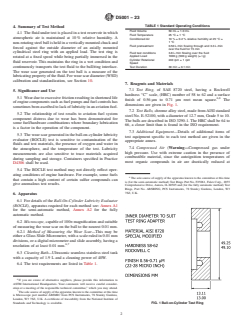
6.4 The test requirements are listed in Table 1.
7. Reagents and Materials
7.1 Test Ring, of SAE 8720 steel, having a Rockwell hardness “C” scale, (HRC) number of 58 to 62 and a surface finish of 0.56 μm
6,8
to 0.71 μm root mean square. The dimensions are given in Fig. 1.
7.2 Test Balls, chrome alloy steel, made from AISI standard steel No. E-52100, with a diameter of 12.7 mm, Grade 5 to 10. The
balls are described in ISO 3290-1. The HRC shall be 64 to 66, a closer limit than is found in the ISO requirement.
7.3 Additional Equipment—Details of additional items of test equipment specific to each test method are given in the appropriate
annex.
7.4 Compressed Air (Warning—Compressed gas under high pressure. Use with extreme caution in the presence of combustible
material, since the autoignition temperatures of most organic compounds in air are drastically reduced at elevated pressures. See
A3.1.), containing less than 0.1 ppm hydrocarbons and 50 ppm water.
7.5 Desiccator, containing a non-indicating drying agent, capable of storing test rings, balls, and hardware.
7.6 Gloves, clean, lint-free, cotton, disposable.
7.7 Wiper, wiping tissue, light duty, lint free, hydrocarbon free, disposable.
7.8 Isooctane (Warning—Extremely flammable. Harmful if inhaled. Vapors may cause flash fires. See A3.2.), conforming to
American Chemical Society (ACS) Reagent/General Purpose Reagent (GPR) grade standards, 95 % purity minimum, 2,2,4-
trimethylpentane.
7.9 Isopropyl Alcohol (Warning—Flammable. See A3.3.), conforming to ACS Reagent/GPR grade standards.
TABLE 1 Standard Operating Conditions
Fluid Volume 50 mL ± 1.0 mL
Fluid Temperature 25 °C ± 1 °C
Conditioned Air 10 % ± 0.2 % relative humidity at 25 °C ±
1 °C
Fluid pretreatment 0.50 L ⁄min flowing through and 3.3 L ⁄min
over the fluid for 15 min
Fluid test conditions 3.8 L ⁄min flowing over the fluid
Applied Load 1000 g (500 g weight) (± l g)
Cylinder Rotational 240 rpm ± 1 rpm
Speed
Test Duration 30 min ± 0.1 min
If you are aware of alternative suppliers, please provide this information to ASTM International Headquarters. Your comments will receive careful consideration at a
meeting of the responsible technical committee, which you may attend.
The sole source of supply of the apparatus known to the committee at this time is Microscope part number ABSMIC from PCS Instruments, 78 Stanley Gardens, London,
W3 7SZ, U.K. A certificate of traceability from the National Institute of Standards and Technology is available.
The sole source of supply of the apparatus known to the committee at this time is (for the semi-automatic method) Test Rings Part No. F25061, Falex Corp., 2055
Comprehensive Drive, Aurora, IL 60505 and (for the fully automatic method) Test Rings, Part No. ABSRING, PCS Instruments, 78 Stanley Gardens, London, W3 7SZ, U.K.
D5001 − 23
FIG. 1 Ball-on-Cylinder Test Ring
7.10 Acetone (Warning—Extremely flammable. Vapors may cause flash fire. See A3.4.), conforming to ACS Reagent/GPR grade
standards.
7.11 Reference Fluids:
7.11.1 Fluid JFA —High lubricity reference (Warning—Flammable). The URL of this webpage is http://
webstore.astmtmc.cmu.edu/webstore/ProductDetail.aspx?ProductID=50. Store in clean, borosilicate glass with an aluminum
foil-lined insert cap or a fully epoxy-lined metal container. Store in dark area.
7.11.2 Fluid JFB —Low lubricity reference (Warning—Flammable. Vapor harmful). The URL of this webpage is http://
webstore.astmtmc.cmu.edu/webstore/ProductDetail.aspx?ProductID=51.https://www.astmtmc.org/ftp/docs/s
ds/fuel/JFB10_CofA.pdf. Store in clean, borosilicate glass with an aluminum foil-lined insert cap or a fully epoxy-lined metal
container. Store in a dark area.
7.11.3 The reference fluids shall be stored in epoxy lined containers or borosilicate glass bottles with aluminum foil or PTFE lined
insert caps. Borosilicate glass bottles shall be stored in a dark area.
8. Sampling, Test Specimens, and Test Units
8.1 Cleaning of Apparatus and Test Components:
8.1.1 Test Rings, as Received:
8.1.1.1 The test rings shall be partially stripped of any protective coatings by manually rubbing them with rags or paper towels
saturated with isooctane.
8.1.1.2 Place partially cleaned rings in a clean 500 mL beaker. Transfer a sufficient volume of a 1 to 1 mixture of
isooctaneisooctane (2,2,4-trimethyl pentane) and isopropyl alcohol to the beaker such that the test rings are completely covered.
8.1.1.3 Place beaker in ultrasonic cleaner and turn on for 15 min.
Reference Fluids JFA and JFB are available from ASTM Test Monitoring Center, 6555 Penn Ave., Pittsburgh, PA 15026-4489.203 Armstrong Dr., Freeport, PA 16229.
D5001 − 23
8.1.1.4 Remove test rings and repeat ultrasonic cleaning cycle of 8.1.1.3 with a clean beaker and fresh solvents.
8.1.1.5 Handle all clean test rings with clean forceps or disposable gloves. Remove test rings from beaker and rinse with isooctane,
dry, and rinse with acetone.
NOTE 1—Drying operations can be accomplished using a compressed air jet at 140 to 210 kPa 140 kPa to 210 kPa pressure.
8.1.1.6 Dry and store in a desiccator.
8.1.2 Test Balls, as Received.
8.1.2.1 Place balls in 300 mL beaker. Transfer a sufficient volume of a 1 to 1 mixture of isooctane and isopropyl alcohol to the
beaker such that the test balls are completely covered by the cleaning solvent.
NOTE 2—Approximately a five-day supply can be processed at one time.
8.1.2.2 Place beaker in ultrasonic cleaner and turn on for 15 min.
8.1.2.3 Repeat the cleaning cycle of 8.1.2.2 with a clean beaker and fresh solvent.
8.1.2.4 Remove and rinse with isooctane,isooctane, dry, and rinse with acetone.
8.1.2.5 Dry and store in a desiccator.
8.1.3 Reservoir, Reservoir Cover, Ball Chuck, Lock Ring, Mandrel Assembly (Method A, Semi Automatic Method) Test Ring
Assembly (Method B, Fully Automatic Method), and all other parts which come into direct contact with the test fuel (refer to the
appropriate annex).
8.1.3.1 Rinse with isooctane.
8.1.3.2 Clean in an ultrasonic cleaner with a 1:1 mixture of isooctane and isopropyl alcohol for 5 min.
8.1.3.3 Remove and rinse with isooctane, dry, and rinse with acetone.
8.1.3.4 Store in a desiccator until required.
8.1.4 Hardware:
8.1.4.1 The hardware and utensils, that is, any part that comes in contact with the test fluid shall be cleaned by washing thoroughly
with isooctane and wiped with a wiper.
8.1.4.2 Store parts in desiccator when not in use.
8.1.5 After Test:
8.1.5.1 Remove reservoir and test ring.
8.1.5.2 Disassemble components and clean in an ultrasonic cleaner using a 1 to 1 mixture of isooctane and isopropyl alcohol for
5 min. Rinse with isooctane, dry, and rinse with acetone. Reassemble components.
8.1.5.3 Dry and store in a desiccator.
NOTE 3—When testing the same fluid, it is permissible to clean the reservoir by hand. The reservoir is rinsed with isooctane. Wipe with disposable wiper
to remove residual fuel related deposits and test debris. The reservoir is rinsed again with isooctane. Dry and final rinse with acetone, dry.
8.1.5.4 Store parts in desiccator when not in use.
D5001 − 23
8.1.5.5 Semi-Automatic (Method A) Only—Care shall be taken to ensure that the fuel aeration tube is rinsed and dried during the
cleaning procedure. Store parts in desiccator when not in use.
9. Preparation of Apparatus
9.1 Use the following procedures, where applicable:
Annex A1 for the semi-automatic method.
Annex A2 for the fully automatic method.
10. Calibration and Standardization
10.1 Visually inspect test balls before each test. Discard balls that exhibit pits, corrosion, or surface abnormalities.
10.2 Reference Fluids:
10.2.1 Conduct three tests on each new batch of the reference fluids in accordance with Section 11 using a test ring previously
standardized by reference fluid testing.
10.2.2 Repeat the three tests if the wear scar diameters differ by more than 0.04 mm for Reference Fluid A or by more than 0.08
mm for Reference Fluid B.
10.2.3 Reject the reference fluid concerned if the wear scar diameters for the repeat tests (10.2.2) again differ by more than the
values obtained in 10.2.1.
10.2.4 Calculate the average wear scar for the three results that are within the values of 10.2.2 for the appropriate Reference Fluid.
10.2.5 Compare the average results with the WSD of the Reference Fluid values provided by the ASTM Test Monitoring Center
Certificate of Analysis. The TMC issues COAs for both JFA and JFB posted on the website: http://www.astmtmc.cmu.edu/
SDS.aspx.https://www.astmtmc.org/ftp/docs/sds/
10.2.6 Reject the new Reference Fluid batch if the average results obtained at 10.2.4 differ by more than 0.04 mm for Reference
Fluid A or by more than 0.08 mm for Reference Fluid B from the Reference Fluid values given in 10.2.5.
10.3 Test Ring Calibration:
10.3.1 Test each new ring with Reference Fluid A as per Section 11.
10.3.2 The ring is acceptable if the wear scar diameter result is within 0.04 mm WSD of the Reference Fluid A value shown in
10.2.5.
10.3.3 Repeat the test if the wear scar diameter does not agree within 0.04 mm WSD of the Reference Fluid A value shown in
10.2.5.
10.3.4 Reject the ring if the two values obtained in 10.3.1 and 10.3.3 differ by more than 0.04 mm WSD from each other or if
both of the values differ by more than 0.04 mm WSD from the Reference Fluid A value shown in 10.2.5.
10.3.5 Test each new ring with Reference Fluid B as per Section 11.
10.3.6 The ring is acceptable if the wear scar diameter result is within 0.08 mm WSD of the Reference Fluid B value shown in
10.2.5.
10.3.7 Repeat the test if the wear scar diameter does not agree within 0.08 mm WSD of the Reference Fluid B value shown in
10.2.5.
10.3.8 Reject the ring if the two values obtained in 10.3.5 and 10.3.7 differ by more than 0.08 mm WSD from each other or if
both of the values differ by more than 0.08 mm WSD from the Reference Fluid B value shown in 10.2.5.
D5001 − 23
NOTE 4—The BOCLE test result is very sensitive to contamination of the reference fluids, test rings, balls and hardware.
11. Procedure
11.1 The procedure for testing using the semi automatic method is described in Annex A1.
11.2 The procedure for testing using the fully automatic method is described in Annex A2.
12. Calculation and Interpretation of Results
12.1 Wear Scar Measurement:
12.1.1 Turn on the microscope light and position test ball under the microscope at 100× magnification.
12.1.2 Focus the microscope and adjust the stage such that wear scar is centered within the field of view.
12.1.3 Align the wear scar to either a divisional point of reference on the numerical scale wit
...