

ASTM D7223-21
(Specification)Standard Specification for Aviation Certification Turbine Fuel
General Information
- Abstract
SCOPE
1.1 This specification covers the use of purchasing agencies in formulating specifications for purchases of aviation turbine fuel under contract.
1.2 This specification defines one specific type of aviation turbine fuel for civil use in the certification of aircraft. The specification can be used as a standard in describing the quality of this aviation fuel from the refinery to the aircraft.
1.3 This specification does not include the fuels that are commonly used in aviation turbine engines. Those are listed in Specification D1655.
1.4 The aviation turbine fuel defined by this specification may be used in other than turbine engines that are specifically designed and certified for this fuel.
1.5 The use of EI/IP (Energy Institute/Institute of Petroleum) test methods is permitted. The user of this specification is referred to Specification D1655 (latest revision), Specification for Aviation Turbine Fuels, Paragraph 2, Referenced Documents and Table 1, Detailed Requirements of Aviation Turbine Fuels, Column 4, Test Methods, to determine the pairing of the IP test method with the particular detailed requirement, and to Section 11, Test Methods, to identify jointed standards and referee methods.
1.6 The values stated in SI units are to be regarded as standard. No other units of measurement are included in this standard.
1.6.1 Exception—Units of pressure are also given in psi.
1.7 This international standard was developed in accordance with internationally recognized principles on standardization established in the Decision on Principles for the Development of International Standards, Guides and Recommendations issued by the World Trade Organization Technical Barriers to Trade (TBT) Committee.
- Status
- Published
- Publication Date
- 30-Nov-2021
- Technical Committee
- D02 - Petroleum Products, Liquid Fuels, and Lubricants
- Drafting Committee
- D02.J0.01 - Jet Fuel Specifications
Overview
ASTM D7223-21: Standard Specification for Aviation Certification Turbine Fuel is a globally recognized specification developed by ASTM International. This standard provides a comprehensive framework for defining and ensuring the quality of a specific type of aviation turbine fuel, intended primarily for civil aircraft certification. ASTM D7223-21 enables purchasing agencies and suppliers to reference an agreed-upon standard in procurement contracts, ensuring that fuel from refinery to aircraft meets strict performance, safety, and cleanliness criteria.
Key Topics
- Scope of the Standard
- Defines fuel quality standards for aviation certification turbine fuel used in civil aviation.
- Details the properties that aviation turbine fuel must possess at the point of delivery.
- Specifies Jet C-1 as the primary fuel type covered.
- Quality Requirements
- Mandates visual inspection for absence of undissolved water, sediment, and suspended matter.
- Establishes limits for physical and chemical properties, such as density, viscosity, sulfur content, freezing point, and net heat of combustion.
- Specifies acceptable additives and their maximum concentrations, including antioxidants, metal deactivators, electrical conductivity improvers, fuel system icing inhibitors, and biocides.
- Sampling and Testing
- Outlines standardized test methods for verifying fuel properties, referencing several ASTM methods to ensure traceability and reproducibility.
- Requires samples to be drawn following best practices to avoid contamination and ensure representative analysis.
- Reporting and Compliance
- Recommends the use of standardized inspection forms for consistent documentation.
- Emphasizes mutual agreement between purchaser and supplier on reporting formats for contract fulfillment.
Applications
Adherence to ASTM D7223-21 is vital in many aviation and fuel industry processes, including:
- Civil Aircraft Certification
- Enables manufacturers and regulatory authorities to validate aircraft using fuel that meets rigorous, clearly defined standards.
- Aviation Fuel Procurement
- Assists purchasing agencies, airlines, and fuel suppliers in formulating detailed fuel specifications for contractual agreements.
- Reduces disputes by providing objective criteria for fuel acceptance.
- Fuel Production and Blending
- Guides refineries and blenders in producing aviation turbine fuel that consistently meets international requirements, ensuring safe and reliable aircraft operation.
- Quality Control and Inspection
- Offers a centralized checklist for fuel testing laboratories to ensure conformance with industry expectations.
- Fuel Handling and Distribution
- Informs operational best practices for sampling, additive use, and contamination prevention throughout the supply chain.
- Alternative & Special-Purpose Uses
- While focused on turbine fuel for certification, the specification allows for use in specialized engines designed for this fuel.
Related Standards
ASTM D7223-21 references and complements several other key standards in aviation fuel quality and safety:
- ASTM D1655 - Standard Specification for Aviation Turbine Fuels: Covers commonly used jet fuels, not specific to certification purposes.
- ASTM D4171 - Specification for Fuel System Icing Inhibitors: Requirements for additives preventing fuel system icing.
- ASTM D445, D7042 - Test Methods for Kinematic and Dynamic Viscosity.
- ASTM D130 - Test Method for Corrosiveness to Copper.
- ASTM D2386, D5972 - Test Methods for Freezing Point of Aviation Fuels.
- ASTM D2624 - Test Methods for Electrical Conductivity of Aviation and Distillate Fuels.
- ASTM D3241 - Test Method for Thermal Oxidation Stability.
- International Guidelines - Developed in line with World Trade Organization (WTO) principles for facilitating international trade.
Keywords: aviation certification turbine fuel, ASTM D7223-21, aviation fuel specification, jet C-1, turbine aircraft fuel, fuel quality standard, jet fuel procurement, aviation fuel additives, fuel quality testing, civil aviation certification, ASTM standard, aviation fuel contract, fuel sampling, aviation compliance.
Relations
- Effective Date
- 01-Apr-2024
- Effective Date
- 15-Mar-2024
- Refers
ASTM D3241-24 - Standard Test Method for Thermal Oxidation Stability of Aviation Turbine Fuels - Effective Date
- 01-Mar-2024
- Effective Date
- 01-Mar-2024
- Effective Date
- 01-Mar-2024
- Refers
ASTM D4175-23a - Standard Terminology Relating to Petroleum Products, Liquid Fuels, and Lubricants - Effective Date
- 15-Dec-2023
- Effective Date
- 01-Dec-2023
- Effective Date
- 01-Dec-2023
- Effective Date
- 01-Dec-2023
- Effective Date
- 01-Nov-2023
- Effective Date
- 01-Nov-2023
- Effective Date
- 01-Nov-2023
- Refers
ASTM D3241-23ae1 - Standard Test Method for Thermal Oxidation Stability of Aviation Turbine Fuels - Effective Date
- 01-Oct-2023
- Effective Date
- 01-Oct-2023
- Refers
ASTM D3241-23a - Standard Test Method for Thermal Oxidation Stability of Aviation Turbine Fuels - Effective Date
- 01-Oct-2023
Get Certified
Connect with accredited certification bodies for this standard

Element Materials Technology
Materials testing and product certification.

ABS Group Brazil
ABS Group certification services in Brazil.

ABS Quality Evaluations Inc.
American Bureau of Shipping quality certification.
Sponsored listings
Frequently Asked Questions
ASTM D7223-21 is a technical specification published by ASTM International. Its full title is "Standard Specification for Aviation Certification Turbine Fuel". This standard covers: SCOPE 1.1 This specification covers the use of purchasing agencies in formulating specifications for purchases of aviation turbine fuel under contract. 1.2 This specification defines one specific type of aviation turbine fuel for civil use in the certification of aircraft. The specification can be used as a standard in describing the quality of this aviation fuel from the refinery to the aircraft. 1.3 This specification does not include the fuels that are commonly used in aviation turbine engines. Those are listed in Specification D1655. 1.4 The aviation turbine fuel defined by this specification may be used in other than turbine engines that are specifically designed and certified for this fuel. 1.5 The use of EI/IP (Energy Institute/Institute of Petroleum) test methods is permitted. The user of this specification is referred to Specification D1655 (latest revision), Specification for Aviation Turbine Fuels, Paragraph 2, Referenced Documents and Table 1, Detailed Requirements of Aviation Turbine Fuels, Column 4, Test Methods, to determine the pairing of the IP test method with the particular detailed requirement, and to Section 11, Test Methods, to identify jointed standards and referee methods. 1.6 The values stated in SI units are to be regarded as standard. No other units of measurement are included in this standard. 1.6.1 Exception—Units of pressure are also given in psi. 1.7 This international standard was developed in accordance with internationally recognized principles on standardization established in the Decision on Principles for the Development of International Standards, Guides and Recommendations issued by the World Trade Organization Technical Barriers to Trade (TBT) Committee.
SCOPE 1.1 This specification covers the use of purchasing agencies in formulating specifications for purchases of aviation turbine fuel under contract. 1.2 This specification defines one specific type of aviation turbine fuel for civil use in the certification of aircraft. The specification can be used as a standard in describing the quality of this aviation fuel from the refinery to the aircraft. 1.3 This specification does not include the fuels that are commonly used in aviation turbine engines. Those are listed in Specification D1655. 1.4 The aviation turbine fuel defined by this specification may be used in other than turbine engines that are specifically designed and certified for this fuel. 1.5 The use of EI/IP (Energy Institute/Institute of Petroleum) test methods is permitted. The user of this specification is referred to Specification D1655 (latest revision), Specification for Aviation Turbine Fuels, Paragraph 2, Referenced Documents and Table 1, Detailed Requirements of Aviation Turbine Fuels, Column 4, Test Methods, to determine the pairing of the IP test method with the particular detailed requirement, and to Section 11, Test Methods, to identify jointed standards and referee methods. 1.6 The values stated in SI units are to be regarded as standard. No other units of measurement are included in this standard. 1.6.1 Exception—Units of pressure are also given in psi. 1.7 This international standard was developed in accordance with internationally recognized principles on standardization established in the Decision on Principles for the Development of International Standards, Guides and Recommendations issued by the World Trade Organization Technical Barriers to Trade (TBT) Committee.
ASTM D7223-21 is classified under the following ICS (International Classification for Standards) categories: 75.160.20 - Liquid fuels. The ICS classification helps identify the subject area and facilitates finding related standards.
ASTM D7223-21 has the following relationships with other standards: It is inter standard links to ASTM D445-24, ASTM D1655-24, ASTM D3241-24, ASTM D3227-24, ASTM D1322-24, ASTM D4175-23a, ASTM D86-23a, ASTM D86-23ae1, ASTM D1322-23, ASTM D445-23, ASTM D5001-23, ASTM D3242-23, ASTM D3241-23ae1, ASTM D1655-23a, ASTM D3241-23a. Understanding these relationships helps ensure you are using the most current and applicable version of the standard.
ASTM D7223-21 is available in PDF format for immediate download after purchase. The document can be added to your cart and obtained through the secure checkout process. Digital delivery ensures instant access to the complete standard document.
Standards Content (Sample)
This international standard was developed in accordance with internationally recognized principles on standardization established in the Decision on Principles for the
Development of International Standards, Guides and Recommendations issued by the World Trade Organization Technical Barriers to Trade (TBT) Committee.
Designation:D7223 −21
Standard Specification for
Aviation Certification Turbine Fuel
This standard is issued under the fixed designation D7223; the number immediately following the designation indicates the year of
original adoption or, in the case of revision, the year of last revision. A number in parentheses indicates the year of last reapproval. A
superscript epsilon (´) indicates an editorial change since the last revision or reapproval.
1. Scope* 2. Referenced Documents
2.1 ASTM Standards:
1.1 This specification covers the use of purchasing agencies
D56 Test Method for Flash Point by Tag Closed Cup Tester
in formulating specifications for purchases of aviation turbine
D86 Test Method for Distillation of Petroleum Products and
fuel under contract.
Liquid Fuels at Atmospheric Pressure
1.2 This specification defines one specific type of aviation
D130 Test Method for Corrosiveness to Copper from Petro-
turbine fuel for civil use in the certification of aircraft. The
leum Products by Copper Strip Test
specificationcanbeusedasastandardindescribingthequality
D381 Test Method for Gum Content in Fuels by Jet Evapo-
of this aviation fuel from the refinery to the aircraft.
ration
D445 Test Method for Kinematic Viscosity of Transparent
1.3 This specification does not include the fuels that are
and Opaque Liquids (and Calculation of Dynamic Viscos-
commonly used in aviation turbine engines. Those are listed in
ity)
Specification D1655.
D1266 Test Method for Sulfur in Petroleum Products (Lamp
1.4 The aviation turbine fuel defined by this specification
Method)
may be used in other than turbine engines that are specifically
D1298 Test Method for Density, Relative Density, or API
designed and certified for this fuel.
Gravity of Crude Petroleum and Liquid Petroleum Prod-
ucts by Hydrometer Method
1.5 The use of EI/IP (Energy Institute/Institute of Petro-
D1319 Test Method for Hydrocarbon Types in Liquid Petro-
leum) test methods is permitted. The user of this specification
leum Products by Fluorescent Indicator Adsorption
is referred to Specification D1655 (latest revision), Specifica-
D1322 Test Method for Smoke Point of Kerosene and
tion for Aviation Turbine Fuels, Paragraph 2, Referenced
Aviation Turbine Fuel
Documents and Table 1, Detailed Requirements of Aviation
D1655 Specification for Aviation Turbine Fuels
Turbine Fuels, Column 4, Test Methods, to determine the
D1840 Test Method for Naphthalene Hydrocarbons inAvia-
pairing of the IP test method with the particular detailed
tion Turbine Fuels by Ultraviolet Spectrophotometry
requirement, and to Section 11, Test Methods, to identify
D2386 Test Method for Freezing Point of Aviation Fuels
jointed standards and referee methods.
D2622 Test Method for Sulfur in Petroleum Products by
1.6 The values stated in SI units are to be regarded as Wavelength Dispersive X-ray Fluorescence Spectrometry
standard. No other units of measurement are included in this D2624 Test Methods for Electrical Conductivity ofAviation
standard. and Distillate Fuels
D2887 Test Method for Boiling Range Distribution of Pe-
1.6.1 Exception—Units of pressure are also given in psi.
troleum Fractions by Gas Chromatography
1.7 This international standard was developed in accor-
D3227 Test Method for (Thiol Mercaptan) Sulfur in
dance with internationally recognized principles on standard-
Gasoline, Kerosine,Aviation Turbine, and Distillate Fuels
ization established in the Decision on Principles for the
(Potentiometric Method)
Development of International Standards, Guides and Recom-
D3241 Test Method for Thermal Oxidation Stability of
mendations issued by the World Trade Organization Technical
Aviation Turbine Fuels
Barriers to Trade (TBT) Committee.
D3242 Test Method for Acidity in Aviation Turbine Fuel
D3338 Test Method for Estimation of Net Heat of Combus-
tion of Aviation Fuels
This specification is under the jurisdiction of ASTM Committee D02 on
Petroleum Products, Liquid Fuels, and Lubricants and is the direct responsibility of
Subcommittee D02.J0.01 on Jet Fuel Specifications. For referenced ASTM standards, visit the ASTM website, www.astm.org, or
Current edition approved Dec. 1, 2021. Published December 2021. Originally contact ASTM Customer Service at service@astm.org. For Annual Book of ASTM
approved in 2005. Last previous edition approved in 2017 as D7223 – 17. DOI: Standards volume information, refer to the standard’s Document Summary page on
10.1520/D7223-21. the ASTM website.
*A Summary of Changes section appears at the end of this standard
Copyright © ASTM International, 100 Barr Harbor Drive, PO Box C700, West Conshohocken, PA 19428-2959. United States
D7223−21
D3828 Test Methods for Flash Point by Small Scale Closed 4. General
Cup Tester
4.1 Thisspecification,unlessotherwiseprovided,prescribes
D3948 TestMethodforDeterminingWaterSeparationChar-
the required properties of aviation certification turbine fuel at
acteristicsofAviationTurbineFuelsbyPortableSeparom-
the time and place of delivery.
eter
5. Classification
D4052 Test Method for Density, Relative Density, and API
Gravity of Liquids by Digital Density Meter
5.1 Onetypeofaviationturbinefuelisprovided,asfollows:
D4057 Practice for Manual Sampling of Petroleum and
5.1.1 Jet C-1—A relatively wide boiling range volatile
Petroleum Products
distillate.
D4171 Specification for Fuel System Icing Inhibitors
6. Materials and Manufacture
D4175 Terminology Relating to Petroleum Products, Liquid
Fuels, and Lubricants
6.1 Aviation turbine fuel, except as otherwise specified in
D4294 Test Method for Sulfur in Petroleum and Petroleum
this specification, shall consist of blends of refined hydrocar-
Products by Energy Dispersive X-ray Fluorescence Spec-
bons (see Note 1) derived from conventional sources including
trometry
crude oil, natural gas liquid condensates, heavy oil, shale oil,
D4306 Practice for Aviation Fuel Sample Containers for and oil sands. The use of jet fuel blends, containing compo-
Tests Affected by Trace Contamination
nents from other sources, is permitted only on a specific,
D4529 Test Method for Estimation of Net Heat of Combus- individualbasis(seeAnnexA1onfuelsfromnon-conventional
tion of Aviation Fuels sources in Specification D1655).
D4809 Test Method for Heat of Combustion of Liquid
NOTE 1—Conventionally refined jet fuel contains trace levels of
Hydrocarbon Fuels by Bomb Calorimeter (Precision
materials which are not hydrocarbons, including oxygenates,
Method) organosulfur, and nitrogeneous compounds.
D4952 Test Method for Qualitative Analysis for Active
6.1.1 Fuels used in engines and aircraft are ultimately
Sulfur Species in Fuels and Solvents (Doctor Test)
approved by the certifying authority subsequent to formal
D5001 Test Method for Measurement of Lubricity of Avia-
submission of evidence to the authority as part of the type
tion Turbine Fuels by the Ball-on-Cylinder Lubricity
certification program for that aircraft and engine model.
Evaluator (BOCLE)
Additives to be used as supplements to an approved fuel must
D5006 Test Method for Measurement of Fuel System Icing
also be similarly approved on an individual basis (see Speci-
Inhibitors (Ether Type) in Aviation Fuels
fication D1655).
D5453 Test Method for Determination of Total Sulfur in
6.2 Additives—May be added to this aviation turbine fuel in
Light Hydrocarbons, Spark Ignition Engine Fuel, Diesel
the amount and of the composition specified in the following
Engine Fuel, and Engine Oil by Ultraviolet Fluorescence
list of approved material:
D5972 Test Method for Freezing Point of Aviation Fuels
6.2.1 Antioxidants—In amounts not to exceed 24.0 mg⁄L
(Automatic Phase Transition Method)
active ingredients (not including mass of solvent):
D6378 Test Method for Determination of Vapor Pressure
6.2.1.1 2,6-ditertiary-butyl phenol.
(VP ) of Petroleum Products, Hydrocarbons, and
X
6.2.1.2 2,6-ditertiary-butyl-4-methyl phenol.
Hydrocarbon-Oxygenate Mixtures (Triple Expansion
6.2.1.3 2,4-dimethyl-6-tertiary-butyl phenol.
Method)
6.2.1.4 75 % minimum 2,6-ditertiary-butyl phenol, plus
D7042 Test Method for Dynamic Viscosity and Density of
25 % maximum mixed tertiary and tritertiary-butyl phenols.
Liquids by Stabinger Viscometer (and the Calculation of
6.2.1.5 55 % minimum 2,4-dimethyl-6-tertiary-butyl
Kinematic Viscosity)
phenol, plus 15 % minimum 2,6-ditertiary-butyl-4-methyl
E29 Practice for Using Significant Digits in Test Data to
phenol, remainder as monomethyl and dimethyl tertiary-butyl
Determine Conformance with Specifications
phenols.
6.2.1.6 72 % minimum 2,4-dimethyl-6-tertiary-butyl
2.2 Other Standards:
phenol, 28 % maximum monomethyl and dimethyl-tertiary-
AFRL-RQ-WP-TR-2013-0271 Determination of the Mini-
butyl phenols.
mum Use Level of Fuel System Icing Inhibitor (FSII) in
6.2.2 Metal Deactivator Additive (MDA), in amount not to
JP-8 that will Provide Adequate Icing Inhibition and
exceed 2.0 mg⁄L(not including mass of solvent) on initial fuel
Biostatic Protection for Air Force Aircraft
manufacture at the refinery. Higher initial concentrations are
permitted in circumstances where copper contamination is
3. Terminology
suspected to occur during distribution. Cumulative concentra-
3.1 For definitions of terms used in this specification, refer
tion of MDA when retreating the fuel shall not exceed
to Terminology D4175.
5.7 mg⁄L:
Supporting data (Guidelines for Approval or Disapproval of Additives) have
Available from Defense Technical Information Center (DTIC), 8725 John J. been filed at ASTM International Headquarters and may be obtained by requesting
Kingman Road, Ft. Belvoir, VA 22060–6218, http://www.dtic.mil/dtic, accession Research Report RR:D02-1125. Contact ASTM Customer Service at
number ADA595127. service@astm.org.
D7223−21
6.2.2.1 N,N-disalicylidene-1,2-propane diamine. 9. Sampling
6.2.3 Electrical Conductivity Additive—Stadis 450 not to
9.1 Because of the importance of proper sampling proce-
exceed 3 mg⁄L.
dures in establishing fuel quality, use the appropriate proce-
6.2.3.1 When loss of fuel conductivity necessitates retreat-
dures in Practice D4057 to obtain a representative sample from
ment with electrical conductivity additive, the following con-
the batch of fuel for specification compliance testing. This
centration limits apply:
requirement is met by producing fuel as a discrete batch then
At Manufacture:
testing it for specification compliance. This requirement is not
Stadis 450 3 mg ⁄L, max
satisfied by averaging online analysis results.
Retreatment:
Stadis 450 cumulative total 5 mg ⁄L, max
9.2 A number of jet fuel properties including thermal
6.2.4 Leak Detection Additive—Tracer A (LDTA-A) may
stability, water separation, electrical conductivity, and others
be added to the fuel in amounts not to exceed 1 mg⁄kg.
are very sensitive to trace contamination that can originate
6.2.5 Other additives are permitted. These include fuel
from sample containers. For recommended sample containers
system icing inhibitor and special purpose additives such as
refer to Practice D4306.
biocides.The quantities and types must be declared by the fuel
10. Report
supplier and agreed to by the purchaser. Only additives
approved by the aircraft certifying authority are permitted in 10.1 The type and number of reports to ensure conformance
with the requirements of this specification shall be mutually
the fuel on which an aircraft is operated.
6.2.5.1 Biocidaladditivesareavailableforcontrolledusage. agreed upon by the seller and the purchaser of the aviation
turbine fuel.
Where such an additive is used in the fuel, the approval status
of the additive and associated conditions must be checked for
10.2 A suggested form for reporting inspection data on
the specific aircraft and engines to be operated.
aviation turbine fuel is given in Specification D1655.
6.2.5.2 Fuel System Icing Inhibitor:
11. Test Methods
(1) Diethylene Glycol Monomethyl Ether (DIEGME), con-
forming to the requirements of Specification D4171, Type III,
11.1 Determine the requirements enumerated in this speci-
maybeusedinconcentrationsof0.10 %to0.15%byvolume.
fication in accordance with the followingASTM test methods.
(2) Test Method D5006 may be used to determine the
11.1.1 Density—Test Method D1298 or D4052. Test
concentration of DIEGME in aviation fuels.
Method D4052 shall be the referee test method.
11.1.2 Distillation—Test Method D86 or D2887 with the
6.3 Guidance material is presented in Appendix X3 of
conversion to D86 temperatures given in correlation procedure
Specification D1655 concerning the need to control processing
(Appendix X5) in Test Method D2887.
additives in jet fuel production.
11.1.3 Vapor Pressure—Test Method D6378. Record abso-
7. Detailed Requirements
lute vapor pressure (VPx).
11.1.4 Flash Point—Test Method D56 or D3828. Test
7.1 The aviation turbine fu
...
This document is not an ASTM standard and is intended only to provide the user of an ASTM standard an indication of what changes have been made to the previous version. Because
it may not be technically possible to adequately depict all changes accurately, ASTM recommends that users consult prior editions as appropriate. In all cases only the current version
of the standard as published by ASTM is to be considered the official document.
Designation: D7223 − 17 D7223 − 21 An American National Standard
Standard Specification for
Aviation Certification Turbine Fuel
This standard is issued under the fixed designation D7223; the number immediately following the designation indicates the year of
original adoption or, in the case of revision, the year of last revision. A number in parentheses indicates the year of last reapproval. A
superscript epsilon (´) indicates an editorial change since the last revision or reapproval.
1. Scope*
1.1 This specification covers the use of purchasing agencies in formulating specifications for purchases of aviation turbine fuel
under contract.
1.2 This specification defines one specific type of aviation turbine fuel for civil use in the certification of aircraft. The specification
can be used as a standard in describing the quality of this aviation fuel from the refinery to the aircraft.
1.3 This specification does not include the fuels that are commonly used in aviation turbine engines. Those are listed in
Specification D1655.
1.4 The aviation turbine fuel defined by this specification may be used in other than turbine engines that are specifically designed
and certified for this fuel.
1.5 The use of EI/IP (Energy Institute/Institute of Petroleum) test methods is permitted. The user of this specification is referred
to Specification D1655 (latest revision), Specification for Aviation Turbine Fuels, Paragraph 2, Referenced Documents and Table
1, Detailed Requirements of Aviation Turbine Fuels, Column 4, Test Methods, to determine the pairing of the IP test method with
the particular detailed requirement, and to Section 11, Test Methods, to identify jointed standards and referee methods.
1.6 The values stated in SI units are to be regarded as standard. No other units of measurement are included in this standard.
1.6.1 Exception—Units of pressure are also given in psi.
1.7 This international standard was developed in accordance with internationally recognized principles on standardization
established in the Decision on Principles for the Development of International Standards, Guides and Recommendations issued
by the World Trade Organization Technical Barriers to Trade (TBT) Committee.
2. Referenced Documents
2.1 ASTM Standards:
D56 Test Method for Flash Point by Tag Closed Cup Tester
D86 Test Method for Distillation of Petroleum Products and Liquid Fuels at Atmospheric Pressure
D130 Test Method for Corrosiveness to Copper from Petroleum Products by Copper Strip Test
This specification is under the jurisdiction of ASTM Committee D02 on Petroleum Products, Liquid Fuels, and Lubricants and is the direct responsibility of Subcommittee
D02.J0.01 on Jet Fuel Specifications.
Current edition approved July 1, 2017Dec. 1, 2021. Published July 2017December 2021. Originally approved in 2005. Last previous edition approved in 20162017 as
D7223 – 16a.D7223 – 17. DOI: 10.1520/D7223-17.10.1520/D7223-21.
For referenced ASTM standards, visit the ASTM website, www.astm.org, or contact ASTM Customer Service at service@astm.org. For Annual Book of ASTM Standards
volume information, refer to the standard’s Document Summary page on the ASTM website.
*A Summary of Changes section appears at the end of this standard
Copyright © ASTM International, 100 Barr Harbor Drive, PO Box C700, West Conshohocken, PA 19428-2959. United States
D7223 − 21
D381 Test Method for Gum Content in Fuels by Jet Evaporation
D445 Test Method for Kinematic Viscosity of Transparent and Opaque Liquids (and Calculation of Dynamic Viscosity)
D1266 Test Method for Sulfur in Petroleum Products (Lamp Method)
D1298 Test Method for Density, Relative Density, or API Gravity of Crude Petroleum and Liquid Petroleum Products by
Hydrometer Method
D1319 Test Method for Hydrocarbon Types in Liquid Petroleum Products by Fluorescent Indicator Adsorption
D1322 Test Method for Smoke Point of Kerosene and Aviation Turbine Fuel
D1655 Specification for Aviation Turbine Fuels
D1840 Test Method for Naphthalene Hydrocarbons in Aviation Turbine Fuels by Ultraviolet Spectrophotometry
D2386 Test Method for Freezing Point of Aviation Fuels
D2622 Test Method for Sulfur in Petroleum Products by Wavelength Dispersive X-ray Fluorescence Spectrometry
D2624 Test Methods for Electrical Conductivity of Aviation and Distillate Fuels
D2887 Test Method for Boiling Range Distribution of Petroleum Fractions by Gas Chromatography
D3227 Test Method for (Thiol Mercaptan) Sulfur in Gasoline, Kerosine, Aviation Turbine, and Distillate Fuels (Potentiometric
Method)
D3241 Test Method for Thermal Oxidation Stability of Aviation Turbine Fuels
D3242 Test Method for Acidity in Aviation Turbine Fuel
D3338 Test Method for Estimation of Net Heat of Combustion of Aviation Fuels
D3828 Test Methods for Flash Point by Small Scale Closed Cup Tester
D3948 Test Method for Determining Water Separation Characteristics of Aviation Turbine Fuels by Portable Separometer
D4052 Test Method for Density, Relative Density, and API Gravity of Liquids by Digital Density Meter
D4057 Practice for Manual Sampling of Petroleum and Petroleum Products
D4171 Specification for Fuel System Icing Inhibitors
D4175 Terminology Relating to Petroleum Products, Liquid Fuels, and Lubricants
D4294 Test Method for Sulfur in Petroleum and Petroleum Products by Energy Dispersive X-ray Fluorescence Spectrometry
D4306 Practice for Aviation Fuel Sample Containers for Tests Affected by Trace Contamination
D4529 Test Method for Estimation of Net Heat of Combustion of Aviation Fuels
D4809 Test Method for Heat of Combustion of Liquid Hydrocarbon Fuels by Bomb Calorimeter (Precision Method)
D4952 Test Method for Qualitative Analysis for Active Sulfur Species in Fuels and Solvents (Doctor Test)
D5001 Test Method for Measurement of Lubricity of Aviation Turbine Fuels by the Ball-on-Cylinder Lubricity Evaluator
(BOCLE)
D5006 Test Method for Measurement of Fuel System Icing Inhibitors (Ether Type) in Aviation Fuels
D5453 Test Method for Determination of Total Sulfur in Light Hydrocarbons, Spark Ignition Engine Fuel, Diesel Engine Fuel,
and Engine Oil by Ultraviolet Fluorescence
D5972 Test Method for Freezing Point of Aviation Fuels (Automatic Phase Transition Method)
D6378 Test Method for Determination of Vapor Pressure (VP ) of Petroleum Products, Hydrocarbons, and Hydrocarbon-
X
Oxygenate Mixtures (Triple Expansion Method)
D7042 Test Method for Dynamic Viscosity and Density of Liquids by Stabinger Viscometer (and the Calculation of Kinematic
Viscosity)
E29 Practice for Using Significant Digits in Test Data to Determine Conformance with Specifications
2.2 Other Standards:
AFRL-RQ-WP-TR-2013-0271 Determination of the Minimum Use Level of Fuel System Icing Inhibitor (FSII) in JP-8 that will
Provide Adequate Icing Inhibition and Biostatic Protection for Air Force Aircraft
3. Terminology
3.1 For definitions of terms used in this specification, refer to Terminology D4175.
4. General
4.1 This specification, unless otherwise provided, prescribes the required properties of aviation certification turbine fuel at the time
and place of delivery.
5. Classification
5.1 One type of aviation turbine fuel is provided, as follows:
Available from Defense Technical Information Center (DTIC), 8725 John J. Kingman Road, Ft. Belvoir, VA 22060–6218, http://www.dtic.mil/dtic, accession number
ADA595127.
D7223 − 21
5.1.1 Jet C-1—A relatively wide boiling range volatile distillate.
6. Materials and Manufacture
6.1 Aviation turbine fuel, except as otherwise specified in this specification, shall consist of blends of refined hydrocarbons (see
Note 1) derived from conventional sources including crude oil, natural gas liquid condensates, heavy oil, shale oil, and oil sands.
The use of jet fuel blends, containing components from other sources, is permitted only on a specific, individual basis (see Annex
A1 on fuels from non-conventional sources in Specification D1655).
NOTE 1—Conventionally refined jet fuel contains trace levels of materials which are not hydrocarbons, including oxygenates, organosulfur, and
nitrogeneous compounds.
6.1.1 Fuels used in engines and aircraft are ultimately approved by the certifying authority subsequent to formal submission of
evidence to the authority as part of the type certification program for that aircraft and engine model. Additives to be used as
supplements to an approved fuel must also be similarly approved on an individual basis (see Specification D1655).
6.2 Additives—May be added to this aviation turbine fuel in the amount and of the composition specified in the following list of
approved material:
6.2.1 Antioxidants—In amounts not to exceed 24.0 mg ⁄L active ingredients (not including mass of solvent):
6.2.1.1 2,6-ditertiary-butyl phenol.
6.2.1.2 2,6-ditertiary-butyl-4-methyl phenol.
6.2.1.3 2,4-dimethyl-6-tertiary-butyl phenol.
6.2.1.4 75 % minimum 2,6-ditertiary-butyl phenol, plus 25 % maximum mixed tertiary and tritertiary-butyl phenols.
6.2.1.5 55 % minimum 2,4-dimethyl-6-tertiary-butyl phenol, plus 15 % minimum 2,6-ditertiary-butyl-4-methyl phenol, remainder
as monomethyl and dimethyl tertiary-butyl phenols.
6.2.1.6 72 % minimum 2,4-dimethyl-6-tertiary-butyl phenol, 28 % maximum monomethyl and dimethyl-tertiary-butyl phenols.
6.2.2 Metal Deactivator Additive (MDA), in amount not to exceed 2.0 mg ⁄L (not including mass of solvent) on initial fuel
manufacture at the refinery. Higher initial concentrations are permitted in circumstances where copper contamination is suspected
to occur during distribution. Cumulative concentration of MDA when retreating the fuel shall not exceed 5.7 mg ⁄L:
6.2.2.1 N,N-disalicylidene-1,2-propane diamine.
6.2.3 Electrical Conductivity Additive—Stadis 450 not to exceed 3 mg ⁄L.
6.2.3.1 When loss of fuel conductivity necessitates retreatment with electrical conductivity additive, the following concentration
limits apply:
At Manufacture:
Stadis 450 3 mg ⁄L, max
Retreatment:
Stadis 450 cumulative total 5 mg ⁄L, max
6.2.4 Leak Detection Additive—Tracer A (LDTA-A) may be added to the fuel in amounts not to exceed 1 mg ⁄kg.
Supporting data (Guidelines for Approval or Disapproval of Additives) have been filed at ASTM International Headquarters and may be obtained by requesting Research
Report RR:D02-1125. Contact ASTM Customer Service at service@astm.org.
Stadis 450 is a registered trademark marketed by Innospec Inc., Innospec Manufacturing Park, Oil Sites Road, Ellesmere Port, Cheshire, CH65 4EY, UK.
Tracer A (LDTA-A) is a registered trademark of Tracer Research Corp., 3755 N. Business Center Dr., Tucson, AZ 85705.
D7223 − 21
6.2.5 Other additives are permitted. These include fuel system icing inhibitor and special purpose additives such as biocides. The
quantities and types must be declared by the fuel supplier and agreed to by the purchaser. Only additives approved by the aircraft
certifying authority are permitted in the fuel on which an aircraft is operated.
6.2.5.1 Biocidal additives are available for controlled usage. Where such an additive is used in the fuel, the approval status of the
additive and associated conditions must be checked for the specific aircraft and engines to be operated.
6.2.5.2 Fuel System Icing Inhibitor:
(1) Diethylene Glycol Monomethyl Ether (DIEGME), conforming to the requirements of Specification D4171, Type III, may
be used in concentrations of 0.10 % to 0.15 % by volume.
(2) Test Method D5006 may be used to determine the concentration of DIEGME in aviation fuels.
6.3 Guidance material is presented in Appendix X3 of Specification D1655 concerning the need to control processing additives
in jet fuel production.
7. Detailed Requirements
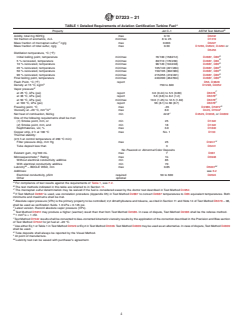
7.1 The aviation turbine fuel shall conform to the requirements prescribed in Table 1.
7.2 Test results shall not exceed the maximum or be less than the minimum values specified in Table 1. No allowance shall be
made for the precision of the test methods. To determine conformance to the specification requirement, a test result may be rounded
to the same number of significant figures as in Table 1 using Practice E29. Where multiple determinations are made, the average
result, rounded according to Practice E29, shall be used.
7.3 If any additives are used, the aviation turbine fuel shall conform to the Table 2 listed requirements.
8. Workmanship, Finish, and Appearance
8.1 The aviation turbine fuel herein specified shall be visually free of undissolved water, sediment, and suspended matter. The odor
of the fuel shall not be nauseating or irritating. No substance of known dangerous toxicity under usual conditions of handling and
use shall be present, except as permitted in this specification.
9. Sampling
9.1 Because of the importance of proper sampling procedures in establishing fuel quality, use the appropriate procedures in
Practice D4057 to obtain a representative sample from the batch of fuel for specification compliance testing. This requirement is
met by producing fuel as a discrete batch then testing it for specification compliance. This requirement is not satisfied by averaging
online analysis results.
9.2 A number of jet fuel properties
...