

ASTM C1656-13(2023)
(Guide)Standard Guide for Measuring the Reactivity of Hydraulic Refractory Castables Using Exothermic Profile
General Information
- Abstract
SIGNIFICANCE AND USE
4.1 The heat of hydration of a calcium aluminate-based castable is liberated over a short period of time (as compared to portland cement). This makes it easy to measure the heat profile using off-the-shelf thermocouple equipment.
4.2 The heat profile can be used to make inferences about the setting and strength gain behavior of a castable and sometimes the working time of a castable.
4.3 Factors that should be controlled when comparing two castables include: size, shape, and mass of cast object, start temperature of the mix, temperature of environment, and the thermal conductivity of the environment. If these factors are held constant, then the two castables’ heat profiles can be compared.
4.4 The temperature increase created by the castable exothermic reaction shall be at least 2.0 °C more than the normal fluctuation of the laboratory temperature so that the time of this increase is easily discernible to the user.
4.5 Varying the amount of cement in the castable, the amount of water, the type and quantity of admixtures, and so forth, will change the shape, maximum temperature, and time to maximum temperature of the curve.
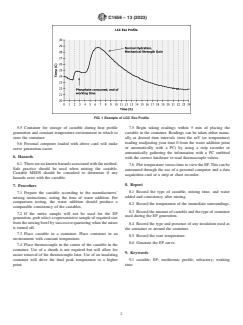
4.6 Following is an example of a curve generated for an LCC (see Fig. 1) that does exhibit two peaks, the first one marking the end of working time. In this curve, one could also infer that the start temperature of the mix was 24 °C and also that the hydraulic strength gain reaction was significantly started, but not completed by 6 h.
FIG. 1 Example of LCC Exo Profile
SCOPE
1.1 This guide applies to all castables with a reactive binder system that produces a measurable heat profile during the setting and hardening process. The majority of these systems will have calcium aluminate cement as one component of the binder system.
1.2 This standard does not purport to address all of the safety concerns, if any, associated with its use. It is the responsibility of the user of this standard to establish appropriate safety, health, and environmental practices and determine the applicability of regulatory limitations prior to use.
1.3 This international standard was developed in accordance with internationally recognized principles on standardization established in the Decision on Principles for the Development of International Standards, Guides and Recommendations issued by the World Trade Organization Technical Barriers to Trade (TBT) Committee.
- Status
- Published
- Publication Date
- 31-Jul-2023
- Technical Committee
- C08 - Refractories
- Drafting Committee
- C08.09 - Monolithics


Overview
ASTM C1656-13(2023) is the Standard Guide for Measuring the Reactivity of Hydraulic Refractory Castables Using Exothermic Profile, developed by ASTM International. This standard provides a methodology for assessing the reactivity of hydraulic refractory castables-primarily those containing calcium aluminate cement-by monitoring the heat evolved during the setting and hardening process. The guide is designed for use with all castables possessing a reactive binder system that yields a measurable heat profile. Understanding the exothermic profile helps professionals infer key performance parameters such as setting behavior, strength gain, and working time, leading to improved quality control and material optimization in industrial refractory applications.
Key Topics
- Heat of Hydration Measurement: The standard details procedures for measuring the short-duration heat evolution of calcium aluminate-based castables, providing valuable insight into the hydration process.
- Exothermic Profile (EP) Analysis: By plotting temperature versus time using thermocouple data, users can generate a characteristic curve reflecting the castable's reactivity.
- Test Variables to Control:
- Size, shape, and mass of the cast object
- Starting temperature of the mix
- Ambient environmental temperature
- Thermal conductivity of the container and its surroundings
- Influence Factors:
- Variations in cement, water, and admixtures affect the exothermic curve's shape, peak temperature, and time to peak.
- Data Capture:
- Use of standard thermocouple equipment
- Manual or automated recording for temperature tracking
- Requirement that the exothermic temperature rise exceeds natural laboratory fluctuations by at least 2.0 °C for clear measurement
Applications
- Quality Assurance for Refractory Castables: ASTM C1656-13(2023) allows manufacturers and users to benchmark the reactivity and setting behavior of different hydraulic castables, ensuring consistency and optimum material performance.
- Comparative Castable Evaluation: Maintaining standardized conditions, castables can be compared based on their exothermic profiles, aiding in product development, mixture optimization, and troubleshooting.
- Process Control in Industrial Installations: Understanding the working time and initial strength development enables better planning for casting schedules, reducing the risk of early failure or improper installation.
- Research and Development: The guide supports R&D efforts by providing a reproducible approach to studying the effects of binder chemistry changes, admixture modifications, and varied processing conditions.
- Documentation and Reporting: Standardized reporting requirements cover material identification, mixing details, ambient and starting temperatures, and equipment used, supporting traceability and regulatory compliance.
Related Standards
Professionals working with ASTM C1656-13(2023) may find the following related ASTM standards valuable:
- ASTM C71: Terminology Relating to Refractories
- ASTM C401: Classification of Alumina and Alumina-Silicate Castable Refractories
- ASTM C862: Practice for Preparing Refractory Concrete Specimens by Casting
Practical Value
By establishing a consistent method for measuring the exothermic profile of hydraulic refractory castables, ASTM C1656-13(2023) supports enhanced quality control, reliable product comparisons, and a better understanding of materials’ hydration kinetics. Use of this guide leads to improved performance, increased safety, and cost-efficiency in refractory installation and maintenance across industries such as steel, cement, and petrochemical processing.
Keywords: ASTM C1656, exothermic profile, refractory castables, calcium aluminate cement, heat of hydration, setting behavior, strength gain, quality control, industrial refractories, castable working time, test standard.
Relations
- Effective Date
- 01-Oct-2018
- Effective Date
- 01-Apr-2012
- Effective Date
- 01-Mar-2012
- Effective Date
- 01-Apr-2008
- Effective Date
- 01-Mar-2008
- Effective Date
- 15-Dec-2007
- Refers
ASTM C401-91(2005) - Standard Classification of Alumina and Alumina-Silicate Castable Refractories - Effective Date
- 01-Dec-2005
- Effective Date
- 10-Nov-2002
- Effective Date
- 10-Dec-2001
- Effective Date
- 10-Dec-2001
- Effective Date
- 10-Dec-2001
- Effective Date
- 10-Dec-2001
- Effective Date
- 10-Feb-2001
- Effective Date
- 10-Feb-2001
- Refers
ASTM C401-91(2000) - Standard Classification of Alumina and Alumina-Silicate Castable Refractories - Effective Date
- 01-Jan-2000
Get Certified
Connect with accredited certification bodies for this standard

DIBt (Deutsches Institut für Bautechnik)
German Institute for Building Technology.
DIN CERTCO
DIN Group product certification.

Aboma Certification B.V.
Specialized in construction, metal, and transport sectors.
Sponsored listings
Frequently Asked Questions
ASTM C1656-13(2023) is a guide published by ASTM International. Its full title is "Standard Guide for Measuring the Reactivity of Hydraulic Refractory Castables Using Exothermic Profile". This standard covers: SIGNIFICANCE AND USE 4.1 The heat of hydration of a calcium aluminate-based castable is liberated over a short period of time (as compared to portland cement). This makes it easy to measure the heat profile using off-the-shelf thermocouple equipment. 4.2 The heat profile can be used to make inferences about the setting and strength gain behavior of a castable and sometimes the working time of a castable. 4.3 Factors that should be controlled when comparing two castables include: size, shape, and mass of cast object, start temperature of the mix, temperature of environment, and the thermal conductivity of the environment. If these factors are held constant, then the two castables’ heat profiles can be compared. 4.4 The temperature increase created by the castable exothermic reaction shall be at least 2.0 °C more than the normal fluctuation of the laboratory temperature so that the time of this increase is easily discernible to the user. 4.5 Varying the amount of cement in the castable, the amount of water, the type and quantity of admixtures, and so forth, will change the shape, maximum temperature, and time to maximum temperature of the curve. 4.6 Following is an example of a curve generated for an LCC (see Fig. 1) that does exhibit two peaks, the first one marking the end of working time. In this curve, one could also infer that the start temperature of the mix was 24 °C and also that the hydraulic strength gain reaction was significantly started, but not completed by 6 h. FIG. 1 Example of LCC Exo Profile SCOPE 1.1 This guide applies to all castables with a reactive binder system that produces a measurable heat profile during the setting and hardening process. The majority of these systems will have calcium aluminate cement as one component of the binder system. 1.2 This standard does not purport to address all of the safety concerns, if any, associated with its use. It is the responsibility of the user of this standard to establish appropriate safety, health, and environmental practices and determine the applicability of regulatory limitations prior to use. 1.3 This international standard was developed in accordance with internationally recognized principles on standardization established in the Decision on Principles for the Development of International Standards, Guides and Recommendations issued by the World Trade Organization Technical Barriers to Trade (TBT) Committee.
SIGNIFICANCE AND USE 4.1 The heat of hydration of a calcium aluminate-based castable is liberated over a short period of time (as compared to portland cement). This makes it easy to measure the heat profile using off-the-shelf thermocouple equipment. 4.2 The heat profile can be used to make inferences about the setting and strength gain behavior of a castable and sometimes the working time of a castable. 4.3 Factors that should be controlled when comparing two castables include: size, shape, and mass of cast object, start temperature of the mix, temperature of environment, and the thermal conductivity of the environment. If these factors are held constant, then the two castables’ heat profiles can be compared. 4.4 The temperature increase created by the castable exothermic reaction shall be at least 2.0 °C more than the normal fluctuation of the laboratory temperature so that the time of this increase is easily discernible to the user. 4.5 Varying the amount of cement in the castable, the amount of water, the type and quantity of admixtures, and so forth, will change the shape, maximum temperature, and time to maximum temperature of the curve. 4.6 Following is an example of a curve generated for an LCC (see Fig. 1) that does exhibit two peaks, the first one marking the end of working time. In this curve, one could also infer that the start temperature of the mix was 24 °C and also that the hydraulic strength gain reaction was significantly started, but not completed by 6 h. FIG. 1 Example of LCC Exo Profile SCOPE 1.1 This guide applies to all castables with a reactive binder system that produces a measurable heat profile during the setting and hardening process. The majority of these systems will have calcium aluminate cement as one component of the binder system. 1.2 This standard does not purport to address all of the safety concerns, if any, associated with its use. It is the responsibility of the user of this standard to establish appropriate safety, health, and environmental practices and determine the applicability of regulatory limitations prior to use. 1.3 This international standard was developed in accordance with internationally recognized principles on standardization established in the Decision on Principles for the Development of International Standards, Guides and Recommendations issued by the World Trade Organization Technical Barriers to Trade (TBT) Committee.
ASTM C1656-13(2023) is classified under the following ICS (International Classification for Standards) categories: 91.100.10 - Cement. Gypsum. Lime. Mortar. The ICS classification helps identify the subject area and facilitates finding related standards.
ASTM C1656-13(2023) has the following relationships with other standards: It is inter standard links to ASTM C71-12(2018), ASTM C71-12, ASTM C401-12, ASTM C71-08, ASTM C862-02(2008), ASTM C71-07, ASTM C401-91(2005), ASTM C862-02, ASTM C71-00a, ASTM C71-01, ASTM C71-01a, ASTM C71-00, ASTM C862-01, ASTM C862-91(1997), ASTM C401-91(2000). Understanding these relationships helps ensure you are using the most current and applicable version of the standard.
ASTM C1656-13(2023) is available in PDF format for immediate download after purchase. The document can be added to your cart and obtained through the secure checkout process. Digital delivery ensures instant access to the complete standard document.
Standards Content (Sample)
This international standard was developed in accordance with internationally recognized principles on standardization established in the Decision on Principles for the
Development of International Standards, Guides and Recommendations issued by the World Trade Organization Technical Barriers to Trade (TBT) Committee.
Designation: C1656 − 13 (Reapproved 2023)
Standard Guide for
Measuring the Reactivity of Hydraulic Refractory Castables
Using Exothermic Profile
This standard is issued under the fixed designation C1656; the number immediately following the designation indicates the year of
original adoption or, in the case of revision, the year of last revision. A number in parentheses indicates the year of last reapproval. A
superscript epsilon (´) indicates an editorial change since the last revision or reapproval.
1. Scope 4. Significance and Use
1.1 This guide applies to all castables with a reactive binder
4.1 The heat of hydration of a calcium aluminate-based
system that produces a measurable heat profile during the castable is liberated over a short period of time (as compared
setting and hardening process. The majority of these systems
to portland cement). This makes it easy to measure the heat
will have calcium aluminate cement as one component of the profile using off-the-shelf thermocouple equipment.
binder system.
4.2 The heat profile can be used to make inferences about
1.2 This standard does not purport to address all of the
the setting and strength gain behavior of a castable and
safety concerns, if any, associated with its use. It is the
sometimes the working time of a castable.
responsibility of the user of this standard to establish appro-
4.3 Factors that should be controlled when comparing two
priate safety, health, and environmental practices and deter-
castables include: size, shape, and mass of cast object, start
mine the applicability of regulatory limitations prior to use.
temperature of the mix, temperature of environment, and the
1.3 This international standard was developed in accor-
thermal conductivity of the environment. If these factors are
dance with internationally recognized principles on standard-
held constant, then the two castables’ heat profiles can be
ization established in the Decision on Principles for the
compared.
Development of International Standards, Guides and Recom-
4.4 The temperature increase created by the castable exo-
mendations issued by the World Trade Organization Technical
thermic reaction shall be at least 2.0 °C more than the normal
Barriers to Trade (TBT) Committee.
fluctuation of the laboratory temperature so that the time of this
2. Referenced Documents increase is easily discernible to the user.
2.1 ASTM Standards: 4.5 Varying the amount of cement in the castable, the
C71 Terminology Relating to Refractories amount of water, the type and quantity of admixtures, and so
C401 Classification of Alumina and Alumina-Silicate forth, will change the shape, maximum temperature, and time
Castable Refractories to maximum temperature of the curve.
C862 Practice for Preparing Refractory Concrete Specimens
4.6 Following is an example of a curve generated for an
by Casting
LCC (see Fig. 1) that does exhibit two peaks, the first one
marking the end of working time. In this curve, one could also
3. Terminology
infer that the start temperature of the mix was 24 °C and also
3.1 Definitions:
that the hydraulic strength gain reaction was significantly
3.1.1 EP – exothermic profile, n—the curve generated by
started, but not completed by 6 h.
plotting temperature of the embedded thermocouple versus
time.
5. Apparatus
3.1.2 LCC, n—low-cement castable.
5.1 Mixing equipment as prescribed in Practice C862.
5.2 Type T thermocouple. (Type J, E, or K is also acceptable
but not preferred due to range of sensitivity. Other types cannot
This guide is under the jurisdiction of ASTM Committee C08 on Refractories
be used.) Wire ends should be joined by solder or welding.
and is the direct responsibility of Subcommittee C08.09 on Monolithics.
Simple twisting is not recommended due to the potential for
Current edition approved Aug. 1, 2023. Published August 2023. Originally
approved in 2007. Last previous edition approved in 2018 as C1656 – 13 (2018).
inaccurate readings.
DOI: 10.1520/C1656-13R23.
For referenced ASTM standards, visit the ASTM website, www.astm.org, or 5.3 Thermocouple sheathing (optional).
con
...