

ASTM C198-09(2019)
(Test Method)Standard Test Method for Cold Bonding Strength of Refractory Mortar
General Information
- Abstract
SIGNIFICANCE AND USE
3.1 The data developed by this test method show the bonding strength and intrinsic strength of different qualities of air-setting mortar. The procedures described in this test method measure the bonding strength and intrinsic strength of air-setting mortars when used with specific brands or lots of refractory brick.
3.2 Note that it is possible to obtain results with these methods for brick and mortar combinations which are incompatible for use at high operating temperatures. The user must determine this compatibility. Only brick and mortar combinations known or intended to be compatible for a particular use should be tested.
3.3 Properties of the brick, including its strength, apparent porosity, and pore size distribution, can affect the measurement of both the bonding strength of the brick-mortar composite and the intrinsic strength of the mortar. The average modulus of rupture of the test brick, as determined by Test Methods C133, should exceed that expected for the mortar being tested. The testing of specific brands or lots of brick and mortar is preferred.
3.4 Three modes of failure are available: the break may occur within the brick itself, at the brick-mortar interface, or within the mortar itself. The latter provides a practical measurement of the strength of the mortar itself and is the predominant mode of failure with the four-point flexure test described. The three-point flexure test measures the failure strength of the brick-mortar composite. Failure within the brick itself suggests that either the particular brick contained a serious flaw, or that the mortar joint strength is of the same magnitude or greater than that of the refractory brick. The mode of failure should always be reported in the final report.
3.5 A ruggedness test for this test method3 performed in 1985 found the following variables to be rugged: specimen size (2.5 to 3.0 in.), mortared surface (cut versus uncut), joint thickness (1/16 to 1/8 in.), pulling of rods (fast versu...
SCOPE
1.1 This test method covers the determination of the bonding strength of air-setting refractory mortar by determining the flexural strength (modulus of rupture) at room temperature of oven-dried brick-mortar joints.
1.2 The values stated in inch-pound units are to be regarded as standard. The values given in parentheses are mathematical conversions to SI units that are provided for information only and are not considered standard.
1.3 This standard does not purport to address all of the safety concerns, if any, associated with its use. It is the responsibility of the user of this standard to establish appropriate safety, health, and environmental practices and determine the applicability of regulatory limitations prior to use.
1.4 This international standard was developed in accordance with internationally recognized principles on standardization established in the Decision on Principles for the Development of International Standards, Guides and Recommendations issued by the World Trade Organization Technical Barriers to Trade (TBT) Committee.
- Status
- Published
- Publication Date
- 31-Mar-2019
- Technical Committee
- C08 - Refractories
- Drafting Committee
- C08.01 - Strength
Overview
ASTM C198-09(2019): Standard Test Method for Cold Bonding Strength of Refractory Mortar defines a reliable procedure for evaluating the bonding strength and intrinsic strength of air-setting (cold-setting) refractory mortar when joined with specific refractory brick. Developed by ASTM International, this standard test method determines the flexural strength, also known as the modulus of rupture, of oven-dried brick-mortar joints at room temperature. The results provide crucial data for understanding the bonding effectiveness of various brick and mortar combinations used in high-temperature industrial applications.
Key Topics
- Bonding Strength Measurement: The standard details how to measure both the bonding strength at the brick-mortar interface and the intrinsic strength of air-setting mortars using flexure testing at room temperature.
- Sample Preparation: Specifies the selection and preparation of mortar and refractory brick samples. Only combinations known or intended to be compatible for a particular use should be tested.
- Modes of Failure:
- Failure within the brick itself
- Failure at the brick-mortar interface
- Failure within the mortar (gives intrinsic mortar strength)
- Testing Methods:
- Three-point flexure test: Measures composite strength of the brick-mortar assembly.
- Four-point flexure test: Predominantly measures strength of the mortar itself.
- Influencing Factors: Identifies properties of the brick (strength, porosity, pore size distribution) as factors that impact test results, highlighting the importance of testing specific brands or lots for accurate compatibility and performance assessment.
- Reporting Requirements: The standard includes guidance for reporting sample identity, testing method, results, and observed mode of failure to ensure transparency and reproducibility.
- Precision and Repeatability: Discusses interlaboratory studies that establish repeatability (within a laboratory) and reproducibility (across laboratories) limits, helping to standardize results interpretation.
Applications
ASTM C198-09(2019) is essential for:
- Quality Control: Ensuring refractory mortar used in manufacturing or repair meets required bonding strength specifications before installation in demanding environments, such as furnaces, kilns, and incinerators.
- Product Development and Material Selection: Assisting manufacturers and engineers in evaluating new air-setting mortar products or comparing the performance of different mortar-brick combinations.
- Specification Compliance: Providing a standardized approach for verifying that mortar and brick combinations conform to project, client, or regulatory requirements for cold bonding strength.
- Research and Development: Supporting laboratories and academic investigators in developing improved refractory materials and understanding the behavior of mortars under various conditions.
- Troubleshooting: Identifying failure modes in existing installations and informing maintenance or replacement strategies.
Related Standards
Several ASTM standards are referenced in and complement ASTM C198-09(2019):
- ASTM C133 - Test Methods for Cold Crushing Strength and Modulus of Rupture of Refractories: Provides methods for assessing the mechanical strength of refractory bricks to ensure suitability for use with mortars in this test.
- ASTM C78/C78M - Test Method for Flexural Strength of Concrete: Offers techniques applicable to flexural strength measurement.
- ASTM C651 - Test Method for Flexural Strength of Manufactured Carbon and Graphite Articles: Presents comparable procedures for four-point loading.
- ASTM E4 - Practices for Force Verification of Testing Machines: Ensures the precision and accuracy of force measurements during testing.
- ASTM E177 - Practice for Use of the Terms Precision and Bias in ASTM Test Methods: Standardizes terminology regarding test precision.
- ASTM E691 - Practice for Conducting an Interlaboratory Study to Determine the Precision of a Test Method: Guides on organizing studies that underpin precision assessments.
By adhering to ASTM C198-09(2019), organizations achieve trustworthy and consistent evaluation of cold bonding strength for refractory mortar, optimizing performance and safety in high-temperature industrial settings.
Relations
- Effective Date
- 01-Apr-2019
- Effective Date
- 01-Apr-2024
- Effective Date
- 01-May-2020
- Effective Date
- 01-Dec-2016
- Effective Date
- 01-Oct-2015
- Effective Date
- 01-May-2015
- Effective Date
- 01-Apr-2015
- Effective Date
- 01-Jun-2014
- Effective Date
- 01-May-2014
- Effective Date
- 01-Oct-2013
- Effective Date
- 01-May-2013
- Effective Date
- 01-May-2013
- Effective Date
- 01-Nov-2011
- Effective Date
- 01-Jun-2011
- Effective Date
- 01-Oct-2010
Get Certified
Connect with accredited certification bodies for this standard

DIBt (Deutsches Institut für Bautechnik)
German Institute for Building Technology.
DIN CERTCO
DIN Group product certification.

Aboma Certification B.V.
Specialized in construction, metal, and transport sectors.
Sponsored listings
Frequently Asked Questions
ASTM C198-09(2019) is a standard published by ASTM International. Its full title is "Standard Test Method for Cold Bonding Strength of Refractory Mortar". This standard covers: SIGNIFICANCE AND USE 3.1 The data developed by this test method show the bonding strength and intrinsic strength of different qualities of air-setting mortar. The procedures described in this test method measure the bonding strength and intrinsic strength of air-setting mortars when used with specific brands or lots of refractory brick. 3.2 Note that it is possible to obtain results with these methods for brick and mortar combinations which are incompatible for use at high operating temperatures. The user must determine this compatibility. Only brick and mortar combinations known or intended to be compatible for a particular use should be tested. 3.3 Properties of the brick, including its strength, apparent porosity, and pore size distribution, can affect the measurement of both the bonding strength of the brick-mortar composite and the intrinsic strength of the mortar. The average modulus of rupture of the test brick, as determined by Test Methods C133, should exceed that expected for the mortar being tested. The testing of specific brands or lots of brick and mortar is preferred. 3.4 Three modes of failure are available: the break may occur within the brick itself, at the brick-mortar interface, or within the mortar itself. The latter provides a practical measurement of the strength of the mortar itself and is the predominant mode of failure with the four-point flexure test described. The three-point flexure test measures the failure strength of the brick-mortar composite. Failure within the brick itself suggests that either the particular brick contained a serious flaw, or that the mortar joint strength is of the same magnitude or greater than that of the refractory brick. The mode of failure should always be reported in the final report. 3.5 A ruggedness test for this test method3 performed in 1985 found the following variables to be rugged: specimen size (2.5 to 3.0 in.), mortared surface (cut versus uncut), joint thickness (1/16 to 1/8 in.), pulling of rods (fast versu... SCOPE 1.1 This test method covers the determination of the bonding strength of air-setting refractory mortar by determining the flexural strength (modulus of rupture) at room temperature of oven-dried brick-mortar joints. 1.2 The values stated in inch-pound units are to be regarded as standard. The values given in parentheses are mathematical conversions to SI units that are provided for information only and are not considered standard. 1.3 This standard does not purport to address all of the safety concerns, if any, associated with its use. It is the responsibility of the user of this standard to establish appropriate safety, health, and environmental practices and determine the applicability of regulatory limitations prior to use. 1.4 This international standard was developed in accordance with internationally recognized principles on standardization established in the Decision on Principles for the Development of International Standards, Guides and Recommendations issued by the World Trade Organization Technical Barriers to Trade (TBT) Committee.
SIGNIFICANCE AND USE 3.1 The data developed by this test method show the bonding strength and intrinsic strength of different qualities of air-setting mortar. The procedures described in this test method measure the bonding strength and intrinsic strength of air-setting mortars when used with specific brands or lots of refractory brick. 3.2 Note that it is possible to obtain results with these methods for brick and mortar combinations which are incompatible for use at high operating temperatures. The user must determine this compatibility. Only brick and mortar combinations known or intended to be compatible for a particular use should be tested. 3.3 Properties of the brick, including its strength, apparent porosity, and pore size distribution, can affect the measurement of both the bonding strength of the brick-mortar composite and the intrinsic strength of the mortar. The average modulus of rupture of the test brick, as determined by Test Methods C133, should exceed that expected for the mortar being tested. The testing of specific brands or lots of brick and mortar is preferred. 3.4 Three modes of failure are available: the break may occur within the brick itself, at the brick-mortar interface, or within the mortar itself. The latter provides a practical measurement of the strength of the mortar itself and is the predominant mode of failure with the four-point flexure test described. The three-point flexure test measures the failure strength of the brick-mortar composite. Failure within the brick itself suggests that either the particular brick contained a serious flaw, or that the mortar joint strength is of the same magnitude or greater than that of the refractory brick. The mode of failure should always be reported in the final report. 3.5 A ruggedness test for this test method3 performed in 1985 found the following variables to be rugged: specimen size (2.5 to 3.0 in.), mortared surface (cut versus uncut), joint thickness (1/16 to 1/8 in.), pulling of rods (fast versu... SCOPE 1.1 This test method covers the determination of the bonding strength of air-setting refractory mortar by determining the flexural strength (modulus of rupture) at room temperature of oven-dried brick-mortar joints. 1.2 The values stated in inch-pound units are to be regarded as standard. The values given in parentheses are mathematical conversions to SI units that are provided for information only and are not considered standard. 1.3 This standard does not purport to address all of the safety concerns, if any, associated with its use. It is the responsibility of the user of this standard to establish appropriate safety, health, and environmental practices and determine the applicability of regulatory limitations prior to use. 1.4 This international standard was developed in accordance with internationally recognized principles on standardization established in the Decision on Principles for the Development of International Standards, Guides and Recommendations issued by the World Trade Organization Technical Barriers to Trade (TBT) Committee.
ASTM C198-09(2019) is classified under the following ICS (International Classification for Standards) categories: 91.100.10 - Cement. Gypsum. Lime. Mortar. The ICS classification helps identify the subject area and facilitates finding related standards.
ASTM C198-09(2019) has the following relationships with other standards: It is inter standard links to ASTM C198-09(2013), ASTM C133-24, ASTM C651-20, ASTM C78/C78M-15b, ASTM C651-15, ASTM C78/C78M-15a, ASTM C78/C78M-15, ASTM E4-14, ASTM E177-14, ASTM C651-13, ASTM E177-13, ASTM E691-13, ASTM E691-11, ASTM C651-11, ASTM E177-10. Understanding these relationships helps ensure you are using the most current and applicable version of the standard.
ASTM C198-09(2019) is available in PDF format for immediate download after purchase. The document can be added to your cart and obtained through the secure checkout process. Digital delivery ensures instant access to the complete standard document.
Standards Content (Sample)
This international standard was developed in accordance with internationally recognized principles on standardization established in the Decision on Principles for the
Development of International Standards, Guides and Recommendations issued by the World Trade Organization Technical Barriers to Trade (TBT) Committee.
Designation: C198 − 09 (Reapproved 2019)
Standard Test Method for
Cold Bonding Strength of Refractory Mortar
This standard is issued under the fixed designation C198; the number immediately following the designation indicates the year of
original adoption or, in the case of revision, the year of last revision. A number in parentheses indicates the year of last reapproval. A
superscript epsilon (´) indicates an editorial change since the last revision or reapproval.
1. Scope Determine the Precision of a Test Method
1.1 This test method covers the determination of the bond-
3. Significance and Use
ing strength of air-setting refractory mortar by determining the
flexural strength (modulus of rupture) at room temperature of 3.1 The data developed by this test method show the
bonding strength and intrinsic strength of different qualities of
oven-dried brick-mortar joints.
air-setting mortar.The procedures described in this test method
1.2 The values stated in inch-pound units are to be regarded
measure the bonding strength and intrinsic strength of air-
as standard. The values given in parentheses are mathematical
setting mortars when used with specific brands or lots of
conversions to SI units that are provided for information only
refractory brick.
and are not considered standard.
3.2 Note that it is possible to obtain results with these
1.3 This standard does not purport to address all of the
methods for brick and mortar combinations which are incom-
safety concerns, if any, associated with its use. It is the
patible for use at high operating temperatures. The user must
responsibility of the user of this standard to establish appro-
determine this compatibility. Only brick and mortar combina-
priate safety, health, and environmental practices and deter-
tions known or intended to be compatible for a particular use
mine the applicability of regulatory limitations prior to use.
should be tested.
1.4 This international standard was developed in accor-
dance with internationally recognized principles on standard- 3.3 Properties of the brick, including its strength, apparent
ization established in the Decision on Principles for the porosity, and pore size distribution, can affect the measurement
Development of International Standards, Guides and Recom- of both the bonding strength of the brick-mortar composite and
mendations issued by the World Trade Organization Technical the intrinsic strength of the mortar. The average modulus of
Barriers to Trade (TBT) Committee. rupture of the test brick, as determined by Test Methods C133,
should exceed that expected for the mortar being tested. The
2. Referenced Documents
testing of specific brands or lots of brick and mortar is
preferred.
2.1 ASTM Standards:
C78/C78M Test Method for Flexural Strength of Concrete
3.4 Three modes of failure are available: the break may
(Using Simple Beam with Third-Point Loading)
occur within the brick itself, at the brick-mortar interface, or
C133 Test Methods for Cold Crushing Strength and Modu-
within the mortar itself. The latter provides a practical mea-
lus of Rupture of Refractories
surement of the strength of the mortar itself and is the
C651 Test Method for Flexural Strength of Manufactured
predominant mode of failure with the four-point flexure test
CarbonandGraphiteArticlesUsingFour-PointLoadingat
described. The three-point flexure test measures the failure
Room Temperature
strengthofthebrick-mortarcomposite.Failurewithinthebrick
E4 Practices for Force Verification of Testing Machines
itself suggests that either the particular brick contained a
E177 Practice for Use of the Terms Precision and Bias in
serious flaw, or that the mortar joint strength is of the same
ASTM Test Methods
magnitude or greater than that of the refractory brick. The
E691 Practice for Conducting an Interlaboratory Study to
mode of failure should always be reported in the final report.
3.5 A ruggedness test for this test method performed in
1985foundthefollowingvariablestoberugged:specimensize
This test method is under the jurisdiction of ASTM Committee C08 on
(2.5 to 3.0 in.), mortared surface (cut versus uncut), joint
Refractories and is the direct responsibility of Subcommittee C08.01 on Strength.
1 1
Current edition approved April 1, 2019. Published April 2019. Originally
thickness ( ⁄16 to ⁄8 in.), pulling of rods (fast versus slow), the
approved in 1945. Last previous edition approved in 2013 as C198 – 09 (2013).
DOI: 10.1520/C0198-09R19.
For referenced ASTM standards, visit the ASTM website, www.astm.org, or
contact ASTM Customer Service at service@astm.org. For Annual Book of ASTM Supporting data have been filed at ASTM International Headquarters and may
Standards volume information, refer to the standard’s Document Summary page on beobtainedbyrequestingResearchReportRR:C08-1008.ContactASTMCustomer
the ASTM website. Service at service@astm.org.
Copyright © ASTM International, 100 Barr Harbor Drive, PO Box C700, West Conshohocken, PA 19428-2959. United States
C198 − 09 (2019)
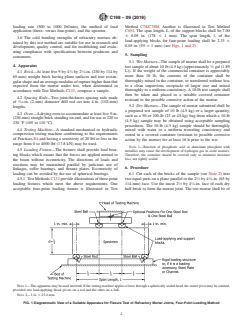
loading rate (500 to 1000 lbf/min), the method of load Method C78/C78M. Another is illustrated in Test Method
application (three- versus four-point), and the operator. C651. The span length, L, of the support blocks shall be 7.00
6 0.05 in. (178 6 1 mm). The span length, l,ofthe
3.6 The cold bonding strengths of refractory mortars ob-
load-applying blocks for four-point loading shall be 2.33 6
tained by this test method are suitable for use in research and
0.05 in. (59 6 1 mm) (see Figs. 1 and 2).
development, quality control, and for establishing and evalu-
ating compliance with specifications between producers and
5. Sampling
consumers.
5.1 Wet Mortars—The sample of mortar shall be a prepared
4. Apparatus 1
test sample of about 10 lb (4.5 kg) (approximately ⁄2 gal (1.89
1 1
L)). If the weight of the commercial container is appreciably
4.1 Brick—At least five 9 by 4 ⁄4 by 2 ⁄2-in. (230 by 114 by
more than 10 lb, the contents of the container shall be
65-mm) straight brick having plane surfaces and true rectan-
thoroughly mixed in the container, or transferred without loss
gular shape and an average modulus of rupture higher than that
to a clean impervious receptacle of larger size and mixed
expected from the mortar under test, when determined in
thoroughly to a uniform consistency. A 10-lb test sample shall
accordance with Test Methods C133, compose a sample.
then be taken and placed in a suitable covered container
4.2 Spacing Rods—Two joint-thickness spacing rods made
resistant to the possible corrosive action of the mortar.
of ⁄16-in. (2-mm) diameter drill rod cut into 4-in. (102-mm)
5.2 Dry Mortars—The sample of mortar submitted shall be
lengths.
a prepared test sample of 10 lb (4.5 kg) or a larger quantity,
4.3 Oven—Adrying oven to accommodate at least five 9-in.
such as a 50 or 100-lb (23 or 45-kg) bag from which a 10-lb
(230-mm) straight brick standing on end, and for use at 220 to
(4.5 kg) sample may be obtained using acceptable sampling
230 °F (105 to 110 °C).
procedures. The 10-lb (4.5 kg) sample should be thoroughly
4.4 Testing Machine—A standard mechanical or hydraulic
mixed with water to a uniform troweling consistency and
compression testing machine conforming to the requirements
stored in a covered container (resistant to possible corrosive
of Practices E4 and having a sensitivity of 20 lbf or less in the
action by the mortar) for at least 16 h prior to the test.
range from 0 to 4000 lbf (17.8 kN) may be used.
NOTE 1—Reaction of phosphoric acid or aluminum phosphate with
4.5 Loading Fixture—The fixtures shall provide load bear- metallics may cause the development of hydrogen gas in some mortars.
Therefore, the container should be covered only to minimize moisture
ing blocks which ensure that the forces are applied normal to
loss, not tightly sealed.
the beam without eccentricity. The directions of loads and
reactions may be maintained parallel by judicious use of
6. Procedure
linkages, roller bearings, and flexure plates. Eccentricity of
loading can be avoided by the use of spherical bearings. 6.1 Cut each of the bricks of the sample (see Note 2) into
1 1
4.5.1 Test Methods C133 provide illustrations of three-point two equal parts on a plane parallel to the 2 ⁄2 by 4 ⁄4-in. (65 by
1 1
loading fixtures which meet the above requirements. One 114-mm) face. Use the uncut 2 ⁄2 by 4 ⁄4-in. face of each dry
acceptable four-point loading fixture is illustrated in Test half-brick to form the mortar joint. The test mortar shall be of
NOTE1—Thisapparatusmaybeusedinverted.Ifthetestingmachineappliesaforcethroughasphericall
...