

ASTM D8397-23
(Specification)Standard Specification for Acrylic and Reactive Adhesives for Installation of Vinyl and Rubber Floor Coverings
General Information
- Abstract
SCOPE
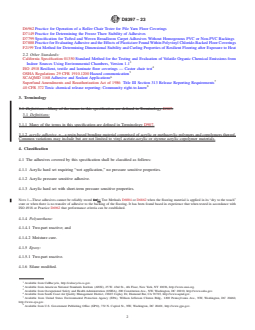
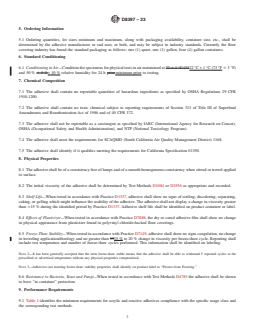
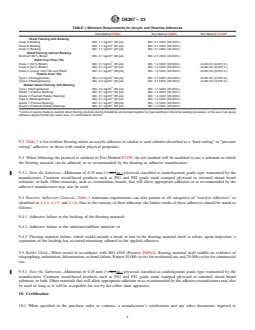
1.1 This specification establishes minimum requirements for adhesives used for the installation of resilient floor coverings, within a climate-controlled structure, when adhered directly and permanently to a structurally sound and recommended substrate.
1.2 This specification will provide the means to determine adhesive bonding as a result of different resilient flooring backing systems used with PVC and rubber flooring materials.
1.3 Adhesives referenced in this specification may also be used for installation of carpets outlined in Specification D7799. Test methods and practices referenced in this specification will provide the means to determine adhesive bonding for PVC backed carpet types, whether classified as broadloom or tile.
1.4 The values stated in SI units are to be regarded as standard. The values given in parentheses after SI units are provided for information only and are not considered standard.
1.5 This standard does not purport to address all of the safety concerns, if any, associated with its use. It is the responsibility of the user of this standard to establish appropriate safety, health, and environmental practices and determine the applicability of regulatory limitations prior to use.
1.6 This international standard was developed in accordance with internationally recognized principles on standardization established in the Decision on Principles for the Development of International Standards, Guides and Recommendations issued by the World Trade Organization Technical Barriers to Trade (TBT) Committee.
- Status
- Published
- Publication Date
- 31-Jul-2023
- Technical Committee
- D14 - Adhesives
- Drafting Committee
- D14.10 - Working Properties
Buy Documents

ASTM D8397-23 - Standard Specification for Acrylic and Reactive Adhesives for Installation of Vinyl and Rubber Floor Coverings
REDLINE ASTM D8397-23 - Standard Specification for Acrylic and Reactive Adhesives for Installation of Vinyl and Rubber Floor Coverings
Overview
ASTM D8397-23 is the international standard specification for acrylic and reactive adhesives used in the installation of vinyl and rubber floor coverings. Published by ASTM International, this specification establishes the minimum physical and performance requirements for adhesives to ensure durable installation of resilient flooring materials, including sheet vinyl, rubber tile, and associated products. The standard also covers the use of these adhesives for specific carpet installations and ensures compliance with key safety and environmental practices.
Key Topics
Adhesive Types Covered:
- Acrylic hard set adhesives
- Acrylic pressure sensitive adhesives
- Acrylic hard set adhesives with short-term pressure sensitive properties
- Polyurethane (two-part reactive, moisture cure)
- Epoxy (two-part reactive)
- Silane modified adhesives
Applications:
- Direct and permanent installation of resilient floor coverings to structurally sound substrates in climate-controlled environments
- Installation of vinyl and rubber sheet and tile flooring
- Use with PVC-backed and non-PVC carpet types as referenced in ASTM D7799
Performance Requirements:
- Establishes minimum bond strengths for adhesives according to floor covering type and backing system
- Specifies testing methods for properties such as shear strength, peel resistance, freeze-thaw stability, viscosity, and resistance to mold and bacteria
- Addresses adhesive performance under dynamic conditions (e.g., roller chair testing for dimensional stability and bond integrity)
Health, Safety, and Environmental Considerations:
- Compliance with OSHA hazard communication
- No reportable carcinogens or hazardous ingredients above regulatory limits
- Adherence to SCAQMD 1168 and California Specification 01350 for low VOC emissions, contributing to indoor air quality
Applications
ASTM D8397-23 is widely applicable across the construction and flooring industries for both commercial and residential projects. The standard guides manufacturers, installers, and specifiers in selecting adhesives that provide:
- Reliable bonding for vinyl and rubber flooring in high-traffic environments, such as schools, healthcare facilities, offices, and public buildings
- Compatibility with a wide variety of substrate types, from underlayment-grade plywood to cementitious boards, ensuring versatile installation options
- Assurance that adhesives have undergone rigorous quality testing for durability, freeze-thaw resistance, and resistance to microbial attack
- Support for indoor environmental quality goals by specifying adhesives with low volatile organic compound (VOC) emissions where required
By adhering to this standard, stakeholders can ensure product consistency, safety, and performance, thus reducing risks of flooring failure and costly repairs.
Related Standards
ASTM D8397-23 references several key related standards to ensure comprehensive quality and compatibility:
- ASTM D907 - Terminology of Adhesives
- ASTM D1084 / D2556 - Test methods for viscosity of adhesives
- ASTM D1337 - Practice for storage life of adhesives
- ASTM D4783 - Resistance to microbial attack
- ASTM D6004 - Determining shear strength of flooring adhesives
- ASTM D6862 - 90-degree peel resistance of adhesives
- ASTM D6962 / ISO 4918 - Castor chair test for flooring durability
- ASTM D7149 - Freeze-thaw stability of adhesives
- ASTM D7888 - Evaluation of plasticizer effects on adhesive films
- ASTM F2199 - Dimensional stability and curling of resilient flooring
- ASTM D7799 - Specification for tufted and woven broadloom carpet adhesives
- California Specification 01350 - Low VOC emissions
- SCAQMD 1168 - South Coast Air Quality Management District rule for adhesives and sealants
- OSHA 29 CFR 1910.1200 - Hazard communication regulations
Keywords: acrylic adhesive, reactive adhesive, vinyl floor installation, rubber flooring adhesive, resilient floor covering, floor adhesive performance, VOC emissions, adhesive bond strength, flooring standards, ASTM D8397
Relations
- Effective Date
- 01-Jan-2024
- Effective Date
- 01-Jun-2020
- Effective Date
- 01-Nov-2018
- Effective Date
- 01-Nov-2018
- Effective Date
- 15-Jul-2018
- Effective Date
- 01-May-2014
- Effective Date
- 01-Mar-2014
- Effective Date
- 15-Oct-2013
- Effective Date
- 01-Jul-2012
- Effective Date
- 15-May-2012
- Effective Date
- 01-May-2012
- Effective Date
- 01-Feb-2012
- Effective Date
- 01-Dec-2011
- Effective Date
- 01-Dec-2011
- Effective Date
- 01-Dec-2011
Buy Documents
ASTM D8397-23 - Standard Specification for Acrylic and Reactive Adhesives for Installation of Vinyl and Rubber Floor Coverings
REDLINE ASTM D8397-23 - Standard Specification for Acrylic and Reactive Adhesives for Installation of Vinyl and Rubber Floor Coverings
Frequently Asked Questions
ASTM D8397-23 is a technical specification published by ASTM International. Its full title is "Standard Specification for Acrylic and Reactive Adhesives for Installation of Vinyl and Rubber Floor Coverings". This standard covers: SCOPE 1.1 This specification establishes minimum requirements for adhesives used for the installation of resilient floor coverings, within a climate-controlled structure, when adhered directly and permanently to a structurally sound and recommended substrate. 1.2 This specification will provide the means to determine adhesive bonding as a result of different resilient flooring backing systems used with PVC and rubber flooring materials. 1.3 Adhesives referenced in this specification may also be used for installation of carpets outlined in Specification D7799. Test methods and practices referenced in this specification will provide the means to determine adhesive bonding for PVC backed carpet types, whether classified as broadloom or tile. 1.4 The values stated in SI units are to be regarded as standard. The values given in parentheses after SI units are provided for information only and are not considered standard. 1.5 This standard does not purport to address all of the safety concerns, if any, associated with its use. It is the responsibility of the user of this standard to establish appropriate safety, health, and environmental practices and determine the applicability of regulatory limitations prior to use. 1.6 This international standard was developed in accordance with internationally recognized principles on standardization established in the Decision on Principles for the Development of International Standards, Guides and Recommendations issued by the World Trade Organization Technical Barriers to Trade (TBT) Committee.
SCOPE 1.1 This specification establishes minimum requirements for adhesives used for the installation of resilient floor coverings, within a climate-controlled structure, when adhered directly and permanently to a structurally sound and recommended substrate. 1.2 This specification will provide the means to determine adhesive bonding as a result of different resilient flooring backing systems used with PVC and rubber flooring materials. 1.3 Adhesives referenced in this specification may also be used for installation of carpets outlined in Specification D7799. Test methods and practices referenced in this specification will provide the means to determine adhesive bonding for PVC backed carpet types, whether classified as broadloom or tile. 1.4 The values stated in SI units are to be regarded as standard. The values given in parentheses after SI units are provided for information only and are not considered standard. 1.5 This standard does not purport to address all of the safety concerns, if any, associated with its use. It is the responsibility of the user of this standard to establish appropriate safety, health, and environmental practices and determine the applicability of regulatory limitations prior to use. 1.6 This international standard was developed in accordance with internationally recognized principles on standardization established in the Decision on Principles for the Development of International Standards, Guides and Recommendations issued by the World Trade Organization Technical Barriers to Trade (TBT) Committee.
ASTM D8397-23 is classified under the following ICS (International Classification for Standards) categories: 97.150 - Floor coverings. The ICS classification helps identify the subject area and facilitates finding related standards.
ASTM D8397-23 has the following relationships with other standards: It is inter standard links to ASTM D6962-24, ASTM F2199-20, ASTM D2556-14(2018), ASTM D7888-18, ASTM F2199-18, ASTM F2199-09(2014), ASTM D2556-14, ASTM D7888-13, ASTM D907-12a, ASTM D7799-12, ASTM D907-12, ASTM D6962-12, ASTM D6862-11, ASTM D2556-11, ASTM D907-11a. Understanding these relationships helps ensure you are using the most current and applicable version of the standard.
ASTM D8397-23 is available in PDF format for immediate download after purchase. The document can be added to your cart and obtained through the secure checkout process. Digital delivery ensures instant access to the complete standard document.
Standards Content (Sample)
This international standard was developed in accordance with internationally recognized principles on standardization established in the Decision on Principles for the
Development of International Standards, Guides and Recommendations issued by the World Trade Organization Technical Barriers to Trade (TBT) Committee.
Designation: D8397 − 23
Standard Specification for
Acrylic and Reactive Adhesives for Installation of Vinyl and
Rubber Floor Coverings
This standard is issued under the fixed designation D8397; the number immediately following the designation indicates the year of
original adoption or, in the case of revision, the year of last revision. A number in parentheses indicates the year of last reapproval. A
superscript epsilon (´) indicates an editorial change since the last revision or reapproval.
1. Scope D1084 Test Methods for Viscosity of Adhesives
D1337 Practice for Storage Life of Adhesives by Viscosity
1.1 This specification establishes minimum requirements
and Bond Strength
for adhesives used for the installation of resilient floor
D2556 Test Method for Apparent Viscosity of Adhesives
coverings, within a climate-controlled structure, when adhered
Having Shear-Rate-Dependent Flow Properties Using Ro-
directly and permanently to a structurally sound and recom-
tational Viscometry
mended substrate.
D4783 Test Methods for Resistance of Adhesive Prepara-
1.2 This specification will provide the means to determine
tions in Container to Attack by Bacteria, Yeast, and Fungi
adhesive bonding as a result of different resilient flooring
D6004 Test Method for Determining Adhesive Shear
backing systems used with PVC and rubber flooring materials.
Strength of Resilient Flooring and Carpet Adhesives
1.3 Adhesives referenced in this specification may also be D6862 Test Method for 90 Degree Peel Resistance of
Adhesives
used for installation of carpets outlined in Specification D7799.
Test methods and practices referenced in this specification will D6962 Practice for Operation of a Roller Chair Tester for
Pile Yarn Floor Coverings
provide the means to determine adhesive bonding for PVC
backed carpet types, whether classified as broadloom or tile. D7149 Practice for Determining the Freeze Thaw Stability
of Adhesives
1.4 The values stated in SI units are to be regarded as
D7799 Specification for Tufted and Woven Broadloom Car-
standard. The values given in parentheses after SI units are
pet Adhesives Without Homogenous PVC or Non-PVC
provided for information only and are not considered standard.
Backings
1.5 This standard does not purport to address all of the
D7888 Practice for Evaluating Adhesive and the Effects of
safety concerns, if any, associated with its use. It is the
Plasticizer Found Within Polyvinyl Chloride-Backed
responsibility of the user of this standard to establish appro-
Floor Coverings
priate safety, health, and environmental practices and deter-
F2199 Test Method for Determining Dimensional Stability
mine the applicability of regulatory limitations prior to use.
and Curling Properties of Resilient Flooring after Expo-
1.6 This international standard was developed in accor-
sure to Heat
dance with internationally recognized principles on standard-
2.2 Other Standards:
ization established in the Decision on Principles for the
California Specification 01350 Standard Method for the
Development of International Standards, Guides and Recom-
Testing and Evaluation of Volatile Organic Chemical
mendations issued by the World Trade Organization Technical
Emissions from Indoor Sources Using Environmental
Barriers to Trade (TBT) Committee.
Chambers, Version 1.1
ISO 4918 Resilient, textile and laminate floor coverings —
2. Referenced Documents
Castor chair test
2.1 ASTM Standards:
OSHA Regulations 29 CFR 1910.1200 Hazard communica-
D907 Terminology of Adhesives
tion
SCAQMD 1168 Adhesive and Sealant Applications
This specification is under the jurisdiction of ASTM Committee D14 on
Adhesives and is the direct responsibility of Subcommittee D14.10 on Working
Properties.
Current edition approved Aug. 1, 2023. Published August 2023. Originally Available from CalRecycle, http://calrecycle.ca.gov.
approved in 2022. Last previous edition approved in 2022 as D8397 – 22. DOI: Available from American National Standards Institute (ANSI), 25 W. 43rd St.,
10.1520/D8397-23. 4th Floor, New York, NY 10036, http://www.ansi.org.
2 5
For referenced ASTM standards, visit the ASTM website, www.astm.org, or Available from Occupational Safety and Health Administration (OSHA), 200
contact ASTM Customer Service at service@astm.org. For Annual Book of ASTM Constitution Ave., NW, Washington, DC 20210, http://www.osha.gov.
Standards volume information, refer to the standard’s Document Summary page on Available from South Coast Air Quality Management District, 21865 Copley
the ASTM website. Dr, Diamond Bar, CA 91765, http://www.aqmd.gov.
Copyright © ASTM International, 100 Barr Harbor Drive, PO Box C700, West Conshohocken, PA 19428-2959. United States
D8397 − 23
Superfund Amendments and Reauthorization Act of 1986 7.2 The adhesive shall contain no toxic chemical subject to
Title III Section 313 Release Reporting Requirements reporting requirements of Section 313 of Title III of Superfund
40 CFR 372 Toxic chemical release reporting: Community Amendments and Reauthorization Act of 1986 and of 40 CFR
right-to-know 372.
7.3 The adhesive shall not be reportable as a carcinogen as
3. Terminology
specified by IARC (International Agency for Research on
3.1 Definitions:
Cancer), OSHA (Occupational Safety and Health
3.1.1 Many of the terms in this specification are defined in
Administration), and NTP (National Toxicology Program).
Terminology D907.
7.4 The adhesive shall meet the requirements for SCAQMD
3.1.2 acrylic adhesive, n—a resin-based bonding material
(South California Air Quality Management District) 1168.
comprised of acrylic or methacrylic polymers and copolymers
thereof. Common variations may include but are not limited to
7.5 The adhesive shall identify if it qualifies meeting the
vinyl acetate-acrylic or styrene acrylic copolymer materials.
requirements for California Specification 01350.
4. Classification
8. Physical Properties
4.1 The adhesives covered by this specification shall be
8.1 The adhesive shall be of a consistency free of lumps and
classified as follows:
of a smooth homogeneous consistency when stirred or trowel
4.1.1 Acrylic hard set requiring “wet application,” no pres-
applied to surface.
sure sensitive properties.
8.2 The initial viscosity of the adhesive shall be determined
4.1.2 Acrylic pressure sensitive adhesive.
by Test Methods D1084 or D2556 as appropriate and recorded.
4.1.3 Acrylic hard set with short-term pressure sensitive
properties.
8.3 Shelf Life—When tested in accordance with Practice
D1337, adhesive shall show no signs of settling, discoloring,
NOTE 1—These adhesives cannot be reliably tested by Test Methods
separating, caking, or gelling which might influence the
D6004 or D6862 when the flooring material is applied in its “dry to the
touch” state or when there is no transfer of adhesive to the backing of the
usability of the adhesive. The adhesive shall not display a
flooring. It has been found based in experience that when tested in
change in viscosity greater than 615 % during the identified
accordance with ISO 4918 or Practice D6962 that performance criteria can
period by Practice D1337. Adhesive shelf life shall be identi-
be established.
fied on product container or label.
4.1.4 Polyurethane:
8.4 Effects of Plasticizer—When tested in accordance with
4.1.4.1 Two-part reactive; and
Practice D7888, the dry or cured adhesive film shall show no
4.1.4.2 Moisture cure.
change in physical appearance from plasticizer found in
4.1.5 Epoxy:
polyvinyl chloride-backed floor coverings.
4.1.5.1 Two-part reactive.
4.1.6 Silane modified.
8.5 Freeze-Thaw Stability—When tested in accordance with
Practice D7149, adhesive shall show no signs coagulation, no
5. Ordering Information
change in troweling application/rheology and no greater than
5.1 Ordering quantities, lot sizes minimum and maximum,
15 % to 20 % change in viscosity per freeze-thaw cycle.
along with packaging availability, container size, etc., shall be Reporting shall include test temperature and number of freeze-
determined by the adhesive manufacturer or end user, or b
...
This document is not an ASTM standard and is intended only to provide the user of an ASTM standard an indication of what changes have been made to the previous version. Because
it may not be technically possible to adequately depict all changes accurately, ASTM recommends that users consult prior editions as appropriate. In all cases only the current version
of the standard as published by ASTM is to be considered the official document.
Designation: D8397 − 22 D8397 − 23
Standard Specification for
Acrylic and Reactive Adhesives for Installation of Vinyl and
Rubber Floor Coverings
This standard is issued under the fixed designation D8397; the number immediately following the designation indicates the year of
original adoption or, in the case of revision, the year of last revision. A number in parentheses indicates the year of last reapproval. A
superscript epsilon (´) indicates an editorial change since the last revision or reapproval.
1. Scope
1.1 This specification establishes minimum requirements for adhesives used for the installation of resilient floor coverings, within
a climate-controlled structure, when adhered directly and permanently to a structurally sound and recommended substrate.
1.2 This specification will provide the means to determine adhesive bonding as a result of different resilient flooring backing
systems used with PVC and rubber flooring materials.
1.3 Adhesives referenced in this specification may also be used for installation of carpets outlined in Specification D7799. Test
methods and practices referenced in this specification will provide the means to determine adhesive bonding for PVC backed carpet
types, whether classified as broadloom or tile.
1.4 The values stated in SI units are to be regarded as standard. The values given in parentheses after SI units are provided for
information only and are not considered standard.
1.5 This standard does not purport to address all of the safety concerns, if any, associated with its use. It is the responsibility
of the user of this standard to establish appropriate safety, health, and environmental practices and determine the applicability of
regulatory limitations prior to use.
1.6 This international standard was developed in accordance with internationally recognized principles on standardization
established in the Decision on Principles for the Development of International Standards, Guides and Recommendations issued
by the World Trade Organization Technical Barriers to Trade (TBT) Committee.
2. Referenced Documents
2.1 ASTM Standards:
D907 Terminology of Adhesives
D1084 Test Methods for Viscosity of Adhesives
D1337 Practice for Storage Life of Adhesives by Viscosity and Bond Strength
D2556 Test Method for Apparent Viscosity of Adhesives Having Shear-Rate-Dependent Flow Properties Using Rotational
Viscometry
D4783 Test Methods for Resistance of Adhesive Preparations in Container to Attack by Bacteria, Yeast, and Fungi
D6004 Test Method for Determining Adhesive Shear Strength of Resilient Flooring and Carpet Adhesives
D6862 Test Method for 90 Degree Peel Resistance of Adhesives
This specification is under the jurisdiction of ASTM Committee D14 on Adhesives and is the direct responsibility of Subcommittee D14.10 on Working Properties.
Current edition approved May 1, 2022Aug. 1, 2023. Published May 2022August 2023. Originally approved in 2022. Last previous edition approved in 2022 as D8397 – 22.
DOI: 10.1520/D8397-22.10.1520/D8397-23.
For referenced ASTM standards, visit the ASTM website, www.astm.org, or contact ASTM Customer Service at service@astm.org. For Annual Book of ASTM Standards
volume information, refer to the standard’s Document Summary page on the ASTM website.
Copyright © ASTM International, 100 Barr Harbor Drive, PO Box C700, West Conshohocken, PA 19428-2959. United States
D8397 − 23
D6962 Practice for Operation of a Roller Chair Tester for Pile Yarn Floor Coverings
D7149 Practice for Determining the Freeze Thaw Stability of Adhesives
D7799 Specification for Tufted and Woven Broadloom Carpet Adhesives Without Homogenous PVC or Non-PVC Backings
D7888 Practice for Evaluating Adhesive and the Effects of Plasticizer Found Within Polyvinyl Chloride-Backed Floor Coverings
F2199 Test Method for Determining Dimensional Stability and Curling Properties of Resilient Flooring after Exposure to Heat
2.2 Other Standards:
California Specification 01350 Standard Method for the Testing and Evaluation of Volatile Organic Chemical Emissions from
Indoor Sources Using Environmental Chambers, Version 1.1
ISO 4918 Resilient, textile and laminate floor coverings — Castor chair test
OSHA Regulations 29 CFR 1910.1200 Hazard communication
SCAQMD 1168 Adhesive and Sealant Applications
Superfund Amendments and Reauthorization Act of 1986 Title III Section 313 Release Reporting Requirements
40 CFR 372 Toxic chemical release reporting: Community right-to-know
3. Terminology
3.1 Definitions—Many of the terms in this specification are defined in Terminology D907.
3.1 Definitions:
3.1.1 Many of the terms in this specification are defined in Terminology D907.
3.1.2 acrylic adhesive, n—a resin-based bonding material comprised of acrylic or methacrylic polymers and copolymers thereof.
Common variations may include but are not limited to vinyl acetate-acrylic or styrene acrylic copolymer materials.
4. Classification
4.1 The adhesives covered by this specification shall be classified as follows:
4.1.1 Acrylic hard set requiring “wet application,” no pressure sensitive properties.
4.1.2 Acrylic pressure sensitive adhesive.
4.1.3 Acrylic hard set with short-term pressure sensitive properties.
NOTE 1—These adhesives cannot be reliably tested forby Test Methods D6004 or D6862 when the flooring material is applied in its “dry to the touch”
state or when there is no transfer of adhesive to the backing of the flooring. It has been found based in experience that when tested in accordance with
ISO 4918 or Practice D6962 that performance criteria can be established.
4.1.4 Polyurethane:
4.1.4.1 Two-part reactive; and
4.1.4.2 Moisture cure.
4.1.5 Epoxy:
4.1.5.1 Two-part reactive.
4.1.6 Silane modified.
Available from CalRecycle, http://calrecycle.ca.gov.
Available from American National Standards Institute (ANSI), 25 W. 43rd St., 4th Floor, New York, NY 10036, http://www.ansi.org.
Available from Occupational Safety and Health Administration (OSHA), 200 Constitution Ave., NW, Washington, DC 20210, http://www.osha.gov.
Available from South Coast Air Quality Management District, 21865 Copley Dr, Diamond Bar, CA 91765, http://www.aqmd.gov.
Available from United States Environmental Protection Agency (EPA), William Jefferson Clinton Bldg., 1200 Pennsylvania Ave., NW, Washington, DC 20460,
http://www.epa.gov.
Available from U.S. Government Publishing Office (GPO), 732 N. Capitol St., NW, Washington, DC 20401, http://www.gpo.gov.
D8397 − 23
5. Ordering Information
5.1 Ordering quantities, lot sizes minimum and maximum, along with packaging availability, container size, etc., shall be
determined by the adhesive manufacturer or end user, or both, and may be subject to industry standards. Currently the floor
covering industry has found the standard packaging as follows: one (1) quart, one (1) gallon, four (4) gallon containers.
6. Standard Conditioning
6.1 Conditioning in Air—Condition the specimens for physical tests in air maintained at 22 6 1 °C (7322 °C + 1 °C (73 °F 6 3 °F)
and 50 % 6 5 %+ 10 % relative humidity for 24 h prior minimum prior to testing.
7. Chemical Composition
7.1 The adhesive shall contain no reportable quantities of hazardous ingredients as specified by OSHA Regulations 29 CFR
1910.1200.
7.2 The adhesive shall contain no toxic chemical subject to reporting requirements of Section 313 of Title III of Superfund
Amendments and Reauthorization Act of 1986 and of 40 CFR 372.
7.3 The adhesive shall not be reportable as a carcinogen as specified by IARC (International Agency for Research on Cancer),
OSHA (Occupational Safety and Health Administration), and NTP (National Toxicology Program).
7.4 The adhesive shall meet the requirements for SCAQMD (South California Air Quality Management District) 1168.
7.5 The adhesive shall identify if it qualifies meeting the requirements for California Specification 01350.
8. Physical Properties
8.1 The adhesive shall be of a consistency free of lumps and of a smooth homogeneous consistency when stirred or trowel applied
to surface.
8.2 The ini
...