

ASTM D6004-21
(Test Method)Standard Test Method for Determining Adhesive Shear Strength of Resilient Flooring and Carpet Adhesives
General Information
- Abstract
SIGNIFICANCE AND USE
4.1 In selecting or developing a resilient flooring or carpet adhesive, it is critical to have knowledge regarding how well the adhesive will bond to the desired substrate. Shear loading simulates a common failure mode.
4.2 The test method determines the failure shear load for the test adhesive and specific substrate combination.
SCOPE
1.1 This test method describes a procedure to measure shear strength development for adhesives used to bond resilient flooring and carpet to selected substrates.
1.2 This test method provides a quantitative means of measuring and recording shear strength of the adhesive when it is applied to the desired substrate.
1.3 The values stated in inch-pound units are to be regarded as standard. The values given in parentheses are mathematical conversions to SI units that are provided for information only and are not considered standard.
1.4 This standard does not purport to address all of the safety concerns, if any, associated with its use. It is the responsibility of the user of this standard to establish appropriate safety, health, and environmental practices and determine the applicability of regulatory limitations prior to use.
1.5 This international standard was developed in accordance with internationally recognized principles on standardization established in the Decision on Principles for the Development of International Standards, Guides and Recommendations issued by the World Trade Organization Technical Barriers to Trade (TBT) Committee.
- Status
- Published
- Publication Date
- 31-Mar-2021
- Technical Committee
- D14 - Adhesives
- Drafting Committee
- D14.70 - Construction Adhesives
Buy Documents
ASTM D6004-21 - Standard Test Method for Determining Adhesive Shear Strength of Resilient Flooring and Carpet Adhesives
REDLINE ASTM D6004-21 - Standard Test Method for Determining Adhesive Shear Strength of Resilient Flooring and Carpet Adhesives
Overview
ASTM D6004-21: Standard Test Method for Determining Adhesive Shear Strength of Resilient Flooring and Carpet Adhesives specifies a quantitative procedure to evaluate how well adhesives bond resilient flooring and carpet to various substrates. This widely referenced ASTM International standard helps manufacturers, product specifiers, and installers assess adhesive performance under shear loading conditions-a primary mode of potential adhesive joint failure in flooring applications.
By simulating real-world stresses, this method provides actionable data on the adhesive's shear strength and its compatibility with selected flooring and underlayment materials. ASTM D6004-21 is crucial for ensuring reliable, durable installations in commercial and residential environments.
Key Topics
- Shear Strength Measurement: The standard outlines precise steps to measure the shear strength of adhesives when bonding resilient flooring or carpet to specific substrates, including specimen preparation, conditioning, and test execution.
- Reproducibility and Precision: The method provides for repeatability and reproducibility, with clear data reporting for tensile shear strength. Laboratories can compare results and benchmark adhesive products reliably.
- Material and Substrate Details: The standard specifies types of adhesives, substrates (such as plywood and oriented strand board), test samples, and preparation methods.
- Procedural Consistency: Conditioning requirements, application tools, and test procedures are standardized, allowing for consistent results across different settings.
- Reporting Requirements: The method details what data to report, such as adhesive and substrate types, trowel notch size, open time, and measured shear strength.
Applications
ASTM D6004-21 is essential for stakeholders throughout the flooring industry:
- Adhesive Manufacturers: Use the standard to validate the shear strength of new adhesive formulations or to assess quality across production batches.
- Flooring and Carpet Installers: Rely on test data to select adhesives with proven strength for specific combinations of resilient flooring or carpet and substrates, minimizing risk of bond failure.
- Product Specifiers and Quality Assurance Teams: Reference this standard in project documentation to ensure reliable adhesive selection, especially for environments where high shear loads are expected, such as high-traffic commercial spaces.
- Research and Development: Laboratories and R&D professionals use ASTM D6004-21 to benchmark new products or underlayment systems and verify compliance with industry expectations.
The standard directly supports best practices in flooring adhesives testing, enhancing product reliability and safety in the built environment.
Related Standards
For a comprehensive approach to adhesive strength and flooring quality, consider these related ASTM and industry standards:
- ASTM D907 - Terminology of Adhesives
- ASTM D8089 - Practice for Accelerated Heat Aging for Floor Covering Adhesives
- ASTM E4 - Practices for Force Verification of Testing Machines
- ASTM E177 - Practice for Use of the Terms Precision and Bias in ASTM Test Methods
- PS1 - Voluntary Product Standard for Construction and Industrial Plywood
- PS2 - Voluntary Product Standard for Structural Use Panels
Referencing these standards together with ASTM D6004-21 ensures robust testing, consistent reporting, and higher confidence in flooring performance.
Keywords: adhesive shear strength, resilient flooring adhesives, carpet adhesives, ASTM D6004, flooring bond performance, substrate adhesion, flooring installation standards.
Relations
- Effective Date
- 15-Nov-2017
- Effective Date
- 01-Jun-2014
- Effective Date
- 01-May-2014
- Effective Date
- 01-May-2013
- Effective Date
- 01-Jul-2012
- Effective Date
- 01-May-2012
- Effective Date
- 01-Dec-2011
- Effective Date
- 01-Jan-2011
- Effective Date
- 01-Oct-2010
- Effective Date
- 01-Jun-2010
- Effective Date
- 01-Nov-2009
- Effective Date
- 01-Apr-2009
- Effective Date
- 01-Dec-2008
- Effective Date
- 01-Oct-2008
- Effective Date
- 01-Oct-2008
Buy Documents
ASTM D6004-21 - Standard Test Method for Determining Adhesive Shear Strength of Resilient Flooring and Carpet Adhesives
REDLINE ASTM D6004-21 - Standard Test Method for Determining Adhesive Shear Strength of Resilient Flooring and Carpet Adhesives
Frequently Asked Questions
ASTM D6004-21 is a standard published by ASTM International. Its full title is "Standard Test Method for Determining Adhesive Shear Strength of Resilient Flooring and Carpet Adhesives". This standard covers: SIGNIFICANCE AND USE 4.1 In selecting or developing a resilient flooring or carpet adhesive, it is critical to have knowledge regarding how well the adhesive will bond to the desired substrate. Shear loading simulates a common failure mode. 4.2 The test method determines the failure shear load for the test adhesive and specific substrate combination. SCOPE 1.1 This test method describes a procedure to measure shear strength development for adhesives used to bond resilient flooring and carpet to selected substrates. 1.2 This test method provides a quantitative means of measuring and recording shear strength of the adhesive when it is applied to the desired substrate. 1.3 The values stated in inch-pound units are to be regarded as standard. The values given in parentheses are mathematical conversions to SI units that are provided for information only and are not considered standard. 1.4 This standard does not purport to address all of the safety concerns, if any, associated with its use. It is the responsibility of the user of this standard to establish appropriate safety, health, and environmental practices and determine the applicability of regulatory limitations prior to use. 1.5 This international standard was developed in accordance with internationally recognized principles on standardization established in the Decision on Principles for the Development of International Standards, Guides and Recommendations issued by the World Trade Organization Technical Barriers to Trade (TBT) Committee.
SIGNIFICANCE AND USE 4.1 In selecting or developing a resilient flooring or carpet adhesive, it is critical to have knowledge regarding how well the adhesive will bond to the desired substrate. Shear loading simulates a common failure mode. 4.2 The test method determines the failure shear load for the test adhesive and specific substrate combination. SCOPE 1.1 This test method describes a procedure to measure shear strength development for adhesives used to bond resilient flooring and carpet to selected substrates. 1.2 This test method provides a quantitative means of measuring and recording shear strength of the adhesive when it is applied to the desired substrate. 1.3 The values stated in inch-pound units are to be regarded as standard. The values given in parentheses are mathematical conversions to SI units that are provided for information only and are not considered standard. 1.4 This standard does not purport to address all of the safety concerns, if any, associated with its use. It is the responsibility of the user of this standard to establish appropriate safety, health, and environmental practices and determine the applicability of regulatory limitations prior to use. 1.5 This international standard was developed in accordance with internationally recognized principles on standardization established in the Decision on Principles for the Development of International Standards, Guides and Recommendations issued by the World Trade Organization Technical Barriers to Trade (TBT) Committee.
ASTM D6004-21 is classified under the following ICS (International Classification for Standards) categories: 97.150 - Floor coverings. The ICS classification helps identify the subject area and facilitates finding related standards.
ASTM D6004-21 has the following relationships with other standards: It is inter standard links to ASTM D8089-17, ASTM E4-14, ASTM E177-14, ASTM E177-13, ASTM D907-12a, ASTM D907-12, ASTM D907-11a, ASTM D907-11, ASTM E177-10, ASTM E4-10, ASTM E4-09a, ASTM E4-09, ASTM E4-08, ASTM E177-08, ASTM D907-08b. Understanding these relationships helps ensure you are using the most current and applicable version of the standard.
ASTM D6004-21 is available in PDF format for immediate download after purchase. The document can be added to your cart and obtained through the secure checkout process. Digital delivery ensures instant access to the complete standard document.
Standards Content (Sample)
This international standard was developed in accordance with internationally recognized principles on standardization established in the Decision on Principles for the
Development of International Standards, Guides and Recommendations issued by the World Trade Organization Technical Barriers to Trade (TBT) Committee.
Designation: D6004 − 21
Standard Test Method for
Determining Adhesive Shear Strength of Resilient Flooring
and Carpet Adhesives
This standard is issued under the fixed designation D6004; the number immediately following the designation indicates the year of
original adoption or, in the case of revision, the year of last revision.Anumber in parentheses indicates the year of last reapproval.A
superscript epsilon (´) indicates an editorial change since the last revision or reapproval.
1. Scope 2.2 Voluntary Product Standards:
PS1Construction and Industrial Plywood
1.1 Thistestmethoddescribesaproceduretomeasureshear
PS2Structural Use Panels
strength development for adhesives used to bond resilient
flooring and carpet to selected substrates.
3. Terminology
1.2 This test method provides a quantitative means of
3.1 Definitions—Many of the terms in this test method are
measuringandrecordingshearstrengthoftheadhesivewhenit
defined in Terminology D907.
is applied to the desired substrate.
1.3 The values stated in inch-pound units are to be regarded
4. Significance and Use
as standard. The values given in parentheses are mathematical
4.1 In selecting or developing a resilient flooring or carpet
conversions to SI units that are provided for information only
adhesive, it is critical to have knowledge regarding how well
and are not considered standard.
the adhesive will bond to the desired substrate. Shear loading
1.4 This standard does not purport to address all of the
simulates a common failure mode.
safety concerns, if any, associated with its use. It is the
4.2 Thetestmethoddeterminesthefailureshearloadforthe
responsibility of the user of this standard to establish appro-
test adhesive and specific substrate combination.
priate safety, health, and environmental practices and deter-
mine the applicability of regulatory limitations prior to use.
5. Apparatus
1.5 This international standard was developed in accor-
dance with internationally recognized principles on standard-
5.1 Applicator Trowel—Use trowel notching as recom-
ization established in the Decision on Principles for the
mended by flooring manufacturer or appropriate.
Development of International Standards, Guides and Recom-
5.2 Three 10-lb (4.54-kg) weight equivalents.
mendations issued by the World Trade Organization Technical
5.3 Three 2×3-in. (51×76 mm) sections of substrate for
Barriers to Trade (TBT) Committee.
dead weight distribution.
2. Referenced Documents
5.4 Floor covering seam roller or similar type.
2.1 ASTM Standards:
5.5 Convection Oven, capable of maintaining a temperature
D907Terminology of Adhesives
of 122 6 2°F (50 6 1°C).
D8089Practice for Accelerated Heat Aging for Floor Cov-
5.6 Calibrated Universal Testing Machine, capable of a
ering Adhesives
controlled application of force with a force measurement
E4Practices for Force Verification of Testing Machines
accuracy of 61% when calibrated in compliance with Prac-
E177Practice for Use of the Terms Precision and Bias in
tices E4 requirements.
ASTM Test Methods
6. Materials
6.1 Adhesive—Any appropriate adhesive for resilient floor-
This test method is under the jurisdiction of ASTM Committee D14 on
Adhesives and is the direct responsibility of Subcommittee D14.70 on Construction ing or carpet installation.
Adhesives
6.2 Duck Cloth—Natural, untreated, #10, 14.73 oz.
Current edition approved April 1, 2021. Published April 2021. Originally
approved in 1996. Last previous edition approved in 2020 as D6004–20. DOI:
10.1520/D6004-21.
For referenced ASTM standards, visit the ASTM website, www.astm.org, or
contact ASTM Customer Service at service@astm.org. For Annual Book of ASTM Available from Standardization Documents Order Desk, DODSSP, Bldg. 4,
Standards volume information, refer to the standard’s Document Summary page on Section D, 700 Robbins Ave., Philadelphia, PA 19111-5098, http://
the ASTM website. dodssp.daps.dla.mil.
Copyright © ASTM International, 100 Barr Harbor Drive, PO Box C700, West Conshohocken, PA 19428-2959. United States
D6004 − 21
6.3 Substrate—Minimum of ⁄4-in. (6.35-mm) plywood 9.1.2 Wait10minandplacethreepiecesofcarpetspecimen
classified as flooring substrate type warrantied by the manu- perpendicular to the trowel pattern, each covering a 6-in. or
facturer. Common wood-based products such as PS2 grade
3×2-in. (38.7 cm or 51×76 mm) area of the adhesive (Fig.
mark stamped oriented strand board substrate or PS1 grade
1).
mark stamped plywood substrate. Other products, recom-
9.1.3 Placea2×3-in.(51×76mm)substratesectionontop
mended by the adhesive manufacturer may also be used.
of each carpet specimen for dead weight distribution (Fig. 2).
6.4 Flooring Material—As recommended by manufacturer.
9.1.4 Place a 10-lb weight on each 2×3-in. (51×76 mm)
dead weight distribution substrate section. Follow manufactur-
7. Conditioning
er’s recommendations for bonding and installation.
7.1 Condition the duck cloth, underlayment and adhesive to
9.1.5 Remove the weights and the dead weight substrate
be tested for 24 h at 73 6 3°F (23 6 2°C) and 50% 65%
sections from the test panel.
relative humidity prior to testing.
9.1.6 Allow the test panel to dry 24 h at 73 6 3°F (22 6
1°C) and 50 6 5% relative humidity.
8. Sample Preparation
9.1.7 Place the test panel in a 122°F (50°C) oven for 72 h.
8.1 Carpet:
9.1.8 Remove the test panel from the oven and allow it to
8.1.1 Cut the carpet to be tested into three 2×6-in.
cool at 73 6 3°F (22 6 1°C) and 50 6 5 % relative humidity
(51×127-mm) pieces.
for3h.
8.1.2 Cut one section of substrate into a 16 × 5-in.
(406×127-mm) section. 9.1.9 Test the specimens in tension shear using a calibrated
universaltestingmachine,aligningtheupperandlowerjawsas
8.2 Resilient Flooring:
pe
...
This document is not an ASTM standard and is intended only to provide the user of an ASTM standard an indication of what changes have been made to the previous version. Because
it may not be technically possible to adequately depict all changes accurately, ASTM recommends that users consult prior editions as appropriate. In all cases only the current version
of the standard as published by ASTM is to be considered the official document.
Designation: D6004 − 20 D6004 − 21
Standard Test Method for
Determining Adhesive Shear Strength of Resilient Flooring
and Carpet Adhesives
This standard is issued under the fixed designation D6004; the number immediately following the designation indicates the year of
original adoption or, in the case of revision, the year of last revision. A number in parentheses indicates the year of last reapproval. A
superscript epsilon (´) indicates an editorial change since the last revision or reapproval.
1. Scope
1.1 This test method describes a procedure to measure shear strength development for adhesives used to bond resilient flooring
and carpet adhesives to selected substrates.
1.2 This test method provides a quantitative means of measuring and recording shear strength of the adhesive when it is applied
to the desired substrate.
1.3 The values stated in inch-pound units are to be regarded as standard. The values given in parentheses are mathematical
conversions to SI units that are provided for information only and are not considered standard.
1.4 This standard does not purport to address all of the safety concerns, if any, associated with its use. It is the responsibility
of the user of this standard to establish appropriate safety, health, and environmental practices and determine the applicability of
regulatory limitations prior to use.
1.5 This international standard was developed in accordance with internationally recognized principles on standardization
established in the Decision on Principles for the Development of International Standards, Guides and Recommendations issued
by the World Trade Organization Technical Barriers to Trade (TBT) Committee.
2. Referenced Documents
2.1 ASTM Standards:
D907 Terminology of Adhesives
D8089 Practice for Accelerated Heat Aging for Floor Covering Adhesives
E4 Practices for Force Verification of Testing Machines
E177 Practice for Use of the Terms Precision and Bias in ASTM Test Methods
2.2 Voluntary Product Standards:
PS1 Construction and Industrial Plywood
PS2 Structural Use Panels
3. Terminology
3.1 Definitions—Many of the terms in this test method are defined in Terminology D907.
This test method is under the jurisdiction of ASTM Committee D14 on Adhesives and is the direct responsibility of Subcommittee D14.70 on Construction Adhesives
Current edition approved July 1, 2020April 1, 2021. Published August 2020April 2021. Originally approved in 1996. Last previous edition approved in 20112020 as
D6004 – 04 (2011)D6004 – 20. which was withdrawn January 2020 and reinstated in July 2020. DOI: 10.1520/D6004-20.DOI: 10.1520/D6004-21.
For referenced ASTM standards, visit the ASTM website, www.astm.org, or contact ASTM Customer Service at service@astm.org. For Annual Book of ASTM Standards
volume information, refer to the standard’s Document Summary page on the ASTM website.
Available from Standardization Documents Order Desk, DODSSP, Bldg. 4, Section D, 700 Robbins Ave., Philadelphia, PA 19111-5098, http://dodssp.daps.dla.mil.
Copyright © ASTM International, 100 Barr Harbor Drive, PO Box C700, West Conshohocken, PA 19428-2959. United States
D6004 − 21
4. Significance and Use
4.1 In selecting or developing a resilient flooring or carpet adhesive, it is critical to have knowledge regarding how well the
adhesive will bond to the desired substrate. Shear loading simulates a common failure mode.
4.2 The test method determines the failure shear load for the test adhesive and specific substrate combination.
5. Apparatus
5.1 Applicator Trowel—Use trowel notching as recommended by flooring manufacturer or appropriate.
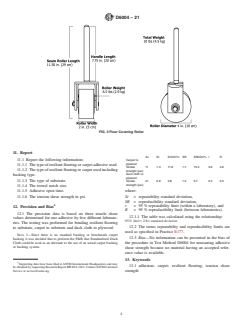
5.2 Three 10-lb (4.54-kg) weight equivalents.
5.3 Three 2 × 3-in. (51 mm × 76 (51 × 76 mm) sections of substrate for dead weight distribution.
5.4 Floor covering seam roller or similar type.
5.5 Convection Oven, capable of maintaining a temperature of 122 6 2°F (50 6 1°C).
5.6 Calibrated Universal Testing Machine, capable of a controlled application of force with a force measurement accuracy of
61 % when calibrated in compliance with Practices E4 requirements.
6. Materials
6.1 Adhesive—Any appropriate adhesive for resilient flooring or carpet installation.
6.2 Duck Cloth—Natural, untreated, #10, 14.73 oz.
6.3 Substrate—Minimum of ⁄4-in. (6.35-mm) plywood classified as flooring substrate type warrantied by the manufacturer.
Common wood-based products such as PS2 grade mark stamped oriented strand board substrate or PS1 grade mark stamped
plywood substrate. Other products, recommended by the adhesive manufacturer may also be used.
6.4 Flooring Material—As recommended by manufacturer.
7. Conditioning
7.1 Condition the duck cloth, underlayment and adhesive to be tested for 24 h at 73 6 3°F (23 6 2°C) and 50 % 6 5 % relative
humidity prior to testing.
8. Sample Preparation
8.1 Carpet:
8.1.1 Cut the carpet to be tested into three 2 × 6-in. (51 × 127-mm) pieces.
8.1.2 Cut one section of substrate into a 16 × 5-in. (406 × 127-mm) section.
8.2 Resilient Flooring:
8.2.1 Cut substrate into 2 × 7-in. (51 × 177-mm) pieces.
8.2.2 Cut flooring material into 1 × 4-in. (25 × 101-mm) pieces.
D6004 − 21
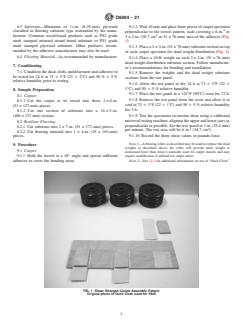
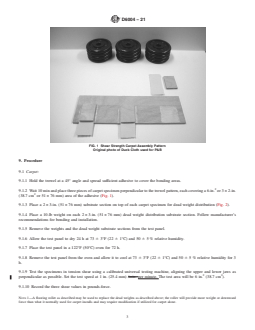
FIG. 1 Shear Strength Carpet Assembly Pattern
Original photo of Duck Cloth used for P&B
9. Procedure
9.1 Carpet:
9.1.1 Hold the trowel at a 45° angle and spread sufficient adhesive to cover the bonding areas.
9.1.2 Wait 10 min and place three pieces of carpet specimen perpendicular to the trowel pattern, each covering a 6-in. or 3 × 2-in.
(38.7 cm or 51 × 76 mm) area of the adhesive (Fig. 1).
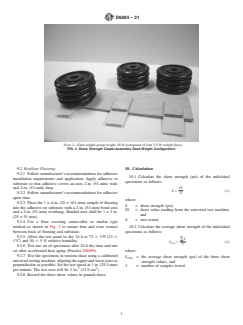
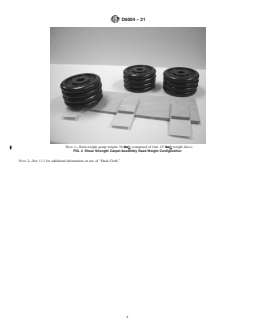
9.1.3 Place a 2 × 3-in. (51 × 76 mm) substrate section on top of each carpet specimen for dead weight distribution (Fig. 2).
9.1.4 Place a 10-lb weight on each 2 × 3-in. (51 × 76 mm) dead weight distribution substrate section. Follow manufacturer’s
recommendations for bonding and installation.
9.1.5 Remove the weights and the dead w
...