

ASTM E2930-13(2021)
(Practice)Standard Practice for Pressure Decay Leak Test Method
General Information
- Abstract
SIGNIFICANCE AND USE
5.1 The equipment, test duration, and technique should be determined before commencement of the test based on the required test sensitivity or accuracy (see Annex A1 and Annex A2). If the test is used to certify that the vessel has a minimum specified leakage rate, then the test equipment and test duration should be chosen to have a resolution ten times less than the specification and an accuracy which is four times less than the specification. The test should be designed so that the total pressure change is less than 10 % of the starting pressure. Leak test specifications should specify the vessel test pressure or differential pressure. If the test specification does not specify a test pressure, then a safe test pressure should be used that complies with the applicable safety standards8.
SCOPE
1.1 This practice describes a method for determining the leakage rate of a vessel subject to a positive pressure difference. The technique is based upon evaluation of the change of mass within the test object based on a pressure decay measurement. The pressure decay measurement uses the ideal gas equation of state and the measured pressures, temperatures, and time to determine the mass loss from the vessel. This method does not apply to deformable vessels.
1.2 This standard does not purport to address all of the safety concerns, if any, associated with its use. It is the responsibility of the user of this standard to establish appropriate safety, health, and environmental practices and determine the applicability of regulatory limitations prior to use.
1.3 This international standard was developed in accordance with internationally recognized principles on standardization established in the Decision on Principles for the Development of International Standards, Guides and Recommendations issued by the World Trade Organization Technical Barriers to Trade (TBT) Committee.
- Status
- Published
- Publication Date
- 31-May-2021
- Technical Committee
- E07 - Nondestructive Testing
- Drafting Committee
- E07.08 - Leak Testing Method
Overview
ASTM E2930-13(2021), the “Standard Practice for Pressure Decay Leak Test Method,” outlines an effective non-destructive testing procedure for determining the leakage rate of vessels subjected to a positive pressure differential. This practice is widely implemented across diverse industries that require precise verification of vessel integrity, such as manufacturing, aerospace, energy, and transportation. The standard employs principles of pressure decay and the ideal gas law, utilizing measurements of pressure, temperature, and elapsed time to calculate mass loss from the vessel, thus assessing its leak rate. Importantly, this method is applicable only to non-deformable vessels.
Key Topics
- Pressure Decay Leak Test Principle: The method assesses leakage by monitoring pressure decrease in a sealed, pressurized vessel over time, referencing the ideal gas law for mass loss calculation.
- Test Sensitivity and Accuracy: Testing parameters, including equipment selection and test duration, must be determined based on required sensitivity. For certification purposes, the standard recommends selecting test equipment with a resolution at least ten times finer and accuracy at least four times finer than the leakage specification.
- Measurement and Calibration: Accurate leak rate results depend on the precise calibration of pressure, temperature, and time measurement devices. Calibration must be traceable to national or international standards.
- Preparation and Procedure: The vessel should be clean, dry, and free of internal components subject to deformation or failure. Non-condensable, inert gases are required for pressurization, and temperature stability is critical during testing.
- Interferences: Factors like gas absorption, desorption, and permeation can affect results, especially at very low leak rates. These influences should be considered and mitigated as appropriate.
- Reporting and Documentation: The standard stipulates detailed reporting requirements, including test conditions, results, and equipment accuracy, ensuring traceability and reproducibility.
Applications
ASTM E2930-13(2021) is widely adopted in industries requiring precise leak detection for quality assurance, regulatory compliance, and safety:
- Aerospace & Automotive: Leak testing of fuel tanks, hydraulic systems, and other pressure vessels to meet safety and performance specifications.
- Manufacturing: Quality control of containers, pipework, and sealed enclosures during production to prevent failures in service.
- Power Generation and Process Industries: Verification of boilers, reactors, and critical containment vessels for safe operation.
- Medical Device Manufacturing: Testing the hermeticity and integrity of pressurized medical enclosures and delivery systems.
- Research and Development: Benchmarking and validating vessel design and manufacturing methods.
Adhering to this standard helps organizations detect unacceptable leakage rates early, reducing the risk of product failures, environmental harm, or hazardous conditions.
Related Standards
For comprehensive leak testing programs and personnel qualification, the following standards and guidelines are commonly referenced alongside ASTM E2930-13(2021):
- ASME Boiler and Pressure Vessel Code Section V Article 10: Contains requirements for leak testing in pressure vessels.
- ASTM E543: Provides requirements for agencies performing non-destructive testing.
- ANSI/ASNT-CP-189 and SNT-TC-1A: Standards for qualifying and certifying non-destructive testing personnel.
- ISO/IEC Guide 98-3: Guidance on expressing the uncertainty of measurement.
- NAS-410: Covers certification and qualification of nondestructive testing personnel.
- ASTM E1316: Terminology standard for nondestructive examinations.
Practical Value
Utilizing ASTM E2930-13(2021) ensures standardized, reliable pressure decay leak testing, supporting product quality, regulatory compliance, and operational safety. This method enables organizations to quantify leakage rates with traceable accuracy, integrates seamlessly with existing quality management systems, and is recognized by major regulatory bodies and manufacturers worldwide. Implementing this standard simplifies communication with stakeholders, promotes best practices, and supports continuous improvement in leak testing protocols.
Relations
- Effective Date
- 01-Feb-2024
- Effective Date
- 01-Dec-2019
- Effective Date
- 01-Mar-2019
- Effective Date
- 01-Jan-2018
- Effective Date
- 15-Jun-2017
- Effective Date
- 01-Feb-2017
- Effective Date
- 01-Aug-2016
- Effective Date
- 01-Feb-2016
- Effective Date
- 01-Dec-2015
- Effective Date
- 01-Sep-2015
- Effective Date
- 01-Jun-2014
- Effective Date
- 01-Jun-2014
- Effective Date
- 01-Dec-2013
- Effective Date
- 15-Jun-2013
- Effective Date
- 01-Jun-2013
Get Certified
Connect with accredited certification bodies for this standard

Institut za varilstvo d.o.o. (Welding Institute)
Slovenia's leading welding institute since 1952. ISO 3834, EN 1090, pressure equipment certification, NDT personnel, welder qualification. Only IIW Au
Sponsored listings
Frequently Asked Questions
ASTM E2930-13(2021) is a standard published by ASTM International. Its full title is "Standard Practice for Pressure Decay Leak Test Method". This standard covers: SIGNIFICANCE AND USE 5.1 The equipment, test duration, and technique should be determined before commencement of the test based on the required test sensitivity or accuracy (see Annex A1 and Annex A2). If the test is used to certify that the vessel has a minimum specified leakage rate, then the test equipment and test duration should be chosen to have a resolution ten times less than the specification and an accuracy which is four times less than the specification. The test should be designed so that the total pressure change is less than 10 % of the starting pressure. Leak test specifications should specify the vessel test pressure or differential pressure. If the test specification does not specify a test pressure, then a safe test pressure should be used that complies with the applicable safety standards8. SCOPE 1.1 This practice describes a method for determining the leakage rate of a vessel subject to a positive pressure difference. The technique is based upon evaluation of the change of mass within the test object based on a pressure decay measurement. The pressure decay measurement uses the ideal gas equation of state and the measured pressures, temperatures, and time to determine the mass loss from the vessel. This method does not apply to deformable vessels. 1.2 This standard does not purport to address all of the safety concerns, if any, associated with its use. It is the responsibility of the user of this standard to establish appropriate safety, health, and environmental practices and determine the applicability of regulatory limitations prior to use. 1.3 This international standard was developed in accordance with internationally recognized principles on standardization established in the Decision on Principles for the Development of International Standards, Guides and Recommendations issued by the World Trade Organization Technical Barriers to Trade (TBT) Committee.
SIGNIFICANCE AND USE 5.1 The equipment, test duration, and technique should be determined before commencement of the test based on the required test sensitivity or accuracy (see Annex A1 and Annex A2). If the test is used to certify that the vessel has a minimum specified leakage rate, then the test equipment and test duration should be chosen to have a resolution ten times less than the specification and an accuracy which is four times less than the specification. The test should be designed so that the total pressure change is less than 10 % of the starting pressure. Leak test specifications should specify the vessel test pressure or differential pressure. If the test specification does not specify a test pressure, then a safe test pressure should be used that complies with the applicable safety standards8. SCOPE 1.1 This practice describes a method for determining the leakage rate of a vessel subject to a positive pressure difference. The technique is based upon evaluation of the change of mass within the test object based on a pressure decay measurement. The pressure decay measurement uses the ideal gas equation of state and the measured pressures, temperatures, and time to determine the mass loss from the vessel. This method does not apply to deformable vessels. 1.2 This standard does not purport to address all of the safety concerns, if any, associated with its use. It is the responsibility of the user of this standard to establish appropriate safety, health, and environmental practices and determine the applicability of regulatory limitations prior to use. 1.3 This international standard was developed in accordance with internationally recognized principles on standardization established in the Decision on Principles for the Development of International Standards, Guides and Recommendations issued by the World Trade Organization Technical Barriers to Trade (TBT) Committee.
ASTM E2930-13(2021) is classified under the following ICS (International Classification for Standards) categories: 23.020.30 - Pressure vessels, gas cylinders. The ICS classification helps identify the subject area and facilitates finding related standards.
ASTM E2930-13(2021) has the following relationships with other standards: It is inter standard links to ASTM E1316-24, ASTM E1316-19b, ASTM E1316-19, ASTM E1316-18, ASTM E1316-17a, ASTM E1316-17, ASTM E1316-16a, ASTM E1316-16, ASTM E1316-15a, ASTM E1316-15, ASTM E1316-14e1, ASTM E1316-14, ASTM E1316-13d, ASTM E1316-13c, ASTM E1316-13b. Understanding these relationships helps ensure you are using the most current and applicable version of the standard.
ASTM E2930-13(2021) is available in PDF format for immediate download after purchase. The document can be added to your cart and obtained through the secure checkout process. Digital delivery ensures instant access to the complete standard document.
Standards Content (Sample)
This international standard was developed in accordance with internationally recognized principles on standardization established in the Decision on Principles for the
Development of International Standards, Guides and Recommendations issued by the World Trade Organization Technical Barriers to Trade (TBT) Committee.
Designation: E2930 − 13 (Reapproved 2021)
Standard Practice for
Pressure Decay Leak Test Method
This standard is issued under the fixed designation E2930; the number immediately following the designation indicates the year of
original adoption or, in the case of revision, the year of last revision.Anumber in parentheses indicates the year of last reapproval.A
superscript epsilon (´) indicates an editorial change since the last revision or reapproval.
1. Scope SNT-TC-1A Recommended Practice for Nondestructive
Testing Personnel Qualification and Certification
1.1 This practice describes a method for determining the
2.3 AIA Document:
leakage rate of a vessel subject to a positive pressure differ-
NAS-410Certification and Qualification of Nondestructive
ence. The technique is based upon evaluation of the change of
Testing Personnel
masswithinthetestobjectbasedonapressuredecaymeasure-
2.4 ASME Standards:
ment. The pressure decay measurement uses the ideal gas
ASMEBoilerandPressureVesselCodeSectionVArticle10
equationofstateandthemeasuredpressures,temperatures,and
(paragraph T-1044)
time to determine the mass loss from the vessel. This method
does not apply to deformable vessels. 2.5 ISO Standards:
ISO/IEC Guide 98–3Uncertainty of Measurement — Part 3
1.2 This standard does not purport to address all of the
safety concerns, if any, associated with its use. It is the
3. Terminology
responsibility of the user of this standard to establish appro-
3.1 Definitions:
priate safety, health, and environmental practices and deter-
3.1.1 pressure decay test resolution—the resolution of the
mine the applicability of regulatory limitations prior to use.
test that can be derived from the test equipment specifications
1.3 This international standard was developed in accor-
and the volume of the test vessel. The test resolution is
dance with internationally recognized principles on standard-
determined by evaluation of the individual resolutions of the
ization established in the Decision on Principles for the
pressure measurement, temperature measurement, and time
Development of International Standards, Guides and Recom-
measurement for a known vessel volume. The method for
mendations issued by the World Trade Organization Technical
determining the test resolution is give in Annex A1.
Barriers to Trade (TBT) Committee.
3.1.2 pressure decay test accuracy—the test accuracy is the
2. Referenced Documents
estimated accuracy of the test based on a combination of the
2.1 ASTM Standards:
measurement accuracies of contributing variables.The method
E479Guide for Preparation of a Leak Testing Specification
for determining the test accuracy is given in Annex A2.
(Withdrawn 2014)
4. Summary of Test Method
E543Specification forAgencies Performing Nondestructive
Testing
4.1 This practice requires a known volume and the use of
E1316Terminology for Nondestructive Examinations
the pressure rate of decay technique for quantitative measure-
2.2 ANSI/ASNT Standards:
ment of leakage rates.The practice is written to be usable over
ANSI/ASNT-CP-189Standard for Qualification and Certifi-
a wide range of pressures and system volumes.This method is
cation of Nondestructive Testing Personnel
only applicable to the test of non-deformable volumes or
devices. Test devices which may have significant changes in
1 volume due to pressurization should not be tested with this
This practice is under the jurisdiction of ASTM Committee E07 on Nonde-
structive Testing and is the direct responsibility of Subcommittee E07.08 on Leak method. The method requires the measurement of the system
Testing Method.
pressure and temperature as a function of time and as such
Current edition approved June 1, 2021. Published June 2021. Originally
requires that these measurements be made with calibrated
approved in 2013. Last previous edition approved in 2013 as E2930–13. DOI:
10.1520/E2930-13R21.
For referenced ASTM standards, visit the ASTM website, www.astm.org, or
contact ASTM Customer Service at service@astm.org. For Annual Book of ASTM Available fromAerospace IndustriesAssociation ofAmerica, Inc. (AIA), 1000
Standards volume information, refer to the standard’s Document Summary page on WilsonBlvd.,Suite1700,Arlington,VA22209-3928,http://www.aia-aerospace.org.
the ASTM website. Available from American Society of Mechanical Engineers (ASME), ASME
The last approved version of this historical standard is referenced on International Headquarters, Three Park Ave., New York, NY 10016-5990, http://
www.astm.org. www.asme.org.
4 7
AvailablefromAmericanSocietyforNondestructiveTesting(ASNT),P.O.Box Available fromAmerican National Standards Institute (ANSI), 25 W. 43rd St.,
28518, 1711 Arlingate Ln., Columbus, OH 43228-0518, http://www.asnt.org. 4th Floor, New York, NY 10036, http://www.ansi.org.
Copyright © ASTM International, 100 Barr Harbor Drive, PO Box C700, West Conshohocken, PA 19428-2959. United States
E2930 − 13 (2021)
instrumentation. The range of the measurement technique can
vary significantly but is generally applicable in the range
-8 -4
greater than1×10 mol/s (2.2 × 10 std cc/s)
5. Significance and Use
5.1 The equipment, test duration, and technique should be
determined before commencement of the test based on the
required test sensitivity or accuracy (see AnnexA1 and Annex
A2). If the test is used to certify that the vessel has a minimum
specifiedleakagerate,thenthetestequipmentandtestduration
should be chosen to have a resolution ten times less than the
specification and an accuracy which is four times less than the
specification. The test should be designed so that the total
pressurechangeislessthan10%ofthestartingpressure.Leak
test specifications should specify the vessel test pressure or
differential pressure. If the test specification does not specify a
test pressure, then a safe test pressure should be used that
FIG. 1 Test Apparatus
complies with the applicable safety standards .
6. Basis of Application
10. Hazards
6.1 The following items are subject to contractual agree-
10.1 In no instance should the test pressure exceed the
ment between parties using or referencing this practice.
maximum allowed vessel design limits.
6.2 Personnel Qualification:
6.2.1 If specified in the contractual agreement, personnel
11. Sampling, Test Specimens, and Test Units
performing examinations to this practice shall be qualified in
11.1 The units for test should be in mol/s or pressure based
accordance with a national or internationally recognized NDT
units of Pa m /s or std cc/s with the units referenced to a
personnel qualification practice or standard such as ANSI/
standard temperature of 0°C or 273.15 K (unless otherwise
ASNT-CP-189, SNT-TC-1A, NAS-410, or a similar document
specified in the test specification).The actual test temperatures
and certified by the employer or certifying agency, as appli-
can vary over the specified operable ranges of the
cable.The practice or standard used and its applicable revision
instrumentation, as long as the temperature is stable enough to
shall be identified in the contractual agreement between the
meet the test resolution requirements.
using parties.
6.3 Qualification of Nondestructive Agencies—If specified
12. Preparation of Apparatus
in the contractual agreement, NDT agencies shall be qualified
12.1 Vessel Preparation—The test vessel should be clean
and evaluated as described in Practice E543. The applicable
and dry. Hydrostatic, bubble, and liquid penetrant testing
revisionofPracticeE543shallbeinthecontractualagreement.
should not be performed prior to a pressure decay test. All
7. Interferences
internalcomponentssubjecttodeformationorfailureshouldbe
removed. Care should be taken where trapped or poorly
7.1 Interferences in the reported leak values could result
accessible volumes may be encountered (double gasket seals)
fromdesorptionofgasesfromthevesseloradsorptionofgases
because they can increase the uncertainty of the test.
into the vessel. In addition, the effect of permeation of gases
out of the test vessel may be significant for very low leak rate
13. Calibration and Standardization
measurements. Eq A2.3 of Annex A2 can be modified to
incorporate these additional effects if appropriate. This test 13.1 The test equipment (pressure measurement, tempera-
assumes a nominal isothermal testing environment. ture measurement, and time measurement) must be appropri-
ately calibrated and traceable to national or international
8. Apparatus
standards. The accuracy of the method depends on the deter-
8.1 The required test equipment includes a pressure gauge/
mination of the test vessel volume as outlined in Annex A3.
transducer of the appropriate range, automated or manual
13.2 Commercial pressure decay systems often use an
timing system for data collection, and a temperature measure-
internal leak standard to determine the volume of the test
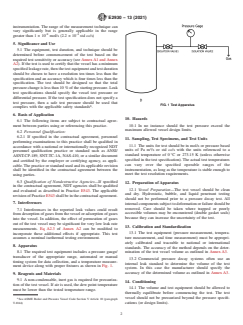
ment device along with proper fixtures as shown in Fig. 1.
system. In this case the manufacturer should specify the
accuracy of the determined volume as outlined in Annex A3.
9. Reagents and Materials
9.1 Anon-condensable, inert gas is required for pressuriza-
14. Conditioning
tion of the test vessel. If air is used, the dew point temperature
14.1 The volume and test equipment should be allowed to
must be lower than the tested temperature range.
thermally equilibrate before commencing the test. The test
vessel should not be pressurized beyond the pressure specifi-
See ASME Boiler and Pressure Vessel Code Section V Article 10 (paragraph
T-1044) cations (or design limits).
E2930 − 13 (2021)
15. Procedure N 5 ∆ PV ⁄ ∆ t T ⁄T ,Pa m ⁄s,orStdcc/s (2)
~~ ! ~ !!~ !
R
15.1 Assemble the test system and determine the system
where:
volume (see Annex A3). An isolation valve should be used
V = the vessel volume
between the test vessel and test system for isolation purposes.
R = the universal gas constant 8.3144 J/mol K (8.3144 Pa
m /(mol K)
15.2 Performaleaktestofthetestsystemwiththeisolation
T = the vessel temperature, K
valve closed and ensure that the leakage of the test system is
T = the reference temperature for the units (typically
less than 1% of the target test value for the test vessel. R
273.15 K)
15.3 Determine the test parameters (initial pressure and test
∆P = the change in pressure between successive points
time)andcalculatethetestresolutionandaccuraciesaccording
�t = the change in time in seconds between successive
to Annex A1 and Annex A2. Ensure that the calculated test
points
resolution is at least ten times less than the target leakage rate.
Examples are provided in Eq 3 and 4
Ensure that the test accuracy is at least four times less than the
target leakage rate.
where:
15.4 Pressurize the vessel to the target pressure and close
�P = 10000 Pa (0.1 atm)
the isolation valve 2.
V = 0.0001 m
�t = 100 sec.
15.5 Stabilization Time (Setting Time)—After
T = 273.15
R
pressurization, the temperature and pressure should be moni-
T = 298 K
tored as a function of time over the test duration previously
established in 5.1. The pressure should be recorded at a ~10000 Pa!·0.0001m ·273.15K
23 3
N 5 59.3 310 Pam ⁄s (3)
minimum of ten time intervals during the test sequence. The 100s·293K
temperatureshouldberecordedatthebeginningandendofthe 3
0.1 atm ·100cm ·273.15K
~ !
22 3
N 5 59.3 310 Std cm ⁄s (4)
test to ensure that the temperature is stable to within the
100s·293K
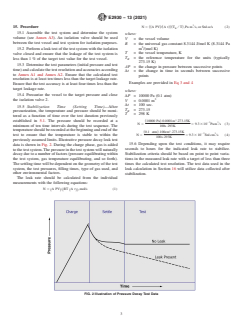
previously assumed limits. Illustrative pressure
...