

ASTM E1419/E1419M-15a(2020)
(Practice)Standard Practice for Examination of Seamless, Gas-Filled, Pressure Vessels Using Acoustic Emission
General Information
- Abstract
SIGNIFICANCE AND USE
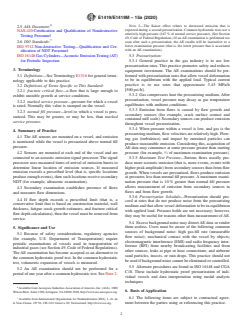
5.1 Because of safety considerations, regulatory agencies (for example, U.S. Department of Transportation) require periodic examinations of vessels used in transportation of industrial gases (see Section 49, Code of Federal Regulations). The AE examination has become accepted as an alternative to the common hydrostatic proof test. In the common hydrostatic test, volumetric expansion of vessels is measured.
5.2 An AE examination should not be performed for a period of one year after a common hydrostatic test. See Note 2.
Note 2: The Kaiser effect relates to decreased emission that is expected during a second pressurization. Common hydrostatic tests use a relatively high pressure (167 % of normal service pressure). (See Section 49, Code of Federal Regulations.) If an AE examination is performed too soon after such a pressurization, the AE results will be insensitive to a lower examination pressure (that is, the lower pressure that is associated with an AE examination).
5.3 Pressurization:
5.3.1 General practice in the gas industry is to use low pressurization rates. This practice promotes safety and reduces equipment investment. The AE examinations should be performed with pressurization rates that allow vessel deformation to be in equilibrium with the applied load. Typical current practice is to use rates that approximate 3.45 MPa/h [500 psi/h].
5.3.2 Gas compressors heat the pressurizing medium. After pressurization, vessel pressure may decay as gas temperature equilibrates with ambient conditions.
5.3.3 Emission from flaws is caused by flaw growth and secondary sources (for example, crack surface contact and contained mill scale). Secondary sources can produce emission throughout vessel pressurization.
5.3.4 When pressure within a vessel is low, and gas is the pressurizing medium, flow velocities are relatively high. Flowing gas (turbulence) and impact by entrained particles can produce measurable emission. Considering this, acquisition of AE d...
SCOPE
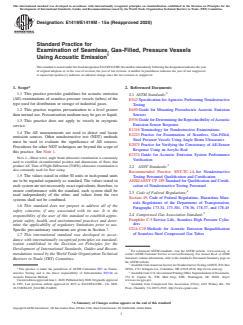
1.1 This practice provides guidelines for acoustic emission (AE) examinations of seamless pressure vessels (tubes) of the type used for distribution or storage of industrial gases.
1.2 This practice requires pressurization to a level greater than normal use. Pressurization medium may be gas or liquid.
1.3 This practice does not apply to vessels in cryogenic service.
1.4 The AE measurements are used to detect and locate emission sources. Other nondestructive test (NDT) methods must be used to evaluate the significance of AE sources. Procedures for other NDT techniques are beyond the scope of this practice. See Note 1.
Note 1: Shear wave, angle beam ultrasonic examination is commonly used to establish circumferential position and dimensions of flaws that produce AE. Time of Flight Diffraction (TOFD), ultrasonic examination is also commonly used for flaw sizing.
1.5 The values stated in either SI units or inch-pound units are to be regarded separately as standard. The values stated in each system are not necessarily exact equivalents; therefore, to ensure conformance with the standard, each system shall be used independently of the other, and values from the two systems shall not be combined.
1.6 This standard does not purport to address all of the safety concerns, if any, associated with its use. It is the responsibility of the user of this standard to establish appropriate safety, health, and environmental practices and determine the applicability of regulatory limitations prior to use. Specific precautionary statements are given in Section 7.
1.7 This international standard was developed in accordance with internationally recognized principles on standardization established in the Decision on Principles for the Development of International Standards, Guides and Recommendations issued by the World Trade Organization Technical Barriers to Trade (TBT) Committee.
- Status
- Published
- Publication Date
- 31-May-2020
- Technical Committee
- E07 - Nondestructive Testing
- Drafting Committee
- E07.04 - Acoustic Emission Method
Overview
ASTM E1419/E1419M-15a(2020) is the internationally recognized standard practice for the examination of seamless, gas-filled, pressure vessels using acoustic emission (AE) testing. Developed by ASTM International, this standard provides comprehensive guidelines for performing AE examinations on pressure vessels (tubes) used for the distribution or storage of industrial gases. The acoustic emission method has gained acceptance as a practical, non-destructive alternative to traditional hydrostatic testing, contributing to the safety and integrity of vessels employed in gas transportation and storage.
Key Topics
- Scope of Application: The standard covers procedures for AE examination of seamless vessels, excluding those in cryogenic service. It specifies pressurization above normal service levels and guides the use of either gas or liquid as the pressurizing medium.
- Regulatory Compliance: AE testing serves as a preferred alternative in periodic inspections, meeting requirements by regulatory agencies like the U.S. Department of Transportation.
- Examination Timing: To ensure accurate results, AE tests should not be conducted within one year of a hydrostatic test due to effects such as the Kaiser effect, which can diminish emission sensitivity.
- Pressurization Protocols: Emphasizes low, controlled pressurization rates (typically around 3.45 MPa/h or 500 psi/h) to balance vessel safety, reduce equipment investment, and ensure test reliability.
- Detection and Evaluation: AE testing identifies and locates emission sources potentially indicative of structural flaws. However, further non-destructive testing methods (such as ultrasonic techniques) are required to assess the significance and dimensions of identified flaws.
- Background Noise Management: Recognizes sources of background acoustic noise (e.g., flow noise, mechanical contact, EMI/RFI, leaks), and provides guidance for data acquisition only under controlled conditions.
Applications
- Industrial Gas Storage and Transportation: Used widely for in-service inspection of seamless pressure vessels containing industrial gases, ensuring the safety of storage and transport systems.
- Regulatory Inspection Alternative: Offers a less invasive and potentially more informative approach than hydrostatic testing, with the ability to monitor flaws during pressurization events that mimic actual service conditions.
- Flaw Detection and Maintenance: Facilitates early detection of flaw growth, secondary emission sources, and structural degradation, enabling proactive maintenance and vessel lifecycle management.
- Data-Driven Safety Decisions: Acoustic emission location analysis guides follow-up inspections with other NDT techniques for critical flaw sizing and service decisions (e.g., vessel removal from service if flaw dimensions exceed established limits).
- International Operations: Adoption of this AE practice improves standardization and cross-border recognition for gas vessel integrity assessment, supporting global operations and exports.
Related Standards
- ASTM E543: Specification for agencies performing nondestructive testing.
- ASTM E650: Guide for mounting piezoelectric acoustic emission sensors.
- ASTM E976: Guide for determining the reproducibility of acoustic emission sensor response.
- ASTM E2223: Practice for examination of seamless, gas-filled, steel pressure vessels using angle beam ultrasonics.
- ASTM E2075: Practice for verifying the consistency of AE-sensor response using an acrylic rod.
- ASTM E2374: Guide for acoustic emission system performance verification.
- ASNT SNT-TC-1A & ANSI/ASNT CP-189: Qualification and certification of nondestructive testing personnel.
- ISO 9712: Non-destructive testing - Qualification and certification of NDT personnel.
- ISO 16148: Gas cylinders – Acoustic emission testing for periodic inspection.
- CGA Pamphlet C-5 & CGA C18: Guidelines from the Compressed Gas Association on service life and AE testing of compressed gas cylinders.
- 49 CFR (U.S. Department of Transportation): Hazardous materials regulations supporting vessel inspection requirements.
By following ASTM E1419/E1419M, organizations and inspectors ensure reliable, standardized acoustic emission testing, contributing to the ongoing safety and regulatory compliance of pressure vessels used throughout the industrial gas sector. This standard’s guidance effectively bridges AE methodology with broader non-destructive examination practices, supporting robust vessel management programs worldwide.
Relations
- Effective Date
- 01-Jun-2020
- Effective Date
- 01-Feb-2024
- Effective Date
- 01-Dec-2019
- Effective Date
- 01-Mar-2019
- Effective Date
- 01-Jan-2018
- Effective Date
- 15-Jun-2017
- Effective Date
- 01-Feb-2017
- Effective Date
- 01-Aug-2016
- Effective Date
- 01-Feb-2016
- Effective Date
- 01-Dec-2015
- Effective Date
- 01-Dec-2015
- Effective Date
- 01-Sep-2015
- Effective Date
- 01-Jun-2014
- Effective Date
- 01-Jun-2014
- Effective Date
- 01-Dec-2013
Get Certified
Connect with accredited certification bodies for this standard

Institut za varilstvo d.o.o. (Welding Institute)
Slovenia's leading welding institute since 1952. ISO 3834, EN 1090, pressure equipment certification, NDT personnel, welder qualification. Only IIW Au
Sponsored listings
Frequently Asked Questions
ASTM E1419/E1419M-15a(2020) is a standard published by ASTM International. Its full title is "Standard Practice for Examination of Seamless, Gas-Filled, Pressure Vessels Using Acoustic Emission". This standard covers: SIGNIFICANCE AND USE 5.1 Because of safety considerations, regulatory agencies (for example, U.S. Department of Transportation) require periodic examinations of vessels used in transportation of industrial gases (see Section 49, Code of Federal Regulations). The AE examination has become accepted as an alternative to the common hydrostatic proof test. In the common hydrostatic test, volumetric expansion of vessels is measured. 5.2 An AE examination should not be performed for a period of one year after a common hydrostatic test. See Note 2. Note 2: The Kaiser effect relates to decreased emission that is expected during a second pressurization. Common hydrostatic tests use a relatively high pressure (167 % of normal service pressure). (See Section 49, Code of Federal Regulations.) If an AE examination is performed too soon after such a pressurization, the AE results will be insensitive to a lower examination pressure (that is, the lower pressure that is associated with an AE examination). 5.3 Pressurization: 5.3.1 General practice in the gas industry is to use low pressurization rates. This practice promotes safety and reduces equipment investment. The AE examinations should be performed with pressurization rates that allow vessel deformation to be in equilibrium with the applied load. Typical current practice is to use rates that approximate 3.45 MPa/h [500 psi/h]. 5.3.2 Gas compressors heat the pressurizing medium. After pressurization, vessel pressure may decay as gas temperature equilibrates with ambient conditions. 5.3.3 Emission from flaws is caused by flaw growth and secondary sources (for example, crack surface contact and contained mill scale). Secondary sources can produce emission throughout vessel pressurization. 5.3.4 When pressure within a vessel is low, and gas is the pressurizing medium, flow velocities are relatively high. Flowing gas (turbulence) and impact by entrained particles can produce measurable emission. Considering this, acquisition of AE d... SCOPE 1.1 This practice provides guidelines for acoustic emission (AE) examinations of seamless pressure vessels (tubes) of the type used for distribution or storage of industrial gases. 1.2 This practice requires pressurization to a level greater than normal use. Pressurization medium may be gas or liquid. 1.3 This practice does not apply to vessels in cryogenic service. 1.4 The AE measurements are used to detect and locate emission sources. Other nondestructive test (NDT) methods must be used to evaluate the significance of AE sources. Procedures for other NDT techniques are beyond the scope of this practice. See Note 1. Note 1: Shear wave, angle beam ultrasonic examination is commonly used to establish circumferential position and dimensions of flaws that produce AE. Time of Flight Diffraction (TOFD), ultrasonic examination is also commonly used for flaw sizing. 1.5 The values stated in either SI units or inch-pound units are to be regarded separately as standard. The values stated in each system are not necessarily exact equivalents; therefore, to ensure conformance with the standard, each system shall be used independently of the other, and values from the two systems shall not be combined. 1.6 This standard does not purport to address all of the safety concerns, if any, associated with its use. It is the responsibility of the user of this standard to establish appropriate safety, health, and environmental practices and determine the applicability of regulatory limitations prior to use. Specific precautionary statements are given in Section 7. 1.7 This international standard was developed in accordance with internationally recognized principles on standardization established in the Decision on Principles for the Development of International Standards, Guides and Recommendations issued by the World Trade Organization Technical Barriers to Trade (TBT) Committee.
SIGNIFICANCE AND USE 5.1 Because of safety considerations, regulatory agencies (for example, U.S. Department of Transportation) require periodic examinations of vessels used in transportation of industrial gases (see Section 49, Code of Federal Regulations). The AE examination has become accepted as an alternative to the common hydrostatic proof test. In the common hydrostatic test, volumetric expansion of vessels is measured. 5.2 An AE examination should not be performed for a period of one year after a common hydrostatic test. See Note 2. Note 2: The Kaiser effect relates to decreased emission that is expected during a second pressurization. Common hydrostatic tests use a relatively high pressure (167 % of normal service pressure). (See Section 49, Code of Federal Regulations.) If an AE examination is performed too soon after such a pressurization, the AE results will be insensitive to a lower examination pressure (that is, the lower pressure that is associated with an AE examination). 5.3 Pressurization: 5.3.1 General practice in the gas industry is to use low pressurization rates. This practice promotes safety and reduces equipment investment. The AE examinations should be performed with pressurization rates that allow vessel deformation to be in equilibrium with the applied load. Typical current practice is to use rates that approximate 3.45 MPa/h [500 psi/h]. 5.3.2 Gas compressors heat the pressurizing medium. After pressurization, vessel pressure may decay as gas temperature equilibrates with ambient conditions. 5.3.3 Emission from flaws is caused by flaw growth and secondary sources (for example, crack surface contact and contained mill scale). Secondary sources can produce emission throughout vessel pressurization. 5.3.4 When pressure within a vessel is low, and gas is the pressurizing medium, flow velocities are relatively high. Flowing gas (turbulence) and impact by entrained particles can produce measurable emission. Considering this, acquisition of AE d... SCOPE 1.1 This practice provides guidelines for acoustic emission (AE) examinations of seamless pressure vessels (tubes) of the type used for distribution or storage of industrial gases. 1.2 This practice requires pressurization to a level greater than normal use. Pressurization medium may be gas or liquid. 1.3 This practice does not apply to vessels in cryogenic service. 1.4 The AE measurements are used to detect and locate emission sources. Other nondestructive test (NDT) methods must be used to evaluate the significance of AE sources. Procedures for other NDT techniques are beyond the scope of this practice. See Note 1. Note 1: Shear wave, angle beam ultrasonic examination is commonly used to establish circumferential position and dimensions of flaws that produce AE. Time of Flight Diffraction (TOFD), ultrasonic examination is also commonly used for flaw sizing. 1.5 The values stated in either SI units or inch-pound units are to be regarded separately as standard. The values stated in each system are not necessarily exact equivalents; therefore, to ensure conformance with the standard, each system shall be used independently of the other, and values from the two systems shall not be combined. 1.6 This standard does not purport to address all of the safety concerns, if any, associated with its use. It is the responsibility of the user of this standard to establish appropriate safety, health, and environmental practices and determine the applicability of regulatory limitations prior to use. Specific precautionary statements are given in Section 7. 1.7 This international standard was developed in accordance with internationally recognized principles on standardization established in the Decision on Principles for the Development of International Standards, Guides and Recommendations issued by the World Trade Organization Technical Barriers to Trade (TBT) Committee.
ASTM E1419/E1419M-15a(2020) is classified under the following ICS (International Classification for Standards) categories: 23.020.30 - Pressure vessels, gas cylinders. The ICS classification helps identify the subject area and facilitates finding related standards.
ASTM E1419/E1419M-15a(2020) has the following relationships with other standards: It is inter standard links to ASTM E1419/E1419M-15a, ASTM E1316-24, ASTM E1316-19b, ASTM E1316-19, ASTM E1316-18, ASTM E1316-17a, ASTM E1316-17, ASTM E1316-16a, ASTM E1316-16, ASTM E1316-15a, ASTM E2374-15, ASTM E1316-15, ASTM E1316-14, ASTM E1316-14e1, ASTM E1316-13d. Understanding these relationships helps ensure you are using the most current and applicable version of the standard.
ASTM E1419/E1419M-15a(2020) is available in PDF format for immediate download after purchase. The document can be added to your cart and obtained through the secure checkout process. Digital delivery ensures instant access to the complete standard document.
Standards Content (Sample)
This international standard was developed in accordance with internationally recognized principles on standardization established in the Decision on Principles for the
Development of International Standards, Guides and Recommendations issued by the World Trade Organization Technical Barriers to Trade (TBT) Committee.
Designation: E1419/E1419M − 15a (Reapproved 2020)
Standard Practice for
Examination of Seamless, Gas-Filled, Pressure Vessels
Using Acoustic Emission
ThisstandardisissuedunderthefixeddesignationE1419/E1419M;thenumberimmediatelyfollowingthedesignationindicatestheyear
of original adoption or, in the case of revision, the year of last revision. A number in parentheses indicates the year of last reapproval.
A superscript epsilon (´) indicates an editorial change since the last revision or reapproval.
1. Scope* 2. Referenced Documents
1.1 This practice provides guidelines for acoustic emission
2.1 ASTM Standards:
(AE) examinations of seamless pressure vessels (tubes) of the
E543 Specification for Agencies Performing Nondestructive
type used for distribution or storage of industrial gases.
Testing
1.2 This practice requires pressurization to a level greater E650 Guide for Mounting Piezoelectric Acoustic Emission
than normal use. Pressurization medium may be gas or liquid.
Sensors
E976 GuideforDeterminingtheReproducibilityofAcoustic
1.3 This practice does not apply to vessels in cryogenic
Emission Sensor Response
service.
E1316 Terminology for Nondestructive Examinations
1.4 The AE measurements are used to detect and locate
E2223 Practice for Examination of Seamless, Gas-Filled,
emission sources. Other nondestructive test (NDT) methods
Steel Pressure Vessels Using Angle Beam Ultrasonics
must be used to evaluate the significance of AE sources.
E2075 Practice for Verifying the Consistency of AE-Sensor
Procedures for other NDT techniques are beyond the scope of
Response Using an Acrylic Rod
this practice. See Note 1.
E2374 Guide for Acoustic Emission System Performance
NOTE 1—Shear wave, angle beam ultrasonic examination is commonly
Verification
used to establish circumferential position and dimensions of flaws that
produceAE.Time of Flight Diffraction (TOFD), ultrasonic examination is
2.2 ASNT Standards:
also commonly used for flaw sizing.
Recommended Practice SNT-TC-1A for Nondestructive
1.5 The values stated in either SI units or inch-pound units Testing Personnel Qualification and Certification
are to be regarded separately as standard. The values stated in ANSI/ASNT CP-189 Standard for Qualification and Certifi-
each system are not necessarily exact equivalents; therefore, to
cation of Nondestructive Testing Personnel
ensure conformance with the standard, each system shall be
2.3 Code of Federal Regulations:
used independently of the other, and values from the two
Section 49, Code of Federal Regulations, Hazardous Mate-
systems shall not be combined.
rials Regulations of the Department of Transportation,
1.6 This standard does not purport to address all of the
Paragraphs 173.34, 173.301, 178.36, 178.37, and 178.45
safety concerns, if any, associated with its use. It is the
2.4 Compressed Gas Association Standard:
responsibility of the user of this standard to establish appro-
Pamphlet C-5 Service Life, Seamless High Pressure Cylin-
priate safety, health, and environmental practices and deter-
ders
mine the applicability of regulatory limitations prior to use.
CGA-C18 Methods for Acoustic Emission Requalification
Specific precautionary statements are given in Section 7.
of Seamless Steel Compressed Gas Tubes
1.7 This international standard was developed in accor-
dance with internationally recognized principles on standard-
ization established in the Decision on Principles for the
Development of International Standards, Guides and Recom-
For referenced ASTM standards, visit the ASTM website, www.astm.org, or
mendations issued by the World Trade Organization Technical contact ASTM Customer Service at service@astm.org. For Annual Book of ASTM
Standards volume information, refer to the standard’s Document Summary page on
Barriers to Trade (TBT) Committee.
the ASTM website.
AvailablefromAmericanSocietyforNondestructiveTesting(ASNT),P.O.Box
This practice is under the jurisdiction of ASTM Committee E07 on Nonde- 28518, 1711 Arlingate Ln., Columbus, OH 43228-0518, http://www.asnt.org.
structive Testing and is the direct responsibility of Subcommittee E07.04 on AvailablefromU.S.GovernmentPrintingOfficeSuperintendentofDocuments,
Acoustic Emission Method. 732 N. Capitol St., NW, Mail Stop: SDE, Washington, DC 20401, http://
CurrenteditionapprovedJune1,2020.PublishedJuly2020.Originallyapproved www.access.gpo.gov.
in 1991. Last previous edition approved in 2015 as E1419/E1419M – 15a. DOI: Available from Compressed Gas Association (CGA), 4221 Walney Rd., 5th
10.1520/E1419_E1419M-15AR20. Floor, Chantilly, VA 20151-2923, http://www.cganet.com.
*A Summary of Changes section appears at the end of this standard
Copyright © ASTM International, 100 Barr Harbor Drive, PO Box C700, West Conshohocken, PA 19428-2959. United States
E1419/E1419M − 15a (2020)
NOTE 2—The Kaiser effect relates to decreased emission that is
2.5 AIA Document:
expected during a second pressurization. Common hydrostatic tests use a
NAS-410 Certification and Qualification of Nondestructive
relatively high pressure (167 % of normal service pressure). (See Section
Testing Personnel
49, Code of Federal Regulations.) If anAE examination is performed too
2.6 ISO Standards: soon after such a pressurization, the AE results will be insensitive to a
lower examination pressure (that is, the lower pressure that is associated
ISO 9712 Non-destructive Testing—Qualification and Cer-
with an AE examination).
tification of NDT Personnel
ISO 16148 Gas Cylinders—Acoustic Emission Testing (AT) 5.3 Pressurization:
for Periodic Inspection
5.3.1 General practice in the gas industry is to use low
pressurization rates. This practice promotes safety and reduces
3. Terminology
equipment investment. The AE examinations should be per-
formed with pressurization rates that allow vessel deformation
3.1 Definitions—See Terminology E1316 for general termi-
to be in equilibrium with the applied load. Typical current
nology applicable to this practice.
practice is to use rates that approximate 3.45 MPa/h
3.2 Definitions of Terms Specific to This Standard:
[500 psi⁄h].
3.2.1 fracture critical flaw—a flaw that is large enough to
5.3.2 Gas compressors heat the pressurizing medium. After
exhibit unstable growth at service conditions.
pressurization, vessel pressure may decay as gas temperature
3.2.2 marked service pressure—pressure for which a vessel
equilibrates with ambient conditions.
is rated. Normally this value is stamped on the vessel.
5.3.3 Emission from flaws is caused by flaw growth and
3.2.3 normal fill pressure—level to which a vessel is pres-
secondary sources (for example, crack surface contact and
surized. This may be greater, or may be less, than marked
contained mill scale). Secondary sources can produce emission
service pressure.
throughout vessel pressurization.
5.3.4 When pressure within a vessel is low, and gas is the
4. Summary of Practice
pressurizing medium, flow velocities are relatively high. Flow-
4.1 The AE sensors are mounted on a vessel, and emission
ing gas (turbulence) and impact by entrained particles can
is monitored while the vessel is pressurized above normal fill
produce measurable emission. Considering this, acquisition of
pressure.
AE data may commence at some pressure greater than starting
pressure (for example, ⁄3 of maximum examination pressure).
4.2 Sensors are mounted at each end of the vessel and are
connected to an acoustic emission signal processor. The signal 5.3.5 Maximum Test Pressure—Serious flaws usually pro-
processor uses measured times of arrival of emission bursts to duce more acoustic emission (that is, more events, events with
determine linear location of emission sources. If measured higher peak amplitude) from secondary sources than from flaw
emission exceeds a prescribed level (that is, specific locations growth. When vessels are pressurized, flaws produce emission
produce enough events), then such locations receive secondary at pressures less than normal fill pressure.Amaximum exami-
NDT (for example, ultrasonic examination).
nation pressure that is 10 % greater than normal fill pressure
allows measurement of emission from secondary sources in
4.3 Secondary examination establishes presence of flaws
flaws and from flaw growth.
and measures flaw dimensions.
5.3.6 Pressurization Schedule—Pressurization should pro-
4.4 If flaw depth exceeds a prescribed limit (that is, a
ceed at rates that do not produce noise from the pressurizing
conservative limit that is based on construction material, wall
medium and that allow vessel deformation to be in equilibrium
thickness, fatigue crack growth estimates, and fracture critical
with applied load. Pressure holds are not necessary; however,
flaw depth calculations), then the vessel must be removed from
they may be useful for reasons other than measurement ofAE.
service.
5.4 Excess background noise may distortAE data or render
5. Significance and Use them useless. Users must be aware of the following common
sources of background noise: high gas-fill rate (measurable
5.1 Because of safety considerations, regulatory agencies
flow noise); mechanical contact with the vessel by objects;
(for example, U.S. Department of Transportation) require
electromagnetic interference (EMI) and radio frequency inter-
periodic examinations of vessels used in transportation of
ference (RFI) from nearby broadcasting facilities and from
industrial gases (see Section 49, Code of Federal Regulations).
other sources; leaks at pipe or hose connections; and airborne
The AE examination has become accepted as an alternative to
sand particles, insects, or rain drops. This practice should not
the common hydrostatic proof test. In the common hydrostatic
beusedifbackgroundnoisecannotbeeliminatedorcontrolled.
test, volumetric expansion of vessels is measured.
5.5 Alternate procedures are found in ISO 16148 and CGA
5.2 An AE examination should not be performed for a
C18. These include hydrostatic proof pressurization of indi-
period of one year after a common hydrostatic test. See Note 2.
vidual vessels and data interpretation using modal analysis
techniques
Available fromAerospace IndustriesAssociation ofAmerica, Inc. (AIA), 1000
6. Basis of Application
WilsonBlvd.,Suite1700,Arlington,VA22209-3928,http://www.aia-aerospace.org.
6.1 The following items are subject to contractual agree-
Available from International Organization for Standardization (ISO), 1, ch. de
la Voie-Creuse, CP 56, CH-1211 Geneva 20, Switzerland, http://www.iso.org. ment between the parties using or referencing this practice.
E1419/E1419M − 15a (2020)
6.2 Personnel Qualification—If specified in the contractual 7.2 Couplant must be used to acoustically connect sensors
agreement, personnel performing examinations to this standard to the vessel surface. Adhesives that have acceptable acoustic
shall be qualified in accordance with a nationally or interna- properties, and adhesives used in combination with traditional
tionally recognized NDT personnel qualification practice or couplants, are acceptable.
standardsuchasANSI/ASNT-CP-189,SNT-TC-1A,NAS-410,
7.3 Sensors may be held in place with magnets, adhesive
ISO 9712, or a similar document and certified by the employer
tape, or other mechanical means.
or certifying agency, as applicable. The practice or standard
used and its applicable revision shall be identified in the 7.4 The AE sensors are used to detect strain-induced stress
contractual agreement between the using parties. waves produced by flaws. Sensors must be held in contact with
the vessel wall to ensure adequate acoustic coupling.
6.3 Qualification of Nondestructive Agencies—If specified
in the contractual agreement, NDT agencies shall be qualified
7.5 Apreamplifier may be enclosed in the sensor housing or
and evaluated as described in Practice E543. The applicable
in a separate enclosure. If a separate preamplifier is used, cable
edition of Practice E543 shall be specified in the contractual
length, between sensor and preamp, must not exceed 2 m
agreement.
[6.6 ft].
6.4 Time of Examination—The timing of examination shall
7.6 Power/signal cable length (that is, cable between pre-
be in accordance with 5.2 unless otherwise specified.
amp and signal processor) shall not exceed 150 m [500 ft]. See
A1.5.
6.5 Extent of Examination—The extent of examination in-
cludes the entire pressure vessel unless otherwise specified.
7.7 Signal processors are computerized instruments with
6.6 Reporting Criteria/Acceptance Criteria—Reporting cri-
independent channels that filter, measure, and convert analog
teria for the examination results shall be in accordance with
information into digital form for display and permanent stor-
Section 11unlessotherwisespecified.Sinceacceptancecriteria
age.Asignal processor must have sufficient speed and capacity
(for example, reference radiographs) are not specified in this
to independently process data from all sensors simultaneously.
practice, they shall be specified in the contractual agreement.
The signal processor should provide capability to filter data for
replay. A printer should be used to provide hard copies of
6.7 Reexamination of Repaired/Reworked Items—
examination results.
Reexamination of repaired/reworked items is not addressed in
7.7.1 A video monitor should display processed examina-
thispracticeandifrequired shall be specified in thecontractual
tiondatainvariousformats.Displayformatmaybeselectedby
agreement.
the equipment operator.
7. Apparatus
7.7.2 Adata storage device may be used to provide data for
replay or for archives.
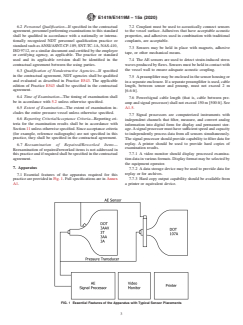
7.1 Essential features of the apparatus required for this
practice are provided in Fig. 1. Full specifications are in Annex 7.7.3 Hard copy output capability should be available from
A1. a printer or equivalent device.
FIG. 1 Essential Features of the Apparatus with Typical Sensor Placements
E1419/E1419M − 15a (2020)
8. Safety Precautions 10.2 Isolate vessel to prevent contact with other vessels,
hardware, and so forth. When the vessel cannot be completely
8.1 As in any pressurization of metal vessels, ambient
isolated, indicate, in the examination report, external sources
temperature should not be below the ductile-brittle transition
which could have produced emission.
temperature of the pressure vessel construction material.
10.3 Connect fill hose and pressure transducer. Eliminate
9. Calibration and Standardization
any leaks at connections.
9.1 Annual calibration and verification of pressure
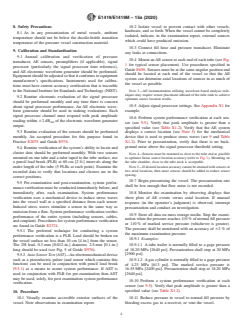
10.4 Mount anAE sensor at each end of each tube (see Fig.
transducer, AE sensors, preamplifiers (if applicable), signal
1 for typical sensor placement). Use procedures specified in
processor (particularly the signal processor time reference),
Guide E650. Sensors must be at the same angular position and
and AE electronic waveform generator should be performed.
should be located at each end of the vessel so that the AE
Equipment should be adjusted so that it conforms to equipment
system can determine axial locations of sources in as much of
manufacturer’s specifications. Instruments used for calibra-
the vessel as possible.
tions must have current accuracy certification that is traceable
to the National Institute for Standards and Technology (NIST).
NOTE 3—AE instrumentation utilizing waveform based analysis tech-
niques may require sensor placement inboard of the tube ends to achieve
9.2 Routine electronic evaluation of the signal processor
optimum source location results.
should be performed monthly and any time there is concern
10.5 Adjust signal processor settings. See Appendix X1 for
about signal processor performance. An AE electronic wave-
example.
form generator should be used in making evaluations. Each
signal processor channel must respond with peak amplitude
10.6 Perform system performance verification at each sen-
reading within 62dB of the electronic waveform generator
AE
sor (see 9.5). Verify that peak amplitude is greater than a
output.
specified value (see Table X1.2). Verify that the AE system
9.3 Routine evaluation of the sensors should be performed displays a correct location (see Note 5) for the mechanical
monthly. An accepted procedure for this purpose found in
device that is used to produce stress waves (see 9 and Table
Practice E2075 and Guide E976. X1.2). Prior to pressurization, verify that there is no back-
ground noise above the signal processor threshold setting.
9.4 Routine verification of the system’s ability to locate and
cluster data should be performed monthly. With two sensors
NOTE 4—Sensors must be mounted as close to the tube end as possible
mounted on one tube and a ruler taped to the tube surface, use
to optimize linear source location accuracy (refer to Fig. 1). Mounting on
the tube shoulder, close to the tube neck is acceptable.
a pencil lead break (PLB) at 60 cm [2 ft.] intervals along the
NOTE 5—If desired location accuracy cannot be attained with sensors at
entire length of the tube (5 PLBs at each point). Examine the
two axial locations, then more sensors should be added to reduce sensor
recorded data to verify that locations and clusters are in the
spacing.
correct positions.
10.7 Begin pressurizing the vessel. The pressurization rate
9.5 Pre-examination and post-examination, system perfor-
shall be low enough that flow
...