

ASTM D2131-22
(Classification)Standard Classification for Natural Muscovite Mica Splittings
General Information
- Abstract
ABSTRACT
This specification covers the determination of muscovite mica splittings of standard commercial grades and specifies the maximum allowable physical defects for each grade. It is applicable to commercially available natural muscovite mica splittings regardless of the basic color of the mica or its source. This specification covers thirteen grades of mica splittings based on size and form classification. Mica splittings shall meet the specified physical property requirements such as size, thickness, defects, and absence of any foreign matter. Where specified, the visual quality shall conform to the description of the visual category specified such as V-1, V-2, V-3, V-4, V-5, V-5.1, V-6, V-7, V-8, V-9, V-10, V-11, and V-12. The method of sampling of mica splittings in bookform and loose with powder form are specified and method of calculation of defect percentage is given.
SCOPE
1.1 This classification covers the determination of muscovite mica splittings of standard commercial grades and specifies the maximum allowable physical defects for each grade. It is applicable to commercially available natural muscovite mica splittings regardless of the basic color of the mica or its source.
1.2 The values stated in inch-pound units are to be regarded as the standard. The values given in parentheses are for information only.
1.3 This standard is very similar to ISO 6386. It is expected that materials would be classified identically using the criteria of either standard. The grades shown under “ASTM Grade No.” in Table 1 and Table 2 are shown under “Old Grade No.” in ISO 6386-1981.
1.4 This international standard was developed in accordance with internationally recognized principles on standardization established in the Decision on Principles for the Development of International Standards, Guides and Recommendations issued by the World Trade Organization Technical Barriers to Trade (TBT) Committee.
- Status
- Published
- Publication Date
- 30-Apr-2022
- Technical Committee
- D09 - Electrical and Electronic Insulating Materials
- Drafting Committee
- D09.01 - Electrical Insulating Products



Overview
ASTM D2131-22: Standard Classification for Natural Muscovite Mica Splittings provides a comprehensive framework for determining the commercial grades of natural muscovite mica splittings. This standard, developed by ASTM International, specifies the allowable physical defects, size, thickness, and quality requirements for mica splittings, irrespective of their color or origin. Thirteen distinct grades are covered, addressing both bookform and loose-with-powder forms of mica. The classification system ensures consistent quality and standardization across industries that utilize muscovite mica splittings, enhancing supplier-buyer communication and product suitability for a range of technical applications.
Key Topics
Grades and Classification:
- Covers thirteen mica splitting grades based on defined area, thickness, and usable dimension requirements.
- Includes both bookform and loose-with-powder mica.
- Size and thickness specifications facilitate consistent product selection for end-users.
Physical Defects and Allowable Limits:
- Specifies maximum allowable defects by grade, including rough edges, stains, fractures, holes, waviness, thickness variations, and foreign matter.
- Limits ensure that the mica splittings meet robust industrial quality demands.
Visual Quality Categories:
- Up to thirteen visual quality categories (V-1 through V-12) can be assigned based on clarity and staining, with detailed descriptions cross-referenced in ASTM D351.
Sampling and Defect Measurement:
- Outlines standardized sampling methods for bookform and loose mica, ensuring representative quality assessments.
- Defined procedures for defect calculation enable objective grading and batch acceptance.
International Alignment:
- Closely aligned with ISO 6386, facilitating harmonized global trade and material interchangeability.
Applications
Natural muscovite mica splittings, as classified by ASTM D2131-22, are widely used across various industries requiring reliable electrical and thermal insulation, as well as stable mechanical performance. Typical application areas include:
Electrical and Electronic Insulating Materials
Used extensively in capacitors, commutators, and insulation for electrical machinery due to mica's exceptional dielectric properties.Automotive and Aerospace Industries
Critical in heat-shielding applications and gaskets where stability at high temperatures is required.Construction and Specialty Manufacturing Utilized in reinforcing composites, roofing, and specialty paints and coatings, where particle size and purity impact performance.
Arts, Crafts, and Decorative Uses Grades with high visual quality and minimal staining are preferred for artistic and decorative applications.
The detailed gradation and visual quality categorization ensure that mica splittings meet tailored performance needs for both general and highly specialized technical requirements.
Related Standards
ASTM D351 - Classification for Natural Muscovite Block Mica and Thins Based on Visual Quality
Complements D2131-22 by providing further clarity on visual grading.ASTM D1711 - Terminology Relating to Electrical Insulation
Defines key terms for the insulation industry, supporting consistency in communication.ISO 6386:1981 - Muscovite Mica Splittings-Grading and Visual Classification
International equivalent for grading, promoting material compatibility in global markets.
Practical Value
Implementing ASTM D2131-22 enables manufacturers, suppliers, and end-users to specify, procure, and verify natural muscovite mica splittings with confidence. Adherence to this standard ensures:
- Consistent, reliable product quality.
- Reduced risk of material performance issues.
- Enhanced buyer-supplier transparency through objective grade definitions.
- Improved compliance with both domestic and international material specifications.
For industries requiring high-quality natural mica, ASTM D2131-22 is a foundational document enabling optimized material selection and product performance.
Relations
- Effective Date
- 01-Mar-2024
- Effective Date
- 01-Nov-2018
- Effective Date
- 01-Nov-2015
- Effective Date
- 01-Nov-2014
- Effective Date
- 01-May-2014
- Effective Date
- 15-Jan-2014
- Effective Date
- 01-Nov-2013
- Effective Date
- 01-Aug-2011
- Effective Date
- 01-May-2008
- Effective Date
- 01-May-2008
- Effective Date
- 10-Mar-2003
- Effective Date
- 10-Mar-2002
- Effective Date
- 10-Oct-1999
- Effective Date
- 10-Sep-1997
Get Certified
Connect with accredited certification bodies for this standard

Bureau Veritas Chile
Bureau Veritas certification services in Chile.
Bureau Veritas Peru
Bureau Veritas certification services in Peru.
BVQI Peru
Bureau Veritas certification in Peru.
Sponsored listings
Frequently Asked Questions
ASTM D2131-22 is a standard published by ASTM International. Its full title is "Standard Classification for Natural Muscovite Mica Splittings". This standard covers: ABSTRACT This specification covers the determination of muscovite mica splittings of standard commercial grades and specifies the maximum allowable physical defects for each grade. It is applicable to commercially available natural muscovite mica splittings regardless of the basic color of the mica or its source. This specification covers thirteen grades of mica splittings based on size and form classification. Mica splittings shall meet the specified physical property requirements such as size, thickness, defects, and absence of any foreign matter. Where specified, the visual quality shall conform to the description of the visual category specified such as V-1, V-2, V-3, V-4, V-5, V-5.1, V-6, V-7, V-8, V-9, V-10, V-11, and V-12. The method of sampling of mica splittings in bookform and loose with powder form are specified and method of calculation of defect percentage is given. SCOPE 1.1 This classification covers the determination of muscovite mica splittings of standard commercial grades and specifies the maximum allowable physical defects for each grade. It is applicable to commercially available natural muscovite mica splittings regardless of the basic color of the mica or its source. 1.2 The values stated in inch-pound units are to be regarded as the standard. The values given in parentheses are for information only. 1.3 This standard is very similar to ISO 6386. It is expected that materials would be classified identically using the criteria of either standard. The grades shown under “ASTM Grade No.” in Table 1 and Table 2 are shown under “Old Grade No.” in ISO 6386-1981. 1.4 This international standard was developed in accordance with internationally recognized principles on standardization established in the Decision on Principles for the Development of International Standards, Guides and Recommendations issued by the World Trade Organization Technical Barriers to Trade (TBT) Committee.
ABSTRACT This specification covers the determination of muscovite mica splittings of standard commercial grades and specifies the maximum allowable physical defects for each grade. It is applicable to commercially available natural muscovite mica splittings regardless of the basic color of the mica or its source. This specification covers thirteen grades of mica splittings based on size and form classification. Mica splittings shall meet the specified physical property requirements such as size, thickness, defects, and absence of any foreign matter. Where specified, the visual quality shall conform to the description of the visual category specified such as V-1, V-2, V-3, V-4, V-5, V-5.1, V-6, V-7, V-8, V-9, V-10, V-11, and V-12. The method of sampling of mica splittings in bookform and loose with powder form are specified and method of calculation of defect percentage is given. SCOPE 1.1 This classification covers the determination of muscovite mica splittings of standard commercial grades and specifies the maximum allowable physical defects for each grade. It is applicable to commercially available natural muscovite mica splittings regardless of the basic color of the mica or its source. 1.2 The values stated in inch-pound units are to be regarded as the standard. The values given in parentheses are for information only. 1.3 This standard is very similar to ISO 6386. It is expected that materials would be classified identically using the criteria of either standard. The grades shown under “ASTM Grade No.” in Table 1 and Table 2 are shown under “Old Grade No.” in ISO 6386-1981. 1.4 This international standard was developed in accordance with internationally recognized principles on standardization established in the Decision on Principles for the Development of International Standards, Guides and Recommendations issued by the World Trade Organization Technical Barriers to Trade (TBT) Committee.
ASTM D2131-22 is classified under the following ICS (International Classification for Standards) categories: 73.080 - Non-metalliferous minerals. The ICS classification helps identify the subject area and facilitates finding related standards.
ASTM D2131-22 has the following relationships with other standards: It is inter standard links to ASTM D1711-24, ASTM D351-18, ASTM D1711-15, ASTM D1711-14a, ASTM D1711-14, ASTM D351-14, ASTM D1711-13, ASTM D1711-11a, ASTM D351-97(2008)e1, ASTM D1711-08, ASTM D351-97(2003), ASTM D1711-02, ASTM D1711-99, ASTM D351-97. Understanding these relationships helps ensure you are using the most current and applicable version of the standard.
ASTM D2131-22 is available in PDF format for immediate download after purchase. The document can be added to your cart and obtained through the secure checkout process. Digital delivery ensures instant access to the complete standard document.
Standards Content (Sample)
This international standard was developed in accordance with internationally recognized principles on standardization established in the Decision on Principles for the
Development of International Standards, Guides and Recommendations issued by the World Trade Organization Technical Barriers to Trade (TBT) Committee.
Designation:D2131 −22
Standard Classification for
Natural Muscovite Mica Splittings
This standard is issued under the fixed designation D2131; the number immediately following the designation indicates the year of
original adoption or, in the case of revision, the year of last revision. A number in parentheses indicates the year of last reapproval. A
superscript epsilon (´) indicates an editorial change since the last revision or reapproval.
1. Scope 3. Terminology
3.1 For definitions relating to mica and for terms applicable
1.1 This classification covers the determination of musco-
to this standard, refer to Terminology D1711, and Classifica-
vite mica splittings of standard commercial grades and speci-
tion D351.
fies the maximum allowable physical defects for each grade. It
is applicable to commercially available natural muscovite mica
4. Classification
splittings regardless of the basic color of the mica or its source.
4.1 Mica splittings are classified by size, form, and visual
1.2 The values stated in inch-pound units are to be regarded
quality and properties.
as the standard. The values given in parentheses are for
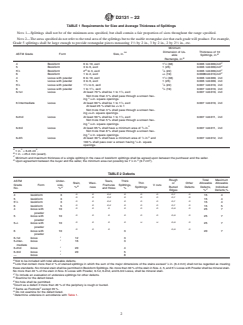
4.2 Thirteen grades, based on size and form, are described
information only.
as given in Table 1.
1.3 This standard is very similar to ISO 6386. It is expected
4.3 Within the grades, up to thirteen categories of visual
that materials would be classified identically using the criteria
quality are able to be separately specified, as listed in Section
of either standard. The grades shown under “ASTM Grade
6. Not all of the visual quality categories are available in all
No.” in Table 1 and Table 2 are shown under “Old Grade No.”
grades.
in ISO 6386-1981.
5. Physical Properties
1.4 This international standard was developed in accor-
5.1 Natural muscovite mica splittings shall meet the size
dance with internationally recognized principles on standard-
requirements specified in Table 1. Classification D351, Table 1
ization established in the Decision on Principles for the
and Fig. 1, define more completely the areas and minimum
Development of International Standards, Guides and Recom-
dimensions that define the size grades, and which are to be
mendations issued by the World Trade Organization Technical
used in conjunction with Table 1 of this classification.
Barriers to Trade (TBT) Committee.
5.2 There shall not be more than the maximum allowable
2. Referenced Documents
total defects specified in Table 2 based on percentage weight.
2 Such defects shall not lie predominantly in any one category.
2.1 ASTM Standards:
5.3 There shall not be more of any single defect than the
D351 Classification for Natural Muscovite Block Mica and
Thins Based on Visual Quality percentages specified where a specific percentage is allowed
for such defect.
D1711 Terminology Relating to Electrical Insulation
2.2 ISO Publications: 5.4 There shall not be any foreign matter included among
the splittings.
ISO 6386-1981 Muscovite Mica Splittings—Grading and
Visual Classification
6. Visual Quality
6.1 Where specified, the visual quality shall conform to the
description of the visual category specified, as given in
This classification is under the jurisdiction of ASTM Committee D09 on
Classification D351:
Electrical and Electronic Insulating Materials and is the direct responsibility of
Subcommittee D09.01 on Electrical Insulating Products.
6.1.1 V-1—Clear,
Current edition approved May 1, 2022. Published May 2022. Originally
6.1.2 V-2—Clear and Slightly Stained,
approved in 1962. Last previous edition approved in 2016 as D2131 – 97 (2016).
6.1.3 V-3—Fair Stained,
DOI: 10.1520/D2131-22.
6.1.4 V-4—Good Stained,
For referenced ASTM standards, visit the ASTM website, www.astm.org, or
contact ASTM Customer Service at service@astm.org. For Annual Book of ASTM
6.1.5 V-5—Stained A Quality,
Standards volume information, refer to the standard’s Document Summary page on
6.1.6 V-5.1—Stained D351 Quality,
the ASTM website.
6.1.7 V-6—Stained B Quality,
Available from American National Standards Institute (ANSI), 25 W. 43rd St.,
4th Floor, New York, NY 10036, http://www.ansi.org. 6.1.8 V-7—Heavy Stained,
Copyright © ASTM International, 100 Barr Harbor Drive, PO Box C700, West Conshohocken, PA 19428-2959. United States
D2131−22
TABLE 1 Requirements for Size and Average Thickness of Splittings
NOTE 1—Splittings shall not be of the minimum area specified, but shall contain a fair proportion of sizes throughout the range specified.
NOTE 2—The areas specified do not refer to the total area of the splittings but to the usable rectangular size that each grade will produce. For example,
1 1
Grade 5 splittings shall be large enough to provide rectangular pieces measuring 1 ⁄2by2in.,3by2in.,2by2 ⁄3 in., etc.
Minimum
Dimension of Us- Thickness of 10
2A
ASTM Grade Form Size, in.
B
able Splittings, in.
B
Rectangle, in.
C
4 Bookform 6 to 10, excl 1 ⁄2 (38) 0.006 to0.009,incl
C
5 Bookform 3 to 6, excl 1 (25) 0.006 to0.009,incl
1 D 7 C
5 ⁄2 Bookform 2 to 3, excl ⁄8 (22) 0.006 to0.009,incl
C
6 Bookform 1 to 2, excl ⁄4 (19) 0.0006to0.010,incl
4 Loose with powder 6 to 10, excl 1 ⁄2 (38) 0.006 to0.009, incl
5 Loose with powder 3 to 6, excl 1 (25) 0.006
...
This document is not an ASTM standard and is intended only to provide the user of an ASTM standard an indication of what changes have been made to the previous version. Because
it may not be technically possible to adequately depict all changes accurately, ASTM recommends that users consult prior editions as appropriate. In all cases only the current version
of the standard as published by ASTM is to be considered the official document.
Designation: D2131 − 97 (Reapproved 2016) D2131 − 22
Standard Classification for
Natural Muscovite Mica Splittings
This standard is issued under the fixed designation D2131; the number immediately following the designation indicates the year of
original adoption or, in the case of revision, the year of last revision. A number in parentheses indicates the year of last reapproval. A
superscript epsilon (´) indicates an editorial change since the last revision or reapproval.
1. Scope
1.1 This specificationclassification covers the determination of muscovite mica splittings of standard commercial grades and
specifies the maximum allowable physical defects for each grade. It is applicable to commercially available natural muscovite mica
splittings regardless of the basic color of the mica or its source.
1.2 The values stated in inch-pound units are to be regarded as the standard. The values given in parentheses are for information
only.
1.3 This standard is very similar to ISO 6386. It is expected that materials would be classified identically using the criteria of either
standard. The grades shown under “ASTM Grade No.” in Table 1 and Table 2 are shown under “Old Grade No.” in ISO 6386-1981.
1.4 This international standard was developed in accordance with internationally recognized principles on standardization
established in the Decision on Principles for the Development of International Standards, Guides and Recommendations issued
by the World Trade Organization Technical Barriers to Trade (TBT) Committee.
2. Referenced Documents
2.1 ASTM Standards:
D351 Classification for Natural Muscovite Block Mica and Thins Based on Visual Quality
D1711 Terminology Relating to Electrical Insulation
2.2 ISO Publications:
ISO 6386-1981 Muscovite Mica Splittings—Grading and Visual Classification
3. Terminology
3.1 For definitions relating to mica and for terms applicable to this standard, refer to Terminology D1711, and Classification D351.
4. Classification
4.1 Mica splittings are classified by size, form, and visual quality and properties.
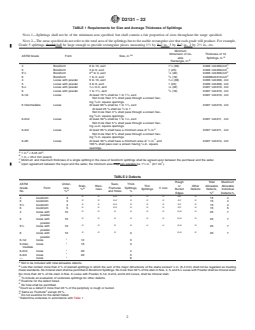
4.2 Thirteen grades, based on size and form, are described as given in Table 1.
This specificationclassification is under the jurisdiction of ASTM Committee D09 on Electrical and Electronic Insulating Materials and is the direct responsibility of
Subcommittee D09.01 on Electrical Insulating Products.
Current edition approved May 15, 2016May 1, 2022. Published May 2016May 2022. Originally approved in 1962. Last previous edition approved in 20082016 as
ε1
D2131 – 97 (2008)(2016). . DOI: 10.1520/D2131-97R16.10.1520/D2131-22.
For referenced ASTM standards, visit the ASTM website, www.astm.org, or contact ASTM Customer Service at service@astm.org. For Annual Book of ASTM Standards
volume information, refer to the standard’s Document Summary page on the ASTM website.
Available from American National Standards Institute (ANSI), 25 W. 43rd St., 4th Floor, New York, NY 10036, http://www.ansi.org.
Copyright © ASTM International, 100 Barr Harbor Drive, PO Box C700, West Conshohocken, PA 19428-2959. United States
D2131 − 22
TABLE 1 Requirements for Size and Average Thickness of Splittings
NOTE 1—Splittings shall not be of the minimum area specified, but shall contain a fair proportion of sizes throughout the range specified.
NOTE 2—The areas specified do not refer to the total area of the splittings but to the usable rectangular size that each grade will produce. For example,
1 1
Grade 5 splittings shouldshall be large enough to provide rectangular pieces measuring 1 ⁄2 by 2, 2 in., 3 by 2, 2 in., 2 by 2 ⁄3 in., etc.
Minimum
Dimension of Us- Thickness of 10
2A
ASTM Grade Form Size, in.
B
able Splittings, in.
B
Rectangle, in.
1 C
4 Bookform 6 to 10, excl 1 ⁄2 (38) 0.006 to0.009,incl
C
5 Bookform 3 to 6, excl 1 (25) 0.006 to0.009,incl
D C
1 7
5 ⁄2 Bookform 2 to 3, excl ⁄8 (22) 0.006 to0.009,incl
C
6 Bookform 1 to 2, excl ⁄4 (19) 0.0006to0.010,incl
4 Loose with powder 6 to 10, excl 1 ⁄2 (38) 0.006 to0.009, incl
5 Loose with powder 3 to 6, excl 1 (25) 0.006 to0.009, incl
1 1 7
5 ⁄2 Loose with powder 1 ⁄2 to 3, excl ⁄8 (22) 0.007 to0.010, incl
1 3
6 Loose with powder 1 to 1 ⁄2, excl ⁄4 (19) 0.007 to0.010, incl
6-1st Loose At least 70 % shall be 1 to 1 ⁄2, excl 0.007 to0.010, incl
Not more than 3 % shall pass through a screen hav-
ing ⁄4-in. square openings.
6 Intermediate Loose At least 60 % shall be 1 to 1 ⁄2, excl 0.007 to0.010, incl
At least 25 % shall be ⁄4 to 1
Not more than 3 % shall pass through a screen hav-
ing ⁄8-in. square openings.
6-2nd Loose At least 50 % shall be 1 to 1 ⁄2, excl 0.007 to0.011, incl
Not more than 5 % shall pass through a screen hav-
ing ⁄8-in. square openings.
6-3rd Loose At least 65 % shall have a minimum area of ⁄4 in. 0.007 to0.011, incl
Not more than 8 % shall pass through a screen hav-
ing ⁄8 in. square openings.
6-4th Loose At least 30 % shall have a minimum area of ⁄2 in. and 0.007 to0.012, incl
100 % shall pass over a screen having ⁄4-in. square
openings.
A 2 2
1 in. = 6.45 cm .
B
1 in. = 25.4 mm (exact).
C
Minimum and maximum thickness of a single splitting in the case of bookform splittings shall be agreed upon between the purchaser and the seller.
D 2 2
Upon agreement between the buyer and the seller, the minimum ar
...