

ASTM E1843-20
(Guide)Standard Guide for Sexual Violence Investigation, Examination, and Evidence Collection Protocol
General Information
- Abstract
ABSTRACT
This guide covers the basic components for the development of a sexual assault investigation protocol, with specific attention to the examination of assault scenes, victims and suspects of sexual assault, the recovery of testimonial, physical, and behavioral evidence, and the preservation and custody of physical evidence. This guide also outlines procedures requiring the experience of experts in a diversity of fields. A multidisciplinary team approach to sexual assault investigation is necessary and is the current standard of care. This team should include members skilled in the following disciplines: law enforcement, criminalistics, victim advocacy, and clinical, forensic practice.
SCOPE
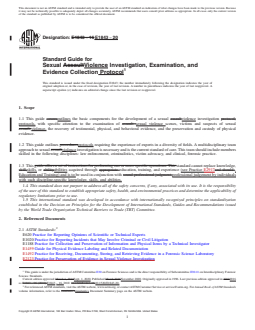
1.1 This guide outlines the basic components for the development of a sexual violence investigation protocols, with specific attention to the examination of sexual violence scenes, victims and suspects of sexual violence, the recovery of testimonial, physical, and behavioral evidence, and the preservation and custody of physical evidence.
1.2 This guide outlines protocols requiring the experience of experts in a diversity of fields. A multidisciplinary team approach to sexual violence investigation is necessary and is the current standard of care. This team should include members skilled in the following disciplines: law enforcement, criminalistics, victim advocacy, and clinical, forensic practice.
1.3 This standard cannot replace knowledge, skills, or abilities acquired through education, training, and experience (see Practice E2917, Education and Training) and is to be used in conjunction with professional judgement by individuals with such discipline-specific knowledge, skills, and abilities.
1.4 This standard does not purport to address all of the safety concerns, if any, associated with its use. It is the responsibility of the user of this standard to establish appropriate safety, health, and environmental practices and determine the applicability of regulatory limitations prior to use.
1.5 This international standard was developed in accordance with internationally recognized principles on standardization established in the Decision on Principles for the Development of International Standards, Guides and Recommendations issued by the World Trade Organization Technical Barriers to Trade (TBT) Committee.
- Status
- Published
- Publication Date
- 31-Aug-2020
- Technical Committee
- E30 - Forensic Sciences
- Drafting Committee
- E30.11 - Interdisciplinary Forensic Science Standards
Buy Documents
ASTM E1843-20 - Standard Guide for Sexual Violence Investigation, Examination, and Evidence Collection Protocol
REDLINE ASTM E1843-20 - Standard Guide for Sexual Violence Investigation, Examination, and Evidence Collection Protocol
Overview
ASTM E1843-20: Standard Guide for Sexual Violence Investigation, Examination, and Evidence Collection Protocol establishes a comprehensive framework for developing protocols related to sexual violence investigations. Developed by ASTM International, this standard provides structured guidance for examining sexual violence scenes, victims, and suspects, as well as for collecting, preserving, and transmitting testimonial, physical, and behavioral evidence. The guide emphasizes a multidisciplinary team approach-the recognized standard of care-integrating expertise from law enforcement, forensic science, victim advocacy, and clinical disciplines.
This guide serves to improve the clarity, sensitivity, and effectiveness of investigations while maintaining the integrity and chain of custody of physical evidence. It is designed for use alongside professional judgment and discipline-specific training and experience, supporting protocols that are victim-centered and trauma-informed.
Key Topics
Multidisciplinary Investigation Team
- Involvement of law enforcement, forensic specialists, victim advocates, and healthcare professionals
- Coordination and timely response across allied disciplines
Evidence Collection and Preservation
- Procedures for securing scenes and evidence
- Chain of custody protocols to ensure the reliability of physical evidence
- Documentation requirements, including diagrams, photography, and injury recording
Victim and Suspect Examination
- Standardized procedures for interviewing and examining victims and suspects
- Use of trained medical professionals for forensic examination and sample collection
- Special considerations for vulnerable populations (children, elderly, disabled, and trafficking victims)
Child Protocols
- Specific guidelines for investigating child sexual violence, including communication with caregivers and family, child interviewing, and collection of physical evidence with minimal trauma
Post-Examination Support and Follow-Up
- Recommendations for victim support, follow-up medical care, and ongoing communication
- Referrals to services and informational resources
Recognition and Prevention of Sexually Transmitted Infections
- Identification, treatment, and prevention protocols related to STIs in the context of sexual violence
Safety and Compliance
- Guidance on personal protective equipment, contamination prevention, and regulatory compliance
Applications
ASTM E1843-20 is widely applicable across the criminal justice, forensic science, healthcare, and victim advocacy sectors. Its best practices are integral to:
- Law enforcement agencies developing or updating sexual violence investigation procedures
- Forensic and crime laboratories managing evidence from sexual violence cases
- Healthcare providers offering medical-forensic examinations for victims and suspects
- Victim advocates supporting individuals affected by sexual violence and ensuring their needs are at the forefront
- Training and professional development for practitioners involved in sexual violence response
By following the protocols outlined in ASTM E1843-20, organizations ensure thorough, legally defensible investigations that respect the dignity and safety of victims, protect the rights of the accused, and maintain the admissibility and reliability of evidence in judicial proceedings.
Related Standards
ASTM E1843-20 references several related standards, including:
- ASTM E2917 - Practice for Forensic Science Practitioner Training, Continuing Education, and Professional Development Programs
- ASTM E1188 - Practice for Collection and Preservation of Information and Physical Items by a Technical Investigator
- ASTM E1492 - Practice for Receiving, Documenting, Storing, and Retrieving Evidence in a Forensic Science Laboratory
- ASTM E1459 - Guide for Physical Evidence Labeling and Related Documentation
- ASTM E2123 - Practice for Preservation of Evidence in Sexual Violence Investigation
- ASTM E2124 - Specification for Equipment and Supplies in Sexual Violence Investigations
Other references include national protocols for medical forensic examinations, as well as CDC and World Health Organization materials on sexual violence and violence prevention.
Keywords: sexual violence investigation, forensic evidence collection, multidisciplinary approach, victim-centered protocols, forensic science standards, chain of custody, sexual assault protocol, ASTM E1843-20.
Relations
- Effective Date
- 01-Feb-2024
- Effective Date
- 01-Sep-2023
- Effective Date
- 15-Feb-2019
- Effective Date
- 01-Jun-2013
- Effective Date
- 15-Feb-2013
- Effective Date
- 01-Sep-2011
- Effective Date
- 01-Jun-2011
- Effective Date
- 01-May-2011
- Effective Date
- 01-Jun-2010
- Refers
ASTM E2123-10 - Standard Practice for the Transmittal of Evidence in Sexual Assault Investigation - Effective Date
- 01-Jun-2010
- Refers
ASTM E2123-09 - Standard Practice for the Transmittal of Evidence in Sexual Assault Investigation - Effective Date
- 15-Aug-2009
- Effective Date
- 15-Jun-2009
- Effective Date
- 15-Jan-2006
- Effective Date
- 15-Jul-2005
- Effective Date
- 01-May-2005
Buy Documents
ASTM E1843-20 - Standard Guide for Sexual Violence Investigation, Examination, and Evidence Collection Protocol
REDLINE ASTM E1843-20 - Standard Guide for Sexual Violence Investigation, Examination, and Evidence Collection Protocol
Get Certified
Connect with accredited certification bodies for this standard

BSI Group
BSI (British Standards Institution) is the business standards company that helps organizations make excellence a habit.

TÜV Rheinland
TÜV Rheinland is a leading international provider of technical services.

TÜV SÜD
TÜV SÜD is a trusted partner of choice for safety, security and sustainability solutions.
Sponsored listings
Frequently Asked Questions
ASTM E1843-20 is a guide published by ASTM International. Its full title is "Standard Guide for Sexual Violence Investigation, Examination, and Evidence Collection Protocol". This standard covers: ABSTRACT This guide covers the basic components for the development of a sexual assault investigation protocol, with specific attention to the examination of assault scenes, victims and suspects of sexual assault, the recovery of testimonial, physical, and behavioral evidence, and the preservation and custody of physical evidence. This guide also outlines procedures requiring the experience of experts in a diversity of fields. A multidisciplinary team approach to sexual assault investigation is necessary and is the current standard of care. This team should include members skilled in the following disciplines: law enforcement, criminalistics, victim advocacy, and clinical, forensic practice. SCOPE 1.1 This guide outlines the basic components for the development of a sexual violence investigation protocols, with specific attention to the examination of sexual violence scenes, victims and suspects of sexual violence, the recovery of testimonial, physical, and behavioral evidence, and the preservation and custody of physical evidence. 1.2 This guide outlines protocols requiring the experience of experts in a diversity of fields. A multidisciplinary team approach to sexual violence investigation is necessary and is the current standard of care. This team should include members skilled in the following disciplines: law enforcement, criminalistics, victim advocacy, and clinical, forensic practice. 1.3 This standard cannot replace knowledge, skills, or abilities acquired through education, training, and experience (see Practice E2917, Education and Training) and is to be used in conjunction with professional judgement by individuals with such discipline-specific knowledge, skills, and abilities. 1.4 This standard does not purport to address all of the safety concerns, if any, associated with its use. It is the responsibility of the user of this standard to establish appropriate safety, health, and environmental practices and determine the applicability of regulatory limitations prior to use. 1.5 This international standard was developed in accordance with internationally recognized principles on standardization established in the Decision on Principles for the Development of International Standards, Guides and Recommendations issued by the World Trade Organization Technical Barriers to Trade (TBT) Committee.
ABSTRACT This guide covers the basic components for the development of a sexual assault investigation protocol, with specific attention to the examination of assault scenes, victims and suspects of sexual assault, the recovery of testimonial, physical, and behavioral evidence, and the preservation and custody of physical evidence. This guide also outlines procedures requiring the experience of experts in a diversity of fields. A multidisciplinary team approach to sexual assault investigation is necessary and is the current standard of care. This team should include members skilled in the following disciplines: law enforcement, criminalistics, victim advocacy, and clinical, forensic practice. SCOPE 1.1 This guide outlines the basic components for the development of a sexual violence investigation protocols, with specific attention to the examination of sexual violence scenes, victims and suspects of sexual violence, the recovery of testimonial, physical, and behavioral evidence, and the preservation and custody of physical evidence. 1.2 This guide outlines protocols requiring the experience of experts in a diversity of fields. A multidisciplinary team approach to sexual violence investigation is necessary and is the current standard of care. This team should include members skilled in the following disciplines: law enforcement, criminalistics, victim advocacy, and clinical, forensic practice. 1.3 This standard cannot replace knowledge, skills, or abilities acquired through education, training, and experience (see Practice E2917, Education and Training) and is to be used in conjunction with professional judgement by individuals with such discipline-specific knowledge, skills, and abilities. 1.4 This standard does not purport to address all of the safety concerns, if any, associated with its use. It is the responsibility of the user of this standard to establish appropriate safety, health, and environmental practices and determine the applicability of regulatory limitations prior to use. 1.5 This international standard was developed in accordance with internationally recognized principles on standardization established in the Decision on Principles for the Development of International Standards, Guides and Recommendations issued by the World Trade Organization Technical Barriers to Trade (TBT) Committee.
ASTM E1843-20 is classified under the following ICS (International Classification for Standards) categories: 11.100.99 - Other standards related to laboratory medicine. The ICS classification helps identify the subject area and facilitates finding related standards.
ASTM E1843-20 has the following relationships with other standards: It is inter standard links to ASTM E2917-24, ASTM E1188-23, ASTM E2917-19, ASTM E1020-13, ASTM E1459-13, ASTM E1188-11, ASTM E1492-11, ASTM E620-11, ASTM E2124-10, ASTM E2123-10, ASTM E2123-09, ASTM E2124-09, ASTM E1020-96(2006), ASTM E1492-05, ASTM E1459-92(2005). Understanding these relationships helps ensure you are using the most current and applicable version of the standard.
ASTM E1843-20 is available in PDF format for immediate download after purchase. The document can be added to your cart and obtained through the secure checkout process. Digital delivery ensures instant access to the complete standard document.
Standards Content (Sample)
This international standard was developed in accordance with internationally recognized principles on standardization established in the Decision on Principles for the
Development of International Standards, Guides and Recommendations issued by the World Trade Organization Technical Barriers to Trade (TBT) Committee.
Designation: E1843 − 20 An American National Standard
Standard Guide for
Sexual Violence Investigation, Examination, and Evidence
Collection Protocol
This standard is issued under the fixed designation E1843; the number immediately following the designation indicates the year of
original adoption or, in the case of revision, the year of last revision. A number in parentheses indicates the year of last reapproval. A
superscript epsilon (´) indicates an editorial change since the last revision or reapproval.
1. Scope E620 Practice for Reporting Opinions of Scientific or Tech-
nical Experts
1.1 This guide outlines the basic components for the devel-
E1020 Practice for Reporting Incidents that May Involve
opment of a sexual violence investigation protocols, with
Criminal or Civil Litigation
specific attention to the examination of sexual violence scenes,
E1188 Practice for Collection and Preservation of Informa-
victims and suspects of sexual violence, the recovery of
tion and Physical Items by a Technical Investigator
testimonial, physical, and behavioral evidence, and the preser-
E1459 Guide for Physical Evidence Labeling and Related
vation and custody of physical evidence.
Documentation
1.2 Thisguideoutlinesprotocolsrequiringtheexperienceof
E1492 Practice for Receiving, Documenting, Storing, and
experts in a diversity of fields. A multidisciplinary team
Retrieving Evidence in a Forensic Science Laboratory
approach to sexual violence investigation is necessary and is
E2123 Practice for Preservation of Evidence in Sexual
thecurrentstandardofcare.Thisteamshouldincludemembers
Violence Investigation
skilled in the following disciplines: law enforcement,
E2124 Specification for Equipment and Supplies in Sexual
criminalistics, victim advocacy, and clinical, forensic practice.
Violence Investigations
1.3 This standard cannot replace knowledge, skills, or E2917 Practice for Forensic Science Practitioner Training,
Continuing Education, and Professional Development
abilities acquired through education, training, and experience
(see Practice E2917, Education and Training) and is to be used Programs
inconjunctionwithprofessionaljudgementbyindividualswith
3. Terminology
such discipline-specific knowledge, skills, and abilities.
3.1 Definitions:
1.4 This standard does not purport to address all of the
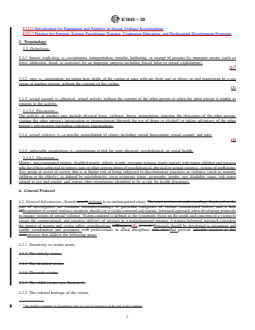
3.1.1 human traffıcking, n—recruitment, transportation,
safety concerns, if any, associated with its use. It is the
transfer, harboring, or receipt of persons by improper means
responsibility of the user of this standard to establish appro-
(such as force, abduction, fraud, or coercion) for an improper
priate safety, health, and environmental practices and deter-
purpose including forced labor or sexual exploitation).
mine the applicability of regulatory limitations prior to use.
(1)
1.5 This international standard was developed in accor-
dance with internationally recognized principles on standard- 3.1.2 rape, n—penetration, no matter how slight, of the
vagina or anus with any body part or object, or oral penetration
ization established in the Decision on Principles for the
Development of International Standards, Guides and Recom- by a sex organ of another person, without the consent of the
victim.
mendations issued by the World Trade Organization Technical
Barriers to Trade (TBT) Committee. (2)
3.1.3 sexual assault, n—physical, sexual activity without
2. Referenced Documents
the consent of the other person or when the other person is
2.1 ASTM Standards:
unable to consent to the activity.
3.1.3.1 Discussion—The activity or conduct may include
This guide is under the jurisdiction of ASTM Committee E30 on Forensic
physical force, violence, threat, intimidation, ignoring the
Sciences and is the direct responsibility of Subcommittee E30.11 on Interdisciplin-
objections of the other person, causing the other person’s
ary Forensic Science Standards.
intoxication or incapacitation (through the use of drugs or
Current edition approved Sept. 1, 2020. Published November 2020. Originally
alcohol) or taking advantage of the other person’s intoxication
approved in 1996. Last previous edition approved in 2016 as E1843 – 16. DOI:
10.1520/E1843-20.
(including voluntary intoxication).
For referenced ASTM standards, visit the ASTM website, www.astm.org, or
contact ASTM Customer Service at service@astm.org. For Annual Book of ASTM
Standardsvolumeinformation,refertothestandards’sDocumentSummarypageon The boldface numbers in parentheses refer to a list of references at the end of
the ASTM website. this standard.
Copyright © ASTM International, 100 Barr Harbor Drive, PO Box C700, West Conshohocken, PA 19428-2959. United States
E1843 − 20
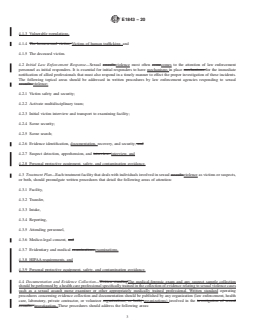
3.1.4 sexual violence, n—a specific constellation of crimes or both, should promulgate written procedures that detail the
including sexual harassment, sexual assault, and rape. following areas of attention:
(3) 4.3.1 Facility,
4.3.2 Transfer,
3.1.5 vulnerable populations, n—populations at risk for
4.3.3 Intake,
poor physical, psychological, or social health.
4.3.4 Reporting,
3.1.5.1 Discussion—Minors, unaccompanied minors, dis-
4.3.5 Attending personnel,
abled people, elderly people, pregnant women, single parents
4.3.6 Medico-legal consent,
with minor children and persons who have been subjected to
4.3.7 Evidentiary and medical examinations,
torture, rape or other serious forms of psychological, physical
4.3.8 HIPAA requirements, and
or sexual violence, victims of trafficking. Any group or sector
4.3.9 Personal protective equipment, safety, and contamina-
of society that is at higher risk of being subjected to discrimi-
tion avoidance.
natory practices or violence, (such as women, children or the
4.4 Documentation and Evidence Collection—The medical-
elderly), as defined by race/ethnicity, socio-economic status,
forensic exam and any suspect sample collection should be
geography, gender, age, disability status, risk status related to
performed by a health care professional specifically trained in
sex and gender, and among other populations identified to be
the collection of evidence relating to sexual violence cases
at-risk for health disparities.
such as a sexual assault nurse examiner or other appropriately
medically trained professional. Written standard operating
4. General Protocol
procedures concerning evidence collection and documentation
4.1 General Information—Sexual violence is an underre-
should be published by any organization (law enforcement,
ported crime. Responders to sexual violence incidents should
health care, laboratory, private contractor, or volunteer organi-
use a victim-centered and trauma- informed approach when
zations) involved in the investigation.These procedures should
developing protocols to engage victims of sexual violence.
address the following areas:
Victim-centered is defined as the systematic focus on the needs
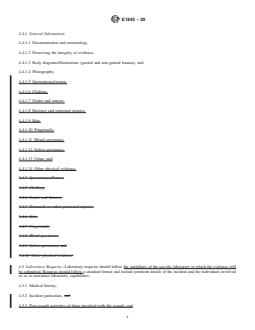
4.4.1 General Information:
and concerns of a victim to ensure the compassionate and
4.4.1.1 Documentation and terminology,
sensitive delivery of services in a nonjudgmental manner. A
4.4.1.2 Preserving the integrity of evidence,
trauma-informed approach considers the impact of trauma and
4.4.1.3 Body diagrams/illustrations (genital and non-genital
victimsafetyconsiderations (4).Protocolsshouldbedeveloped
trauma), and
to encourage and enable coordination and assistance with
4.4.1.4 Photography.
professionals in allied disciplines that provide services that
4.4.1.5 Spermatozoa/semen,
address the following areas:
4.4.1.6 Clothing,
4.1.1 Sensitivity to victim needs,
4.4.1.7 Swabs and smears,
4.1.2 The cultural heritage of the victim,
4.4.1.8 Bruising and patterned injuries,
4.1.3 Vulnerable populations,
4.4.1.9 Hair,
4.1.4 Victims of human trafficking, and
4.4.1.10 Fingernails,
4.1.5 The deceased victim.
4.4.1.11 Blood specimens,
4.4.1.12 Saliva specimens,
4.2 Initial Law Enforcement Response—Sexual violence
mostoftencomestotheattentionoflawenforcementpersonnel 4.4.1.13 Urine, and
asinitialresponders.Itisessentialforinitialresponderstohave 4.4.1.14 Other physical evidence.
mechanisms in place for the immediate notification of allied
4.5 Laboratory Requests—Laboratory requests should fol-
professionals that must also respond in a timely manner to
low the guidelines of the specific laboratory to which the
effecttheproperinvestigationoftheseincidents.Thefollowing
evidence will be submitted. Requests should follow a standard
topical areas should be addressed in written procedures by law
format and include pertinent details of the incident and the
enforcement agencies responding to sexual violence:
individuals involved so as to maximize laboratory capabilities:
4.2
...
This document is not an ASTM standard and is intended only to provide the user of an ASTM standard an indication of what changes have been made to the previous version. Because
it may not be technically possible to adequately depict all changes accurately, ASTM recommends that users consult prior editions as appropriate. In all cases only the current version
of the standard as published by ASTM is to be considered the official document.
Designation: E1843 − 16 E1843 − 20
Standard Guide for
Sexual AssaultViolence Investigation, Examination, and
Evidence Collection Protocol
This standard is issued under the fixed designation E1843; the number immediately following the designation indicates the year of
original adoption or, in the case of revision, the year of last revision. A number in parentheses indicates the year of last reapproval. A
superscript epsilon (´) indicates an editorial change since the last revision or reapproval.
1. Scope
1.1 This guide coversoutlines the basic components for the development of a sexual assaultviolence investigation protocol,
protocols, with specific attention to the examination of assault sexual violence scenes, victims and suspects of sexual
assault,violence, the recovery of testimonial, physical, and behavioral evidence, and the preservation and custody of physical
evidence.
1.2 This guide outlines proceduresprotocols requiring the experience of experts in a diversity of fields. A multidisciplinary team
approach to sexual assaultviolence investigation is necessary and is the current standard of care. This team should include members
skilled in the following disciplines: law enforcement, criminalistics, victim advocacy, and clinical, forensic practice.
1.3 This guide offers a set of instructions for performing one or more specific operations. This standard cannot replace knowledge,
skill,skills, or abilityabilities acquired through appropriate education, training, and experience (see Practice E2917and should ,
Education and Training) and is to be used in conjunction with sound professional judgment.professional judgement by individuals
with such discipline-specific knowledge, skills, and abilities.
1.4 This standard does not purport to address all of the safety concerns, if any, associated with its use. It is the responsibility
of the user of this standard to establish appropriate safety, health, and environmental practices and determine the applicability of
regulatory limitations prior to use.
1.5 This international standard was developed in accordance with internationally recognized principles on standardization
established in the Decision on Principles for the Development of International Standards, Guides and Recommendations issued
by the World Trade Organization Technical Barriers to Trade (TBT) Committee.
2. Referenced Documents
2.1 ASTM Standards:
E620 Practice for Reporting Opinions of Scientific or Technical Experts
E1020 Practice for Reporting Incidents that May Involve Criminal or Civil Litigation
E1188 Practice for Collection and Preservation of Information and Physical Items by a Technical Investigator
E1459 Guide for Physical Evidence Labeling and Related Documentation
E1492 Practice for Receiving, Documenting, Storing, and Retrieving Evidence in a Forensic Science Laboratory
E2123 Practice for Preservation of Evidence in Sexual Violence Investigation
This guide is under the jurisdiction of ASTM Committee E30 on Forensic Sciences and is the direct responsibility of Subcommittee E30.11 on Interdisciplinary Forensic
Science Standards.
Current edition approved March 1, 2016Sept. 1, 2020. Published March 2016November 2020. Originally approved in 1996. Last previous edition approved in 20102016
as E1843 – 96 (2010).E1843 – 16. DOI: 10.1520/E1843-16.10.1520/E1843-20.
For referenced ASTM standards, visit the ASTM website, www.astm.org, or contact ASTM Customer Service at service@astm.org. For Annual Book of ASTM Standards
volume information, refer to the standards’sstandards’s Document Summary page on the ASTM website.
Copyright © ASTM International, 100 Barr Harbor Drive, PO Box C700, West Conshohocken, PA 19428-2959. United States
E1843 − 20
E2124 Specification for Equipment and Supplies in Sexual Violence Investigations
E2917 Practice for Forensic Science Practitioner Training, Continuing Education, and Professional Development Programs
3. Terminology
3.1 Definitions:
3.1.1 human traffıcking, n—recruitment, transportation, transfer, harboring, or receipt of persons by improper means (such as
force, abduction, fraud, or coercion) for an improper purpose including forced labor or sexual exploitation).
(1)
3.1.2 rape, n—penetration, no matter how slight, of the vagina or anus with any body part or object, or oral penetration by a sex
organ of another person, without the consent of the victim.
(2)
3.1.3 sexual assault, n—physical, sexual activity without the consent of the other person or when the other person is unable to
consent to the activity.
3.1.3.1 Discussion—
The activity or conduct may include physical force, violence, threat, intimidation, ignoring the objections of the other person,
causing the other person’s intoxication or incapacitation (through the use of drugs or alcohol) or taking advantage of the other
person’s intoxication (including voluntary intoxication).
3.1.4 sexual violence, n—a specific constellation of crimes including sexual harassment, sexual assault, and rape.
(3)
3.1.5 vulnerable populations, n—populations at risk for poor physical, psychological, or social health.
3.1.5.1 Discussion—
Minors, unaccompanied minors, disabled people, elderly people, pregnant women, single parents with minor children and persons
who have been subjected to torture, rape or other serious forms of psychological, physical or sexual violence, victims of trafficking.
Any group or sector of society that is at higher risk of being subjected to discriminatory practices or violence, (such as women,
children or the elderly), as defined by race/ethnicity, socio-economic status, geography, gender, age, disability status, risk status
related to sex and gender, and among other populations identified to be at-risk for health disparities.
4. General Protocol
4.1 General Information—Sexual assaultviolence is an underreported crime. The most serious misunderstandings displayed on the
part of investigators are common misunderstandings of particular categories of victims (enumerated below) and a lack
ofResponders to sexual violence incidents should use a victim-centered and trauma- informed approach when developing protocols
to engage victims of sexual violence. Victim-centered is defined as the systematic focus on the needs and concerns of a victim to
ensure the compassionate and sensitive delivery of services in a nonjudgmental manner. A trauma-informed approach considers
the impact of trauma and victim safety considerations willingness(4). to work Protocols should be developed to encourage and
enable coordination and assistance with professionals in allied disciplines who also that provide valuable services in this
area:services that address the following areas:
4.1.1 Sensitivity to victim needs,
3.1.2 The elderly victim,
3.1.3 The disabled victim,
3.1.4 The male victim,
3.1.5 The child victim (see Section 4),
4.1.2 The cultural heritage of the victim,
The boldface numbers in parentheses refer to a list of references at the end of this standard.
E1843 − 20
4.1.3 Vulnerable populations,
4.1.4 The homosexual victim, Victims of human trafficking, and
4.1.5 The deceased victim.
4.2 Initial Law Enforcement Response—Sexual assaultsviolence most often comecomes to the attention of law enforcement
personnel as initial responders. It is essential for initial responders to have mechanisms in place mechanisms for the immediate
notification of allied professionals that must also respond in a timely manner to effect the proper investigation of these incidents.
The following topical areas should be addressed in written procedures by law enforcement agencies responding to sexual
assaults:violence:
4.2.1 Victim safety and security;
4.2.2 Activate multidisciplinary team;
4.2.3 Initial victim interview and transport to examining facility;
4.2.4 Scene security;
4.2.5 Scene search;
4.2.6 Evidence identification, documentation, recovery, and security; and
4.2.7 Suspect detection, apprehension, and interview. interview, and
4.2.8 Personal protective equipment, safety, and contamination avoidance.
4.3 Treatment Plan—Each treatment facility that deals with individuals involved in sexual assaultsviolence as victims or suspects,
or both, should promulgate written procedures that detail the following areas of attention:
4.3.1 Facility,
4.3.2 Transfer,
4.3.3 Intake,
4.3.4 Reporting,
4.3.5 Attending personnel,
4.3.6 Medico-legal consent, and
4.3.7 Evidentiary and medical examinations.examinations,
4.3.8 HIPAA requirements, and
4.3.9 Personal protective equipment, safety, and contamination avoidance.
4.4 Documentation and Evidence Collection—Written standingThe medical-forensic exam and any suspect sample collection
should be performed by a health care professional specifically trained in the collection of evidence relating to sexual violence cases
such as a sexual assault nurse examiner or other appropriately medically trained professional. Written standard operating
procedures concerning evidence collection and documentation should be published by any organization (law enforcement, health
care, laboratory, private contractor, or volunteer organizations, or both) organizations) involved in the investigation of sexual
assaults. investigation. These procedures should address the following areas:
E1843 − 20
4.4.1 General Information:
4.4.1.1 Documentation and terminology,
4.4.1.2 Preserving the integrity of evidence,
4.4.1.3 Body diagrams/illustrations (genital and non-
...