

ASTM C1610/C1610M-21
(Test Method)Standard Test Method for Static Segregation of Self-Consolidating Concrete Using Column Technique
General Information
- Abstract
SIGNIFICANCE AND USE
5.1 This test method provides users with a procedure to determine the potential static segregation of self-consolidating concrete.
Note 1: This test method may not be sufficiently rapid to evaluate self-consolidating concrete mixtures in the field before placement. Test Method C1712 provides a rapid method for assessing static segregation resistance of self-consolidating concrete.
5.2 This test method shall be used to develop self-consolidating concrete mixtures with segregation not exceeding specified limits. Self-consolidating concrete is a fluid concrete that can be prone to segregation if not proportioned to be cohesive. A cohesive self-consolidating concrete is important for all applications but is especially critical for deep-section applications such as walls or columns. Therefore, the degree of segregation can indicate if a mixture is suitable for the application.
Note 2: Some level of segregation is tolerable as long as the desired strength and durability performance is achieved.
SCOPE
1.1 This test method covers the determination of static segregation of self-consolidating concrete (SCC) by measuring the coarse aggregate content in the top and bottom portions of a cylindrical specimen (or column).
1.2 This test method is not applicable to self-consolidating concrete containing lightweight aggregate.
1.3 This test method is applicable under laboratory and field conditions.
1.4 The values stated in either SI units or inch-pound units are to be regarded separately as standard. The values stated in each system may not be exact equivalents; therefore, each system shall be used independently of the other. Combining values from the two systems may result in non-conformance with the standard.
1.5 The text of this standard references notes and footnotes that provide explanatory material. These notes and footnotes (excluding those in tables and figures) shall not be considered as requirements of the standard.
1.6 This standard does not purport to address all of the safety concerns, if any, associated with its use. It is the responsibility of the user of this standard to establish appropriate safety, health, and environmental practices and determine the applicability of regulatory limitations prior to use. (Warning—Fresh hydraulic cementitious mixtures are caustic and may cause chemical burns to skin and tissue upon prolonged exposure.2)
1.7 This international standard was developed in accordance with internationally recognized principles on standardization established in the Decision on Principles for the Development of International Standards, Guides and Recommendations issued by the World Trade Organization Technical Barriers to Trade (TBT) Committee.
- Status
- Published
- Publication Date
- 14-May-2021
- Technical Committee
- C09 - Concrete and Concrete Aggregates
- Drafting Committee
- C09.47 - Self-Consolidating Concrete
Buy Documents

ASTM C1610/C1610M-21 - Standard Test Method for Static Segregation of Self-Consolidating Concrete Using Column Technique
REDLINE ASTM C1610/C1610M-21 - Standard Test Method for Static Segregation of Self-Consolidating Concrete Using Column Technique
Overview
ASTM C1610/C1610M-21, published by ASTM International, specifies the standard test method for measuring the static segregation of self-consolidating concrete (SCC) using the column technique. This method is essential for evaluating the stability of SCC mixtures and ensuring their suitability for various structural applications, particularly when fluid concrete is used in deep sections such as walls and columns. Static segregation, or the settlement of coarse aggregate, can impact the durability and strength of finished concrete structures, making reliable testing procedures critical for quality control.
Key Topics
- Purpose of the Test: The method is designed to determine the static segregation potential of freshly-mixed SCC by comparing the coarse aggregate content at the top and bottom of a cylindrical specimen.
- Applicability: Suitable for both laboratory and field conditions but not intended for SCC containing lightweight aggregate.
- Sampling and Testing: Involves placing SCC into a specialized column mold, allowing the mixture to stand undisturbed, then analyzing coarse aggregate content from different sections.
- Metric and Imperial Units: The standard recognizes both SI and inch-pound units, which must not be combined.
- Safety Considerations: Highlights the importance of implementing appropriate safety, health, and environmental practices, particularly due to the caustic nature of fresh cementitious mixtures.
- Test Limitations: The method may not be rapid enough for real-time field decisions prior to concrete placement. ASTM C1712 provides a faster alternative for field assessments.
Applications
This standard is widely used by:
- Concrete Producers: To develop SCC mixtures with optimal stability, minimizing risk of unwanted segregation during placement.
- Structural Engineers: To assess whether specific SCC mixtures are suitable for critical applications, especially where high fluidity and resistance to segregation are paramount.
- Quality Control Laboratories: For routine testing of SCC mixes as part of comprehensive quality assurance programs.
- Construction Site Managers: To verify SCC is cohesive and will deliver the required finish and strength, particularly for deep-section elements like columns, piers, and walls.
Key practical values provided by ASTM C1610/C1610M-21 include:
- Ensuring the homogeneity of self-consolidating concrete
- Reducing potential for performance issues related to aggregate settlement
- Providing guidance in optimizing SCC mixture proportions for challenging applications
Related Standards
Various ASTM standards complement or are referenced by ASTM C1610/C1610M-21, supporting comprehensive assessment and management of self-consolidating concrete:
- ASTM C125 - Terminology Relating to Concrete and Concrete Aggregates
- ASTM C127 - Relative Density and Absorption of Coarse Aggregate
- ASTM C172/C172M - Sampling Freshly Mixed Concrete
- ASTM C173/C173M and C231/C231M - Air Content of Freshly Mixed Concrete
- ASTM C1712 - Rapid Assessment of Static Segregation Resistance of SCC
- ASTM C1758/C1758M - Fabricating Test Specimens with SCC
- ASTM D1785 - Specification for PVC Plastic Pipe
Practical Value
Adopting ASTM C1610/C1610M-21 helps organizations ensure the quality, durability, and structural integrity of self-consolidating concrete in demanding construction environments. By rigorously testing static segregation, concrete professionals can:
- Reduce costly repairs due to inadequate concrete placement
- Ensure compliance with international construction standards
- Improve confidence in the performance of SCC for both standard and specialized building projects
Keywords: Static segregation, self-consolidating concrete, SCC, coarse aggregate, stability, ASTM C1610, column technique, concrete testing, quality control, concrete standards.
Relations
- Effective Date
- 01-Jan-2024
- Effective Date
- 01-Jan-2024
- Effective Date
- 01-Oct-2023
- Effective Date
- 01-Sep-2023
- Effective Date
- 15-Dec-2019
- Effective Date
- 01-Jan-2019
- Effective Date
- 01-Oct-2018
- Effective Date
- 01-Jul-2018
- Effective Date
- 01-Jan-2018
- Effective Date
- 15-Dec-2016
- Effective Date
- 01-Feb-2016
- Effective Date
- 15-Dec-2015
- Effective Date
- 01-Aug-2015
- Effective Date
- 01-Jul-2015
- Effective Date
- 01-Feb-2015
Buy Documents
ASTM C1610/C1610M-21 - Standard Test Method for Static Segregation of Self-Consolidating Concrete Using Column Technique
REDLINE ASTM C1610/C1610M-21 - Standard Test Method for Static Segregation of Self-Consolidating Concrete Using Column Technique
Get Certified
Connect with accredited certification bodies for this standard

DIBt (Deutsches Institut für Bautechnik)
German Institute for Building Technology.
DIN CERTCO
DIN Group product certification.

Aboma Certification B.V.
Specialized in construction, metal, and transport sectors.
Sponsored listings
Frequently Asked Questions
ASTM C1610/C1610M-21 is a standard published by ASTM International. Its full title is "Standard Test Method for Static Segregation of Self-Consolidating Concrete Using Column Technique". This standard covers: SIGNIFICANCE AND USE 5.1 This test method provides users with a procedure to determine the potential static segregation of self-consolidating concrete. Note 1: This test method may not be sufficiently rapid to evaluate self-consolidating concrete mixtures in the field before placement. Test Method C1712 provides a rapid method for assessing static segregation resistance of self-consolidating concrete. 5.2 This test method shall be used to develop self-consolidating concrete mixtures with segregation not exceeding specified limits. Self-consolidating concrete is a fluid concrete that can be prone to segregation if not proportioned to be cohesive. A cohesive self-consolidating concrete is important for all applications but is especially critical for deep-section applications such as walls or columns. Therefore, the degree of segregation can indicate if a mixture is suitable for the application. Note 2: Some level of segregation is tolerable as long as the desired strength and durability performance is achieved. SCOPE 1.1 This test method covers the determination of static segregation of self-consolidating concrete (SCC) by measuring the coarse aggregate content in the top and bottom portions of a cylindrical specimen (or column). 1.2 This test method is not applicable to self-consolidating concrete containing lightweight aggregate. 1.3 This test method is applicable under laboratory and field conditions. 1.4 The values stated in either SI units or inch-pound units are to be regarded separately as standard. The values stated in each system may not be exact equivalents; therefore, each system shall be used independently of the other. Combining values from the two systems may result in non-conformance with the standard. 1.5 The text of this standard references notes and footnotes that provide explanatory material. These notes and footnotes (excluding those in tables and figures) shall not be considered as requirements of the standard. 1.6 This standard does not purport to address all of the safety concerns, if any, associated with its use. It is the responsibility of the user of this standard to establish appropriate safety, health, and environmental practices and determine the applicability of regulatory limitations prior to use. (Warning—Fresh hydraulic cementitious mixtures are caustic and may cause chemical burns to skin and tissue upon prolonged exposure.2) 1.7 This international standard was developed in accordance with internationally recognized principles on standardization established in the Decision on Principles for the Development of International Standards, Guides and Recommendations issued by the World Trade Organization Technical Barriers to Trade (TBT) Committee.
SIGNIFICANCE AND USE 5.1 This test method provides users with a procedure to determine the potential static segregation of self-consolidating concrete. Note 1: This test method may not be sufficiently rapid to evaluate self-consolidating concrete mixtures in the field before placement. Test Method C1712 provides a rapid method for assessing static segregation resistance of self-consolidating concrete. 5.2 This test method shall be used to develop self-consolidating concrete mixtures with segregation not exceeding specified limits. Self-consolidating concrete is a fluid concrete that can be prone to segregation if not proportioned to be cohesive. A cohesive self-consolidating concrete is important for all applications but is especially critical for deep-section applications such as walls or columns. Therefore, the degree of segregation can indicate if a mixture is suitable for the application. Note 2: Some level of segregation is tolerable as long as the desired strength and durability performance is achieved. SCOPE 1.1 This test method covers the determination of static segregation of self-consolidating concrete (SCC) by measuring the coarse aggregate content in the top and bottom portions of a cylindrical specimen (or column). 1.2 This test method is not applicable to self-consolidating concrete containing lightweight aggregate. 1.3 This test method is applicable under laboratory and field conditions. 1.4 The values stated in either SI units or inch-pound units are to be regarded separately as standard. The values stated in each system may not be exact equivalents; therefore, each system shall be used independently of the other. Combining values from the two systems may result in non-conformance with the standard. 1.5 The text of this standard references notes and footnotes that provide explanatory material. These notes and footnotes (excluding those in tables and figures) shall not be considered as requirements of the standard. 1.6 This standard does not purport to address all of the safety concerns, if any, associated with its use. It is the responsibility of the user of this standard to establish appropriate safety, health, and environmental practices and determine the applicability of regulatory limitations prior to use. (Warning—Fresh hydraulic cementitious mixtures are caustic and may cause chemical burns to skin and tissue upon prolonged exposure.2) 1.7 This international standard was developed in accordance with internationally recognized principles on standardization established in the Decision on Principles for the Development of International Standards, Guides and Recommendations issued by the World Trade Organization Technical Barriers to Trade (TBT) Committee.
ASTM C1610/C1610M-21 is classified under the following ICS (International Classification for Standards) categories: 91.100.30 - Concrete and concrete products. The ICS classification helps identify the subject area and facilitates finding related standards.
ASTM C1610/C1610M-21 has the following relationships with other standards: It is inter standard links to ASTM C173/C173M-24, ASTM C231/C231M-24, ASTM C1758/C1758M-23, ASTM C173/C173M-23, ASTM C125-19a, ASTM C125-19, ASTM C125-18b, ASTM C125-18a, ASTM C125-18, ASTM C125-16, ASTM C192/C192M-16, ASTM C125-15b, ASTM D1785-15, ASTM C125-15a, ASTM C125-15. Understanding these relationships helps ensure you are using the most current and applicable version of the standard.
ASTM C1610/C1610M-21 is available in PDF format for immediate download after purchase. The document can be added to your cart and obtained through the secure checkout process. Digital delivery ensures instant access to the complete standard document.
Standards Content (Sample)
This international standard was developed in accordance with internationally recognized principles on standardization established in the Decision on Principles for the
Development of International Standards, Guides and Recommendations issued by the World Trade Organization Technical Barriers to Trade (TBT) Committee.
Designation: C1610/C1610M − 21
Standard Test Method for
Static Segregation of Self-Consolidating Concrete Using
Column Technique
This standard is issued under the fixed designation C1610/C1610M; the number immediately following the designation indicates the
year of original adoption or, in the case of revision, the year of last revision. A number in parentheses indicates the year of last
reapproval. A superscript epsilon (´) indicates an editorial change since the last revision or reapproval.
1. Scope* 2. Referenced Documents
1.1 This test method covers the determination of static 2.1 ASTM Standards:
segregation of self-consolidating concrete (SCC) by measuring C125 Terminology Relating to Concrete and Concrete Ag-
the coarse aggregate content in the top and bottom portions of gregates
a cylindrical specimen (or column). C127 Test Method for Relative Density (Specific Gravity)
and Absorption of Coarse Aggregate
1.2 This test method is not applicable to self-consolidating
C172/C172M Practice for Sampling Freshly Mixed Con-
concrete containing lightweight aggregate.
crete
1.3 This test method is applicable under laboratory and field
C173/C173M Test Method forAir Content of Freshly Mixed
conditions.
Concrete by the Volumetric Method
1.4 The values stated in either SI units or inch-pound units C192/C192M Practice for Making and Curing Concrete Test
Specimens in the Laboratory
are to be regarded separately as standard. The values stated in
each system may not be exact equivalents; therefore, each C231/C231M Test Method forAir Content of Freshly Mixed
Concrete by the Pressure Method
system shall be used independently of the other. Combining
values from the two systems may result in non-conformance C1712 Test Method for Rapid Assessment of Static Segre-
gation Resistance of Self-Consolidating Concrete Using
with the standard.
Penetration Test
1.5 The text of this standard references notes and footnotes
C1758/C1758M Practice for Fabricating Test Specimens
that provide explanatory material. These notes and footnotes
with Self-Consolidating Concrete
(excluding those in tables and figures) shall not be considered
D1785 Specification for Poly(Vinyl Chloride) (PVC) Plastic
as requirements of the standard.
Pipe, Schedules 40, 80, and 120
1.6 This standard does not purport to address all of the
safety concerns, if any, associated with its use. It is the
3. Terminology
responsibility of the user of this standard to establish appro-
3.1 Definitions:
priate safety, health, and environmental practices and deter-
3.1.1 For definitions of terms used in this test method, refer
mine the applicability of regulatory limitations prior to use.
to Terminology C125.
(Warning—Fresh hydraulic cementitious mixtures are caustic
3.2 Definitions of Terms Specific to This Standard:
and may cause chemical burns to skin and tissue upon
3.2.1 static segregation, n—settlement of coarse aggregate
prolonged exposure. )
particles in an undisturbed mass of fresh concrete.
1.7 This international standard was developed in accor-
dance with internationally recognized principles on standard-
4. Summary of Test Method
ization established in the Decision on Principles for the
4.1 Asampleoffreshly-mixedself-consolidatingconcreteis
Development of International Standards, Guides and Recom-
placed in a cylindrical mold without tamping or vibration. The
mendations issued by the World Trade Organization Technical
mold is separated into three sections representing different
Barriers to Trade (TBT) Committee.
levels of the cylindrical specimen (or column). Portions of
SCCfromthetopandbottomsectionarewashedona4.75mm
This test method is under the jurisdiction of ASTM Committee C09 on
(No. 4) sieve, leaving the coarse aggregate on the sieve. The
Concrete and ConcreteAggregates and is the direct responsibility of Subcommittee
C09.47 on Self-Consolidating Concrete.
Current edition approved May 15, 2021. Published June 2021. Originally
approved in 2006. Last previous edition approved in 2019 as C1610/C1610M – 19. For referenced ASTM standards, visit the ASTM website, www.astm.org, or
DOI: 10.1520/C1610_C1610M-21. contact ASTM Customer Service at service@astm.org. For Annual Book of ASTM
Section on Safety Precautions, Manual of Aggregate and Concrete Testing, Standards volume information, refer to the standard’s Document Summary page on
Annual Book of ASTM Standards, Vol 04.02. the ASTM website.
*A Summary of Changes section appears at the end of this standard
Copyright © ASTM International, 100 Barr Harbor Drive, PO Box C700, West Conshohocken, PA 19428-2959. United States
C1610/C1610M − 21
masses of coarse aggregate in the top and the bottom sections 6. Apparatus
are determined and the percent static segregation is calculated.
6.1 Balance—as described in Test Method C127.
5. Significance and Use
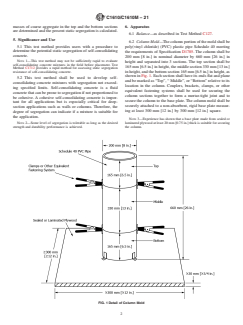
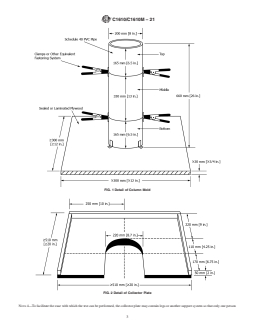
6.2 Column Mold—The column portion of the mold shall be
5.1 This test method provides users with a procedure to poly(vinyl chloride) (PVC) plastic pipe Schedule 40 meeting
determine the potential static segregation of self-consolidating the requirements of Specification D1785. The column shall be
concrete.
200 mm [8 in.] in nominal diameter by 660 mm [26 in.] in
NOTE 1—This test method may not be sufficiently rapid to evaluate
height and separated into 3 sections. The top section shall be
self-consolidating concrete mixtures in the field before placement. Test
165 mm [6.5 in.] in height, the middle section 330 mm [13 in.]
Method C1712 provides a rapid method for assessing static segregation
in height, and the bottom section 165 mm [6.5 in.] in height, as
resistance of self-consolidating concrete.
shown in Fig. 1. Each section shall have its ends flat and plane
5.2 This test method shall be used to develop self-
and be marked as “Top”, “ Middle”, or “Bottom” relative to its
consolidating concrete mixtures with segregation not exceed-
location in the column. Couplers, brackets, clamps, or other
ing specified limits. Self-consolidating concrete is a fluid
equivalent fastening systems shall be used for securing the
concrete that can be prone to segregation if not proportioned to
column sections together to form a mortar-tight joint and to
be cohesive. A cohesive self-consolidating concrete is impor-
secure the column to the base plate. The column mold shall be
tant for all applications but is especially critical for deep-
securely attached to a non-absorbent, rigid base plate measur-
section applications such as walls or columns. Therefore, the
ing at least 300 mm [12 in.] by 300 mm [12 in.] square.
degree of segregation can indicate if a mixture is suitable for
the application.
NOTE 3—Experience has shown that a base plate made from sealed or
laminated plywood at least 20 mm [0.75 in.] thick is suitable for securing
NOTE 2—Some l
...
This document is not an ASTM standard and is intended only to provide the user of an ASTM standard an indication of what changes have been made to the previous version. Because
it may not be technically possible to adequately depict all changes accurately, ASTM recommends that users consult prior editions as appropriate. In all cases only the current version
of the standard as published by ASTM is to be considered the official document.
Designation: C1610/C1610M − 19 C1610/C1610M − 21
Standard Test Method for
Static Segregation of Self-Consolidating Concrete Using
Column Technique
This standard is issued under the fixed designation C1610/C1610M; the number immediately following the designation indicates the
year of original adoption or, in the case of revision, the year of last revision. A number in parentheses indicates the year of last
reapproval. A superscript epsilon (´) indicates an editorial change since the last revision or reapproval.
1. Scope*
1.1 This test method covers the determination of static segregation of self-consolidating concrete (SCC) by measuring the coarse
aggregate content in the top and bottom portions of a cylindrical specimen (or column).
1.2 This test method is not applicable to self-consolidating concrete containing lightweight aggregate.
1.3 This test method is applicable under laboratory and field conditions.
1.4 The values stated in either SI units or inch-pound units are to be regarded separately as standard. The values stated in each
system may not be exact equivalents; therefore, each system shall be used independently of the other. Combining values from the
two systems may result in non-conformance with the standard.
1.5 The text of this standard references notes and footnotes that provide explanatory material. These notes and footnotes
(excluding those in tables and figures) shall not be considered as requirements of the standard.
1.6 This standard does not purport to address all of the safety concerns, if any, associated with its use. It is the responsibility
of the user of this standard to establish appropriate safety, health, and environmental practices and determine the applicability of
regulatory limitations prior to use. (Warning—Fresh hydraulic cementitious mixtures are caustic and may cause chemical burns
to skin and tissue upon prolonged exposure. )
1.7 This international standard was developed in accordance with internationally recognized principles on standardization
established in the Decision on Principles for the Development of International Standards, Guides and Recommendations issued
by the World Trade Organization Technical Barriers to Trade (TBT) Committee.
2. Referenced Documents
2.1 ASTM Standards:
C125 Terminology Relating to Concrete and Concrete Aggregates
C127 Test Method for Relative Density (Specific Gravity) and Absorption of Coarse Aggregate
C172/C172M Practice for Sampling Freshly Mixed Concrete
C173/C173M Test Method for Air Content of Freshly Mixed Concrete by the Volumetric Method
This test method is under the jurisdiction of ASTM Committee C09 on Concrete and Concrete Aggregates and is the direct responsibility of Subcommittee C09.47 on
Self-Consolidating Concrete.
Current edition approved June 15, 2019May 15, 2021. Published August 2019June 2021. Originally approved in 2006. Last previous edition approved in 20172019 as
C1610/C1610M – 17.19. DOI: 10.1520/C1610_C1610M-19.10.1520/C1610_C1610M-21.
Section on Safety Precautions, Manual of Aggregate and Concrete Testing, Annual Book of ASTM Standards, Vol 04.02.
For referenced ASTM standards, visit the ASTM website, www.astm.org, or contact ASTM Customer Service at service@astm.org. For Annual Book of ASTM Standards
volume information, refer to the standard’s Document Summary page on the ASTM website.
*A Summary of Changes section appears at the end of this standard
Copyright © ASTM International, 100 Barr Harbor Drive, PO Box C700, West Conshohocken, PA 19428-2959. United States
C1610/C1610M − 21
C192/C192M Practice for Making and Curing Concrete Test Specimens in the Laboratory
C231/C231M Test Method for Air Content of Freshly Mixed Concrete by the Pressure Method
C1712 Test Method for Rapid Assessment of Static Segregation Resistance of Self-Consolidating Concrete Using Penetration
Test
C1758/C1758M Practice for Fabricating Test Specimens with Self-Consolidating Concrete
D1785 Specification for Poly(Vinyl Chloride) (PVC) Plastic Pipe, Schedules 40, 80, and 120
3. Terminology
3.1 Definitions:
3.1.1 For definitions of terms used in this test method, refer to Terminology C125.
3.2 Definitions of Terms Specific to This Standard:
3.2.1 static segregation, n—settlement of coarse aggregate particles in an undisturbed mass of fresh concrete.
4. Summary of Test Method
4.1 A sample of freshly-mixed self-consolidating concrete is placed in a cylindrical mold without tamping or vibration. The mold
is separated into three sections representing different levels of the cylindrical specimen (or column). Portions of SCC from the top
and bottom section are washed on a 4.75 mm (No. 4) sieve, leaving the coarse aggregate on the sieve. The masses of coarse
aggregate in the top and the bottom sections are determined and the percent static segregation is calculated.
5. Significance and Use
5.1 This test method provides users with a procedure to determine the potential static segregation of self-consolidating concrete.
NOTE 1—This test method may not be sufficiently rapid to evaluate self-consolidating concrete mixtures in the field before placement. Test Method C1712
provides a rapid method for assessing static segregation resistance of self-consolidating concrete.
5.2 This test method shall be used to develop self-consolidating concrete mixtures with segregation not exceeding specified limits.
Self-consolidating concrete is a fluid concrete that can be prone to segregation if not proportioned to be cohesive. A cohesive
self-consolidating concrete is important for all applications but is especially critical for deep-section applications such as walls or
columns. Therefore, the degree of segregation can indicate if a mixture is suitable for the application.
NOTE 2—Some level of segregation is tolerable as long as the desired strength and durability performance is achieved.
6. Apparatus
6.1 Balance—as described in Test Method C127.
6.2 Column Mold—The column portion of the mold shall be poly(vinyl chloride) (PVC) plastic pipe Schedule 40 meeting the
requirements of Specification D1785. The column shall be 200 mm [8 in.] in nominal diameter by 660 mm [26 in.] in height and
separated into 3 sections. The top section shall be 165 mm [6.5 in.] in height, the middle section 330 mm [13 in.] in height, and
the bottom section 165 mm [6.5 in.] in height, as shown in Fig. 1. Each section shall have its ends flat and plane and be marked
as “Top”, “ Middle”, or “Bottom” relative to its location in the column. Couplers, brackets, clamps, or other equivalent fastening
systems shall be used for securing the column sections together to form a mortar-tight joint and to secure the column to the base
plate. The column mold shall be securely attached to a non-absorbent, rigid base plate measuring at least 300 mm [12 in.] by 300
mm [12 in.] square.
NOTE 3—Experience has shown that a base plate made from sealed or
...