

ASTM D5121-22
(Practice)Standard Practice for Preparation of Rock Slabs for Durability Testing
General Information
- Abstract
SIGNIFICANCE AND USE
4.1 This practice is used to prepare rock specimens for durability testing and to evaluate any internal defects, such as cracks, that may not be apparent on the surfaces of broken blocks of rock. Such evaluation can also aid in the selection and location of slabs for testing as outlined in Practice D4992. In some cases, the need for further testing or evaluation may be eliminated.
4.2 The sawing of rock samples will reduce them to a suitable specimen size and quantity for testing and, in many cases, preserve the natural structure of the internal defects so the samples can be evaluated by the various durability tests.
4.3 Durability tests specimens should be 65 ± 5 mm (2.5 ± 0.25 in) thick normal to bedding or any potential planes of weakness which may be observed in the samples. In no case will the size of the slab be less than 125 mm (5 in.) on a side, excluding the thickness Ideally, a test specimen size equal to the proposed design size would provide the ultimate in correlation between laboratory tests and actual field performance. However, in most cases, this is neither practical nor economically feasible.
Note 1: The quality of the result produced by this standard is dependent upon the competence of the personnel performing it, and the suitability of the equipment and facilities used. Agencies that meet the criteria of Practice D3740 are generally considered capable of competent and objective testing/sampling/inspection/etc. Users of this standard are cautioned that compliance with Practice D3740 does not in itself assure reliable results. Reliable results depend on many factors; Practice D3740 provides a means of evaluation some of those factors.
SCOPE
1.1 This practice covers the preparation of rock slabs for various tests and any visual inspections used to evaluate the durability of rock for erosion control. These tests include, but are not limited to, Test Methods D5240/D5240M, D5312/D5312M, and D5313/D5313M. This practice is appropriate for the assessment of breakwater stone, armor stone, riprap, and gabion sized rock materials.
1.2 Units—The values stated in SI units are to be regarded as standard. The inch-pound units given in parentheses are for information only.
1.3 All observed and measured values shall conform to the guidelines for significant digits and rounding established in Practice D6026, unless superseded by this standard.
1.4 This practice offers a set of instructions for performing one or more specific operations. This document cannot replace education or experience and should be used in conjunction with professional judgment. Not all aspects of this practice may be applicable in all circumstances. This ASTM standard is not intended to represent or replace the standard of care by which the adequacy of a given professional service must be judged, nor should this document be applied without consideration of a project's many unique aspects. The word “Standard” in the title of this document means only that the document has been approved through the ASTM consensus process.
1.5 This standard does not purport to address all of the safety concerns, if any, associated with its use. It is the responsibility of the user of this standard to establish appropriate safety, health, and environmental practices and determine the applicability of regulatory limitations prior to use. For a specific hazards statement, see Section 7.
1.6 This international standard was developed in accordance with internationally recognized principles on standardization established in the Decision on Principles for the Development of International Standards, Guides and Recommendations issued by the World Trade Organization Technical Barriers to Trade (TBT) Committee.
- Status
- Published
- Publication Date
- 31-Dec-2021
- Technical Committee
- D18 - Soil and Rock
- Drafting Committee
- D18.17 - Rock for Erosion Control


Overview
ASTM D5121-22: Standard Practice for Preparation of Rock Slabs for Durability Testing provides detailed procedures for preparing rock slabs for various durability tests, specifically for erosion control applications. This ASTM standard ensures rock samples are prepared in a way that maintains the integrity of their internal structures, allowing reliable evaluation of features such as internal defects and cracks. The standard is widely adopted in geotechnical engineering to support the assessment of rocks used in critical infrastructure, including breakwater stone, armor stone, riprap, and gabion fill materials.
Key Topics
- Specimen Preparation Methodology
- Sawing rock blocks into slabs of specific sizes and orientations to reflect the natural structure and potential planes of weakness.
- Ideal slabs are 65 ± 5 mm thick, with minimum dimensions not less than 125 mm on a side, ensuring sufficient representation for laboratory durability tests.
- Visual Inspection
- Thorough inspection to identify internal defects such as fractures, weak planes, or inclusions that are not visible on external surfaces.
- Use of still or video cameras and a photographic scale for documentation.
- Equipment and Materials
- Utilization of laboratory diamond saws or diamond wire saws capable of delivering clean, parallel cuts.
- Employment of water as a coolant during sawing to minimize sample alteration.
- Recording and Documentation
- Detailed records including identification number, sample origin, rock type, test trials, observed defects, and photographic evidence.
- Safety Considerations
- Emphasis on proper handling procedures and personal protective equipment to manage risks from cutting operations and potential projectiles.
Applications
ASTM D5121-22 is especially valuable in the preparation of rock samples for:
- Durability testing in accordance with ASTM test methods (D5240/D5240M, D5312/D5312M, D5313/D5313M), which assess how well rocks withstand cycles of wetting/drying, freezing/thawing, and salt crystallization.
- Material selection for erosion control, where the performance of breakwater stone, armor stone, riprap, and gabion fill directly impacts the longevity and safety of shorelines, riverbanks, and infrastructure.
- Quality assurance during construction projects, ensuring that only rocks with suitable durability and minimal defects are used for critical applications.
- Laboratory correlation with field performance, aiding engineers in forecasting the behavior of rock materials under real-world conditions.
- Geotechnical investigations, supporting consultants and engineers in characterizing rock sources and optimizing material procurement.
Related Standards
For thorough compliance and best practices, practitioners should reference the following related ASTM standards:
- ASTM D4992 - Practice for Evaluation of Rock to be Used for Erosion Control
- ASTM D5240/D5240M - Test Method for Evaluation of the Durability of Rock for Erosion Control Using Sodium Sulfate or Magnesium Sulfate
- ASTM D5312/D5312M - Test Method for Evaluation of Durability of Rock for Erosion Control Under Freezing and Thawing Conditions
- ASTM D5313/D5313M - Test Method for Evaluation of Durability of Rock for Erosion Control Under Wetting and Drying Conditions
- ASTM D653 - Terminology Relating to Soil, Rock, and Contained Fluids
- ASTM D3740 - Practice for Minimum Requirements for Agencies Engaged in Testing and/or Inspection of Soil and Rock as Used in Engineering Design and Construction
- ASTM D6026 - Practice for Using Significant Digits and Data Records in Geotechnical Data
By following ASTM D5121-22 and related references, industry professionals can ensure rock durability testing is executed with precision, reliability, and adherence to international best practices for erosion control and geotechnical engineering.
Relations
- Effective Date
- 01-Nov-2023
- Effective Date
- 01-Jan-2020
- Effective Date
- 01-Oct-2019
- Effective Date
- 01-Aug-2014
- Effective Date
- 01-May-2014
- Effective Date
- 15-Jan-2013
- Effective Date
- 15-Jan-2013
- Effective Date
- 01-Jul-2012
- Effective Date
- 01-Jul-2012
- Effective Date
- 01-Jul-2012
- Effective Date
- 01-May-2012
- Effective Date
- 01-Mar-2012
- Effective Date
- 01-Sep-2011
- Effective Date
- 01-Sep-2011
- Effective Date
- 01-Mar-2010
Get Certified
Connect with accredited certification bodies for this standard

DIBt (Deutsches Institut für Bautechnik)
German Institute for Building Technology.
DIN CERTCO
DIN Group product certification.

Aboma Certification B.V.
Specialized in construction, metal, and transport sectors.
Sponsored listings
Frequently Asked Questions
ASTM D5121-22 is a standard published by ASTM International. Its full title is "Standard Practice for Preparation of Rock Slabs for Durability Testing". This standard covers: SIGNIFICANCE AND USE 4.1 This practice is used to prepare rock specimens for durability testing and to evaluate any internal defects, such as cracks, that may not be apparent on the surfaces of broken blocks of rock. Such evaluation can also aid in the selection and location of slabs for testing as outlined in Practice D4992. In some cases, the need for further testing or evaluation may be eliminated. 4.2 The sawing of rock samples will reduce them to a suitable specimen size and quantity for testing and, in many cases, preserve the natural structure of the internal defects so the samples can be evaluated by the various durability tests. 4.3 Durability tests specimens should be 65 ± 5 mm (2.5 ± 0.25 in) thick normal to bedding or any potential planes of weakness which may be observed in the samples. In no case will the size of the slab be less than 125 mm (5 in.) on a side, excluding the thickness Ideally, a test specimen size equal to the proposed design size would provide the ultimate in correlation between laboratory tests and actual field performance. However, in most cases, this is neither practical nor economically feasible. Note 1: The quality of the result produced by this standard is dependent upon the competence of the personnel performing it, and the suitability of the equipment and facilities used. Agencies that meet the criteria of Practice D3740 are generally considered capable of competent and objective testing/sampling/inspection/etc. Users of this standard are cautioned that compliance with Practice D3740 does not in itself assure reliable results. Reliable results depend on many factors; Practice D3740 provides a means of evaluation some of those factors. SCOPE 1.1 This practice covers the preparation of rock slabs for various tests and any visual inspections used to evaluate the durability of rock for erosion control. These tests include, but are not limited to, Test Methods D5240/D5240M, D5312/D5312M, and D5313/D5313M. This practice is appropriate for the assessment of breakwater stone, armor stone, riprap, and gabion sized rock materials. 1.2 Units—The values stated in SI units are to be regarded as standard. The inch-pound units given in parentheses are for information only. 1.3 All observed and measured values shall conform to the guidelines for significant digits and rounding established in Practice D6026, unless superseded by this standard. 1.4 This practice offers a set of instructions for performing one or more specific operations. This document cannot replace education or experience and should be used in conjunction with professional judgment. Not all aspects of this practice may be applicable in all circumstances. This ASTM standard is not intended to represent or replace the standard of care by which the adequacy of a given professional service must be judged, nor should this document be applied without consideration of a project's many unique aspects. The word “Standard” in the title of this document means only that the document has been approved through the ASTM consensus process. 1.5 This standard does not purport to address all of the safety concerns, if any, associated with its use. It is the responsibility of the user of this standard to establish appropriate safety, health, and environmental practices and determine the applicability of regulatory limitations prior to use. For a specific hazards statement, see Section 7. 1.6 This international standard was developed in accordance with internationally recognized principles on standardization established in the Decision on Principles for the Development of International Standards, Guides and Recommendations issued by the World Trade Organization Technical Barriers to Trade (TBT) Committee.
SIGNIFICANCE AND USE 4.1 This practice is used to prepare rock specimens for durability testing and to evaluate any internal defects, such as cracks, that may not be apparent on the surfaces of broken blocks of rock. Such evaluation can also aid in the selection and location of slabs for testing as outlined in Practice D4992. In some cases, the need for further testing or evaluation may be eliminated. 4.2 The sawing of rock samples will reduce them to a suitable specimen size and quantity for testing and, in many cases, preserve the natural structure of the internal defects so the samples can be evaluated by the various durability tests. 4.3 Durability tests specimens should be 65 ± 5 mm (2.5 ± 0.25 in) thick normal to bedding or any potential planes of weakness which may be observed in the samples. In no case will the size of the slab be less than 125 mm (5 in.) on a side, excluding the thickness Ideally, a test specimen size equal to the proposed design size would provide the ultimate in correlation between laboratory tests and actual field performance. However, in most cases, this is neither practical nor economically feasible. Note 1: The quality of the result produced by this standard is dependent upon the competence of the personnel performing it, and the suitability of the equipment and facilities used. Agencies that meet the criteria of Practice D3740 are generally considered capable of competent and objective testing/sampling/inspection/etc. Users of this standard are cautioned that compliance with Practice D3740 does not in itself assure reliable results. Reliable results depend on many factors; Practice D3740 provides a means of evaluation some of those factors. SCOPE 1.1 This practice covers the preparation of rock slabs for various tests and any visual inspections used to evaluate the durability of rock for erosion control. These tests include, but are not limited to, Test Methods D5240/D5240M, D5312/D5312M, and D5313/D5313M. This practice is appropriate for the assessment of breakwater stone, armor stone, riprap, and gabion sized rock materials. 1.2 Units—The values stated in SI units are to be regarded as standard. The inch-pound units given in parentheses are for information only. 1.3 All observed and measured values shall conform to the guidelines for significant digits and rounding established in Practice D6026, unless superseded by this standard. 1.4 This practice offers a set of instructions for performing one or more specific operations. This document cannot replace education or experience and should be used in conjunction with professional judgment. Not all aspects of this practice may be applicable in all circumstances. This ASTM standard is not intended to represent or replace the standard of care by which the adequacy of a given professional service must be judged, nor should this document be applied without consideration of a project's many unique aspects. The word “Standard” in the title of this document means only that the document has been approved through the ASTM consensus process. 1.5 This standard does not purport to address all of the safety concerns, if any, associated with its use. It is the responsibility of the user of this standard to establish appropriate safety, health, and environmental practices and determine the applicability of regulatory limitations prior to use. For a specific hazards statement, see Section 7. 1.6 This international standard was developed in accordance with internationally recognized principles on standardization established in the Decision on Principles for the Development of International Standards, Guides and Recommendations issued by the World Trade Organization Technical Barriers to Trade (TBT) Committee.
ASTM D5121-22 is classified under the following ICS (International Classification for Standards) categories: 91.100.15 - Mineral materials and products. The ICS classification helps identify the subject area and facilitates finding related standards.
ASTM D5121-22 has the following relationships with other standards: It is inter standard links to ASTM D3740-23, ASTM D5240/D5240M-20, ASTM D3740-19, ASTM D653-14, ASTM D4992-14, ASTM D5240/D5240M-12(2013), ASTM D5240/D5240M-12(2013)e1, ASTM D5240/D5240M-12, ASTM D5312/D5312M-12, ASTM D5313/D5313M-12, ASTM D3740-12a, ASTM D3740-12, ASTM D653-11, ASTM D3740-11, ASTM D3740-10. Understanding these relationships helps ensure you are using the most current and applicable version of the standard.
ASTM D5121-22 is available in PDF format for immediate download after purchase. The document can be added to your cart and obtained through the secure checkout process. Digital delivery ensures instant access to the complete standard document.
Standards Content (Sample)
This international standard was developed in accordance with internationally recognized principles on standardization established in the Decision on Principles for the
Development of International Standards, Guides and Recommendations issued by the World Trade Organization Technical Barriers to Trade (TBT) Committee.
Designation: D5121 − 22
Standard Practice for
Preparation of Rock Slabs for Durability Testing
This standard is issued under the fixed designation D5121; the number immediately following the designation indicates the year of
original adoption or, in the case of revision, the year of last revision. A number in parentheses indicates the year of last reapproval. A
superscript epsilon (´) indicates an editorial change since the last revision or reapproval.
1. Scope* mendations issued by the World Trade Organization Technical
Barriers to Trade (TBT) Committee.
1.1 This practice covers the preparation of rock slabs for
various tests and any visual inspections used to evaluate the
2. Referenced Documents
durability of rock for erosion control. These tests include, but
2.1 ASTM Standards:
are not limited to, Test Methods D5240/D5240M, D5312/
D653 Terminology Relating to Soil, Rock, and Contained
D5312M, and D5313/D5313M.This practice is appropriate for
Fluids
the assessment of breakwater stone, armor stone, riprap, and
D3740 Practice for Minimum Requirements for Agencies
gabion sized rock materials.
Engaged in Testing and/or Inspection of Soil and Rock as
1.2 Units—The values stated in SI units are to be regarded
Used in Engineering Design and Construction
as standard. The inch-pound units given in parentheses are for
D4992 Practice for Evaluation of Rock to be Used for
information only.
Erosion Control
1.3 All observed and measured values shall conform to the D5240/D5240M Test Method for Evaluation of the Durabil-
guidelines for significant digits and rounding established in ity of Rock for Erosion Control Using Sodium Sulfate or
Practice D6026, unless superseded by this standard. Magnesium Sulfate
D5312/D5312M TestMethodforEvaluationofDurabilityof
1.4 This practice offers a set of instructions for performing
Rock for Erosion Control Under Freezing and Thawing
one or more specific operations. This document cannot replace
Conditions
education or experience and should be used in conjunction
D5313/D5313M TestMethodforEvaluationofDurabilityof
with professional judgment. Not all aspects of this practice may
Rock for Erosion Control Under Wetting and Drying
be applicable in all circumstances. This ASTM standard is not
Conditions
intended to represent or replace the standard of care by which
D6026 Practice for Using Significant Digits and Data Re-
the adequacy of a given professional service must be judged,
cords in Geotechnical Data
nor should this document be applied without consideration of
a project’s many unique aspects. The word “Standard” in the
3. Terminology
title of this document means only that the document has been
3.1 Definitions—For definitions of common technical terms
approved through the ASTM consensus process.
used in this standard, refer to Terminology D653.
1.5 This standard does not purport to address all of the
3.2 Definitions of Terms Specific to This Standard:
safety concerns, if any, associated with its use. It is the
3.2.1 rock saw, n—a saw capable of cutting rock. The term
responsibility of the user of this standard to establish appro-
“rock saw” shall include the blade which saws the rock, any
priate safety, health, and environmental practices and deter-
components that control or power the sawing process or both,
mine the applicability of regulatory limitations prior to use.
and framework on which the blade and any other associated
For a specific hazards statement, see Section 7.
components are mounted.
1.6 This international standard was developed in accor-
3.2.1.1 Discussion—A rock saw may be a water-cooled
dance with internationally recognized principles on standard-
diamond blade or diamond wire saw.
ization established in the Decision on Principles for the
Development of International Standards, Guides and Recom-
3.2.2 slab, n—a section of rock having two smooth, ap-
proximately parallel faces, produced by two saw cuts. The
thickness of the slab is generally less than the other dimensions
This practice is under the jurisdiction of ASTM Committee D18 on Soil and
Rock and is the direct responsibility of Subcommittee D18.17 on Rock for Erosion
Control. For referenced ASTM standards, visit the ASTM website, www.astm.org, or
Current edition approved Jan. 1, 2022. Published January 2022. Originally contact ASTM Customer Service at service@astm.org. For Annual Book of ASTM
approved in 1990. Last previous edition approved in 2015 as D5121–15. DOI: Standards volume information, refer to the standard’s Document Summary page on
10.1520/D5121-22. the ASTM website.
*A Summary of Changes section appears at the end of this standard
Copyright © ASTM International, 100 Barr Harbor Drive, PO Box C700, West Conshohocken, PA 19428-2959. United States
D5121 − 22
of the rock. The slab will be the specimen of a rock which will 5.1.1 The rock saw apparatus shall have a vise to hold the
subsequently undergo durability tests. samples during the cutting process, in addition to an automatic
feed (either gravity, hydraulic, or screwfeed operated) that
3.2.3 slice, n—in rock testing, the smooth surface of rock
controls the cutting action. A table saw with a removable vise
piece produced by the cutting of the rock by a rock saw.
is also acceptable.The saw shall have a platform to prevent the
3.2.4 gabion-fill stone, n—stone generally less than 25 kg
cut slab from falling and shattering.
(50 lb) and placed in baskets of wire or other suitable material.
5.2 Camera—A video or still camera capable of producing
These baskets are then tied together to form an integral
good quality, color images for taking pictures of the rock
structure designed to resist erosion along stream banks and
sample and specimens before and after slab cutting.
around bridge piers.
5.3 Photographic Scale—A scale of appropriate dimension
4. Significance and Use
and division when compared to the field of view and the detail
4.1 This practice is used to prepare rock specimens for being studied. When selecting a scale, always choose the scale
that will provide at least as precise a measurement as the
durability testing and to evaluate any internal defects, such as
system that will be measuring the photographic information. If
cracks, that may not be apparent on the surfaces of broken
the system has a precision to one millimeter, make sure the
blocks of rock. Such evaluation can also aid in the selection
scale used is accurate and precise to at least one millimeter
and location of slabs for testing as outlined in Practice D4992.
across the entire scale.
Insomecases,theneedforfurthertestingorevaluationmaybe
eliminated.
6. Materials
4.2 The sawing of rock samples will reduce them to a
6.1 Coolant—Water shall be used as a coolant between the
suitable specimen size and quantity for testing and, in many
rock surface and the saw blade during the cutting process.
cases, preserve the natural structure of the internal defects so
Coolants other than water may interfere with subsequent
the samples can be evaluated by the various durability tests.
testing or evaluation, or both.
4.3 Durability tests specimens should be 65 6 5 mm (2.5 6
6.2 Wash—Water shall be used for washing samples and
0.25 in) thick normal to bedding or any potential planes of
specimens. Washing with something other than water may
weakness which may be observed in the samples. In no case
interfere with subsequent testing or evaluation or both.
will the size of the slab be less than 125 mm (5 in.) on a side,
excluding the thickness Ideally, a test specimen size equal to
7. Hazards
the proposed design size would p
...
This document is not an ASTM standard and is intended only to provide the user of an ASTM standard an indication of what changes have been made to the previous version. Because
it may not be technically possible to adequately depict all changes accurately, ASTM recommends that users consult prior editions as appropriate. In all cases only the current version
of the standard as published by ASTM is to be considered the official document.
Designation: D5121 − 15 D5121 − 22
Standard Practice for
Preparation of Rock Slabs for Durability Testing
This standard is issued under the fixed designation D5121; the number immediately following the designation indicates the year of
original adoption or, in the case of revision, the year of last revision. A number in parentheses indicates the year of last reapproval. A
superscript epsilon (´) indicates an editorial change since the last revision or reapproval.
1. Scope*
1.1 This practice covers the preparation of rock slabs for various tests and any visual inspections used to evaluate the durability
of rock for erosion control. These tests include, but are not limited to, Test Methods D5240D5240/D5240M, D5312D5312/
D5312M, and D5313D5313/D5313M. This practice is appropriate for the assessment of breakwater stone, armor stone, riprap, and
gabion sized rock materials.
1.2 Units—The values stated in SI units are to be regarded as standard. The values inch-pound units given in parentheses are
mathematical conversions to inch-pound units that are provided for information only and are not considered standard.for
information only.
1.3 All observed and measured values shall conform to the guidelines for significant digits and rounding established in Practice
D6026, unless superseded by this standard.
1.4 This practice offers a set of instructions for performing one or more specific operations. This document cannot replace
education or experience and should be used in conjunction with professional judgment. Not all aspects of this practice may be
applicable in all circumstances. This ASTM standard is not intended to represent or replace the standard of care by which the
adequacy of a given professional service must be judged, nor should this document be applied without consideration of a project’s
many unique aspects. The word “Standard” in the title of this document means only that the document has been approved through
the ASTM consensus process.
1.5 This standard does not purport to address all of the safety concerns, if any, associated with its use. It is the responsibility
of the user of this standard to establish appropriate safety safety, health, and healthenvironmental practices and determine the
applicability of regulatory limitations prior to use. For a specific hazards statement, see Section 7.
1.6 This international standard was developed in accordance with internationally recognized principles on standardization
established in the Decision on Principles for the Development of International Standards, Guides and Recommendations issued
by the World Trade Organization Technical Barriers to Trade (TBT) Committee.
2. Referenced Documents
2.1 ASTM Standards:
D653 Terminology Relating to Soil, Rock, and Contained Fluids
D3740 Practice for Minimum Requirements for Agencies Engaged in Testing and/or Inspection of Soil and Rock as Used in
Engineering Design and Construction
This practice is under the jurisdiction of ASTM Committee D18 on Soil and Rock and is the direct responsibility of Subcommittee D18.17 on Rock for Erosion Control.
Current edition approved July 1, 2015Jan. 1, 2022. Published July 2015January 2022. Originally approved in 1990. Last previous edition approved in 20062015 as
D5121–10.–15. DOI: 10.1520/D5121-15.10.1520/D5121-22.
For referenced ASTM standards, visit the ASTM website, www.astm.org, or contact ASTM Customer Service at service@astm.org. For Annual Book of ASTM Standards
volume information, refer to the standard’s Document Summary page on the ASTM website.
*A Summary of Changes section appears at the end of this standard
Copyright © ASTM International, 100 Barr Harbor Drive, PO Box C700, West Conshohocken, PA 19428-2959. United States
D5121 − 22
D4992 Practice for Evaluation of Rock to be Used for Erosion Control
D5240D5240/D5240M Test Method for Evaluation of the Durability of Rock for Erosion Control Using Sodium Sulfate or
Magnesium Sulfate
D5312D5312/D5312M Test Method for Evaluation of Durability of Rock for Erosion Control Under Freezing and Thawing
Conditions
D5313D5313/D5313M Test Method for Evaluation of Durability of Rock for Erosion Control Under Wetting and Drying
Conditions
D6026 Practice for Using Significant Digits and Data Records in Geotechnical Data
3. Terminology
3.1 Definitions—For definitions of common technical terms used in this standard, refer to Terminology D653.
3.2 Definitions of Terms Specific to This Standard:
3.2.1 rock saw, n—a saw capable of cutting rock. The term “rock saw” shall include the blade which saws the rock, any
components that control or power the sawing process or both, and framework on which the blade and any other associated
components are mounted.
3.2.1.1 Discussion—
A rock saw may be a water-cooled diamond blade or diamond wire saw.
3.2.2 slab, n—a section of rock having two smooth, approximately parallel faces, produced by two saw cuts. The thickness of the
slab is generally less than the other dimensions of the rock. The slab will be the specimen of a rock which will subsequently
undergo durability tests.
3.2.3 slice, n—in rock testing, the smooth surface of rock piece produced by the cutting of the rock by a rock saw.
3.2.4 gabion-fill stone, n—stone generally less than 25 kg (50 lb) and placed in baskets of wire or other suitable material. These
baskets are then tied together to form an integral structure designed to resist erosion along stream banks and around bridge piers.
4. Significance and Use
4.1 This practice is used to prepare rock specimens for durability testing and to evaluate any internal defects, such as cracks, that
may not be apparent on the surfaces of broken blocks of rock. Such evaluation can also aid in the selection and location of slabs
for testing as outlined in Practice D4992. In some cases, the need for further testing or evaluation may be eliminated.
4.2 The sawing of rock samples will reduce them to a suitable specimen size and quantity for testing and, in many cases, preserve
the natural structure of the internal defects so the samples can be evaluated by the various durability tests.
4.3 Durability tests specimens should be 65 6 5 mm (2.5 6 0.25 in) thick normal to bedding or any potential planes of weakness
which may be observed in the samples. In no case will the size of the slab be less than 125 mm (5 in.) on a side, excluding the
thickness Ideally, a test specimen size equal to the proposed design size would provide the ultimate in correlation between
laboratory tests and actual field performance. However, in most cases, this is neither practical nor economically feasible.
NOTE 1—The quality of the result produced by this standard is dependent upon the competence of the personnel performing it, and the suitability of the
equipment and facilities used. Agencies that meet the criteria of Practice D3740 are generally considered capable of competent and objective
testing/sampling/inspection/etc. Users of this standard are cautioned that compliance with Practice D3740 does not in itself assure reliable results. Reliable
results depend on many factors; Practice D3740 provides a means of evaluation some of those factors.
5. Apparatus
5.1 Rock Saw—Any laboratory Laboratory diamond sawsaws used to cut geological and concrete specimens, or a diamond
sawsaws used for lapidary purposes, shall be acceptable. A and diamond wire saws, are acceptable. For saws using a blade,
minimum blade diameter of 35 cm (14 in.) will be needed to obtain the required slab (a larger blade is preferable). The blade shall
be Use a circular diamond blade. The size of the slab that can be obtained by sawing is limited by the blade-stabilizing flanges.
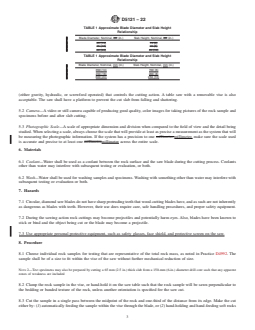
Table 1 gives the approximate blade diameter and slab height relationships for saws typically used.
5.1.1 The rock saw apparatus shall have a vise to hold the samples during the cutting process, in addition to an automatic feed
D5121 − 22
TABLE 1 Approximate Blade Diameter and Slab Height
Relationship
Blade Diameter, Nominal, cm (in.) Slab Height, Nominal, cm (in.)
35 (14) 15 (6)
45 (18) 20 (8)
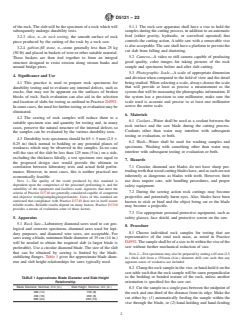
60 (24) 25 (10)
TABLE 1 Approximate Blade Diameter and Slab Height
Relationship
Blade Diameter,
...