

ASTM D6825-21
(Guide)Standard Guide for Placement of Riprap Revetments
General Information
- Abstract
SIGNIFICANCE AND USE
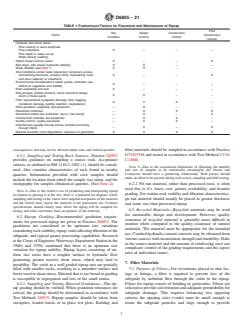
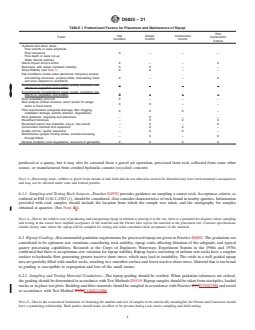
4.1 Riprap is a commonly used form of scour protection and general slope protection. Riprap provides a long term solution when properly sized and installed. Riprap has structural flexibility so it will conform to irregular surfaces and adapt to minor subgrade settlement. It is often appropriate for use in conjunction with soil bioengineering (vegetation establishment) alternatives. In some environments, riprap may provide habitat for benthic organisms and fish.
4.2 Revetments provide a facing or lining to armor a surface; and the layer thickness is typically minimized while providing the necessary resistance to scour. In this case, standardized practices to obtain consistent coverage having acceptable thickness tolerances and voids become important.
4.3 This guide may be used by owners, installation contractors, regulatory agencies, inspection organizations, and designers and specifiers who are involved in the construction of riprap revetments. Modifications may be required for specific job conditions. This guide is not intended for construction specifications on large projects, but may be referenced where preparation of job specific construction specifications are not justified. If this practice is included by reference in contract documents, the specifier should provide a list of supplemental requirements.
SCOPE
1.1 This guide covers methods to place riprap with associated filters for erosion control purposes. This guide does not recommend a specific course of action because of the diverse methods and procedures that are capable of producing a functional product. This guide identifies favorable riprap qualities and recommends practices best suited to obtain those qualities. The production of rock, use of recycled materials, rock with cut dimensions, and engineering and revetment design are beyond the scope of this guide. Special forms of riprap, including hand placed riprap, grouted riprap, or keyed (plated) riprap that is tamped into place to smooth the surface, are also beyond the scope of this guide.
1.2 This guide offers an organized collection of information or a series of options and does not recommend a specific course of action. This document cannot replace education or experience and should be used in conjunction with professional judgment. Not all aspects of this guide may be applicable in all circumstances. This ASTM standard is not intended to represent or replace the standard of care by which the adequacy of a given professional service must be judged, nor should this document be applied without consideration of a project's many unique aspects. The word “Standard” in the title of this document means only that the document has been developed and approved through the ASTM consensus process
1.3 Units—The values stated in SI units are to be regarded as standard. The values given in parentheses after SI units are provided for information only and are not considered standard.
1.4 This standard may involve hazardous operations and equipment. This standard does not purport to address all of the safety concerns, if any, associated with its use. It is the responsibility of the user of this standard to establish appropriate safety, health, and environmental practices and determine the applicability of regulatory limitations prior to use.
1.5 This international standard was developed in accordance with internationally recognized principles on standardization established in the Decision on Principles for the Development of International Standards, Guides and Recommendations issued by the World Trade Organization Technical Barriers to Trade (TBT) Committee.
- Status
- Published
- Publication Date
- 31-Oct-2021
- Technical Committee
- D18 - Soil and Rock
- Drafting Committee
- D18.17 - Rock for Erosion Control
Overview
ASTM D6825-21: Standard Guide for Placement of Riprap Revetments provides practical guidance on the installation of riprap revetments for erosion and scour protection. Issued by ASTM International, this standard is widely referenced by owners, contractors, inspectors, and designers involved in hydraulic and geotechnical projects. Riprap, a layer of durable stones or aggregate, is commonly employed to armor slopes, channels, and banks against the detrimental effects of flowing water and wave action. The guide emphasizes adaptable placement practices, ensuring consistent and reliable performance of riprap systems across a variety of field conditions.
Key Topics
Riprap Revetment Purpose
Riprap revetments offer long-term protection by resisting erosion and accommodating minor subgrade settlement. They also present ecological benefits, sometimes providing habitats for aquatic life.Placement Guidance
The standard addresses placement methods for riprap with associated filters, recommending systematic techniques to achieve uniform coverage, structural integrity, and minimized voids. Important operational considerations, such as minimizing drop height and avoiding segregation of rock sizes, are discussed.Material Selection and Filters
The guide identifies desired qualities for riprap, filters, and bedding materials. It underscores considerations in gradation, durability, and compatibility, and outlines material evaluation and quality assurance. Both aggregate filters as well as geotextiles are addressed for subgrade protection.Quality Control
Recommendations for inspection and testing to verify layer thickness, material gradation, and stability are described. Field measurement practices and tolerances support effective project implementation and risk reduction.Equipment and Construction Practices
The use of appropriate equipment-including specialized buckets and loaders-is described to achieve proper placement. The guide advises minimizing mechanical disturbance to maintain the integrity of the riprap layer and any underlying geotextiles.Adaptability
The guide emphasizes the need for professional judgment, noting that placement practices should be tailored to specific site and project requirements and that the guidance provided does not replace detailed engineering design.
Applications
ASTM D6825-21 is a crucial reference for various applications, including:
Riverbanks and Shorelines:
Protecting waterway edges, embankments, and shorelines from hydraulic erosion and wave action.Infrastructure Protection:
Armoring highways, bridges, culverts, and drainage channels from scour and structural undermining.Slope Stabilization:
Preventing slope failures in natural or constructed earthen embankments.Environmental Integration:
Used in conjunction with soil bioengineering and vegetative stabilization to balance engineering and ecological considerations.Small and Medium Projects:
Serves as guidance for smaller installations where developing detailed project-specific specifications may not be warranted, but standard practice ensures performance.
Related Standards
Several related ASTM and AASHTO standards offer complementary procedures and technical requirements for riprap and erosion control systems:
- ASTM D4992: Practice for Evaluation of Rock to be Used for Erosion Control
- ASTM D6092: Practice for Specifying Standard Sizes of Stone for Erosion Control
- ASTM D5519: Test Methods for Particle Size Analysis of Natural and Man-Made Riprap Materials
- ASTM D653: Terminology Relating to Soil, Rock, and Contained Fluids
- AASHTO M 288: Geotextile Specification for Highway Applications
- EN 13383-1 (Europe): Armourstone
By following ASTM D6825-21, stakeholders ensure a systematic, reliable approach to the placement of riprap revetments, achieving effective erosion control and long-term infrastructure protection. The standard supports sustainable development by integrating quality assurance, material best practices, and adaptable techniques fit for diverse project needs.
Relations
- Effective Date
- 01-Nov-2019
- Effective Date
- 01-Feb-2016
- Effective Date
- 01-Nov-2015
- Effective Date
- 01-Nov-2014
- Effective Date
- 01-Aug-2014
- Effective Date
- 01-May-2014
- Effective Date
- 01-Feb-2014
- Effective Date
- 15-Dec-2013
- Effective Date
- 01-Jan-2013
- Effective Date
- 01-Sep-2011
- Effective Date
- 01-Jan-2011
- Effective Date
- 01-Jan-2009
- Effective Date
- 01-Dec-2008
- Effective Date
- 01-Dec-2008
- Effective Date
- 01-Nov-2008
Get Certified
Connect with accredited certification bodies for this standard

DIBt (Deutsches Institut für Bautechnik)
German Institute for Building Technology.
DIN CERTCO
DIN Group product certification.

Aboma Certification B.V.
Specialized in construction, metal, and transport sectors.
Sponsored listings
Frequently Asked Questions
ASTM D6825-21 is a guide published by ASTM International. Its full title is "Standard Guide for Placement of Riprap Revetments". This standard covers: SIGNIFICANCE AND USE 4.1 Riprap is a commonly used form of scour protection and general slope protection. Riprap provides a long term solution when properly sized and installed. Riprap has structural flexibility so it will conform to irregular surfaces and adapt to minor subgrade settlement. It is often appropriate for use in conjunction with soil bioengineering (vegetation establishment) alternatives. In some environments, riprap may provide habitat for benthic organisms and fish. 4.2 Revetments provide a facing or lining to armor a surface; and the layer thickness is typically minimized while providing the necessary resistance to scour. In this case, standardized practices to obtain consistent coverage having acceptable thickness tolerances and voids become important. 4.3 This guide may be used by owners, installation contractors, regulatory agencies, inspection organizations, and designers and specifiers who are involved in the construction of riprap revetments. Modifications may be required for specific job conditions. This guide is not intended for construction specifications on large projects, but may be referenced where preparation of job specific construction specifications are not justified. If this practice is included by reference in contract documents, the specifier should provide a list of supplemental requirements. SCOPE 1.1 This guide covers methods to place riprap with associated filters for erosion control purposes. This guide does not recommend a specific course of action because of the diverse methods and procedures that are capable of producing a functional product. This guide identifies favorable riprap qualities and recommends practices best suited to obtain those qualities. The production of rock, use of recycled materials, rock with cut dimensions, and engineering and revetment design are beyond the scope of this guide. Special forms of riprap, including hand placed riprap, grouted riprap, or keyed (plated) riprap that is tamped into place to smooth the surface, are also beyond the scope of this guide. 1.2 This guide offers an organized collection of information or a series of options and does not recommend a specific course of action. This document cannot replace education or experience and should be used in conjunction with professional judgment. Not all aspects of this guide may be applicable in all circumstances. This ASTM standard is not intended to represent or replace the standard of care by which the adequacy of a given professional service must be judged, nor should this document be applied without consideration of a project's many unique aspects. The word “Standard” in the title of this document means only that the document has been developed and approved through the ASTM consensus process 1.3 Units—The values stated in SI units are to be regarded as standard. The values given in parentheses after SI units are provided for information only and are not considered standard. 1.4 This standard may involve hazardous operations and equipment. This standard does not purport to address all of the safety concerns, if any, associated with its use. It is the responsibility of the user of this standard to establish appropriate safety, health, and environmental practices and determine the applicability of regulatory limitations prior to use. 1.5 This international standard was developed in accordance with internationally recognized principles on standardization established in the Decision on Principles for the Development of International Standards, Guides and Recommendations issued by the World Trade Organization Technical Barriers to Trade (TBT) Committee.
SIGNIFICANCE AND USE 4.1 Riprap is a commonly used form of scour protection and general slope protection. Riprap provides a long term solution when properly sized and installed. Riprap has structural flexibility so it will conform to irregular surfaces and adapt to minor subgrade settlement. It is often appropriate for use in conjunction with soil bioengineering (vegetation establishment) alternatives. In some environments, riprap may provide habitat for benthic organisms and fish. 4.2 Revetments provide a facing or lining to armor a surface; and the layer thickness is typically minimized while providing the necessary resistance to scour. In this case, standardized practices to obtain consistent coverage having acceptable thickness tolerances and voids become important. 4.3 This guide may be used by owners, installation contractors, regulatory agencies, inspection organizations, and designers and specifiers who are involved in the construction of riprap revetments. Modifications may be required for specific job conditions. This guide is not intended for construction specifications on large projects, but may be referenced where preparation of job specific construction specifications are not justified. If this practice is included by reference in contract documents, the specifier should provide a list of supplemental requirements. SCOPE 1.1 This guide covers methods to place riprap with associated filters for erosion control purposes. This guide does not recommend a specific course of action because of the diverse methods and procedures that are capable of producing a functional product. This guide identifies favorable riprap qualities and recommends practices best suited to obtain those qualities. The production of rock, use of recycled materials, rock with cut dimensions, and engineering and revetment design are beyond the scope of this guide. Special forms of riprap, including hand placed riprap, grouted riprap, or keyed (plated) riprap that is tamped into place to smooth the surface, are also beyond the scope of this guide. 1.2 This guide offers an organized collection of information or a series of options and does not recommend a specific course of action. This document cannot replace education or experience and should be used in conjunction with professional judgment. Not all aspects of this guide may be applicable in all circumstances. This ASTM standard is not intended to represent or replace the standard of care by which the adequacy of a given professional service must be judged, nor should this document be applied without consideration of a project's many unique aspects. The word “Standard” in the title of this document means only that the document has been developed and approved through the ASTM consensus process 1.3 Units—The values stated in SI units are to be regarded as standard. The values given in parentheses after SI units are provided for information only and are not considered standard. 1.4 This standard may involve hazardous operations and equipment. This standard does not purport to address all of the safety concerns, if any, associated with its use. It is the responsibility of the user of this standard to establish appropriate safety, health, and environmental practices and determine the applicability of regulatory limitations prior to use. 1.5 This international standard was developed in accordance with internationally recognized principles on standardization established in the Decision on Principles for the Development of International Standards, Guides and Recommendations issued by the World Trade Organization Technical Barriers to Trade (TBT) Committee.
ASTM D6825-21 is classified under the following ICS (International Classification for Standards) categories: 91.100.15 - Mineral materials and products. The ICS classification helps identify the subject area and facilitates finding related standards.
ASTM D6825-21 has the following relationships with other standards: It is inter standard links to ASTM D75/D75M-19, ASTM C33/C33M-16e1, ASTM D5519-15, ASTM D5519-14, ASTM D653-14, ASTM D4992-14, ASTM D6092-14, ASTM D75/D75M-13, ASTM C33/C33M-13, ASTM D653-11, ASTM C33/C33M-11, ASTM D653-09, ASTM D653-08a, ASTM C33/C33M-08, ASTM D653-08. Understanding these relationships helps ensure you are using the most current and applicable version of the standard.
ASTM D6825-21 is available in PDF format for immediate download after purchase. The document can be added to your cart and obtained through the secure checkout process. Digital delivery ensures instant access to the complete standard document.
Standards Content (Sample)
This international standard was developed in accordance with internationally recognized principles on standardization established in the Decision on Principles for the
Development of International Standards, Guides and Recommendations issued by the World Trade Organization Technical Barriers to Trade (TBT) Committee.
Designation: D6825 − 21
Standard Guide for
Placement of Riprap Revetments
This standard is issued under the fixed designation D6825; the number immediately following the designation indicates the year of
original adoption or, in the case of revision, the year of last revision.Anumber in parentheses indicates the year of last reapproval.A
superscript epsilon (´) indicates an editorial change since the last revision or reapproval.
1. Scope* ization established in the Decision on Principles for the
Development of International Standards, Guides and Recom-
1.1 This guide covers methods to place riprap with associ-
mendations issued by the World Trade Organization Technical
ated filters for erosion control purposes. This guide does not
Barriers to Trade (TBT) Committee.
recommend a specific course of action because of the diverse
methods and procedures that are capable of producing a
2. Referenced Documents
functionalproduct.Thisguideidentifiesfavorableriprapquali-
ties and recommends practices best suited to obtain those 2.1 ASTM Standards:
qualities. The production of rock, use of recycled materials, C33/C33MSpecification for Concrete Aggregates
rock with cut dimensions, and engineering and revetment C136/C136MTest Method for Sieve Analysis of Fine and
design are beyond the scope of this guide. Special forms of Coarse Aggregates
riprap, including hand placed riprap, grouted riprap, or keyed D75/D75MPractice for Sampling Aggregates
(plated) riprap that is tamped into place to smooth the surface, D653Terminology Relating to Soil, Rock, and Contained
are also beyond the scope of this guide. Fluids
D4992Practice for Evaluation of Rock to be Used for
1.2 This guide offers an organized collection of information
Erosion Control
oraseriesofoptionsanddoesnotrecommendaspecificcourse
D5519Test Methods for Particle Size Analysis of Natural
of action. This document cannot replace education or experi-
and Man-Made Riprap Materials
ence and should be used in conjunction with professional
D6092Practice for Specifying Standard Sizes of Stone for
judgment.Notallaspectsofthisguidemaybeapplicableinall
Erosion Control
circumstances. This ASTM standard is not intended to repre-
sent or replace the standard of care by which the adequacy of 2.2 AASHTO Standard:
M288Geotextile Specification for Highway Applications
a given professional service must be judged, nor should this
documentbeappliedwithoutconsiderationofaproject’smany
unique aspects. The word “Standard” in the title of this 3. Terminology
document means only that the document has been developed
3.1 Definitions—For definitions of common technical terms
and approved through the ASTM consensus process
used in this standard, refer to Terminology D653.
1.3 Units—The values stated in SI units are to be regarded
3.2 Definitions of Terms Specific to This Standard:
as standard. The values given in parentheses after SI units are
3.2.1 bedding, n—an aggregate mixture placed below the
providedforinformationonlyandarenotconsideredstandard.
riprap.
1.4 This standard may involve hazardous operations and
3.2.1.1 Discussion—Bedding material is usually sand and
equipment. This standard does not purport to address all of the gravel sized, but may include cobble sized material. If placed
safety concerns, if any, associated with its use. It is the
without a geotextile, the bedding material may be used as a
responsibility of the user of this standard to establish appro- filter. If placed in conjunction with a geotextile, the bedding
priate safety, health, and environmental practices and deter-
may provide a cushion for protection of the geotextile during
mine the applicability of regulatory limitations prior to use. riprap placement and provide confinement of the geotextile. It
1.5 This international standard was developed in accor-
is possible to have more than one bedding layer.
dance with internationally recognized principles on standard-
For referenced ASTM standards, visit the ASTM website, www.astm.org, or
ThisguideisunderthejurisdictionofASTMCommitteeD18onSoilandRock contact ASTM Customer Service at service@astm.org. For Annual Book of ASTM
and is the direct responsibility of Subcommittee D18.17 on Rock for Erosion Standards volume information, refer to the standard’s Document Summary page on
Control. the ASTM website.
Current edition approved Nov. 1, 2021. Published November 2021. Originally Available from American Association of State Highway and Transportation
ε1
approved in 2002. Last previous edition approved in 2014 as D6825–14 . DOI: Officials (AASHTO), 444 N. Capitol St., NW, Suite 249, Washington, DC 20001,
10.1520/D6825-21. http://www.transportation.org.
*A Summary of Changes section appears at the end of this standard
Copyright © ASTM International, 100 Barr Harbor Drive, PO Box C700, West Conshohocken, PA 19428-2959. United States
D6825 − 21
3.2.2 chinking, n—thepracticeoffillingriprapsurfacevoids riprap revetments. Modifications may be required for specific
with smaller sized rock or aggregate. job conditions. This guide is not intended for construction
specifications on large projects, but may be referenced where
3.2.3 clam shell, n—a bucket tool that is operated from a
preparation of job specific construction specifications are not
draglineorcrane;thebucketishingedatthetopandopenslike
justified. If this practice is included by reference in contract
a clam so that rock can be placed without dropping it.
documents, the specifier should provide a list of supplemental
3.2.4 D ,n—the particle diameter at which x% by weight
x
requirements.
(dry) of the particles of a particular sample are finer.
3.2.5 filter, n—any substance, as geotextile or layer of 5. Planning for Riprap Placement
sand/aggregate, placed to provide separation and retention of
5.1 Site conditions, level of protection required, construc-
materials, while allowing water to pass.
tion methods, and equipment may affect the sizing, thickness,
3.2.6 floater, n—a individual rock within the riprap layer
and lateral extent of a riprap revetment. For some small
that is not interlocked with the surrounding rocks.
projects, riprap may be dumped with minimal analysis or
quality control, and still fulfill the intended purpose. For larger
3.2.7 maximum aspect ratio, n—the ratio of the greatest to
projects and critical structures, engineering, careful placement,
the least dimension, measured across mutually perpendicular
and quality control become increasingly justified to minimize
axes, for any piece of rock; synonym, slabbiness.
material costs and reduce the chance of failure. The degree of
3.2.8 orange peel, n—a bucket tool that is operated from a
control appropriate should be appropriate for each project.The
draglineorcraneandresemblestheshapeofanorangepeeling;
methods for placement and quality control should be compat-
the sides lift up and out so that rock can be placed without
iblewiththelevelofsiteinvestigationandotherconsiderations
dropping it.
included in Table 1, which includes factors that should be
3.2.9 pit run material, n—rock that has been blasted but not
considered for each project, but are beyond the scope of this
processed to remove undersize pieces; synonym, shot rock or
guide. Some recommended publications (1-9) from theArmy
quarry run.
Corps of Engineers, the Federal HighwayAdministration, and
the National Cooperative Highway Research Program for
3.2.10 revetment, n—bank protection by armor, that is, by
facing of a bank or embankment with erosion-resistant mate- additionalinformationonthesefactorsandengineeringcriteria
rial. are given in the References section.
NOTE 1—Slope stability should always be considered. If it is not
3.2.11 riprap, n—material generally less than 2 tonnes (2.2
investigatedanalyticallybyaqualifiedprofessional,thenitshouldatleast
tons) in mass, specially selected and graded.
be considered subjectively in light of the site conditions and surrounding
3.2.11.1 Discussion—When properly placed, riprap pre-
conditions (riverbanks, shorelines, or landforms). Many agencies have
generalized maximum allowable slopes (usually in the range of 1.5H:1V
vents erosion through minor wave action, or strong currents
to3H:1V);however,thesemustberecognizedassitespecific.Limitations
and thereby preserves the shape of a surface, slope, or
of the foundation, bank, material interfaces, seepage conditions, or toe
underlying structure. Riprap may be specifically produced for
scour may lead to instability.
the intended purpose, or it may be a by-product from a mining
NOTE 2—All of the references in this standard are from the United
operation, structure demolition, or industrial process.
States. There are international standards such as EN 13383-1 “Armour-
stone” from the European Committee for Standardization (9) that should
3.2.12 rock, n—any naturally formed aggregate of mineral
also be considered.
matter occurring in large masses or fragments.
3.2.12.1 Discussion—Rock may be either insitu or exca-
6. Riprap Materials
vated material.
6.1 Stone Sources and Evaluation—Rock must be durable
material. In some cases, a source may be established based on
4. Significance and Use
rock classification, geologic evaluation, and observations of
4.1 Riprapisacommonlyusedformofscourprotectionand existing installations showing that the rock is durable. If a
general slope protection. Riprap provides a long term solution
history of rock durability is not established, sampling and
when properly sized and installed. Riprap has structural flex-
testing the rock may be required. Acceptable material proper-
ibility so it will conform to irregular surfaces and adapt to
ties for rock are dependent on the conditions (such as abrasion
minor subgrade settlement. It is often appropriate for use in
and saturation frequency due to wave run-up) and climate in
conjunction with soil bioengineering (vegetation establish-
the vicinity of where it will be used. Source selection should
ment) alternatives. In some environments, riprap may provide
also consider the material properties available from local
habitat for benthic organisms and fish.
sources. Riprap is most commonly produced at a quarry, but it
may also be screened from a gravel pit operation, processed
4.2 Revetments provide a facing or lining to armor a
from rock collected from some other source, or manufactured
surface; and the layer thickness is typically minimized while
from crushed hydraulic-cement (recycled) concrete.
providing the necessary resistance to scour. In this case,
standardized practices to obtain consistent coverage having
NOTE 3—Borrowing stone, cobbles or gravel from stream or lake beds
acceptable thickness tolerances and voids become important. that do not otherwise need to be disturbed may have environmental
4.3 This guide may be used by owners, installation
contractors, regulatory agencies, inspection organizations, and
The boldface numbers in parentheses refer to a list of references at the end of
designersandspecifierswhoareinvolvedintheconstructionof this standard.
D6825 − 21
TABLE 1 Predominant Factors for Placement and Maintenance of Riprap
Post
Site Design Construction
Factor Construction
Condition Control Control
Control
Hydraulic bed shear stress
Flow velocity or wave amplitude
Flow turbulence X-- -- --
Flow depth or wave run-up
Water density (salinity)
Debris impact and ice action X -- -- X
Bed slope, side slopes (hydraulic stability) X X -- --
Slope Stability (see Note 1) X X -- --
Site Conditions (under water placement, temporary access,
encroaching structures, property limits, meandering rivers X-- -- X
and scour adjacent to revetment)
Environmental considerations (water quality, recreation use,
X-- -- --
effects on vegetation and wildlife)
Rock availability and cost X -- -- --
Risk analysis (critical structure, return period for design
X X -- --
storm or flood event)
Filter requirements (subgrade drainage, filter clogging,
XX X --
installation damage, particle retention, degradation)
Rock gradation, angularity and placement -- X -- --
Revetment thickness -- X X X
Revetment extent (toe protection, key-in, free board) -- X -- X
Construction methods and equipment -- X X --
Quality control / quality assurance -- X X --
Disturbances (people moving stones, animals burrowing
-- X -- X
through filters)
Material durability (rock degradation, exposure of geotextile) X X X X
consequences and may not be allowed under state and federal permits.
filter materials should be sampled in accordance with Practice
D75/D75M and tested in accordance with Test Method C136/
6.1.1 Sampling and Testing Rock Sources—Practice D4992
C136M.
provides guidance on sampling a source rock. Acceptance
criteria, as outlined in EM 1110-2-2302 (1), should be consid-
NOTE 5—Due to the economical limitations of obtaining the number
ered. Also consider characteristics of rock found in nearby
and size of samples to be statistically meaningful, the Owner and
Contractor should have a partnering relationship. Both parties should
quarries. Information provided with rock samples should
makeanefforttobepresentduringrocksourcesamplingandfieldtesting.
include the location from which the sample was taken, and the
stratigraphy for samples obtained at quarries. (See Note 4).
6.2.2 Pit run material, rather than processed rock, is often
used due to it’s lower cost, greater availability, and broader
NOTE 4—Due to the relative cost of producing and transporting riprap
grading. For similar rock stability and filtration characteristics,
in relation to placing it at the site, there is a potential for disputes where
pit run material should usually be placed in greater thickness
samplingandtestingatthesourcehaveimpliedacceptanceofthematerial
and the Owner later rejects the material at the placement site. Contract
and stone size than processed riprap.
specifications should clearly state where the riprap will be sampled for
6.3 Recycled Materials—Recycled materials may be used
testing and what constitutes final acceptance of the material.
for sustainable design and development. However, quality
6.2 Riprap Grading—Recommended gradation require-
assurance of recycled material is generally more difficult to
ments for processed riprap are given in Practice D6092. The
monitor when compared to the quality assurance of natural
gradations are considered to be optimum size variations
materials. The material must be appropriate for the intended
consideringrockstability,riprapvoidsaffectingfiltrationofthe
use. Crushed hydraulic-cement concrete may be obtained from
subgrade, and typical quarry processing capabilities. Research
varioussourceswithinconsistentstrengthanddurability.Slabs
attheCorpsofEngineersWaterwaysExperimentStationinthe
in the source material and the amount of reinforcing steel can
1960s and 1970s confirmed that there is an optimum size
complicate control of the grading requirements and the aspect
variation for riprap stability. Riprap layers consisting of un-
ratio of individual stones.
form size rocks have a rougher surface to hydraulic flow
generating greater tractive shear stress, which may lead to
7. Filter Materials
instability. The voids in a well graded riprap mix are partially
filled with smaller rocks, resulting in a smoother surface and 7.1 Purpose of Filters—For revetments placed as thin fac-
lowertractiveshearstress.Materialthatistoobroadingrading ings or linings, a filter is required to prevent loss of the
is susceptible to segregation and loss of the small stones. subgrade by turbulent flow through the voids in the riprap.
6.2.1 Sampling and Testing Material Gradations—The rip- Filters for riprap consist of bedding or geotextiles. Filters are
rap grading should be verified. When gradation tolerances are selectedtoprovidesoilretentionandadequatepermeabilityfor
critical, the grading should be determined in accordance with subgrade drainage. This requires balancing two opposing
Test Methods D5519. Riprap samples should be taken from criteria: the opening sizes (voids) must be small enough to
stockpiles, loaded trucks or in place test plots. Bedding and retain the subgrade particles and large enough to provide
D6825 − 21
adequate permeability for water passage. In some cases, interlocking integrity of the placed riprap layer. Wheel-
multiple layers may be required. mountedfront-endloadershaveatendencytospintheirwheels
and tear apart the interlocked integrity of the rock layer.
7.2 Bedding—Bedding material should be composed of
Front-end loaders generally offer poor visibility of the area in
tough, durable particles, free from thin, flat and elongated
front of the bucket which creates problems for the operator,
pieces,andshouldcontainminimalquantitiesoforganicmatter
since riprap cannot be spread like soils and aggregates.
andsoftfriableparticles.Aggregatesshouldgenerallymeetthe
qualityrequirementsofSpecificationC33/C33M.Sometypical 9.4 Dump trucks should be equipped with bottom-hinged
gradation requirements for bedding materials are given in tailgates if rock is placed directly into position with the trucks.
Practice D6092. It is sometimes more economical to specify a The bottom hinged tailgates allow the load of rock to slide en
commonly produced gradation, such as a state transportation masse from the truck; and they reduce the drop height.
department gradation for concrete or bituminous aggregate. It
10. Foundation Preparation
may be necessary to adjust the gradation requirements to meet
filter requirements for protection of the subgrade soils.
10.1 Thefoundationsurfaceshouldbereasonablysmoothto
match tolerances normally obtained by rough grading with
7.3 Geotextiles—The geotextiles must have adequate
bladed equipment. Foundation areas may need to be excavated
strength to withstand installation stresses during placement.
or properly filled to meet lines and grades for the revetment.
AASHTO M288 provides recommended geot
...
This document is not an ASTM standard and is intended only to provide the user of an ASTM standard an indication of what changes have been made to the previous version. Because
it may not be technically possible to adequately depict all changes accurately, ASTM recommends that users consult prior editions as appropriate. In all cases only the current version
of the standard as published by ASTM is to be considered the official document.
´1
Designation: D6825 − 14 D6825 − 21
Standard Guide for
Placement of Riprap Revetments
This standard is issued under the fixed designation D6825; the number immediately following the designation indicates the year of
original adoption or, in the case of revision, the year of last revision. A number in parentheses indicates the year of last reapproval. A
superscript epsilon (´) indicates an editorial change since the last revision or reapproval.
ε NOTE—Editorially updated units of measurement statement in April 2018.
1. Scope*
1.1 This guide covers methods to place riprap with associated filters for erosion control purposes. This guide does not recommend
a specific course of action because of the diverse methods and procedures that are capable of producing a functional product. This
guide identifies favorable riprap qualities and recommends practices best suited to obtain those qualities. The production of rock,
use of recycled materials, rock with cut dimensions, and engineering and revetment design are beyond the scope of this guide.
Special forms of riprap, including hand placed riprap, grouted riprap, or keyed (plated) riprap that is tamped into place to smooth
the surface, are also beyond the scope of this guide.
1.2 This guide offers an organized collection of information or a series of options and does not recommend a specific course of
action. This document cannot replace education or experience and should be used in conjunction with professional judgment. Not
all aspects of this guide may be applicable in all circumstances. This ASTM standard is not intended to represent or replace the
standard of care by which the adequacy of a given professional service must be judged, nor should this document be applied
without consideration of a project’s many unique aspects. The word “Standard” in the title of this document means only that the
document has been developed and approved through the ASTM consensus process
1.3 Units—The values stated in SI units are to be regarded as standard. The values given in parentheses after SI units are provided
for information only and are not considered standard.
1.4 This standard may involve hazardous operations and equipment. This standard does not purport to address all of the safety
concerns, if any, associated with its use. It is the responsibility of the user of this standard to establish appropriate safety and health
practices and determine the applicability of regulatory requirements prior to use.
1.4 This standard may involve hazardous operations and equipment. This standard does not purport to address all of the safety
concerns, if any, associated with its use. It is the responsibility of the user of this standard to establish appropriate safety, health,
and environmental practices and determine the applicability of regulatory limitations prior to use.
1.5 This international standard was developed in accordance with internationally recognized principles on standardization
established in the Decision on Principles for the Development of International Standards, Guides and Recommendations issued
by the World Trade Organization Technical Barriers to Trade (TBT) Committee.
2. Referenced Documents
2.1 ASTM Standards:
This guide is under the jurisdiction of ASTM Committee D18 on Soil and Rock and is the direct responsibility of Subcommittee D18.17 on Rock for Erosion Control.
Current edition approved Feb. 1, 2014Nov. 1, 2021. Published March 2014November 2021. Originally approved in 2002. Last previous edition approved in 20082014 as
ε1
D6825 – 02D6825 – 14 (Reapproved 2008) . DOI: 10.1520/D6825-14E01.10.1520/D6825-21.
For referenced ASTM standards, visit the ASTM website, www.astm.org, or contact ASTM Customer Service at service@astm.org. For Annual Book of ASTM Standards
volume information, refer to the standard’s Document Summary page on the ASTM website.
*A Summary of Changes section appears at the end of this standard
Copyright © ASTM International, 100 Barr Harbor Drive, PO Box C700, West Conshohocken, PA 19428-2959. United States
D6825 − 21
C33C33/C33M Specification for Concrete Aggregates
C136C136/C136M Test Method for Sieve Analysis of Fine and Coarse Aggregates
D75D75/D75M Practice for Sampling Aggregates
D653 Terminology Relating to Soil, Rock, and Contained Fluids
D4992 Practice for Evaluation of Rock to be Used for Erosion Control
D5519 Test Methods for Particle Size Analysis of Natural and Man-Made Riprap Materials
D6092 Practice for Specifying Standard Sizes of Stone for Erosion Control
2.2 AASHTO Standard:
M 288 Geotextile Specification for Highway Applications
3. Terminology
3.1 Definitions—See For definitions of common technical terms used in this standard, refer to Terminology D653 for general
definitions.
3.2 Definitions of Terms Specific to This Standard:
3.2.1 bedding—bedding, n—an aggregate mixture placed below the riprap. Bedding material is usually sand and gravel sized, but
may include cobble sized material. If placed without a geotextile, the bedding material may be used as a filter. If placed in
conjunction with a geotextile, the bedding may provide a cushion for protection of the geotextile during riprap placement and
provide confinement of the geotextile. It is possible to have more than one bedding layer.
3.2.1.1 Discussion—
Bedding material is usually sand and gravel sized, but may include cobble sized material. If placed without a geotextile, the
bedding material may be used as a filter. If placed in conjunction with a geotextile, the bedding may provide a cushion for
protection of the geotextile during riprap placement and provide confinement of the geotextile. It is possible to have more than one
bedding layer.
3.2.2 chinking—chinking, n—the practice of filling riprap surface voids with smaller sized rock or aggregate.
3.2.3 clam shell—shell, n—a bucket tool that is operated from a dragline or crane. Thecrane; the bucket is hinged at the top and
opens like a clam so that rock can be placed without dropping it.
3.2.4 D —, n—the particle diameter at which x % by weight (dry) of the particles of a particular sample are finer.
x
3.2.5 filter—filter, n—any substance, as geotextile or layer of sand/aggregate, placed to provide separation and retention of
materials, while allowing water to pass.
3.2.6 floater—floater, n—a individual rock within the riprap layer that is not interlocked with the surrounding rocks.
3.2.7 maximum aspect ratio—ratio, n—the ratio of the greatest to the least dimension, measured across mutually perpendicular
axes, for any piece of rock; synonym, slabbiness.
3.2.8 orange peel—peel, n—a bucket tool that is operated from a dragline or crane and resembles the shape of an orange peeling.
Thepeeling; the sides lift up and out so that rock can be placed without dropping it.
3.2.9 pit run material—material, n—rock that has been blasted but not processed to remove undersize pieces; synonym, shot rock
or quarry run.
3.2.10 revetment—revetment, n—bank protection by armor, that is, by facing of a bank or embankment with erosion-resistant
material.
3.2.11 riprap—riprap, n—material generally less than 2 tons (1.8 tonnes)tonnes (2.2 tons) in mass, specially selected and graded.
When properly placed, riprap prevents erosion through minor wave action, or strong currents and thereby preserves the shape of
Available from American Association of State Highway and Transportation Officials (AASHTO), 444 N. Capitol St., NW, Suite 249, Washington, DC 20001,
http://www.transportation.org.
D6825 − 21
a surface, slope, or underlying structure. Riprap may be specifically produced for the intended purpose, or it may be a by-product
from a mining operation, structure demolition, or industrial process.
3.2.11.1 Discussion—
When properly placed, riprap prevents erosion through minor wave action, or strong currents and thereby preserves the shape of
a surface, slope, or underlying structure. Riprap may be specifically produced for the intended purpose, or it may be a by-product
from a mining operation, structure demolition, or industrial process.
3.2.12 rock—rock, n—any naturally formed aggregate of mineral matter occurring in large masses or fragments. Rock may be
either insitu or excavated material.
3.2.12.1 Discussion—
Rock may be either insitu or excavated material.
4. Significance and Use
4.1 Riprap is a commonly used form of scour protection and general slope protection. Riprap provides a long term solution when
properly sized and installed. Riprap has structural flexibility so it will conform to irregular surfaces and adapt to minor subgrade
settlement. It is often appropriate for use in conjunction with soil bioengineering (vegetation establishment) alternatives. In some
environments, riprap may provide habitat for benthic organisms and fish.
4.2 Revetments provide a facing or lining to armor a surface; and the layer thickness is typically minimized while providing the
necessary resistance to scour. In this case, standardized practices to obtain consistent coverage having acceptable thickness
tolerances and voids become important.
4.3 This guide may be used by owners, installation contractors, regulatory agencies, inspection organizations, and designers and
specifiers who are involved in the construction of riprap revetments. Modifications may be required for specific job conditions. This
guide is not intended for construction specifications on large projects, but may be referenced where preparation of job specific
construction specifications are not justified. If this practice is included by reference in contract documents, the specifier mustshould
provide a list of supplemental requirements.
5. Planning for Riprap Placement
5.1 Site conditions, level of protection required, construction methods, and equipment may affect the sizing, thickness, and lateral
extent of a riprap revetment. For some small projects, riprap may be dumped with minimal analysis or quality control, and still
fulfill the intended purpose. For larger projects and critical structures, engineering, careful placement, and quality control become
increasingly justified to minimize material costs and reduce the chance of failure. The degree of control appropriate should be
appropriate for each project. The methods for placement and quality control should be compatible with the level of site
investigation and other considerations included in Table 1., Table 1which includes factors whichthat should be considered,
considered for each project, but are beyond the scope of this guide. Some recommended publications (1-79) from the Army Corps
of Engineers and Engineers, the Federal Highway Administration Administration, and the National Cooperative Highway Research
Program for additional information on these factors and engineering criteria are given in the References section.
NOTE 1—Slope stability should always be considered. If it is not investigated analytically by a qualified professional, then it should at least be considered
subjectively in light of the site conditions and surrounding conditions (riverbanks, shorelines, or landforms). Many agencies have generalized maximum
allowable slopes (usually in the range of 1.5H:1V to 3H:1V); however, these must be recognized as site specific. Limitations of the foundation, bank,
material interfaces, seepage conditions, or toe scour may lead to instability.
NOTE 2—All of the references in this standard are from the United States. There are international standards such as EN 13383-1 “Armourstone” from
the European Committee for Standardization (9) that should also be considered.
6. Riprap Materials
6.1 Stone Sources and Evaluation—Rock must be durable material. In some cases, a source may be established based on rock
classification, geologic evaluation, and observations of existing installations showing that the rock is durable. If a history of rock
durability is not established, sampling and testing the rock may be required. Acceptable material properties for rock are dependent
on the conditions (such as abrasion and saturation frequency due to wave run-up) and climate in the vicinity of where it will be
used. Source selection mustshould also consider the material properties available from local sources. Riprap is most commonly
The boldface numbers in parentheses refer to a list of references at the end of this standard.
D6825 − 21
TABLE 1 Predominant Factors for Placement and Maintenance of Riprap
Post
Site Design Construction
Factor Construction
Condition Control Control
Control
Hydraulic bed shear stress
Flow velocity or wave amplitude
Flow turbulence X -- -- --
Flow depth or wave run-up
Water density (salinity)
Debris impact and ice action X -- -- X
Bed slope, side slopes (hydraulic stability) X X -- --
Slope Stability (see Note 1) X X -- --
Site Conditions (under water placement, temporary access,
encroaching structures, property limits, meandering rivers X -- -- X
and scour adjacent to revetment)
Environmental considerations (water quality, recreation use,
X -- -- --
affects on vegetation and wildlife)
Environmental considerations (water quality, recreation use,
X -- -- --
effects on vegetation and wildlife)
Rock availability and cost X -- -- --
Risk analysis (critical structure, return period for design
X X -- --
storm or flood event)
Filter requirements (subgrade drainage, filter clogging,
X X X --
installation damage, particle retention, degradation)
Rock gradation, angularity and placement -- X -- --
Revetment thickness -- X X X
Revetment extent (toe protection, key-in, free board) -- X -- X
Construction methods and equipment -- X X --
Quality control / quality assurance -- X X --
Disturbances (people moving stones, animals burrowing
-- X -- X
through filters)
Material durability (rock degradation, exposure of geotextile) X X X X
produced at a quarry, but it may also be screened from a gravel pit operation, processed from rock collected from some other
source, or manufactured from crushed hydraulic-cement (recycled) concrete.
NOTE 3—Borrowing stone, cobbles or gravel from stream or lake beds that do not otherwise need to be disturbed may have environmental consequences
and may not be allowed under state and federal permits.
6.1.1 Sampling and Testing Rock Sources—Practice D4992 provides guidance on sampling a source rock. Acceptance criteria, as
outlined in EM 1110-2-2302 (1), should be considered. Also consider characteristics of rock found in nearby quarries. Information
provided with rock samples should include the location from which the sample was taken, and the stratigraphy for samples
obtained at quarries. (See Note 34).
NOTE 4—Due to the relative cost of producing and transporting riprap in relation to placing it at the site, there is a potential for disputes where sampling
and testing at the source have implied acceptance of the material and the Owner later rejects the material at the placement site. Contract specifications
should clearly state where the riprap will be sampled for testing and what constitutes final acceptance of the material.
6.2 Riprap Grading—Recommended gradation requirements for processed riprap are given in Practice D6092. The gradations are
considered to be optimum size variations considering rock stability, riprap voids affecting filtration of the subgrade, and typical
quarry processing capabilities. Research at the Corps of Engineers Waterways Experiment Station in the 1960s and 1970s
confirmed that there is an optimum size variation for riprap stability. Riprap layers consisting of unform size rocks have a rougher
surface to hydraulic flow generating greater tractive shear stress, which may lead to instability. The voids in a well graded riprap
mix are partially filled with smaller rocks, resulting in a smoother surface and lower tractive shear stress. Material that is too broad
in grading is susceptible to segregation and loss of the small stones.
6.2.1 Sampling and Testing Material Gradations—The riprap grading should be verified. When gradation tolerances are critical,
the grading should be determined in accordance with Test Methods D5519. Riprap samples should be taken from stockpiles, loaded
trucks or in place test plots. Bedding and filter materials should be sampled in accordance with Practice D75D75/D75M and tested
in accordance with Test Method C136C136/C136M.
NOTE 5—Due to the economical limitations of obtaining the number and size of samples to be statistically meaningful, the Owner and Contractor should
have a partnering relationship. Both parties should make an effort to be present during rock source sampling and field testing.
D6825 − 21
6.2.2 Pit run material, rather than processed rock, is often used due to it’s lower cost, greater availability, and broader grading.
For similar rock stability and filtration characteristics, pit run material must should usually be placed in greater thickness and stone
size than processed riprap.
6.3 Recycled Materials—Recycled materials may be used for sustainable design and development. However, quality assurance of
recycled material is generally more difficult to monitor when compared to the quality assurance of natural materials. The material
must be appropriate for the intended use. Crushed hydraulic-cement concrete may be obtained from various sources with
inconsistent strength and durability. Slabs in the source material and the amount of reinforcing steel can complicate control of the
grading requirements and the aspect ratio of individual stones.
7. Filter Materials
7.1 Purpose of Filters—For revetments placed as thin facings or linings, a filter is required to prevent loss of the subgrade by
turbulent flow through the voids in the riprap. Filters for riprap consist of bedding or geotextiles. Filters are selected to provide
soil retention and adequate permeability for subgrade drainage. This requires balancing two opposing criteria: the opening sizes
(voids) must be small enough to retain the subgrade particles and large enough to provide adequate permeability for water passage.
In some cases, multiple layers may be required.
7.2 Bedding—Bedding material should be composed of tough, durable particles, free from thin, flat and elongated pieces, and
should contain minimal quantities of organic matter and soft friable particles. Aggregates should generally meet the quality
requirements of Specification C33C33/C33M. Some typical gradation requirements for bedding materials are given in Practice
D6092. It is sometimes more economical to specify a commonly produced gradation, such as a state transportation department
gradation for concrete or bituminous aggregate. It may be necessary to adjust the gradation requirements to meet filter requirements
for protection of the subgrade soils.
7.3 Geotextiles—The geotextiles must have adequate strength to withstand installation stresses during placement. AASHTO
M 288 provides recommended geotextile properties for survival during construction. The geotextile properties are related to
specific placement conditions and equipment operation.
8. Handling and Transportation
8.1 Riprap should be handled and selectively loaded onto trucks in a manner to avoid segregation and provide a distribution of
rock sizes. Each truckload should be representative of the gradation requirements.
8.2 Rock breakage during handling and transportation will reduce the rock sizes and alter the gradation before final placement.
The rock susceptibility to size degradation is very dependent on the rock strength, the
...