

ASTM C1489-15(2022)
(Specification)Standard Specification for Lime Putty for Structural Purposes
General Information
- Abstract
ABSTRACT
This specification covers lime putty products made from hydrated lime or quicklime products. Lime putty is suitable for use in masonry, plaster and stucco applications. The hydrated lime or quicklime products used to make lime putty shall be tested and shall conform to the chemical composition, plasticity, residue, soaking period, popping and pitting, and density requirements specified.
SCOPE
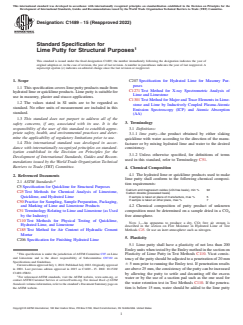
1.1 This specification covers lime putty products made from hydrated lime or quicklime products. Lime putty is suitable for use in masonry, plaster and stucco applications.
1.2 The values stated in SI units are to be regarded as standard. No other units of measurement are included in this standard.
1.3 This standard does not purport to address all of the safety concerns, if any, associated with its use. It is the responsibility of the user of this standard to establish appropriate safety, health, and environmental practices and determine the applicability of regulatory limitations prior to use.
1.4 This international standard was developed in accordance with internationally recognized principles on standardization established in the Decision on Principles for the Development of International Standards, Guides and Recommendations issued by the World Trade Organization Technical Barriers to Trade (TBT) Committee.
- Status
- Published
- Publication Date
- 30-Jun-2022
- Technical Committee
- C07 - Lime and Limestone
- Drafting Committee
- C07.02 - Specifications and Guidelines


Overview
ASTM C1489-15(2022), Standard Specification for Lime Putty for Structural Purposes, establishes the requirements for lime putty products made from hydrated lime or quicklime. Lime putty, a critical material in masonry, plaster, and stucco applications, must comply with strict guidelines for chemical composition, plasticity, residue, soaking period, popping and pitting, and density. This standard serves as a reliable benchmark for manufacturers, construction professionals, and regulators seeking consistent and high-quality lime putty tailored for structural applications.
Key Topics
- Material Composition: Lime putty must be produced from either hydrated lime or quicklime. These base materials are required to meet minimum standards of purity, specifically for calcium and magnesium oxides, and limits on carbon dioxide content depending on the sampling location.
- Physical Properties: The specification enforces standards for plasticity, which is measured to ensure proper workability in applications. Density requirements ensure the appropriateness of the material for consistent performance on site.
- Testing and Quality Control:
- Conformity to chemical composition using recognized test methods.
- Residue limits to ensure a fine, workable putty ideal for detailed and structural uses.
- Soaking requirements differ based on the type of lime used. Quicklime-based putty requires a longer soak for full hydration.
- Popping and pitting tests ensure that the final product is free of unhydrated particles or voids that could compromise performance.
- Safety and Units: The standard is written using SI units. Users are responsible for compliance with all applicable safety, health, and environmental regulations.
Applications
Lime putty covered by ASTM C1489-15(2022) is primarily used in:
- Masonry Construction: As a mortar component for brick or stone masonry, providing plasticity, workability, and longevity.
- Plaster and Stucco: Serving as a base material in interior and exterior plaster and stucco finishes, where its smooth consistency and workability are critical for high-quality surface results.
- Repair and Restoration Projects: Essential for conservation work in historic building restoration, where matching original construction materials and methods is a priority to maintain structure and appearance.
- Architectural Finishes: Enables detailed craftsmanship for ornamental plastering and specialty applications in buildings requiring traditional finishes.
By meeting ASTM specifications, lime putty ensures reliable performance and compatibility with established construction practices, supporting both durability and aesthetic requirements.
Related Standards
Several referenced ASTM standards work together to support comprehensive quality assurance for lime putty:
- ASTM C5 – Specification for Quicklime for Structural Purposes
- ASTM C25 – Test Methods for Chemical Analysis of Limestone, Quicklime, and Hydrated Lime
- ASTM C50 – Practice for Sampling, Preparation, Packaging, and Marking of Lime and Limestone Products
- ASTM C51 – Terminology Relating to Lime and Limestone
- ASTM C110 – Test Methods for Physical Testing of Quicklime, Hydrated Lime, and Limestone
- ASTM C185 – Test Method for Air Content of Hydraulic Cement Mortar
- ASTM C206/C207 – Specifications for Finishing and Masonry Hydrated Lime
- ASTM C1271/C1301 – Test Methods for Elemental Analysis in Lime and Limestone
Referencing these related standards ensures that all aspects of lime putty production and evaluation are thoroughly addressed, contributing to high standards in construction materials and practices.
Keywords: ASTM C1489, lime putty, hydrated lime, quicklime, masonry, plaster, stucco, construction material standards, building restoration, plasticity, material testing.
Relations
- Effective Date
- 01-Oct-2023
- Effective Date
- 01-Apr-2020
- Effective Date
- 01-Dec-2019
- Effective Date
- 01-May-2019
- Effective Date
- 01-Dec-2018
- Refers
ASTM C110-16 - Standard Test Methods for Physical Testing of Quicklime, Hydrated Lime, and Limestone - Effective Date
- 01-Dec-2016
- Effective Date
- 01-Jul-2015
- Refers
ASTM C110-15 - Standard Test Methods for Physical Testing of Quicklime, Hydrated Lime, and Limestone - Effective Date
- 01-Jun-2015
- Effective Date
- 01-Jun-2015
- Effective Date
- 01-Dec-2014
- Refers
ASTM C110-14 - Standard Test Methods for Physical Testing of Quicklime, Hydrated Lime, and Limestone - Effective Date
- 01-Dec-2014
- Refers
ASTM C110-11 - Standard Test Methods for Physical Testing of Quicklime, Hydrated Lime, and Limestone - Effective Date
- 01-Jun-2011
- Effective Date
- 01-Jun-2011
- Effective Date
- 01-Jun-2011
- Effective Date
- 01-Jun-2011
Get Certified
Connect with accredited certification bodies for this standard

DIBt (Deutsches Institut für Bautechnik)
German Institute for Building Technology.
DIN CERTCO
DIN Group product certification.

Aboma Certification B.V.
Specialized in construction, metal, and transport sectors.
Sponsored listings
Frequently Asked Questions
ASTM C1489-15(2022) is a technical specification published by ASTM International. Its full title is "Standard Specification for Lime Putty for Structural Purposes". This standard covers: ABSTRACT This specification covers lime putty products made from hydrated lime or quicklime products. Lime putty is suitable for use in masonry, plaster and stucco applications. The hydrated lime or quicklime products used to make lime putty shall be tested and shall conform to the chemical composition, plasticity, residue, soaking period, popping and pitting, and density requirements specified. SCOPE 1.1 This specification covers lime putty products made from hydrated lime or quicklime products. Lime putty is suitable for use in masonry, plaster and stucco applications. 1.2 The values stated in SI units are to be regarded as standard. No other units of measurement are included in this standard. 1.3 This standard does not purport to address all of the safety concerns, if any, associated with its use. It is the responsibility of the user of this standard to establish appropriate safety, health, and environmental practices and determine the applicability of regulatory limitations prior to use. 1.4 This international standard was developed in accordance with internationally recognized principles on standardization established in the Decision on Principles for the Development of International Standards, Guides and Recommendations issued by the World Trade Organization Technical Barriers to Trade (TBT) Committee.
ABSTRACT This specification covers lime putty products made from hydrated lime or quicklime products. Lime putty is suitable for use in masonry, plaster and stucco applications. The hydrated lime or quicklime products used to make lime putty shall be tested and shall conform to the chemical composition, plasticity, residue, soaking period, popping and pitting, and density requirements specified. SCOPE 1.1 This specification covers lime putty products made from hydrated lime or quicklime products. Lime putty is suitable for use in masonry, plaster and stucco applications. 1.2 The values stated in SI units are to be regarded as standard. No other units of measurement are included in this standard. 1.3 This standard does not purport to address all of the safety concerns, if any, associated with its use. It is the responsibility of the user of this standard to establish appropriate safety, health, and environmental practices and determine the applicability of regulatory limitations prior to use. 1.4 This international standard was developed in accordance with internationally recognized principles on standardization established in the Decision on Principles for the Development of International Standards, Guides and Recommendations issued by the World Trade Organization Technical Barriers to Trade (TBT) Committee.
ASTM C1489-15(2022) is classified under the following ICS (International Classification for Standards) categories: 91.100.50 - Binders. Sealing materials. The ICS classification helps identify the subject area and facilitates finding related standards.
ASTM C1489-15(2022) has the following relationships with other standards: It is inter standard links to ASTM C51-23, ASTM C185-20, ASTM C185-19, ASTM C25-19e1, ASTM C51-18, ASTM C110-16, ASTM C185-15, ASTM C110-15, ASTM C110-15e1, ASTM C110-14e1, ASTM C110-14, ASTM C110-11, ASTM C25-11e1, ASTM C207-06(2011), ASTM C51-11. Understanding these relationships helps ensure you are using the most current and applicable version of the standard.
ASTM C1489-15(2022) is available in PDF format for immediate download after purchase. The document can be added to your cart and obtained through the secure checkout process. Digital delivery ensures instant access to the complete standard document.
Standards Content (Sample)
This international standard was developed in accordance with internationally recognized principles on standardization established in the Decision on Principles for the
Development of International Standards, Guides and Recommendations issued by the World Trade Organization Technical Barriers to Trade (TBT) Committee.
Designation: C1489 −15 (Reapproved 2022)
Standard Specification for
Lime Putty for Structural Purposes
This standard is issued under the fixed designation C1489; the number immediately following the designation indicates the year of
original adoption or, in the case of revision, the year of last revision. A number in parentheses indicates the year of last reapproval. A
superscript epsilon (´) indicates an editorial change since the last revision or reapproval.
1. Scope C207 Specification for Hydrated Lime for Masonry Pur-
poses
1.1 This specification covers lime putty products made from
C1271 Test Method for X-ray Spectrometric Analysis of
hydrated lime or quicklime products. Lime putty is suitable for
Lime and Limestone
use in masonry, plaster and stucco applications.
C1301 Test Method for Major and Trace Elements in Lime-
1.2 The values stated in SI units are to be regarded as
stone and Lime by Inductively Coupled Plasma-Atomic
standard. No other units of measurement are included in this
Emission Spectroscopy (ICP) and Atomic Absorption
standard.
(AA)
1.3 This standard does not purport to address all of the
3. Terminology
safety concerns, if any, associated with its use. It is the
responsibility of the user of this standard to establish appro-
3.1 Definitions:
priate safety, health, and environmental practices and deter-
3.1.1 lime putty—the product obtained by either slaking
mine the applicability of regulatory limitations prior to use.
quicklime with water according to the direction of the manu-
1.4 This international standard was developed in accor-
facturer or by mixing hydrated lime and water to the desired
dance with internationally recognized principles on standard-
consistency.
ization established in the Decision on Principles for the
3.1.2 Unless otherwise specified, for definitions of terms
Development of International Standards, Guides and Recom-
used in this standard, refer to Terminology C51.
mendations issued by the World Trade Organization Technical
Barriers to Trade (TBT) Committee.
4. Chemical Composition
4.1 The hydrated lime or quicklime products used to make
2. Referenced Documents
lime putty shall conform to the following chemical composi-
2.1 ASTM Standards:
tion requirements:
C5 Specification for Quicklime for Structural Purposes
Calcium and magnesium oxides (LOI-free basis), min % 92
C25 Test Methods for Chemical Analysis of Limestone,
Carbon dioxide (presoaked basis)
Quicklime, and Hydrated Lime If sample is taken at place of manufacture, max % 5
If sample is taken at other place, max % 7
C50 Practice for Sampling, Sample Preparation, Packaging,
and Marking of Lime and Limestone Products 4.2 Chemical composition of putty product of unknown
composition must be determined on a sample dried in a CO
C51 Terminology Relating to Lime and Limestone (as Used
by the Industry) free atmosphere.
C110 Test Methods for Physical Testing of Quicklime,
NOTE 1—An apparatus to produce a dry, CO free air stream is
Hydrated Lime, and Limestone
described in the section on Free Moisture in Hydrated Lime of Test
C185 Test Method for Air Content of Hydraulic Cement
Methods C25. Or use an inert atmosphere such as nitrogen.
Mortar
5. Plasticity
C206 Specification for Finishing Hydrated Lime
5.1 Lime putty shall have a plasticity of not less than 200
EmleyunitswhentestedbytheEmleymethodinthesectionon
This specification is under the jurisdiction of ASTM Committee C07 on Lime
Plasticity of Lime Putty in Test Methods C110. Vicat consis-
and Limestone and is the direct responsibility of Subcommittee C07.02 on
tencyoftheputtyshouldbeadjustedtoapenetrationof20 mm
Specifications and Guidelines.
6 5 mm prior to running the Emley test. If penetration results
Current edition approved July 1, 2022. Published July 2022. Originally approved
are above 25 mm, the consistency of the putty can be increased
in 2001. Last previous edition approved in 2015 as C1489 – 15. DOI: 10.1520/
C1489-15R22.
by allowing the putty to settle and decanting off the excess
For referenced ASTM standards, visit the ASTM website, www.astm.org, or
water or by the use of a suction pad such as the one used for
contact ASTM Customer Service at service@astm.org. For Annual Book of ASTM
the water retention test in Test Methods C110. If the penetra-
Standards volume information, refer to the standard’s Document Summary page on
the ASTM website. tion is below 15 mm, water should be added to the lime p
...