

ASTM B365-12(2019)
(Specification)Standard Specification for Tantalum and Tantalum Alloy Rod and Wire
General Information
- Abstract
ABSTRACT
This specification covers unalloyed and alloyed tantalum rod and wire. The materials covered are: R05200, R05400, R05255, R05252, and R05240. These materials shall be made from vacuum-arc melted or electron-beam melted ingots or powder-metallurgy consolidated unalloyed tantalum. The chemical composition shall conform to the required contents of carbon, oxygen, nitrogen, hydrogen, niobium, iron, titanium, tungsten, molybdenum, silicon, nickel, and tantalum. Chemical analysis shall be made. Mechanical properties shall conform to the required tensile strength, yield strength, and elongation.
SIGNIFICANCE AND USE
12.1 For the purpose of determining compliance with the specified limits for requirements on the properties listed in this specification, observed and calculated values shall be rounded as indicated by the rounding method of Practice E29.
SCOPE
1.1 This specification covers unalloyed and alloyed tantalum rod and wire.
1.2 The materials covered by this specification are:
1.2.1 R05200, unalloyed tantalum, electron-beam furnace or vacuum-arc melt, or both,
1.2.2 R05400, unalloyed tantalum, powder-metallurgy consolidation,
1.2.3 R05255, tantalum alloy, 90 % tantalum, 10 % tungsten, electron-beam furnace or vacuum-arc melt, or both,
1.2.4 R05252, tantalum alloy, 97.5 % tantalum, 2.5 % tungsten, electron-beam furnace or vacuum-arc melt, or both, and
1.2.5 R05240 tantalum alloy, 60 % tantalum, 40 % niobium, electron-beam furnace or vacuum-arc melt, or both.
1.3 The values stated in inch-pound units are to be regarded as standard. The values given in parentheses are mathematical conversions to SI units that are provided for information only and are not considered standard.
1.4 The following precautionary caveat pertains only to the test methods portion, Section 13, of this specification: This standard does not purport to address all of the safety problems, if any, associated with its use. It is the responsibility of the user of this standard to establish appropriate safety, health, and environmental practices and determine the applicability of regulatory limitations prior to use.
1.5 This international standard was developed in accordance with internationally recognized principles on standardization established in the Decision on Principles for the Development of International Standards, Guides and Recommendations issued by the World Trade Organization Technical Barriers to Trade (TBT) Committee.
- Status
- Published
- Publication Date
- 31-Oct-2019
- Technical Committee
- B10 - Reactive and Refractory Metals and Alloys
- Drafting Committee
- B10.03 - Niobium, Tantalum, and Vanadium

Overview
ASTM B365-12(2019) - Standard Specification for Tantalum and Tantalum Alloy Rod and Wire establishes the requirements for unalloyed and alloyed tantalum rods and wires used in a variety of demanding industries. Developed by ASTM International, this standard applies to materials produced by vacuum-arc melting, electron-beam melting, and powder-metallurgy consolidation. With coverage for multiple grades - including R05200, R05400, R05255, R05252, and R05240 - the specification ensures reliability in both chemical composition and mechanical properties. Compliance with the ASTM B365 standard is essential for manufacturers and purchasers targeting high-performance applications where the unique properties of tantalum are critical.
Key Topics
Material Grades Covered
- R05200: Unalloyed tantalum (electron-beam/vacuum-arc melted)
- R05400: Unalloyed tantalum (powder-metallurgy)
- R05255: Tantalum alloy (90% tantalum, 10% tungsten)
- R05252: Tantalum alloy (97.5% tantalum, 2.5% tungsten)
- R05240: Tantalum alloy (60% tantalum, 40% niobium)
Manufacturing Methods
- Vacuum-arc melted ingots
- Electron-beam melted ingots
- Powder-metallurgy consolidation
Chemical Requirements
- Strict content limits for carbon, oxygen, nitrogen, hydrogen, niobium, iron, titanium, tungsten, molybdenum, silicon, nickel, and tantalum
- Additional chemical analysis can be specified by the purchaser
Mechanical Properties
- Requirements for tensile strength, yield strength, and elongation for each alloy and size
- Mechanical tests must be conducted as per established ASTM methods
Dimensional and Tolerance Requirements
- Specification on permissible dimensional variations for rod and wire
- Standard tolerances for rounds, with custom tolerances available upon agreement
Certification and Inspection
- Requirement for manufacturer certification of compliance
- Provisions for inspection, sampling, and acceptance by both manufacturer and purchaser
Packaging and Marking
- Material must be properly packaged and clearly marked for traceability and safe handling
Applications
ASTM B365 standard tantalum rod and wire products are widely used in:
Aerospace Components
- High-performance, corrosion-resistant fasteners and parts
Chemical Processing Equipment
- Piping, heat exchangers, and reactors used in aggressive chemical environments
Electronics Manufacturing
- Capacitors, filaments, and other electrical components
Medical Devices
- Surgical instruments and implants due to tantalum's biocompatibility
Research and Development
- Laboratory apparatus requiring high purity and resistance to reactive chemicals
The robust requirements for chemical purity and mechanical performance make ASTM B365-compliant tantalum and its alloys crucial in industries where reliability and performance are non-negotiable.
Related Standards
Understanding and applying ASTM B365 is enhanced by reference to other relevant international and ASTM standards, including:
- ASTM E8 / E8M – Test Methods for Tension Testing of Metallic Materials
- ASTM E29 – Practice for Using Significant Digits in Test Data to Determine Conformance with Specifications
- ASTM B708 – Tantalum and Tantalum Alloy Plate, Sheet, and Strip
- ASTM Committee B10 – Reactive and Refractory Metals and Alloys
Adherence to ASTM B365 ensures compatibility and traceability across the global supply chain, supporting international trade and safety in products utilizing tantalum rod and wire.
Keywords: ASTM B365, tantalum rod, tantalum alloy wire, chemical requirements, mechanical properties, vacuum-arc melted tantalum, powder-metallurgy tantalum, aerospace applications, chemical processing, electronics grade tantalum.
Relations
- Effective Date
- 01-Nov-2019
- Effective Date
- 01-Oct-2008
- Effective Date
- 15-Nov-2006
- Effective Date
- 15-Sep-2006
- Effective Date
- 01-May-2006
- Effective Date
- 01-Dec-2004
- Effective Date
- 01-Apr-2004
- Effective Date
- 10-Jul-2003
- Effective Date
- 10-May-2002
- Effective Date
- 10-Oct-2001
- Effective Date
- 10-Oct-2001
- Effective Date
- 10-Oct-2001
- Effective Date
- 10-Oct-2001
- Effective Date
- 10-May-1999
Get Certified
Connect with accredited certification bodies for this standard

Element Materials Technology
Materials testing and product certification.

Inštitut za kovinske materiale in tehnologije
Institute of Metals and Technology. Materials testing, metallurgical analysis, NDT.
Sponsored listings
Frequently Asked Questions
ASTM B365-12(2019) is a technical specification published by ASTM International. Its full title is "Standard Specification for Tantalum and Tantalum Alloy Rod and Wire". This standard covers: ABSTRACT This specification covers unalloyed and alloyed tantalum rod and wire. The materials covered are: R05200, R05400, R05255, R05252, and R05240. These materials shall be made from vacuum-arc melted or electron-beam melted ingots or powder-metallurgy consolidated unalloyed tantalum. The chemical composition shall conform to the required contents of carbon, oxygen, nitrogen, hydrogen, niobium, iron, titanium, tungsten, molybdenum, silicon, nickel, and tantalum. Chemical analysis shall be made. Mechanical properties shall conform to the required tensile strength, yield strength, and elongation. SIGNIFICANCE AND USE 12.1 For the purpose of determining compliance with the specified limits for requirements on the properties listed in this specification, observed and calculated values shall be rounded as indicated by the rounding method of Practice E29. SCOPE 1.1 This specification covers unalloyed and alloyed tantalum rod and wire. 1.2 The materials covered by this specification are: 1.2.1 R05200, unalloyed tantalum, electron-beam furnace or vacuum-arc melt, or both, 1.2.2 R05400, unalloyed tantalum, powder-metallurgy consolidation, 1.2.3 R05255, tantalum alloy, 90 % tantalum, 10 % tungsten, electron-beam furnace or vacuum-arc melt, or both, 1.2.4 R05252, tantalum alloy, 97.5 % tantalum, 2.5 % tungsten, electron-beam furnace or vacuum-arc melt, or both, and 1.2.5 R05240 tantalum alloy, 60 % tantalum, 40 % niobium, electron-beam furnace or vacuum-arc melt, or both. 1.3 The values stated in inch-pound units are to be regarded as standard. The values given in parentheses are mathematical conversions to SI units that are provided for information only and are not considered standard. 1.4 The following precautionary caveat pertains only to the test methods portion, Section 13, of this specification: This standard does not purport to address all of the safety problems, if any, associated with its use. It is the responsibility of the user of this standard to establish appropriate safety, health, and environmental practices and determine the applicability of regulatory limitations prior to use. 1.5 This international standard was developed in accordance with internationally recognized principles on standardization established in the Decision on Principles for the Development of International Standards, Guides and Recommendations issued by the World Trade Organization Technical Barriers to Trade (TBT) Committee.
ABSTRACT This specification covers unalloyed and alloyed tantalum rod and wire. The materials covered are: R05200, R05400, R05255, R05252, and R05240. These materials shall be made from vacuum-arc melted or electron-beam melted ingots or powder-metallurgy consolidated unalloyed tantalum. The chemical composition shall conform to the required contents of carbon, oxygen, nitrogen, hydrogen, niobium, iron, titanium, tungsten, molybdenum, silicon, nickel, and tantalum. Chemical analysis shall be made. Mechanical properties shall conform to the required tensile strength, yield strength, and elongation. SIGNIFICANCE AND USE 12.1 For the purpose of determining compliance with the specified limits for requirements on the properties listed in this specification, observed and calculated values shall be rounded as indicated by the rounding method of Practice E29. SCOPE 1.1 This specification covers unalloyed and alloyed tantalum rod and wire. 1.2 The materials covered by this specification are: 1.2.1 R05200, unalloyed tantalum, electron-beam furnace or vacuum-arc melt, or both, 1.2.2 R05400, unalloyed tantalum, powder-metallurgy consolidation, 1.2.3 R05255, tantalum alloy, 90 % tantalum, 10 % tungsten, electron-beam furnace or vacuum-arc melt, or both, 1.2.4 R05252, tantalum alloy, 97.5 % tantalum, 2.5 % tungsten, electron-beam furnace or vacuum-arc melt, or both, and 1.2.5 R05240 tantalum alloy, 60 % tantalum, 40 % niobium, electron-beam furnace or vacuum-arc melt, or both. 1.3 The values stated in inch-pound units are to be regarded as standard. The values given in parentheses are mathematical conversions to SI units that are provided for information only and are not considered standard. 1.4 The following precautionary caveat pertains only to the test methods portion, Section 13, of this specification: This standard does not purport to address all of the safety problems, if any, associated with its use. It is the responsibility of the user of this standard to establish appropriate safety, health, and environmental practices and determine the applicability of regulatory limitations prior to use. 1.5 This international standard was developed in accordance with internationally recognized principles on standardization established in the Decision on Principles for the Development of International Standards, Guides and Recommendations issued by the World Trade Organization Technical Barriers to Trade (TBT) Committee.
ASTM B365-12(2019) is classified under the following ICS (International Classification for Standards) categories: 77.150.99 - Other products of non-ferrous metals. The ICS classification helps identify the subject area and facilitates finding related standards.
ASTM B365-12(2019) has the following relationships with other standards: It is inter standard links to ASTM B365-12, ASTM E29-08, ASTM E29-06b, ASTM E29-06a, ASTM E29-06, ASTM E29-04, ASTM E8-04, ASTM E8-03, ASTM E29-02e1, ASTM E8-01e1, ASTM E8-01e2, ASTM E8-00b, ASTM E8-01, ASTM E29-93a(1999). Understanding these relationships helps ensure you are using the most current and applicable version of the standard.
ASTM B365-12(2019) is available in PDF format for immediate download after purchase. The document can be added to your cart and obtained through the secure checkout process. Digital delivery ensures instant access to the complete standard document.
Standards Content (Sample)
This international standard was developed in accordance with internationally recognized principles on standardization established in the Decision on Principles for the
Development of International Standards, Guides and Recommendations issued by the World Trade Organization Technical Barriers to Trade (TBT) Committee.
Designation:B365 −12 (Reapproved 2019)
Standard Specification for
Tantalum and Tantalum Alloy Rod and Wire
This standard is issued under the fixed designation B365; the number immediately following the designation indicates the year of
original adoption or, in the case of revision, the year of last revision. A number in parentheses indicates the year of last reapproval. A
superscript epsilon (´) indicates an editorial change since the last revision or reapproval.
1. Scope 2. Referenced Documents
2.1 ASTM Standards:
1.1 This specification covers unalloyed and alloyed tanta-
lum rod and wire. E8 Test Methods for Tension Testing of Metallic Materials
[Metric] E0008_E0008M
1.2 The materials covered by this specification are:
E29 Practice for Using Significant Digits in Test Data to
1.2.1 R05200, unalloyed tantalum, electron-beam furnace
Determine Conformance with Specifications
or vacuum-arc melt, or both,
1.2.2 R05400, unalloyed tantalum, powder-metallurgy
3. Terminology
consolidation,
3.1 Definitions of Terms Specific to This Standard:
1.2.3 R05255, tantalum alloy, 90 % tantalum, 10 %
3.1.1 lot, n—all material produced from the same ingot or a
tungsten, electron-beam furnace or vacuum-arc melt, or both,
single powder blend at one time, with the same cross section
1.2.4 R05252, tantalum alloy, 97.5 % tantalum, 2.5 %
and with the same nominal metallurgical parameters.
tungsten, electron-beam furnace or vacuum-arc melt, or both,
3.1.2 rod, n—material 0.125 to 2.5 in. (3.18 to 63.50 mm) in
and
diameter in round, hexagonal, or octagonal cross section
1.2.5 R05240 tantalum alloy, 60 % tantalum, 40 % niobium,
supplied in straight lengths.
electron-beam furnace or vacuum-arc melt, or both.
3.1.3 wire, n—material 0.010 to 0.124 in. (0.254 to 3.15
1.3 The values stated in inch-pound units are to be regarded
mm) in diameter furnished in coils or on spools or reels.
as standard. The values given in parentheses are mathematical
Material less than 0.010 in. in diameter is not covered by this
conversions to SI units that are provided for information only
specification.
and are not considered standard.
4. Ordering Information
1.4 The following precautionary caveat pertains only to the
test methods portion, Section 13, of this specification: This 4.1 Orders for material under this specification shall include
standard does not purport to address all of the safety problems,
the following information as applicable:
if any, associated with its use. It is the responsibility of the user 4.1.1 Quantity (weight or number of pieces),
of this standard to establish appropriate safety, health, and
4.1.2 Name of material (tantalum rod or wire),
environmental practices and determine the applicability of 4.1.3 Type (see 1.2),
regulatory limitations prior to use.
4.1.4 Method of manufacture (Section 5),
1.5 This international standard was developed in accor- 4.1.5 ASTM designation,
dance with internationally recognized principles on standard-
4.1.6 Finish and appearance (Section 9), and
ization established in the Decision on Principles for the 4.1.7 Additions to the specification and supplementary re-
Development of International Standards, Guides and Recom-
quirements if required.
mendations issued by the World Trade Organization Technical
5. Materials and Manufacture
Barriers to Trade (TBT) Committee.
5.1 Material covered by this specification shall be made
from vacuum-arc melted or electron-beam melted ingots or
powder-metallurgy consolidated unalloyed tantalum.
This specification is under the jurisdiction of ASTM Committee B10 on
Reactive and Refractory Metals and Alloys and is the direct responsibility of
Subcommittee B10.03 on Niobium and Tantalum. For referenced ASTM standards, visit the ASTM website, www.astm.org, or
Current edition approved Nov. 1, 2019. Published November 2019. Originally contact ASTM Customer Service at service@astm.org. For Annual Book of ASTM
approved in 1961. Last previous edition approved in 2012 as B365 – 12. DOI: Standards volume information, refer to the standard’s Document Summary page on
10.1520/B0365-12R19. the ASTM website.
Copyright ©ASTM International, 100 Barr Harbor Drive, PO Box C700, West Conshohocken, PA19428-2959. United States
B365−12 (2019)
5.2 The various tantalum mill products covered by this 8.3.1 The permissible variation in cut lengths shall not
specification are formed with the conventional extrusion, exceed a total of 0.25 in. (6.35 mm).
forming, swaging, rolling, and drawing equipment normally
8.3.2 The permissible variation in straightness of rounds
available in metal working plants.
shall not exceed 0.050 in. (1.27 mm)/ft (304.8 mm) in any
length.
6. Chemical Composition
8.4 Quantity or Weight—For orders requiring up to 100 lb
6.1 The tantalum and tantalum alloy ingots and the tantalum
(45.4 kg), the manufacturer may overship by 10 %. When the
powder-metallurgy consolidated ingots for conversion to fin-
order is for quantities up to 500 lb (226.8 kg), the manufacturer
ished products covered by this specification shall conform to
may overship by 5 %. The permissible overship for quantities
the requirements for chemical composition as prescribed in
larger than this shall be negotiated between the purchaser and
Table 1.
the manufacturer.
6.1.1 Analysis for elements not listed in Table 1 and not
normally expected in tantalum shall not be required unless
9. Workmanship, Finish, and Appearance
specified at time of purchase.
9.1 The finished rod and wire shall be free of injurious
6.2 The manufacturer’s ingot analysis shall be considered
external and internal imperfections of a nature that will
the chemical analysis for products supplied under this specifi-
interfere with the purpose for which it is intended in accor-
cation.
dance with standards of acceptability agreed upon between the
6.3 When requested by the purchaser at the time of
manufacturer and the purchaser.
purchase, the seller shall furnish a report certifying the values
9.2 Material may be finished as forged, rolled, swaged,
ofcarbon,oxygen,nitrogen,andhydrogenasspecifiedinTable
drawn in the as-cleaned, as-machined, or as-ground conditions.
2 for each lot of material supplied. The performance of this
The manufacturer shall be permitted to remove minor surface
special provision will be negotiated.
imperfections provided such removal does not reduce the
7. Mechanical Properties dimensions below the minimum permitted by the tolerances
established in Section 8 of this specification.
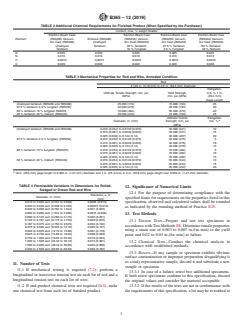
7.1 Materials supplied under this specification shall con-
form to the requirements for mechanical properties as specified
9.3 Methods of testing for defects and standards of accept-
in Table 3.
ability shall be as agreed upon between the manufacturer and
the purchaser at time of purchase.
7.2 The performance of mechanical tests to this requirement
will be negotiated at time of purchase.
10. Sampling
8. Dimensions, Mass, and Permissible Variations
10.1 Samples shall be taken from the material to determine
8.1 Tolerances on Rounds—Tolerances on tantalum and
conformity to this specification. The samples shall be taken so
tantalum alloy round products covered by this specification
as to be representative of the finished products.
shall be as specified in Table 4.
10.2 Care shall be taken to ensure that the sample selected
8.2 Tolerances for Square, Rectangular, or Other Shapes—
for testing is representative of the material, and that it is not
Tolerances for forged or rolled square, rectangular, or other
contaminated by the sampling procedure. If there is any
shapes shall be as agreed upon between purchaser and seller at
question relating to the sampling technique, or to the testing
the time of purchase.
thereof, the methods of sampling and testing shall be as agreed
8.3 Other Tolerances and Limitations: upon between the purchaser and the manufacturer.
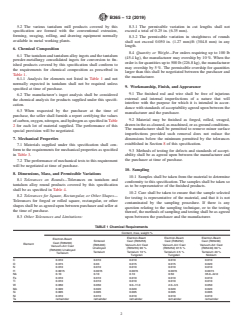
TABLE 1 Chemical Requirements
Content, max, weight%
Electron-Beam Electron-Beam Electron-Beam
Electron-Beam
Sintered Cast (R05255) Cast (R05252) Cast (R05240)
Cast (R05200)
Element
(R05400) Vacuum-Arc Cast Vacuum-Arc Cast Vacuum-Arc Cast
Vacuum-Arc Cast
Unalloyed (R05255) 90% (R05252) 97.5% (R05240) 60%
(R05200) Unalloyed
Tantalum Tantalum 10% Tantalum 2.5% Tantalum 40%
Tantalum
Tungsten Tungsten Niobium
C 0.010 0.010 0.010 0.010 0.010
O 0.015 0.03 0.015 0.015 0.020
N 0.010 0.010 0.010 0.010 0.010
H 0.0015 0.0015 0.0015 0.0015 0.0015
Nb 0.10 0.10 0.10 0.50 35.0–42.0
Fe 0.010 0.010 0.010 0.010 0.010
Ti 0.010 0.010 0.010 0.010 0.010
W 0.050 0.050 9.0–11.0 2.0–3.5 0.050
Mo 0.020 0.020 0.020 0.020 0.020
Si 0.005 0.005 0.005 0.005 0.005
Ni 0.010 0.010 0.010 0.010 0.010
Ta remainder remainder remainder remainder remainder
B365−12 (2019)
TABLE 2 Additional Chemical Requirements for Finished Product (When Specified
...