

ASTM E805-22
(Practice)Standard Practice for Identification of Instrumental Methods of Color or Color-Difference Measurement of Materials
General Information
- Abstract
SIGNIFICANCE AND USE
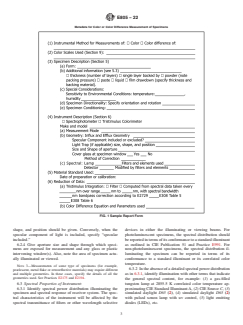
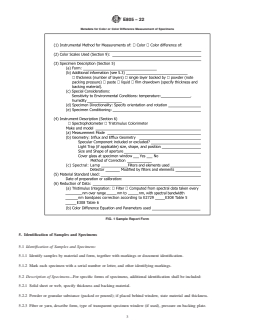
4.1 The options available in methods for the measurement of color or color-difference are many. These involve choices in: (1) specimens, (2) geometric and spectral properties of instruments, (3) calibration bases for standards used, (4) procedure for sample handling including conditioning, (5) procedure for taking data, and (6) equations for converting instrumental data to final results. Once the measurements have been made, it is essential to document what has been done for the purpose of interlaboratory comparisons, or for future use. A sample form is provided in Fig. 1 to record identifying information applicable to any instrumental method of color or color-difference measurement.
4.2 Refer to Guide E179, Practices E991, E1164, E1345, E1708, E1767, E2152, and E2194 and Test Methods D5386, D6166, E1247, E1331, E1347, E1348, and E1349, for specific details of measurements.
SCOPE
1.1 This practice covers the documentation of instrumental measurement of color or color difference for current communication or for future reference. The practice is applicable to instrumental measurements of materials where color is seen by reflected, transmitted or emitted light and any combinations of one or more of these processes. The practice is recommended for documentation of methodology in interlaboratory color-measurement programs.
1.2 Providing an adequate identification of an instrumental measure of color or color-difference involves documenting the metadata necessary for archiving and future use of the measurement data collected. The metadata can be divided in five parts:
1.2.1 Nature and source of available samples and the form of specimens actually measured,
1.2.2 Instrumental conditions of measurement, including instrument geometrical and spectral conditions of measurement,
1.2.3 Standards used,
1.2.4 Data acquisition procedure, and
1.2.5 Color scales employed.
1.3 This standard does not purport to address all of the safety concerns, if any, associated with its use. It is the responsibility of the user of this standard to establish appropriate safety, health, and environmental practices and determine the applicability of regulatory limitations prior to use.
1.4 This international standard was developed in accordance with internationally recognized principles on standardization established in the Decision on Principles for the Development of International Standards, Guides and Recommendations issued by the World Trade Organization Technical Barriers to Trade (TBT) Committee.
- Status
- Published
- Publication Date
- 31-May-2022
- Technical Committee
- E12 - Color and Appearance
- Drafting Committee
- E12.04 - Color and Appearance Analysis
Buy Documents
ASTM E805-22 - Standard Practice for Identification of Instrumental Methods of Color or Color-Difference Measurement of Materials
REDLINE ASTM E805-22 - Standard Practice for Identification of Instrumental Methods of Color or Color-Difference Measurement of Materials
Overview
ASTM E805-22, Standard Practice for Identification of Instrumental Methods of Color or Color-Difference Measurement of Materials, provides a systematic approach for documenting the methodology used in instrumental color and color-difference measurements. This standard, issued by ASTM International, is applicable where color is measured through reflected, transmitted, or emitted light for a wide range of materials. Detailed documentation ensures effective communication of methods, supports interlaboratory color comparisons, and enables future reference and reproducibility of results.
Color measurement by instruments is highly sensitive to sample type, instrumentation, calibration, and test procedures. ASTM E805-22 establishes a clear framework for recording all essential aspects of color measurement, facilitating quality assurance and data integrity within industries that rely on precise color evaluation.
Key Topics
Documentation of Measurement Metadata:
The standard mandates comprehensive documentation of the following five metadata categories:- Nature and source of samples: Material identification, specimen form, and any unique markings.
- Instrumental conditions: Detailed geometric and spectral settings, including the type of instrument, setup, and any conditioning steps.
- Standards used: Information on reference, working, and product standards applied during measurement.
- Data acquisition procedure: Steps for data collection, number of readings, specimen handling, and environmental factors.
- Color scales employed: Identification of color scales and equations used, such as CIE Lab*, CIEDE2000, Gardner, and Munsell systems.
Sample and Instrument Identification:
Procedures for marking, cataloging, and describing specimens are specified to ensure traceability. The standard requires documentation of equipment details, such as make, model, measurement geometry, and spectral characteristics.Reporting Practices:
Emphasis is placed on clarity and precision of reported measurement data, advising against implying false precision and requiring significant figures to match the method's capabilities.Interlaboratory Comparison:
ASTM E805-22 is especially recommended for comparative studies across different labs, enabling standardized communication of colorimetric methods.
Applications
ASTM E805-22 is essential for industries and research organizations that require repeatable and reliable color measurements, including:
- Paints and Coatings: Ensures consistency in color specification and quality across product lines.
- Textiles and Plastics: Supports evaluation of dyes, pigments, and colorfastness.
- Automotive and Aerospace Materials: Enables uniform color and appearance assessment.
- Paper, Food, and Chemical Sectors: Facilitates routine quality control where instrumental color evaluation is critical.
- Interlaboratory Testing: Provides the basis for uniform documentation in round-robin or proficiency testing scenarios.
By standardizing the identification and reporting of color measurement procedures, ASTM E805-22 helps improve product quality, regulatory compliance, and confidence in color-critical decisions.
Related Standards
ASTM E805-22 references and complements a suite of ASTM and international standards covering specific measurement practices, instrumental requirements, and colorimetric scales:
- ASTM E179: Guide for selection of geometric conditions in color measurement.
- ASTM E1164: Practice for obtaining spectrometric data for object-color evaluation.
- ASTM D2244: Practice for calculation of color tolerances and color differences.
- ASTM E1347, E1348, E1349: Methods for tristimulus, transmittance, and reflectance color measurement.
- ASTM D5386, D6166: Test methods for color evaluation in liquids.
- ASTM E313: Practice for calculating yellowness and whiteness indices.
- CIE Publications: Including guidelines for colorimetry and illuminants (e.g., CIE 15, CIEDE2000).
- DIN 6176: Standard for DIN99o color-difference calculation.
Using ASTM E805-22 in conjunction with these referenced documents fosters robust, harmonized color measurement practices across materials science, industry, and quality assurance processes.
Keywords: color measurement, color-difference, instrumental colorimetry, ASTM E805-22, documentation, color standards, reflectance, transmittance, spectrophotometry, interlaboratory comparisons, metadata.
Relations
- Effective Date
- 01-Mar-2024
- Effective Date
- 01-Nov-2023
- Effective Date
- 01-Nov-2023
- Refers
ASTM E1164-23 - Standard Practice for Obtaining Spectrometric Data for Object-Color Evaluation - Effective Date
- 01-Nov-2023
- Effective Date
- 01-Oct-2023
- Effective Date
- 01-May-2020
- Effective Date
- 01-May-2020
- Effective Date
- 01-Nov-2019
- Effective Date
- 01-Nov-2019
- Effective Date
- 01-May-2019
- Refers
ASTM E1708-14(2019) - Standard Practice for Electronic Interchange of Color and Appearance Data - Effective Date
- 01-May-2019
- Effective Date
- 01-Nov-2017
- Effective Date
- 01-May-2017
- Effective Date
- 01-Nov-2015
- Effective Date
- 01-Nov-2015
Buy Documents
ASTM E805-22 - Standard Practice for Identification of Instrumental Methods of Color or Color-Difference Measurement of Materials
REDLINE ASTM E805-22 - Standard Practice for Identification of Instrumental Methods of Color or Color-Difference Measurement of Materials
Get Certified
Connect with accredited certification bodies for this standard

BSMI (Bureau of Standards, Metrology and Inspection)
Taiwan's standards and inspection authority.
Sponsored listings
Frequently Asked Questions
ASTM E805-22 is a standard published by ASTM International. Its full title is "Standard Practice for Identification of Instrumental Methods of Color or Color-Difference Measurement of Materials". This standard covers: SIGNIFICANCE AND USE 4.1 The options available in methods for the measurement of color or color-difference are many. These involve choices in: (1) specimens, (2) geometric and spectral properties of instruments, (3) calibration bases for standards used, (4) procedure for sample handling including conditioning, (5) procedure for taking data, and (6) equations for converting instrumental data to final results. Once the measurements have been made, it is essential to document what has been done for the purpose of interlaboratory comparisons, or for future use. A sample form is provided in Fig. 1 to record identifying information applicable to any instrumental method of color or color-difference measurement. 4.2 Refer to Guide E179, Practices E991, E1164, E1345, E1708, E1767, E2152, and E2194 and Test Methods D5386, D6166, E1247, E1331, E1347, E1348, and E1349, for specific details of measurements. SCOPE 1.1 This practice covers the documentation of instrumental measurement of color or color difference for current communication or for future reference. The practice is applicable to instrumental measurements of materials where color is seen by reflected, transmitted or emitted light and any combinations of one or more of these processes. The practice is recommended for documentation of methodology in interlaboratory color-measurement programs. 1.2 Providing an adequate identification of an instrumental measure of color or color-difference involves documenting the metadata necessary for archiving and future use of the measurement data collected. The metadata can be divided in five parts: 1.2.1 Nature and source of available samples and the form of specimens actually measured, 1.2.2 Instrumental conditions of measurement, including instrument geometrical and spectral conditions of measurement, 1.2.3 Standards used, 1.2.4 Data acquisition procedure, and 1.2.5 Color scales employed. 1.3 This standard does not purport to address all of the safety concerns, if any, associated with its use. It is the responsibility of the user of this standard to establish appropriate safety, health, and environmental practices and determine the applicability of regulatory limitations prior to use. 1.4 This international standard was developed in accordance with internationally recognized principles on standardization established in the Decision on Principles for the Development of International Standards, Guides and Recommendations issued by the World Trade Organization Technical Barriers to Trade (TBT) Committee.
SIGNIFICANCE AND USE 4.1 The options available in methods for the measurement of color or color-difference are many. These involve choices in: (1) specimens, (2) geometric and spectral properties of instruments, (3) calibration bases for standards used, (4) procedure for sample handling including conditioning, (5) procedure for taking data, and (6) equations for converting instrumental data to final results. Once the measurements have been made, it is essential to document what has been done for the purpose of interlaboratory comparisons, or for future use. A sample form is provided in Fig. 1 to record identifying information applicable to any instrumental method of color or color-difference measurement. 4.2 Refer to Guide E179, Practices E991, E1164, E1345, E1708, E1767, E2152, and E2194 and Test Methods D5386, D6166, E1247, E1331, E1347, E1348, and E1349, for specific details of measurements. SCOPE 1.1 This practice covers the documentation of instrumental measurement of color or color difference for current communication or for future reference. The practice is applicable to instrumental measurements of materials where color is seen by reflected, transmitted or emitted light and any combinations of one or more of these processes. The practice is recommended for documentation of methodology in interlaboratory color-measurement programs. 1.2 Providing an adequate identification of an instrumental measure of color or color-difference involves documenting the metadata necessary for archiving and future use of the measurement data collected. The metadata can be divided in five parts: 1.2.1 Nature and source of available samples and the form of specimens actually measured, 1.2.2 Instrumental conditions of measurement, including instrument geometrical and spectral conditions of measurement, 1.2.3 Standards used, 1.2.4 Data acquisition procedure, and 1.2.5 Color scales employed. 1.3 This standard does not purport to address all of the safety concerns, if any, associated with its use. It is the responsibility of the user of this standard to establish appropriate safety, health, and environmental practices and determine the applicability of regulatory limitations prior to use. 1.4 This international standard was developed in accordance with internationally recognized principles on standardization established in the Decision on Principles for the Development of International Standards, Guides and Recommendations issued by the World Trade Organization Technical Barriers to Trade (TBT) Committee.
ASTM E805-22 is classified under the following ICS (International Classification for Standards) categories: 17.180.20 - Colours and measurement of light. The ICS classification helps identify the subject area and facilitates finding related standards.
ASTM E805-22 has the following relationships with other standards: It is inter standard links to ASTM D1500-24, ASTM E1331-15(2023), ASTM E1247-12(2023), ASTM E1164-23, ASTM D156-23, ASTM E1708-20, ASTM E1347-06(2020), ASTM E1708-19, ASTM E1331-15(2019), ASTM E1345-98(2019), ASTM E1708-14(2019), ASTM E1247-12(2017), ASTM E308-17, ASTM E259-06(2015), ASTM E1347-06(2015). Understanding these relationships helps ensure you are using the most current and applicable version of the standard.
ASTM E805-22 is available in PDF format for immediate download after purchase. The document can be added to your cart and obtained through the secure checkout process. Digital delivery ensures instant access to the complete standard document.
Standards Content (Sample)
This international standard was developed in accordance with internationally recognized principles on standardization established in the Decision on Principles for the
Development of International Standards, Guides and Recommendations issued by the World Trade Organization Technical Barriers to Trade (TBT) Committee.
Designation: E805 −22
Standard Practice for
Identification of Instrumental Methods of Color or Color-
Difference Measurement of Materials
This standard is issued under the fixed designation E805; the number immediately following the designation indicates the year of
original adoption or, in the case of revision, the year of last revision. A number in parentheses indicates the year of last reapproval. A
superscript epsilon (´) indicates an editorial change since the last revision or reapproval.
1. Scope 2. Referenced Documents
2.1 ASTM Standards:
1.1 This practice covers the documentation of instrumental
D156 Test Method for Saybolt Color of Petroleum Products
measurement of color or color difference for current commu-
(Saybolt Chromometer Method)
nication or for future reference. The practice is applicable to
D1209 Test Method for Color of Clear Liquids (Platinum-
instrumental measurements of materials where color is seen by
Cobalt Scale)
reflected, transmitted or emitted light and any combinations of
D1500 Test Method forASTM Color of Petroleum Products
one or more of these processes. The practice is recommended
(ASTM Color Scale)
for documentation of methodology in interlaboratory color-
D1535 Practice for Specifying Color by the Munsell System
measurement programs.
D1544 Test Method for Color of Transparent Liquids (Gard-
1.2 Providing an adequate identification of an instrumental
ner Color Scale)
measure of color or color-difference involves documenting the
D2244 Practice for Calculation of Color Tolerances and
metadata necessary for archiving and future use of the mea-
Color Differences from Instrumentally Measured Color
surement data collected. The metadata can be divided in five
Coordinates
parts:
D5386 Test Method for Color of Liquids Using Tristimulus
1.2.1 Nature and source of available samples and the form Colorimetry
of specimens actually measured,
D6166 Test Method for Color of Pine Chemicals and Re-
lated Products (Instrumental Determination of Gardner
1.2.2 Instrumental conditions of measurement, including
Color)
instrument geometrical and spectral conditions of
E179 Guide for Selection of Geometric Conditions for
measurement,
Measurement of Reflection and Transmission Properties
1.2.3 Standards used,
of Materials
1.2.4 Data acquisition procedure, and
E259 Practice for Preparation of Pressed Powder White
1.2.5 Color scales employed.
Reflectance Factor Transfer Standards for Hemispherical
and Bi-Directional Geometries
1.3 This standard does not purport to address all of the
E284 Terminology of Appearance
safety concerns, if any, associated with its use. It is the
E308 PracticeforComputingtheColorsofObjectsbyUsing
responsibility of the user of this standard to establish appro-
the CIE System
priate safety, health, and environmental practices and deter-
E313 Practice for Calculating Yellowness and Whiteness
mine the applicability of regulatory limitations prior to use.
Indices from Instrumentally Measured Color Coordinates
1.4 This international standard was developed in accor-
E991 Practice for Color Measurement of Fluorescent Speci-
dance with internationally recognized principles on standard-
mens Using the One-Monochromator Method
ization established in the Decision on Principles for the
E1164 PracticeforObtainingSpectrometricDataforObject-
Development of International Standards, Guides and Recom-
Color Evaluation
mendations issued by the World Trade Organization Technical
E1247 Practice for Detecting Fluorescence in Object-Color
Barriers to Trade (TBT) Committee.
Specimens by Spectrophotometry
E1331 Test Method for Reflectance Factor and Color by
This practice is under the jurisdiction of ASTM Committee E12 on Color and
Appearance and is the direct responsibility of Subcommittee E12.04 on Color and
Appearance Analysis. For referenced ASTM standards, visit the ASTM website, www.astm.org, or
Current edition approved June 1, 2022. Published June 2022. Originally contact ASTM Customer Service at service@astm.org. For Annual Book of ASTM
approved in 1981. Last previous edition approved in 2017 as E805 – 12a (2017). Standards volume information, refer to the standard’s Document Summary page on
DOI: 10.1520/E0805-22. the ASTM website.
Copyright © ASTM International, 100 Barr Harbor Drive, PO Box C700, West Conshohocken, PA 19428-2959. United States
E805 − 22
Spectrophotometry Using Hemispherical Geometry instrumental data to final results. Once the measurements have
E1345 Practice for Reducing the Effect of Variability of been made, it is essential to document what has been done for
Color Measurement by Use of Multiple Measurements thepurposeofinterlaboratorycomparisons,orforfutureuse.A
E1347 Test Method for Color and Color-Difference Mea- sample form is provided in Fig. 1 to record identifying
surement by Tristimulus Colorimetry information applicable to any instrumental method of color or
E1348 Test Method for Transmittance and Color by Spec- color-difference measurement.
trophotometry Using Hemispherical Geometry
4.2 Refer to Guide E179, Practices E991, E1164, E1345,
E1349 Test Method for Reflectance Factor and Color by
E1708, E1767, E2152, and E2194 and Test Methods D5386,
Spectrophotometry Using Bidirectional (45°:0° or 0°:45°)
D6166, E1247, E1331, E1347, E1348, and E1349, for specific
Geometry
details of measurements.
E1708 Practice for Electronic Interchange of Color and
Appearance Data
5. Identification of Samples and Specimens
E1767 Practice for Specifying the Geometries of Observa-
5.1 Identification of Samples and Specimens:
tion and Measurement to Characterize the Appearance of
5.1.1 Identify samples by material and form, together with
Materials
markings or document identification.
E2152 Practice for Computing the Colors of Fluorescent
5.1.2 Markeachspecimenwithaserialnumberorletter,and
Objects from Bispectral Photometric Data
other identifying markings.
E2153 Practice for Obtaining Bispectral Photometric Data
for Evaluation of Fluorescent Color
5.2 Description of Specimens—For specific forms of
E2175 Practice for Specifying the Geometry of Multiangle
specimens, additional identification shall be included:
Spectrophotometers
5.2.1 Solid sheet or web, specify thickness and backing
E2194 Test Method for Multiangle Color Measurement of
material.
Metal Flake Pigmented Materials
5.2.2 Powder or granular substance (packed or poured); if
E2729 Practice for Rectification of Spectrophotometric
placed behind window, state material and thickness.
Bandpass Differences
5.2.3 Fiber or yarn, describe form, type of transparent
2.2 Other Standard Documents: specimen window (if used), pressure on backing plate.
CIE Publication 51 A Method for Assessing the Quality of
5.2.4 Paste (if placed behind window), state material and
Daylight Simulators for Colorimetry thickness.
DIN 6176 Farbmetrische, Bestimmung von Farbabstände
5.2.5 Liquid (if observed through window), state window
bie Körperfarben nach der DIN99o–Formel (Colorimetric material and path length.
Determination of Color-Differences of Object Colors Ac-
5.2.6 Film drawdown, specify film thickness and back-
cording to the DIN99o Formula) ground.
5.2.7 For gonioapparent materials, identify the direction of
3. Terminology
illumination and viewing relative to the specimen.
5.2.8 Conditioning, if any.
3.1 DefinitionsoftermsinTerminologyE284areapplicable
to this practice.
NOTE 2—When specimens are measured behind glass or other material,
specify thickness and material type. In addition, specify the method used
3.2 Definitions of Terms Specific to This Standard:
for data correction.
3.3 metadata, n—structured information that describes,
explains, locates, and otherwise makes it easier to retrieve and
5 6. Identification of Instrument
use an information resource (1).
6.1 Sufficient description of the instrumentation shall be
NOTE 1—In the case of color and color difference measurements, the
provided to enable one of ordinary skill in the art to reproduce
data about the instrument, the measurement procedure, the treatment of
the measurement. The make and model number of the instru-
the specimen, identification of color scale and the calculations are to be
included in the metadata.
ment used shall be reported.
6.2 For interlaboratory comparisons, long-term studies, and
4. Significance and Use
measurements used to document conformance to a color
4.1 The options available in methods for the measurement
specification, the physical properties of the instrument shall be
ofcolororcolor-differencearemany.Theseinvolvechoicesin:
identified by it, as follows:
(1) specimens, (2) geometric and spectral properties of
6.2.1 Mode of Measurement, such as transmittance factor,
instruments, (3) calibration bases for standards used, (4)
reflectance factor, total radiance factor, etc.
procedure for sample handling including conditioning, (5)
6.2.2 Geometric Properties of Instrument, for multi-angle
procedure for taking data, and (6) equations for converting
spectrophotometers following Practice E2175 or for all others
following Practice E1767 the influx geometry and eflux geom-
etry including aperture angles and sizes.
Available from CIE (International Commission on Illumination), http://
www.cie.co.at or http://www.techstreet.
6.2.3 Specular Component, where hemispherical illumina-
Available from Beuth
...
This document is not an ASTM standard and is intended only to provide the user of an ASTM standard an indication of what changes have been made to the previous version. Because
it may not be technically possible to adequately depict all changes accurately, ASTM recommends that users consult prior editions as appropriate. In all cases only the current version
of the standard as published by ASTM is to be considered the official document.
Designation: E805 − 12a (Reapproved 2017) E805 − 22
Standard Practice for
Identification of Instrumental Methods of Color or Color-
Difference Measurement of Materials
This standard is issued under the fixed designation E805; the number immediately following the designation indicates the year of
original adoption or, in the case of revision, the year of last revision. A number in parentheses indicates the year of last reapproval. A
superscript epsilon (´) indicates an editorial change since the last revision or reapproval.
1. Scope
1.1 This practice covers the documentation of instrumental measurement of color or color difference for current communication
or for future reference. The practice is applicable to instrumental measurements of materials where color is seen by reflected,
transmitted or emitted light and any combinations of one or more of these processes. The practice is recommended for
documentation of methodology in interlaboratory color-measurement programs.
1.2 Providing an adequate identification of an instrumental measure of color or color-difference involves documenting the
metadata necessary for archiving and future use of the measurement data collected. The metadata can be divided in five parts:
1.2.1 Nature and source of available samples and the form of specimens actually measured,
1.2.2 Instrumental conditions of measurement, including instrument geometrical and spectral conditions of measurement,
1.2.3 Standards used,
1.2.4 Data acquisition procedure, and
1.2.5 Color scales employed.
1.3 This standard does not purport to address all of the safety concerns, if any, associated with its use. It is the responsibility
of whoever uses the user of this standard to consult and establish appropriate safety safety, health, and healthenvironmental
practices and determine the applicability of regulatory limitations prior to use.
1.4 This international standard was developed in accordance with internationally recognized principles on standardization
established in the Decision on Principles for the Development of International Standards, Guides and Recommendations issued
by the World Trade Organization Technical Barriers to Trade (TBT) Committee.
2. Referenced Documents
2.1 ASTM Standards:
D156 Test Method for Saybolt Color of Petroleum Products (Saybolt Chromometer Method)
D1209 Test Method for Color of Clear Liquids (Platinum-Cobalt Scale)
D1500 Test Method for ASTM Color of Petroleum Products (ASTM Color Scale)
This practice is under the jurisdiction of ASTM Committee E12 on Color and Appearance and is the direct responsibility of Subcommittee E12.04 on Color and
Appearance Analysis.
Current edition approved May 1, 2017June 1, 2022. Published May 2017June 2022. Originally approved in 1981. Last previous edition approved in 20122017 as
E805 – 12a.E805 – 12a (2017). DOI: 10.1520/E0805-12AR17.10.1520/E0805-22.
For referenced ASTM standards, visit the ASTM website, www.astm.org, or contact ASTM Customer Service at service@astm.org. For Annual Book of ASTM Standards
volume information, refer to the standard’s Document Summary page on the ASTM website.
Copyright © ASTM International, 100 Barr Harbor Drive, PO Box C700, West Conshohocken, PA 19428-2959. United States
E805 − 22
D1535 Practice for Specifying Color by the Munsell System
D1544 Test Method for Color of Transparent Liquids (Gardner Color Scale)
D2244 Practice for Calculation of Color Tolerances and Color Differences from Instrumentally Measured Color Coordinates
D5386 Test Method for Color of Liquids Using Tristimulus Colorimetry
D6166 Test Method for Color of Pine Chemicals and Related Products (Instrumental Determination of Gardner Color)
E179 Guide for Selection of Geometric Conditions for Measurement of Reflection and Transmission Properties of Materials
E259 Practice for Preparation of Pressed Powder White Reflectance Factor Transfer Standards for Hemispherical and
Bi-Directional Geometries
E284 Terminology of Appearance
E308 Practice for Computing the Colors of Objects by Using the CIE System
E313 Practice for Calculating Yellowness and Whiteness Indices from Instrumentally Measured Color Coordinates
E991 Practice for Color Measurement of Fluorescent Specimens Using the One-Monochromator Method
E1164 Practice for Obtaining Spectrometric Data for Object-Color Evaluation
E1247 Practice for Detecting Fluorescence in Object-Color Specimens by Spectrophotometry
E1331 Test Method for Reflectance Factor and Color by Spectrophotometry Using Hemispherical Geometry
E1345 Practice for Reducing the Effect of Variability of Color Measurement by Use of Multiple Measurements
E1347 Test Method for Color and Color-Difference Measurement by Tristimulus Colorimetry
E1348 Test Method for Transmittance and Color by Spectrophotometry Using Hemispherical Geometry
E1349 Test Method for Reflectance Factor and Color by Spectrophotometry Using Bidirectional (45°:0° or 0°:45°) Geometry
E1708 Practice for Electronic Interchange of Color and Appearance Data
E1767 Practice for Specifying the Geometries of Observation and Measurement to Characterize the Appearance of Materials
E2152 Practice for Computing the Colors of Fluorescent Objects from Bispectral Photometric Data
E2153 Practice for Obtaining Bispectral Photometric Data for Evaluation of Fluorescent Color
E2175 Practice for Specifying the Geometry of Multiangle Spectrophotometers
E2194 Test Method for Multiangle Color Measurement of Metal Flake Pigmented Materials
E2729 Practice for Rectification of Spectrophotometric Bandpass Differences
2.2 Other Standard Documents:
CIE Publication 51 A Method for Assessing the Quality of Daylight Simulators for Colorimetry
DIN 6176 Farbmetrische, Bestimmung von Farbabstände bie Körperfarben nach der DIN99–FormelDIN99o–Formel (Colori-
metric Determination of Color-Differences of Object Colors According to the DIN99o Formula)
3. Terminology
3.1 Definitions of terms in Terminology E284 are applicable to this practice.
3.2 Definitions of Terms Specific to This Standard:
3.3 metadata, n—structeredstructured information that describes, explains, locates, and otherwise makes it easier to retrieve and
use an information resource (1).
NOTE 1—In the case of color and color difference measurements, the data about the instrument, the measurement procedure, the treatment of the specimen,
identification of color scale and the calculations are to be included in the metadata.
4. Significance and Use
4.1 The options available in methods for the measurement of color or color-difference are many. These involve choices in: (1)
specimens, (2) geometric and spectral properties of instruments, (3) calibration bases for standards used, (4) procedure for sample
handling including conditioning, (5) procedure for taking data, and (6) equations for converting instrumental data to final results.
Once the measurements have been made, it is essential to document what has been done for the purpose of interlaboratory
comparisons, or for future use. A sample form is provided in Fig. 1 to record identifying information applicable to any instrumental
method of color or color-difference measurement.
4.2 Refer to Guide E179, Practices E991, E1164, E1345, E1708, E1767, E2152, and E2194 and Test Methods D5386, D6166,
E1247, E1331, E1347, E1348, and E1349, for specific details of measurements.
Available from CIE (International Commission on Illumination), http://www.cie.co.at or http://www.techstreet.
Available from Beuth Verlag GmbH (DIN–Deutsches Institut fur Normung e.V.), Burggrafenstrasse 6, 10787, Berlin, Germany, http://www.en.din.de.
The boldface numbers in parentheses refer to the list of references at the end of this practice.
E805 − 22
Metadata for Color or Color Difference Measurement of Specimens
FIG. 1 Sample Report Form
5. Identification of Samples and Specimens
5.1 Identification of Samples and Specimens:
5.1.1 Identify samples by material and form, together with markings or document identification.
5.1.2 Mark each specimen with a serial number or letter, and other identifying markings.
5.2 Description of Specimens—For specific forms of specimens, additional identification shall be included:
5.2.1 Solid sheet or web, specify thickness and backing material.
5.2.2 Powder or granular substance (packed or poured); if placed behind window, state material and thickness.
5.2.3 Fiber or yarn, describe form, type of transparent specimen window (if used), pressure on backing plate.
E805 − 22
5.2.4 Paste (if placed behind window), state material and thickness.
5.2.5 Liquid (if observed through window), state window material and path length.
5.2.6 Film drawdown, specify film thickness and background.
5.2.7 For gonioapparent materials, identify the direction of illumination and viewing relative to the specimen.
5.2.8 Conditioning, if any.
NOTE 2—When specimens are measured behind glass or other material, specify thickness and material type. In addition, specify the method used for data
correction.
6. Identification of Instrument
6.1 Sufficient description of the instrumentation shall be provided to enable one of ordinary skill in the art to reproduce the
measurement. The make and model number of the instrument used shall be reported.
6.2 For interlaboratory comparisons, long-term studies, and measurements used to document conformance to a color specification,
the physical prop
...