

ASTM E179-17(2022)
(Guide)Standard Guide for Selection of Geometric Conditions for Measurement of Reflection and Transmission Properties of Materials
General Information
- Abstract
SCOPE
1.1 This guide is intended for use in selecting terminology, measurement scales, and instrumentation for describing or evaluating such appearance characteristics as glossiness, opacity, lightness, transparency, and haziness in terms of reflected or transmitted light. This guide does not consider the spectral variations responsible for color, but the geometric variables described herein can importantly affect instrumentally measured values of color. This guide is general in scope rather than specific as to instrument or material.
1.2 This international standard was developed in accordance with internationally recognized principles on standardization established in the Decision on Principles for the Development of International Standards, Guides and Recommendations issued by the World Trade Organization Technical Barriers to Trade (TBT) Committee.
- Status
- Published
- Publication Date
- 30-Sep-2022
- Technical Committee
- E12 - Color and Appearance
- Drafting Committee
- E12.03 - Geometry
Overview
ASTM E179-17(2022): Standard Guide for Selection of Geometric Conditions for Measurement of Reflection and Transmission Properties of Materials provides comprehensive guidance for selecting appropriate measurement geometries when evaluating the reflective and transmissive properties of materials. Developed by ASTM, this standard assists users in ensuring that optical appearance properties such as glossiness, opacity, lightness, transparency, and haziness are measured accurately and consistently using reflected or transmitted light. The guide emphasizes the importance of specifying geometric conditions because these influence measured values of appearance, even when color per se is not the attribute under direct evaluation.
Key Topics
- Geometric Measurement Scales: The guide covers critical terminology and measurement scales, distinguishing between regular (specular), diffuse, total, and directional reflection/transmission.
- Illumination and Viewing Angles: Accurate specification and selection of incident and viewing angles, azimuthal and rotation angles, and aperture sizes for different instruments.
- Specimen Preparation: Recommendations for specimen flatness, thickness, surface quality, and environmental conditioning to ensure representative results.
- Types of Reflection and Transmission: Comprehensive descriptions of how to measure and report regular and diffuse reflection/transmission, gloss, haze, and related appearance attributes.
- Instrumentation Considerations: Guidance on instrument setup to minimize vignetting and ensure compliance with the Helmholtz reciprocal relation for reliable, reproducible measurements.
- Applicability: Practical directions for diverse materials including opaque, translucent, and transparent substrates in forms ranging from liquids to coated surfaces.
Applications
The methodologies in ASTM E179-17(2022) are used widely in research, product development, manufacturing, and quality assurance where understanding and communicating optical appearance is essential. Common applications include:
- Material Quality Control: Ensuring consistency in the gloss, transparency, or opacity of manufactured products such as ceramics, plastics, coatings, textiles, and glass.
- Product Development: Selecting appropriate appearance attributes for new materials and comparing prototypes with reference standards.
- Process Optimization: Adjusting formulation or processing parameters in response to measured differences in reflection or transmission properties.
- Regulatory Compliance and Specification: Preparing documentation to meet international trade requirements and technical barriers to trade (TBT) as outlined by the WTO, supported by globally recognized terminology and practices.
- Comparative Analysis: Resolving discrepancies in appearance measurements among multiple measurement geometries or across different sites and instruments.
By clarifying geometric measurement conditions, this standard supports precise communication across supply chains and facilitates the resolution of technical disputes regarding appearance measurements.
Related Standards
Several ASTM and CIE standards are referenced for implementation alongside ASTM E179-17(2022), including but not limited to:
- ASTM D523: Test Method for Specular Gloss
- ASTM E1331: Test Method for Reflectance Factor and Color by Spectrophotometry Using Hemispherical Geometry
- ASTM D1003: Test Method for Haze and Luminous Transmittance of Transparent Plastics
- ASTM E1164: Practice for Obtaining Spectrometric Data for Object-Color Evaluation
- ASTM E2194 and E2539: Test Methods for Multiangle Color Measurement of Gonioapparent Materials
- CIE Publication No. 15: Colorimetry
- CIE Publication No. 17: International Lighting Vocabulary
These related standards offer detailed protocols for specific test scenarios and materials. By adhering to ASTM E179-17(2022) in conjunction with these references, organizations can ensure robust, standardized, and internationally accepted characterization of appearance properties.
Keywords: geometric conditions, reflection measurement, transmission measurement, gloss measurement, opacity, transparency, ASTM E179, appearance properties, optical properties, material standards.
Relations
- Effective Date
- 01-Dec-2023
- Effective Date
- 01-Nov-2023
- Refers
ASTM E1164-23 - Standard Practice for Obtaining Spectrometric Data for Object-Color Evaluation - Effective Date
- 01-Nov-2023
- Effective Date
- 15-Jun-2020
- Effective Date
- 01-Nov-2019
- Effective Date
- 01-Oct-2018
- Effective Date
- 01-Jul-2016
- Effective Date
- 01-Jan-2016
- Refers
ASTM D1455-87(2015) - Standard Test Method for 60° Specular Gloss of Emulsion Floor Polish - Effective Date
- 01-Nov-2015
- Effective Date
- 01-Nov-2015
- Effective Date
- 01-Jul-2015
- Effective Date
- 01-Jul-2015
- Refers
ASTM E2539-14 - Standard Test Method for Multiangle Color Measurement of Interference Pigments - Effective Date
- 01-Nov-2014
- Effective Date
- 01-Nov-2014
- Effective Date
- 01-May-2014
Get Certified
Connect with accredited certification bodies for this standard

BSMI (Bureau of Standards, Metrology and Inspection)
Taiwan's standards and inspection authority.
Sponsored listings
Frequently Asked Questions
ASTM E179-17(2022) is a guide published by ASTM International. Its full title is "Standard Guide for Selection of Geometric Conditions for Measurement of Reflection and Transmission Properties of Materials". This standard covers: SCOPE 1.1 This guide is intended for use in selecting terminology, measurement scales, and instrumentation for describing or evaluating such appearance characteristics as glossiness, opacity, lightness, transparency, and haziness in terms of reflected or transmitted light. This guide does not consider the spectral variations responsible for color, but the geometric variables described herein can importantly affect instrumentally measured values of color. This guide is general in scope rather than specific as to instrument or material. 1.2 This international standard was developed in accordance with internationally recognized principles on standardization established in the Decision on Principles for the Development of International Standards, Guides and Recommendations issued by the World Trade Organization Technical Barriers to Trade (TBT) Committee.
SCOPE 1.1 This guide is intended for use in selecting terminology, measurement scales, and instrumentation for describing or evaluating such appearance characteristics as glossiness, opacity, lightness, transparency, and haziness in terms of reflected or transmitted light. This guide does not consider the spectral variations responsible for color, but the geometric variables described herein can importantly affect instrumentally measured values of color. This guide is general in scope rather than specific as to instrument or material. 1.2 This international standard was developed in accordance with internationally recognized principles on standardization established in the Decision on Principles for the Development of International Standards, Guides and Recommendations issued by the World Trade Organization Technical Barriers to Trade (TBT) Committee.
ASTM E179-17(2022) is classified under the following ICS (International Classification for Standards) categories: 17.180.20 - Colours and measurement of light. The ICS classification helps identify the subject area and facilitates finding related standards.
ASTM E179-17(2022) has the following relationships with other standards: It is inter standard links to ASTM E808-23, ASTM E1331-15(2023), ASTM E1164-23, ASTM E811-09(2020)e1, ASTM E1331-15(2019), ASTM D4061-13(2018), ASTM C584-81(2016), ASTM E808-01(2016), ASTM D1455-87(2015), ASTM E1348-15, ASTM E811-09(2015), ASTM E1331-15, ASTM E2539-14, ASTM E2194-14, ASTM C346-87(2014). Understanding these relationships helps ensure you are using the most current and applicable version of the standard.
ASTM E179-17(2022) is available in PDF format for immediate download after purchase. The document can be added to your cart and obtained through the secure checkout process. Digital delivery ensures instant access to the complete standard document.
Standards Content (Sample)
This international standard was developed in accordance with internationally recognized principles on standardization established in the Decision on Principles for the
Development of International Standards, Guides and Recommendations issued by the World Trade Organization Technical Barriers to Trade (TBT) Committee.
Designation:E179 −17 (Reapproved 2022)
Standard Guide for
Selection of Geometric Conditions for Measurement of
Reflection and Transmission Properties of Materials
This standard is issued under the fixed designation E179; the number immediately following the designation indicates the year of
original adoption or, in the case of revision, the year of last revision. A number in parentheses indicates the year of last reapproval. A
superscript epsilon (´) indicates an editorial change since the last revision or reapproval.
INTRODUCTION
This is a guide describing the selecting of geometric conditions of measurement of appearance
attributes such as color, gloss, reflectance, opacity, and transmittance. It includes a selection of
numerical scales for appearance attributes other than color.
In describing appearance, wavelength (or spectral) variability is primarily responsible for color,
while geometric (or directional) selectivity is primarily responsible for gloss, luster, translucency, and
like attributes. However, geometric conditions not only affect geometric variables such as gloss and
transparency, but also affect color, diffuse reflectance, and transmittance. Likewise spectral conditions
can affect the measurement of geometric attributes of appearance. Therefore both the spectral and
geometric conditions of measurement must be identified in specifying an appearance attribute of a
specimen.
This guide describes the selection of geometric conditions and as a consequence should help
improve agreement in these measurements as well as providing useful guidance in resolving
differences between spectral-type measurements that are related to geometry.
1. Scope 2. Referenced Documents
1.1 This guide is intended for use in selecting terminology, 2.1 ASTM Standards:
measurement scales, and instrumentation for describing or C346 Test Method for 45-deg Specular Gloss of Ceramic
evaluating such appearance characteristics as glossiness, Materials
opacity, lightness, transparency, and haziness in terms of C347 Test Method for Reflectivity and Coefficient of Scatter
reflected or transmitted light. This guide does not consider the of White Porcelain Enamels (Withdrawn 1990)
spectral variations responsible for color, but the geometric C523 Test Method for Light Reflectance of Acoustical Ma-
variables described herein can importantly affect instrumen- terials by the Integrating Sphere Reflectometer (With-
tally measured values of color. This guide is general in scope drawn 1988)
rather than specific as to instrument or material. C584 Test Method for Specular Gloss of Glazed Ceramic
Whitewares and Related Products
1.2 This international standard was developed in accor-
D523 Test Method for Specular Gloss
dance with internationally recognized principles on standard-
D1003 Test Method for Haze and Luminous Transmittance
ization established in the Decision on Principles for the
of Transparent Plastics
Development of International Standards, Guides and Recom-
D1455 Test Method for 60° Specular Gloss of Emulsion
mendations issued by the World Trade Organization Technical
Floor Polish
Barriers to Trade (TBT) Committee.
For referenced ASTM standards, visit the ASTM website, www.astm.org, or
This guide is under the jurisdiction of ASTM Committee E12 on Color and contact ASTM Customer Service at service@astm.org. For Annual Book of ASTM
Appearance and is the direct responsibility of Subcommittee E12.03 on Geometry. Standards volume information, refer to the standard’s Document Summary page on
Current edition approved Oct. 1, 2022. Published November 2022. Originally the ASTM website.
approved in 1961. Last previous edition approved in 2017 as E179 – 17. DOI: The last approved version of this historical standard is referenced on
10.1520/E0179-17R22. www.astm.org.
Copyright © ASTM International, 100 Barr Harbor Drive, PO Box C700, West Conshohocken, PA 19428-2959. United States
E179−17 (2022)
D1494 Test Method for Diffuse Light Transmission Factor 3.1.1 flux (radiant), Φ,n—the time rate of flow of radiant
of Reinforced Plastics Panels energy; radiant power (Terminology E284).
D1746 Test Method for Transparency of Plastic Sheeting
3.1.2 incident flux, Φ,n—flux incident on the specimen at a
i
D1834 Test Method for 20° Specular Gloss of Waxed Paper
specified illumination angle and aperture angle.
(Withdrawn 2004)
3.1.3 reflected flux, Φ,n—flux reflected from the specimen
r
D4039 Test Method for Reflection Haze of High-Gloss
at a specified viewing angle and aperture angle.
Surfaces
3.1.4 reference reflected flux, Φ ,n—flux reflected from a
r.r
D4061 Test Method for Retroreflectance of Horizontal Coat-
referencestandardofreflectance,illuminatedandviewedinthe
ings
same manner as the specimen under consideration.
E97 Method of Test for Directional Reflectance Factor,
45-Deg 0-Deg, of Opaque Specimens by Broad-Band
3.1.5 transmitted flux, Φ,n—flux transmitted through the
t
Filter Reflectometry (Withdrawn 1991) specimen at a specified viewing angle and field angle.
E284 Terminology of Appearance
3.1.6 reflectance, ρ,n—ratio of the reflected flux to the
E429 Test Method for Measurement and Calculation of
incident flux defined as ρ = Φ / Φ.
r i
Reflecting Characteristics of Metallic Surfaces Using
3.1.7 reflectance factor, R, n—ratio of the reflected flux to
Integrating Sphere Instruments (Withdrawn 1996)
the reference reflected flux defined asR= Φ / Φ .
r r.r
E430 TestMethodsforMeasurementofGlossofHigh-Gloss
3.1.8 transmittance, τ,n—ratio of the transmitted flux to the
Surfaces by Abridged Goniophotometry
incident flux defined as τ = Φ / Φ.
E808 Practice for Describing Retroreflection t i
3.1.8.1 Discussion—A companion term, transmittance
E809 Practice for Measuring Photometric Characteristics of
factor, is not normally used in the measurement of appearance
Retroreflectors
attributes.
E810 Test Method for Coefficient of Retroreflection of
Retroreflective Sheeting Utilizing the Coplanar Geometry
3.1.9 For other definitions see Terminology E284 and CIE
E811 Practice for Measuring Colorimetric Characteristics of
Publication Nos. 17 and 38.
Retroreflectors Under Nighttime Conditions
E991 Practice for Color Measurement of Fluorescent Speci-
4. Summary of Guide
mens Using the One-Monochromator Method
4.1 When light impinges upon a material, several phenom-
E1164 PracticeforObtainingSpectrometricDataforObject-
ena can occur. Part of the light may be reflected, part may be
Color Evaluation
transmitted, and part may be absorbed. This guide deals with
E1331 Test Method for Reflectance Factor and Color by
the reflected and transmitted light and the selection of geomet-
Spectrophotometry Using Hemispherical Geometry
ric conditions for its measurement.
E1348 Test Method for Transmittance and Color by Spec-
4.2 An idealization of the light reflected and transmitted by
trophotometry Using Hemispherical Geometry
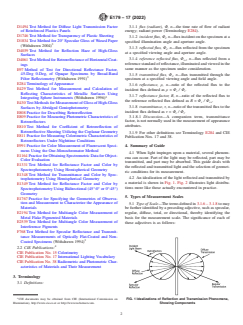
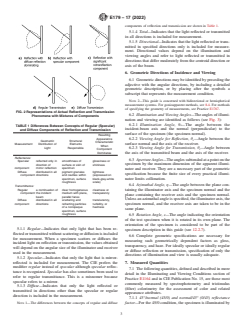
a material is shown in Fig. 1. Fig. 2 illustrates light distribu-
E1349 Test Method for Reflectance Factor and Color by
tions more like those actually encountered in practice.
Spectrophotometry Using Bidirectional (45°:0° or 0°:45°)
Geometry
5. Types of Measurement Scales
E1767 Practice for Specifying the Geometries of Observa-
tion and Measurement to Characterize the Appearance of
5.1 Type of Scale—Thetermsdefinedin3.1.6–3.1.8tomay
Materials
be further identified by a preceding adjective, such as specular,
E2194 Test Method for Multiangle Color Measurement of
regular, diffuse, total, or directional, thereby identifying the
Metal Flake Pigmented Materials
basis for the measurement scale. The significance of each of
E2539 Test Method for Multiangle Color Measurement of these adjectives is as follows:
Interference Pigments
F768 Test Method for Specular Reflectance and Transmit-
tance Measurements of Optically Flat-Coated and Non-
Coated Specimens (Withdrawn 1994)
2.2 CIE Publications:
CIE Publication No. 15 Colorimetry
CIE Publication No. 17 International Lighting Vocabulary
CIE Publication No. 38 Radiometric and Photometric Char-
acteristics of Materials and Their Measurement
3. Terminology
3.1 Definitions:
CIE documents may be obtained from CIE (International Commission on FIG. 1Idealizations of Reflection and Transmission Phenomena,
Illumination), http://www.cie.co.at or http://www.techstreet.com. Showing Components
E179−17 (2022)
components of reflection and transmission are shown in Table 1.
5.1.4 Total—Indicates that the light reflected or transmitted
in all directions is included for measurement.
5.1.5 Directional—Indicates that the light reflected or trans-
mitted in specified directions only is included for measure-
ment. Directional values depend on the illumination and
viewing angles and refer to light reflected or transmitted in
directions that differ moderately from the centroid direction or
axis of the beam.
6. Geometric Directions of Incidence and Viewing
6.1 Geometric directions may be identified by preceding the
adjective with the angular directions, by including a detailed
geometric description, or by placing after the symbols a
subscript that represents the measurement condition.
NOTE 2—This guide is concerned with bidirectional or hemispherical
measurement systems. For gonioapparent methods, see 8.4. For methods
of specifying the geometry of measurements, see Practice E1767.
FIG. 2Representations of Actual Reflection and Transmission
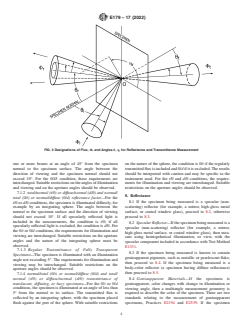
6.2 Illumination and Viewing Angles—The angles of illumi-
Phenomena with Mixtures of Components
nation and viewing are identified as follows (see Fig. 3):
6.2.1 Illumination Angle, θ —The angle between the
i
TABLE 1 Differences Between Concepts of Regular (Specular)
incident-beam axis and the normal (perpendicular) to the
and Diffuse Components of Reflection and Transmission
surface of the specimen (the specimen normal).
Resulting
Appearance 6.2.2 Viewing Angle for Reflection, θ —Angle between the
r
Geometric Structural
Characteristic
surface normal and the axis of the receiver.
Measurement Distribution of Elements
When
Light Responsible
6.2.3 Viewing Angle for Transmission, θ—Angle between
Component t
Dominates the axis of the transmitted beam and the axis of the receiver.
Reflectance:
6.3 ApertureAngles—Theanglessubtendedatapointonthe
Specular reflected only in smoothness of glossiness or
specimen by the maximum dimension of the apparent illumi-
direction of surface or skin of shininess
component mirror reflection specimen
nator and receiver. They are a necessary part of the geometric
Diffuse distributed in all pigment granules lightness
specification because the finite size of every practical illumi-
component directions and cavities within (expressed on
specimen, surface black-gray-white nator limits collimation.
roughness scale)
6.4 Azimuthal Angle, η—The angle between the plane con-
Transmittance:
Regular a continuation of clear homogeneous clearness or
taining the illuminator axis and the specimen normal and the
component the incident medium with plane, transparency
plane containing the receiver axis and the specimen normal.
beam parallel faces
Unless an azimuthal angle is specified, the illuminator axis, the
Diffuse distributed in all scattering and translucency,
component directions refracting particles turbidity, or
specimen normal, and the receiver axis are taken to be in the
of a nonopaque haziness
same plane.
specimen, surface
roughness
6.5 Rotation Angle, ε—The angle indicating the orientation
of the test specimen when it is rotated in its own plane. The
orientation of the specimen is considered to be part of the
5.1.1 Regular—Indicates that only light that has been re-
specimen description in this guide (see 12.2.7).
flectedortransmittedwithoutscatteringordiffusionisincluded
6.6 Complete geometric specifications are necessary for
for measurement. When a specimen scatters or diffuses the
measuring such geometrically dependent factors as gloss,
incident light on reflection or transmission, the values obtained
transparency, and haze. For ideally specular or ideally regular
will depend on the angular size of the illuminator and receiver
or diffuse reflection or transmission, specification of only the
used in the measurement.
directions of illumination and view is usually adequate.
5.1.2 Specular—Indicates that only the light that is mirror-
reflected is included for measurement. The CIE prefers the
7. Measured Quantities
modifier regular instead of specular although specular reflec-
7.1 The following quantities, defined and described in more
tance is recognized. Specular has also sometimes been used to
detail in the Illuminating and Viewing Conditions section of
refer to regular transmittance. This is a misnomer because
Practice E1164 and in CIE Publication No. 15, are those most
specular refers to a mirror.
commonly measured by spectrophotometry and tristimulus
5.1.3 Diffuse—Indicates that only the light reflected or
(filter) colorimetry for the assessment of color and related
transmitted in directions other than the specular or regular
appearance attributes.
direction is included in the measurement.
7.1.1 45°/normal (45/0) and normal/45° (0/45) reflectance
NOTE 1—The differences between the concepts of regular and diffuse factor—For the 45/0 condition, the specimen is illuminated by
E179−17 (2022)
FIG. 3Designations of Flux, Φ, and Angles θ, η, for Reflectance and Transmittance Measurement
one or more beams at an angle of 45° from the specimen on the nature of the sphere, the condition is 0/t if the regularly
normal to the specimen surface. The angle between the transmittedfluxisincludedand0/difitisexcluded.Theresults
direction of viewing and the
...