

ASTM D994/D994M-11(2022)
(Specification)Standard Specification for Preformed Expansion Joint Filler for Concrete (Bituminous Type)
General Information
- Abstract
ABSTRACT
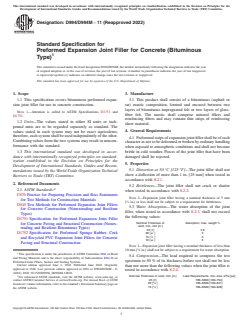
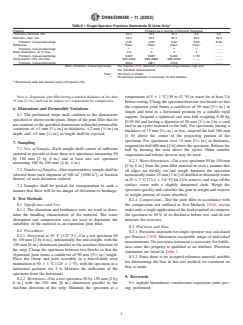
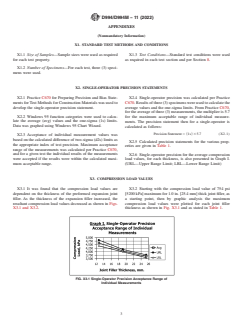
This specification covers bituminous preformed expansion joint filler for use in concrete construction. This product shall consist of a bituminous (asphalt or tar) mastic composition, formed and encased between two layers of bituminous impregnated felt or two layers of glass-fiber felt. The mastic shall comprise mineral fillers and reinforcing fibers and may contain thin strips of reinforcing sheet material. Different test methods shall be performed in order to determine the following properties: distortion at 52°C, brittleness, water absorption, and compression.
SCOPE
1.1 This specification covers bituminous preformed expansion joint filler for use in concrete construction.
Note 1: Attention is called to ASTM Specifications D1751 and D1752.
1.2 Units—The values stated in either SI units or inch-pound units are to be regarded separately as standard. The values stated in each system may not be exact equivalents; therefore, each system shall be used independently of the other. Combining values from the two systems may result in nonconformance with the standard.
1.3 This international standard was developed in accordance with internationally recognized principles on standardization established in the Decision on Principles for the Development of International Standards, Guides and Recommendations issued by the World Trade Organization Technical Barriers to Trade (TBT) Committee.
- Status
- Published
- Publication Date
- 31-May-2022
- Technical Committee
- D04 - Road and Paving Materials
- Drafting Committee
- D04.34 - Preformed Joint Fillers, Sealers and Sealing Systems

Overview
ASTM D994/D994M-11(2022): Standard Specification for Preformed Expansion Joint Filler for Concrete (Bituminous Type) provides requirements for bituminous preformed expansion joint fillers used in concrete construction. These fillers are critical for accommodating the movement of concrete slabs caused by temperature changes, moisture variation, and load shifts, thus helping to prevent cracking and structural damage in concrete pavements, highways, bridges, and other infrastructure.
This specification covers expansion joint fillers consisting of a bituminous (asphalt or tar) mastic composition encased between two layers of either bituminous-impregnated felt or glass-fiber felt. The core material includes mineral fillers and reinforcing fibers, and may have additional reinforcement with thin sheet material. The standard outlines performance properties, manufacturing requirements, test methods, and dimensional tolerances to ensure consistency and reliability in concrete joint fillers.
Key Topics
Material Composition
Expansion joint fillers must be composed of a stable bituminous mastic encased in durable felt layers, ensuring flexibility and moisture resistance.Critical Performance Properties
The standard addresses several essential properties tested under specified methods:- Distortion at elevated temperature (52°C)
- Brittleness at low temperature
- Water absorption rates
- Compression load resistance
Manufacturing and Handling Requirements
Preformed strips must maintain their integrity during ordinary handling and atmospheric exposure without becoming brittle in cold weather. Any damaged product must be rejected.Dimensional Tolerances
The specification sets permissible variations in thickness, depth, and length to ensure proper fit and performance at job sites.Testing and Quality Assurance
Testing procedures are described to guarantee the product’s properties meet standard requirements, supporting consistent performance during installation and throughout the service life of the concrete structure.
Applications
Bituminous preformed expansion joint fillers specified by ASTM D994/D994M-11(2022) offer practical solutions in a variety of construction sectors:
Highways and Pavements
Utilized in longitudinal and transverse joints, these fillers absorb movement and prevent cracking in concrete roads and airport runways.Bridges and Overpasses
Joint fillers provide a flexible interface between concrete segments, allowing for expansion and contraction due to temperature shifts and dynamic loading.Industrial Floors and Structural Slabs
They deliver protection for large concrete floor slabs in warehouses, factories, and commercial structures, where heavy loads and thermal changes are common.Sidewalks, Driveways, and Curbs
By accommodating slab movement, these joint fillers enhance the longevity and durability of smaller-scale concrete installations.
These applications benefit from the product’s resistance to water ingress, its ability to absorb compression, and its resilience to climatic extremes-features outlined and validated within the standard.
Related Standards
ASTM D994/D994M-11(2022) should be considered alongside other key standards in the field of concrete joint fillers:
- ASTM D1751 – Specification for Preformed Expansion Joint Filler for Concrete Paving and Structural Construction (Nonextruding and Resilient Bituminous Types)
- ASTM D1752 – Specification for Preformed Sponge Rubber, Cork, and Recycled PVC Expansion Joint Fillers for Concrete Paving and Structural Construction
- ASTM D545 – Test Methods for Preformed Expansion Joint Fillers for Concrete Construction (Nonextruding and Resilient Types)
- ASTM C670 – Practice for Preparing Precision and Bias Statements for Test Methods for Construction Materials
These related standards provide additional options and guidance for selecting and testing expansion joint fillers based on specific application needs, material preferences, and performance criteria.
Keywords: bituminous expansion joint filler, ASTM D994, concrete joint filler, preformed expansion joints, highway concrete construction, bridge joint fillers, bituminous type, ASTM joint filler standards
Relations
- Effective Date
- 01-Feb-2024
- Effective Date
- 01-Jan-2024
- Effective Date
- 01-Dec-2023
- Effective Date
- 01-Dec-2023
- Effective Date
- 01-Nov-2019
- Effective Date
- 01-Oct-2018
- Effective Date
- 01-Jun-2014
- Effective Date
- 01-Sep-2013
- Effective Date
- 01-Jul-2013
- Effective Date
- 01-Oct-2010
- Effective Date
- 01-Dec-2008
- Effective Date
- 01-Dec-2008
- Effective Date
- 01-Dec-2008
- Effective Date
- 01-Jul-2008
- Effective Date
- 15-Jul-2005
Get Certified
Connect with accredited certification bodies for this standard

DIBt (Deutsches Institut für Bautechnik)
German Institute for Building Technology.
DIN CERTCO
DIN Group product certification.

Aboma Certification B.V.
Specialized in construction, metal, and transport sectors.
Sponsored listings
Frequently Asked Questions
ASTM D994/D994M-11(2022) is a technical specification published by ASTM International. Its full title is "Standard Specification for Preformed Expansion Joint Filler for Concrete (Bituminous Type)". This standard covers: ABSTRACT This specification covers bituminous preformed expansion joint filler for use in concrete construction. This product shall consist of a bituminous (asphalt or tar) mastic composition, formed and encased between two layers of bituminous impregnated felt or two layers of glass-fiber felt. The mastic shall comprise mineral fillers and reinforcing fibers and may contain thin strips of reinforcing sheet material. Different test methods shall be performed in order to determine the following properties: distortion at 52°C, brittleness, water absorption, and compression. SCOPE 1.1 This specification covers bituminous preformed expansion joint filler for use in concrete construction. Note 1: Attention is called to ASTM Specifications D1751 and D1752. 1.2 Units—The values stated in either SI units or inch-pound units are to be regarded separately as standard. The values stated in each system may not be exact equivalents; therefore, each system shall be used independently of the other. Combining values from the two systems may result in nonconformance with the standard. 1.3 This international standard was developed in accordance with internationally recognized principles on standardization established in the Decision on Principles for the Development of International Standards, Guides and Recommendations issued by the World Trade Organization Technical Barriers to Trade (TBT) Committee.
ABSTRACT This specification covers bituminous preformed expansion joint filler for use in concrete construction. This product shall consist of a bituminous (asphalt or tar) mastic composition, formed and encased between two layers of bituminous impregnated felt or two layers of glass-fiber felt. The mastic shall comprise mineral fillers and reinforcing fibers and may contain thin strips of reinforcing sheet material. Different test methods shall be performed in order to determine the following properties: distortion at 52°C, brittleness, water absorption, and compression. SCOPE 1.1 This specification covers bituminous preformed expansion joint filler for use in concrete construction. Note 1: Attention is called to ASTM Specifications D1751 and D1752. 1.2 Units—The values stated in either SI units or inch-pound units are to be regarded separately as standard. The values stated in each system may not be exact equivalents; therefore, each system shall be used independently of the other. Combining values from the two systems may result in nonconformance with the standard. 1.3 This international standard was developed in accordance with internationally recognized principles on standardization established in the Decision on Principles for the Development of International Standards, Guides and Recommendations issued by the World Trade Organization Technical Barriers to Trade (TBT) Committee.
ASTM D994/D994M-11(2022) is classified under the following ICS (International Classification for Standards) categories: 91.100.30 - Concrete and concrete products. The ICS classification helps identify the subject area and facilitates finding related standards.
ASTM D994/D994M-11(2022) has the following relationships with other standards: It is inter standard links to ASTM C670-24a, ASTM C670-24, ASTM D1751-23, ASTM D545-23, ASTM D545-19, ASTM D1751-18, ASTM D545-14, ASTM D1752-04a(2013), ASTM C670-13, ASTM C670-10, ASTM D1751-04(2013)e1, ASTM D1752-04a(2008), ASTM D1751-04(2008), ASTM D545-08, ASTM D545-99(2005). Understanding these relationships helps ensure you are using the most current and applicable version of the standard.
ASTM D994/D994M-11(2022) is available in PDF format for immediate download after purchase. The document can be added to your cart and obtained through the secure checkout process. Digital delivery ensures instant access to the complete standard document.
Standards Content (Sample)
This international standard was developed in accordance with internationally recognized principles on standardization established in the Decision on Principles for the
Development of International Standards, Guides and Recommendations issued by the World Trade Organization Technical Barriers to Trade (TBT) Committee.
Designation: D994/D994M −11 (Reapproved 2022)
Standard Specification for
Preformed Expansion Joint Filler for Concrete (Bituminous
Type)
This standard is issued under the fixed designation D994/D994M; the number immediately following the designation indicates the year
of original adoption or, in the case of revision, the year of last revision. A number in parentheses indicates the year of last reapproval.
A superscript epsilon (´) indicates an editorial change since the last revision or reapproval.
This standard has been approved for use by agencies of the U.S. Department of Defense.
1. Scope 3. Manufacture
1.1 This specification covers bituminous preformed expan- 3.1 This product shall consist of a bituminous (asphalt or
sion joint filler for use in concrete construction. tar) mastic composition, formed and encased between two
layers of bituminous impregnated felt or two layers of glass-
NOTE 1—Attention is called to ASTM Specifications D1751 and
fiber felt. The mastic shall comprise mineral fillers and
D1752.
reinforcing fibers and may contain thin strips of reinforcing
1.2 Units—The values stated in either SI units or inch-
sheet material.
pound units are to be regarded separately as standard. The
values stated in each system may not be exact equivalents; 4. General Requirements
therefore,eachsystemshallbeusedindependentlyoftheother.
4.1 Preformedstripsofexpansionjointfillershallbeofsuch
Combining values from the two systems may result in noncon-
character as not to be deformed or broken by ordinary handling
formance with the standard.
when exposed to atmospheric conditions and shall not become
1.3 This international standard was developed in accor-
brittle in cold weather. Pieces of the joint filler that have been
dance with internationally recognized principles on standard- damaged shall be rejected.
ization established in the Decision on Principles for the
5. Properties
Development of International Standards, Guides and Recom-
5.1 Distortion at 50 °C [125 °F]—The joint filler shall not
mendations issued by the World Trade Organization Technical
show a deflection of more than 1 in. [25 mm] when tested in
Barriers to Trade (TBT) Committee.
accordance with 8.2.1.
2. Referenced Documents
5.2 Brittleness—The joint filler shall not crack or shatter
2.1 ASTM Standards:
when tested in accordance with 8.2.2.
C670 Practice for Preparing Precision and Bias Statements
NOTE 2—Expansion joint filler having a nominal thickness of 5 mm
for Test Methods for Construction Materials
[ ⁄4 in.] or less shall not be subject to a requirement for brittleness.
D545 Test Methods for Preformed Expansion Joint Fillers
5.3 Water Absorption—The water absorption of the joint
for Concrete Construction (Nonextruding and Resilient
filler, when tested in accordance with 8.2.3, shall not exceed
Types)
the following values:
D1751 Specification for Preformed Expansion Joint Filler
Nominal Thickness of Absorption, max, weight %
for Concrete Paving and Structural Construction (Nonex-
Joint, min, mm [in.]
truding and Resilient Bituminous Types)
25 [1] 2.5
D1752 Specification for Preformed Sponge Rubber, Cork 20 [ ⁄4]3
15 [ ⁄2]4
and Recycled PVC Expansion Joint Fillers for Concrete
10 [ ⁄8]5
Paving and Structural Construction
NOTE 3—Expansion joint filler having a nominal thickness of less than
10 mm [ ⁄8 in.] shall not be subject to a requirement for water absorption.
This specification is under the jurisdiction of ASTM Committee D04 on Road
5.4 Compression—The load required to compress the test
and Paving Materials and is the direct responsibility of Subcommittee D04.34 on
specimen to 50 % of its thickness before test shall not be less
Preformed Joint Fillers, Sealers and Sealing Systems.
Current edition approved June 1, 2022. Published June 2022. Originally
than nor more than the following values when the joint filler is
approved in 1948. Last previous edition approved in 2016 as D994/D994M – 11
tested in accordance with 8.2.4.
(2016). DOI: 10.1520/D0994_D0994M-11R22.
Nominal Thickness of Joint, mm [in.] Load Requirements, min–max. kPa [psi]
For referenced ASTM standards, visit the ASTM website, www.astm.org, or
25 [1] 700–5000 [100–754]
contact ASTM Customer Service at service@astm.org. For Annual Book of ASTM
20 [ ⁄4 ] 700–6000 [100–841]
Standards volume information, refer to the standard’s Document Summary page on
15 [ ⁄2 ] 700–6500 [100–928]
the ASTM website.
Copyright © ASTM International, 100 Barr Harbor Drive, PO Box C700, West Conshohocken, PA 19428-2959. United States
D994/D994M − 11 (2022)
A
TABLE 1 Single-Operator Precision Statements SI Units Only
Property Property as a function of Nominal Thickness
Thickness, Nominal, mm. 25.4 19.1 12.7 9.5 6.4
Distortion, max. mm. 25.4 25.4 25.4 25.4 25.4
Precision, max.accept.range. 2.93 2.30 5.92 6.03 6.84
Brittleness Pass* Pass* Pass* Pass* ----
Precision, max.accept.range ** ** ** ** ----
Water Absorption, wt % max. 2.5 3 4 5 ----
Precision, max.accept.range. 0.057 0.087 0.400 1.187 ----
Compression, kPa, min-max. 690–5200 690–5800 690–6400 ---- ----
Precision, max.accept.range. 204.2 180.1 416.5 ---- ----
Note—Precision, max.accept.range. Per Practice C670, Maximum acceptable range between high and
low individual measurements.
Pass* Not crack or shatter.
** No precision statement is necessary for this attribute.
A
All precision data was derived using inch-pound units.
NOTE 4—Expansion joint filler having a nominal thickness of less than
temperature of 5 6 1 °C [39 to 43 °F] in water for at least 2 h
15 mm [ ⁄2 in.] shall not be subject to a requirement for compression.
before testing. Clamp the specimen between two boards so that
the expansion joint forms a cantilever of 90 mm [3 ⁄2 in.] in
6. Dimensions and Permissible Variations
length and hold in a horizontal position by a suitable rigid
6.1 The preformed strips shall conform to the dimensions
support. Suspend a spherical cast iron ball weighing 0.40 kg
specified or shown on the plans. Strips of the joint filler that do
[0.95 lb] and having a diameter of 50 mm [1 ⁄8 in.] by a cord
not conform to the specified dimensions within the permissible
tied to an eyelet fastened to the ball. For specimens having a
1 1
variations of 61mm[ ⁄16 in.] in thickness, 62mm[ ⁄8 in.] in
thickness of 15 mm [ ⁄16 in.] or less, suspend the ball 300 mm
depth, and 65mm[ ⁄4 in.] in length shall be rejected.
[1 ft] above the center of the projecting portion of the
specimen. For specimens over 15 mm [ ⁄16 in.] in thickness,
7. Sampling
suspendtheball600mm[2ft]abovethespecimen.Releasethe
7.1 Size of Sample—Each sample s
...