

ASTM D5821-13(2017)
(Test Method)Standard Test Method for Determining the Percentage of Fractured Particles in Coarse Aggregate
General Information
- Abstract
SIGNIFICANCE AND USE
4.1 Some specifications contain requirements relating to percentage of fractured particles in coarse aggregates. One purpose of such requirements is to maximize shear strength by increasing inter-particle friction in either bound or unbound aggregate mixtures. Another purpose is to provide stability for surface treatment aggregates and to provide increased friction and texture for aggregates used in pavement surface courses. This test method provides a standard procedure for determining the acceptability of coarse aggregate with respect to such requirements.
4.2 Specifications differ as to the number of fractured faces required on a fractured particle, and they also differ as to whether percentage by mass or percentage by particle count shall be used. If the specification does not specify, use the criterion of at least one fractured face and calculate percentage by mass.
SCOPE
1.1 This test method covers the determination of the percentage, by mass or by count, of a coarse aggregate sample that consists of fractured particles meeting specified requirements.
1.2 The values stated in SI units are to be regarded as the standard. The values in parentheses are provided for information only.
1.3 This standard does not purport to address all of the safety concerns, if any, associated with its use. It is the responsibility of the user of this standard to establish appropriate safety, health, and environmental practices and determine the applicability of regulatory limitations prior to use.
1.4 This international standard was developed in accordance with internationally recognized principles on standardization established in the Decision on Principles for the Development of International Standards, Guides and Recommendations issued by the World Trade Organization Technical Barriers to Trade (TBT) Committee.
- Status
- Published
- Publication Date
- 30-Sep-2017
- Technical Committee
- D04 - Road and Paving Materials
- Drafting Committee
- D04.51 - Aggregate Tests
Overview
ASTM D5821-13(2017), Standard Test Method for Determining the Percentage of Fractured Particles in Coarse Aggregate, establishes standardized procedures to evaluate the proportion of fractured particles in coarse aggregate samples. Developed by ASTM International, this method is widely referenced in the construction and transportation industries to assess aggregate quality for use in pavements and other bound or unbound mixtures.
Fractured particles are defined as aggregate pieces that have one or more angular, rough, or broken surfaces caused by crushing or other artificial means. The presence of fractured faces is crucial in many specifications due to its effects on material performance, including mechanical stability and friction.
Key Topics
Purpose and Significance
The primary reasons for specifying fractured particle content include:- Maximizing the shear strength of aggregate mixtures by increasing inter-particle friction.
- Enhancing the stability of surface treatments.
- Improving friction and texture of aggregates used in pavement surface courses.
Determination Criterion
- Standards and project specifications may require a different number of fractured faces per particle and may express results as percentage by mass or particle count.
- If not specified, the default is at least one fractured face calculated by mass.
Testing Procedure
- Sample preparation involves washing, sieving, and drying the aggregate to constant mass.
- Particles are inspected individually, and those meeting the fractured face criteria (faces with a projected area at least one-quarter of the maximum cross-sectional area and possessing angular or slightly blunt edges) are separated for evaluation.
- The percentage of fractured particles is determined by comparing the fractured portion to the whole, either by mass or count.
Reporting Requirements
- Results must include the percentage of fractured particles, the criteria used (number of faces and mass/count basis), the sieve size, and the total sample mass.
Applications
Road and Pavement Construction
- Ensures that coarse aggregates used in asphalt and concrete pavements provide the necessary stability and resistance to movement under traffic loads.
- Used in both new construction and rehabilitation projects to select suitable aggregate sources.
Surface Treatment Aggregates
- Determines the suitability of aggregates for surface treatments (such as chip seals) which rely on aggregate shape for bonding and durability.
Quality Control and Acceptance
- Employed in material acceptance testing at production sites, quarries, and construction projects.
- Assists in verifying compliance with local, state, or national material specifications for transportation infrastructure.
Research and Development
- Helps researchers study the relationship between aggregate shape parameters and pavement performance, supporting advancements in pavement design.
Related Standards
When applying ASTM D5821-13(2017), the following related ASTM standards may also be relevant:
- ASTM C136 - Sieve Analysis of Fine and Coarse Aggregates
- ASTM C702 - Reducing Samples of Aggregate to Testing Size
- ASTM D8 - Terminology Relating to Materials for Roads and Pavements
- ASTM D75 - Sampling Aggregates
- ASTM E11 - Specification for Woven Wire Test Sieve Cloth and Test Sieves
These standards collectively ensure a comprehensive approach to aggregate sampling, testing, and specification compliance in construction materials testing.
Employing ASTM D5821-13(2017) in aggregate evaluation helps improve pavement durability, safety, and performance by identifying the appropriate aggregate quality, particularly focusing on the percentage of fractured particles in coarse aggregate mixes.
Relations
- Effective Date
- 01-Aug-2019
- Effective Date
- 15-Dec-2018
- Effective Date
- 15-Aug-2018
- Effective Date
- 01-Jul-2018
- Effective Date
- 01-Feb-2018
- Effective Date
- 15-Jul-2017
- Effective Date
- 15-Jun-2017
- Effective Date
- 01-May-2017
- Effective Date
- 01-Mar-2017
- Effective Date
- 01-Dec-2016
- Effective Date
- 15-Sep-2016
- Effective Date
- 01-Sep-2016
- Effective Date
- 01-Sep-2015
- Effective Date
- 01-Oct-2013
- Effective Date
- 15-Sep-2013
Get Certified
Connect with accredited certification bodies for this standard

DIBt (Deutsches Institut für Bautechnik)
German Institute for Building Technology.
DIN CERTCO
DIN Group product certification.

Aboma Certification B.V.
Specialized in construction, metal, and transport sectors.
Sponsored listings
Frequently Asked Questions
ASTM D5821-13(2017) is a standard published by ASTM International. Its full title is "Standard Test Method for Determining the Percentage of Fractured Particles in Coarse Aggregate". This standard covers: SIGNIFICANCE AND USE 4.1 Some specifications contain requirements relating to percentage of fractured particles in coarse aggregates. One purpose of such requirements is to maximize shear strength by increasing inter-particle friction in either bound or unbound aggregate mixtures. Another purpose is to provide stability for surface treatment aggregates and to provide increased friction and texture for aggregates used in pavement surface courses. This test method provides a standard procedure for determining the acceptability of coarse aggregate with respect to such requirements. 4.2 Specifications differ as to the number of fractured faces required on a fractured particle, and they also differ as to whether percentage by mass or percentage by particle count shall be used. If the specification does not specify, use the criterion of at least one fractured face and calculate percentage by mass. SCOPE 1.1 This test method covers the determination of the percentage, by mass or by count, of a coarse aggregate sample that consists of fractured particles meeting specified requirements. 1.2 The values stated in SI units are to be regarded as the standard. The values in parentheses are provided for information only. 1.3 This standard does not purport to address all of the safety concerns, if any, associated with its use. It is the responsibility of the user of this standard to establish appropriate safety, health, and environmental practices and determine the applicability of regulatory limitations prior to use. 1.4 This international standard was developed in accordance with internationally recognized principles on standardization established in the Decision on Principles for the Development of International Standards, Guides and Recommendations issued by the World Trade Organization Technical Barriers to Trade (TBT) Committee.
SIGNIFICANCE AND USE 4.1 Some specifications contain requirements relating to percentage of fractured particles in coarse aggregates. One purpose of such requirements is to maximize shear strength by increasing inter-particle friction in either bound or unbound aggregate mixtures. Another purpose is to provide stability for surface treatment aggregates and to provide increased friction and texture for aggregates used in pavement surface courses. This test method provides a standard procedure for determining the acceptability of coarse aggregate with respect to such requirements. 4.2 Specifications differ as to the number of fractured faces required on a fractured particle, and they also differ as to whether percentage by mass or percentage by particle count shall be used. If the specification does not specify, use the criterion of at least one fractured face and calculate percentage by mass. SCOPE 1.1 This test method covers the determination of the percentage, by mass or by count, of a coarse aggregate sample that consists of fractured particles meeting specified requirements. 1.2 The values stated in SI units are to be regarded as the standard. The values in parentheses are provided for information only. 1.3 This standard does not purport to address all of the safety concerns, if any, associated with its use. It is the responsibility of the user of this standard to establish appropriate safety, health, and environmental practices and determine the applicability of regulatory limitations prior to use. 1.4 This international standard was developed in accordance with internationally recognized principles on standardization established in the Decision on Principles for the Development of International Standards, Guides and Recommendations issued by the World Trade Organization Technical Barriers to Trade (TBT) Committee.
ASTM D5821-13(2017) is classified under the following ICS (International Classification for Standards) categories: 91.100.30 - Concrete and concrete products. The ICS classification helps identify the subject area and facilitates finding related standards.
ASTM D5821-13(2017) has the following relationships with other standards: It is inter standard links to ASTM D8-19, ASTM D8-18c, ASTM D8-18b, ASTM D8-18a, ASTM D8-18, ASTM D8-17c, ASTM D8-17b, ASTM D8-17a, ASTM D8-17, ASTM D8-16b, ASTM D8-16a, ASTM D8-16, ASTM D8-15, ASTM E11-13, ASTM D8-13b. Understanding these relationships helps ensure you are using the most current and applicable version of the standard.
ASTM D5821-13(2017) is available in PDF format for immediate download after purchase. The document can be added to your cart and obtained through the secure checkout process. Digital delivery ensures instant access to the complete standard document.
Standards Content (Sample)
This international standard was developed in accordance with internationally recognized principles on standardization established in the Decision on Principles for the
Development of International Standards, Guides and Recommendations issued by the World Trade Organization Technical Barriers to Trade (TBT) Committee.
Designation: D5821 − 13 (Reapproved 2017)
Standard Test Method for
Determining the Percentage of Fractured Particles in Coarse
Aggregate
This standard is issued under the fixed designation D5821; the number immediately following the designation indicates the year of
original adoption or, in the case of revision, the year of last revision. A number in parentheses indicates the year of last reapproval. A
superscript epsilon (´) indicates an editorial change since the last revision or reapproval.
1. Scope 3. Terminology
3.1 Definitions:
1.1 This test method covers the determination of the
percentage, by mass or by count, of a coarse aggregate sample
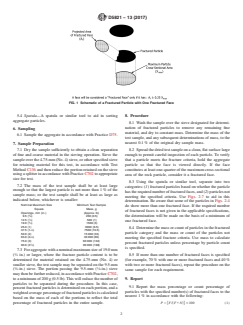
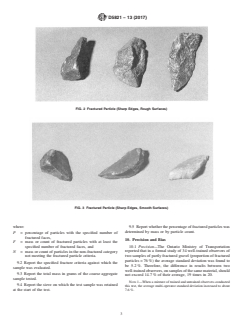
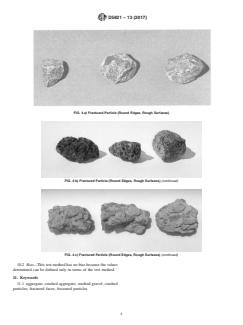
3.1.1 fractured face, n—an angular, rough, or broken sur-
that consists of fractured particles meeting specified require- face of an aggregate particle created by crushing, by other
ments.
artificial means, or by nature (see Terminology D8).
3.1.1.1 Discussion—For this standard, a face will be con-
1.2 The values stated in SI units are to be regarded as the
sidered a “fractured face” only if it has a projected area at least
standard. The values in parentheses are provided for informa-
as large as one-quarter of the maximum projected area (maxi-
tion only.
mum cross-sectional area) of the particle (this excludes small
1.3 This standard does not purport to address all of the
nicks, see Fig. 1) and the face has sharp or slightly blunt edges.
safety concerns, if any, associated with its use. It is the
3.1.2 fractured particle, n—a particle of aggregate having at
responsibility of the user of this standard to establish appro-
least the minimum number of fractured faces specified (usually
priate safety, health, and environmental practices and deter-
one or two).
mine the applicability of regulatory limitations prior to use.
1.4 This international standard was developed in accor-
4. Significance and Use
dance with internationally recognized principles on standard-
ization established in the Decision on Principles for the
4.1 Some specifications contain requirements relating to
Development of International Standards, Guides and Recom-
percentage of fractured particles in coarse aggregates. One
mendations issued by the World Trade Organization Technical
purpose of such requirements is to maximize shear strength by
Barriers to Trade (TBT) Committee.
increasing inter-particle friction in either bound or unbound
aggregate mixtures.Another purpose is to provide stability for
2. Referenced Documents
surface treatment aggregates and to provide increased friction
and texture for aggregates used in pavement surface courses.
2.1 ASTM Standards:
Thistestmethodprovidesastandardprocedurefordetermining
C136 Test Method for Sieve Analysis of Fine and Coarse
the acceptability of coarse aggregate with respect to such
Aggregates
requirements.
C702 PracticeforReducingSamplesofAggregatetoTesting
Size
4.2 Specifications differ as to the number of fractured faces
D8 Terminology Relating to Materials for Roads and Pave-
required on a fractured particle, and they also differ as to
ments
whether percentage by mass or percentage by particle count
D75 Practice for Sampling Aggregates
shall be used. If the specification does not specify, use the
E11 Specification for Woven Wire Test Sieve Cloth and Test
criterion of at least one fractured face and calculate percentage
Sieves
by mass.
5. Apparatus
This test method is under the jurisdiction of ASTM Committee D04 on Road
5.1 Balance—A balance or scale accurate and readable to
and Paving Materials and is the direct responsibility of Subcommittee D04.51 on
within 0.1 % of the test sample mass at any point within the
Aggregate Tests.
range of use.
Current edition approved Oct. 1, 2017. Published October 2017. Originally
approved in 1995. Last previous edition approved in 2013 as D5821 – 13. DOI:
5.2 Sieves—Sieves conforming to Specification E11.
10.1520/D5821-13R17.
For referenced ASTM standards, visit the ASTM website, www.astm.org, or
5.3 Splitter—A sample splitter suitable for dividing field
contact ASTM Customer Service at service@astm.org. For Annual Book of ASTM
samples into test portion sizes in accordance with Practice
Standards volume information, refer to the standard’s Document Summary page on
the ASTM website. C702.
Copyright © ASTM International, 100 Barr Harbor Drive, PO Box C700, West Conshohocken, PA 19428-2959. United States
D5821 − 13 (2017)
FIG. 1 Schematic of a Fractured Particle with One Fractured Face
5.4 Spatula—A spatula or similar tool to aid in sorting 8. Procedure
aggregate particles.
8.1 Wash the sample over the sieve designated for determi-
nation of fractured particles to remove any remaining fine
6. Sampling
material, and dry to constant mass. Determine the mass of the
6.1 Sample the aggregate in accordance with Practice D75.
test sample, and any subsequent determinations of mass, to the
nearest 0.1 % of the original dry sample mass.
7. Sample Preparation
8.2 Spreadthedriedtestsampleonaclean,flatsurfacelarge
7.1 Dry the sample sufficiently to obtain a clean separation
of fine and coarse material in the sieving operation. Sieve the enough to permit careful inspection of each particle. To verify
that a particle meets the fracture criteria, hold the aggregate
sampleoverthe4.75-mm(No.4)sieve,orotherspecifiedsieve
for retaining material for this test, in accordance with Test particle so that the face is viewed directly. If the face
Method C136 and then reduce the portion retained on the sieve constitutes at least one-quarter of the maximum cross-sectional
usingasplitterinaccordancewithPracticeC702toappropriate
area of the rock particle, consider it a fractured face.
size for test.
8.3 Using the spatula or similar tool, separate into two
7.2 The mass of the test sample shall be at least large
cat
...