

ASTM F140-98(2020)
(Practice)Standard Practice for Making Reference Glass-Metal Butt Seals and Testing for Expansion Characteristics by Polarimetric Methods
General Information
- Abstract
SIGNIFICANCE AND USE
4.1 The term “reference” as employed in this practice implies that either the glass or the metal of the reference glass-metal seal will be a “standard reference material” such as those supplied for other physical tests by the National Institute for Standards and Technology (NIST), or a secondary reference material whose sealing characteristics have been determined by seals to a standard reference material (see NIST SP 260). Until standard reference materials for seals are established by the NIST, secondary reference materials may be agreed upon between manufacturer and purchaser.
SCOPE
1.1 This practice covers the preparation and testing of reference glass-metal butt seals of two general configurations, one applicable to determining stress in the glass and the other applicable to determining the degree of mismatch of thermal expansion (or contraction). Tests are in accordance with Test Method F218, Subsection 1.1.
1.2 This practice applies to all glass and metal (or alloy) combinations normally sealed together in the production of electronic components. It should not be attempted with glass-metal combinations having widely divergent thermal expansion (or contraction) properties.
1.3 This international standard was developed in accordance with internationally recognized principles on standardization established in the Decision on Principles for the Development of International Standards, Guides and Recommendations issued by the World Trade Organization Technical Barriers to Trade (TBT) Committee.
- Status
- Published
- Publication Date
- 31-Jul-2020
- Technical Committee
- C14 - Glass and Glass Products
- Drafting Committee
- C14.04 - Physical and Mechanical Properties
Overview
ASTM F140-98(2020): Standard Practice for Making Reference Glass-Metal Butt Seals and Testing for Expansion Characteristics by Polarimetric Methods establishes procedures for preparing and evaluating reference glass-metal butt seals. This practice is essential for verifying the compatibility of glass and metal pairs commonly used in electronic component manufacturing. By utilizing polarimetric methods, the standard provides reliable means for assessing stress within glass and for determining thermal expansion or contraction mismatches between sealed materials.
The practice supports both the creation of reference seals, using either standard reference materials (like those from the National Institute for Standards and Technology - NIST) or approved secondary reference materials, and the measurement of critical properties that determine the long-term performance and reliability of glass-to-metal seals.
Key Topics
- Reference Materials: Defines the use of standard or secondary reference materials for both glass and metal, ensuring consistency and traceability in measurement.
- Seal Preparation: Describes cleaning, heat-treating, and polishing requirements for specimens, aiming to remove contaminants and achieve precise geometric configurations.
- Seal Configurations: Specifies two primary seal geometries:
- One optimized for measuring stress in the glass.
- One designed to quantify the degree of thermal expansion mismatch.
- Testing Methods: Details the polarimetric techniques for measuring optical retardation and assessing stress at the glass-metal interface, as well as steps for calculating average seal stress and thermal contraction mismatch.
- Annealing Processes: Emphasizes controlled annealing as a critical step for relieving stresses except those attributable to expansion differences.
- Reporting Requirements: Lists the essential information for complete and standardized documentation of seal tests, including material types, specimen dimensions, test conditions, and calculated results.
Applications
- Quality Control in Electronics Manufacturing: Used to qualify glass-metal seal combinations before full-scale or high-reliability production of electronic devices such as hermetically sealed relays, vacuum tubes, or optoelectronic components.
- Vendor and Customer Agreement: Facilitates technical agreements between manufacturers and purchasers regarding material suitability and acceptance criteria for glass-metal seals.
- Material Characterization: Supports research and development by providing standardized methods to evaluate new glass or metal alloys for use in electronic packaging and hermetic enclosures.
- Root Cause Analysis: Assists in the identification of failure modes related to thermal expansion mismatch or residual stress in glass-metal assemblies.
Related Standards
- ASTM F218: Test Method for Measuring Optical Retardation and Analyzing Stress in Glass
- ASTM F15, F30, F31, F79, F105, F256: Specifications for various sealing alloys and sealing glasses used in glass-metal applications
- NIST SP 260: National guidelines for standard reference materials for use in physical tests, ensuring traceability and accuracy
- Test Method F47 (withdrawn): Relevant for historical handling procedures and material treatment references
Practical Value
Implementing ASTM F140-98(2020) enables manufacturers and testing laboratories to:
- Optimize Product Reliability: By identifying optimal glass-metal combinations, reducing residual stresses, and minimizing expansion mismatches, products gain improved longevity and performance.
- Support Compliance: Aligns with internationally recognized principles (World Trade Organization TBT Committee) for standardization, supporting global trade and regulatory acceptance.
- Ensure Repeatability and Traceability: The use of reference materials and clearly defined test configurations allows for reproducible and traceable quality assurance processes in glass-to-metal sealing operations.
Keywords: ASTM F140, glass-metal butt seals, polarimetric methods, expansion mismatch, reference materials, electronic component manufacturing, thermal stress, seal testing, quality control, international standard.
Relations
- Effective Date
- 01-May-2020
- Effective Date
- 01-Nov-2019
- Effective Date
- 01-Nov-2019
- Effective Date
- 01-Jun-2017
- Effective Date
- 01-Jul-2015
- Effective Date
- 01-May-2015
- Effective Date
- 01-May-2015
- Effective Date
- 01-May-2013
- Effective Date
- 01-Jul-2012
- Effective Date
- 01-Jul-2012
- Refers
ASTM F218-12 - Standard Test Method for Measuring Optical Retardation and Analyzing Stress in Glass - Effective Date
- 01-Mar-2012
- Effective Date
- 01-Oct-2010
- Effective Date
- 01-Oct-2010
- Effective Date
- 01-Oct-2010
- Effective Date
- 01-Apr-2010
Frequently Asked Questions
ASTM F140-98(2020) is a standard published by ASTM International. Its full title is "Standard Practice for Making Reference Glass-Metal Butt Seals and Testing for Expansion Characteristics by Polarimetric Methods". This standard covers: SIGNIFICANCE AND USE 4.1 The term “reference” as employed in this practice implies that either the glass or the metal of the reference glass-metal seal will be a “standard reference material” such as those supplied for other physical tests by the National Institute for Standards and Technology (NIST), or a secondary reference material whose sealing characteristics have been determined by seals to a standard reference material (see NIST SP 260). Until standard reference materials for seals are established by the NIST, secondary reference materials may be agreed upon between manufacturer and purchaser. SCOPE 1.1 This practice covers the preparation and testing of reference glass-metal butt seals of two general configurations, one applicable to determining stress in the glass and the other applicable to determining the degree of mismatch of thermal expansion (or contraction). Tests are in accordance with Test Method F218, Subsection 1.1. 1.2 This practice applies to all glass and metal (or alloy) combinations normally sealed together in the production of electronic components. It should not be attempted with glass-metal combinations having widely divergent thermal expansion (or contraction) properties. 1.3 This international standard was developed in accordance with internationally recognized principles on standardization established in the Decision on Principles for the Development of International Standards, Guides and Recommendations issued by the World Trade Organization Technical Barriers to Trade (TBT) Committee.
SIGNIFICANCE AND USE 4.1 The term “reference” as employed in this practice implies that either the glass or the metal of the reference glass-metal seal will be a “standard reference material” such as those supplied for other physical tests by the National Institute for Standards and Technology (NIST), or a secondary reference material whose sealing characteristics have been determined by seals to a standard reference material (see NIST SP 260). Until standard reference materials for seals are established by the NIST, secondary reference materials may be agreed upon between manufacturer and purchaser. SCOPE 1.1 This practice covers the preparation and testing of reference glass-metal butt seals of two general configurations, one applicable to determining stress in the glass and the other applicable to determining the degree of mismatch of thermal expansion (or contraction). Tests are in accordance with Test Method F218, Subsection 1.1. 1.2 This practice applies to all glass and metal (or alloy) combinations normally sealed together in the production of electronic components. It should not be attempted with glass-metal combinations having widely divergent thermal expansion (or contraction) properties. 1.3 This international standard was developed in accordance with internationally recognized principles on standardization established in the Decision on Principles for the Development of International Standards, Guides and Recommendations issued by the World Trade Organization Technical Barriers to Trade (TBT) Committee.
ASTM F140-98(2020) is classified under the following ICS (International Classification for Standards) categories: 21.140 - Seals, glands. The ICS classification helps identify the subject area and facilitates finding related standards.
ASTM F140-98(2020) has the following relationships with other standards: It is inter standard links to ASTM F256-05(2020), ASTM F105-72(2019), ASTM F79-69(2019), ASTM F30-96(2017), ASTM F256-05(2015), ASTM F79-69(2015), ASTM F105-72(2015), ASTM F15-04(2013), ASTM F31-12, ASTM F30-96(2012), ASTM F218-12, ASTM F31-05(2010), ASTM F79-69(2010), ASTM F256-05(2010), ASTM F105-72(2010). Understanding these relationships helps ensure you are using the most current and applicable version of the standard.
ASTM F140-98(2020) is available in PDF format for immediate download after purchase. The document can be added to your cart and obtained through the secure checkout process. Digital delivery ensures instant access to the complete standard document.
Standards Content (Sample)
This international standard was developed in accordance with internationally recognized principles on standardization established in the Decision on Principles for the
Development of International Standards, Guides and Recommendations issued by the World Trade Organization Technical Barriers to Trade (TBT) Committee.
Designation: F140 − 98 (Reapproved 2020)
Standard Practice for
Making Reference Glass-Metal Butt Seals and Testing for
Expansion Characteristics by Polarimetric Methods
ThisstandardisissuedunderthefixeddesignationF140;thenumberimmediatelyfollowingthedesignationindicatestheyearoforiginal
adoptionor,inthecaseofrevision,theyearoflastrevision.Anumberinparenthesesindicatestheyearoflastreapproval.Asuperscript
epsilon (´) indicates an editorial change since the last revision or reapproval.
1. Scope F256Specification for Chromium-Iron Sealing Alloys with
18 or 28 Percent Chromium
1.1 This practice covers the preparation and testing of
2.2 NIST Publications:
reference glass-metal butt seals of two general configurations,
NIST SP260NIST Special Publications (SP260s)
one applicable to determining stress in the glass and the other
applicable to determining the degree of mismatch of thermal
3. Summary of Practice
expansion (or contraction). Tests are in accordance with Test
3.1 Five seals of a standard configuration are prepared from
Method F218, Subsection 1.1.
representative specimens of the glass and metal to be tested.
1.2 This practice applies to all glass and metal (or alloy)
The glass and metal are cleaned, treated, and sized to specified
combinations normally sealed together in the production of
proportions. Plane-interfaced seals are formed, annealed, and
electronic components. It should not be attempted with glass-
measured for residual optical retardation.The stress parallel to
metal combinations having widely divergent thermal expan-
the interface in each seal is calculated from the optical
sion (or contraction) properties.
retardation, and the average stress is computed for the sample.
1.3 This international standard was developed in accor- For disk-seals the thermal expansion mismatch is calculated.
dance with internationally recognized principles on standard-
4. Significance and Use
ization established in the Decision on Principles for the
Development of International Standards, Guides and Recom- 4.1 The term “reference” as employed in this practice
implies that either the glass or the metal of the reference
mendations issued by the World Trade Organization Technical
Barriers to Trade (TBT) Committee. glass-metalsealwillbea“standardreferencematerial”suchas
those supplied for other physical tests by the National Institute
2. Referenced Documents
forStandardsandTechnology(NIST),orasecondaryreference
2 materialwhosesealingcharacteristicshavebeendeterminedby
2.1 ASTM Standards:
sealstoastandardreferencematerial(seeNISTSP260).Until
F15Specification for Iron-Nickel-Cobalt Sealing Alloy
standard reference materials for seals are established by the
F30Specification for Iron-Nickel Sealing Alloys
NIST, secondary reference materials may be agreed upon
F31Specification for Nickel-Chromium-Iron SealingAlloys
between manufacturer and purchaser.
F47Test Method for Crystallographic Perfection of Silicon
by Preferential Etch Techniques (Withdrawn 1998)
5. Apparatus
F79Specification for Type 101 Sealing Glass
5.1 Polarimeter, as specified in Test Method F218 for
F105Specification for Type 58 Borosilicate Sealing Glass
measuring optical retardation and analyzing stress in glass.
F218Test Method for Measuring Optical Retardation and
Analyzing Stress in Glass 5.2 Cut-off Saw, with diamond-impregnated wheel and No.
180 grit abrasive blade under flowing coolant for cutting and
fine-grinding glass rod.
This practice is under the jurisdiction ofASTM Committee C14 on Glass and
5.3 Glass Polisher, buffing wheel with cerium oxide polish-
Glass Products and is the direct responsibility of Subcommittee C14.04 on Physical
ing powder or laboratory-type equipment with fine-grinding
and Mechanical Properties.
Current edition approved Aug. 1, 2020. Published September 2020. Originally and polishing laps.
approved in 1971. Last previous edition approved in 2013 as F140 – 98 (2013).
5.4 Heat-treating and Oxidizing Furnaces, with suitable
DOI: 10.1520/F0140-98R20.
For referenced ASTM standards, visit the ASTM website, www.astm.org, or controls and with provisions for appropriate atmospheres (see
contact ASTM Customer Service at service@astm.org. For Annual Book of ASTM
Annex A1) for preconditioning metal, if required.
Standards volume information, refer to the standard’s Document Summary page on
the ASTM website.
The last approved version of this historical standard is referenced on Available from National Institute of Standards and Technology (NIST), 100
www.astm.org. Bureau Dr., Stop 1070, Gaithersburg, MD 20899-1070, http://www.nist.gov.
Copyright © ASTM International, 100 Barr Harbor Drive, PO Box C700, West Conshohocken, PA 19428-2959. United States
F140 − 98 (2020)
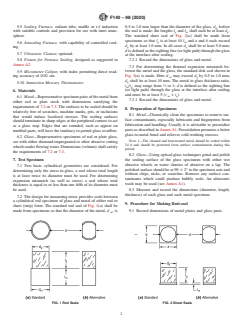
5.5 Sealing Furnace, radiant tube, muffle or r-f induction 0.5 to 1.0 mm larger than the diameter of the glass, d , before
g
with suitable controls and provision for use with inert atmo- the seal is made; the lengths l and l shall each be at least d .
g m g
sphere. The standard sheet seal of Fig. 2(a) shall be made from
specimens so that l is at least 10 l and a and b each exceed
g m
5.6 Annealing Furnace, with capability of controlled cool-
d by at least 1.0 mm. In all cases d shall be at least 5.0 mm;
g g
ing.
disdefinedasthesightingline(orlightpath)throughtheglass
5.7 Ultrasonic Cleaner, optional.
at the interface after sealing.
5.8 Fixture for Furnace Sealing, designed as suggested in 7.2.1 Record the dimensions of glass and metal.
Annex A2.
7.3 For determining the thermal expansion mismatch be-
5.9 Micrometer Caliper, with index permitting direct read- tween the metal and the glass, the standard disk seal shown in
Fig. 3(a) is made. Here d may exceed d by 0.5 to 1.0 mm;
ing accuracy of 0.02 cm.
m g
d shall be at least 10 mm. The metal to glass thickness ratio,
g
5.10 Immersion Mercury Thermometer.
t /t , may range from ⁄3 to 1; d is defined as the sighting line
m g
(or light path) through the glass at the interface after sealing
6. Materials
and must be at least 5 (t + t ).
m g
6.1 Metal—Representativespecimenpairsofthemetalfrom
7.3.1 Record the dimensions of glass and metal.
either rod or plate stock with dimensions satisfying the
requirements of 7.2 or 7.3.The surfaces to be sealed should be
8. Preparation of Specimens
relatively free of scratches, machine marks, pits, or inclusions
8.1 Metal—Chemically clean the specimens to remove sur-
that would induce localized stresses. The sealing surfaces
face contaminants, especially lubricants and fingerprints from
should terminate in sharp edges at the peripheral corners to act
fabrication and handling. Usually it is advisable to preoxidize
as a glass stop. Edges that are rounded, such as appear on
partsasdescribedinAnnexA1.Preoxidationpromotesabetter
tumbledparts,willhavethetendencytopermitglassoverflow.
glass-to-metal bond and relieves cold-working stresses.
6.2 Glass—Representative specimens of rod or plate glass,
NOTE 1—The cleaned and heat-treated metal should be sealed within
cut with either diamond-impregnated or other abrasive cutting
24 h and should be protected from surface contamination during this
wheelsunderflowingwater.Dimensions(volume)shallsatisfy
period.
the requirements of 7.2 or 7.3.
8.2 Glass—Using optical-glass techniques grind and polish
7. Test Specimen
the sealing surface of the glass specimens with either wet
abrasive wheels or water slurries of abrasive on a lap. The
7.1 Two basic cylindrical geometries are considered. For
polishedsurfaceshouldbeat90 62°tothespecimenaxisand
determining only the stress in glass, a seal whose total length
without chips, nicks, or scratches. Remove any surface con-
is at least twice its diameter must be used. For determining
taminants which could produce bubbly seals. An ultrasonic
expansion mismatch (as well as stress) a seal whose total
wash may be used (see Annex A1).
thickness is equal to or less than one fifth of its diameter must
be used.
8.3 Measure and record the dimensions (diameter, length,
thickness) of each glass and each metal specimen.
7.2 The design for measuring stress provides seals between
a cylindrical rod specimen of glass and metal of either rod or
9. Procedure for Making Butt-seal
sheet (strip) form. The standard rod seal of Fig. 1(a) shall be
made from specimens so that the diameter of the metal, d , is 9.1 Record dimensions of metal plates and glass parts.
m
FIG. 1 Rod Seals FIG. 2 Sheet Seals
F140 − 98 (2020)
of the black fringe should appear to be about half its initial
value, the other half apparently being obscured by the metal.
Record the rotation of the analyzer required to produce
extinction.
NOTE 2—Sealing combinations may exist in which the thermal expan-
sion coefficients of glass and metal at room temperature may differ
significantly. In these cases it may be important to record the temperature
oftherefractionliquid(ortheseal)atthetimetheretardationismeasured.
NOTE 3—In certain glasses, especially those compositions containing
more than one alkali oxide, part of the retardation observed may not be
associated with the mismatch stress of interest. In these cases some
structural birefringence is caused by temporary stresses at elevated
temperatures. The exact analysis of mismatch stress should be evaluated
by completely removing the metal member by acid immersion. The
retardation should again be read at the same glass surface. Any residual
retardation should then be algebraically subtracted from that previously
FIG. 3 Disk Seals
observed.
NOTE 4—If it is desired to minimize any uncertainties about measuring
through the curved surfaces, these may be ground after annealing to
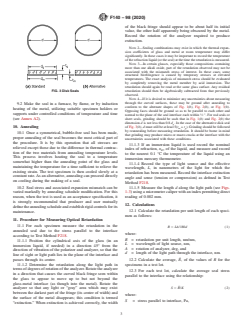
9.2 Make the seal in a furnace, by flame, or by induction
conform to the alternate shapes of Fig. 1(b), Fig. 2(b),or Fig. 3(b).
heating of the metal, utilizing suitable specimen holders or
Opposing faces should be ground so as to be parallel to each other and
supports under controlled conditions of temperature and time 1
normal to the plane of the seal interface each within ⁄2 °. For rod seals or
(see Annex A2).
sheet seals, grinding should be such that in Fig. 1(b) and Fig. 2(b) the
dimension d is not less than 0.8 d . In the case of the alternative disk seal
g
ofFig.3(b),dmuststillbeatleast5(t +t ).Grindingshouldbefollowed
10. Annealing
m g
by reannealing before measuring retardation. It should be borne in mind
10.1 Once a symmetrical, bubble-free seal has been made,
that grinding may produce micro or macro cracks at the interface with the
proper annealing of the seal becomes the most critical part of
uncertainties associated with these conditions.
the procedure. It is by this operation that all stresses are
11.1.3 If an immersion liquid is used record the nominal
relieved except those due to the difference in thermal contrac-
index of refraction, n , of the liquid, and measure and record
D
tion of the two materials from annealing temperature levels.
to the nearest 0.1 °C
...