

ASTM E275-08(2022)
(Practice)Standard Practice for Describing and Measuring Performance of Ultraviolet and Visible Spectrophotometers
General Information
- Abstract
SIGNIFICANCE AND USE
4.1 This practice permits an analyst to compare the general performance of an instrument, as it is being used in a specific spectrophotometric method, with the performance of instruments used in developing the method.
SCOPE
1.1 This practice covers the description of requirements of spectrophotometric performance, especially for test methods, and the testing of the adequacy of available equipment for a specific method (for example, qualification for a given application). The tests give a measurement of some of the important parameters controlling results obtained in spectrophotometric methods, but it is specifically not to be concluded that all the factors in instrument performance are measured, or in fact may be required for a given application.
1.1.1 This practice is primarily directed to dispersive spectrophotometers used for transmittance measurements rather than instruments designed for diffuse transmission and diffuse reflection.
1.2 The values stated in SI units are to be regarded as standard. No other units of measurement are included in this standard.
1.3 This standard does not purport to address all of the safety concerns, if any, associated with its use. It is the responsibility of the user of this standard to establish appropriate safety, health, and environmental practices and determine the applicability of regulatory limitations prior to use.
1.4 This international standard was developed in accordance with internationally recognized principles on standardization established in the Decision on Principles for the Development of International Standards, Guides and Recommendations issued by the World Trade Organization Technical Barriers to Trade (TBT) Committee.
- Status
- Published
- Publication Date
- 31-Dec-2021
- Technical Committee
- E13 - Molecular Spectroscopy and Separation Science
- Drafting Committee
- E13.01 - Ultra-Violet, Visible, and Luminescence Spectroscopy
Overview
ASTM E275-08(2022), Standard Practice for Describing and Measuring Performance of Ultraviolet and Visible Spectrophotometers, is an internationally recognized guideline developed by ASTM International. This standard provides a framework for evaluating and documenting the performance characteristics of ultraviolet (UV) and visible spectrophotometers, particularly those used for transmittance measurements. The primary purpose is to ensure that the spectrophotometric data obtained in laboratory or industrial settings are reliable, reproducible, and aligned with method development and validation requirements.
By following the procedures outlined in ASTM E275, analysts and laboratories can compare their spectrophotometric instruments' performance with those originally used in method development. This practice supports method transfer, traceability, and compliance with global quality assurance norms.
Key Topics
- Performance Parameters: The standard identifies essential spectrophotometer attributes, such as wavelength accuracy and precision, photometric accuracy and precision, stray light, resolution, and characteristics of absorption cells.
- Instrument Qualification: ASTM E275 provides methods to assess the suitability of a spectrophotometer for a specific analytical method and verify that the instrument meets necessary performance requirements for accurate spectrophotometric analysis.
- Operational Guidance: The practice includes recommendations for selecting optimal operating conditions (e.g., spectral bandwidth, signal-to-noise ratio, scanning parameters) and emphasizes the importance of manufacturer instructions and proper documentation.
- Reference Materials: It describes the use of certified reference materials (CRMs) and calibration procedures involving known emission or absorption spectra, including those of mercury arcs, holmium oxide glass or solution, and didymium glass, for accurate wavelength verification.
- Absorption Cell Management: The standard details appropriate practices for using and maintaining cells to avoid introducing error, such as ensuring cleanliness, proper orientation, and matching cell path lengths.
Applications
ASTM E275 is vital for laboratories, researchers, and quality assurance professionals involved in molecular spectroscopy, particularly ultraviolet-visible (UV-Vis) analysis. Key applications include:
- Method Development & Validation: Supports the accurate duplication of spectrophotometric methods across different instruments or laboratories by providing a clear set of instrument performance criteria.
- Quality Control: Enables regular instrument performance checks, ensuring that measurement results remain reliable over time, which is crucial for regulatory compliance, product release, and research integrity.
- Instrument Qualification: Facilitates qualification and performance verification of new or existing spectrophotometers prior to routine analytical use or method transfer.
- Troubleshooting: Assists in identifying sources of analytical error related to instrument operation or maintenance, such as issues with wavelength calibration, photometric accuracy, or cell cleanliness.
Related Standards
ASTM E275 references and complements several other important standards for spectroscopic analysis:
- ASTM E131 - Terminology Relating to Molecular Spectroscopy
- ASTM E168 - Practices for General Techniques of Infrared Quantitative Analysis
- ASTM E169 - Practices for General Techniques of Ultraviolet-Visible Quantitative Analysis
- ASTM E387 - Test Method for Estimating Stray Radiant Power Ratio
- ASTM E958 - Practice for Estimation of the Spectral Bandwidth of Ultraviolet-Visible Spectrophotometers
Practical Value
Implementing ASTM E275 in your laboratory enhances the consistency, traceability, and reliability of UV-Vis spectrophotometric determinations. By adhering to this practice, laboratories can meet international requirements, support audit readiness, and underpin data integrity-critical in regulated environments such as pharmaceuticals, environmental analysis, and materials characterization.
Keywords: ultraviolet-visible spectrophotometer, UV-Vis, molecular spectroscopy, instrument qualification, wavelength accuracy, photometric accuracy, ASTM E275, reference materials, method validation, performance verification.
Relations
- Effective Date
- 01-Aug-2014
- Effective Date
- 01-Mar-2010
- Effective Date
- 01-Oct-2009
- Effective Date
- 01-Oct-2009
- Effective Date
- 01-Mar-2006
- Effective Date
- 01-Sep-2005
- Effective Date
- 01-Apr-2005
- Effective Date
- 01-Nov-2004
- Refers
ASTM E168-99(2004) - Standard Practices for General Techniques of Infrared Quantitative Analysis - Effective Date
- 01-Feb-2004
- Effective Date
- 01-Feb-2004
- Effective Date
- 10-Sep-2002
- Effective Date
- 10-Sep-2000
- Effective Date
- 10-Oct-1999
- Effective Date
- 10-Feb-1999
- Effective Date
- 10-Feb-1999
Get Certified
Connect with accredited certification bodies for this standard

BSMI (Bureau of Standards, Metrology and Inspection)
Taiwan's standards and inspection authority.
Sponsored listings
Frequently Asked Questions
ASTM E275-08(2022) is a standard published by ASTM International. Its full title is "Standard Practice for Describing and Measuring Performance of Ultraviolet and Visible Spectrophotometers". This standard covers: SIGNIFICANCE AND USE 4.1 This practice permits an analyst to compare the general performance of an instrument, as it is being used in a specific spectrophotometric method, with the performance of instruments used in developing the method. SCOPE 1.1 This practice covers the description of requirements of spectrophotometric performance, especially for test methods, and the testing of the adequacy of available equipment for a specific method (for example, qualification for a given application). The tests give a measurement of some of the important parameters controlling results obtained in spectrophotometric methods, but it is specifically not to be concluded that all the factors in instrument performance are measured, or in fact may be required for a given application. 1.1.1 This practice is primarily directed to dispersive spectrophotometers used for transmittance measurements rather than instruments designed for diffuse transmission and diffuse reflection. 1.2 The values stated in SI units are to be regarded as standard. No other units of measurement are included in this standard. 1.3 This standard does not purport to address all of the safety concerns, if any, associated with its use. It is the responsibility of the user of this standard to establish appropriate safety, health, and environmental practices and determine the applicability of regulatory limitations prior to use. 1.4 This international standard was developed in accordance with internationally recognized principles on standardization established in the Decision on Principles for the Development of International Standards, Guides and Recommendations issued by the World Trade Organization Technical Barriers to Trade (TBT) Committee.
SIGNIFICANCE AND USE 4.1 This practice permits an analyst to compare the general performance of an instrument, as it is being used in a specific spectrophotometric method, with the performance of instruments used in developing the method. SCOPE 1.1 This practice covers the description of requirements of spectrophotometric performance, especially for test methods, and the testing of the adequacy of available equipment for a specific method (for example, qualification for a given application). The tests give a measurement of some of the important parameters controlling results obtained in spectrophotometric methods, but it is specifically not to be concluded that all the factors in instrument performance are measured, or in fact may be required for a given application. 1.1.1 This practice is primarily directed to dispersive spectrophotometers used for transmittance measurements rather than instruments designed for diffuse transmission and diffuse reflection. 1.2 The values stated in SI units are to be regarded as standard. No other units of measurement are included in this standard. 1.3 This standard does not purport to address all of the safety concerns, if any, associated with its use. It is the responsibility of the user of this standard to establish appropriate safety, health, and environmental practices and determine the applicability of regulatory limitations prior to use. 1.4 This international standard was developed in accordance with internationally recognized principles on standardization established in the Decision on Principles for the Development of International Standards, Guides and Recommendations issued by the World Trade Organization Technical Barriers to Trade (TBT) Committee.
ASTM E275-08(2022) is classified under the following ICS (International Classification for Standards) categories: 17.180.30 - Optical measuring instruments. The ICS classification helps identify the subject area and facilitates finding related standards.
ASTM E275-08(2022) has the following relationships with other standards: It is inter standard links to ASTM E169-04(2014), ASTM E131-10, ASTM E169-04(2009), ASTM E387-04(2009), ASTM E168-06, ASTM E131-05, ASTM E958-93(2005), ASTM E169-04, ASTM E168-99(2004), ASTM E387-04, ASTM E131-02, ASTM E131-00a, ASTM E168-99, ASTM E169-99, ASTM E958-93(1999). Understanding these relationships helps ensure you are using the most current and applicable version of the standard.
ASTM E275-08(2022) is available in PDF format for immediate download after purchase. The document can be added to your cart and obtained through the secure checkout process. Digital delivery ensures instant access to the complete standard document.
Standards Content (Sample)
This international standard was developed in accordance with internationally recognized principles on standardization established in the Decision on Principles for the
Development of International Standards, Guides and Recommendations issued by the World Trade Organization Technical Barriers to Trade (TBT) Committee.
Designation: E275 − 08 (Reapproved 2022)
Standard Practice for
Describing and Measuring Performance of Ultraviolet and
Visible Spectrophotometers
This standard is issued under the fixed designation E275; the number immediately following the designation indicates the year of
original adoption or, in the case of revision, the year of last revision. A number in parentheses indicates the year of last reapproval. A
superscript epsilon (´) indicates an editorial change since the last revision or reapproval.
INTRODUCTION
In developing a spectrophotometric method, it is the responsibility of the originator to describe the
instrumentation and the performance required to duplicate the precision and accuracy of the method.
It is necessary to specify this performance in terms that may be used by others in applications of the
method.
The tests and measurements described in this practice are for the purpose of determining the
experimental conditions required for a particular analytical method. In using this practice, an analyst
has either a particular analysis for which he describes requirements for instrument performance or he
expects to test the capability of an instrument to perform a particular analysis. To accomplish either
of these objectives, it is necessary that instrument performance be obtained in terms of the factors that
control the analysis. Unfortunately, it is true that not all the factors that can affect the results of an
analysis are readily measured and easily specified for the various types of spectrophotometric
equipment.
Of the many factors that control analytical results, this practice covers verification of the essential
parameters of wavelength accuracy, photometric accuracy, stray light, resolution, and characteristics
of absorption cells as the parameters of spectrophotometry that are likely to be affected by the analyst
in obtaining data. Other important factors, particularly those primarily dependent on instrument
design, are also covered in this practice.
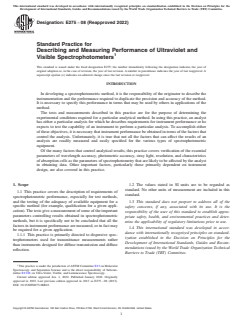
1. Scope 1.2 The values stated in SI units are to be regarded as
standard. No other units of measurement are included in this
1.1 This practice covers the description of requirements of
standard.
spectrophotometric performance, especially for test methods,
and the testing of the adequacy of available equipment for a
1.3 This standard does not purport to address all of the
specific method (for example, qualification for a given appli-
safety concerns, if any, associated with its use. It is the
cation).The tests give a measurement of some of the important
responsibility of the user of this standard to establish appro-
parameters controlling results obtained in spectrophotometric
priate safety, health, and environmental practices and deter-
methods, but it is specifically not to be concluded that all the
mine the applicability of regulatory limitations prior to use.
factors in instrument performance are measured, or in fact may
1.4 This international standard was developed in accor-
be required for a given application.
dance with internationally recognized principles on standard-
1.1.1 This practice is primarily directed to dispersive spec-
ization established in the Decision on Principles for the
trophotometers used for transmittance measurements rather
Development of International Standards, Guides and Recom-
than instruments designed for diffuse transmission and diffuse
mendations issued by the World Trade Organization Technical
reflection.
Barriers to Trade (TBT) Committee.
This practice is under the jurisdiction of ASTM Committee E13 on Molecular
Spectroscopy and Separation Science and is the direct responsibility of Subcom-
mittee E13.01 on Ultra-Violet, Visible, and Luminescence Spectroscopy.
Current edition approved Jan. 1, 2022. Published January 2022. Originally
approved in 1965. Last previous edition approved in 2013 as E275 – 08 (2013).
DOI: 10.1520/E0275-08R22.
Copyright © ASTM International, 100 Barr Harbor Drive, PO Box C700, West Conshohocken, PA 19428-2959. United States
E275 − 08 (2022)
2. Referenced Documents 6. Parameters in Spectrophotometry
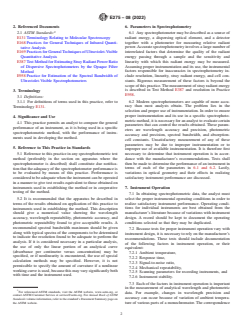
2.1 ASTM Standards: 6.1 Any spectrophotometer may be described as a source of
radiant energy, a dispersing optical element, and a detector
E131 Terminology Relating to Molecular Spectroscopy
E168 Practices for General Techniques of Infrared Quanti- together with a photometer for measuring relative radiant
power.Accurate spectrophotometry involves a large number of
tative Analysis
E169 PracticesforGeneralTechniquesofUltraviolet-Visible interrelated factors that determine the quality of the radiant
energy passing through a sample and the sensitivity and
Quantitative Analysis
E387 TestMethodforEstimatingStrayRadiantPowerRatio linearity with which this radiant energy may be measured.
Assuming proper instrumentation and its use, the instrumental
of Dispersive Spectrophotometers by the Opaque Filter
Method factors responsible for inaccuracies in spectrophotometry in-
clude resolution, linearity, stray radiant energy, and cell con-
E958 Practice for Estimation of the Spectral Bandwidth of
Ultraviolet-Visible Spectrophotometers stants. Rigorous measurement of these factors is beyond the
scopeofthispractice.Themeasurementofstrayradiantenergy
3. Terminology is described in Test Method E387 and resolution in Practice
E958.
3.1 Definitions:
6.2 Modern spectrophotometers are capable of more accu-
3.1.1 For definitions of terms used in this practice, refer to
racy than most analysts obtain. The problem lies in the
Terminology E131.
selection and proper use of instrumentation. In order to ensure
proper instrumentation and its use in a specific spectrophoto-
4. Significance and Use
metric method, it is necessary for an analyst to evaluate certain
4.1 This practice permits an analyst to compare the general
parameters that can control the results obtained. These param-
performance of an instrument, as it is being used in a specific
eters are wavelength accuracy and precision, photometric
spectrophotometric method, with the performance of instru-
accuracy and precision, spectral bandwidth, and absorption-
ments used in developing the method.
cell constants. Unsatisfactory measurement of any of these
parameters may be due to improper instrumentation or to
5. Reference to This Practice in Standards
improper use of available instrumentation. It is therefore first
5.1 Reference to this practice in any spectrophotometric test necessary to determine that instrument operation is in accor-
method (preferably in the section on apparatus where the dance with the manufacturer’s recommendations. Tests shall
spectrophotometer is described) shall constitute due notifica- then be made to determine the performance of an instrument in
tionthattheadequacyofthespectrophotometerperformanceis terms of each of the parameters in 6.1 and 6.2. Lastly,
to be evaluated by means of this practice. Performance is variations in optical geometry and their effects in realizing
consideredtobeadequatewhentheinstrumentcanbeoperated satisfactory instrument performance are discussed.
in a manner to give test results equivalent to those obtained on
instruments used in establishing the method or in cooperative 7. Instrument Operation
testing of the method.
7.1 In obtaining spectrophotometric data, the analyst must
select the proper instrumental operating conditions in order to
5.2 It is recommended that the apparatus be described in
terms of the results obtained on application of this practice to realize satisfactory instrument performance. Operating condi-
tions for individual instruments are best obtained from the
instruments used in establishing the method. This description
should give a numerical value showing the wavelength manufacturer’s literature because of variations with instrument
design. A record should be kept to document the operating
accuracy, wavelength repeatability, photometric accuracy, and
photometric repeatability found to give acceptable results. A conditions selected so that they may be duplicated.
recommended spectral bandwidth maximum should be given
7.2 Because tests for proper instrument operation vary with
along with typical spectra of the components to be determined
instrument design, it is necessary to rely on the manufacturer’s
to indicate the resolution found to be adequate to perform the
recommendations. These tests should include documentation
analysis. If it is considered necessary in a particular analysis,
of the following factors in instrument operation, or their
the use of only the linear portion of an analytical curve
equivalent:
(absorbance per centimetre versus concentration) may be
7.2.1 Ambient temperature,
specified, or if nonlinearity is encountered, the use of special
7.2.2 Response time,
calculation methods may be specified. However, it is not
7.2.3 Signal-to-noise ratio,
permissible to specify the amount of curvature if a nonlinear
7.2.4 Mechanical repeatability,
workingcurveisused,becausethismayvarysignificantlyboth
7.2.5 Scanning parameters for recording instruments, and
with time and the instrument used.
7.2.6 Instrument stability.
7.3 Each of the factors in instrument operation is important
in the measurement of analytical wavelength and photometric
For referenced ASTM standards, visit the ASTM website, www.astm.org, or
data. For example, changes in wavelength precision and
contact ASTM Customer Service at service@astm.org. For Annual Book of ASTM
accuracy can occur because of variation of ambient tempera-
Standards volume information, refer to the standard’s Document Summary page on
the ASTM website. ture of various parts of a monochromator. The correspondence
E275 − 08 (2022)
of the absorbance to wavelength and any internal calculations 10. Reference Wavelengths in the Ultraviolet Region
(or corrections) can affect wavelength measurement for digital
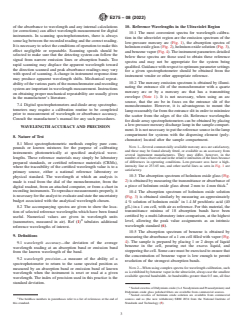
10.1 The most convenient spectra for wavelength calibra-
instruments. In scanning spectrophotometers, there is always
tion in the ultraviolet region are the emission spectrum of the
somelagbetweentherecordedreadingandthecorrectreading.
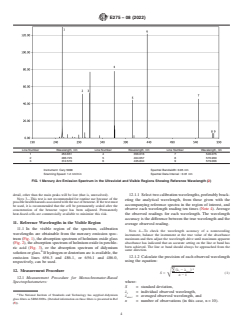
low-pressure mercury arc (Fig. 1), the absorption spectra of
Itisnecessarytoselecttheconditionsofoperationtomakethis
holmium oxide glass (Fig. 2), holmium oxide solution (Fig. 3),
effect negligible or repeatable. Scanning speeds should be
andbenzenevapor(Fig.4).Theinstrumentparametersdetailed
selected to make sure that the detecting system can follow the
below these spectra are those used to obtain these reference
signal from narrow emission lines or absorption bands. Too
spectra and may not be appropriate for the system being
rapid scanning may displace the apparent wavelength toward
qualified.Guidancewithrespecttooptimumparametersettings
the direction scanned and peak absorbance readings may vary
for a given spectrophotometer should be obtained from the
with speed of scanning. A change in instrument response-time
instrument vendor or other appropriate reference.
may produce apparent wavelength shifts. Mechanical repeat-
10.2 The mercury emission spectrum is obtained by illumi-
abilityofthevariouspartsofthemonochromatorandrecording
nating the entrance slit of the monochromator with a quartz
system are important in wavelength measurement. Instructions
mercury arc or by a mercury arc that has a transmitting
on obtaining proper mechanical repeatability are usually given
envelope (Note 1). It is not necessary, when using an arc
in the manufacturer’s literature.
source, that the arc be in focus on the entrance slit of the
7.4 Digital spectrophotometers and diode array spectropho-
monochromator. However, it is advantageous to mount the
tometers may require a calibration routine to be completed
lamp reasonably far from the entrance slit in order to minimize
prior to measurement of wavelength or absorbance accuracy.
the scatter from the edges of the slit. Reference wavelengths
Consult the manufacturer’s manual for any such procedures.
for diode array spectrophotometers can be obtained by placing
a low-pressure mercury discharge lamp in the sample compart-
WAVELENGTH ACCURACY AND PRECISION
ment.Itisnotnecessarytoputthereferencesourceinthelamp
compartment for systems with the dispersing element (poly-
8. Nature of Test
chomator) located after the sample compartment.
8.1 Most spectrophotometric methods employ pure com-
NOTE 1—Several commercially available mercury arcs are satisfactory,
pounds or known mixtures for the purpose of calibrating
and these may be found already fitted, or available as an accessory from
instruments photometrically at specified analytical wave-
several instrument manufacturers. They may differ, however, in the
lengths. These reference materials may simply be laboratory
numberoflinesobservedandintherelativeintensitiesofthelinesbecause
prepared standards, or certified reference materials (CRMs), of differences in operating conditions. Low-pressure arcs have a high-
intensity line at 253.65 nm, and other useful lines as seen in Fig. 1 are
where the traceability of the certified wavelength value is to a
satisfactory.
primary source, either a national reference laboratory or
10.3 The absorption spectrum of holmium oxide glass (Fig.
physical standard. The wavelength at which an analysis is
2) is obtained by measuring the transmittance or absorbance of
made is read from the dial of the monochromator, from the
a piece of holmium oxide glass about 2 mm to 4 mm thick.
digital readout, from an attached computer, or from a chart in
recording instruments. To reproduce measurements properly, it
10.4 The absorption spectrum of holmium oxide solution
isnecessaryfortheanalysttoevaluateandstatetheuncertainty
(Fig. 3) is obtained similarly by measuring an approximately
budget associated with the analytical wavelength chosen.
4 % solution of holmium oxide in 1.4 M perchloric acid (40
g/L) in a 1 cm cell, with air as reference. For this material, the
8.2 The accompanying spectra are given to show the loca-
transmittance minima of 18 absorption bands have been
tion of selected reference wavelengths which have been found
certified by a multi-laboratory inter-comparison, at the highest
useful. Numerical values are given in wavelength units
level, allowing the peak value assignments as an intrinsic
(nanometres, measured in air). Ref (1) tabulates additional
wavelength standard (6).
reference wavelengths of interest.
10.5 The absorption spectrum of benzene is obtained by
9. Definitions
measuring the absorbance of a 1 cm cell filled with vapor (Fig.
4). The sample is prepared by placing 1 or 2 drops of liquid
9.1 wavelength accuracy—the deviation of the average
benzene in the cell, pouring out the excess liquid, and
wavelength reading at an absorption band or emission band
stoppering the cell. Some care must be exercised to ensure that
from the known wavelength of the band.
the concentration of benzene vapor is low enough to permit
9.2 wavelength precision—a measure of the ability of a
resolution of the strongest absorption bands.
spectrophotometer to return to the same spectral position as
NOTE 2—When using complex spectra for wavelength calibration, such
measured by an absorption band or emission band of known
asisexhibitedbybenzenevaporintheultraviolet,alwaysusethesmallest
wavelength when the instrument is reset or read at a given
available spectral bandwidth. At bandwidths greater than 0.5 nm, all fine
wavelength. The index of precision used in this practice is the
standard deviation.
Sealed cuvettes of Didymium oxide (1+1 Neodymium and Praesodymium) and
Didymium oxide glass polished filters are available from commercial sources.
Sealed cuvettes of holmium oxide solution are available from commercial
The boldface numbers in parentheses refer to a list of references at the end of sources and as (the now withdrawn) SRM 2034 from the National Institute of
this standard. Standards and Technology (5).
E275 − 08 (2022)
Line Number Wavelength, nm Line Number Wavelength, nm Line Number Wavelength, nm
1 253.651 4 356.016 7 546.075
2 296.725 5 404.657 8 576.960
3 312.570 6 435.834 9 579.066
Instrument: Cary 5000 Spectral Bandwidth: 0.05 nm
Scanning Speed: 1.2 nm/min Spectral Data Interval : 0.01 nm
FIG. 1 Mercury Arc Emission Spectrum in the Ultraviolet and Visible Regions Showing Reference Wavelength (2)
detail, other than the main peaks will be lost (that is, unresolved).
12.1.1 Selecttwocalibrationwavelengths,preferablybrack-
NOTE 3—This test is not recommended for routine use because of the
eting the analytical wavelength, from those given with the
possiblehealthhazardsassociatedwiththeuseofbenzene.Ifthetestmust
accompanying reference spectra in the region of interest, and
be used, it is recommended that the cell be permanently sealed after the
observe each wavelength reading ten times (Note 4). Average
concentration of the benzene vapor has been adjusted. Permanently
heat-fused cells are commercially available to minimize this risk. the observed readings for each wavelength. The wavelength
accuracy is the difference between the true wavelength and the
11. Reference Wavelengths in the Visible Region
average observed reading.
11.1 In the visible region of the spectrum, calibration
NOTE 4—To check the wavelength accuracy of a nonrecording
wavelengths are obtainable from the mercury emission spec-
instrument, balance the instrument at the true value of the absorbance
trum (Fig. 1), the absorption spectrum of holmium oxide glass maximum and then adjust the wavelength drive until maximum apparent
absorbance has indicated that an accurate setting on the line or band has
(Fig. 2), the absorption spectrum of holmium oxide in perchlo-
been achieved. The line or band should always be approached from the
ric acid (Fig. 3), or the absorption spectrum of didymium
same direction.
solutionorglass. Ifhydrogenordeuteriumarcisavailable,the
12.1.2 Calculate the precision of each observed wavelength
emission lines 656.3 and 486.1, or 656.1 and 486.0,
using the equation:
respectively, can be used.
~λ 2 λ !
( i aver
12. Measurement Procedure
S 5Π(1)
n 2 1
12.1 Measurement Procedure for Monochromator-Based
where:
Spectrophotometers:
S = standard deviation,
λ = individual observed wavelength,
i
The National Institute of Standards and Technology has supplied didymium
λ = averaged observed wavelength, and
aver
glass filters as SRM 2009a. (Detailed information on these filters is presented in Ref
n = number of observations (in this case, n = 10).
(5)).
E275 − 08 (2022)
Band Number Wavelength, nm Band Number Wavelength, nm Band Number Wavelength, nm Band Number Wavelength, nm
1 241.64 4 333.86 7 445.67 10 536.27
2 279.38 5 360.92 8 453.62 11 637.69
3 287.55 6 418.66 9 460.21
Instrument: Cary 5000 Spectral Bandwidth: 0.1 nm
Scanning Speed: 0.6 nm/min Spectral Data Interval: 0.02 nm
FIG. 2 Spectrum of Holmium Oxide Glass Showing Reference Wavelength (3)
12.2 Measurement Procedure for Diode Array Spectropho- SPECTRAL BANDWIDTH
tometers:
12.2.1 Acquire ten transmittance spectra of holmium oxide
13. Selection of Spectral Bandwidth
solution or glass or didymium glass. Extract the indicated
13.1 One of the most important parameters the analyst must
positions of certified peaks that bracket the analytical wave-
select is the spectral band
...