

ASTM C1621/C1621M-17(2023)
(Test Method)Standard Test Method for Passing Ability of Self-Consolidating Concrete by J-Ring
General Information
- Abstract
SIGNIFICANCE AND USE
5.1 This test method provides a procedure to determine the passing ability of self-consolidating concrete. This test method is applicable for laboratory use in comparing the passing ability of different concrete mixtures. It is also applicable in the field as a quality control test.
5.2 The difference between the slump flow and J-Ring flow is an indication of the passing ability of the concrete. A difference less than 25 mm [1 in.] indicates good passing ability and a difference greater than 50 mm [2 in.] indicates poor passing ability. The orientation of the mold for the J-Ring test and for the slump flow test without the J-Ring shall be the same.
5.3 This test method is limited to self-consolidating concrete with nominal maximum size of aggregate of up to 25 mm [1 in.].
SCOPE
1.1 This test method covers determination of the passing ability of self-consolidating concrete (SCC) by using the J-Ring in combination with a mold.
1.2 The values stated in either SI units or inch-pound units are to be regarded separately as standard. The values stated in each system may not be exact equivalents; therefore, each system shall be used independently of the other. Combining values from the two systems may result in non-conformance with the standard.
1.3 The text of this standard references notes and footnotes that provide explanatory material. These notes and footnotes (excluding those in tables and figures) shall not be considered as requirements of the standard.
1.4 This standard does not purport to address all of the safety concerns, if any, associated with its use. It is the responsibility of the user of this standard to establish appropriate safety, health, and environmental practices and determine the applicability of regulatory limitations prior to use. (Warning—Fresh hydraulic cementitious mixtures are caustic and may cause chemical burns to skin and tissue upon prolonged exposure.2)
1.5 This international standard was developed in accordance with internationally recognized principles on standardization established in the Decision on Principles for the Development of International Standards, Guides and Recommendations issued by the World Trade Organization Technical Barriers to Trade (TBT) Committee.
- Status
- Published
- Publication Date
- 30-Sep-2023
- Technical Committee
- C09 - Concrete and Concrete Aggregates
- Drafting Committee
- C09.47 - Self-Consolidating Concrete

Overview
ASTM C1621/C1621M-17(2023) is an international standard test method developed by ASTM International for determining the passing ability of self-consolidating concrete (SCC) using the J-Ring apparatus. This standard provides a systematic approach for measuring how well SCC flows and passes through spaces that simulate reinforcing obstacles, an essential property for ensuring the quality and performance of concrete in complex formwork.
Proper assessment of SCC’s passing ability supports both laboratory comparison of mixtures and field quality control, helping engineers, contractors, and quality managers ensure that SCC will completely fill forms without segregation or blockage.
Key Topics
Test Scope and Applicability
- Evaluates the passing ability of self-consolidating concrete mixtures with maximum aggregate sizes up to 25 mm (1 in.).
- Applicable for both laboratory research and onsite quality control to compare different SCC mixtures’ abilities to flow through obstructions.
J-Ring and Slump Flow Method
- A J-Ring apparatus, combined with a slump flow test, simulates concrete placement around reinforcement.
- The test calculates the difference between the standard slump flow and the J-Ring flow of SCC.
Blocking Assessment
- The difference in flow diameters indicates degree of blocking:
- Less than 25 mm (1 in.): Good passing ability, no visible blocking.
- More than 50 mm (2 in.): Poor passing ability, noticeable to extreme blocking.
- Between 25 mm and 50 mm (1-2 in.): Minimal to noticeable blocking.
- The difference in flow diameters indicates degree of blocking:
Safety and Units
- The standard emphasizes safety practices due to caustic nature of fresh SCC.
- Procedures are detailed using both SI and inch-pound units, but these should not be intermixed during testing.
Applications
Quality Control on Construction Sites
- Onsite teams can use this test as a quality assurance procedure to evaluate if the SCC being delivered or produced will pass through rebar and fill architectural or structural forms without the need for vibration.
Mixture Comparison in Research and Development
- Concrete producers and materials laboratories use the test to compare different SCC formulations, optimizing mix designs for better workability and performance.
Acceptance Criteria for Projects
- Contractors and owners often specify passing ability requirements based on ASTM C1621/C1621M in project specifications to ensure compliance with construction and performance standards.
Supports Sustainable Construction
- Ensures efficient use of SCC by reducing rework, increasing durability, and supporting complex concrete designs in infrastructure and building projects.
Related Standards
For broader quality assurance in concrete production and SCC performance, ASTM C1621/C1621M references and is complemented by several related ASTM standards:
- ASTM C125: Terminology Relating to Concrete and Concrete Aggregates
- ASTM C143/C143M: Standard Test Method for Slump of Hydraulic-Cement Concrete
- ASTM C1611/C1611M: Slump Flow of Self-Consolidating Concrete
- ASTM C172: Practice for Sampling Freshly Mixed Concrete
- ASTM C173/C173M: Air Content of Freshly Mixed Concrete by the Volumetric Method
- ASTM C1758/C1758M: Practice for Fabricating Test Specimens with Self-Consolidating Concrete
Practical Value
Implementing ASTM C1621/C1621M-17(2023) in your concrete testing protocols ensures:
- Reliable assessment of SCC performance in complex formwork conditions.
- Consistent quality control criteria on job sites and in laboratories.
- Reduced risk of defects such as honeycombing or incomplete filling in reinforced structures.
- Compliance with international best practices in concrete construction.
By utilizing this standard, stakeholders can confidently specify, test, and deliver self-consolidating concrete with verified passing ability, supporting structural integrity, aesthetics, and constructability in modern concrete construction.
Relations
- Effective Date
- 01-Oct-2023
- Effective Date
- 01-Jan-2024
- Effective Date
- 01-Oct-2023
- Effective Date
- 01-Sep-2023
- Effective Date
- 01-Feb-2016
- Effective Date
- 01-Feb-2015
Get Certified
Connect with accredited certification bodies for this standard

DIBt (Deutsches Institut für Bautechnik)
German Institute for Building Technology.
DIN CERTCO
DIN Group product certification.

Aboma Certification B.V.
Specialized in construction, metal, and transport sectors.
Sponsored listings
Frequently Asked Questions
ASTM C1621/C1621M-17(2023) is a standard published by ASTM International. Its full title is "Standard Test Method for Passing Ability of Self-Consolidating Concrete by J-Ring". This standard covers: SIGNIFICANCE AND USE 5.1 This test method provides a procedure to determine the passing ability of self-consolidating concrete. This test method is applicable for laboratory use in comparing the passing ability of different concrete mixtures. It is also applicable in the field as a quality control test. 5.2 The difference between the slump flow and J-Ring flow is an indication of the passing ability of the concrete. A difference less than 25 mm [1 in.] indicates good passing ability and a difference greater than 50 mm [2 in.] indicates poor passing ability. The orientation of the mold for the J-Ring test and for the slump flow test without the J-Ring shall be the same. 5.3 This test method is limited to self-consolidating concrete with nominal maximum size of aggregate of up to 25 mm [1 in.]. SCOPE 1.1 This test method covers determination of the passing ability of self-consolidating concrete (SCC) by using the J-Ring in combination with a mold. 1.2 The values stated in either SI units or inch-pound units are to be regarded separately as standard. The values stated in each system may not be exact equivalents; therefore, each system shall be used independently of the other. Combining values from the two systems may result in non-conformance with the standard. 1.3 The text of this standard references notes and footnotes that provide explanatory material. These notes and footnotes (excluding those in tables and figures) shall not be considered as requirements of the standard. 1.4 This standard does not purport to address all of the safety concerns, if any, associated with its use. It is the responsibility of the user of this standard to establish appropriate safety, health, and environmental practices and determine the applicability of regulatory limitations prior to use. (Warning—Fresh hydraulic cementitious mixtures are caustic and may cause chemical burns to skin and tissue upon prolonged exposure.2) 1.5 This international standard was developed in accordance with internationally recognized principles on standardization established in the Decision on Principles for the Development of International Standards, Guides and Recommendations issued by the World Trade Organization Technical Barriers to Trade (TBT) Committee.
SIGNIFICANCE AND USE 5.1 This test method provides a procedure to determine the passing ability of self-consolidating concrete. This test method is applicable for laboratory use in comparing the passing ability of different concrete mixtures. It is also applicable in the field as a quality control test. 5.2 The difference between the slump flow and J-Ring flow is an indication of the passing ability of the concrete. A difference less than 25 mm [1 in.] indicates good passing ability and a difference greater than 50 mm [2 in.] indicates poor passing ability. The orientation of the mold for the J-Ring test and for the slump flow test without the J-Ring shall be the same. 5.3 This test method is limited to self-consolidating concrete with nominal maximum size of aggregate of up to 25 mm [1 in.]. SCOPE 1.1 This test method covers determination of the passing ability of self-consolidating concrete (SCC) by using the J-Ring in combination with a mold. 1.2 The values stated in either SI units or inch-pound units are to be regarded separately as standard. The values stated in each system may not be exact equivalents; therefore, each system shall be used independently of the other. Combining values from the two systems may result in non-conformance with the standard. 1.3 The text of this standard references notes and footnotes that provide explanatory material. These notes and footnotes (excluding those in tables and figures) shall not be considered as requirements of the standard. 1.4 This standard does not purport to address all of the safety concerns, if any, associated with its use. It is the responsibility of the user of this standard to establish appropriate safety, health, and environmental practices and determine the applicability of regulatory limitations prior to use. (Warning—Fresh hydraulic cementitious mixtures are caustic and may cause chemical burns to skin and tissue upon prolonged exposure.2) 1.5 This international standard was developed in accordance with internationally recognized principles on standardization established in the Decision on Principles for the Development of International Standards, Guides and Recommendations issued by the World Trade Organization Technical Barriers to Trade (TBT) Committee.
ASTM C1621/C1621M-17(2023) is classified under the following ICS (International Classification for Standards) categories: 91.100.30 - Concrete and concrete products. The ICS classification helps identify the subject area and facilitates finding related standards.
ASTM C1621/C1621M-17(2023) has the following relationships with other standards: It is inter standard links to ASTM C1621/C1621M-17, ASTM C173/C173M-24, ASTM C1758/C1758M-23, ASTM C173/C173M-23, ASTM C173/C173M-16, ASTM C1758/C1758M-15. Understanding these relationships helps ensure you are using the most current and applicable version of the standard.
ASTM C1621/C1621M-17(2023) is available in PDF format for immediate download after purchase. The document can be added to your cart and obtained through the secure checkout process. Digital delivery ensures instant access to the complete standard document.
Standards Content (Sample)
This international standard was developed in accordance with internationally recognized principles on standardization established in the Decision on Principles for the
Development of International Standards, Guides and Recommendations issued by the World Trade Organization Technical Barriers to Trade (TBT) Committee.
Designation: C1621/C1621M − 17 (Reapproved 2023)
Standard Test Method for
Passing Ability of Self-Consolidating Concrete by J-Ring
This standard is issued under the fixed designation C1621/C1621M; the number immediately following the designation indicates the
year of original adoption or, in the case of revision, the year of last revision. A number in parentheses indicates the year of last
reapproval. A superscript epsilon (´) indicates an editorial change since the last revision or reapproval.
1. Scope* C125 Terminology Relating to Concrete and Concrete Ag-
gregates
1.1 This test method covers determination of the passing
C143/C143M Test Method for Slump of Hydraulic-Cement
ability of self-consolidating concrete (SCC) by using the
Concrete
J-Ring in combination with a mold.
C172 Practice for Sampling Freshly Mixed Concrete
1.2 The values stated in either SI units or inch-pound units
C173/C173M Test Method for Air Content of Freshly Mixed
are to be regarded separately as standard. The values stated in
Concrete by the Volumetric Method
each system may not be exact equivalents; therefore, each
C1611/C1611M Test Method for Slump Flow of Self-
system shall be used independently of the other. Combining
Consolidating Concrete
values from the two systems may result in non-conformance
C1758/C1758M Practice for Fabricating Test Specimens
with the standard.
with Self-Consolidating Concrete
1.3 The text of this standard references notes and footnotes
3. Terminology
that provide explanatory material. These notes and footnotes
(excluding those in tables and figures) shall not be considered 3.1 Definitions:
as requirements of the standard.
3.1.1 For definitions of terms used in this test method, refer
to Terminology C125.
1.4 This standard does not purport to address all of the
safety concerns, if any, associated with its use. It is the
3.2 Definitions of Terms Specific to This Standard:
responsibility of the user of this standard to establish appro-
3.2.1 halo, n—an observed cement paste or mortar ring that
priate safety, health, and environmental practices and deter-
has clearly separated from the coarse aggregate, around the
mine the applicability of regulatory limitations prior to use.
outside circumference of concrete after flowing from the mold.
(Warning—Fresh hydraulic cementitious mixtures are caustic
3.2.2 J-ring, n—an apparatus consisting of a rigid ring
and may cause chemical burns to skin and tissue upon
supported on sixteen 16 mm [ ⁄8 in.] diameter rods equally
prolonged exposure. )
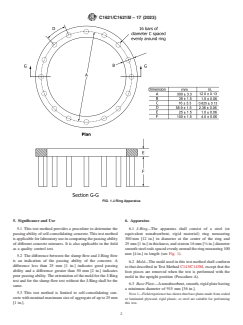
spaced on a 300 mm [12 in.] diameter circle 100 mm [4 in.]
1.5 This international standard was developed in accor-
above a flat surface as shown in Fig. 1.
dance with internationally recognized principles on standard-
3.2.3 J-ring flow, n—the distance of lateral flow of concrete
ization established in the Decision on Principles for the
using the J-Ring in combination with a mold.
Development of International Standards, Guides and Recom-
3.2.4 passing ability, n—the ability of self-consolidating
mendations issued by the World Trade Organization Technical
concrete to flow under its own weight (without vibration) and
Barriers to Trade (TBT) Committee.
fill completely all spaces within intricate formwork, containing
2. Referenced Documents obstacles, such as reinforcement.
2.1 ASTM Standards:
4. Summary of Test Method
4.1 A sample of freshly mixed concrete is placed in a mold,
either in the upright or inverted position, that is concentric with
This test method is under the jurisdiction of ASTM Committee C09 on
the J-Ring (Fig. 2). The concrete is placed in one lift without
Concrete and Concrete Aggregates and is the direct responsibility of Subcommittee
C09.47 on Self-Consolidating Concrete.
tamping or vibration. The mold is raised, and the concrete is
Current edition approved Oct. 1, 2023. Published October 2023. Originally
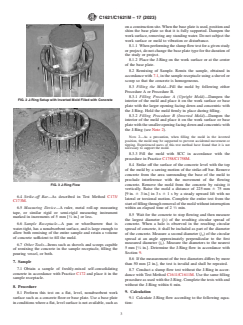
allowed to spread through the J-Ring (Fig. 3). After spreading
approved in 2006. Last previous edition approved in 2017 as C1621/C1621M – 17.
ceases, two diameters of the concrete mass are measured in
DOI: 10.1520/C1621_C1621M-17R23.
approximately orthogonal directions. J-Ring flow is the aver-
Section on Safety Precautions, Manual of Aggregate and Concrete Testing,
Annual Book of ASTM Standards, Vol 04.02.
age of the two diameters. The test is repeated without the
For referenced ASTM standards, visit the ASTM website, www.astm.org, or
J-Ring to obtain the slump flow. The difference between the
contact ASTM Customer Service at service@astm.org. For Annual Book of ASTM
slump flow and J-Ring flow is an indicator of the passing
Standards volume information, refer to the standard’s Document Summary page on
the ASTM website. ability of the concrete.
*A Summary of Changes section appears at the end of this standard
Copyright © ASTM International, 100 Barr Harbor Drive, PO Box C700, West Conshohocken, PA 19428-2959. United States
C1621/C1621M − 17 (2023)
FIG. 1 J-Ring Apparatus
5. Significance and Use 6. Apparatus
5.1 This test method provides a procedure to determine the 6.1 J-Ring—The apparatus shall consist of a steel (or
passing ability of self-consolidating concrete. This test method equivalent nonabsorbent, rigid material) ring measuring
is applicable for laboratory use in comparing the passing ability
300 mm [12 in.] in diameter at the center of the ring and
of different concrete mixtures. It is also applicable in the field
25 mm [1 in.] in thickness, and sixteen 16 mm [ ⁄8 in.] diameter
as a quality control test.
smooth steel rods spaced evenly around the ring measuring 100
mm [4 in.] in length (see Fig. 1).
5.2 The difference between the slump flow and J-Ring flow
is an indication of the passing ability of the concrete. A
6.2 Mold—The mold used in this test method shall conform
difference less than 25 mm [1 in.] indicates good passing
to that described in Test Method C143/C143M, except that the
ability and a difference greater than 50 mm [2 in.] indicates
foot pieces are removed when the test is performed with the
poor passing ability. The orientation of the mold for the J-Ring
mold in the upright position (Procedure A).
test and for the slump flow test without the J-Ring shall be the
6.3 Base Plate—A nonabsorbent, smooth, rigid plate having
same.
a minimum diameter of 915 mm [36 in.].
5.3 This test method is limited to self-consolidating con-
NOTE 1—Field experience has shown that base plates made from sealed
crete with nominal maximum size of aggregate of up to 25 mm
or laminated plywood, rigid plastic, or steel are suitable for performing
[1 in.]. this test.
C1621/C1621M − 17 (2023)
on a construction site. When the base plate is used, position and
shim the base plate so that it is fully supported. Dampen the
work surface, removing any standing water. Do not subject the
work surface or mold to vibration or disturbance.
8.1.1 When performing the slump flow test for a given study
or project, do not change the base plate type for the duration of
the study or project.
8.1.2 Place the J-Ring on the work surface or at the center
of the base plate.
8.2 Remixing of Sample. Remix the sample, obtained in
accordance with 7.1, in the sample receptacle using a shovel or
scoop so that the concrete
...