

ASTM E1951-14(2019)
(Guide)Standard Guide for Calibrating Reticles and Light Microscope Magnifications
General Information
- Abstract
SIGNIFICANCE AND USE
4.1 These methods can be used to determine magnifications as viewed through the eyepieces of light microscopes.
4.2 These methods can be used to calibrate microscope magnifications for photography, video systems, and projection stations.
4.3 Reticles may be calibrated as independent articles and as components of a microscope system.
SCOPE
1.1 This guide covers methods for calculating and calibrating microscope magnifications, photographic magnifications, video monitor magnifications, grain size comparison reticles, and other measuring reticles. Reflected light microscopes are used to characterize material microstructures. Many materials engineering decisions may be based on qualitative and quantitative analyses of a microstructure. It is essential that microscope magnifications and reticle dimensions be accurate.
1.2 The calibration using these methods is only as precise as the measuring devices used. It is recommended that the stage micrometer or scale used in the calibration should be traceable to the National Institute of Standards and Technology (NIST) or a similar organization.
1.3 This standard does not purport to address all of the safety concerns, if any, associated with its use. It is the responsibility of the user of this standard to establish appropriate safety, health, and environmental practices and determine the applicability of regulatory limitations prior to use.
1.4 This international standard was developed in accordance with internationally recognized principles on standardization established in the Decision on Principles for the Development of International Standards, Guides and Recommendations issued by the World Trade Organization Technical Barriers to Trade (TBT) Committee.
- Status
- Published
- Publication Date
- 31-Oct-2019
- Technical Committee
- E04 - Metallography
- Drafting Committee
- E04.03 - Light Microscopy
Overview
ASTM E1951-14(2019), Standard Guide for Calibrating Reticles and Light Microscope Magnifications, provides a comprehensive framework for the calibration of microscope magnifications, photographic and digital imaging systems, and various types of measuring reticles. This guide is essential for ensuring the accuracy of quantitative and qualitative analyses in materials characterization, particularly in metallography and materials engineering, where reliable measurements underpin critical decisions.
Calibration covered by this guide includes methods for calculating and verifying the magnification seen through microscope eyepieces, as well as the magnification applied in photographic, video, and projection systems. Accurate calibration directly impacts the effectiveness of microstructure analysis, grain size determination, and the consistency of measurements used across multiple laboratories and industries.
Key Topics
Microscope Magnification Calibration
Procedures for determining total system magnification by combining the objective, eyepiece, and any intermediate lenses, ensuring the observed magnification matches calculated values.Photographic and Digital Imaging Calibration
Methods for calibrating magnification in photomicrographs and digital video or computer monitor displays using reference standards like stage micrometers.Reticle and Micrometer Calibration
Steps to calibrate eyepiece and filar micrometers, enabling precise measurement of microscopic features. Calibration includes measurement consistency, objective lens combinations, and repeatability.Grain Size Reticle Calibration
Procedures to verify that reticle graphics accurately represent ASTM grain size numbers, crucial for standardized grain size comparisons in metallography.Traceability and Precision
Importance of using measuring devices-like stage micrometers-that are traceable to national standards (NIST or equivalent organizations) to enhance the reliability and precision of calibrations.User Guidance and Limitations
Recommendations for users on proper calibration methods and avoidance of errors due to system variability, equipment limitations, or operator handling. The standard also emphasizes adopting proper safety and regulatory practices.
Applications
Materials Characterization
Accurate microscope magnification and reticle calibration are vital in metallographic analysis, allowing for robust evaluation of microstructures, phase identification, and grain size assessment.Quality Control and Assurance
Critical in industrial and research settings, the guide ensures that microscopy measurements used for component inspection, material certification, and process verification are precise and repeatable.Microscopy System Setup
Laboratories can standardize their procedures for configuring and verifying imaging equipment, thereby minimizing measurement discrepancies and aligning with best practices.Educational and Training
Used as a foundational reference for instructing new technicians or establishing laboratory protocols involving light microscopes and image analysis systems.Documentation and Reporting
Provides defensible calibration records required for audits, reproducibility of scientific results, and compliance with industrial or regulatory standards.
Related Standards
ASTM E7: Terminology Relating to Metallography
Provides definitions and terminology essential for interpreting and applying measurement techniques in metallography.ASTM E112: Test Methods for Determining Average Grain Size
Complements E1951 by providing procedures for grain size evaluation, including quantitative and comparison methods.NIST Traceability
Although not an ASTM standard, traceability to the National Institute of Standards and Technology is emphasized for reference equipment, ensuring international consistency and credibility.General ISO and ASTM Microscopy Standards
This guide aligns with broader international standardization principles, supporting mutual recognition and harmonization across global trade, research, and regulatory activities.
Keywords: microscope calibration, reticle calibration, light microscope magnification, stage micrometer, photomicrograph calibration, filar micrometer, metallography, grain size measurement, ASTM E1951, NIST traceability, quality assurance, microscopy standards.
Relations
- Effective Date
- 01-Jun-2015
- Effective Date
- 01-Nov-2014
- Effective Date
- 15-Nov-2012
- Effective Date
- 01-Nov-2010
- Effective Date
- 01-Oct-2009
- Effective Date
- 23-Oct-2006
- Effective Date
- 01-Nov-2004
- Effective Date
- 01-Nov-2004
- Effective Date
- 10-May-2003
- Effective Date
- 10-Dec-2001
- Effective Date
- 10-Dec-2001
- Effective Date
- 01-Jan-1996
- Effective Date
- 01-Jan-1996
- Effective Date
- 01-Jan-1996
Frequently Asked Questions
ASTM E1951-14(2019) is a guide published by ASTM International. Its full title is "Standard Guide for Calibrating Reticles and Light Microscope Magnifications". This standard covers: SIGNIFICANCE AND USE 4.1 These methods can be used to determine magnifications as viewed through the eyepieces of light microscopes. 4.2 These methods can be used to calibrate microscope magnifications for photography, video systems, and projection stations. 4.3 Reticles may be calibrated as independent articles and as components of a microscope system. SCOPE 1.1 This guide covers methods for calculating and calibrating microscope magnifications, photographic magnifications, video monitor magnifications, grain size comparison reticles, and other measuring reticles. Reflected light microscopes are used to characterize material microstructures. Many materials engineering decisions may be based on qualitative and quantitative analyses of a microstructure. It is essential that microscope magnifications and reticle dimensions be accurate. 1.2 The calibration using these methods is only as precise as the measuring devices used. It is recommended that the stage micrometer or scale used in the calibration should be traceable to the National Institute of Standards and Technology (NIST) or a similar organization. 1.3 This standard does not purport to address all of the safety concerns, if any, associated with its use. It is the responsibility of the user of this standard to establish appropriate safety, health, and environmental practices and determine the applicability of regulatory limitations prior to use. 1.4 This international standard was developed in accordance with internationally recognized principles on standardization established in the Decision on Principles for the Development of International Standards, Guides and Recommendations issued by the World Trade Organization Technical Barriers to Trade (TBT) Committee.
SIGNIFICANCE AND USE 4.1 These methods can be used to determine magnifications as viewed through the eyepieces of light microscopes. 4.2 These methods can be used to calibrate microscope magnifications for photography, video systems, and projection stations. 4.3 Reticles may be calibrated as independent articles and as components of a microscope system. SCOPE 1.1 This guide covers methods for calculating and calibrating microscope magnifications, photographic magnifications, video monitor magnifications, grain size comparison reticles, and other measuring reticles. Reflected light microscopes are used to characterize material microstructures. Many materials engineering decisions may be based on qualitative and quantitative analyses of a microstructure. It is essential that microscope magnifications and reticle dimensions be accurate. 1.2 The calibration using these methods is only as precise as the measuring devices used. It is recommended that the stage micrometer or scale used in the calibration should be traceable to the National Institute of Standards and Technology (NIST) or a similar organization. 1.3 This standard does not purport to address all of the safety concerns, if any, associated with its use. It is the responsibility of the user of this standard to establish appropriate safety, health, and environmental practices and determine the applicability of regulatory limitations prior to use. 1.4 This international standard was developed in accordance with internationally recognized principles on standardization established in the Decision on Principles for the Development of International Standards, Guides and Recommendations issued by the World Trade Organization Technical Barriers to Trade (TBT) Committee.
ASTM E1951-14(2019) is classified under the following ICS (International Classification for Standards) categories: 37.020 - Optical equipment. The ICS classification helps identify the subject area and facilitates finding related standards.
ASTM E1951-14(2019) has the following relationships with other standards: It is inter standard links to ASTM E7-15, ASTM E7-14, ASTM E112-12, ASTM E112-10, ASTM E7-03(2009), ASTM E112-96(2004)e2, ASTM E112-96(2004)e1, ASTM E112-96(2004), ASTM E7-03, ASTM E7-01, ASTM E7-00, ASTM E112-96e1, ASTM E112-96e3, ASTM E112-96e2. Understanding these relationships helps ensure you are using the most current and applicable version of the standard.
ASTM E1951-14(2019) is available in PDF format for immediate download after purchase. The document can be added to your cart and obtained through the secure checkout process. Digital delivery ensures instant access to the complete standard document.
Standards Content (Sample)
This international standard was developed in accordance with internationally recognized principles on standardization established in the Decision on Principles for the
Development of International Standards, Guides and Recommendations issued by the World Trade Organization Technical Barriers to Trade (TBT) Committee.
Designation:E1951 −14 (Reapproved 2019)
Standard Guide for
Calibrating Reticles and Light Microscope Magnifications
This standard is issued under the fixed designation E1951; the number immediately following the designation indicates the year of
original adoption or, in the case of revision, the year of last revision. A number in parentheses indicates the year of last reapproval. A
superscript epsilon (´) indicates an editorial change since the last revision or reapproval.
1. Scope 4. Significance and Use
1.1 This guide covers methods for calculating and calibrat- 4.1 These methods can be used to determine magnifications
ing microscope magnifications, photographic magnifications, as viewed through the eyepieces of light microscopes.
video monitor magnifications, grain size comparison reticles,
4.2 These methods can be used to calibrate microscope
and other measuring reticles. Reflected light microscopes are
magnifications for photography, video systems, and projection
used to characterize material microstructures. Many materials
stations.
engineering decisions may be based on qualitative and quan-
4.3 Reticlesmaybecalibratedasindependentarticlesandas
titative analyses of a microstructure. It is essential that micro-
components of a microscope system.
scope magnifications and reticle dimensions be accurate.
1.2 Thecalibrationusingthesemethodsisonlyaspreciseas
5. Procedures
the measuring devices used. It is recommended that the stage
5.1 Nominal Magnification Calculations:
micrometer or scale used in the calibration should be traceable
5.1.1 A calculated magnification, using the manufacturer’s
to the National Institute of Standards and Technology (NIST)
or a similar organization. supplied ratings, is only an approximation of the true
magnification, since individual optical components may vary
1.3 This standard does not purport to address all of the
from their marked magnification. For a precise determination
safety concerns, if any, associated with its use. It is the
of the magnification observed through an eyepiece, see the
responsibility of the user of this standard to establish appro-
procedure describe in 5.5.
priate safety, health, and environmental practices and deter-
5.1.2 For a compound microscope, the total magnification
mine the applicability of regulatory limitations prior to use.
(M) of an image through the eyepiece is the product of the
1.4 This international standard was developed in accor- t
objective lens magnification (M ), the eyepiece magnification
o
dance with internationally recognized principles on standard-
(M ), and, if present, a zoom system or other intermediate lens
ization established in the Decision on Principles for the e
magnification (M).An expression for the total magnification is
Development of International Standards, Guides and Recom- i
shown in Eq 1.
mendations issued by the World Trade Organization Technical
Barriers to Trade (TBT) Committee.
M 5 M 3M 3M (1)
t o e i
5.1.3 Example 1—For a microscope configured with a 10X
2. Referenced Documents
objective, a 10X eyepiece, and a 1.25X intermediate lens, the
2.1 ASTM Standards:
total magnification observed through the eyepiece would be
E7 Terminology Relating to Metallography
calculated as follows.
E112 Test Methods for Determining Average Grain Size
M 5 1031031.25 5 125 (2)
t
3. Terminology
5.2 Calibration for Photomicrography Magnifications:
3.1 Definitions—All terms used in this guide are defined in 5.2.1 The magnification of an image can be determined by
Terminology E7. photographing a calibrated stage micrometer using the desired
optical setup. First, photograph the stage micrometer using the
desired combination of objective, bellows extension, zoom and
ThisguideisunderthejurisdictionofASTMCommitteeE04onMetallography
intermediate lens, and then measure the apparent ruling length
and is the direct responsibility of Subcommittee E04.03 on Light Microscopy.
on the photomicrograph. The measurement should be made
Current edition approved Nov. 1, 2019. Published November 2019. Originally
consistently from an edge or center of one division to the
approved in 1998. Last previous edition approved in 2014 as E1951–14. DOI:
10.1520/E1951-14R19.
corresponding edge or center of another (see Note 1). By
For referenced ASTM standards, visit the ASTM website, www.astm.org, or
dividing this apparent length of ruling by the known dimension
contact ASTM Customer Service at service@astm.org. For Annual Book of ASTM
of the micrometer, the magnification of the photomicrograph is
Standards volume information, refer to the standard’s Document Summary page on
the ASTM website. determined (see Fig. 1). The accuracy of the calibration is
Copyright © ASTM International, 100 Barr Harbor Drive, PO Box C700, West Conshohocken, PA 19428-2959. United States
E1951−14 (2019)
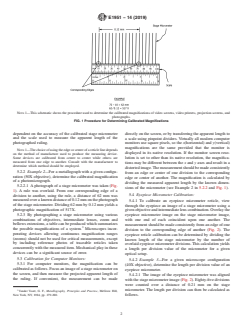
NOTE 1—This schematic shows the procedure used to determine the calibrated magnifications of video screens, video printers, projection screens, and
photographs.
FIG. 1 Procedure for Determining Calibrated Magnifications
dependent on the accuracy of the calibrated stage micrometer directly on the screen, or by transferring the apparent length to
and the scale used to measure the apparent length of the a scale using pinpoint dividers. Virtually all modern computer
photographed ruling.
monitors use square pixels, so the x(horizontal) and y(vertical)
magnifications are the same provided that the monitor is
NOTE1—Thechoiceofusingtheedgeorcenterofareticlelinedepends
displayed in its native resolution. If the monitor screen reso-
on the method of manufacture used to produce the measuring device.
Some devices are calibrated from center to center while others are lution is set to other than its native resolution, the magnifica-
measured from one edge to another. Consult with the manufacturer to
tions may be different between the x and y axes and result in a
determine which method should be employed.
distortedimage.Themeasurementshouldbemadeconsistently
5.2.2 Example 2—For a metallograph with a given configu-
from an edge or center of one division to the corresponding
ration (50X objective), determine the calibrated magnification
edge or center of another. The magnification is calculated by
of a photomicrograph.
dividing the measured apparent length by the known dimen-
5.2.2.1 Aphotograph of a stage micrometer was taken (Fig.
sions of the micrometer (see Example 2 in 5.2.2 and Fig. 1).
1). A rule was overlaid. From one corresponding edge of a
5.4 Eyepiece Micrometer Calibration:
division to another, using the rule, a distance of 62 mm was
measuredoveraknowndistanceof0.12mmonthephotograph 5.4.1 To calibrate an eyepiece micrometer reticle, view
of the stage micrometer. Dividing 62 mm by 0.12 mm yields a through the eyepiece an image of a stage micrometer using a
photographic magnification of 517X.
givenobjectiveandintermediatelenscombination.Overlaythe
5.2.3 By photographing a stage micrometer using various
eyepiece micrometer image on the stage micrometer image,
combinations of objectives, intermediate lenses, zoom and
with one end of each coincident upon one another. The
bellows extensions, a table can be produced which summarizes
measurement should be made consistently from an edge of one
the possible magnifications of a system. Microscopes incor-
division to the corresponding edge of another (Fig. 2). The
porating devices allowing continuous magnification ranges
eyepiece reticle calibration can be determined by dividing the
(zooms) should not be used for critical measurements, except
known length of the stage micrometer by the number of
by including reference photos of traceable reticles taken
overlaid eyepiece micrometer divisions.This calculation yields
concurrently with the measured item. Mechanical play in these
a length per division value of the micrometer for a given
devices can be a significant source of error.
optical setup.
5.3 Calibration for Computer Monitors:
5.4.2 Example 3—For a given microscope configuration
5.3.1 For computer monitors, the magnification can be
(40X objective), determine the length per division value of an
calibrated as follows. Focus an image of a stage micrometer on
eyepiece micrometer.
the screen, and then measure the projected apparent length of
5.4.2.1 The image of the eyepiece micrometer was aligned
the ruling. If convenient, the measurement can be made
with the stage micrometer image (Fig. 2). Eighty-five divisions
were counted over a distance of 0.21 mm on the stage
3 micrometer. The length per division can then be calculated as
Vander Voort, G. F., Metallography, Principles and Practice, McGraw Hill,
follows.
New York, NY, 1984, pp. 279-280.
E1951−14 (2019)
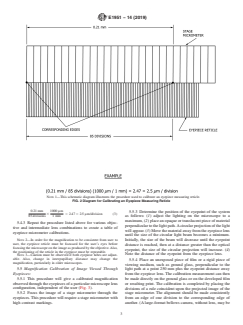
NOTE 1—This schematic diagram illustrates the procedure used to calibrate an eyepiece measuring reticle.
FIG. 2 Diagram for Calibrating an Eyepiece Measuring Reticle
0.21 mm 1000 µm
5.5.3 Determine the position of the eyepoint of the system
3 5 2.47 5 2.5 µm/division (3)
85 divisions 1mm as follows: (1) adjust the lighting on the microscope to a
maximum, (2) place an opaque or translucent piece of material
5.4.3 Repeat the procedure listed above for various objec-
perpendiculartothelightpath.Acircularprojectionofthelight
tive and intermediate lens combinations to create a table of
will appear. (3) Move the material away from the eyepiece lens
eyepiece micrometer calibrations.
until the size of the circular light beam becomes a minimum.
NOTE 2—In order for the magnification to be consistent from user to
Initially, the size of the beam will decrease until the eyepoint
user, the eyepiece reticle must be focussed for the user’s eyes before
distance is reached, then at a distance greater than the optical
focusing the microscope on the image as produced by the objective.Also,
eyepoint, the size of the circular projection will increase. (4)
the positioning of the reticle in the eyepiece must be repeatable.
Note the distance of the eyepoint from the eyepiece lens.
NOTE 3—Caution must be observed if both eyepiece tubes are adjust-
able. Also, change in interpupillary distance may change the
5.5.4 Place an unexposed piece of film or a rigid piece of
magnification, particularly in older microscopes.
viewing medium, such as ground glass, perpendicular to the
5.5 Magnification Calibration of Image Viewed Through light path at a point 250 mm plus the eyepoint distance away
Eyepieces: from the eyepiece lens. The calibration measurement can then
5.5.1 This procedure will give a calibrated magnification be made directly on the ground glass or on the developed film
observed through the eyepieces of a particular microscope lens or resulting print. The calibration is completed by placing the
configuration, independent of the user (Fig. 3). divisions of a rule coincident upon the projected image of the
5.5.2 Focus the image of a stage micrometer through the stage micrometer. The alignment should be made consistently
eyepieces. This procedure will require a stage micrometer with from an edge of one division to the corresponding edge of
high contrast markings. another. (Alarge-format bellows camera, without lens, may be
E1951−14 (2019)
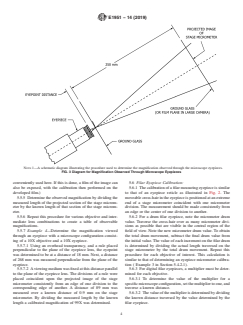
NOTE 1—A schematic diagram illustrating the procedure used to determine the magnification observed through the microscope eyepieces.
FIG. 3 Diagram for Magnification Observed Through Microscope Eyepieces
conveniently used here. If this is done, a film of the image can 5.6 Filar Eyepiece Calibration:
also be exposed, with the calibration then performed on the 5.6.1 The calibration of a filar measuring eyepiece is similar
developed film.) to that of an eyepiece reticle as illustrated in Fig. 2. The
5.5.5 Determine the observed magnification by dividing the moveable cross-hair in the eyepiece is positioned at an extreme
measured length of the projected section of the stage microm- end of a stage micrometer coincident with one micrometer
eter by the known length of that section of the stage microm- divi
...