

ASTM C1696-20
(Guide)Standard Guide for Industrial Thermal Insulation Systems
General Information
- Abstract
SIGNIFICANCE AND USE
4.1 When choosing a thermal insulation product or combination of products, physical, chemical and mechanical properties and the significance of those properties should be considered. ASTM test methods are usually performed under laboratory conditions and may not accurately represent field conditions depending on process temperature, environment, and operating conditions. Performance results obtained using ASTM test methods can be used to determine compliance of materials to specifications but do not necessarily predict installed performance. Values stated in the ASTM material standards are those that apply to the majority of materials and not to any specific product; other tested values may exist for specific material applications.
4.2 Design of thermal insulation systems requires the understanding of process requirements, temperature control, heat loss criteria, control of thermal shock, and mechanical forces on insulation generated by thermal gradients and wind environmental conditions. Sometimes, the mechanical design of piping and equipment needs to be modified to support insulation adequately and provide for insulation weatherproofing. Process requirements may dictate the control of critical temperature to prevent freezing, maintain viscosity, or minimize internal corrosion. When handling heat transfer fluids such as ethylene oxide or hot oils, the selection of insulation materials and the insulation system design becomes critical. whereby If these fluids are absorb in insulation materials, the fluid flash point could be below the fluid operating temperature. Specified heat gain or heat loss and acceptable surface temperatures could also dictate thermal design of insulation systems. Environmental corrosivity, high wind, and extreme ambient temperatures affect the selection of weatherproofing and methods of its securement. A combination of these factors plays a significant role in the selection of insulation materials and application methods to provide long-l...
SCOPE
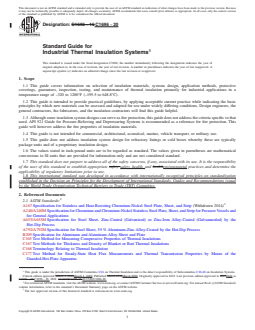
1.1 This guide covers information on selection of insulation materials, systems design, application methods, protective coverings, guarantees, inspection, testing, and maintenance of thermal insulation primarily for industrial applications in a temperature range of –320 to 1200°F (–195.5 to 648.8°C).
1.2 This guide is intended to provide practical guidelines, by applying acceptable current practice while indicating the basic principles by which new materials can be assessed and adapted for use under widely differing conditions. Design engineers, the general contractors, the fabricators, and the insulation contractors will find this guide helpful.
1.3 Although some insulation system designs can serve as fire protection, this guide does not address the criteria specific to that need. API 521 Guide for Pressure-Relieving and Depressuring Systems is recommended as a reference for fire protection. This guide will however address the fire properties of insulation materials.
1.4 This guide is not intended for commercial, architectural, acoustical, marine, vehicle transport, or military use.
1.5 This guide does not address insulation system design for refractory linings or cold boxes whereby these are typically package units and of a proprietary insulation design.
1.6 The values stated in inch-pound units are to be regarded as standard. The values given in parentheses are mathematical conversions to SI units that are provided for information only and are not considered standard.
1.7 This standard does not purport to address all of the safety concerns, if any, associated with its use. It is the responsibility of the user of this standard to establish appropriate safety, health, and environmental practices and determine the applicability of regulatory limitations prior to use.
1.8 This international standard was developed in accordance with internationally recognized principles on standardization established i...
- Status
- Published
- Publication Date
- 29-Feb-2020
- Technical Committee
- C16 - Thermal Insulation
- Drafting Committee
- C16.40 - Insulation Systems
Overview
ASTM C1696-20 – Standard Guide for Industrial Thermal Insulation Systems provides essential guidelines for the selection, design, installation, and maintenance of thermal insulation materials and systems used in industrial settings. Issued by ASTM International, this guide focuses on applications within a broad temperature range of –320 to 1200°F (–195.5 to 648.8°C). The standard assists design engineers, contractors, fabricators, and insulation professionals in developing efficient and resilient insulation systems, ensuring both operational safety and energy efficiency.
Key Topics
- Material Selection: Guidance on evaluating the physical, chemical, and mechanical properties of insulation materials, including thermal conductivity, compressive strength, dimensional stability, and combustibility.
- Systems Design: Considerations for designing insulation systems to meet process requirements, manage temperature control, reduce heat loss, prevent corrosion, and address thermal shock and mechanical forces.
- Application and Installation: Recommendations for appropriate installation methods, including the importance of weatherproofing, mechanical support modifications, and compliance with manufacturer and purchaser specifications.
- Protection and Maintenance: Emphasis on the need for protective coverings to safeguard insulation from moisture, fire, chemical exposure, UV radiation, and physical damage. Includes suggestions for inspection, periodic maintenance, and agreed-upon repair methods.
- Testing and Compliance: Overview of relevant ASTM test methods used to evaluate insulation materials under both laboratory and field conditions, recognizing the limitations in predicting actual installed performance.
Applications
The scope of ASTM C1696-20 primarily targets industrial thermal insulation systems for applications such as:
- Process Pipelines and Equipment: Insulation for process piping, tanks, vessels, and related industrial equipment, ensuring thermal efficiency, process control, and personnel protection.
- Temperature-Sensitive Operations: Systems where maintaining specific temperatures is critical to prevent freezing, sustain material viscosity, or minimize internal corrosion.
- Energy Conservation: Reducing heat loss or gain in industrial facilities, contributing directly to operational cost savings and environmental sustainability.
- Corrosive and Extreme Environments: Selection of insulation materials and protective coverings designed to withstand high wind, corrosive atmospheres, and temperature extremes commonly found in industrial environments.
- Heat Transfer Fluids: Special precautions and material selection when insulating equipment carrying volatile or flammable heat transfer fluids.
Note: The guide excludes commercial, architectural, acoustical, marine, transportation, and military usages, as well as proprietary refractory or cold box designs.
Related Standards
ASTM C1696-20 references and complements a variety of industry standards and codes, including:
- ASTM Standards:
- C533 (Calcium Silicate Block and Pipe Insulation)
- C552 (Cellular Glass Insulation)
- C612 (Mineral Fiber Block and Board)
- E84 (Test Method for Surface Burning Characteristics)
- E136 (Test Method for Material Combustibility)
- C680 (Estimating Heat Gain/Loss in Insulated Systems), among others.
- API 521: Guide for Pressure-Relieving and Depressuring Systems (for fire protection considerations).
- NFPA Standards: Including NFPA 49 (Hazardous Chemicals Data) and NFPA 259 (Potential Heat of Building Materials).
- NACE SP0198: For corrosion control under insulation.
- Federal Regulations: Such as 40 CFR 60 for environmental protection and regulatory compliance.
Practical Value
Using ASTM C1696-20 ensures that industrial insulation systems are selected and installed based on best practices, current industry standards, and safety considerations. Effective application of this guide can lead to:
- Enhanced process stability and safety in industrial environments.
- Increased energy efficiency and significant cost savings for facility operators.
- Reduced risk of equipment damage, corrosion, and unplanned maintenance.
- Improved long-term performance, reliability, and regulatory compliance of thermal insulation systems.
Keywords: industrial thermal insulation, ASTM C1696-20, insulation material selection, insulation systems design, insulation standards, process piping insulation, energy efficiency, industrial maintenance, ASTM standards.
Relations
- Effective Date
- 01-Mar-2020
- Effective Date
- 15-Apr-2024
- Effective Date
- 01-Mar-2024
- Effective Date
- 01-Mar-2024
- Effective Date
- 01-Feb-2024
- Effective Date
- 01-Jan-2024
- Effective Date
- 01-Dec-2023
- Effective Date
- 15-Nov-2023
- Effective Date
- 01-Nov-2023
- Effective Date
- 01-Nov-2023
- Effective Date
- 01-Sep-2023
- Effective Date
- 01-Sep-2023
- Effective Date
- 01-Sep-2023
- Effective Date
- 01-Apr-2020
- Effective Date
- 15-Mar-2020
Get Certified
Connect with accredited certification bodies for this standard

DNV
DNV is an independent assurance and risk management provider.

Lloyd's Register
Lloyd's Register is a global professional services organisation specialising in engineering and technology.
DNV Energy Systems
Energy and renewable energy certification.
Sponsored listings
Frequently Asked Questions
ASTM C1696-20 is a guide published by ASTM International. Its full title is "Standard Guide for Industrial Thermal Insulation Systems". This standard covers: SIGNIFICANCE AND USE 4.1 When choosing a thermal insulation product or combination of products, physical, chemical and mechanical properties and the significance of those properties should be considered. ASTM test methods are usually performed under laboratory conditions and may not accurately represent field conditions depending on process temperature, environment, and operating conditions. Performance results obtained using ASTM test methods can be used to determine compliance of materials to specifications but do not necessarily predict installed performance. Values stated in the ASTM material standards are those that apply to the majority of materials and not to any specific product; other tested values may exist for specific material applications. 4.2 Design of thermal insulation systems requires the understanding of process requirements, temperature control, heat loss criteria, control of thermal shock, and mechanical forces on insulation generated by thermal gradients and wind environmental conditions. Sometimes, the mechanical design of piping and equipment needs to be modified to support insulation adequately and provide for insulation weatherproofing. Process requirements may dictate the control of critical temperature to prevent freezing, maintain viscosity, or minimize internal corrosion. When handling heat transfer fluids such as ethylene oxide or hot oils, the selection of insulation materials and the insulation system design becomes critical. whereby If these fluids are absorb in insulation materials, the fluid flash point could be below the fluid operating temperature. Specified heat gain or heat loss and acceptable surface temperatures could also dictate thermal design of insulation systems. Environmental corrosivity, high wind, and extreme ambient temperatures affect the selection of weatherproofing and methods of its securement. A combination of these factors plays a significant role in the selection of insulation materials and application methods to provide long-l... SCOPE 1.1 This guide covers information on selection of insulation materials, systems design, application methods, protective coverings, guarantees, inspection, testing, and maintenance of thermal insulation primarily for industrial applications in a temperature range of –320 to 1200°F (–195.5 to 648.8°C). 1.2 This guide is intended to provide practical guidelines, by applying acceptable current practice while indicating the basic principles by which new materials can be assessed and adapted for use under widely differing conditions. Design engineers, the general contractors, the fabricators, and the insulation contractors will find this guide helpful. 1.3 Although some insulation system designs can serve as fire protection, this guide does not address the criteria specific to that need. API 521 Guide for Pressure-Relieving and Depressuring Systems is recommended as a reference for fire protection. This guide will however address the fire properties of insulation materials. 1.4 This guide is not intended for commercial, architectural, acoustical, marine, vehicle transport, or military use. 1.5 This guide does not address insulation system design for refractory linings or cold boxes whereby these are typically package units and of a proprietary insulation design. 1.6 The values stated in inch-pound units are to be regarded as standard. The values given in parentheses are mathematical conversions to SI units that are provided for information only and are not considered standard. 1.7 This standard does not purport to address all of the safety concerns, if any, associated with its use. It is the responsibility of the user of this standard to establish appropriate safety, health, and environmental practices and determine the applicability of regulatory limitations prior to use. 1.8 This international standard was developed in accordance with internationally recognized principles on standardization established i...
SIGNIFICANCE AND USE 4.1 When choosing a thermal insulation product or combination of products, physical, chemical and mechanical properties and the significance of those properties should be considered. ASTM test methods are usually performed under laboratory conditions and may not accurately represent field conditions depending on process temperature, environment, and operating conditions. Performance results obtained using ASTM test methods can be used to determine compliance of materials to specifications but do not necessarily predict installed performance. Values stated in the ASTM material standards are those that apply to the majority of materials and not to any specific product; other tested values may exist for specific material applications. 4.2 Design of thermal insulation systems requires the understanding of process requirements, temperature control, heat loss criteria, control of thermal shock, and mechanical forces on insulation generated by thermal gradients and wind environmental conditions. Sometimes, the mechanical design of piping and equipment needs to be modified to support insulation adequately and provide for insulation weatherproofing. Process requirements may dictate the control of critical temperature to prevent freezing, maintain viscosity, or minimize internal corrosion. When handling heat transfer fluids such as ethylene oxide or hot oils, the selection of insulation materials and the insulation system design becomes critical. whereby If these fluids are absorb in insulation materials, the fluid flash point could be below the fluid operating temperature. Specified heat gain or heat loss and acceptable surface temperatures could also dictate thermal design of insulation systems. Environmental corrosivity, high wind, and extreme ambient temperatures affect the selection of weatherproofing and methods of its securement. A combination of these factors plays a significant role in the selection of insulation materials and application methods to provide long-l... SCOPE 1.1 This guide covers information on selection of insulation materials, systems design, application methods, protective coverings, guarantees, inspection, testing, and maintenance of thermal insulation primarily for industrial applications in a temperature range of –320 to 1200°F (–195.5 to 648.8°C). 1.2 This guide is intended to provide practical guidelines, by applying acceptable current practice while indicating the basic principles by which new materials can be assessed and adapted for use under widely differing conditions. Design engineers, the general contractors, the fabricators, and the insulation contractors will find this guide helpful. 1.3 Although some insulation system designs can serve as fire protection, this guide does not address the criteria specific to that need. API 521 Guide for Pressure-Relieving and Depressuring Systems is recommended as a reference for fire protection. This guide will however address the fire properties of insulation materials. 1.4 This guide is not intended for commercial, architectural, acoustical, marine, vehicle transport, or military use. 1.5 This guide does not address insulation system design for refractory linings or cold boxes whereby these are typically package units and of a proprietary insulation design. 1.6 The values stated in inch-pound units are to be regarded as standard. The values given in parentheses are mathematical conversions to SI units that are provided for information only and are not considered standard. 1.7 This standard does not purport to address all of the safety concerns, if any, associated with its use. It is the responsibility of the user of this standard to establish appropriate safety, health, and environmental practices and determine the applicability of regulatory limitations prior to use. 1.8 This international standard was developed in accordance with internationally recognized principles on standardization established i...
ASTM C1696-20 is classified under the following ICS (International Classification for Standards) categories: 27.220 - Heat recovery. Thermal insulation. The ICS classification helps identify the subject area and facilitates finding related standards.
ASTM C1696-20 has the following relationships with other standards: It is inter standard links to ASTM C1696-16, ASTM C168-24, ASTM E136-24a, ASTM E96/E96M-24, ASTM E136-24, ASTM E176-24, ASTM E84-23d, ASTM E96/E96M-23, ASTM A240/A240M-23a, ASTM C680-23a, ASTM C578-23, ASTM E84-23c, ASTM C1289-23a, ASTM C1055-20, ASTM C209-20. Understanding these relationships helps ensure you are using the most current and applicable version of the standard.
ASTM C1696-20 is available in PDF format for immediate download after purchase. The document can be added to your cart and obtained through the secure checkout process. Digital delivery ensures instant access to the complete standard document.
Standards Content (Sample)
This international standard was developed in accordance with internationally recognized principles on standardization established in the Decision on Principles for the
Development of International Standards, Guides and Recommendations issued by the World Trade Organization Technical Barriers to Trade (TBT) Committee.
Designation: C1696 − 20
Standard Guide for
Industrial Thermal Insulation Systems
This standard is issued under the fixed designation C1696; the number immediately following the designation indicates the year of
original adoption or, in the case of revision, the year of last revision. A number in parentheses indicates the year of last reapproval. A
superscript epsilon (´) indicates an editorial change since the last revision or reapproval.
1. Scope Development of International Standards, Guides and Recom-
mendations issued by the World Trade Organization Technical
1.1 This guide covers information on selection of insulation
Barriers to Trade (TBT) Committee.
materials, systems design, application methods, protective
coverings, guarantees, inspection, testing, and maintenance of
2. Referenced Documents
thermal insulation primarily for industrial applications in a
2.1 ASTM Standards:
temperature range of –320 to 1200°F (–195.5 to 648.8°C).
A167 Specification for Stainless and Heat-Resisting
1.2 This guide is intended to provide practical guidelines,
Chromium-Nickel Steel Plate, Sheet, and Strip (With-
by applying acceptable current practice while indicating the 3
drawn 2014)
basic principles by which new materials can be assessed and
A240/A240M Specification for Chromium and Chromium-
adapted for use under widely differing conditions. Design
Nickel Stainless Steel Plate, Sheet, and Strip for Pressure
engineers, the general contractors, the fabricators, and the
Vessels and for General Applications
insulation contractors will find this guide helpful.
A653/A653M Specification for Steel Sheet, Zinc-Coated
1.3 Although some insulation system designs can serve as (Galvanized) or Zinc-Iron Alloy-Coated (Galvannealed)
fire protection, this guide does not address the criteria specific by the Hot-Dip Process
to that need. API 521 Guide for Pressure-Relieving and A792/A792M Specification for Steel Sheet, 55 %
Depressuring Systems is recommended as a reference for fire Aluminum-Zinc Alloy-Coated by the Hot-Dip Process
protection. This guide will however address the fire properties B209 Specification for Aluminum and Aluminum-Alloy
of insulation materials. Sheet and Plate
C165 Test Method for Measuring Compressive Properties of
1.4 This guide is not intended for commercial, architectural,
Thermal Insulations
acoustical, marine, vehicle transport, or military use.
C167 Test Methods for Thickness and Density of Blanket or
1.5 Thisguidedoesnotaddressinsulationsystemdesignfor
Batt Thermal Insulations
refractory linings or cold boxes whereby these are typically
C168 Terminology Relating to Thermal Insulation
package units and of a proprietary insulation design.
C177 Test Method for Steady-State Heat Flux Measure-
ments and Thermal Transmission Properties by Means of
1.6 The values stated in inch-pound units are to be regarded
as standard. The values given in parentheses are mathematical the Guarded-Hot-Plate Apparatus
C195 Specification for Mineral Fiber Thermal Insulating
conversions to SI units that are provided for information only
and are not considered standard. Cement
C203 Test Methods for Breaking Load and Flexural Proper-
1.7 This standard does not purport to address all of the
ties of Block-Type Thermal Insulation
safety concerns, if any, associated with its use. It is the
C209 Test Methods for Cellulosic Fiber Insulating Board
responsibility of the user of this standard to establish appro-
C240 Test Methods for Testing Cellular Glass Insulation
priate safety, health, and environmental practices and deter-
Block
mine the applicability of regulatory limitations prior to use.
C272/C272M Test Method for Water Absorption of Core
1.8 This international standard was developed in accor-
Materials for Sandwich Constructions
dance with internationally recognized principles on standard-
C302 Test Method for Density and Dimensions of Pre-
ization established in the Decision on Principles for the
formed Pipe-Covering-Type Thermal Insulation
1 2
This guide is under the jurisdiction of ASTM Committee C16 on Thermal For referenced ASTM standards, visit the ASTM website, www.astm.org, or
Insulation and is the direct responsibility of Subcommittee C16.40 on Insulation contact ASTM Customer Service at service@astm.org. For Annual Book of ASTM
Systems. Standards volume information, refer to the standard’s Document Summary page on
Current edition approved March 1, 2020. Published March 2020. Originally the ASTM website.
approved in 2012. Last previous edition approved in 2016 as C1696 – 16. DOI: The last approved version of this historical standard is referenced on
10.1520/C1696-20. www.astm.org.
Copyright © ASTM International, 100 Barr Harbor Drive, PO Box C700, West Conshohocken, PA 19428-2959. United States
C1696 − 20
C303 Test Method for Dimensions and Density of Pre- C1055 Guide for Heated System Surface Conditions that
formed Block and Board–Type Thermal Insulation Produce Contact Burn Injuries
C1104/C1104M Test Method for Determining the Water
C335/C335M Test Method for Steady-State Heat Transfer
Properties of Pipe Insulation Vapor Sorption of Unfaced Mineral Fiber Insulation
C351 Test Method for Mean Specific Heat of Thermal C1126 Specification for Faced or Unfaced Rigid Cellular
Phenolic Thermal Insulation
Insulation (Withdrawn 2008)
C356 Test Method for Linear Shrinkage of Preformed High- C1139 Specification for Fibrous Glass Thermal Insulation
and Sound Absorbing Blanket and Board for Military
Temperature Thermal Insulation Subjected to Soaking
Applications (Withdrawn 2019)
Heat
C411 Test Method for Hot-Surface Performance of High- C1289 Specification for Faced Rigid Cellular Polyisocyanu-
rate Thermal Insulation Board
Temperature Thermal Insulation
C1393 Specification for Perpendicularly Oriented Mineral
C446 Test Method for Breaking Load and Calculated Modu-
Fiber Roll and Sheet Thermal Insulation for Pipes and
lus of Rupture of Preformed Insulation for Pipes (With-
Tanks
drawn 2002)
C1427 Specification for Extruded Preformed Flexible Cel-
C447 Practice for Estimating the Maximum Use Tempera-
lular Polyolefin Thermal Insulation in Sheet and Tubular
ture of Thermal Insulations
Form
C449 Specification for Mineral Fiber Hydraulic-Setting
C1511 Test Method for Determining the Water Retention
Thermal Insulating and Finishing Cement
(Repellency) Characteristics of Fibrous Glass Insulation
C450 Practice for Fabrication of Thermal Insulating Fitting
(Aircraft Type)
Covers for NPS Piping, and Vessel Lagging
C1559 Test Method for Determining Wicking of Fibrous
C518 Test Method for Steady-State Thermal Transmission
Glass Blanket Insulation (Aircraft Type)
Properties by Means of the Heat Flow Meter Apparatus
C1617 Practice for Quantitative Accelerated Laboratory
C533 Specification for Calcium Silicate Block and Pipe
Evaluation of Extraction Solutions Containing Ions
Thermal Insulation
Leached from Thermal Insulation on Aqueous Corrosion
C534/C534M Specification for Preformed Flexible Elasto-
of Metals
meric Cellular Thermal Insulation in Sheet and Tubular
C1775 Specification for Laminate Protective Jacket and
Form
Tape for Use over Thermal Insulation for Outdoor Appli-
C547 Specification for Mineral Fiber Pipe Insulation
cations
C552 Specification for Cellular Glass Thermal Insulation
D1621 Test Method for Compressive Properties of Rigid
C553 Specification for Mineral Fiber Blanket Thermal Insu-
Cellular Plastics
lation for Commercial and Industrial Applications
D1622/D1622M Test Method forApparent Density of Rigid
C578 Specification for Rigid, Cellular Polystyrene Thermal
Cellular Plastics
Insulation
D2126 Test Method for Response of Rigid Cellular Plastics
C591 Specification for Unfaced Preformed Rigid Cellular
to Thermal and Humid Aging
Polyisocyanurate Thermal Insulation
D2842 Test Method for Water Absorption of Rigid Cellular
C592 Specification for Mineral Fiber Blanket Insulation and
Plastics
Blanket-Type Pipe Insulation (Metal-Mesh Covered) (In-
D3574 Test Methods for Flexible Cellular Materials—Slab,
dustrial Type)
Bonded, and Molded Urethane Foams
C610 Specification for Molded Expanded Perlite Block and
E84 Test Method for Surface Burning Characteristics of
Pipe Thermal Insulation
Building Materials
C612 Specification for Mineral Fiber Block and Board
E96/E96M Test Methods for Water Vapor Transmission of
Thermal Insulation
Materials
C665 Specification for Mineral-Fiber Blanket Thermal Insu-
E136 TestMethodforAssessingCombustibilityofMaterials
lation for Light Frame Construction and Manufactured
Using a Vertical Tube Furnace at 750°C
Housing
E176 Terminology of Fire Standards
C680 Practice for Estimate of the Heat Gain or Loss and the
E659 Test Method for Autoignition Temperature of Chemi-
Surface Temperatures of Insulated Flat, Cylindrical, and
cals
Spherical Systems by Use of Computer Programs
E2652 Test Method for Assessing Combustibility of Mate-
C692 Test Method for Evaluating the Influence of Thermal
rials Using a Tube Furnace with a Cone-shaped Airflow
Insulations on External Stress Corrosion Cracking Ten-
Stabilizer, at 750°C
dency of Austenitic Stainless Steel
2.2 API Standard:
C795 Specification for Thermal Insulation for Use in Con-
API 521 Guide for Pressure-Relieving and Depressuring
tact with Austenitic Stainless Steel
Systems
C871 Test Methods for ChemicalAnalysis of Thermal Insu-
lationMaterialsforLeachableChloride,Fluoride,Silicate,
and Sodium Ions
C1029 Specification for Spray-Applied Rigid Cellular Poly-
Available from American Petroleum Institute (API), 1220 L. St., NW,
urethane Thermal Insulation Washington, DC 20005-4070, http://www.api.org.
C1696 − 20
2.3 NACE Standard: ASTM test methods can be used to determine compliance of
SP0198 StandardPractice—TheControlofCorrosionUnder materials to specifications but do not necessarily predict
Thermal Insulation and Fireproofing Materials—A Sys- installed performance. Values stated in the ASTM material
tem Approach standards are those that apply to the majority of materials and
not to any specific product; other tested values may exist for
2.4 NFPA Standards:
specific material applications.
NFPA 49 Hazardous Chemicals Data
NFPA90A Standard for the Installation ofAir Conditioning
4.2 Design of thermal insulation systems requires the un-
and Ventilating Systems
derstanding of process requirements, temperature control, heat
NFPA 259 Standard Test Method for Potential Heat of
loss criteria, control of thermal shock, and mechanical forces
Building Materials
on insulation generated by thermal gradients and wind envi-
2.5 Federal Standard:
ronmental conditions. Sometimes, the mechanical design of
40 CFR 60 Protection of Environment—Standards of Per-
piping and equipment needs to be modified to support insula-
formance for New Stationary Sources
tion adequately and provide for insulation weatherproofing.
Process requirements may dictate the control of critical tem-
3. Terminology
perature to prevent freezing, maintain viscosity, or minimize
3.1 Definitions—TerminologyC168isrecommendedtopro-
internal corrosion. When handling heat transfer fluids such as
vide definitions and information on symbols, units, and abbre-
ethylene oxide or hot oils, the selection of insulation materials
viationsoftermsusedinASTMstandardspertainingtothermal
and the insulation system design becomes critical. whereby If
insulation materials and materials associated with them. Ter-
these fluids are absorb in insulation materials, the fluid flash
minology E176 is recommended to provide terms and standard
point could be below the fluid operating temperature. Specified
definitions for fire standards. Any term used in this guide that
heat gain or heat loss and acceptable surface temperatures
is not defined in Terminology C168 or E176 will be defined in
could also dictate thermal design of insulation systems. Envi-
the section in which the term is used.
ronmental corrosivity, high wind, and extreme ambient tem-
peratures affect the selection of weatherproofing and methods
3.2 Acronyms:
of its securement. A combination of these factors plays a
ACM = asbestos-containing materials
significant role in the selection of insulation materials and
ACT = autoignition temperature
application methods to provide long-lasting trouble-free ser-
ASJ = all service jacket
vice.
CPVC = chlorinated polyvinyl chloride
4.3 Application methods are generally defined by the pur-
DFT = dry film thickness
EPA = Environmental Protection Agency chaser’s specifications. However, some specialty insulation
FRP = fiberglass-reinforced plastic systems, such as prefabricated insulation panels for ductwork,
FSI/SDI = flame spread index/smoke developed index
precipitators, and tanks, will also have supplemental installa-
MSDS = material safety data sheet
tion requirements specified by the insulation system manufac-
NAIMA = North American Insulation Manufacturers Asso-
turer. defined by the specification of the manufacturer.
ciation
4.4 In any application of thermal insulation, the insulation
NDT = nondestructive testing
requires protection of some type, be it protection from the
NFPA = National Fire Protection Association
elements such as rain, snow, sleet, wind, ultraviolet solar
OSHA = Occupational Safety and Health Administration
radiation, protection from external forces that can cause
PVC = polyvinyl chloride
QA/QC = quality assurance/quality control mechanical damage, vapor passage, fire, chemical attack, or
SS = stainless steel
any combination of these. This protection can be provided in
UV = ultraviolet
by metal, plastic, coated or laminated composites or both,
WVT = water vapor transmission
masticcoatings,oracombinationoftheabovedependingupon
the application, service, and economic requirements. Consid-
4. Significance and Use
ering the enormous overall cost of a new facility, and compar-
4.1 When choosing a thermal insulation product or combi- ingtheinitialcostoftheinsulatedportionasasmallpercentage
nation of products, physical, chemical and mechanical proper-
of that overall cost with the substantially increased operating
ties and the significance of those properties should be consid- costasaresultofinefficientinsulationprotection,itiscommon
ered. ASTM test methods are usually performed under sense to provide only the best insulation system available and
laboratory conditions and may not accurately represent field the best protection for that long-term investment consistent
conditions depending on process temperature, environment, with the appropriate design and economic requirements. Usu-
and operating conditions. Performance results obtained using ally a new facility is very expensive and the initial cost of the
insulation portion is a small percentage of that overall cost.
However, increased operating costs can result from inefficient
Available from NACE International (NACE), 1440 South Creek Dr., Houston,
protection.
TX 77084-4906, http://www.nace.org.
Available from National Fire Protection Association (NFPA), 1 Batterymarch
4.5 Bid invitations should contain information necessary to
Park, Quincy, MA 02169-7471, http://www.nfpa.org.
determine how guarantees of materials and application will be
Available from the U.S. Government Printing Office, Superintendent of
Documents, 732 N. Capital St., NW, Washington, DC 20402-0001. resolved.
C1696 − 20
4.6 It is recommended that the purchaser provide a quality temperature (ACT) is the lowest temperature to which a
assurance program that defines the inspection of all materials, combustible mixture should be raised so that the rate of heat
material safety data sheets (MSDS), and specific application evolved by the exothermic oxidation reaction is greater than
procedures before and during progress of the insulation work. the rate of heat loss to the surroundings and causes ignition.
Autoignitiondependsonspecificmixturesofchemicalsandthe
4.7 During contract negotiations, the contractor and pur-
method and apparatus used for its determination. It also
chasershoulddiscussandagreetotheprocedurestobeadopted
depends on the volume and geometry of the containing vessel,
for suitable periodic inspection and maintenance of the insu-
the insulation material, and the initial temperature and pressure
lation systems to ensure that the initial performance of the
of the mixture and the surroundings.
material will be maintained. And, where applicable, they
5.2.2 Published autoignition temperatures (NFPA 49, for
should agree to the methods of repair and replacement to be
example) are specific to the method of determination (Test
adopted in case damage occurs during service or overhaul.
Method E659) and may not be interpolated or extrapolated for
different configurations. It is improper to state that an insula-
5. Significant Physical Properties of Thermal Insulation
tion material has the property to "suppress an autoignition
Materials
temperature" of a chemical. When a chemical has access to an
5.1 Apparent Thermal Conductivity:
insulated assembly from an external or internal leak, the
5.1.1 The apparent thermal conductivity of an insulation
chemical may be between the outer covering and the
material is the measure of its ability to conduct heat between
insulation, in the insulation, in joints and seams between
the hot and cold surfaces of the insulation. In inch pound units,
insulation segments, or between the insulation and the vessel.
this property (which is also known as the “k” factor of “k”
The autoignition temperature for such a situation is most likely
value) is expressed as the amount of heat that passes through a
to be lower than published data, but that difference may not be
unit area of a unit thickness of a homogeneous substance in a
attributed to the composition of an insulation material. No
specified amount of time for a unit temperature difference,
quantitative change can be predicted without testing the
Btu-in/ft -hr-F (In SI units, this property is expressed in
configuration. The engineer or designer should know how to
W/m-K). Thermal conductivity of insulation changes with
design insulated systems for materials such as heat transfer
mean temperature:
oils, petroleum oils, or hazardous chemicals and consider the
Mean temperature 5 ~inner surface temp1outer surface temp!/2 (1) need to eliminate leakage sources, installation details of
protective insulation coverings, and the selection of an insu-
5.1.1.1 In general, thermal conductivity of insulation in-
lating material.
creases with an increase in mean temperature.Therefore, when
5.3 Coeffıcient of Thermal Expansion/Contraction:
determining the required insulation thickness for a process
5.3.1 The coefficient of thermal expansion (contraction) is
temperature, thermal conductivity at the process temperature
the material property that measures the material’s dimensional
must be considered. This is best determined by a computer
change relative to a change in its temperature. When heated or
program such as ASTM C680. curve from that process tem-
cooled, materials, such as steel, will expand or contract at a
perature to the jacket temperature must be considered. Since
constant rate. These changes (see 7.2.4.7) are reversible in
this is difficult to accomplish using hand calculations, it is
somematerialsandwillreturntotheiroriginaldimensionwhen
recommended that computer programs designed to account for
theirtemperaturereturnstowhereitwasbeforebeingheatedor
this be used.
cooled.Thisreversibilitydistinguishescoefficientofexpansion
5.1.2 There are several different ASTM tests available for
(contraction) from the other two properties relating to dimen-
determining the thermal conductivity of materials depending
sional changes: dimensional stability and linear shrinkage,
on the temperature range and the geometry. of the sample.
neither of which is reversible. Not all insulation materials
Some of these areTest Method C177 referred to as the guarded
exhibit this reversibility property.
hot plate and Test Method C518 referred to as the heat flow
5.3.2 Coefficients of expansion need to be considered when
meter. Both of these tests are for block or flat insulations. Test
Method C335/C335M is used for horizontal pipe insulation. designing insulation system expansion and contraction joints.
The amount of movement that can be accommodated by an
The cylindrical shape of pipe insulation and the presence of a
expansion joint, along with the differential movement between
longitudinal joint in the pipe insulation can may cause the
the insulation and the substrate, is needed when determining
apparentthermalconductivityofthepipeinsulationtobe20 %
the expansion/contraction joints spacing.
or higher than different from that for a flat, one-solid-piece
configuration. Also the orientation of the insulation, vertical
5.4 Combustion Characteristics:
versus horizontal, will affect the surface coefficient of the
5.4.1 Insomeindustrialapplicationsinsulationmaterialsare
insulation, and hence, the heat loss.
required to be noncombustible. When a material is required to
5.2 Autoignition: be noncombustible it usually must pass the requirements of
Test Method E136. InTest Method E136 materials are exposed
5.2.1 Some fluids such as oxygen and some heat transfer
fluidswhenabsorbedininsulationcouldlowertheautoignition to very high temperatures (1382°F or 750°C).
temperature. Autoignition is the initiation of combustion of a 5.4.1.1 A noncombustible material is defined as a material
material in air as the result of heat liberation caused by an that, in the form in which it is used and under the conditions
exothermic oxidation reaction in the absence of an external anticipated, will not ignite, burn, support combustion, or
ignition source such as a spark or flame. The autoignition release flammable vapors when subjected to fire or heat.
C1696 − 20
TABLE 1 Typical ASTM Specifications for Min/Max Values of Some Insulation Materials Used for Industrial Applications
NOTE 1—Values represent a majority of known materials. Not all materials of the same classification may have the same values.All values should be
verified with the material manufacturer before use.
NOTE 2—Verify value with the material manufacturer.
NOTE 3—See Specification C610 for water absorption test and limits. Contact the manufacturer for product data.
NOTE 4—Contact the material manufacturer for Test Method C411 test results when using above 250°F (121°C). Heat rise or fall (change) should be
in a linear progression not to exceed a rate of 200°F (111°C) per hour.
NOTE 5—Value varies with type and density. Contact the manufacturer.
NOTE 6—Value is at ambient temperature. Contact the manufacturer for temperatures above ambient.
NOTE 7—Consult the manufacturer for specific recommendation and properties at temperatures less than -40°F (4.4°C).
NOTE 8—Response to thermal aging per Test Method D2126.
NOTE 9—Response to thermal aging per Test Method D2126. Maximum 4 %.
NOTE 10—The water vapor permeability of mineral fiber insulation is so large that it can not be measured using standard methods. This permeability
should be considered when selecting this type of material.
NOTE 11—N/A = Not applicable.
Calcium Silicate Cellular Glass Pipe Elastomeric Sheet Expanded Perlite Melamine Pipe
Physical Properties (Note 1)
Microporous
(See Definitions)
Pipe and Block and Block and Tubular Pipe and Block and Block
Applicable ASTM Standard C533 Type 1 C552 C534/C534M C610 C1410 C1676
Maximum temperature, °F (C) 1200 (649) 800 (427) 220 – 350 1200 (649) 350 (177) 2102 (1150)
(Note 4) (104 to 175)
Minimum temperature, °F (C) 80 (27) Minus 450 (-268) Minus 297 (-183) 80 (27) Minus 40 (-40) 176 (80)
Density (ASTM C302 and C303) 15 6.12 to 8.62 3to6.5 10 to 14 0.70 ± 0.10 Not Stated
3 3
lb/ft (kg ⁄m ) (240) (98 to 138) (48 to 104) (160 to 224) (11.2 ± 1.6) per
ASTM D 3574
Method A
Block compressive strength 100 (688) 60 (415) per ASTM N/A 70 (483) 80 (36.3) @ 25% / 50 – 140
(minimum) at 5% deformation ex- C240 Capped 160 (72.6) @ 65% (7.3 – 20.3) @ 10%
cept where noted (ASTM C165, per D3574 deformation
D3574 Method B) psi (kPa)
Flexural strength (minimum) psi 50 (344) 41 (283) Block per Not Stated 45 (310) Not Stated Not Stated
(kPa) (ASTM C446) ASTM C203 (Block per C203)
Procedure A,
Method I or II
Dimensional change at max. 2 % Not Stated 7% Length 2% Not Stated Length 2%
temperature (%) (ASTM C356) (per ASTM C534/ Width 2% Width 2%
(See Table 4) C534M) Thick 10% Thick 10%
Surface burning characteristics 0/0 (Note 2) 5/0 Not Stated 0/0 (Note 2) 25/50@1inch 0/10
(ASTM E84) Flame Spread Index (25 mm)
/ Smoke Developed Index
Non combustibility characteristics Pass (Note 2) Pass Not Stated Pass Not Stated Not Stated
(ASTM E136)
Water Vapor permeability (ASTM N/A 0.005 0.10 N/A Not Stated
-10
E96/E96M) Perm-inch (g/Pa-s-m) (0.007) (1.44 × 10 )
(Desiccant Method)
Water vapor sorption (by weight) N/A N/A N/A N/A 25 10 to 5 Based on
Maximum (%) Type and Grade
(ASTM C1104/C1104M)
Water Absorption (ASTM C209)% Note 3
Self-heating (exothermic) No No N/A No No No
Physical properties Mineral Fiber Mineral Fiber Mineral Fiber Mineral Fiber Mineral Fiber Mineral Fiber
(Note 1) (See Section 3, Terminol- Block Board Board Blanket Blanket Blanket
ogy)
Applicable ASTM Standard C612 Type V C612 C612 Type IA, IB, II C553 C553 C553
Type IV A&B and III Type VII Type V and VI Type IV
Maximum temperature, °F (C) 1800 (982) 1200 (649) 450 to 1000 1200 (649) 1000 850 (454)
(Note 5)
Minimum temperature, °F (C)) 0 (-18) 0 (-18) 0 (-18) 0 (-18) 0 (-18) 0 (-18)
Density (ASTM C302 and C303) Not Stated Not Stated Not Stated 12 (192) Max per 10 (160) Max per 8 (128) Max per
3 3
lb/ft (kg ⁄m ) ASTM C167 ASTM C167 ASTM C167
Block compressive strength 1000 PSF (48) 2 50 PSF (2.4) 2 inch 25 to 12 PSF (1.2 to N/A N/A N/A
(minimum) at 5% deformation ex- inch (50 mm) at (50 mm) at 10% 0.6) 2 inch (50 mm)
cept where noted (ASTM C165) 10% deformation deformation at 10% deformation
psi (kPa)
Flexural strength (minimum) psi Not Stated Not Stated Not Stated Not Stated Not Stated Not Stated
(kPa) (ASTM C446)
Dimensional change at max. 4 % 2 % 2 % Not Stated Not Stated Not Stated
temperature (%) (ASTM C356)
(See Table 4)
C1696 − 20
TABLE 1 Continued
Calcium Silicate Cellular Glass Pipe Elastomeric Sheet Expanded Perlite Melamine Pipe
Physical Properties (Note 1)
Microporous
(See Definitions)
Pipe and Block and Block and Tubular Pipe and Block and Block
Surface burning characteristics Less Than 25/50 Less Than 25/50 Less Than 25/50 Less Than 25/50 Less Than 25/50 Less Than 25/50
(ASTM E84) Flame Index /
Smoke Developed Index
Combustion characteristics Fail (Note 2) Pass (Note 2) Pass (Note 2) Pass (Note 2) Pass (Note 2) Pass (Note 2)
(ASTM E136)
Water Vapor permeability (ASTM Note 10 Note 10 Note 10 Note 10 Note 10 Note 10
E96/E96M) Perm-inch (g/Pa-s-m)
(Desiccant Method)
Water vapor sorption (by weight) 5% 5% 5% 5% 5% 5%
Maximum (%)
(ASTM C1104/C1104M)
Water Absorption (ASTM C209)%
Self-heating (exothermic) No No (Note 5) No (Note 5) No (Note 5) No (Note 5) No (Note 5)
Mineral Fiber Hydraulic-
Mineral Fiber Metal Mesh Miner Fiber
Physical Properties (Note 1)
Mineral Fiber Blanket Miner Fiber Pipe Setting Insulating and
(See Definitions)
Blanket Insulating Cement
Finishing Cement
Applicable ASTM Standard C553 Type I thru VII C592 Type I thru IV C547 Type I thru V C449 C195
Maximum temperature, °F (C) 450 (232) 850 or 1200 850 to 1400 1200 (649) 1900 (1038)
1200 (649) (454 or 649) (454 to 760)
Minimum Temperature, °F (C)) 0 (-18) 0 (-18) Not Stated Not Stated 250 (121)
Density (ASTM C302 and C303) 6 (96) to 12 (192) 8 (128) to 12 Max 2 to 18 Not Stated Not Stated
3 3
lb/ft (kg ⁄m ) Max per C167 (160 to 192) per C167
Block compressive strength N/A N/A N/A Not Stated Not Stated
(minimum) at 5% deformation ex-
cept where noted (ASTM C165)
psi (kPa)
Flexural strength (minimum) psi Not Stated Not Stated Not Stated Not Stated Not Stated
(kPa) (ASTM C446)
Dimensional change at max. Not Stated Not Stated 2 % Max Volume 10% Max Volume 35% Max
temperature (%) (ASTM C356) per ASTM C 166 per ASTM C 166
(See Table 4) Linear Shrinkage 5% Linear Shrinkage 5%
per C356 per C356
Surface burning characteristics Less Than 25/50 Less Than 25/50 Less Than 25/50 0/0 0/0
(ASTM E84) Flame Index /
Smoke Developed Index
Combustion characteristics Pass (Note 2) Pass (Note 2) Pass (Note 2) Not Stated Pass
(ASTM E136)
Water Vapor permeability (ASTM Note 10 Note 10 Note 10 N/A N/A
E96/E96M) Perm-inch (g/Pa-s-m)
(Desiccant Method)
Water vapor sorption (by weight) 5% 5% 5% N/A Not Stated
Maximum (%)
(ASTM C1104/C1104M)
Water Absorption (ASTM C209)%
Self-heating (exothermic) No (Note 5) No (Note 5) No (Note 5) No No (Note 5)
Rigid Cellular
Perpendicular Oriented Rigid Cellular Phenolic Polyisocyanurate
Physical Properties (Note 1)
Polystyrene
(See Definitions)
Mineral Fiber Grade 1 Type III Block and Board
Type IV thru VI
Applicable ASTM Standard C1393 C1126 C591 (Note 9) C578 Type XIII
Maximum temperature, °F (C) 1000 (538) 257 (125) 300 (149) 165 (73.9)
Minimum Temperature, °F (C) 0 (-18) Minus 290 (-180) Minus -297 (-183) Minus -297 (-183)
(Note 7)
Density (ASTM C302 and C303) Up to 8 (128) Max 2 (32) per ASTM D1622/ 2–6(32–96) per ASTM 1.6 (26) per ASTM
3 3
lb/ft (kg ⁄m ) per ASTM C303 D1622M D1622/D1622M or C303 D1622/D1622M or C303
Block compressive strength 25 to 125 (1.2 to 5.7) 2 inch 18 (124) per ASTM D1621 22 – 125 20 (138)
(minimum) at 5% deformation ex- (50 mm) at 10% deformation (150 – 862) at 10% deformation
cept where noted (ASTM C165) at 450F (232C) at 10% deformation
psi (kPa)
Flexural strength (minimum) psi Not Stated Not Stated Not Stated 45 (31) per C203
(kPa) (ASTM C446)
Dimensional change at max. Not Stated 2 (per D2126)4to2% 2% at 158F / 97% RH
temperature (%) (ASTM C356) per ASTM D2126 per D2126
(See Table 4)
Surface burning characteristics Less Than 25/50 Less Than 25/50 (Note 2) (Note 2)
(ASTM E84) Flame Index /
Smoke Developed Index
Combustion characteristics N/A Not Stated (Note 2)
(ASTM E136)
Water Vapor permeability (ASTM 0.90 (1.3) 4 – 2 1.5 (86) at
E96/E96M) Perm-inch (g/Pa-s-m) (5.8 – 2.9) 1 inch (25)
(Desiccant Method)
C1696 − 20
TABLE 1 Continued
Rigid Cellular
Perpendicular Oriented Rigid Cellular Phenolic Polyisocyanurate
Physical Properties (Note 1)
Polystyrene
(See Definitions) Mineral Fiber Grade 1 Type III Block and Board
Type IV thru VI
Water vapor sorption (by weight) 5 Not Stated N/A N/A
Maximum (%)
(ASTM C1104/C1104M)
Water Absorption (ASTM C209)% 3 2–0.8 0.5
2 hours per ASTM C272/C272M
Self-heating (exothermic) No (Note 5) N/A N/A N/A
Physical Properties (Note 1) Polyolefin Sheet and Spray Applied Rigid Cellular Polyisocyanu-
(See Definitions)
Tubular Grade 1 Cellular Polyurethane rate Faced Board
Applicable ASTM Standard C1427 C1029 C1289 Type 1 and 2
Maximum temperature, °F (C) 200 (93) -22 (-30) 200 (93)
Minimum Temperature, °F (C)) Minus 150 (-101) 225 (107) -40 (-40)
3 3
Density (ASTM C302and C303) lb/ft (kg ⁄m ) Not Stated Not Stated Not Stated
Block compressive strength (minimum) at 5% Not Stated Not Stated 16-25 (110 – 172)
deformation except where noted (ASTM C165) psi (kPa) per D1621
Flexural strength (minimum) psi (kPa) Not Stated Not Stated 40 (275)
(ASTM C446) per C203
Dimensional change at max. temperature (%) (ASTM C356) 7 per C1427 Not Stated 4.0 to 1.5%
(See Table 4) per D2126
Surface burning characteristics (ASTM E84) Flame Index / Not Stated Not Stated (Note 2)
Smoke Developed Index
Combustion characteristics (ASTM E136) Not Stated Not Stated Not Stated
-9
Water Vapor permeability (ASTM E96/E96M) Perm-inch (g/ 0.05 (7.29 × 10 ) 3.0 (4.4) 0.3 – 8.0 (117-458)
Pa-s-m) (Desiccant Method)
Water vapor sorption (by weight) Maximum (%) Not Stated 5 N/A
(ASTM C1104/C1104M)
Water Absorption (ASTM C209) % 0.2 Not Stated 1.0 – 2.0
Self-heating (exothermic) N/A N/A
5.4.1.2 Amaterial is reported as passing Test Method E136 5.4.1.5 Test Method E136 can be used to evaluate any
if at least three of the four test specimens tested meet the insulation material (with the limitations indicated in 5.4.1.4),
individual test specimen criteria detailed below. The three test including composite systems, but in practice it is usually used
specimens do not need to meet the same individual test to evaluate core insulation component materials only. It is
specimen criteria. rarely used to evaluate facings or adhesives individually, or as
(1) If the weight loss of the test specimen is 50 % or less, the a full composite.
material passes the test when the criteria in both (a) and (b) are 5.4.2 Insomeindustrialapplicationsinsulationmaterialsare
met: required to be limited combustible materials. When a material
(a) The recorded temperatures of the surface and interior isrequiredtobealimitedcombustiblematerialitmustpassthe
thermocouplesdonotatanytimeduringthetestrisemorethan requirements of NFPA 259.
54°F (30°C) above the stabilized furnace temperature mea- 5.4.2.1 A material is considered a limited-combustible ma-
sured prior to the test. terial where all the conditions of (a) and (b) and the conditions
(b)There is no flaming from the test specimen after the first 30 of either (c) or (d) are met.
s. (a) Thematerialdoesnotcomplywiththerequirementsfor
(2) If the weight loss of the specimen exceeds 50%, the noncombustible material in accordance with 5.4.1.2.
material passes the test when the criteria in both (a) and (b) (b) The material, in the form in which it is used, exhibits a
below are met: potential heat value not exceeding 3500 Btu/lb. (8141 kJ/kg)
(a) The recorded temperature of the surface and interior where tested in accordance with NFPA 259, Standard Test
thermocouples do not, at any time during the test, rise above Method for Potential Heat of Building Materials.
the stabilized furnace temperature measured prior to the test. (c) The material has the structural base of a noncombus-
(b) No flaming from the test specimen is observed at any time tible material with a surfacing not exceeding a thickness of ⁄8
during the test. in. (3.2 mm) where the surfacing exhibits a flame spread index
5.4.1.3 Test Method E136 includes two different appara- not greater than 50 when tested in accordance with Test
tuses and procedures to assess whether a material is noncom- Method E84.
bustible. One of the alternatives uses the apparatus and (d) The material is composed of materials that, in the form
procedure of Test Method E2652, but the criteria necessary to andthicknessused,neitherexhibitaflamespreadindexgreater
pass the test are the same and they are as described in 5.4.1.2. than 25 nor evidence of continued progressive combustion
5.4.1.4 Test Method E136 does not apply to laminated or when tested in accordance with Test Method E84, and are of
coatedmaterialsandisnotsuitableorsatisfactoryformaterials such composition that all surfaces that would be exposed by
that soften, flow, melt, intumesce or otherwise separate from cuttingthroughthematerialonanyplanewouldneitherexhibit
the measuring thermocouple. a flame spread index greater than 25 nor exhibit evidence of
C1696 − 20
continued progressive combustion when tested in accordance material rather than pull the material’s internal structure apart.
with Test Method E84. Excessive/unacceptable deformation is usually considered if
permanent or, in other words, if the material does not spring
5.4.2.2 Insulation materials that typically comply with this
requirement are products that have a noncombustible core but back and recover from the deformation when the load is
removed. Many insulation materials exhibit no elasticity or
also have a facing and an adhesive.
resilience,socompressive“resistance”isdefinedinsteadasthe
5.4.3 Insomeindustrialapplicationsinsulationmaterialsare
load that produces yields, such as 5 %, 10 %, or other specified
requiredtomeetcertainsurfaceburningcharacteristics,usually
deformation, per Test Method C165.
assessed by means of a flame spread index (FSI) and a smoke
developed index (SDI). When a material is required to meet
5.5.2 The most common compressive forces that insulation
certain values of flame spread index and smoke developed should endure in the field are caused by foot traffic, support
index it usually must be tested in accordance withTest Method
forces, and differential thermal contraction or expansion be-
E84 (see Table 1). tween the insulation and insulated steel. Proper design and
5.4.3.1 Test Method E84 assesses the comparative surface operatingpracticeswillminimizetheseforces.Properselection
burning behavior of building materials and is typically appli- ofinsulationmaterialwillminimizetheresultingdamagetothe
cable to exposed surfaces such as walls and ceilings. The test
insulation.
is conducted with the specimen in the ceiling position with the
5.5.2.1 Foot Traffıc—Many times personnel must gain ac-
surface to be evaluated exposed face down to the ignition
cess to areas for maintenance. The weight of a person can be
source. The material, product, or assembly being tested needs
distributed over an area as small as 2 to 3 in. (130 to 190
to be capable of being mounted in the test position during the
mm ), depending on the pipe size. For flat surfaces, the force
test. Thus, the test specimen needs to either be self-supporting
is more evenly distributed over a larger area. If the weight of
by its own structural quality, held in place by added supports
the person divided by the area of distribution exceeds the
along the test surface, or secured from the back side.
compressive strength of the material, damage will occur.
5.4.3.2 The purpose of Test Method E84 is to determine the
5.5.2.2 Support Forces—The weight of the pipe and the
relative burning behavior of the material by observing the
content should be transmitted through the insulation to the
flame spread along the specimen. Flame spread and smoke
insulation support rings, bars, or bands.
developed index values are reported. However, there is not
(1) When insulation is required to support cold insulated
necessarily a relationship between these two measurements.
piping or equipment insulation should be selected with the
5.4.3.3 The use of supporting materials on the underside of
necessary compressive strength. An appropriate safety factor
the test specimen in Test Method E84 has the ability to lower
that considers static, dynamic, bending moments should be
the flame spread index from those which might be obtained if
added.
the specimen could be tested without such support. These test
5.5.2.3 Thermal Strain—Dimensional changes in the insu-
results do not necessarily relate to indices obtained by testing
lation or steel are generally a result of thermal expansion or
materials without such support.
contraction. When cold insulation is restrained between two
5.4.3.4 In Test Method E84, testing of materials that melt,
nozzles of a steel vessel and the vessel is cooled, the contrac-
drip, or delaminate to such a degree that the continuity of the
tion of the vessel and, thus the reduction of the distance
flame front is destroyed, results in low flame spread indices
between the two nozzles, will result in compression of the
that do not relate directly to indices obtained by testing
insulation. Excessive deformation that is inelastic will yield a
materials that remain in place.
material failure. When the length and diameter of a large item
5.4.3.5 Several mounting practices have been developed for
increases as the operating temperature increases, insulation
Test Method E84 and they provide help in the preparation of
may be compressed against the outer jacketing, decreasing the
test specimens and mounting methods.
insulation thickness. Test measurements of compressive
5.4.4 The tests described in 5.4.1-5.4.3 can all be used to
strength differ from in{service performance for many reasons.
assess the response of materials, products or assemblies to heat
Many insulation materials behave inelastically when loaded at
and flame under laboratory conditions, but they do not incor-
elevated temperatures. The load produces a deformation and
porate all the factors required for fire hazard or fire risk
the material does not "spring back" to the original configura-
assessment of the materials, products or assemblies under
tion. The same load applied again will produce a different
actualfireconditions.However,theresultsofanyofthesetests
deformation. A permanent deformation may have previously
can be used as elements of a fire hazard or of a fire risk
been induced by packaging, so out-of-the-box testing could
assessment for a particular end use or application. None of
give erroneous test results.
these tests purport to address all of the safety concerns, if any,
5.5.3 The compressive strength of most materials changes
associated with their use. It is the responsibility of the user of
with temperature, so the in-service property can be greatly
the corresponding standard to establish appropriate safety and
different than the strength measured at room temperature and
health practices and determine the applicability of regulatory
reported on the data sheet. This may be a result of thermal
limitations prior to use.
decomposition of the binder or another organic constituent.
5.5 Compressive Properties:
5.5.4 Because of directional cell structure or fiber
5.5.1 Compressive property is the value of the compressive orientation, some materials, for example C1393 material may
load required to compress or deform a material. Compressive exhibit different compressive properties on the axis of loading.
properties are produced by forces that tend to compact the Typically,theaxisofmaximumstrengthisperpendiculartothe
C1696 − 20
axis of minimum strength. Test Method C165 test specimens to illustrate a range of acceptable chloride plus fluoride
are prepared so that the direction of loading will compress the concentrations in conjunction with sodium plus silicate con-
centrations.
insulation thickness. Note that contraction forces, however,
may be acting perpendicular to this axis. 5.6.4.2 Test Method C692 for Evaluating the Influence of
Thermal Insulations on External Stress Corrosion Cracking
5.6 Corrosivity:
Tendency of Austenitic Stainless Steel—This test method, often
5.6.1 The corrosion process of metal is very complex and
referred to as the preproduction test or 28-day test, is used in
takes many forms depending on the nature of the metal or
determining if a material could contribute to stress corrosion
alloy. A number of factors, such as the presence of inclusions
cracking. Testing can also be done with cement, coatings,
or surface coatings at the interface, the homogeneity of its
adhesives, and so forth.
structure, the nature of the corrosive medium (electrolyte), the
5.6.4.3 Test Methods C871 for Chemical Analysis of Ther-
incidental environmental factors such as the presence of
mal Insulation Materials for Leachable Chloride, Fluoride,
oxygen or salt-laden air, pollution, temperature, the velocity of
Silicate, and Sodium Ions—This analysis tells how to test for
the electrolyte movement, and other factors such as stress,
theleachablechloride,fluoride,ionsthataccelerateandsilicate
oxide scales, deposits on surfaces, galvanic effects between
and sodium ions that inhibit the stress corrosion of stainless
dissimilar metals, and the occasional presence of stray electri-
steel.WhenplottedonthegraphinSpecificationC795,itgives
cal currents from external sources affect the rate and type of
some indication that, if the formulation of the materials has not
corrosion.
changed and the material passed Test Method C692, it should
not cause stress corrosion cracking. Specification C795 re-
5.6.2 Corrosion of piping and equipment under insulation is
quires a pH of water leached from the insulation in accordance
a serious concern and cost could cost companies millions of
with Test Methods C871 to be no greater than 12.5 at 77°F
dollars every year in repairs, replacement, and lost production.
(25°C).
Inanefforttominimizethisproblem,anevaluationneedstobe
made as to whether the insulation and accessory materials in a 5.6.5 Control of Corrosion under Thermal Insulation:
particular application will significantly contribute to corrosion.
5.6.5.1 Corrosionunderinsulation(CUI)hasbeenoccurring
Painting or coating surfaces to be insulated may be the best
for
...
This document is not an ASTM standard and is intended only to provide the user of an ASTM standard an indication of what changes have been made to the previous version. Because
it may not be technically possible to adequately depict all changes accurately, ASTM recommends that users consult prior editions as appropriate. In all cases only the current version
of the standard as published by ASTM is to be considered the official document.
Designation: C1696 − 16 C1696 − 20
Standard Guide for
Industrial Thermal Insulation Systems
This standard is issued under the fixed designation C1696; the number immediately following the designation indicates the year of
original adoption or, in the case of revision, the year of last revision. A number in parentheses indicates the year of last reapproval. A
superscript epsilon (´) indicates an editorial change since the last revision or reapproval.
1. Scope
1.1 This guide covers information on selection of insulation materials, systems design, application methods, protective
coverings, guarantees, inspection, testing, and maintenance of thermal insulation primarily for industrial applications in a
temperature range of –320 to 1200°F (–195.5 to 648.8°C).
1.2 This guide is intended to provide practical guidelines, by applying acceptable current practice while indicating the basic
principles by which new materials can be assessed and adapted for use under widely differing conditions. Design engineers, the
general contractors, the fabricators, and the insulation contractors will find this guide helpful.
1.3 Although some insulation system designs can serve as fire protection, this guide does not address the criteria specific to that
need. API 521 Guide for Pressure-Relieving and Depressuring Systems is recommended as a reference for fire protection. This
guide will however address the fire properties of insulation materials.
1.4 This guide is not intended for commercial, architectural, acoustical, marine, vehicle transport, or military use.
1.5 This guide does not address insulation system design for refractory linings or cold boxes whereby these are typically
package units and of a proprietary insulation design.
1.6 The values stated in inch-pound units are to be regarded as standard. The values given in parentheses are mathematical
conversions to SI units that are provided for information only and are not considered standard.
1.7 This standard does not purport to address all of the safety concerns, if any, associated with its use. It is the responsibility
of the user of this standard to establish appropriate safety safety, health, and healthenvironmental practices and determine the
applicability of regulatory limitations prior to use.
1.8 This international standard was developed in accordance with internationally recognized principles on standardization
established in the Decision on Principles for the Development of International Standards, Guides and Recommendations issued
by the World Trade Organization Technical Barriers to Trade (TBT) Committee.
2. Referenced Documents
2.1 ASTM Standards:
A167 Specification for Stainless and Heat-Resisting Chromium-Nickel Steel Plate, Sheet, and Strip (Withdrawn 2014)
A240/A240M Specification for Chromium and Chromium-Nickel Stainless Steel Plate, Sheet, and Strip for Pressure Vessels and
for General Applications
A653/A653M Specification for Steel Sheet, Zinc-Coated (Galvanized) or Zinc-Iron Alloy-Coated (Galvannealed) by the
Hot-Dip Process
A792/A792M Specification for Steel Sheet, 55 % Aluminum-Zinc Alloy-Coated by the Hot-Dip Process
B209 Specification for Aluminum and Aluminum-Alloy Sheet and Plate
C165 Test Method for Measuring Compressive Properties of Thermal Insulations
C167 Test Methods for Thickness and Density of Blanket or Batt Thermal Insulations
C168 Terminology Relating to Thermal Insulation
C177 Test Method for Steady-State Heat Flux Measurements and Thermal Transmission Properties by Means of the
Guarded-Hot-Plate Apparatus
This guide is under the jurisdiction of ASTM Committee C16 on Thermal Insulation and is the direct responsibility of Subcommittee C16.40 on Insulation Systems.
Current edition approved March 1, 2016March 1, 2020. Published March 2016March 2020. Originally approved in 2012. Last previous edition approved in 20152016 as
C1696 – 15.C1696 – 16. DOI: 10.1520/C1696-16.10.1520/C1696-20.
For referenced ASTM standards, visit the ASTM website, www.astm.org, or contact ASTM Customer Service at service@astm.org. For Annual Book of ASTM Standards
volume information, refer to the standard’s Document Summary page on the ASTM website.
The last approved version of this historical standard is referenced on www.astm.org.
Copyright © ASTM International, 100 Barr Harbor Drive, PO Box C700, West Conshohocken, PA 19428-2959. United States
C1696 − 20
C195 Specification for Mineral Fiber Thermal Insulating Cement
C203 Test Methods for Breaking Load and Flexural Properties of Block-Type Thermal Insulation
C209 Test Methods for Cellulosic Fiber Insulating Board
C240 Test Methods for Testing Cellular Glass Insulation Block
C272/C272M Test Method for Water Absorption of Core Materials for Sandwich Constructions
C302 Test Method for Density and Dimensions of Preformed Pipe-Covering-Type Thermal Insulation
C303 Test Method for Dimensions and Density of Preformed Block and Board–Type Thermal Insulation
C335/C335M Test Method for Steady-State Heat Transfer Properties of Pipe Insulation
C351 Test Method for Mean Specific Heat of Thermal Insulation (Withdrawn 2008)
C356 Test Method for Linear Shrinkage of Preformed High-Temperature Thermal Insulation Subjected to Soaking Heat
C411 Test Method for Hot-Surface Performance of High-Temperature Thermal Insulation
C446 Test Method for Breaking Load and Calculated Modulus of Rupture of Preformed Insulation for Pipes (Withdrawn 2002)
C447 Practice for Estimating the Maximum Use Temperature of Thermal Insulations
C449 Specification for Mineral Fiber Hydraulic-Setting Thermal Insulating and Finishing Cement
C450 Practice for Fabrication of Thermal Insulating Fitting Covers for NPS Piping, and Vessel Lagging
C518 Test Method for Steady-State Thermal Transmission Properties by Means of the Heat Flow Meter Apparatus
C533 Specification for Calcium Silicate Block and Pipe Thermal Insulation
C534/C534M Specification for Preformed Flexible Elastomeric Cellular Thermal Insulation in Sheet and Tubular Form
C547 Specification for Mineral Fiber Pipe Insulation
C552 Specification for Cellular Glass Thermal Insulation
C553 Specification for Mineral Fiber Blanket Thermal Insulation for Commercial and Industrial Applications
C578 Specification for Rigid, Cellular Polystyrene Thermal Insulation
C591 Specification for Unfaced Preformed Rigid Cellular Polyisocyanurate Thermal Insulation
C592 Specification for Mineral Fiber Blanket Insulation and Blanket-Type Pipe Insulation (Metal-Mesh Covered) (Industrial
Type)
C610 Specification for Molded Expanded Perlite Block and Pipe Thermal Insulation
C612 Specification for Mineral Fiber Block and Board Thermal Insulation
C665 Specification for Mineral-Fiber Blanket Thermal Insulation for Light Frame Construction and Manufactured Housing
C680 Practice for Estimate of the Heat Gain or Loss and the Surface Temperatures of Insulated Flat, Cylindrical, and Spherical
Systems by Use of Computer Programs
C692 Test Method for Evaluating the Influence of Thermal Insulations on External Stress Corrosion Cracking Tendency of
Austenitic Stainless Steel
C795 Specification for Thermal Insulation for Use in Contact with Austenitic Stainless Steel
C871 Test Methods for Chemical Analysis of Thermal Insulation Materials for Leachable Chloride, Fluoride, Silicate, and
Sodium Ions
C1029 Specification for Spray-Applied Rigid Cellular Polyurethane Thermal Insulation
C1055 Guide for Heated System Surface Conditions that Produce Contact Burn Injuries
C1104/C1104M Test Method for Determining the Water Vapor Sorption of Unfaced Mineral Fiber Insulation
C1126 Specification for Faced or Unfaced Rigid Cellular Phenolic Thermal Insulation
C1139 Specification for Fibrous Glass Thermal Insulation and Sound Absorbing Blanket and Board for Military Applications
(Withdrawn 2019)
C1289 Specification for Faced Rigid Cellular Polyisocyanurate Thermal Insulation Board
C1393 Specification for Perpendicularly Oriented Mineral Fiber Roll and Sheet Thermal Insulation for Pipes and Tanks
C1427 Specification for Extruded Preformed Flexible Cellular Polyolefin Thermal Insulation in Sheet and Tubular Form
C1511 Test Method for Determining the Water Retention (Repellency) Characteristics of Fibrous Glass Insulation (Aircraft
Type)
C1559 Test Method for Determining Wicking of Fibrous Glass Blanket Insulation (Aircraft Type)
C1617 Practice for Quantitative Accelerated Laboratory Evaluation of Extraction Solutions Containing Ions Leached from
Thermal Insulation on Aqueous Corrosion of Metals
C1775 Specification for Laminate Protective Jacket and Tape for Use over Thermal Insulation for Outdoor Applications
D1621 Test Method for Compressive Properties of Rigid Cellular Plastics
D1622/D1622M Test Method for Apparent Density of Rigid Cellular Plastics
D2126 Test Method for Response of Rigid Cellular Plastics to Thermal and Humid Aging
D2842 Test Method for Water Absorption of Rigid Cellular Plastics
D3574 Test Methods for Flexible Cellular Materials—Slab, Bonded, and Molded Urethane Foams
E84 Test Method for Surface Burning Characteristics of Building Materials
E96/E96M Test Methods for Water Vapor Transmission of Materials
E136 Test Method for Assessing Combustibility of Materials Using a Vertical Tube Furnace at 750°C
C1696 − 20
E176 Terminology of Fire Standards
E659 Test Method for Autoignition Temperature of Chemicals
E2652 Test Method for Assessing Combustibility of Materials Using a Tube Furnace with a Cone-shaped Airflow Stabilizer, at
750°C
2.2 API Standard:
API 521 Guide for Pressure-Relieving and Depressuring Systems
2.3 NACE Standard:
SP0198 Standard Practice—The Control of Corrosion Under Thermal Insulation and Fireproofing Materials—A System
Approach
2.4 NFPA Standards:
NFPA 49 Hazardous Chemicals Data
NFPA 90A Standard for the Installation of Air Conditioning and Ventilating Systems
NFPA 259 Standard Test Method for Potential Heat of Building Materials
2.5 Federal Standard:
40 CFR 60 Protection of Environment—Standards of Performance for New Stationary Sources
3. Terminology
3.1 Definitions—Terminology C168 is recommended to provide definitions and information on symbols, units, and abbrevia-
tions of terms used in ASTM standards pertaining to thermal insulation materials and materials associated with them. Terminology
E176 is recommended to provide terms and standard definitions for fire standards. Any term used in this guide that is not defined
in Terminology C168 or E176 will be defined in the section in which the term is used.
3.2 Acronyms:
ACM = asbestos-containing materials
ACT = autoignition temperature
ASJ = all service jacket
CPVC = chlorinated polyvinyl chloride
DFT = dry film thickness
EPA = Environmental Protection Agency
FRP = fiberglass-reinforced plastic
FSI/SDI = flame spread index/smoke developed index
MSDS = material safety data sheet
NAIMA = North American Insulation Manufacturers Association
NDT = nondestructive testing
NFPA = National Fire Protection Association
OSHA = Occupational Safety and Health Administration
PVC = polyvinyl chloride
QA/QC = quality assurance/quality control
SS = stainless steel
UV = ultraviolet
WVT = water vapor transmission
4. Significance and Use
4.1 When choosing a thermal insulation product or combination of products, physical, chemical and mechanical properties and
the significance of those properties should be considered. ASTM test methods are usually performed under laboratory conditions
and may not accurately represent field conditions depending on process temperature, environment, and operating conditions.
Performance results obtained using ASTM test methods can be used to determine compliance of materials to specifications but do
not necessarily predict installed performance. Values stated in the ASTM material standards are those that apply to the majority
of materials and not to any specific product; other tested values may exist for specific material applications.
4.2 Design of thermal insulation systems requires the understanding of process requirements, temperature control, heat loss
criteria, control of thermal shock, and mechanical forces on insulation generated by thermal gradients and wind environmental
conditions. Sometimes, the mechanical design of piping and equipment needs to be modified to support insulation adequately and
provide for insulation weatherproofing. Process requirements may dictate the control of critical temperature to prevent freezing,
maintain viscosity, or minimize internal corrosion. When handling heat transfer fluids such as ethylene oxide or hot oils, the
Available from American Petroleum Institute (API), 1220 L. St., NW, Washington, DC 20005-4070, http://www.api.org.
Available from NACE International (NACE), 1440 South Creek Dr., Houston, TX 77084-4906, http://www.nace.org.
Available from National Fire Protection Association (NFPA), 1 Batterymarch Park, Quincy, MA 02169-7471, http://www.nfpa.org.
Available from the U.S. Government Printing Office, Superintendent of Documents, 732 N. Capital St., NW, Washington, DC 20402-0001.
C1696 − 20
selection of insulation materials and the insulation system design becomes critical. whereby If these fluids are absorb in insulation
materials, the fluid flash point could be below the fluid operating temperature. Specified heat gain or heat loss and acceptable
surface temperatures could also dictate thermal design of insulation systems. Environmental corrosivity, high wind, and extreme
ambient temperatures affect the selection of weatherproofing and methods of its securement. A combination of these factors plays
a significant role in the selection of insulation materials and application methods to provide long-lasting trouble-free service.
4.3 Application methods are generally defined by the purchaser’s specifications. However, some specialty insulation systems,
such as prefabricated insulation panels for ductwork, precipitators, and tanks, will also have supplemental installation requirements
specified by the insulation system manufacturer. defined by the specification of the manufacturer.
4.4 In any application of thermal insulation, the insulation requires protection of some type, be it protection from the elements
such as rain, snow, sleet, wind, ultraviolet solar radiation, protection from external forces that can cause mechanical damage, vapor
passage, fire, chemical attack, or any combination of these. This protection can be provided in by metal, plastic, coated or laminated
composites or both, mastic coatings, or a combination of the above depending upon the application, service, and economic
requirements. Considering the enormous overall cost of a new facility, and comparing the initial cost of the insulated portion as
a small percentage of that overall cost with the substantially increased operating cost as a result of inefficient insulation protection,
it is common sense to provide only the best insulation system available and the best protection for that long-term investment
consistent with the appropriate design and economic requirements. Usually a new facility is very expensive and the initial cost of
the insulation portion is a small percentage of that overall cost. However, increased operating costs can result from inefficient
protection.
4.5 Bid invitations should contain information necessary to determine how guarantees of materials and application will be
resolved.
4.6 It is recommended that the purchaser provide a quality assurance program that defines the inspection of all materials,
material safety data sheets (MSDS), and specific application procedures before and during progress of the insulation work.
4.7 During contract negotiations, the contractor and purchaser should discuss and agree to the procedures to be adopted for
suitable periodic inspection and maintenance of the insulation systems to ensure that the initial performance of the material will
be maintained. And, where applicable, they should agree to the methods of repair and replacement to be adopted in case damage
occurs during service or overhaul.
5. Significant Physical Properties of Thermal Insulation Materials
5.1 Apparent Thermal Conductivity:
5.1.1 The apparent thermal conductivity of an insulation material is the measure of its ability to conduct heat between the hot
and cold surfaces of the insulation. In inch pound units, this property (which is also known as the “k” factor of “k” value) is
expressed as the amount of heat that passes through a unit area of a unit thickness of a homogeneous substance in a specified
amount of time for a unit temperature difference, Btu-in/ft -hr-F (In SI units, this property is expressed in W/m-K). Thermal
conductivity of insulation changes with mean temperature:
Mean temperature 5 ~inner surface temp1outer surface temp!/2 (1)
5.1.1.1 In general, thermal conductivity of insulation increases with an increase in mean temperature. Therefore, when
determining the required insulation thickness for a process temperature, thermal conductivity at the process temperature must be
considered. This is best determined by a computer program such as ASTM C680. curve from that process temperature to the jacket
temperature must be considered. Since this is difficult to accomplish using hand calculations, it is recommended that computer
programs designed to account for this be used.
5.1.2 There are several different ASTM tests available for determining the thermal conductivity of materials depending on the
temperature range and the geometry. of the sample. Some of these are Test Method C177 referred to as the guarded hot plate and
Test Method C518 referred to as the heat flow meter. Both of these tests are for block or flat insulations. Test Method C335/C335M
is used for horizontal pipe insulation. The cylindrical shape of pipe insulation and the presence of a longitudinal joint in the pipe
insulation can may cause the apparent thermal conductivity of the pipe insulation to be 20 % or higher than different from that for
a flat, one-solid-piece configuration. Also the orientation of the insulation, vertical versus horizontal, will affect the surface
coefficient of the insulation, and hence, the heat loss.
5.2 Autoignition:
5.2.1 Some fluids such as oxygen and some heat transfer fluids when absorbed in insulation could lower the autoignition
temperature. Autoignition is the initiation of combustion of a material in air as the result of heat liberation caused by an exothermic
oxidation reaction in the absence of an external ignition source such as a spark or flame. The autoignition temperature (ACT) is
the lowest temperature to which a combustible mixture should be raised so that the rate of heat evolved by the exothermic oxidation
reaction is greater than the rate of heat loss to the surroundings and causes ignition. Autoignition depends on specific mixtures of
chemicals and the method and apparatus used for its determination. It also depends on the volume and geometry of the containing
vessel, the insulation material, and the initial temperature and pressure of the mixture and the surroundings.
C1696 − 20
5.2.2 Published autoignition temperatures (NFPA 49, for example) are specific to the method of determination (Test Method
E659) and may not be interpolated or extrapolated for different configurations. It is improper to state that an insulation material
has the property to "suppress an autoignition temperature" of a chemical. When a chemical has access to an insulated assembly
from an external or internal leak, the chemical may be between the outer covering and the insulation, in the insulation, in joints
and seams between insulation segments, or between the insulation and the vessel. The autoignition temperature for such a situation
is most likely to be lower than published data, but that difference may not be attributed to the composition of an insulation material.
No quantitative change can be predicted without testing the configuration. The engineer or designer should know how to design
insulated systems for materials such as heat transfer oils, petroleum oils, or hazardous chemicals and consider the need to eliminate
leakage sources, installation details of protective insulation coverings, and the selection of an insulating material.
5.3 Coeffıcient of Thermal Expansion/Contraction:
5.3.1 The coefficient of thermal expansion (contraction) is the material property that measures the material’s dimensional
change relative to a change in its temperature. When heated or cooled, materials, such as steel, will expand or contract at a constant
rate. These changes (see 7.2.4.7) are reversible in some materials and will return to their original dimension when their temperature
returns to where it was before being heated or cooled. This reversibility distinguishes coefficient of expansion (contraction) from
the other two properties relating to dimensional changes: dimensional stability and linear shrinkage, neither of which is reversible.
Not all insulation materials exhibit this reversibility property.
5.3.2 Coefficients of expansion need to be considered when designing insulation system expansion and contraction joints. The
amount of movement that can be accommodated by an expansion joint, along with the differential movement between the
insulation and the substrate, is needed when determining the expansion/contraction joints spacing.
5.4 Combustion Characteristics:
5.4.1 In some industrial applications insulation materials are required to be noncombustible. When a material is required to be
noncombustible it usually must pass the requirements of Test Method E136. In Test Method E136 materials are exposed to very
high temperatures (1382°F or 750°C).
5.4.1.1 A noncombustible material is defined as a material that, in the form in which it is used and under the conditions
anticipated, will not ignite, burn, support combustion, or release flammable vapors when subjected to fire or heat.
5.4.1.2 A material is reported as passing Test Method E136 if at least three of the four test specimens tested meet the individual
test specimen criteria detailed below. The three test specimens do not need to meet the same individual test specimen criteria.
(1) If the weight loss of the test specimen is 50 % or less, the material passes the test when the criteria in both (a) and (b) are met:
(a) The recorded temperatures of the surface and interior thermocouples do not at any time during the test rise more than 54°F
(30°C) above the stabilized furnace temperature measured prior to the test.
(b) There is no flaming from the test specimen after the first 30 s.
(2) If the weight loss of the specimen exceeds 50%, the material passes the test when the criteria in both (a) and (b) below are
met:
(a) The recorded temperature of the surface and interior thermocouples do not, at any time during the test, rise above the stabilized
furnace temperature measured prior to the test.
(b) No flaming from the test specimen is observed at any time during the test.
5.4.1.3 Test Method E136 includes two different apparatuses and procedures to assess whether a material is noncombustible.
One of the alternatives uses the apparatus and procedure of Test Method E2652, but the criteria necessary to pass the test are the
same and they are as described in 5.4.1.2.
5.4.1.4 Test Method E136 does not apply to laminated or coated materials and is not suitable or satisfactory for materials that
soften, flow, melt, intumesce or otherwise separate from the measuring thermocouple.
5.4.1.5 Test Method E136 can be used to evaluate any insulation material (with the limitations indicated in 5.4.1.4), including
composite systems, but in practice it is usually used to evaluate core insulation component materials only. It is rarely used to
evaluate facings or adhesives individually, or as a full composite.
5.4.2 In some industrial applications insulation materials are required to be limited combustible materials. When a material is
required to be a limited combustible material it must pass the requirements of NFPA 259.
5.4.2.1 A material is considered a limited-combustible material where all the conditions of (a) and (b) and the conditions of
either (c) or (d) are met.
(a) The material does not comply with the requirements for noncombustible material in accordance with 5.4.1.2.
(b) The material, in the form in which it is used, exhibits a potential heat value not exceeding 3500 Btu/lb. (8141 kJ/kg) where
tested in accordance with NFPA 259, Standard Test Method for Potential Heat of Building Materials.
(c) The material has the structural base of a noncombustible material with a surfacing not exceeding a thickness of ⁄8 in. (3.2
mm) where the surfacing exhibits a flame spread index not greater than 50 when tested in accordance with Test Method E84.
(d) The material is composed of materials that, in the form and thickness used, neither exhibit a flame spread index greater
than 25 nor evidence of continued progressive combustion when tested in accordance with Test Method E84, and are of such
composition that all surfaces that would be exposed by cutting through the material on any plane would neither exhibit a flame
spread index greater than 25 nor exhibit evidence of continued progressive combustion when tested in accordance with Test
Method E84.
C1696 − 20
TABLE 1 Typical ASTM Specifications for Min/Max Values of Some Insulation Materials Used for Industrial Applications
NOTE 1—Values represent a majority of known materials. Not all materials of the same classification may have the same values. All values should be
verified with the material manufacturer before use.
NOTE 2—Verify value with the material manufacturer.
NOTE 3—See Specification C610 for water absorption test and limits. Contact the manufacturer for product data.
NOTE 4—Contact the material manufacturer for Test Method C411 test results when using above 250°F (121°C). Heat rise or fall (change) should be
in a linear progression not to exceed a rate of 200°F (111°C) per hour.
NOTE 5—Value varies with type and density. Contact the manufacturer.
NOTE 6—Value is at ambient temperature. Contact the manufacturer for temperatures above ambient.
NOTE 7—Consult the manufacturer for specific recommendation and properties at temperatures less than -40°F (4.4°C).
NOTE 8—Response to thermal aging per Test Method D2126.
NOTE 9—Response to thermal aging per Test Method D2126. Maximum 4 %.
NOTE 10—The water vapor permeability of mineral fiber insulation is so large that it can not be measured using standard methods. This permeability
should be considered when selecting this type of material.
NOTE 11—N/A = Not applicable.
Calcium Silicate Cellular Glass Pipe Elastomeric Sheet Expanded Perlite Melamine Pipe
Physical Properties (Note 1)
Microporous
(See Definitions)
Pipe and Block and Block and Tubular Pipe and Block and Block
Applicable ASTM Standard C533 Type 1 C552 C534/C534M C610 C1410 C1676
Maximum temperature, °F (C) 1200 (649) 800 (427) 220 – 350 1200 (649) 350 (177) 2102 (1150)
(Note 4) (104 to 175)
Minimum temperature, °F (C) 80 (27) Minus 450 (-268) Minus 297 (-183) 80 (27) Minus 40 (-40) 176 (80)
Density (ASTM C302 and C303) 15 6.12 to 8.62 3 to 6.5 10 to 14 0.70 ± 0.10 Not Stated
3 3
lb/ft (kg ⁄m ) (240) (98 to 138) (48 to 104) (160 to 224) (11.2 ± 1.6) per
ASTM D 3574
Method A
Block compressive strength 100 (688) 60 (415) per ASTM N/A 70 (483) 80 (36.3) @ 25% / 50 – 140
(minimum) at 5% deformation ex- C240 Capped 160 (72.6) @ 65% (7.3 – 20.3) @ 10%
cept where noted (ASTM C165, per D3574 deformation
D3574 Method B) psi (kPa)
Flexural strength (minimum) psi 50 (344) 41 (283) Block per Not Stated 45 (310) Not Stated Not Stated
(kPa) (ASTM C446) ASTM C203 (Block per C203)
Procedure A,
Method I or II
Dimensional change at max. 2 % Not Stated 7% Length 2% Not Stated Length 2%
temperature (%) (ASTM C356) (per ASTM C534/ Width 2% Width 2%
(See Table 4) C534M) Thick 10% Thick 10%
Surface burning characteristics 0/0 (Note 2) 5/0 Not Stated 0/0 (Note 2) 25/50 @ 1 inch 0 / 10
(ASTM E84) Flame Spread Index (25 mm)
/ Smoke Developed Index
Non combustibility characteristics Pass (Note 2) Pass Not Stated Pass Not Stated Not Stated
(ASTM E136)
Water Vapor permeability (ASTM N/A 0.005 0.10 N/A Not Stated
-10
E96/E96M) Perm-inch (g/Pa-s-m) (0.007) (1.44 × 10 )
(Desiccant Method)
Water vapor sorption (by weight) N/A N/A N/A N/A 25 10 to 5 Based on
Maximum (%) Type and Grade
(ASTM C1104/C1104M)
Water Absorption (ASTM C209) % Note 3
Self-heating (exothermic) No No N/A No No No
Physical properties Mineral Fiber Mineral Fiber Mineral Fiber Mineral Fiber Mineral Fiber Mineral Fiber
(Note 1) (See Section 3, Terminol- Block Board Board Blanket Blanket Blanket
ogy)
Applicable ASTM Standard C612 Type V C612 C612 Type IA, IB, II C553 C553 C553
Type IV A&B and III Type VII Type V and VI Type IV
Maximum temperature, °F (C) 1800 (982) 1200 (649) 450 to 1000 1200 (649) 1000 850 (454)
(Note 5)
Minimum temperature, °F (C)) 0 (-18) 0 (-18) 0 (-18) 0 (-18) 0 (-18) 0 (-18)
Density (ASTM C302 and C303) Not Stated Not Stated Not Stated 12 (192) Max per 10 (160) Max per 8 (128) Max per
3 3
lb/ft (kg ⁄m ) ASTM C167 ASTM C167 ASTM C167
Block compressive strength 1000 PSF (48) 2 50 PSF (2.4) 2 inch 25 to 12 PSF (1.2 to N/A N/A N/A
(minimum) at 5% deformation ex- inch (50 mm) at (50 mm) at 10% 0.6) 2 inch (50 mm)
cept where noted (ASTM C165) 10% deformation deformation at 10% deformation
psi (kPa)
Flexural strength (minimum) psi Not Stated Not Stated Not Stated Not Stated Not Stated Not Stated
(kPa) (ASTM C446)
Dimensional change at max. 4 % 2 % 2 % Not Stated Not Stated Not Stated
temperature (%) (ASTM C356)
(See Table 4)
C1696 − 20
TABLE 1 Continued
Physical Properties (Note 1) Calcium Silicate Cellular Glass Pipe Elastomeric Sheet Expanded Perlite Melamine Pipe
Microporous
(See Definitions)
Pipe and Block and Block and Tubular Pipe and Block and Block
Surface burning characteristics Less Than 25/50 Less Than 25/50 Less Than 25/50 Less Than 25/50 Less Than 25/50 Less Than 25/50
(ASTM E84) Flame Index /
Smoke Developed Index
Combustion characteristics Fail (Note 2) Pass (Note 2) Pass (Note 2) Pass (Note 2) Pass (Note 2) Pass (Note 2)
(ASTM E136)
Water Vapor permeability (ASTM Note 10 Note 10 Note 10 Note 10 Note 10 Note 10
E96/E96M) Perm-inch (g/Pa-s-m)
(Desiccant Method)
Water vapor sorption (by weight) 5 % 5 % 5 % 5 % 5 % 5 %
Maximum (%)
(ASTM C1104/C1104M)
Water Absorption (ASTM C209) %
Self-heating (exothermic) No No (Note 5) No (Note 5) No (Note 5) No (Note 5) No (Note 5)
Mineral Fiber Hydraulic-
Physical Properties (Note 1) Mineral Fiber Metal Mesh Miner Fiber
Mineral Fiber Blanket Miner Fiber Pipe Setting Insulating and
(See Definitions)
Blanket Insulating Cement
Finishing Cement
Applicable ASTM Standard C553 Type I thru VII C592 Type I thru IV C547 Type I thru V C449 C195
Maximum temperature, °F (C) 450 (232) 850 or 1200 850 to 1400 1200 (649) 1900 (1038)
1200 (649) (454 or 649) (454 to 760)
Minimum Temperature, °F (C)) 0 (-18) 0 (-18) Not Stated Not Stated 250 (121)
Density (ASTM C302 and C303) 6 (96) to 12 (192) 8 (128) to 12 Max 2 to 18 Not Stated Not Stated
3 3
lb/ft (kg ⁄m ) Max per C167 (160 to 192) per C167
Block compressive strength N/A N/A N/A Not Stated Not Stated
(minimum) at 5% deformation ex-
cept where noted (ASTM C165)
psi (kPa)
Flexural strength (minimum) psi Not Stated Not Stated Not Stated Not Stated Not Stated
(kPa) (ASTM C446)
Dimensional change at max. Not Stated Not Stated 2 % Max Volume 10% Max Volume 35% Max
temperature (%) (ASTM C356) per ASTM C 166 per ASTM C 166
(See Table 4) Linear Shrinkage 5% Linear Shrinkage 5%
per C356 per C356
Surface burning characteristics Less Than 25/50 Less Than 25/50 Less Than 25/50 0/0 0/0
(ASTM E84) Flame Index /
Smoke Developed Index
Combustion characteristics Pass (Note 2) Pass (Note 2) Pass (Note 2) Not Stated Pass
(ASTM E136)
Water Vapor permeability (ASTM Note 10 Note 10 Note 10 N/A N/A
E96/E96M) Perm-inch (g/Pa-s-m)
(Desiccant Method)
Water vapor sorption (by weight) 5% 5% 5% N/A Not Stated
Maximum (%)
(ASTM C1104/C1104M)
Water Absorption (ASTM C209) %
Self-heating (exothermic) No (Note 5) No (Note 5) No (Note 5) No No (Note 5)
Rigid Cellular
Perpendicular Oriented Rigid Cellular Phenolic Polyisocyanurate
Physical Properties (Note 1)
Polystyrene
(See Definitions)
Mineral Fiber Grade 1 Type III Block and Board
Type IV thru VI
Applicable ASTM Standard C1393 C1126 C591 (Note 9) C578 Type XIII
Maximum temperature, °F (C) 1000 (538) 257 (125) 300 (149) 165 (73.9)
Minimum Temperature, °F (C) 0 (-18) Minus 290 (-180) Minus -297 (-183) Minus -297 (-183)
(Note 7)
Density (ASTM C302 and C303) Up to 8 (128) Max 2 (32) per ASTM D1622/ 2 – 6 (32 – 96) per ASTM 1.6 (26) per ASTM
3 3
lb/ft (kg ⁄m ) per ASTM C303 D1622M D1622/D1622M or C303 D1622/D1622M or C303
Block compressive strength 25 to 125 (1.2 to 5.7) 2 inch 18 (124) per ASTM D1621 22 – 125 20 (138)
(minimum) at 5% deformation ex- (50 mm) at 10% deformation (150 – 862) at 10% deformation
cept where noted (ASTM C165) at 450F (232C) at 10% deformation
psi (kPa)
Flexural strength (minimum) psi Not Stated Not Stated Not Stated 45 (31) per C203
(kPa) (ASTM C446)
Dimensional change at max. Not Stated 2 (per D2126) 4 to 2% 2% at 158F / 97% RH
temperature (%) (ASTM C356) per ASTM D2126 per D2126
(See Table 4)
Surface burning characteristics Less Than 25/50 Less Than 25/50 (Note 2) (Note 2)
(ASTM E84) Flame Index /
Smoke Developed Index
Combustion characteristics N/A Not Stated (Note 2)
(ASTM E136)
Water Vapor permeability (ASTM 0.90 (1.3) 4 – 2 1.5 (86) at
E96/E96M) Perm-inch (g/Pa-s-m) (5.8 – 2.9) 1 inch (25)
(Desiccant Method)
Water vapor sorption (by weight) 5 Not Stated N/A N/A
C1696 − 20
TABLE 1 Continued
Rigid Cellular
Perpendicular Oriented Rigid Cellular Phenolic Polyisocyanurate
Physical Properties (Note 1)
Polystyrene
(See Definitions) Mineral Fiber Grade 1 Type III Block and Board
Type IV thru VI
Maximum (%)
(ASTM C1104/C1104M)
Water Absorption (ASTM C209) % 3 2 – 0.8 0.5
2 hours per ASTM C272/C272M
Self-heating (exothermic) No (Note 5) N/A N/A N/A
Polyolefin Sheet and Spray Applied Rigid Cellular Polyisocyanu-
Physical Properties (Note 1)
(See Definitions)
Tubular Grade 1 Cellular Polyurethane rate Faced Board
Applicable ASTM Standard C1427 C1029 C1289 Type 1 and 2
Maximum temperature, °F (C) 200 (93) -22 (-30) 200 (93)
Minimum Temperature, °F (C)) Minus 150 (-101) 225 (107) -40 (-40)
3 3
Density (ASTM C302and C303) lb/ft (kg ⁄m ) Not Stated Not Stated Not Stated
Block compressive strength (minimum) at 5% Not Stated Not Stated 16-25 (110 – 172)
deformation except where noted (ASTM C165) psi (kPa) per D1621
Flexural strength (minimum) psi (kPa) Not Stated Not Stated 40 (275)
(ASTM C446) per C203
Dimensional change at max. temperature (%) (ASTM C356) 7 per C1427 Not Stated 4.0 to 1.5%
(See Table 4) per D2126
Surface burning characteristics (ASTM E84) Flame Index / Not Stated Not Stated (Note 2)
Smoke Developed Index
Combustion characteristics (ASTM E136) Not Stated Not Stated Not Stated
-9
Water Vapor permeability (ASTM E96/E96M) Perm-inch (g/ 0.05 (7.29 × 10 ) 3.0 (4.4) 0.3 – 8.0 (117-458)
Pa-s-m) (Desiccant Method)
Water vapor sorption (by weight) Maximum (%) Not Stated 5 N/A
(ASTM C1104/C1104M)
Water Absorption (ASTM C209) % 0.2 Not Stated 1.0 – 2.0
Self-heating (exothermic) N/A N/A
5.4.2.2 Insulation materials that typically comply with this requirement are products that have a noncombustible core but also
have a facing and an adhesive.
5.4.3 In some industrial applications insulation materials are required to meet certain surface burning characteristics, usually
assessed by means of a flame spread index (FSI) and a smoke developed index (SDI). When a material is required to meet certain
values of flame spread index and smoke developed index it usually must be tested in accordance with Test Method E84 (see Table
1).
5.4.3.1 Test Method E84 assesses the comparative surface burning behavior of building materials and is typically applicable to
exposed surfaces such as walls and ceilings. The test is conducted with the specimen in the ceiling position with the surface to
be evaluated exposed face down to the ignition source. The material, product, or assembly being tested needs to be capable of being
mounted in the test position during the test. Thus, the test specimen needs to either be self-supporting by its own structural quality,
held in place by added supports along the test surface, or secured from the back side.
5.4.3.2 The purpose of Test Method E84 is to determine the relative burning behavior of the material by observing the flame
spread along the specimen. Flame spread and smoke developed index values are reported. However, there is not necessarily a
relationship between these two measurements.
5.4.3.3 The use of supporting materials on the underside of the test specimen in Test Method E84 has the ability to lower the
flame spread index from those which might be obtained if the specimen could be tested without such support. These test results
do not necessarily relate to indices obtained by testing materials without such support.
5.4.3.4 In Test Method E84, testing of materials that melt, drip, or delaminate to such a degree that the continuity of the flame
front is destroyed, results in low flame spread indices that do not relate directly to indices obtained by testing materials that remain
in place.
5.4.3.5 Several mounting practices have been developed for Test Method E84 and they provide help in the preparation of test
specimens and mounting methods.
5.4.4 The tests described in 5.4.1-5.4.3 can all be used to assess the response of materials, products or assemblies to heat and
flame under laboratory conditions, but they do not incorporate all the factors required for fire hazard or fire risk assessment of the
materials, products or assemblies under actual fire conditions. However, the results of any of these tests can be used as elements
of a fire hazard or of a fire risk assessment for a particular end use or application. None of these tests purport to address all of the
safety concerns, if any, associated with their use. It is the responsibility of the user of the corresponding standard to establish
appropriate safety and health practices and determine the applicability of regulatory limitations prior to use.
5.5 Compressive Properties:
5.5.1 Compressive property is the value of the compressive load required to compress or deform a material. Compressive
properties are produced by forces that tend to compact the material rather than pull the material’s internal structure apart.
Excessive/unacceptable deformation is usually considered if permanent or, in other words, if the material does not spring back and
C1696 − 20
recover from the deformation when the load is removed. Many insulation materials exhibit no elasticity or resilience, so
compressive “resistance” is defined instead as the load that produces yields, such as 5 %, 10 %, or other specified deformation, per
Test Method C165.
5.5.2 The most common compressive forces that insulation should endure in the field are caused by foot traffic, support forces,
and differential thermal contraction or expansion between the insulation and insulated steel. Proper design and operating practices
will minimize these forces. Proper selection of insulation material will minimize the resulting damage to the insulation.
5.5.2.1 Foot Traffıc—Many times personnel must gain access to areas for maintenance. The weight of a person can be
2 2
distributed over an area as small as 2 to 3 in. (130 to 190 mm ), depending on the pipe size. For flat surfaces, the force is more
evenly distributed over a larger area. If the weight of the person divided by the area of distribution exceeds the compressive
strength of the material, damage will occur.
5.5.2.2 Support Forces—The weight of the pipe and the content should be transmitted through the insulation to the insulation
support rings, bars, or bands.
(1) When insulation is required to support cold insulated piping or equipment insulation should be selected with the necessary
compressive strength. An appropriate safety factor that considers static, dynamic, bending moments should be added.
5.5.2.3 Thermal Strain—Dimensional changes in the insulation or steel are generally a result of thermal expansion or
contraction. When cold insulation is restrained between two nozzles of a steel vessel and the vessel is cooled, the contraction of
the vessel and, thus the reduction of the distance between the two nozzles, will result in compression of the insulation. Excessive
deformation that is inelastic will yield a material failure. When the length and diameter of a large item increases as the operating
temperature increases, insulation may be compressed against the outer jacketing, decreasing the insulation thickness. Test
measurements of compressive strength differ from in{service performance for many reasons. Many insulation materials behave
inelastically when loaded at elevated temperatures. The load produces a deformation and the material does not "spring back" to
the original configuration. The same load applied again will produce a different deformation. A permanent deformation may have
previously been induced by packaging, so out-of-the-box testing could give erroneous test results.
5.5.3 The compressive strength of most materials changes with temperature, so the in-service property can be greatly different
than the strength measured at room temperature and reported on the data sheet. This may be a result of thermal decomposition of
the binder or another organic constituent.
5.5.4 Because of directional cell structure or fiber orientation, some materials, for example C1393 material may exhibit different
compressive properties on the axis of loading. Typically, the axis of maximum strength is perpendicular to the axis of minimum
strength. Test Method C165 test specimens are prepared so that the direction of loading will compress the insulation thickness.
Note that contraction forces, however, may be acting perpendicular to this axis.
5.6 Corrosivity:
5.6.1 The corrosion process of metal is very complex and takes many forms depending on the nature of the metal or alloy. A
number of factors, such as the presence of inclusions or surface coatings at the interface, the homogeneity of its structure, the nature
of the corrosive medium (electrolyte), the incidental environmental factors such as the presence of oxygen or salt-laden air,
pollution, temperature, the velocity of the electrolyte movement, and other factors such as stress, oxide scales, deposits on surfaces,
galvanic effects between dissimilar metals, and the occasional presence of stray electrical currents from external sources affect the
rate and type of corrosion.
5.6.2 Corrosion of piping and equipment under insulation is a serious concern and cost could cost companies millions of dollars
every year in repairs, replacement, and lost production. In an effort to minimize this problem, an evaluation needs to be made as
to whether the insulation and accessory materials in a particular application will significantly contribute to corrosion. Painting or
coating surfaces to be insulated may be the best way to limit corrosion under insulation.
5.6.3 Chlorides or halides contained in insulation may be leached out of the insulation and can exacerbate oxidation corrosion
to steel and iron pipes, ducts, and other types of insulated surfaces. In addition, they may exacerbate stress corrosion cracking on
austenitic stainless steel. Sources of leachable chlorides and halides in addition to the insulation system are possibly leaking
process liquid from within the piping, ambient air containing salts and wash-down water or rain. The most practical way to reduce
corrosion is to protect the pipe or equipment with an appropriate coating and seal all openings in the insulation with chloride-free
sealant and to use properly designed and installed jacketing and vapor retarder to minimize water entry into the insulation system.
5.6.4 If an evaluation needs to be made as to whether the insulation and accessory materials in a particul
...