

ASTM C461-23
(Test Method)Standard Test Methods for Mastics and Coatings Used With Thermal Insulation
General Information
- Abstract
ABSTRACT
These test methods cover procedures for sampling and testing mastics and coatings for use as weather and vapour barrier finishes on thermal insulations and for other accessory use. Take the samples for laboratory examination from the original containers immediately after stirring to a uniform condition. Determine the number of containers sampled as required representing a shipment. Open the original containers and examine them for uniformity of contents. The procedures for determining the stability of coatings under freezing are presented in details. The paper covers the determination of the volume of volatile matter and the coverage per unit of dry film thickness of mastics and coatings. Application of the material to the test panels shall meet the requirements prescribed, or to the thickness and by the method to be followed in practice, such as spray, brush, or trowel. Test the coated panel prepared in accordance with the required method at 15-min intervals to determine the time required to set-to-touch, and at 30-min intervals to determine the time to reach practical hardness.
SCOPE
1.1 These test methods cover procedures for sampling and testing mastics and coatings for use as weather and vapor retarder finishes on thermal insulations and for other accessory use.
1.2 The values stated in inch-pound units are to be regarded as standard. The values given in parentheses are mathematical conversions to SI units that are provided for information only and are not considered standard.
1.3 The test methods appear in the following order:
Section
Sampling
4
Uniformity and Storage Stability
5
Stability Under Freezing
6
Density and Weight per Gallon
7
Consistency
8
Solids Content
9
Content of Volume Solids and Coverage of Mastics and Coatings
10
Sag Resistance (Build)
11
Drying Time
12
Flash Point
13
1.4 This standard does not purport to address all of the safety concerns, if any, associated with its use. It is the responsibility of the user of this standard to establish appropriate safety, health, and environmental practices and determine the applicability of regulatory limitations prior to use.
1.5 This international standard was developed in accordance with internationally recognized principles on standardization established in the Decision on Principles for the Development of International Standards, Guides and Recommendations issued by the World Trade Organization Technical Barriers to Trade (TBT) Committee.
- Status
- Published
- Publication Date
- 31-Aug-2023
- Technical Committee
- C16 - Thermal Insulation
- Drafting Committee
- C16.33 - Insulation Finishes and Moisture



Overview
ASTM C461-23 establishes standard test methods for the assessment of mastics and coatings used with thermal insulation. Developed by ASTM Committee C16, this international standard outlines procedures for sampling, testing, and evaluating coatings and mastics designed as weather and vapor barrier finishes. These materials are crucial in enhancing the durability and effectiveness of thermal insulation systems, particularly in demanding environments requiring protection against weather, moisture, and vapor ingress.
The standard ensures consistency and performance by covering tests addressing uniformity, storage stability, resistance to freezing, density, solids content, and key application properties. ASTM C461 is widely recognized across industries involved in the manufacturing, installation, and maintenance of thermal insulation systems.
Key Topics
ASTM C461-23 covers several essential test methods, including:
- Sampling Procedures: Ensures representative samples from shipments or production batches for laboratory testing.
- Uniformity and Storage Stability: Examines the consistency of the mastics or coatings after storage, checking for separation, sedimentation, or coagulation.
- Stability Under Freezing: Assesses the ability of coatings to endure repeated freeze-thaw cycles without loss of integrity or coherence.
- Density and Weight per Gallon: Determines the mass and density metrics of the material, critical for application accuracy.
- Consistency: Measures the viscosity and flow properties, ensuring suitability for different application methods such as spray, brush, or trowel.
- Solids Content: Evaluates the percentage of nonvolatile matter, affecting film formation and protective qualities.
- Coverage and Volume Solids: Assesses how much area can be covered per unit volume and calculates necessary application thickness for effective performance.
- Sag Resistance (Build): Tests the applied coating's resistance to slippage and sagging on vertical surfaces.
- Drying Time: Measures the time taken for the coating to be set-to-touch and to reach practical hardness, essential for project scheduling and site work.
- Flash Point: Establishes safe handling and storage conditions based on the ignition characteristics of the product.
Applications
ASTM C461-23 is widely used by:
- Manufacturers of mastics and coatings for quality control and product development, ensuring products meet industry expectations for performance and safety.
- Specifiers and engineers who need reliable performance data for the selection of appropriate weather and vapor barrier finishes in thermal insulation designs.
- Contractors and applicators verifying that products behave as required under typical and extreme service conditions, thereby improving installation quality.
- Testing laboratories, performing standardized evaluations to verify compliance with material specifications in procurement or certification processes.
Typical applications include building envelop systems, industrial process piping, HVAC ductwork, and any scenario where insulation systems demand durable protection against moisture and environmental exposure.
Related Standards
Compliance and integration with related ASTM standards provide a comprehensive approach to material specification and testing. Relevant standards include:
- ASTM C168: Terminology Relating to Thermal Insulation
- ASTM C419: Practice for Making and Curing Test Specimens of Mastic Thermal Insulation Coatings
- ASTM D56 / D93 / D3278: Various methods for determining flash point of liquids
- ASTM D71: Test Method for Relative Density of Solid Pitch and Asphalt
- ASTM D140: Practice for Sampling Asphalt Materials
- ASTM D1475: Determining density of liquid coatings and related products
- ASTM D2196: Test Methods for Rheological Properties of Non-Newtonian Materials
- ASTM D2369: Test Method for Volatile Content of Coatings
Adhering to ASTM C461-23 facilitates confidence in the performance of mastics and coatings, supporting safe, energy-efficient, and long-lasting thermal insulation systems.
Relations
- Effective Date
- 15-Apr-2024
- Effective Date
- 01-Feb-2024
- Effective Date
- 01-Aug-2020
- Effective Date
- 01-Mar-2020
- Effective Date
- 01-Dec-2019
- Effective Date
- 01-Jun-2018
- Effective Date
- 15-Apr-2018
- Effective Date
- 01-Jun-2017
- Effective Date
- 01-Jun-2016
- Effective Date
- 15-Oct-2015
- Effective Date
- 01-Jun-2015
- Effective Date
- 01-Jun-2015
- Effective Date
- 01-Apr-2015
- Effective Date
- 01-Nov-2013
- Effective Date
- 15-Jul-2013
Get Certified
Connect with accredited certification bodies for this standard

DNV
DNV is an independent assurance and risk management provider.

Lloyd's Register
Lloyd's Register is a global professional services organisation specialising in engineering and technology.
DNV Energy Systems
Energy and renewable energy certification.
Sponsored listings
Frequently Asked Questions
ASTM C461-23 is a standard published by ASTM International. Its full title is "Standard Test Methods for Mastics and Coatings Used With Thermal Insulation". This standard covers: ABSTRACT These test methods cover procedures for sampling and testing mastics and coatings for use as weather and vapour barrier finishes on thermal insulations and for other accessory use. Take the samples for laboratory examination from the original containers immediately after stirring to a uniform condition. Determine the number of containers sampled as required representing a shipment. Open the original containers and examine them for uniformity of contents. The procedures for determining the stability of coatings under freezing are presented in details. The paper covers the determination of the volume of volatile matter and the coverage per unit of dry film thickness of mastics and coatings. Application of the material to the test panels shall meet the requirements prescribed, or to the thickness and by the method to be followed in practice, such as spray, brush, or trowel. Test the coated panel prepared in accordance with the required method at 15-min intervals to determine the time required to set-to-touch, and at 30-min intervals to determine the time to reach practical hardness. SCOPE 1.1 These test methods cover procedures for sampling and testing mastics and coatings for use as weather and vapor retarder finishes on thermal insulations and for other accessory use. 1.2 The values stated in inch-pound units are to be regarded as standard. The values given in parentheses are mathematical conversions to SI units that are provided for information only and are not considered standard. 1.3 The test methods appear in the following order: Section Sampling 4 Uniformity and Storage Stability 5 Stability Under Freezing 6 Density and Weight per Gallon 7 Consistency 8 Solids Content 9 Content of Volume Solids and Coverage of Mastics and Coatings 10 Sag Resistance (Build) 11 Drying Time 12 Flash Point 13 1.4 This standard does not purport to address all of the safety concerns, if any, associated with its use. It is the responsibility of the user of this standard to establish appropriate safety, health, and environmental practices and determine the applicability of regulatory limitations prior to use. 1.5 This international standard was developed in accordance with internationally recognized principles on standardization established in the Decision on Principles for the Development of International Standards, Guides and Recommendations issued by the World Trade Organization Technical Barriers to Trade (TBT) Committee.
ABSTRACT These test methods cover procedures for sampling and testing mastics and coatings for use as weather and vapour barrier finishes on thermal insulations and for other accessory use. Take the samples for laboratory examination from the original containers immediately after stirring to a uniform condition. Determine the number of containers sampled as required representing a shipment. Open the original containers and examine them for uniformity of contents. The procedures for determining the stability of coatings under freezing are presented in details. The paper covers the determination of the volume of volatile matter and the coverage per unit of dry film thickness of mastics and coatings. Application of the material to the test panels shall meet the requirements prescribed, or to the thickness and by the method to be followed in practice, such as spray, brush, or trowel. Test the coated panel prepared in accordance with the required method at 15-min intervals to determine the time required to set-to-touch, and at 30-min intervals to determine the time to reach practical hardness. SCOPE 1.1 These test methods cover procedures for sampling and testing mastics and coatings for use as weather and vapor retarder finishes on thermal insulations and for other accessory use. 1.2 The values stated in inch-pound units are to be regarded as standard. The values given in parentheses are mathematical conversions to SI units that are provided for information only and are not considered standard. 1.3 The test methods appear in the following order: Section Sampling 4 Uniformity and Storage Stability 5 Stability Under Freezing 6 Density and Weight per Gallon 7 Consistency 8 Solids Content 9 Content of Volume Solids and Coverage of Mastics and Coatings 10 Sag Resistance (Build) 11 Drying Time 12 Flash Point 13 1.4 This standard does not purport to address all of the safety concerns, if any, associated with its use. It is the responsibility of the user of this standard to establish appropriate safety, health, and environmental practices and determine the applicability of regulatory limitations prior to use. 1.5 This international standard was developed in accordance with internationally recognized principles on standardization established in the Decision on Principles for the Development of International Standards, Guides and Recommendations issued by the World Trade Organization Technical Barriers to Trade (TBT) Committee.
ASTM C461-23 is classified under the following ICS (International Classification for Standards) categories: 27.220 - Heat recovery. Thermal insulation. The ICS classification helps identify the subject area and facilitates finding related standards.
ASTM C461-23 has the following relationships with other standards: It is inter standard links to ASTM C168-24, ASTM D2369-24, ASTM D93-20, ASTM C419-20, ASTM D71-94(2019), ASTM D2196-18, ASTM C168-18, ASTM C168-17, ASTM D56-16, ASTM C168-15a, ASTM C168-15, ASTM D2369-10(2015)e1, ASTM D71-94(2015)e1, ASTM C419-08(2013), ASTM D93-13. Understanding these relationships helps ensure you are using the most current and applicable version of the standard.
ASTM C461-23 is available in PDF format for immediate download after purchase. The document can be added to your cart and obtained through the secure checkout process. Digital delivery ensures instant access to the complete standard document.
Standards Content (Sample)
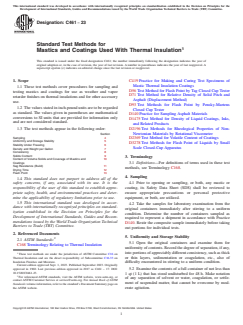
This international standard was developed in accordance with internationally recognized principles on standardization established in the Decision on Principles for the
Development of International Standards, Guides and Recommendations issued by the World Trade Organization Technical Barriers to Trade (TBT) Committee.
Designation: C461 − 23
Standard Test Methods for
Mastics and Coatings Used With Thermal Insulation
This standard is issued under the fixed designation C461; the number immediately following the designation indicates the year of
original adoption or, in the case of revision, the year of last revision. A number in parentheses indicates the year of last reapproval. A
superscript epsilon (´) indicates an editorial change since the last revision or reapproval.
1. Scope C419 Practice for Making and Curing Test Specimens of
Mastic Thermal Insulation Coatings
1.1 These test methods cover procedures for sampling and
D56 Test Method for Flash Point by Tag Closed Cup Tester
testing mastics and coatings for use as weather and vapor
D71 Test Method for Relative Density of Solid Pitch and
retarder finishes on thermal insulations and for other accessory
Asphalt (Displacement Method)
use.
D93 Test Methods for Flash Point by Pensky-Martens
1.2 The values stated in inch-pound units are to be regarded
Closed Cup Tester
as standard. The values given in parentheses are mathematical
D140 Practice for Sampling Asphalt Materials
conversions to SI units that are provided for information only
D1475 Test Method for Density of Liquid Coatings, Inks,
and are not considered standard.
and Related Products
1.3 The test methods appear in the following order: D2196 Test Methods for Rheological Properties of Non-
Newtonian Materials by Rotational Viscometer
Section
Sampling 4
D2369 Test Method for Volatile Content of Coatings
Uniformity and Storage Stability 5
D3278 Test Methods for Flash Point of Liquids by Small
Stability Under Freezing 6
Scale Closed-Cup Apparatus
Density and Weight per Gallon 7
Consistency 8
Solids Content 9
3. Terminology
Content of Volume Solids and Coverage of Mastics and 10
Coatings
3.1 Definitions—For definitions of terms used in these test
Sag Resistance (Build) 11
methods, see Terminology C168.
Drying Time 12
Flash Point 13
4. Sampling
1.4 This standard does not purport to address all of the
safety concerns, if any, associated with its use. It is the 4.1 Prior to opening or sampling, or both, any mastic or
coating, its Safety Data Sheet (SDS) shall be reviewed to
responsibility of the user of this standard to establish appro-
priate safety, health, and environmental practices and deter- ensure appropriate precautions or personal protective
equipment, or both, are utilized.
mine the applicability of regulatory limitations prior to use.
1.5 This international standard was developed in accor-
4.2 Take the samples for laboratory examination from the
dance with internationally recognized principles on standard-
original containers immediately after stirring to a uniform
ization established in the Decision on Principles for the
condition. Determine the number of containers sampled as
Development of International Standards, Guides and Recom-
required to represent a shipment in accordance with Practice
mendations issued by the World Trade Organization Technical
D140. Restir the composite sample immediately before taking
Barriers to Trade (TBT) Committee.
out portions for individual tests.
2. Referenced Documents
5. Uniformity and Storage Stability
2.1 ASTM Standards:
5.1 Open the original containers and examine them for
C168 Terminology Relating to Thermal Insulation
uniformity of contents. Record the degree of separation, if any,
into portions of appreciably different consistency, such as thick
These test methods are under the jurisdiction of ASTM Committee C16 on
or thin layers, sedimentation or coagulation, etc., also of
Thermal Insulation and are the direct responsibility of Subcommittee C16.33 on
Insulation Finishes and Moisture.
difficulty encountered in stirring to a uniform condition.
Current edition approved Sept. 1, 2023. Published September 2023. Originally
5.2 Examine the contents of a full container of not less than
approved in 1960. Last previous edition approved in 2017 as C461 – 17. DOI:
10.1520/C0461-23.
1 qt (1 L) that has stood undisturbed for 48 h. Make notation
For referenced ASTM standards, visit the ASTM website, www.astm.org, or
of any separation of solvent or water, coagulation, or settle-
contact ASTM Customer Service at service@astm.org. For Annual Book of ASTM
ment of suspended matter, that cannot be overcome by mod-
Standards volume information, refer to the standard’s Document Summary page on
the ASTM website. erate agitation.
Copyright © ASTM International, 100 Barr Harbor Drive, PO Box C700, West Conshohocken, PA 19428-2959. United States
C461 − 23
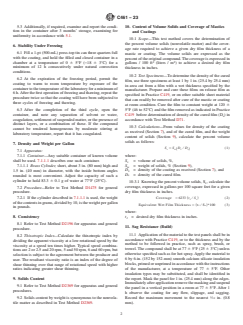
5.3 Additionally, if required, examine and report the condi- 10. Content of Volume Solids and Coverage of Mastics
tion in the container after 3 months’ storage, examining for and Coatings
uniformity in accordance with 5.1.
10.1 Scope—This test method covers the determination of
the percent volume solids (nonvolatile matter) and the cover-
6. Stability Under Freezing
age rate required to achieve a given dry film thickness of a
6.1 Fill a 1-pt (500-mL) press-top tin can three quarters full
mastic or coating. The volume solids are expressed as the
with the coating, and hold the filled and closed container in a
percent of the original compound. The coverage is expressed in
2 2
chamber at a temperature of 0 6 5°F (−18 6 3°C) for a
gallons / 100 ft (liters / m ) to achieve a desired dry film
minimum of 12 h consecutively under natural convection
thickness in inches.
conditions.
10.2 Test Specimens—To determine the density of the cured
6.2 At the expiration of the freezing period, permit the
film, use three specimens at least 1 by 1 in. (25.4 by 25.4 mm)
coating to warm to room temperature by exposure of the
in area cut from a film with a wet thickness specified by the
container to the temperature of the laboratory for a minimum of
manufacturer. Prepare and cure these films on release film as
6 h. After the first operation of freezing and thawing, repeat the
specified in Practice C419, or on other suitable sheet mater
...
This document is not an ASTM standard and is intended only to provide the user of an ASTM standard an indication of what changes have been made to the previous version. Because
it may not be technically possible to adequately depict all changes accurately, ASTM recommends that users consult prior editions as appropriate. In all cases only the current version
of the standard as published by ASTM is to be considered the official document.
Designation: C461 − 17 C461 − 23
Standard Test Methods for
Mastics and Coatings Used With Thermal Insulation
This standard is issued under the fixed designation C461; the number immediately following the designation indicates the year of
original adoption or, in the case of revision, the year of last revision. A number in parentheses indicates the year of last reapproval. A
superscript epsilon (´) indicates an editorial change since the last revision or reapproval.
1. Scope
1.1 These test methods cover procedures for sampling and testing mastics and coatings for use as weather and vapor barrierretarder
finishes on thermal insulations and for other accessory use.
1.2 The values stated in inch-pound units are to be regarded as standard. The values given in parentheses are mathematical
conversions to SI units that are provided for information only and are not considered standard.
1.3 The test methods appear in the following order:
Section
Sampling 4
Uniformity and Storage Stability 5
Stability Under Freezing 6
Density and Weight per Gallon 7
Consistency 8
Solids Content 9
Content of Volume Solids and Coverage of Mastics and 10
Coatings
Sag Resistance (Build) 11
Drying Time 12
Flash Point 13
1.4 This standard does not purport to address all of the safety concerns, if any, associated with its use. It is the responsibility of
the user of this standard to establish appropriate safety and health practices and determine the applicability of regulatory
limitations prior to use.
1.4 This standard does not purport to address all of the safety concerns, if any, associated with its use. It is the responsibility
of the user of this standard to establish appropriate safety, health, and environmental practices and determine the applicability of
regulatory limitations prior to use.
1.5 This international standard was developed in accordance with internationally recognized principles on standardization
established in the Decision on Principles for the Development of International Standards, Guides and Recommendations issued
by the World Trade Organization Technical Barriers to Trade (TBT) Committee.
These test methods are under the jurisdiction of ASTM Committee C16 on Thermal Insulation and are the direct responsibility of Subcommittee C16.33 on Insulation
Finishes and Moisture.
Current edition approved Sept. 1, 2017Sept. 1, 2023. Published September 2017September 2023. Originally approved in 1960. Last previous edition approved in 20152017
as C461 – 81 (2015). DOI: 10.1520/C0461-17.17. DOI: 10.1520/C0461-23.
Copyright © ASTM International, 100 Barr Harbor Drive, PO Box C700, West Conshohocken, PA 19428-2959. United States
C461 − 23
2. Referenced Documents
2.1 ASTM Standards:
C168 Terminology Relating to Thermal Insulation
C419 Practice for Making and Curing Test Specimens of Mastic Thermal Insulation Coatings
D56 Test Method for Flash Point by Tag Closed Cup Tester
D71 Test Method for Relative Density of Solid Pitch and Asphalt (Displacement Method)
D93 Test Methods for Flash Point by Pensky-Martens Closed Cup Tester
D140 Practice for Sampling Asphalt Materials
D1475 Test Method for Density of Liquid Coatings, Inks, and Related Products
D2196 Test Methods for Rheological Properties of Non-Newtonian Materials by Rotational Viscometer
D2369 Test Method for Volatile Content of Coatings
D3278 Test Methods for Flash Point of Liquids by Small Scale Closed-Cup Apparatus
3. Terminology
3.1 Definitions—For definitions of terms used in these test methods, see Terminology C168.
4. Sampling
4.1 Prior to opening or sampling, or both, any mastic or coating, its Safety Data Sheet (SDS) shall be reviewed to ensure
appropriate precautions or personal protective equipment, or both, are utilized.
4.2 Take the samples for laboratory examination from the original containers immediately after stirring to a uniform condition.
Determine the number of containers sampled as required to represent a shipment in accordance with Practice D140. Restir the
composite sample immediately before taking out portions for individual tests.
5. Uniformity and Storage Stability
5.1 Open the original containers and examine them for uniformity of contents. Record the degree of separation, if any, into
portions of appreciably different consistency, such as thick or thin layers, sedimentation or coagulation, etc., also of difficulty
encountered in stirring to a uniform condition.
5.2 Examine the contents of a full container of not less than 1 qt (1 L) that has stood undisturbed for 48 h. Make notation of any
separation of solvent or water, coagulation, or settlement of suspended matter, that cannot be overcome by moderate agitation.
5.3 Additionally, if required, examine and report the condition in the container after 3 months’ storage, examining for uniformity
in accordance with 5.1.
6. Stability Under Freezing
6.1 Fill a 1-pt (500-mL) press-top tin can three quarters full with the coating, and hold the filled and closed container in a chamber
at a temperature of 0 6 5°F (−18 6 3°C) for a minimum of 12 h consecutively under natural convection conditions.
6.2 At the expiration of the freezing period, permit the coating to warm to room temperature by exposure of the container to the
temperature of the laboratory for a minimum of 6 h. After the first operation of freezing and thawing, repeat the procedure twice
so that the coating will have been subjected to three cycles of freezing and thawing.
6.3 After the completion of the third cycle, open the container, and note any separation of solvent or water, coagulation, settlement
of suspended matter, or the presence of distinct layers, or a combination of these. If the compound cannot be rendered
homogeneous by moderate stirring at laboratory temperature, report that it has coagulated.
7. Density and Weight per Gallon
7.1 Apparatus:
For referenced ASTM standards, visit the ASTM website, www.astm.org, or contact ASTM Customer Service at service@astm.org. For Annual Book of ASTM Standards
volume information, refer to the standard’s Document Summary page on the ASTM website.
C461 − 23
7.1.1 Container
...