

ASTM F1060-18
(Test Method)Standard Test Method for Evaluation of Conductive and Compressive Heat Resistance (CCHR)
General Information
- Abstract
SIGNIFICANCE AND USE
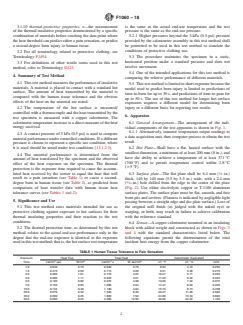
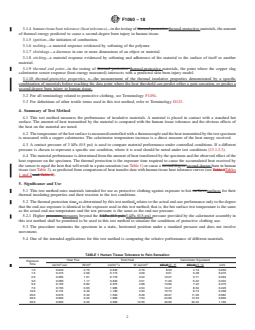
5.1 This test method rates materials intended for use as protective clothing against exposure to hot surfaces for their thermal insulating properties and their reaction to the test conditions.
5.2 The thermal protection time, as determined by this test method, relates to the actual end-use performance only to the degree that the end-use exposure is identical to the exposure used in this test method; that is, the hot surface test temperature is the same as the actual end-use temperature and the test pressure is the same as the end-use pressure.
5.2.1 Higher pressures beyond the 3-kPa (0.5-psi) pressure provided by the calorimeter assembly in this test method shall be permitted to be used in this test method to simulate the conditions of protective clothing use.
5.3 The procedure maintains the specimen in a static, horizontal position under a standard pressure and does not involve movement.
5.4 One of the intended applications for this test method is comparing the relative performance of different materials.
5.5 This test method is limited to short exposure because the model used to predict burn injury is limited to predictions of time-to-burn for up to 30 s, and predictions of time-to-pain for up to 50 s. The use of this test method for longer hot surface exposures requires a different model for determining burn injury or a different basis for reporting test results.
SCOPE
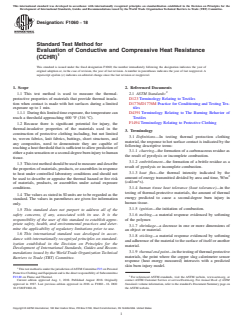
1.1 This test method is used to measure the thermal-protective properties of materials that provide thermal insulation when contact is made with hot surfaces during a limited exposure up to 1 min.
1.1.1 During this limited time exposure, the temperature can reach a threshold approaching 600 °F (316 °C).
1.2 Because there is significant potential for injury, the thermal-insulative properties of the materials used in the construction of protective clothing including, but not limited to, woven fabrics, knit fabrics, battings, sheet structures, and any composites, need to demonstrate they are capable of reaching a heat threshold that is sufficient to allow prediction of either a pain sensation or a second-degree burn injury to human tissue.
1.3 This test method should be used to measure and describe the properties of materials, products, or assemblies in response to heat under controlled laboratory conditions and should not be used to describe or appraise the thermal hazard or fire risk of materials, products, or assemblies under actual exposure conditions.
1.4 The values as stated in SI units are to be regarded as the standard. The values in parentheses are given for information only.
1.5 This standard does not purport to address all of the safety concerns, if any, associated with its use. It is the responsibility of the user of this standard to establish appropriate safety, health, and environmental practices and determine the applicability of regulatory limitations prior to use.
1.6 This international standard was developed in accordance with internationally recognized principles on standardization established in the Decision on Principles for the Development of International Standards, Guides and Recommendations issued by the World Trade Organization Technical Barriers to Trade (TBT) Committee.
- Status
- Published
- Publication Date
- 31-Jul-2018
- Technical Committee
- F23 - Personal Protective Clothing and Equipment
- Drafting Committee
- F23.80 - Flame and Thermal
Buy Documents
ASTM F1060-18 - Standard Test Method for Evaluation of Conductive and Compressive Heat Resistance (CCHR)
REDLINE ASTM F1060-18 - Standard Test Method for Evaluation of Conductive and Compressive Heat Resistance (CCHR)
Overview
ASTM F1060-18, "Standard Test Method for Evaluation of Conductive and Compressive Heat Resistance (CCHR)," is a widely recognized ASTM standard developed to measure the thermal-protective properties of materials intended for protective clothing. This test method evaluates how effectively materials resist heat transfer when in static contact with hot surfaces for short periods, supporting efforts to reduce burn injury risks to workers exposed to high-temperature environments.
The standard is crucial for manufacturers, laboratories, and safety professionals in the selection and performance assessment of materials used in personal protective equipment (PPE). ASTM F1060-18 supports compliance with regulatory best practices and guides the design and certification of heat-resistant textiles and composites.
Key Topics
- Thermal Insulation Performance: Rates the ability of materials to limit heat transfer during contact with hot surfaces at temperatures up to 600°F (316°C), with exposures up to one minute.
- Human Tissue Heat Tolerance: Evaluates test materials against thresholds that predict pain sensation and potential for second-degree burns, supporting worker safety analysis.
- Static Compression Test Conditions: Applies a controlled pressure (typically 3 kPa or 0.5 psi) to simulate the effect of compressive contact in actual PPE use.
- Material Scope: Focuses on a wide range of protective clothing fabrics and constructions, including woven, knit, batts, sheet structures, and composites.
- Short-Term Exposure Modeling: Designed specifically for brief exposures (up to 30 seconds for burns, 50 seconds for pain) under laboratory-controlled conditions.
- Comparative Performance: Enables the benchmarking of different textile materials and assemblies based on their heat resistance.
Applications
ASTM F1060-18 is applied in:
- Personal Protective Equipment (PPE) Design: Assists manufacturers of protective clothing in selecting or developing materials that provide proven heat resistance for environments with exposure to hot equipment, surfaces, or processes.
- Occupational Health and Safety: Supports risk assessments for industries such as firefighting, metalworking, glass manufacturing, foundries, and chemical processing, by enabling evaluation of material safety performance under hot surface contact scenarios.
- Product Certification and Compliance: Used by certification bodies and regulatory authorities to verify whether protective clothing meets relevant safety requirements for thermal resistance.
- Material Quality Control: Enables material suppliers and PPE makers to ensure products match specified performance thresholds, minimizing the risk of thermal injuries.
- Research and Development: Provides a standardized method for testing innovative textiles and composite materials for thermal protection.
Related Standards
For broader or supplemental evaluation of protective textiles and thermal resistance, refer to these documents:
- ASTM D123 - Terminology Relating to Textiles
- ASTM D1776/D1776M - Practice for Conditioning and Testing Textiles
- ASTM D4391 - Terminology Relating to the Burning Behavior of Textiles
- ASTM F1494 - Terminology Relating to Protective Clothing
These and other referenced standards offer additional guidelines for material terminology, testing environments, and fire-related textile property assessment.
Keywords: ASTM F1060-18, conductive and compressive heat resistance, thermal protection, protective clothing, hot surface contact, burn injury, thermal insulation, PPE, textile testing, laboratory test method, safety standards.
Relations
- Effective Date
- 01-Aug-2018
- Effective Date
- 01-Feb-2020
- Effective Date
- 01-May-2018
- Effective Date
- 01-Mar-2017
- Effective Date
- 15-Feb-2016
- Effective Date
- 15-Feb-2016
- Effective Date
- 01-Jan-2016
- Effective Date
- 15-Sep-2015
- Effective Date
- 01-Sep-2015
- Effective Date
- 01-Apr-2015
- Effective Date
- 01-Feb-2015
- Effective Date
- 01-Jul-2013
- Effective Date
- 15-Jun-2013
- Effective Date
- 15-Jun-2013
- Effective Date
- 15-May-2013
Buy Documents
ASTM F1060-18 - Standard Test Method for Evaluation of Conductive and Compressive Heat Resistance (CCHR)
REDLINE ASTM F1060-18 - Standard Test Method for Evaluation of Conductive and Compressive Heat Resistance (CCHR)
Get Certified
Connect with accredited certification bodies for this standard

CIS Institut d.o.o.
Personal Protective Equipment (PPE) certification body. Notified Body NB-2890 for EU Regulation 2016/425 PPE.

Kiwa BDA Testing
Building and construction product certification.
Kmetijski inštitut Slovenije
Agricultural Institute of Slovenia. Soil testing, plant health, agricultural product analysis.
Sponsored listings
Frequently Asked Questions
ASTM F1060-18 is a standard published by ASTM International. Its full title is "Standard Test Method for Evaluation of Conductive and Compressive Heat Resistance (CCHR)". This standard covers: SIGNIFICANCE AND USE 5.1 This test method rates materials intended for use as protective clothing against exposure to hot surfaces for their thermal insulating properties and their reaction to the test conditions. 5.2 The thermal protection time, as determined by this test method, relates to the actual end-use performance only to the degree that the end-use exposure is identical to the exposure used in this test method; that is, the hot surface test temperature is the same as the actual end-use temperature and the test pressure is the same as the end-use pressure. 5.2.1 Higher pressures beyond the 3-kPa (0.5-psi) pressure provided by the calorimeter assembly in this test method shall be permitted to be used in this test method to simulate the conditions of protective clothing use. 5.3 The procedure maintains the specimen in a static, horizontal position under a standard pressure and does not involve movement. 5.4 One of the intended applications for this test method is comparing the relative performance of different materials. 5.5 This test method is limited to short exposure because the model used to predict burn injury is limited to predictions of time-to-burn for up to 30 s, and predictions of time-to-pain for up to 50 s. The use of this test method for longer hot surface exposures requires a different model for determining burn injury or a different basis for reporting test results. SCOPE 1.1 This test method is used to measure the thermal-protective properties of materials that provide thermal insulation when contact is made with hot surfaces during a limited exposure up to 1 min. 1.1.1 During this limited time exposure, the temperature can reach a threshold approaching 600 °F (316 °C). 1.2 Because there is significant potential for injury, the thermal-insulative properties of the materials used in the construction of protective clothing including, but not limited to, woven fabrics, knit fabrics, battings, sheet structures, and any composites, need to demonstrate they are capable of reaching a heat threshold that is sufficient to allow prediction of either a pain sensation or a second-degree burn injury to human tissue. 1.3 This test method should be used to measure and describe the properties of materials, products, or assemblies in response to heat under controlled laboratory conditions and should not be used to describe or appraise the thermal hazard or fire risk of materials, products, or assemblies under actual exposure conditions. 1.4 The values as stated in SI units are to be regarded as the standard. The values in parentheses are given for information only. 1.5 This standard does not purport to address all of the safety concerns, if any, associated with its use. It is the responsibility of the user of this standard to establish appropriate safety, health, and environmental practices and determine the applicability of regulatory limitations prior to use. 1.6 This international standard was developed in accordance with internationally recognized principles on standardization established in the Decision on Principles for the Development of International Standards, Guides and Recommendations issued by the World Trade Organization Technical Barriers to Trade (TBT) Committee.
SIGNIFICANCE AND USE 5.1 This test method rates materials intended for use as protective clothing against exposure to hot surfaces for their thermal insulating properties and their reaction to the test conditions. 5.2 The thermal protection time, as determined by this test method, relates to the actual end-use performance only to the degree that the end-use exposure is identical to the exposure used in this test method; that is, the hot surface test temperature is the same as the actual end-use temperature and the test pressure is the same as the end-use pressure. 5.2.1 Higher pressures beyond the 3-kPa (0.5-psi) pressure provided by the calorimeter assembly in this test method shall be permitted to be used in this test method to simulate the conditions of protective clothing use. 5.3 The procedure maintains the specimen in a static, horizontal position under a standard pressure and does not involve movement. 5.4 One of the intended applications for this test method is comparing the relative performance of different materials. 5.5 This test method is limited to short exposure because the model used to predict burn injury is limited to predictions of time-to-burn for up to 30 s, and predictions of time-to-pain for up to 50 s. The use of this test method for longer hot surface exposures requires a different model for determining burn injury or a different basis for reporting test results. SCOPE 1.1 This test method is used to measure the thermal-protective properties of materials that provide thermal insulation when contact is made with hot surfaces during a limited exposure up to 1 min. 1.1.1 During this limited time exposure, the temperature can reach a threshold approaching 600 °F (316 °C). 1.2 Because there is significant potential for injury, the thermal-insulative properties of the materials used in the construction of protective clothing including, but not limited to, woven fabrics, knit fabrics, battings, sheet structures, and any composites, need to demonstrate they are capable of reaching a heat threshold that is sufficient to allow prediction of either a pain sensation or a second-degree burn injury to human tissue. 1.3 This test method should be used to measure and describe the properties of materials, products, or assemblies in response to heat under controlled laboratory conditions and should not be used to describe or appraise the thermal hazard or fire risk of materials, products, or assemblies under actual exposure conditions. 1.4 The values as stated in SI units are to be regarded as the standard. The values in parentheses are given for information only. 1.5 This standard does not purport to address all of the safety concerns, if any, associated with its use. It is the responsibility of the user of this standard to establish appropriate safety, health, and environmental practices and determine the applicability of regulatory limitations prior to use. 1.6 This international standard was developed in accordance with internationally recognized principles on standardization established in the Decision on Principles for the Development of International Standards, Guides and Recommendations issued by the World Trade Organization Technical Barriers to Trade (TBT) Committee.
ASTM F1060-18 is classified under the following ICS (International Classification for Standards) categories: 13.340.10 - Protective clothing. The ICS classification helps identify the subject area and facilitates finding related standards.
ASTM F1060-18 has the following relationships with other standards: It is inter standard links to ASTM F1060-16, ASTM D1776/D1776M-20, ASTM D4391-18, ASTM D123-17, ASTM D4391-16e1, ASTM D4391-16, ASTM D1776/D1776M-16, ASTM D123-15b, ASTM D123-15a, ASTM D123-15, ASTM D1776/D1776M-15, ASTM F1494-13, ASTM D123-13ae1, ASTM D123-13a, ASTM D123-13. Understanding these relationships helps ensure you are using the most current and applicable version of the standard.
ASTM F1060-18 is available in PDF format for immediate download after purchase. The document can be added to your cart and obtained through the secure checkout process. Digital delivery ensures instant access to the complete standard document.
Standards Content (Sample)
This international standard was developed in accordance with internationally recognized principles on standardization established in the Decision on Principles for the
Development of International Standards, Guides and Recommendations issued by the World Trade Organization Technical Barriers to Trade (TBT) Committee.
Designation: F1060 − 18
Standard Test Method for
Evaluation of Conductive and Compressive Heat Resistance
(CCHR)
This standard is issued under the fixed designation F1060; the number immediately following the designation indicates the year of
original adoption or, in the case of revision, the year of last revision. A number in parentheses indicates the year of last reapproval. A
superscript epsilon (´) indicates an editorial change since the last revision or reapproval.
1. Scope 2. Referenced Documents
1.1 This test method is used to measure the thermal- 2.1 ASTM Standards:
protective properties of materials that provide thermal insula- D123 Terminology Relating to Textiles
tion when contact is made with hot surfaces during a limited D1776/D1776M Practice for Conditioning and Testing Tex-
exposure up to 1 min. tiles
1.1.1 Duringthislimitedtimeexposure,thetemperaturecan D4391 Terminology Relating to The Burning Behavior of
reach a threshold approaching 600 °F (316 °C). Textiles
F1494 Terminology Relating to Protective Clothing
1.2 Because there is significant potential for injury, the
thermal-insulative properties of the materials used in the
3. Terminology
construction of protective clothing including, but not limited
3.1 Definitions—In testing thermal protection clothing
to, woven fabrics, knit fabrics, battings, sheet structures, and
material, the response to hot surface contact is indicated by the
any composites, need to demonstrate they are capable of
following descriptive terms:
reachingaheatthresholdthatissufficienttoallowpredictionof
3.1.1 charring—the formation of a carbonaceous residue as
eitherapainsensationorasecond-degreeburninjurytohuman
the result of pyrolysis or incomplete combustion.
tissue.
3.1.2 embrittlement—the formation of a brittle residue as a
1.3 Thistestmethodshouldbeusedtomeasureanddescribe
result of pyrolysis or incomplete combustion.
the properties of materials, products, or assemblies in response
3.1.3 heat flux—the thermal intensity indicated by the
to heat under controlled laboratory conditions and should not
amount of energy transmitted divided by area and time, W/m
be used to describe or appraise the thermal hazard or fire risk
(cal/cm ·s).
of materials, products, or assemblies under actual exposure
conditions.
3.1.4 human tissue heat tolerance (heat tolerance)—in the
testing of thermal-protective materials, the amount of thermal
1.4 The values as stated in SI units are to be regarded as the
energy predicted to cause a second-degree burn injury in
standard. The values in parentheses are given for information
human tissue.
only.
3.1.5 ignition—the initiation of combustion.
1.5 This standard does not purport to address all of the
3.1.6 melting—a material response evidenced by softening
safety concerns, if any, associated with its use. It is the
responsibility of the user of this standard to establish appro- of the polymer.
priate safety, health, and environmental practices and deter-
3.1.7 shrinkage—a decrease in one or more dimensions of
mine the applicability of regulatory limitations prior to use.
an object or material.
1.6 This international standard was developed in accor-
3.1.8 sticking—a material response evidenced by softening
dance with internationally recognized principles on standard-
and adherence of the material to the surface of itself or another
ization established in the Decision on Principles for the
material.
Development of International Standards, Guides and Recom-
3.1.9 thermal end point—inthetestingofthermal-protective
mendations issued by the World Trade Organization Technical
materials, the point where the copper slug calorimeter sensor
Barriers to Trade (TBT) Committee.
response (heat energy measured) intersects with a predicted
skin burn injury model.
This test method is under the jurisdiction ofASTM Committee F23 on Personal
Protective Clothing and Equipment and is the direct responsibility of Subcommittee
F23.80 on Flame and Thermal. For referenced ASTM standards, visit the ASTM website, www.astm.org, or
Current edition approved Aug. 1, 2018. Published August 2018. Originally contact ASTM Customer Service at service@astm.org. For Annual Book of ASTM
approved in 1987. Last previous edition approved in 2016 as F1060 – 16. DOI: Standards volume information, refer to the standard’s Document Summary page on
10.1520/F1060-18. the ASTM website.
Copyright © ASTM International, 100 Barr Harbor Drive, PO Box C700, West Conshohocken, PA 19428-2959. United States
F1060 − 18
3.1.10 thermal-protective properties, n—the measurement is the same as the actual end-use temperature and the test
of the thermal insulative properties demonstrated by a specific pressure is the same as the end-use pressure.
combination of materials before reaching the data point where 5.2.1 Higher pressures beyond the 3-kPa (0.5-psi) pressure
the heat threshold can predict either a pain sensation, or predict provided by the calorimeter assembly in this test method shall
a second-degree burn injury to human tissue. be permitted to be used in this test method to simulate the
conditions of protective clothing use.
3.2 For all terminology related to protective clothing, see
Terminology F1494. 5.3 The procedure maintains the specimen in a static,
horizontal position under a standard pressure and does not
3.3 For definitions of other textile terms used in this test
involve movement.
method, refer to Terminology D123.
5.4 One of the intended applications for this test method is
4. Summary of Test Method
comparing the relative performance of different materials.
4.1 Thistestmethodmeasurestheperformanceofinsulative
5.5 Thistestmethodislimitedtoshortexposurebecausethe
materials. A material is placed in contact with a standard hot
model used to predict burn injury is limited to predictions of
surface. The amount of heat transmitted by the material is
time-to-burn for up to 30 s, and predictions of time-to-pain for
compared with the human tissue tolerance and the obvious
up to 50 s. The use of this test method for longer hot surface
effects of the heat on the material are noted.
exposures requires a different model for determining burn
4.2 The temperature of the hot surface is measured/ injury or a different basis for reporting test results.
controlled with a thermocouple and the heat transmitted by the
6. Apparatus
test specimen is measured with a copper calorimeter. The
calorimeter temperature increase is a direct measure of the heat 6.1 General Arrangement—The arrangement of the indi-
energy received.
vidual components of the test apparatus is shown in Fig. 1.
6.1.1 Alternatively, transmit temperature output readings to
4.3 Acontact pressure of 3 kPa (0.5 psi) is used to compare
a data acquisition unit, then computer process to obtain the test
materialperformanceundercontrolledconditions.Ifadifferent
result.
pressure is chosen to represent a specific use condition, where
it is used should be noted under test conditions (13.1.2.3).
6.2 Hot Plate—Shall have a flat, heated surface with the
smallest dimension, a minimum of at least 200 mm (8 in.), and
4.4 The material performance is determined from the
have the ability to achieve a temperature of at least 371 °C
amount of heat transferred by the specimen and the observed
(700 °F) and to permit temperature control within 2.8 °C
effect of the heat exposure on the specimen. The thermal
(65 °F).
protection is the exposure time required to cause the accumu-
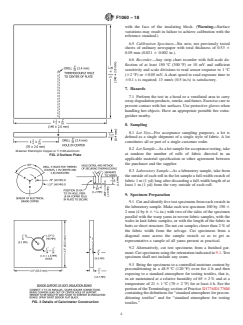
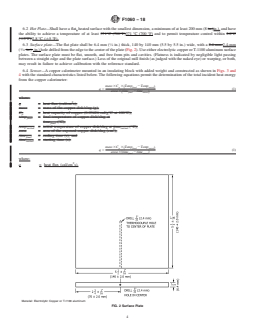
lated heat received by the sensor to equal the heat that will 6.3 Surface plate—The flat plate shall be 6.4 mm ( ⁄4 in.)
result in a pain sensation (see Table 1) or cause a second-
thick, 140 by 140 mm (5.5 by 5.5 in.) wide, with a 2.4-mm
degree burn in human tissue (see Table 2), as predicted from ( ⁄32-in.) hole drilled from the edge to the center of the plate
comparison of heat transfer data with human tissue heat (Fig. 2). Use either electrolytic copper or T-1100 aluminum
tolerance curves (see Tables 1 and 2).
surface plates. The surface plate must be flat, smooth, and free
from pits and cavities. (Flatness is indicated by negligible light
5. Significance and Use
passing between a straight edge and the plate surface.) Loss of
5.1 This test method rates materials intended for use as the original mill finish (as judged with the naked eye) or
protective clothing against exposure to hot surfaces for their warping, or both, may result in failure to achieve calibration
thermal insulating properties and their reaction to the test with the reference standard.
conditions.
6.4 Sensor—A copper calorimeter mounted in an insulating
5.2 The thermal protection time, as determined by this test block with added weight and constructed as shown in Figs. 3
method, relates to the actual end-use performance only to the and 4 with the standard characteristics listed below. The
degree that the end-use exposure is identical to the exposure following equations permit the determination of the total
usedinthistestmethod;thatis,thehotsurfacetesttemperature incident heat energy from the copper calorimeter:
TABLE 1 Human Tissue Tolerance to Pain Sensation
Heat Flux Total Heat Calorimeter Equivalent
Exposure
2 2 2 2
Time
cal/cm ·sec W/cm cal/cm ·s W sec/cm ∆T, °F ∆T, °C ∆mV
1.0 0.640 2.70 0.640 2.70 8.53 4.74 0.250
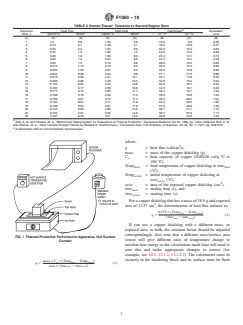
1.5 0.475 2.00 0.713 3.00 9.51 5.28 0.275
2.0 0.385 1.61 0.770 3.22 10.27 5.71 0.293
3.0 0.280 1.17 0.840 3.51 11.20 6.22 0.322
5.0 0.195 0.82 0.975 4.08 13.00 7.22 0.375
7.0 0.155 0.65 1.085 4.54 14.47 8.04 0.420
10.0 0.118 0.49 1.180 4.94 15.73 8.74 0.458
20.0 0.076 0.32 1.520 6.36 20.27 11.26 0.582
30.0 0.060 0.25 1.800 7.53 24.00 13.33 0.690
50.0 0.060 0.25 3.000 12.55 40.00 22.22 1.150
F1060 − 18
A
TABLE 2 Human Tissue Tolerance to Second-Degree Burn
B
Exposure Heat Flux Total Heat Calorimeter Equivalent,
2 2 2 2
Time, s cal/cm ·s W/cm cal/cm ·s W/cm ∆T, °F ∆T, °C ∆mV
(1) (2) (3) (4) (5) (6) (7) (8)
1 1.2 5.0 1.20 5.0 16.0 8.9 0.46
2 0.73 3.1 1.46 6.1 19.5 10.8 0.57
3 0.55 2.3 1.65 6.9 22.0 12.2 0.63
4 0.45 1.9 1.80 7.5 24.0 13.3 0.69
5 0.38 1.6 1.90 8.0 25.3 14.1 0.72
6 0.34 1.4 2.04 8.5 27.2 15.1 0.78
7 0.30 1.3 2.10 8.8 28.0 15.5 0.80
8 0.274 1.15 2.19 9.2 29.2 16.2 0.83
9 0.252 1.06 2.27 9.5 30.2 16.8 0.86
10 0.233 0.98 2.33 9.8 31.1 17.3 0.89
11 0.219 0.92 2.41 10.1 32.1 17.8 0.92
12 0.205 0.86 2.46 10.3 32.8 18.2 0.94
13 0.194 0.81 2.52 10.6 33.6 18.7 0.97
14 0.184 0.77 2.58 10.8 34.3 19.1 0.99
15 0.177 0.74 2.66 11.1 35.4 19.7 1.02
16 0.168 0.70 2.69 11.3 35.8 19.8 1.03
17 0.160 0.67 2.72 11.4 36.3 20.2 1.04
18 0.154 0.64 2.77 11.6 37.0 20.6 1.06
19 0.148 0.62 2.81 11.8 37.5 20.8 1.08
20 0.143 0.60 2.86 12.0 38.1 21.1 1.10
25 0.122 0.51 3.05 12.8 40.7 22.6 1.17
30 0.107 0.45 3.21 13.4 42.8 23.8 1.23
A
Stoll,A. M. and Chianta, M.A., “Method and Rating System for Evaluations of Thermal Protection,” Aerospace Medicine, Vol 40, 1969, pp. 1232–1238 and Stoll,A. M.
and Chianta, M. A., “Heat Transfer through Fabrics as Related to Thermal Injury,” Transaction-New York Academy of Sciences, Vol 33, No. 7, 1971, pp. 649–670.
B
A calorimeter with an iron/constantan thermocouple.
where:
q = heat flux (cal/cm s),
mass = mass of the copper disk/slug (g),
C = heat capacity of copper (0.09426 cal/g °C at
p
100 °C),
Temp = final temperature of copper disk/slug at time
final final
(°C),
Temp = initial temperature of copper disk/slug at
initial
time (°C),
initial
area = area of the exposed copper disk/slug (cm ),
time = ending time (s), and
final
time = starting time (s).
initial
For a copper disk/slug that has a mass of 18.0 g and exposed
area of 12.57 cm , the determination of heat flux reduces to:
0.135 3 Temp 2 Temp
~ !
final initial
q 5 (2)
time 2 time
~ !
final initial
If you use a copper disk/slug with a different mass, or
exposed area, or both, the constant factor should be adjusted
correspondingly. Also note that a different mass/surface area
FIG. 1 Thermal-Protective Performance Apparatus, Hot Surface
sensor will give different rates of temperature change to
Contact
incident heat energy so the calculations made later will need to
note this and make appropriate changes to correct (for
example, see 10.3, 12.1.2, 13.1.3.1). The calorimeter must fit
securely in the insulating block and its surface must be flush
mass 3C 3 ~Temp 2 Temp !
p final initial
q 5 (1)
area 3 time 2 time
~ !
final initial
F1060 − 18
with the face of the insulating block. (Warning—Surface
variations may result in failure to achieve calibration with the
reference standard.)
6.5 Calibration Specimen—
...
This document is not an ASTM standard and is intended only to provide the user of an ASTM standard an indication of what changes have been made to the previous version. Because
it may not be technically possible to adequately depict all changes accurately, ASTM recommends that users consult prior editions as appropriate. In all cases only the current version
of the standard as published by ASTM is to be considered the official document.
Designation: F1060 − 16 F1060 − 18
Standard Test Method for
Evaluation of Conductive and Compressive Heat Resistance
(CCHR)
This standard is issued under the fixed designation F1060; the number immediately following the designation indicates the year of
original adoption or, in the case of revision, the year of last revision. A number in parentheses indicates the year of last reapproval. A
superscript epsilon (´) indicates an editorial change since the last revision or reapproval.
1. Scope
1.1 This test method is used to measure the thermal insulationthermal-protective properties of materials used in protective
clothing when exposed for a short period of time to a hot surface with a temperature up to 600°F (316°C). that provide thermal
insulation when contact is made with hot surfaces during a limited exposure up to 1 min.
1.1.1 During this limited time exposure, the temperature can reach a threshold approaching 600 °F (316 °C).
1.2 This test method is applicable to Because there is significant potential for injury, the thermal-insulative properties of the
materials used in the construction of protective clothing,clothing including, but not limited to:to, woven fabrics, knit fabrics,
battings, sheet structures, and material composites, intended for use as clothing for protection against exposure to hot surfaces. any
composites, need to demonstrate they are capable of reaching a heat threshold that is sufficient to allow prediction of either a pain
sensation or a second-degree burn injury to human tissue.
1.3 This test method should be used to measure and describe the properties of materials, products, or assemblies in response
to heat under controlled laboratory conditions and should not be used to describe or appraise the thermal hazard or fire risk of
materials, products, or assemblies under actual exposure conditions.
1.4 The values as stated in SI units are to be regarded as the standard. The values in parentheses are given for information only.
1.5 This standard does not purport to address all of the safety concerns, if any, associated with its use. It is the responsibility
of the user of this standard to establish appropriate safety safety, health, and healthenvironmental practices and determine the
applicability of regulatory limitations prior to use.
1.6 This international standard was developed in accordance with internationally recognized principles on standardization
established in the Decision on Principles for the Development of International Standards, Guides and Recommendations issued
by the World Trade Organization Technical Barriers to Trade (TBT) Committee.
2. Referenced Documents
2.1 ASTM Standards:
D123 Terminology Relating to Textiles
D1776/D1776M Practice for Conditioning and Testing Textiles
D4391 Terminology Relating to The Burning Behavior of Textiles
F1494 Terminology Relating to Protective Clothing
3. Terminology
3.1 Definitions—In testing thermal protection clothing material, the response to hot surface contact is indicated by the following
descriptive terms:
3.1.1 charring—the formation of a carbonaceous residue as the result of pyrolysis or incomplete combustion.
3.1.2 embrittlement—the formation of a brittle residue as a result of pyrolysis or incomplete combustion.
2 2
3.1.3 heat flux—the thermal intensity indicated by the amount of energy transmitted divided by area and time, W/m (cal/cm ·s).
This test method is under the jurisdiction of ASTM Committee F23 on Personal Protective Clothing and Equipment and is the direct responsibility of Subcommittee
F23.80 on Flame and Thermal.
Current edition approved Aug. 1, 2016Aug. 1, 2018. Published September 2016August 2018. Originally approved in 1987. Last previous edition approved in 20082016
as F1060 - 08.F1060 – 16. DOI: 10.1520/F1060-16.10.1520/F1060-18.
For referenced ASTM standards, visit the ASTM website, www.astm.org, or contact ASTM Customer Service at service@astm.org. For Annual Book of ASTM Standards
volume information, refer to the standard’s Document Summary page on the ASTM website.
Copyright © ASTM International, 100 Barr Harbor Drive, PO Box C700, West Conshohocken, PA 19428-2959. United States
F1060 − 18
3.1.4 human tissue heat tolerance (heat tolerance)—in the testing of thermal protective thermal-protective materials, the amount
of thermal energy predicted to cause a second-degree burn injury in human tissue.
3.1.5 ignition—the initiation of combustion.
3.1.6 melting—a material response evidenced by softening of the polymer.
3.1.7 shrinkage—a decrease in one or more dimensions of an object or material.
3.1.8 sticking—a material response evidenced by softening and adherence of the material to the surface of itself or another
material.
3.1.9 thermal end point—in the testing of thermal protective thermal-protective materials, the point where the copper slug
calorimeter sensor response (heat energy measured) intersects with a predicted skin burn injury model.
3.1.10 thermal-protective properties, n—the measurement of the thermal insulative properties demonstrated by a specific
combination of materials before reaching the data point where the heat threshold can predict either a pain sensation, or predict a
second-degree burn injury to human tissue.
3.2 For all terminology related to protective clothing, see Terminology F1494.
3.3 For definitions of other textile terms used in this test method, refer to Terminology D123.
4. Summary of Test Method
4.1 This test method measures the performance of insulative materials. A material is placed in contact with a standard hot
surface. The amount of heat transmitted by the material is compared with the human tissue tolerance and the obvious effects of
the heat on the material are noted.
4.2 The temperature of the hot surface is measured/controlled with a thermocouple and the heat transmitted by the test specimen
is measured with a copper calorimeter. The calorimeter temperature increase is a direct measure of the heat energy received.
4.3 A contact pressure of 3 kPa (0.5 psi) is used to compare material performance under controlled conditions. If a different
pressure is chosen to represent a specific use condition, where it is used should be noted under test conditions (13.1.2.3).
4.4 The material performance is determined from the amount of heat transferred by the specimen and the observed effect of the
heat exposure on the specimen. The thermal protection is the exposure time required to cause the accumulated heat received by
the sensor to equal the heat that will result in a pain sensation (see Table 1) or cause a second degree second-degree burn in human
tissue (see Table 2), as predicted from comparison of heat transfer data with human tissue heat tolerance curves (see Table 1Tables
1 and 2 and Table 2).
5. Significance and Use
5.1 This test method rates materials intended for use as protective clothing against exposure to hot surfaces,surfaces for their
thermal insulating properties and their reaction to the test conditions.
5.2 The thermal protection time, as determined by this test method, relates to the actual end-use performance only to the degree
that the end-use exposure is identical to the exposure used in this test method; that is, the hot surface test temperature is the same
as the actual end-use temperature and the test pressure is the same as the end-use pressure.
5.2.1 Higher pressures,pressures beyond the 3 kPa (0.5 psi) 3-kPa (0.5-psi) pressure provided by the calorimeter assembly in
this test method shall be permitted to be used in this test method to simulate the conditions of protective clothing use.
5.3 The procedure maintains the specimen in a static, horizontal position under a standard pressure and does not involve
movement.
5.4 One of the intended applications for this test method is comparing the relative performance of different materials.
TABLE 1 Human Tissue Tolerance to Pain Sensation
Heat Flux Total Heat Calorimeter Equivalent
Exposure
2 2 2 2
Time
cal/cm ·sec W/cm cal/cm ·s W sec/cm ΔT°, FΔT, °F ΔT°, CΔT, °C ΔmV
1.0 0.640 2.70 0.640 2.70 8.53 4.74 0.250
1.5 0.475 2.00 0.713 3.00 9.51 5.28 0.275
2.0 0.385 1.61 0.770 3.22 10.27 5.71 0.293
3.0 0.280 1.17 0.840 3.51 11.20 6.22 0.322
5.0 0.195 0.82 0.975 4.08 13.00 7.22 0.375
7.0 0.155 0.65 1.085 4.54 14.47 8.04 0.420
10.0 0.118 0.49 1.180 4.94 15.73 8.74 0.458
20.0 0.076 0.32 1.520 6.36 20.27 11.26 0.582
30.0 0.060 0.25 1.800 7.53 24.00 13.33 0.690
50.0 0.060 0.25 3.000 12.55 40.00 22.22 1.150
F1060 − 18
A
TABLE 2 Human Tissue Tolerance to Second Degree Second-Degree Burn
B
Exposure Heat Flux Total Heat Calorimeter Equivalent,
2 2 2 2
Time, s cal/cm ·s W/cm cal/cm ·s W/cm ΔT,° F ΔT, °C ΔmV
2 2 2 2
cal/cm ·s W/cm cal/cm ·s W/cm ΔT, °F ΔT, °C
(1) (2) (3) (4) (5) (6) (7) (8)
1 1.2 5.0 1.20 5.0 16.0 8.9 0.46
2 0.73 3.1 1.46 6.1 19.5 10.8 0.57
3 0.55 2.3 1.65 6.9 22.0 12.2 0.63
4 0.45 1.9 1.80 7.5 24.0 13.3 0.69
5 0.38 1.6 1.90 8.0 25.3 14.1 0.72
6 0.34 1.4 2.04 8.5 27.2 15.1 0.78
7 0.30 1.3 2.10 8.8 28.0 15.5 0.80
8 0.274 1.15 2.19 9.2 29.2 16.2 0.83
9 0.252 1.06 2.27 9.5 30.2 16.8 0.86
10 0.233 0.98 2.33 9.8 31.1 17.3 0.89
11 0.219 0.92 2.41 10.1 32.1 17.8 0.92
12 0.205 0.86 2.46 10.3 32.8 18.2 0.94
13 0.194 0.81 2.52 10.6 33.6 18.7 0.97
14 0.184 0.77 2.58 10.8 34.3 19.1 0.99
15 0.177 0.74 2.66 11.1 35.4 19.7 1.02
16 0.168 0.70 2.69 11.3 35.8 19.8 1.03
17 0.160 0.67 2.72 11.4 36.3 20.2 1.04
18 0.154 0.64 2.77 11.6 37.0 20.6 1.06
19 0.148 0.62 2.81 11.8 37.5 20.8 1.08
20 0.143 0.60 2.86 12.0 38.1 21.1 1.10
25 0.122 0.51 3.05 12.8 40.7 22.6 1.17
30 0.107 0.45 3.21 13.4 42.8 23.8 1.23
A
Stoll, A. M. and Chianta, M. A., “Method and Rating System for Evaluations of Thermal Protection,” Aerospace Medicine, Vol 40, 1969, pp. 1232–1238 and Stoll, A. M.
and Chianta, M. A., Heat“Heat Transfer through Fabrics as Related to Thermal Injury,Injury,” “Transaction-NewTransaction-New York Academy of Sciences,”Sciences, Vol
33 (7), Nov. 1971, pp33, No. 7, 1971, pp. 649–670.
B
A calorimeter with an iron/constantan thermocouple.
5.5 This test method is limited to short exposure because the model used to predict burn injury is limited to predictions of
time-to-burn for up to 30 seconds,s, and predictions of time-to-pain for up to 50 seconds.s. The use of this test method for longer
hot surface exposures requires a different model for determining burn injury or a different basis for reporting test results.
6. Apparatus
6.1 General Arrangement—The arrangement of the individual components of the test apparatus is shown in Fig. 1.
6.1.1 Alternatively, transmit temperature output readings to a data acquisition unit, then computer process to obtain the test
result.
FIG. 1 Thermal Protective Thermal-Protective Performance Apparatus, Hot Surface Contact
F1060 − 18
6.2 Hot Plate—Shall have a flat, heated surface with the smallest dimension, a minimum of at least 200 mm (8 in.)in.), and have
the ability to achieve a temperature of at least 371°C (700°F)371 °C (700 °F) and to permit temperature control within 2.8°C
(65°F).2.8 °C (65 °F).
6.3 Surface plate—The flat plate shall be 6.4 mm ( ⁄4 in.) thick, 140 by 140 mm (5.5 by 5.5 in.) wide, with a 2.4 mm 2.4-mm
( ⁄32 in.) -in.) hole drilled from the edge to the center of the plate (Fig. 2). Use either electrolytic copper or T-1100 aluminum surface
plates. The surface plate must be flat, smooth, and free from pits and cavities. (Flatness is indicated by negligible light passing
between a straight edge and the plate surface.) Loss of the original mill finish (as judged with the naked eye) or warping, or both,
may result in failure to achieve calibration with the reference standard.
6.4 Sensor—A copper calorimeter mounted in an insulating block with added weight and constructed as shown in Figs. 3 and
4 with the standard characteristics listed below. The following equations permit the determination of the total incident heat energy
from the copper calorimeter:
mass 3C 3 Temp 2 Temp
~ !
p final initial
q 5 (1)
area 3 time 2 time
~ !
final initial
where:
q = heat flux (cal/cm s),
mass = mass of the copper disk/slug (g),
C = heat capacity of copper (0.09426 cal/g°C at 100°C),
p
temp = final temperature of copper disk/slug at
final
time (°C),
final
temp = initial temperature of copper disk/slug at time (°C),
initial initial
area = area of the exposed copper disk/slug (cm ),
time = ending time (s), and
final
time = starting time (s).
initial
mass 3C 3 Temp 2 Temp
~ !
p final initial
q 5 (1)
area 3 time 2 time
~ !
final initial
where:
q = heat flux (cal/cm s),
Material: Electrolytic Copper or T-1100 aluminum
FIG. 2 Surface Plate
F1060 − 18
FIG. 3 Details of Calorimeter Construction
mass = mass of the copper disk/slug (g),
C = heat capacity of copper (0.09426 cal/g °C at 100 °C),
p
Temp = final temperature of copper disk/slug at time (°C),
final final
Temp = initial temperature of copper disk/slug at
initial
time (°C),
initial
area = area of the exposed copper disk/slug (cm ),
time = ending time (s), and
final
time = starting time (s).
initial
For a copper disk/slug that has a mass of 18.0 g and exposed area of 12.57 cm , the determination of heat flux reduces to:
0.135 3 Temp 2 Temp
~ !
final initial
q 5 (2)
time 2 time
~ !
final initial
For a copper disk/slug that has a mass of 18.0 g and exposed area of 12.57 cm , the determination of heat flux reduces to:
0.135 3 Temp 2 Temp
~ !
final initial
q 5 (2)
time 2 time
~ !
final initial
If you use a copper disk/slug wi
...