

ASTM D3475-20
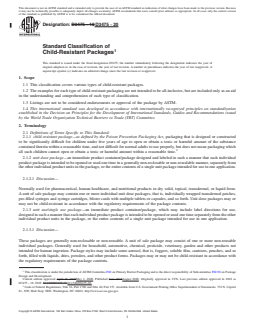
(Classification)Standard Classification of Child-Resistant Packages
General Information
- Abstract
SIGNIFICANCE AND USE
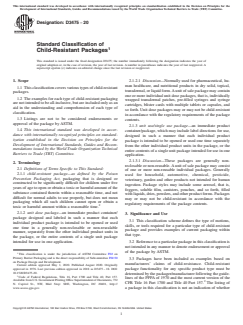
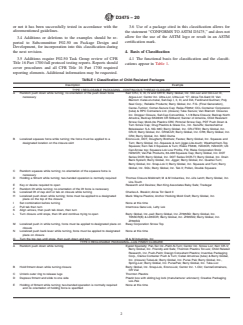
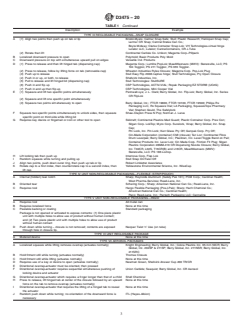
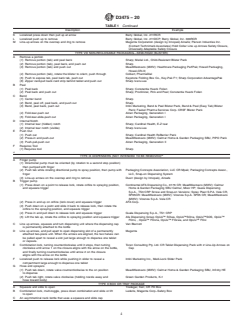
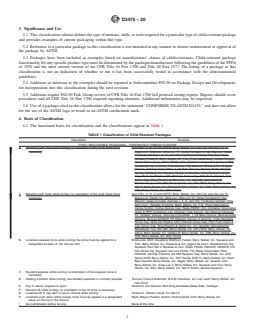
3.1 This classification scheme defines the type of motions, skills, or tools required for a particular type of child-resistant package and provides examples of current packaging within that type.
3.2 Reference to a particular package in this classification is not intended in any manner to denote endorsement or approval of the package by ASTM.
3.3 Packages have been included as examples based on manufacturers' claims of child-resistance. Child-resistant package functionality for any specific product type must be determined by the packager/manufacturer following the guidelines of the PPPA of 1970 and the most current version of the CFR Title 16 Part 1700 and Title 40 Part 157.2 The listing of a package in this classification is not an indication of whether or not it has been successfully tested in accordance with the aforementioned guidelines.
3.4 Additions or deletions to the examples should be reported to Subcommittee F02.50 on Package Design and Development, for incorporation into this classification during the next revision.
3.5 Additions require F02.50 Task Group review of CFR Title 16 Part 1700 full protocol testing reports. Reports should cover procedures and all CFR Title 16 Part 1700 required reporting elements. Additional information may be requested.
3.6 Use of a package cited in this classification allows for the statement “CONFORMS TO ASTM D3475,” and does not allow for the use of the ASTM logo or result in an ASTM certification mark.
SCOPE
1.1 This classification covers various types of child-resistant packages.
1.2 The examples for each type of child-resistant packaging are not intended to be all-inclusive, but are included only as an aid in the understanding and comprehension of each type of classification.
1.3 Listings are not to be considered endorsements or approval of the package by ASTM.
1.4 This international standard was developed in accordance with internationally recognized principles on standardization established in the Decision on Principles for the Development of International Standards, Guides and Recommendations issued by the World Trade Organization Technical Barriers to Trade (TBT) Committee.
- Status
- Published
- Publication Date
- 30-Apr-2020
- Technical Committee
- F02 - Primary Barrier Packaging
- Drafting Committee
- F02.50 - Package Design and Development
Overview
ASTM D3475-20: Standard Classification of Child-Resistant Packages is an international standard developed by ASTM International. This classification provides a comprehensive scheme that categorizes child-resistant packaging based on the type of motions, skills, or tools required to open them. The standard supports manufacturers, regulators, and testers in understanding package types designed to reduce the risk of accidental child access to hazardous substances.
Child-resistant packaging, as defined by regulatory authorities, is intended to be significantly difficult for children under the age of five to open or access toxic or harmful contents, while remaining accessible for normal adult use. The ASTM D3475-20 standard assists the packaging industry with consistent terminology and a detailed framework for various types of child-resistant packages.
Key Topics
- Classification Scheme: The standard lists packaging types based on opening mechanisms (e.g., push-and-turn, squeeze-and-turn, snap closures, flexible and rigid pouches, blister packs, aerosol containers, dispensers).
- Requirements and Claims: Package examples are included based on manufacturer claims, not as endorsements or certifications by ASTM. Compliance with national regulations such as the Poison Prevention Packaging Act (PPPA) of 1970 and relevant sections of the Code of Federal Regulations (CFR) is mandatory.
- Reporting and Review Process: The addition of new package examples to the classification requires review of full testing reports in accordance with CFR Title 16 Part 1700 protocols.
- Terminology: Provides standardized terms such as “child-resistant package,” “unit dose package,” and “unit use/single use package.”
- Updates and Revisions: Recommendations for additions or removals of package examples are processed by ASTM Subcommittee F02.50.
Applications
The ASTM D3475-20 standard is crucial across industries where child safety packaging is essential, particularly for:
- Pharmaceuticals and Healthcare Products: Ensuring medicines, vitamins, and supplements are packaged to prevent child access and accidental poisoning while remaining user-friendly for adults.
- Household Chemicals and Cleaners: Protecting children from hazardous cleaning agents, automotive fluids, and pesticides through effective packaging solutions.
- Consumer Goods: Applying child-resistant closures to products like cosmetics, aerosol sprays, and garden chemicals.
- Regulatory Compliance: Supporting manufacturers and distributors in demonstrating conformance to child-safety regulations in global and domestic markets.
- New Product Development: Guiding packaging designers in selecting or inventing appropriate child-resistant mechanisms according to standardized categories.
Related Standards
Manufacturers and stakeholders in child-resistant packaging should be aware of other relevant standards and regulations, including:
- Poison Prevention Packaging Act (PPPA) of 1970: The U.S. federal law setting the benchmark for child-resistant packaging in consumer products.
- CFR Title 16 Part 1700: U.S. regulations specifying the requirements and testing procedures for special packaging.
- CFR Title 40 Part 157: Addresses child-resistance in pesticide packaging.
- ISO 8317: International standard for child-resistant packaging requirements and testing procedures.
- ASTM F963: Standard Specification for Toy Safety, which may reference child-resistant package requirements for applicable toys.
- ASTM D3475-18: The previous revision of this standard, for reference and understanding historical changes.
Keywords: child-resistant, child-resistant packaging, ASTM D3475-20, child safety packaging, poison prevention, consumer product safety, packaging standards, package classification.
By following ASTM D3475-20, organizations can improve product safety, comply with regulatory requirements, and enhance consumer confidence in child-resistant packaging solutions.
Relations
- Effective Date
- 01-May-2020
- Effective Date
- 01-May-2020
- Effective Date
- 01-May-2020
- Effective Date
- 01-May-2020
- Effective Date
- 01-May-2020
- Effective Date
- 01-May-2020
Get Certified
Connect with accredited certification bodies for this standard

BRCGS (Brand Reputation Compliance Global Standards)
Global food safety and quality standards owner.
Sponsored listings
Frequently Asked Questions
ASTM D3475-20 is a standard published by ASTM International. Its full title is "Standard Classification of Child-Resistant Packages". This standard covers: SIGNIFICANCE AND USE 3.1 This classification scheme defines the type of motions, skills, or tools required for a particular type of child-resistant package and provides examples of current packaging within that type. 3.2 Reference to a particular package in this classification is not intended in any manner to denote endorsement or approval of the package by ASTM. 3.3 Packages have been included as examples based on manufacturers' claims of child-resistance. Child-resistant package functionality for any specific product type must be determined by the packager/manufacturer following the guidelines of the PPPA of 1970 and the most current version of the CFR Title 16 Part 1700 and Title 40 Part 157.2 The listing of a package in this classification is not an indication of whether or not it has been successfully tested in accordance with the aforementioned guidelines. 3.4 Additions or deletions to the examples should be reported to Subcommittee F02.50 on Package Design and Development, for incorporation into this classification during the next revision. 3.5 Additions require F02.50 Task Group review of CFR Title 16 Part 1700 full protocol testing reports. Reports should cover procedures and all CFR Title 16 Part 1700 required reporting elements. Additional information may be requested. 3.6 Use of a package cited in this classification allows for the statement “CONFORMS TO ASTM D3475,” and does not allow for the use of the ASTM logo or result in an ASTM certification mark. SCOPE 1.1 This classification covers various types of child-resistant packages. 1.2 The examples for each type of child-resistant packaging are not intended to be all-inclusive, but are included only as an aid in the understanding and comprehension of each type of classification. 1.3 Listings are not to be considered endorsements or approval of the package by ASTM. 1.4 This international standard was developed in accordance with internationally recognized principles on standardization established in the Decision on Principles for the Development of International Standards, Guides and Recommendations issued by the World Trade Organization Technical Barriers to Trade (TBT) Committee.
SIGNIFICANCE AND USE 3.1 This classification scheme defines the type of motions, skills, or tools required for a particular type of child-resistant package and provides examples of current packaging within that type. 3.2 Reference to a particular package in this classification is not intended in any manner to denote endorsement or approval of the package by ASTM. 3.3 Packages have been included as examples based on manufacturers' claims of child-resistance. Child-resistant package functionality for any specific product type must be determined by the packager/manufacturer following the guidelines of the PPPA of 1970 and the most current version of the CFR Title 16 Part 1700 and Title 40 Part 157.2 The listing of a package in this classification is not an indication of whether or not it has been successfully tested in accordance with the aforementioned guidelines. 3.4 Additions or deletions to the examples should be reported to Subcommittee F02.50 on Package Design and Development, for incorporation into this classification during the next revision. 3.5 Additions require F02.50 Task Group review of CFR Title 16 Part 1700 full protocol testing reports. Reports should cover procedures and all CFR Title 16 Part 1700 required reporting elements. Additional information may be requested. 3.6 Use of a package cited in this classification allows for the statement “CONFORMS TO ASTM D3475,” and does not allow for the use of the ASTM logo or result in an ASTM certification mark. SCOPE 1.1 This classification covers various types of child-resistant packages. 1.2 The examples for each type of child-resistant packaging are not intended to be all-inclusive, but are included only as an aid in the understanding and comprehension of each type of classification. 1.3 Listings are not to be considered endorsements or approval of the package by ASTM. 1.4 This international standard was developed in accordance with internationally recognized principles on standardization established in the Decision on Principles for the Development of International Standards, Guides and Recommendations issued by the World Trade Organization Technical Barriers to Trade (TBT) Committee.
ASTM D3475-20 is classified under the following ICS (International Classification for Standards) categories: 55.020 - Packaging and distribution of goods in general. The ICS classification helps identify the subject area and facilitates finding related standards.
ASTM D3475-20 has the following relationships with other standards: It is inter standard links to ASTM D3475-18, ASTM F2517-22e1, ASTM F3304-22, ASTM F3159-15(2022), ASTM D8233-19, ASTM D7860-14(2022). Understanding these relationships helps ensure you are using the most current and applicable version of the standard.
ASTM D3475-20 is available in PDF format for immediate download after purchase. The document can be added to your cart and obtained through the secure checkout process. Digital delivery ensures instant access to the complete standard document.
Standards Content (Sample)
This international standard was developed in accordance with internationally recognized principles on standardization established in the Decision on Principles for the
Development of International Standards, Guides and Recommendations issued by the World Trade Organization Technical Barriers to Trade (TBT) Committee.
Designation: D3475 −20
Standard Classification of
Child-Resistant Packages
This standard is issued under the fixed designation D3475; the number immediately following the designation indicates the year of
original adoption or, in the case of revision, the year of last revision. A number in parentheses indicates the year of last reapproval. A
superscript epsilon (´) indicates an editorial change since the last revision or reapproval.
1. Scope 2.1.2.1 Discussion—Normally used for pharmaceutical, hu-
man healthcare, and nutritional products in dry solid, topical,
1.1 Thisclassificationcoversvarioustypesofchild-resistant
transdermal, or liquid form.Aunit of sale package may contain
packages.
one or more individual unit dose packages, that is, individually
1.2 The examples for each type of child-resistant packaging
wrapped transdermal patches, pre-filled syringes and syringe
are not intended to be all-inclusive, but are included only as an
cartridges, blister cards with multiple tablets or capsules, and
aid in the understanding and comprehension of each type of
so forth. Unit dose packages may or may not be child-resistant
classification.
in accordance with the regulatory requirements of the package
1.3 Listings are not to be considered endorsements or
contents.
approval of the package by ASTM.
2.1.3 unit use/single use package—an immediate product
1.4 This international standard was developed in accor-
container/package, which may include label directions for use,
dance with internationally recognized principles on standard-
designed in such a manner that each individual product
ization established in the Decision on Principles for the
package is intended to be opened or used one time separately
Development of International Standards, Guides and Recom-
from the other individual product units in the package, or the
mendations issued by the World Trade Organization Technical
entire contents of a single unit package intended for use in one
Barriers to Trade (TBT) Committee.
application.
2.1.3.1 Discussion—These packages are generally non-
2. Terminology
reclosable or non-reusable. A unit of sale package may consist
2.1 Definitions of Terms Specific to This Standard:
of one or more non-reusable individual packages. Generally
2.1.1 child-resistant package—as defined by the Poison
used for household, automotive, chemical, pesticide,
Prevention Packaging Act, packaging that is designed or
veterinary, garden and other products not intended for human
constructed to be significantly difficult for children under five
ingestion. Package styles may include some aerosol, that is,
years of age to open or obtain a toxic or harmful amount of the
foggers, soluble film, canisters, pouches, and so forth, filled
substance contained therein within a reasonable time, and not
withliquids,dries,powders,andotherproductforms.Packages
difficult for normal adults to use properly, but does not mean
may or may not be child-resistant in accordance with the
packaging which all such children cannot open or obtain a
regulatory requirements of the package contents.
toxic or harmful amount within a reasonable time.
2.1.2 unit dose package—an immediate product container/
3. Significance and Use
package designed and labeled in such a manner that each
3.1 This classification scheme defines the type of motions,
individual product package is intended to be opened or used
skills, or tools required for a particular type of child-resistant
one time in a generally non-reclosable or non-resealable
package and provides examples of current packaging within
manner, separately from the other individual product units in
that type.
the package, or the entire contents of a single unit package
intended for use in one application.
3.2 Reference to a particular package in this classification is
not intended in any manner to denote endorsement or approval
of the package by ASTM.
This classification is under the jurisdiction of ASTM Committee F02 on
Primary Barrier Packaging and is the direct responsibility of Subcommittee F02.50
3.3 Packages have been included as examples based on
on Package Design and Development.
manufacturers’ claims of child-resistance. Child-resistant
Current edition approved May 1, 2020. Published August 2020. Originally
package functionality for any specific product type must be
approved in 1976. Last previous edition approved in 2018 as D3475 – 18. DOI:
10.1520/D3475-20.
determined by the packager/manufacturer following the guide-
Code of Federal Regulations, Title 16, Part 1700 and Title 40, Part 157.
lines of the PPPA of 1970 and the most current version of the
Available from U.S. Government Printing Office Superintendent of Documents, 732
CFR Title 16 Part 1700 and Title 40 Part 157. The listing of
N. Capitol St., NW, Mail Stop: SDE, Washington, DC 20401, http://
www.access.gpo.gov. a package in this classification is not an indication of whether
Copyright © ASTM International, 100 Barr Harbor Drive, PO Box C700, West Conshohocken, PA 19428-2959. United States
D3475 − 20
or not it has been successfully tested in accordance with the 3.6 Use of a package cited in this classification allows for
aforementioned guidelines. the statement “CONFORMS TOASTM D3475,” and does not
allow for the use of the ASTM logo or result in an ASTM
3.4 Additions or deletions to the examples should be re-
certification mark.
ported to Subcommittee F02.50 on Package Design and
Development, for incorporation into this classification during
4. Basis of Classification
the next revision.
3.5 Additions require F02.50 Task Group review of CFR
4.1 The functional basis for classification and the classifi-
Title 16 Part 1700 full protocol testing reports. Reports should
cations appear in Table 1.
cover procedures and all CFR Title 16 Part 1700 required
reporting elements. Additional information may be requested.
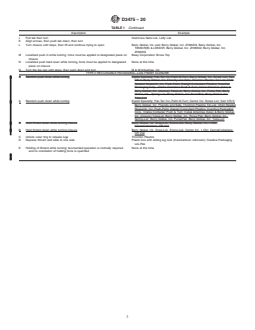
TABLE 1 Classification of Child-Resistant Packages
Description Example
TYPE I RECLOSABLE PACKAGING—CONTINUOUS THREAD CLOSURE
A Random push down while turning; no orientation of the push down force Kerr CR-I, II, III, IV and CRTE; Berry Global, Inc. Clic-Loc and Clic-Loc III,
necessary Argus-Loc; Centor Inc. Ultra-Loc, Ultra-Loc “C”; Alcoa Tot-Gard III; Van
Blarcom metal-on-metal, Saf-Cap I, II, III, and IIIA; Ferdinand Gutman; Poly
Seal Corp.; Reliable Products; Berry Global, Inc. F.G. (Final Generation),
Carow-Turnloc; Comar-Secure Cap; Reike-FS652; CCL Container Corporaton
(tube) & RPC Containers Ltd. (closure) Tube Secure; Van Blarcom Closures
Inc. Dropper Closure, Saf-Cap Convertible, 1-1/8 Beta Closure; Bericap North
America, Bericap SK28/26 CR Slitband; Sanner of America, Child Resistant
Screw Cap; Mold-rite Plastics CRC Pictorial Screw Cap, PDT Push Down &
Turn Screw Cap; Drug Plastics & Glass Co., Inc. SecuRx; Gerresheimer
Boleslawiec S.A. NG 38C; Berry Global, Inc. CR-I/TEIII; Berry Global, Inc.
CR-III; Berry Global, Inc. CR3A/LR; Berry Global, Inc. CR5; Berry Global, Inc.
CR4; Berry Global, Inc. MAC Duma
B Localized squeeze force while turning; the force must be applied to a Econo-Lok, DOT, Dougherty Brothers; Fastex; Berry Global, Inc. Squeeze and
designated location on the closure skirt Turn; Berry Global, Inc.-Squeeze & turn jigger-Lite-touch; Weatherchem-Top
Squeeze; Kerr-Tab II Squeeze & Turn; Rieke FS633, HZ43CR, HZ24CR; US
Can-Screw top; Squeeze Lok Low Profile, FG; Rieke Corporation Stolz
HZ32CR; Val-Pak Products, 63-400 Squeeze Cap; Berry Global, Inc. DOT
Series DCR; Berry Global, Inc. DOT Series DCR-TI; Berry Global, Inc. Drain
Back System; Berry Global, Inc. Jigger; Berry Global, Inc. Quarter-Turn;
Berry Global, Inc. Snap-Lok II; Berry Global, Inc. Squeeze and Turn; Berry
Global, Inc. SQL; Berry Global, Inc. Tab II; Pollen, Double Squeeze
C Random squeeze while turning; no orientation of the squeeze force is
necessary
D Holding a fitment while turning; two-handed operation is normally required Thomas Closure Moldcraft; M&MIndustries, Inc.-Life Latch; Berry Global, Inc.
Lite-Touch
E Key or device required to open Research and Devices; Ben King Associates Baby Safe; Tredegar
F Random lift while turning; no orientation of the lift force is necessary
G Localized lift of cap skirt or tab on closure while turning Charles A. Breskin; Alcoa Tot Gard II
H Localized push down while turning; force must be applied to a designated Mack Wayne Plastics; Anchor Hocking Mold Craft; Berry Global, Inc.
place on the top of the closure
I Set combination before turning None at this time
J Pull tab then turn Intermova Gate Lok, Lefty Lok
K Align arrows, then push tab down, then turn
L Turn closure until stops, then lift and continue trying to open Berry Global, Inc.-pail; Berry Global, Inc. ZH05SQ; Berry Global, Inc.
T05SCR(B) & L05SCR; Berry Global, Inc. ZH05SQ; Berry Global, Inc.
ZH50SQ
M Localized push in while turning, force must be applied to designated place on Bway Corporation Screw Top
closure
N Localized push back lever while turning, force must be applied to designated None at this time
place on closure
O Turn the top cap until stops, then push down and turn M&MIndustries, Inc
TYPE II RECLOSABLE PACKAGING—LUG FINISH CLOSURE
A Random push down while turning Eyelet Specialty; Pac-Tec Inc.-Palm-N-Turn; Centor Inc. Screw Loc; Kerr CR-V;
Berry Global, Inc. Friendly and Safe; Thornton Plastics Tot-Lok; Child Related
Research, Inc. Push-Palm; Design Consultant Plastics; Inventive Packaging
Corp., Clarke Container Push & Turn; Cebal Americas (tube) & Berry Global,
Inc. (closure) TubeLok; Berry Global, Inc. Purse Pak; Berry Global, Inc.,
Spring-Loc; Berry Global, Inc. PursePak; Berry Global, Inc. Tube-Loc
B Hold fitment down while turning closure Berry Global, Inc. Snap-Lok, Econo-Lok; Centor Inc. 1-Clic; CannaContainers,
CR Vial
C Unlock outer ring to release lugs Thornton Plastics
D Depress fitment and slide to one side Plastic box with sliding lug lock (manufacturer unknown); Creative Packaging
Lok-Pak
E Holding of fitment while turning; two-handed operation is normally required None at this time
and no orientation of holding force is specified
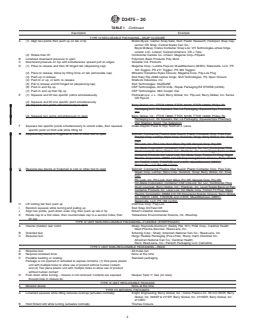
D3475 − 20
TABLE 1 Continued
Description Example
TYPE III RECLOSABLE PACKAGING—SNAP CLOSURE
A(1) Align two points then push up on tab or lip Bristol-Myers; Calmar Snap Safe; Stull; Plastic Research; Henlopen Snap Cap;
Lermer CR Snap; Central States Can Co.;
Boyle Midway; Clarke Container Snap Lok; VH Technologies-virtual hinge
Lutaloc LLC, Lutaloc; CannaContainers, CR J-Tube
(2) Rotate then lift Continental Carlisle Co. Unikon; Magenta Corp.-Pillpack
B Localized downward pressure to open Polymold; Basic Products Poly Mold
C Downward pressure on top with simultaneous upward pull on edges Versatile Ind. Products
D(1) Press to release and then lift hinged tab (dispensing cap) Magenta Corp.; Lumlite PopLok; MeadWestvaco (MWV): Slatersville, LLC; PS
194 Toggloc, PS 211 Toggloc, PS 355 Toggloc.
(2) Press to release, follow by lifting force on tab (removable cap) Wheaton Industries Ryles Closure; Magenta Corp. Pop-Lok Plug
(3) Push up to release Stull Easy Flip 2008 captive hinge; Stull Technologies, Pry Open Closure
(4) Push in or up, or both, to release Shellvick Industries, Inc.
(5) Pull to release and lift hinged lid (dispensing cap) Stull Technologies: StullSURE
(6) Push in and flip up CSP Technologies, ACTIV-VIAL; Ropak Packaging EZ STOR® (UC2G)
(7) Push in and up then flip up CSP Technologies, Mini Cooper Vial
E(1) Squeeze and lift two specific points simultaneously Pennwalt-Lye; J. L. Clark; Berry Global, Inc. Flip-Lok; Berry Global, Inc. Series
CR FlipLok
(2) Squeeze and lift one specific point simultaneously
(3) Squeeze two points simultaneously to open Berry Global, Inc.; FTCR 19000, FTCR 19100, FTCR 19500; Philips Rx
Packaging LLC, Rx Squeeze Vial; LA Packaging, SqueezeTops Pharmacy
Vial; Stephen Gould, The Safelylock
F Squeeze two specific points simultaneously to unlock sides, then squeeze Shaw-Clayton Press N Pop; Norman J. Larus
specific point on third side while lifting lid
...
This document is not an ASTM standard and is intended only to provide the user of an ASTM standard an indication of what changes have been made to the previous version. Because
it may not be technically possible to adequately depict all changes accurately, ASTM recommends that users consult prior editions as appropriate. In all cases only the current version
of the standard as published by ASTM is to be considered the official document.
Designation: D3475 − 18 D3475 − 20
Standard Classification of
Child-Resistant Packages
This standard is issued under the fixed designation D3475; the number immediately following the designation indicates the year of
original adoption or, in the case of revision, the year of last revision. A number in parentheses indicates the year of last reapproval. A
superscript epsilon (´) indicates an editorial change since the last revision or reapproval.
1. Scope
1.1 This classification covers various types of child-resistant packages.
1.2 The examples for each type of child-resistant packaging are not intended to be all-inclusive, but are included only as an aid
in the understanding and comprehension of each type of classification.
1.3 Listings are not to be considered endorsements or approval of the package by ASTM.
1.4 This international standard was developed in accordance with internationally recognized principles on standardization
established in the Decision on Principles for the Development of International Standards, Guides and Recommendations issued
by the World Trade Organization Technical Barriers to Trade (TBT) Committee.
2. Terminology
2.1 Definitions of Terms Specific to This Standard:
2.1.1 child-resistant package—as defined by the Poison Prevention Packaging Act, packaging that is designed or constructed
to be significantly difficult for children under five years of age to open or obtain a toxic or harmful amount of the substance
contained therein within a reasonable time, and not difficult for normal adults to use properly, but does not mean packaging which
all such children cannot open or obtain a toxic or harmful amount within a reasonable time.
2.1.2 unit dose package—an immediate product container/package designed and labeled in such a manner that each individual
product package is intended to be opened or used one time in a generally non-reclosable or non-resealable manner, separately from
the other individual product units in the package, or the entire contents of a single unit package intended for use in one application.
2.1.2.1 Discussion—
Normally used for pharmaceutical, human healthcare, and nutritional products in dry solid, topical, transdermal, or liquid form.
A unit of sale package may contain one or more individual unit dose packages, that is, individually wrapped transdermal patches,
pre-filled syringes and syringe cartridges, blister cards with multiple tablets or capsules, and so forth. Unit dose packages may or
may not be child-resistant in accordance with the regulatory requirements of the package contents.
2.1.3 unit use/single use package—an immediate product container/package, which may include label directions for use,
designed in such a manner that each individual product package is intended to be opened or used one time separately from the other
individual product units in the package, or the entire contents of a single unit package intended for use in one application.
2.1.3.1 Discussion—
These packages are generally non-reclosable or non-reusable. A unit of sale package may consist of one or more non-reusable
individual packages. Generally used for household, automotive, chemical, pesticide, veterinary, garden and other products not
intended for human ingestion. Package styles may include some aerosol, that is, foggers, soluble film, canisters, pouches, and so
forth, filled with liquids, dries, powders, and other product forms. Packages may or may not be child-resistant in accordance with
the regulatory requirements of the package contents.
This classification is under the jurisdiction of ASTM Committee F02 on Primary Barrier Packaging and is the direct responsibility of Subcommittee F02.50 on Package
Design and Development.
Current edition approved April 15, 2018May 1, 2020. Published June 2018August 2020. Originally approved in 1976. Last previous edition approved in 2018 as
D3475 – 18. DOI: 10.1520/D3475-18.10.1520/D3475-20.
Code of Federal Regulations, Title 16, Part 1700 and Title 40, Part 157. Available from U.S. Government Printing Office Superintendent of Documents, 732 N. Capitol
St., NW, Mail Stop: SDE, Washington, DC 20401, http://www.access.gpo.gov.
Copyright © ASTM International, 100 Barr Harbor Drive, PO Box C700, West Conshohocken, PA 19428-2959. United States
D3475 − 20
3. Significance and Use
3.1 This classification scheme defines the type of motions, skills, or tools required for a particular type of child-resistant package
and provides examples of current packaging within that type.
3.2 Reference to a particular package in this classification is not intended in any manner to denote endorsement or approval of
the package by ASTM.
3.3 Packages have been included as examples based on manufacturers’ claims of child-resistance. Child-resistant package
functionality for any specific product type must be determined by the packager/manufacturer following the guidelines of the PPPA
of 1970 and the most current version of the CFR Title 16 Part 1700 and Title 40 Part 157. The listing of a package in this
classification is not an indication of whether or not it has been successfully tested in accordance with the aforementioned
guidelines.
3.4 Additions or deletions to the examples should be reported to Subcommittee F02.50 on Package Design and Development,
for incorporation into this classification during the next revision.
3.5 Additions require F02.50 Task Group review of CFR Title 16 Part 1700 full protocol testing reports. Reports should cover
procedures and all CFR Title 16 Part 1700 required reporting elements. Additional information may be requested.
3.6 Use of a package cited in this classification allows for the statement “CONFORMS TO ASTM D3475,” and does not allow
for the use of the ASTM logo or result in an ASTM certification mark.
4. Basis of Classification
4.1 The functional basis for classification and the classifications appear in Table 1.
TABLE 1 Classification of Child-Resistant Packages
Description Example
TYPE I RECLOSABLE PACKAGING—CONTINUOUS THREAD CLOSURE
A Random push down while turning; no orientation of the push down force Kerr CR-I, II, III, IV and CRTE; Berry Global, Inc. Clic-Loc and Clic-Loc III,
necessary Argus-Loc, Ultra-Loc, Ultra-Loc “C”; Alcoa Tot-Gard III; Van Blarcom metal-
on-metal, Saf-Cap I, II, III, and IIIA; Ferdinand Gutman; Poly Seal Corp.;
Reliable Products; Berry Global, Inc. F.G. (Final Generation), Carow-Turnloc;
Comar-Secure Cap; Reike-FS652; CCL Container Corporaton (tube) & RPC
Containers Ltd. (closure) Tube Secure; Van Blarcom Closures Inc. Dropper
Closure, Saf-Cap Convertible, 1-1/8 Beta Closure; Bericap North America,
Bericap SK28/26 CR Slitband; Sanner of America, Child Resistant Screw
Cap; Mold-rite Plastics CRC Pictorial Screw Cap, PDT Push Down & Turn
Screw Cap; Drug Plastics & Glass Co., Inc. SecuRx; Gerresheimer
Boleslawiec S.A. NG 38C; Berry Global, Inc. CR-I/TEIII; Berry Global, Inc.
CR-III; Berry Global, Inc. CR3A/LR; Berry Global, Inc. CR5; Berry Global, Inc.
CR4; Berry Global, Inc. MAC Duma
A Random push down while turning; no orientation of the push down force Kerr CR-I, II, III, IV and CRTE; Berry Global, Inc. Clic-Loc and Clic-Loc III,
necessary Argus-Loc; Centor Inc. Ultra-Loc, Ultra-Loc “C”; Alcoa Tot-Gard III; Van
Blarcom metal-on-metal, Saf-Cap I, II, III, and IIIA; Ferdinand Gutman; Poly
Seal Corp.; Reliable Products; Berry Global, Inc. F.G. (Final Generation),
Carow-Turnloc; Comar-Secure Cap; Reike-FS652; CCL Container Corporaton
(tube) & RPC Containers Ltd. (closure) Tube Secure; Van Blarcom Closures
Inc. Dropper Closure, Saf-Cap Convertible, 1-1/8 Beta Closure; Bericap North
America, Bericap SK28/26 CR Slitband; Sanner of America, Child Resistant
Screw Cap; Mold-rite Plastics CRC Pictorial Screw Cap, PDT Push Down &
Turn Screw Cap; Drug Plastics & Glass Co., Inc. SecuRx; Gerresheimer
Boleslawiec S.A. NG 38C; Berry Global, Inc. CR-I/TEIII; Berry Global, Inc.
CR-III; Berry Global, Inc. CR3A/LR; Berry Global, Inc. CR5; Berry Global, Inc.
CR4; Berry Global, Inc. MAC Duma
B Localized squeeze force while turning; the force must be applied to a Econo-Lok, DOT, Dougherty Brothers; Fastex; Berry Global, Inc. Squeeze and
designated location on the closure skirt Turn; Berry Global, Inc.-Squeeze & turn jigger-Lite-touch; Weatherchem-Top
Squeeze; Kerr-Tab II Squeeze & Turn; Rieke FS633, HZ43CR, HZ24CR; US
Can-Screw top; Squeeze Lok Low Profile, FG; Rieke Corporation Stolz
HZ32CR; Val-Pak Products, 63-400 Squeeze Cap; Berry Global, Inc. DOT
Series DCR; Berry Global, Inc. DOT Series DCR-TI; Berry Global, Inc. Drain
Back System; Berry Global, Inc. Jigger; Berry Global, Inc. Quarter-Turn;
Berry Global, Inc. Snap-Lok II; Berry Global, Inc. Squeeze and Turn; Berry
Global, Inc. SQL; Berry Global, Inc. Tab II; Pollen, Double Squeeze
C Random squeeze while turning; no orientation of the squeeze force is
necessary
D Holding a fitment while turning; two-handed operation is normally required Thomas Closure Moldcraft; M & M Industries, Inc.-Life Latch; Berry Global, Inc.
Lite-Touch
E Key or device required to open Research and Devices; Ben King Associates Baby Safe; Tredegar
F Random lift while turning; no orientation of the lift force is necessary
G Localized lift of cap skirt or tab on closure while turning Charles A. Breskin; Alcoa Tot Gard II
H Localized push down while turning; force must be applied to a designated Mack Wayne Plastics; Anchor Hocking Mold Craft; Berry Global, Inc.
place on the top of the closure
I Set combination before turning None at this time
D3475 − 20
TABLE 1 Continued
Description Example
J Pull tab then turn Intermova Gate Lok, Lefty Lok
K Align arrows, then push tab down, then turn
L Turn closure until stops, then lift and continue trying to open Berry Global, Inc.-pail; Berry Global, Inc. ZH05SQ; Berry Global, Inc.
T05SCR(B) & L05SCR; Berry Global, Inc. ZH05SQ; Berry Global, Inc.
ZH50SQ
M Localized push in while turning, force must be applied to designated place on Bway Corporation Screw Top
closure
N Localized push back lever while turning, force must be applied to designated None at this time
place on closure
O Turn the top cap until stops, then push down and turn M & M Industries, Inc
TYPE II RECLOSABLE PACKAGING—LUG FINISH CLOSURE
A Random push down while turning Eyelet Specialty; Pac-Tec Inc.-Palm-N-Turn; Berry Global, Inc. Screw Loc; Kerr
CR-V; Berry Global, Inc. Friendly and Safe; Thornton Plastics Tot-Lok; Child
Related Research, Inc. Push-Palm; Design Consultant Plastics; Inventive
Packaging Corp., Clarke Container Push & Turn; Cebal Americas (tube) &
Berry Global, Inc. (closure) TubeLok; Berry Global, Inc. Purse Pak; Berry
Global, Inc., Spring-Loc; Berry Global, Inc. PursePak; Berry Global, Inc.
Tube-Loc
A Random push down while turning Eyelet Specialty; Pac-Tec Inc.-Palm-N-Turn; Centor Inc. Screw Loc; Kerr CR-V;
Berry Global, Inc. Friendly and Safe; Thornton Plastics Tot-Lok; Child Related
Research, Inc. Push-Palm; Design Consultant Plastics; Inventive Packaging
Corp., Clarke Container Push & Turn; Cebal Americas (tube) & Berry Global,
Inc. (closure) TubeLok; Berry Global, Inc. Purse Pak; Berry Global, Inc.,
Spring-Loc; Berry Global, Inc. PursePak; Berry Global, Inc. Tube-Loc
B Hold fitment down while turning closure Berry Global, Inc. Snap-Lok, Econo-Lok; Berry Global, Inc.-1-Clic;
CannaContainers, CR Vial
B Hold fitment down while turning closure Berry Global, Inc. Snap-Lok, Econo-Lok; Centor Inc. 1-Clic; CannaContainers,
CR Vial
C Unlock outer ring to release lugs Thornton Plastics
D Depress fitment and slide to one side Plastic box with sliding lug lock (manufacturer unknown); Creative Packaging
Lok-Pak
E Holding of fitment while turning; two-handed operation is normally required None at this time
and no orientation of holding force is specified
D3475 − 20
TABLE 1 Continued
Description Example
TYPE III RECLOSABLE PACKAGING—SNAP CLOSURE
A (1) Align two points then push up on tab or lip Bristol-Myers; Calmar Snap Safe; Stull; Plastic Research; Henlopen Snap Cap;
Lermer CR Snap; Central States Can Co.;
Boyle Midway; Clarke Container Snap Lok; VH Technologies-virtual hinge
Lutaloc LLC, Lutaloc; CannaContainers, CR J-Tube
(2) Rotate then lift Continental Carlisle Co. Unikon; Magenta Corp.-Pillpack
B Localized downward pressure to open Polymold; Basic Products Poly Mold
C Downward pressure on top with simultaneous upward pull on edges Versatile Ind. Products
D (1) Press to release and then lift hinged tab (dispensing cap) Magenta Corp.; Lumlite PopLok; MeadWestvaco (MWV): Slatersville, LLC; PS
194 Toggloc, PS 211 Toggloc, PS 355 Toggloc.
(2) Press to release, follow by lifting force on tab (removable cap) Wheaton Industries Ryles Closure; Magenta Corp. Pop-Lok Plug
(3) Push up to release Stull Easy Flip 2008 captive hinge; Stull Technologies, Pry Open Closure
(4) Push in or up, or both, to release Shellvick Industries, Inc.
(5) Pull to release and lift hinged lid (dispensing cap) Stull Technologies: StullSURE
(6) Push in and flip up CSP Technologies, ACTIV-VIAL; Ropak Packaging EZ STOR® (UC2G)
(7) Push in and up then flip up CSP Technologies, Mini Cooper Vial
E (1) Squeeze and lift two specific points simultaneously Pennwalt-Lye; J. L. Clark; Berry Global, Inc. Flip-Lo
...