

ASTM D4335-18
(Practice)Standard Practice for Determination of Component Retention of a Mechanical Pump Dispenser
General Information
- Abstract
SIGNIFICANCE AND USE
3.1 This practice may be used to establish performance specifications.
3.2 This practice may be used to establish quality control assessment.
SCOPE
1.1 This practice covers the evaluation of the force required to remove the hood and the actuator from a mechanical dispensing pump.
1.2 This standard does not purport to address all of the safety concerns, if any, associated with its use. It is the responsibility of the user of this standard to establish appropriate safety, health, and environmental practices and determine the applicability of regulatory limitations prior to use.
1.3 This international standard was developed in accordance with internationally recognized principles on standardization established in the Decision on Principles for the Development of International Standards, Guides and Recommendations issued by the World Trade Organization Technical Barriers to Trade (TBT) Committee.
- Status
- Published
- Publication Date
- 30-Apr-2018
- Technical Committee
- F02 - Primary Barrier Packaging
- Drafting Committee
- F02.30 - Mechanical Dispensers
Buy Documents
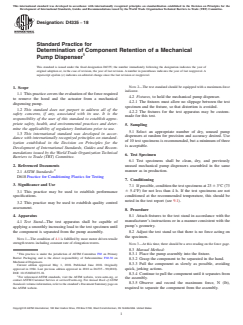


ASTM D4335-18 - Standard Practice for Determination of Component Retention of a Mechanical Pump Dispenser
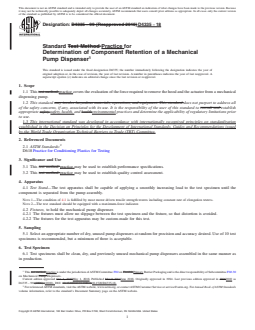
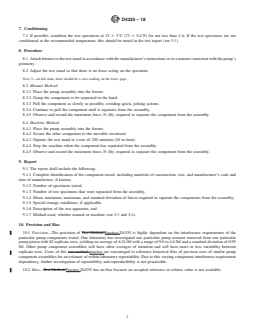


REDLINE ASTM D4335-18 - Standard Practice for Determination of Component Retention of a Mechanical Pump Dispenser
Overview
ASTM D4335-18: Standard Practice for Determination of Component Retention of a Mechanical Pump Dispenser is a widely recognized standard developed by ASTM International. This standard outlines procedures for evaluating the force required to remove critical components-specifically the hood and actuator-from mechanical pump dispensers. By following this practice, manufacturers and quality control professionals can establish performance specifications and ensure consistent, reliable product quality.
ASTM D4335-18 serves as a key reference in the packaging industry, particularly for products utilizing mechanical pump dispensers. It supports quality control assessment by providing a uniform method for testing the retention of assembled components.
Key Topics
- Component Retention Assessment: Defines the procedures to measure the force necessary to detach the pump dispenser’s hood and actuator, offering insights into assembly integrity and safety.
- Test Methods: Details both manual and machine-based approaches for testing component retention on mechanical pump dispensers.
- Manual Method: Specifies step-by-step instructions for hands-on separation and force measurement.
- Machine Method: Describes use of tensile strength testers or constant rate of elongation testers to apply force at a controlled rate.
- Sampling and Test Specimen Preparation: Recommends random sampling of unused, production-assembled dispensers and conditioning of specimens for consistency.
- Reporting Requirements: Outlines essential elements to include in the test report, such as identification of tested components, number of specimens, statistical outcomes (mean, min, max, standard deviation), and test conditions.
- Precision and Bias: Explains sources of variation in results based on component design and assembly, and notes the absence of standard reference values for bias.
Applications
- Product Development: Enables manufacturers of mechanical pump dispensers and packaging solutions to validate the mechanical integrity of their product designs.
- Performance Specification: Assists organizations in developing and communicating force retention criteria for pump assemblies, supporting compliance and customer satisfaction.
- Quality Control: Supports batch-to-batch consistency by providing a reproducible test for component retention strength, reducing field failures and recalls.
- Supplier Evaluation: Provides a basis for auditing and qualifying suppliers by requiring conformance to proven retention standards and documented test results.
- Regulatory Compliance: Aligns with international standards development principles, facilitating market access and compliance with trade and quality regulations.
Related Standards
The following ASTM standards are often referenced alongside or in conjunction with ASTM D4335-18:
- ASTM D618: Practice for Conditioning Plastics for Testing - ensures specimens are properly conditioned to standardized environmental conditions prior to testing.
- Other ASTM Packaging Standards: Consult ASTM’s portfolio of flexible packaging and dispenser testing standards for complementary test methods and best practices.
Keywords: ASTM D4335-18, mechanical pump dispenser, component retention, performance specification, quality control, packaging industry, force measurement, testing standards.
By adhering to ASTM D4335-18, organizations enhance product reliability, support regulatory compliance, and uphold high standards for mechanical pump dispenser performance within the global market.
Relations
- Effective Date
- 01-May-2018
- Effective Date
- 01-Nov-2008
- Effective Date
- 01-Nov-2005
- Effective Date
- 10-Nov-2000
Buy Documents
ASTM D4335-18 - Standard Practice for Determination of Component Retention of a Mechanical Pump Dispenser
REDLINE ASTM D4335-18 - Standard Practice for Determination of Component Retention of a Mechanical Pump Dispenser
Get Certified
Connect with accredited certification bodies for this standard

BRCGS (Brand Reputation Compliance Global Standards)
Global food safety and quality standards owner.
Sponsored listings
Frequently Asked Questions
ASTM D4335-18 is a standard published by ASTM International. Its full title is "Standard Practice for Determination of Component Retention of a Mechanical Pump Dispenser". This standard covers: SIGNIFICANCE AND USE 3.1 This practice may be used to establish performance specifications. 3.2 This practice may be used to establish quality control assessment. SCOPE 1.1 This practice covers the evaluation of the force required to remove the hood and the actuator from a mechanical dispensing pump. 1.2 This standard does not purport to address all of the safety concerns, if any, associated with its use. It is the responsibility of the user of this standard to establish appropriate safety, health, and environmental practices and determine the applicability of regulatory limitations prior to use. 1.3 This international standard was developed in accordance with internationally recognized principles on standardization established in the Decision on Principles for the Development of International Standards, Guides and Recommendations issued by the World Trade Organization Technical Barriers to Trade (TBT) Committee.
SIGNIFICANCE AND USE 3.1 This practice may be used to establish performance specifications. 3.2 This practice may be used to establish quality control assessment. SCOPE 1.1 This practice covers the evaluation of the force required to remove the hood and the actuator from a mechanical dispensing pump. 1.2 This standard does not purport to address all of the safety concerns, if any, associated with its use. It is the responsibility of the user of this standard to establish appropriate safety, health, and environmental practices and determine the applicability of regulatory limitations prior to use. 1.3 This international standard was developed in accordance with internationally recognized principles on standardization established in the Decision on Principles for the Development of International Standards, Guides and Recommendations issued by the World Trade Organization Technical Barriers to Trade (TBT) Committee.
ASTM D4335-18 is classified under the following ICS (International Classification for Standards) categories: 55.020 - Packaging and distribution of goods in general. The ICS classification helps identify the subject area and facilitates finding related standards.
ASTM D4335-18 has the following relationships with other standards: It is inter standard links to ASTM D4335-99(2010), ASTM D618-08, ASTM D618-05, ASTM D618-00. Understanding these relationships helps ensure you are using the most current and applicable version of the standard.
ASTM D4335-18 is available in PDF format for immediate download after purchase. The document can be added to your cart and obtained through the secure checkout process. Digital delivery ensures instant access to the complete standard document.
Standards Content (Sample)
This international standard was developed in accordance with internationally recognized principles on standardization established in the Decision on Principles for the
Development of International Standards, Guides and Recommendations issued by the World Trade Organization Technical Barriers to Trade (TBT) Committee.
Designation: D4335 − 18
Standard Practice for
Determination of Component Retention of a Mechanical
Pump Dispenser
This standard is issued under the fixed designation D4335; the number immediately following the designation indicates the year of
original adoption or, in the case of revision, the year of last revision. A number in parentheses indicates the year of last reapproval. A
superscript epsilon (´) indicates an editorial change since the last revision or reapproval.
NOTE 2—The test standard should be equipped with a maximum-force
1. Scope
indicator.
1.1 This practice covers the evaluation of the force required
4.2 Fixtures, to hold the mechanical pump dispenser.
to remove the hood and the actuator from a mechanical
4.2.1 The fixtures must allow no slippage between the test
dispensing pump.
specimen and the fixture, so that distortion is avoided.
1.2 This standard does not purport to address all of the
4.2.2 The fixtures for the test apparatus may be custom-
safety concerns, if any, associated with its use. It is the
made for this test.
responsibility of the user of this standard to establish appro-
priate safety, health, and environmental practices and deter-
5. Sampling
mine the applicability of regulatory limitations prior to use.
5.1 Select an appropriate number of dry, unused pump
1.3 This international standard was developed in accor-
dispensers at random for precision and accuracy desired. Use
dance with internationally recognized principles on standard-
of 10 test specimens is recommended, but a minimum of three
ization established in the Decision on Principles for the
is acceptable.
Development of International Standards, Guides and Recom-
mendations issued by the World Trade Organization Technical
6. Test Specimen
Barriers to Trade (TBT) Committee.
6.1 Test specimens shall be clean, dry, and previously
2. Referenced Documents
unused mechanical pump dispensers assembled in the same
manner as in production.
2.1 ASTM Standards:
D618 Practice for Conditioning Plastics for Testing
7. Conditioning
3. Significance and Use
7.1 If possible, condition the test specimens at 23 6 3°C (73
6 5.4°F) for not less than 4 h. If the test specimens are not
3.1 This practice may be used to establish performance
conditioned at the recommended temperature, this should be
specifications.
noted in the test report (see 9.1).
3.2 This practice may be used to establish quality control
assessment.
8. Procedure
4. Apparatus 8.1 Attach fixtures to the test stand in accordance with the
manufacturer’s instructions or in a manner consistent with the
4.1 Test Stand—The test apparatus shall be capable of
pump’s geometry.
applying a smoothly increasing load to the test specimen until
the component is separated from the pump assembly.
8.2 Adjust the test stand so that there is no force acting on
the specimen.
NOTE 1—The condition of 4.1 is fulfilled by most motor driven tensile
strength testers including constant rate of elongation testers.
NOTE 3—At this time, there should be a zero reading on the force gage.
8.3 Manual Method:
This practice is under the jurisdiction of ASTM Committee F02 on Primary
8.3.1 Place the pump assembly into the fixture.
Barrier Packaging and is the direct responsibility of Subcommittee F02.30 on
8.3.2 Grasp the component to be separated in the hand.
Mechanical Dispensers.
8.3.3 Pull the component as slowly as possible, avoiding
Current edition approved May 1, 2018. Published June 2018. Originally
quick, jerking actions.
approved in 1984. Last previous edition approved in 2010 as D4335 – 99(2010).
DOI: 10.1520/D4335-18.
8.3.4 Continue to pull the component until it separates from
For referenced ASTM standards, visit the ASTM website, www.astm
...
This document is not an ASTM standard and is intended only to provide the user of an ASTM standard an indication of what changes have been made to the previous version. Because
it may not be technically possible to adequately depict all changes accurately, ASTM recommends that users consult prior editions as appropriate. In all cases only the current version
of the standard as published by ASTM is to be considered the official document.
Designation: D4335 − 99 (Reapproved 2010) D4335 − 18
Standard Test Method Practice for
Determination of Component Retention of a Mechanical
Pump Dispenser
This standard is issued under the fixed designation D4335; the number immediately following the designation indicates the year of
original adoption or, in the case of revision, the year of last revision. A number in parentheses indicates the year of last reapproval. A
superscript epsilon (´) indicates an editorial change since the last revision or reapproval.
1. Scope
1.1 This test method practice covers the evaluation of the force required to remove the hood and the actuator from a mechanical
dispensing pump.
1.2 This standard may involve hazardous materials, operations, and equipment. This standard does not purport to address all
of the safety concerns, if any, associated with its use. It is the responsibility of the user of this standard to consult and establish
appropriate safety safety, health, and healthenvironmental practices and determine the applicability of regulatory limitations prior
to use.
1.3 This international standard was developed in accordance with internationally recognized principles on standardization
established in the Decision on Principles for the Development of International Standards, Guides and Recommendations issued
by the World Trade Organization Technical Barriers to Trade (TBT) Committee.
2. Referenced Documents
2.1 ASTM Standards:
D618 Practice for Conditioning Plastics for Testing
3. Significance and Use
3.1 This test method practice may be used to establish performance specifications.
3.2 This test method practice may be used to establish quality control assessment.
4. Apparatus
4.1 Test Stand—The test apparatus shall be capable of applying a smoothly increasing load to the test specimen until the
component is separated from the pump assembly.
NOTE 1—The condition of 4.1 is fulfilled by most motor driven tensile strength testers including constant rate of elongation testers.
NOTE 2—The test standard should be equipped with a maximum-force indicator.
4.2 Fixtures, to hold the mechanical pump dispenser.
4.2.1 The fixtures must allow no slippage between the test specimen and the fixture, so that distortion is avoided.
4.2.2 The fixtures for the test apparatus may be custom-made for this test.
5. Sampling
5.1 Select an appropriate number of dry, unused pump dispensers at random for precision and accuracy desired. Use of 10 test
specimens is recommended, but a minimum of three is acceptable.
6. Test Specimen
6.1 Test specimens shall be clean, dry, and previously unused mechanical pump dispensers assembled in the same manner as
in production.
This test method practice is under the jurisdiction of ASTM Committee F02 on FlexiblePrimary Barrier Packaging and is the direct responsibility of Subcommittee F02.30
on Mechanical Pump Dispensers.
Current edition approved Oct. 1, 2010May 1, 2018. Published March 2011June 2018. Originally approved in 1984. Last previous edition approved in 20062010 as
D4335 – 99 (2006). (2010). DOI: 10.1520/D4335-99R10.10.1520/D4335-18.
For referenced ASTM standards, visit the ASTM website, www.astm.org, or contact ASTM Customer Service at service@astm.org. For Annual Book of ASTM Standards
volume information, refer to the standard’s Document Summary page on the ASTM website.
Copyright © ASTM International, 100 Barr Harbor Drive, PO Box C700, West Conshohocken, PA 19428-2959. United States
D4335 − 18
7. Conditioning
7.1 If possible, condition the test specimens at 23 6 3°C (73 6 5.4°F) for not less than 4 h. If the test specimens are not
conditioned at the recommended temperature, this should be noted in the test report (see 9.1).
8. Procedure
8.1 Attach fixtures to the test stand in accordance with t
...