

ASTM B369/B369M-20
(Specification)Standard Specification for Copper-Nickel Alloy Castings
General Information
- Abstract
ABSTRACT
This specification establishes the requirements for threadless, seamless, and deoxidized copper pipes in straight lengths, in all nominal or standard pipe sizes, for piping systems that are assembled with brazed-joint pipe fittings. The pipe shall be produced from coppers with either UNS No. C10300 or C12200. The materials for manufacture shall be cast billets, bars, or tubes of such purity and soundness as to be suitable for processing by hot extrusion or piercing, and subsequent cold working to produce a uniform wrought structure in the finished product. Products shall be produced in the H58 (drawn general purpose) temper. Products shall be sampled and prepared, then tested accordingly to examine their conformance to dimensional (outer and inner diameters, wall thickness, cross-sectional area, theoretical weight, mass, length, and roundness or squareness), mechanical (tensile strength and Rockwell hardness), and chemical composition requirements. Products shall also meet performance requirements under microscopical examination, electromagnetic (eddy-current) test, hydrostatic test, and pneumatic test.
SCOPE
1.1 This specification establishes the requirements for copper-nickel alloy castings with nominal compositions shown in Table 1.
1.2 Castings of these alloys are used primarily for corrosion-resistance applications such as construction or pressure vessels, particularly for marine pumps, valves, and fittings.
1.3 These alloys are considered weldable, but they may be ordered with a weld test to ensure weldability. When extensive welding is to be performed on the casting, weldability tests should be specified in the ordering information (5.2.6) to ensure proper welding characteristics.
1.4 Units—The values stated in either inch-pound units or SI units are to be regarded separately as standard. Within the text, SI units are shown in brackets. The values stated in each system are not necessarily exact equivalents; therefore, to ensure conformance with the standard, each system shall be used independently of the other, and values from the two systems shall not be combined.
1.5 The following hazard statement applies only to Section 8, Weldability Test, of this specification.This standard does not purport to address all of the safety concerns, if any, associated with its use. It is the responsibility of the user of this standard to establish appropriate safety, health, and environmental practices and determine the applicability of regulatory limitations prior to use.
1.6 This international standard was developed in accordance with internationally recognized principles on standardization established in the Decision on Principles for the Development of International Standards, Guides and Recommendations issued by the World Trade Organization Technical Barriers to Trade (TBT) Committee.
- Status
- Published
- Publication Date
- 31-Mar-2020
- Technical Committee
- B05 - Copper and Copper Alloys
- Drafting Committee
- B05.05 - Castings and Ingots for Remelting
Overview
ASTM B369/B369M-20: Standard Specification for Copper-Nickel Alloy Castings defines the requirements for copper-nickel alloy castings, primarily intended for applications requiring high corrosion resistance. This standard specifies nominal compositions for copper alloys UNS C96200 and C96400, widely used in pressure vessels, marine equipment, pumps, valves, and related fittings. The specification addresses chemical composition, mechanical properties, weldability, and testing protocols to ensure quality and reliability of copper-nickel castings in demanding industrial environments.
Key Topics
Material Composition
- Defines copper-nickel alloys by UNS numbers (C96200, C96400)
- Specifies limits for elements such as copper, nickel, iron, manganese, silicon, niobium, and others
Mechanical Requirements
- Sets minimum values for tensile and yield strength
- Specifies elongation requirements to ensure ductility
Weldability
- Recognizes the weldable nature of the specified alloys
- Outlines optional weldability testing for projects involving extensive welding
Dimensional and Quality Controls
- Requirements for product dimensions, tolerances, and casting quality
- Procedures for marking, sampling, testing, and certification
Testing Procedures
- Tensile and bend tests, chemical analysis, and soundness verification
- Specific test protocols for weldability and pressure requirements
Compliance and Marking
- Specifies marking methods for traceability
- References requirements for ASME Boiler and Pressure Vessel Code compliance
Applications
Copper-nickel alloy castings certified to ASTM B369/B369M-20 are critical in industries where corrosion resistance and mechanical reliability are essential. Primary applications include:
Marine Engineering
- Seawater pumps, valves, heat exchangers, and fittings for shipbuilding and offshore installations
Pressure Vessels and Piping Systems
- Components of pressure vessels operating in corrosive environments
- Valves, flanges, and piping used in desalination and chemical processing plants
Oil & Gas and Power Generation
- Equipment exposed to saline or aggressive industrial waters
- Components in thermal and hydro power stations
General Fabrication
- Weldable castings for custom assemblies and repairs in corrosive and high-stress environments
With strong resistance to biofouling and seawater corrosion, copper-nickel alloys per ASTM B369/B369M-20 are a trusted choice for long-term reliability.
Related Standards
- ASTM B824: General Requirements for Copper Alloy Castings
- ASTM B208: Practice for Preparing Tension Test Specimens for Copper Alloy Castings
- ASTM B846: Terminology for Copper and Copper Alloys
- AWS A5.6: Specification for Copper and Copper-Alloy Arc-Welding Electrodes
- ASME Boiler and Pressure Vessel Code: For pressure boundary applications
- MIL-STD-129, MIL-STD-248, MIL-STD-278: Standards for marking, welding, and casting in military and government procurement
These referenced standards provide additional requirements for manufacturing, testing, terminology, and sample preparation relevant to copper-nickel castings.
Keywords: ASTM B369/B369M-20, copper-nickel alloy castings, C96200, C96400, corrosion resistance, marine pumps, valves, pressure vessels, weldability, testing, ASTM standards.
Relations
- Effective Date
- 01-Apr-2020
- Effective Date
- 01-Aug-2019
- Effective Date
- 01-Jan-2019
- Effective Date
- 01-Apr-2017
- Effective Date
- 15-Oct-2016
- Effective Date
- 01-Apr-2014
- Effective Date
- 01-Jun-2011
- Effective Date
- 01-Apr-2011
- Effective Date
- 01-Jan-2011
- Effective Date
- 15-Nov-2009
- Effective Date
- 01-Nov-2009
- Effective Date
- 01-Apr-2009
- Effective Date
- 15-Nov-2006
- Effective Date
- 15-May-2006
- Effective Date
- 01-Feb-2006
Get Certified
Connect with accredited certification bodies for this standard

Element Materials Technology
Materials testing and product certification.

Inštitut za kovinske materiale in tehnologije
Institute of Metals and Technology. Materials testing, metallurgical analysis, NDT.
Sponsored listings
Frequently Asked Questions
ASTM B369/B369M-20 is a technical specification published by ASTM International. Its full title is "Standard Specification for Copper-Nickel Alloy Castings". This standard covers: ABSTRACT This specification establishes the requirements for threadless, seamless, and deoxidized copper pipes in straight lengths, in all nominal or standard pipe sizes, for piping systems that are assembled with brazed-joint pipe fittings. The pipe shall be produced from coppers with either UNS No. C10300 or C12200. The materials for manufacture shall be cast billets, bars, or tubes of such purity and soundness as to be suitable for processing by hot extrusion or piercing, and subsequent cold working to produce a uniform wrought structure in the finished product. Products shall be produced in the H58 (drawn general purpose) temper. Products shall be sampled and prepared, then tested accordingly to examine their conformance to dimensional (outer and inner diameters, wall thickness, cross-sectional area, theoretical weight, mass, length, and roundness or squareness), mechanical (tensile strength and Rockwell hardness), and chemical composition requirements. Products shall also meet performance requirements under microscopical examination, electromagnetic (eddy-current) test, hydrostatic test, and pneumatic test. SCOPE 1.1 This specification establishes the requirements for copper-nickel alloy castings with nominal compositions shown in Table 1. 1.2 Castings of these alloys are used primarily for corrosion-resistance applications such as construction or pressure vessels, particularly for marine pumps, valves, and fittings. 1.3 These alloys are considered weldable, but they may be ordered with a weld test to ensure weldability. When extensive welding is to be performed on the casting, weldability tests should be specified in the ordering information (5.2.6) to ensure proper welding characteristics. 1.4 Units—The values stated in either inch-pound units or SI units are to be regarded separately as standard. Within the text, SI units are shown in brackets. The values stated in each system are not necessarily exact equivalents; therefore, to ensure conformance with the standard, each system shall be used independently of the other, and values from the two systems shall not be combined. 1.5 The following hazard statement applies only to Section 8, Weldability Test, of this specification.This standard does not purport to address all of the safety concerns, if any, associated with its use. It is the responsibility of the user of this standard to establish appropriate safety, health, and environmental practices and determine the applicability of regulatory limitations prior to use. 1.6 This international standard was developed in accordance with internationally recognized principles on standardization established in the Decision on Principles for the Development of International Standards, Guides and Recommendations issued by the World Trade Organization Technical Barriers to Trade (TBT) Committee.
ABSTRACT This specification establishes the requirements for threadless, seamless, and deoxidized copper pipes in straight lengths, in all nominal or standard pipe sizes, for piping systems that are assembled with brazed-joint pipe fittings. The pipe shall be produced from coppers with either UNS No. C10300 or C12200. The materials for manufacture shall be cast billets, bars, or tubes of such purity and soundness as to be suitable for processing by hot extrusion or piercing, and subsequent cold working to produce a uniform wrought structure in the finished product. Products shall be produced in the H58 (drawn general purpose) temper. Products shall be sampled and prepared, then tested accordingly to examine their conformance to dimensional (outer and inner diameters, wall thickness, cross-sectional area, theoretical weight, mass, length, and roundness or squareness), mechanical (tensile strength and Rockwell hardness), and chemical composition requirements. Products shall also meet performance requirements under microscopical examination, electromagnetic (eddy-current) test, hydrostatic test, and pneumatic test. SCOPE 1.1 This specification establishes the requirements for copper-nickel alloy castings with nominal compositions shown in Table 1. 1.2 Castings of these alloys are used primarily for corrosion-resistance applications such as construction or pressure vessels, particularly for marine pumps, valves, and fittings. 1.3 These alloys are considered weldable, but they may be ordered with a weld test to ensure weldability. When extensive welding is to be performed on the casting, weldability tests should be specified in the ordering information (5.2.6) to ensure proper welding characteristics. 1.4 Units—The values stated in either inch-pound units or SI units are to be regarded separately as standard. Within the text, SI units are shown in brackets. The values stated in each system are not necessarily exact equivalents; therefore, to ensure conformance with the standard, each system shall be used independently of the other, and values from the two systems shall not be combined. 1.5 The following hazard statement applies only to Section 8, Weldability Test, of this specification.This standard does not purport to address all of the safety concerns, if any, associated with its use. It is the responsibility of the user of this standard to establish appropriate safety, health, and environmental practices and determine the applicability of regulatory limitations prior to use. 1.6 This international standard was developed in accordance with internationally recognized principles on standardization established in the Decision on Principles for the Development of International Standards, Guides and Recommendations issued by the World Trade Organization Technical Barriers to Trade (TBT) Committee.
ASTM B369/B369M-20 is classified under the following ICS (International Classification for Standards) categories: 77.150.30 - Copper products. The ICS classification helps identify the subject area and facilitates finding related standards.
ASTM B369/B369M-20 has the following relationships with other standards: It is inter standard links to ASTM B369-09(2016), ASTM B846-19a, ASTM B846-19, ASTM B824-17, ASTM B824-16, ASTM B824-14, ASTM B846-11a, ASTM B824-11, ASTM B846-11, ASTM B846-09a, ASTM B846-09, ASTM B824-09, ASTM B846-06a, ASTM B846-06, ASTM B208-06. Understanding these relationships helps ensure you are using the most current and applicable version of the standard.
ASTM B369/B369M-20 is available in PDF format for immediate download after purchase. The document can be added to your cart and obtained through the secure checkout process. Digital delivery ensures instant access to the complete standard document.
Standards Content (Sample)
This international standard was developed in accordance with internationally recognized principles on standardization established in the Decision on Principles for the
Development of International Standards, Guides and Recommendations issued by the World Trade Organization Technical Barriers to Trade (TBT) Committee.
Designation:B369/B369M −20
Standard Specification for
Copper-Nickel Alloy Castings
This standard is issued under the fixed designation B369/B369M; the number immediately following the designation indicates the year
of original adoption or, in the case of revision, the year of last revision. A number in parentheses indicates the year of last reapproval.
A superscript epsilon (´) indicates an editorial change since the last revision or reapproval.
This standard has been approved for use by agencies of the U.S. Department of Defense.
1. Scope* 2. Referenced Documents
2.1 ASTM Standards:
1.1 This specification establishes the requirements for
B208 Practice for Preparing Tension Test Specimens for
copper-nickel alloy castings with nominal compositions shown
Copper Alloy Sand, Permanent Mold, Centrifugal, and
in Table 1.
Continuous Castings
1.2 Castings of these alloys are used primarily for
B824 Specification for General Requirements for Copper
corrosion-resistance applications such as construction or pres-
Alloy Castings
sure vessels, particularly for marine pumps, valves, and fit-
B846 Terminology for Copper and Copper Alloys
tings.
2.2 ASME Code:
ASME Boiler and Pressure Vessel Code
1.3 These alloys are considered weldable, but they may be
2.3 AWS Standard:
ordered with a weld test to ensure weldability. When extensive
AWS A5.6 Specification for Copper and Copper-Alloy Arc-
welding is to be performed on the casting, weldability tests
Welding Electrodes
should be specified in the ordering information (5.2.6)to
ensure proper welding characteristics.
3. General Requirements
1.4 Units—The values stated in either inch-pound units or
3.1 The following sections of Specification B824 form a
SI units are to be regarded separately as standard. Within the
part of this specification. In the event of a conflict between this
text, SI units are shown in brackets. The values stated in each
specification and Specification B824, the requirements of this
system are not necessarily exact equivalents; therefore, to
specification shall take precedence.
ensure conformance with the standard, each system shall be
3.1.1 Terminology
used independently of the other, and values from the two
3.1.2 Other Requirements
systems shall not be combined.
3.1.3 Dimensions, Mass, and Permissible Variations
3.1.4 Workmanship, Finish, and Appearance
1.5 The following hazard statement applies only to Section
3.1.5 Sampling
8,WeldabilityTest, of this specification.Thisstandarddoesnot
3.1.6 Number of Tests and Retests
purport to address all of the safety concerns, if any, associated
3.1.7 Specimen Preparation
with its use. It is the responsibility of the user of this standard
3.1.8 Test Methods
to establish appropriate safety, health, and environmental
3.1.9 Significance of Numerical Limits
practices and determine the applicability of regulatory limita-
3.1.10 Inspection
tions prior to use.
3.1.11 Rejection and Rehearing
1.6 This international standard was developed in accor-
3.1.12 Certification
dance with internationally recognized principles on standard-
3.1.13 Test Report
ization established in the Decision on Principles for the
3.1.14 Product Marking
Development of International Standards, Guides and Recom-
3.1.15 Packaging and Package Marking
mendations issued by the World Trade Organization Technical
Barriers to Trade (TBT) Committee.
For referenced ASTM standards, visit the ASTM website, www.astm.org, or
contact ASTM Customer Service at service@astm.org. For Annual Book of ASTM
Standards volume information, refer to the standard’s Document Summary page on
ThisspecificationisunderthejurisdictionofASTMCommitteeB05onCopper the ASTM website.
and Copper Alloys and is the direct responsibility of Subcommittee B05.05 on Available from American Society of Mechanical Engineers (ASME), ASME
Castings and Ingots for Remelting. International Headquarters, Two Park Ave., New York, NY 10016-5990, http://
Current edition approved April 1, 2020. Published April 2020. Originally www.asme.org.
approved in 1961. Last previous edition approved in 2016 as B369 – 09 (2016). Available from American Welding Society (AWS), 8669 NW 36 St., #130,
DOI: 10.1520/B0369_B0369M–20. Miami, FL 33166-6672, http://www.aws.org.
*A Summary of Changes section appears at the end of this standard
Copyright © ASTM International, 100 Barr Harbor Drive, PO Box C700, West Conshohocken, PA 19428-2959. United States
B369/B369M−20
TABLE 1 Nominal Compositions
Composition, %
Copper Alloy UNS No.
Copper Nickel Iron Silicon Manganese Niobium
C96200 87.5 10.0 1.5 0.1 0.9 .
C96400 67.0 30.0 0.7 0.5 0.8 1.0
4. Terminology manufacturer or supplier and the purchaser. Copper may be
given as remainder and may be taken as the difference between
4.1 Fordefinitionsoftermsrelatingtocopperalloys,referto
the sum of all elements analyzed and 100 %. When all the
Terminology B846.
elements in the table are analyzed, their sum shall be 99.5 %
5. Ordering Information minimum.
5.1 Orders for castings under this specification should
7. Mechanical Properties
include the following information:
7.1 Mechanical properties shall be determined from sepa-
5.1.1 Specification title, number, and year of issue;
rately cast test bar castings, and shall conform to the require-
5.1.2 Quantity of castings;
ments shown in Table 3.
5.1.3 Copper Alloy UNS Number (Table 2);
5.1.4 Pattern or drawing number and condition (as-cast,
8. Weldability Test
machined, and so forth);
5.1.5 ASME Boiler and PressureVessel Code Requirements
8.1 When specified in the purchase order at least one test
(Section 12); and
castasshowninFig.1shallbepreparedforeachlotofwelding
5.1.6 When material is purchased for agencies of the U.S.
grade castings (5.2.6).
Government, the Supplementary Requirements of this specifi-
8.2 The block shall be molded, gated, and risered in such a
cation may be specified.
manner to produce a sound casting without defects that might
5.2 The following are optional and should be specified in
interfere with welding or the interpretation of the results of the
the purchase order when required:
test.
5.2.1 Pressure test or soundness requirements (Specification
8.3 The groove in the test block shall be completely filled
B824);
with weld deposit metal, using the manual metallic-arc process
5.2.2 Witness inspection (Specification B824);
with 0.125 in. [3.18 mm] or 0.156 in. [3.97 mm] diameter
5.2.3 Certification (Specification B824);
copper-nickel (70-30) coated electrodes conforming to classi-
5.2.4 Foundry test report (Specification B824);
ficationAWS ECuNi ofAWS SpecificationA5.6.The interpass
5.2.5 Product marking (Specification B824);
temperature need not be controlled, unless it is to be controlled
5.2.6 Weldability test (1.3, Section 8, and Table 2); and
in fabrication.
5.2.7 Approval of weld procedure and records of repairs
(Section 9). 8.4 One 0.375 in. [9.52 mm] minimum thick bend coupon
(see Fig. 2), shall be removed longitudinally from the center of
6. Chemical Composition
the welded block by machining, sawing, abrasive cutting, or
other suitable means. Cut surfaces and edges should be sanded
6.1 Thecastingsshallconformtothechemicalrequirements
smoothifnecessary.Theside-bendspecimenthenshallbebent
shown in Table 2 for the copper alloy UNS numbers specified
180° in a guided bend jig around a mandrel 1.5 in. [38.1 mm]
in the purchase order.
in diameter with the weld located at the center of the bend.
6.2 These specification limits do not preclude the presence
8.5 Cracks or other open defects exceeding 0.125 in.
of other elements. Limits may be established and analysis
[3.18 mm] measured in any direction in the fusion zone or
required for unnamed elements agreed upon between the
heat-affected zone on the convex surface of the specimen after
bending shall be cause for rejection. Cracks originating at
TABLE 2 Chemical Requirements
weld-bead undercuts, at weld-slag inclusions, or at casting
Copper Alloy UNS No. Copper Alloy UNS No.
defects shall not be cause for rejection.
C96200 C96400
Min, % Max, % Min, % Max, %
Copper balance balance
Lead . 0.01 . 0.01
Iron 1.0 1.8 0.25 1.5
TABLE 3 Mechanical Property Requirements
Nickel, incl cobalt 9.0 11.0 28.0 32.0
Copper Alloy Copper Alloy
Manganese . 1.5 . 1.5
UNS No. C96200 UNS No. C96400
Silicon . 0.50 . 0.50
A A
Niobium . 1.0 0.50 1.5 Tensile strength, min, ksi [MPa] 45 [31
...
This document is not an ASTM standard and is intended only to provide the user of an ASTM standard an indication of what changes have been made to the previous version. Because
it may not be technically possible to adequately depict all changes accurately, ASTM recommends that users consult prior editions as appropriate. In all cases only the current version
of the standard as published by ASTM is to be considered the official document.
Designation: B369 − 09 (Reapproved 2016) B369/B369M − 20
Standard Specification for
Copper-Nickel Alloy Castings
This standard is issued under the fixed designation B369;B369/B369M; the number immediately following the designation indicates the
year of original adoption or, in the case of revision, the year of last revision. A number in parentheses indicates the year of last
reapproval. A superscript epsilon (´) indicates an editorial change since the last revision or reapproval.
This standard has been approved for use by agencies of the U.S. Department of Defense.
1. Scope*
1.1 This specification establishes the requirements for copper-nickel alloy castings with nominal compositions shown in Table
1. These are as follows:
Copper Alloy UNS No. Previous Designation
C96200 Alloy A
C96400 Alloy B
1.2 Castings of these alloys are used primarily for corrosion-resistance applications such as in construction and for or pressure
vessels, particularly infor marine pumps, valves, and fittings.
1.3 These alloys are considered weldable, but they may be ordered with a weld test to ensure weldability. When extensive
welding is to be performed on the casting, weldability tests should be specified in the ordering information (5.2.6) to ensure proper
welding characteristics.
1.4 Units—The values stated in either inch-pound units or SI units are to be regarded as standard. The values given in
parentheses are mathematical conversions to SI units that are provided for information only and are not considered
standard.separately as standard. Within the text, SI units are shown in brackets. The values stated in each system are not necessarily
exact equivalents; therefore, to ensure conformance with the standard, each system shall be used independently of the other, and
values from the two systems shall not be combined.
1.5 The following hazard statement applies only to Section 8, Weldability Test, of this specification.This standard does not
purport to address all of the safety concerns, if any, associated with its use. It is the responsibility of the user of this standard to
establish appropriate safety safety, health, and healthenvironmental practices and determine the applicability of regulatory
limitations prior to use.
1.6 This international standard was developed in accordance with internationally recognized principles on standardization
established in the Decision on Principles for the Development of International Standards, Guides and Recommendations issued
by the World Trade Organization Technical Barriers to Trade (TBT) Committee.
2. Referenced Documents
2.1 ASTM Standards:
B208 Practice for Preparing Tension Test Specimens for Copper Alloy Sand, Permanent Mold, Centrifugal, and Continuous
Castings
B824 Specification for General Requirements for Copper Alloy Castings
B846 Terminology for Copper and Copper Alloys
E527 Practice for Numbering Metals and Alloys in the Unified Numbering System (UNS)
2.2 ASME Code:
ASME Boiler and Pressure Vessel Code
This specification is under the jurisdiction of ASTM Committee B05 on Copper and Copper Alloys and is the direct responsibility of Subcommittee B05.05 on Castings
and Ingots for Remelting.
Current edition approved April 1, 2016April 1, 2020. Published May 2016April 2020. Originally approved in 1961. Last previous edition approved in 20092016 as
B369 – 09.B369 – 09 (2016). DOI: 10.1520/B0369-09R16.10.1520/B0369_B0369M–20.
For referenced ASTM standards, visit the ASTM website, www.astm.org, or contact ASTM Customer Service at service@astm.org. For Annual Book of ASTM Standards
volume information, refer to the standard’sstandard’s Document Summary page on the ASTM website.
Available from American Society of Mechanical Engineers (ASME), ASME International Headquarters, Two Park Ave., New York, NY 10016-5990, http://
www.asme.org.
*A Summary of Changes section appears at the end of this standard
Copyright © ASTM International, 100 Barr Harbor Drive, PO Box C700, West Conshohocken, PA 19428-2959. United States
B369/B369M − 20
TABLE 1 Nominal Compositions
Composition, %
Copper Alloy UNS No.
Copper Nickel Iron Silicon Manganese Niobium
C96200 87.5 10.0 1.5 0.1 0.9 .
C96400 67.0 30.0 0.7 0.5 0.8 1.0
2.3 AWS Standard:
AWS A5.6 Specification for Copper and Copper-Alloy Arc-Welding Electrodes
3. General Requirements
3.1 The following sections of Specification B824 form a part of this specification. In the event of a conflict between this
specification and Specification B824, the requirements of this specification shall take precedence.
3.1.1 Terminology (Section 3),
3.1.2 Other Requirements (Section 7),
3.1.3 Dimensions, Mass, and Permissible Variations (Section 8),
3.1.4 Workmanship, Finish, and Appearance (Section 9),
3.1.5 Sampling (Section 10),
3.1.6 Number of Tests and Retests (Section 11),
3.1.7 Specimen Preparation (Section 12),
3.1.8 Test Methods (Section 13),
3.1.9 Significance of Numerical Limits (Section 14),
3.1.10 Inspection (Section 15),
3.1.11 Rejection and Rehearing (Section 16),
3.1.12 Certification (Section 17),
3.1.13 Test Report (Section 18),
3.1.14 Product Marking (Section 19), and
3.1.15 Packaging and Package Marking (Section 20).
4. Terminology
4.1 For definitions of terms relating to copper alloys, refer to Terminology B846.
5. Ordering Information
5.1 Orders for castings under this specification should include the following information:
5.1.1 Specification title, number, and year of issue;
5.1.2 Quantity of castings;
5.1.3 Copper Alloy UNS Number (Table 2);
5.1.4 Pattern or drawing number and condition (as-cast, machined, and so forth);
5.1.5 ASME Boiler and Pressure Vessel Code Requirements (Section 12); and
5.1.6 When material is purchased for agencies of the U.S. Government, the Supplementary Requirements of this specification
may be specified.
TABLE 2 Chemical Requirements
Copper Alloy UNS No. Copper Alloy UNS No.
C96200 C96400
Min, % Max, % Min, % Max, %
Copper balance balance
Lead . 0.01 . 0.01
Iron 1.0 1.8 0.25 1.5
Nickel, incl cobalt 9.0 11.0 28.0 32.0
Manganese . 1.5 . 1.5
Silicon . 0.50 . 0.50
A
Niobium . 1.0 0.50 1.5
Phosphorus . 0.02 . 0.02
Sulfur . 0.02 . 0.02
Carbon . 0.10 . 0.15
A
When product or casting is intended for subsequent welding applications, and so
specified by the purchaser, the niobium content shall be 0.40 % max.
Available from American Welding Society (AWS), 8669 NW 36 St., #130, Miami, FL 33166-6672, http://www.aws.org.
B369/B369M − 20
5.2 The following are optional and should be specified in the purchase order when required:
5.2.1 Pressure test or soundness requirements (Specification B824);
5.2.2 Witness inspection (Specification B824);
5.2.3 Certification (Specification B824);
5.2.4 Foundry test report (Specification B824);
5.2.5 Product marking (Specification B824);
5.2.6 Weldability test (1.3, Section 8, and Table 2); and
5.2.7 Approval of weld procedure and records of repairs (Section 9).
6. Chemical Composition
6.1 The castings shall conform to the chemical requirements shown in Table 2 for the copper alloy UNS numbers specified in
the purchase order.
6.2 These specification limits do not preclude the presence of other elements. Limits may be established and analysis required
for unnamed elements agreed upon between the manufacturer or supplier and the purchaser. Copper may be given as remainder
and may be taken as the difference between the sum of all elements analyzed and 100 %. When all the elements in the table are
analyzed, their sum shall be 99.5 % minimum.
7. Mechanical Properties
7.1 Mechanical properties shall be determined from separately cast test bar castings, and shall meet conform to the requirements
shown in Table 3.
8. Weldability Test
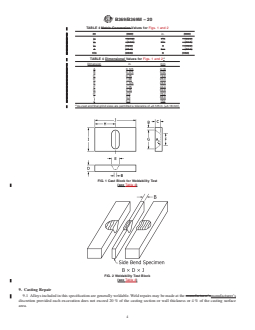
8.1 When specified in the purchase order at least one test cast as shown in Fig. 1 shall be prepared for each lot of welding grade
castings (5.2.6).
8.2 The block shall be molded, gated, and risered in such a manner to produce a sound casting without defects that might
interfere with welding or the interpretation of the results of the test.
8.3 The groove in the test block shall be completely filled with weld deposit metal, using the manual metallic-arc process with
1 5
⁄8-in. (12.7-mm) 0.125 in. [3.18 mm] or ⁄32-in. (3.97-mm) 0.156 in. [3.97 mm] diameter copper-nickel (70-30) coated electrodes
conforming to classification AWS ECuNi of AWS Specification A5.6. The interpass temperature need not be controlled, unless it
is to be controlled in fabrication.
8.4 One ⁄8-in. (9.52-mm) 0.375 in. [9.52 mm] minimum thick bend coupon (see Fig. 2), shall be removed longitudinally from
the center of the welded block by machining, sawing, abrasive cutting, or other suitable means. Cut surfaces and edges should be
sanded smooth if necessary. The side bend side-bend specimen then shall be bent 180° in a guided bend jig around a mandrel 11.5 ⁄2
in. (38.1 mm)[38.1 mm] in diameter with the weld located at the center of the bend.
8.5 Cracks or other open defects exceeding ⁄80.125 in. (3.2 mm) [3.18 mm] measured in any direction in the fusion zone or
heat-affected zone on the convex surface of the specimen after bending shall be cause for rejection. Cracks originating at weld-bead
undercuts, at weld-slag inclusions, or at casting defects shall not be cause for reje
...