

ASTM G47-22
(Test Method)Standard Test Method for Determining Susceptibility to Stress-Corrosion Cracking of 2XXX and 7XXX Aluminum Alloy Products
General Information
- Abstract
SIGNIFICANCE AND USE
4.1 The 3.5 % NaCl solution alternate immersion test provides a test environment for detecting materials that would be likely to be susceptible to SCC in natural outdoor environments, especially environments with marine influences.3,4,5 For determining actual serviceability of a material, other stress-corrosion tests should be performed in the intended service environment under conditions relating to the end use, including protective measures.
4.2 Although this test method is intended for certain alloy types and for testing products primarily in the short-transverse stressing direction, this method is useful for some other types of alloys and stressing directions.
SCOPE
1.1 This test method covers a uniform procedure for characterizing the resistance to stress-corrosion cracking (SCC) of high-strength aluminum alloy wrought products for the guidance of those who perform stress-corrosion tests, for those who prepare stress-corrosion specifications, and for materials engineers.
1.2 This test method covers method of sampling, type of specimen, specimen preparation, test environment, and method of exposure for determining the susceptibility to SCC of 2XXX (with 1.8 % to 7.0 % copper) and 7XXX (with 0.4 % to 2.8 % copper) aluminum alloy products, particularly when stressed in the short-transverse direction relative to the grain structure.
1.3 The values stated in SI units are to be regarded as standard. The values given in parentheses after SI units are provided for information only and are not considered standard.
1.4 This standard does not purport to address all of the safety concerns, if any, associated with its use. It is the responsibility of the user of this standard to establish appropriate safety, health, and environmental practices and determine the applicability of regulatory limitations prior to use.
1.5 This international standard was developed in accordance with internationally recognized principles on standardization established in the Decision on Principles for the Development of International Standards, Guides and Recommendations issued by the World Trade Organization Technical Barriers to Trade (TBT) Committee.
- Status
- Published
- Publication Date
- 30-Nov-2022
- Technical Committee
- G01 - Corrosion of Metals
- Drafting Committee
- G01.06 - Environmentally Assisted Cracking
Buy Documents
ASTM G47-22 - Standard Test Method for Determining Susceptibility to Stress-Corrosion Cracking of 2XXX and 7XXX Aluminum Alloy Products
REDLINE ASTM G47-22 - Standard Test Method for Determining Susceptibility to Stress-Corrosion Cracking of 2XXX and 7XXX Aluminum Alloy Products
Overview
ASTM G47-22: Standard Test Method for Determining Susceptibility to Stress-Corrosion Cracking of 2XXX and 7XXX Aluminum Alloy Products provides a uniform procedure for evaluating the resistance of high-strength aluminum alloy wrought products to stress-corrosion cracking (SCC). This method is especially relevant for 2XXX (copper content 1.8% to 7.0%) and 7XXX (copper content 0.4% to 2.8%) aluminum alloys, focusing primarily on products stressed in the short-transverse direction relative to the grain structure. The standard guides material engineers, test laboratories, and those preparing stress-corrosion specifications in assessing SCC susceptibility for quality assurance and material selection.
Key Topics
- Test Method Scope
Covers sampling, specimen preparation, test environments, and exposure procedures tailored for 2XXX and 7XXX aluminum alloys. - SCC Detection
Utilizes alternate immersion in 3.5% sodium chloride (NaCl) solution, simulating aggressive, marine-influenced service environments. - Test Specimens
Details types (e.g., tension, C-ring), sizes, and orientations-especially stressing short-transverse to the grain structure for optimal SCC sensitivity. - Interpretation of Results
Specifies criteria for SCC failure, including metallographic examination and differentiation from other forms of corrosion such as pitting. - Precision and Bias
Supported by interlaboratory test programs to verify reproducibility and consistency among different laboratories for common alloy tempers.
Applications
ASTM G47-22 is widely adopted across industries that utilize high-strength aluminum alloys, including:
- Aerospace
Used in qualifying aluminum materials intended for aircraft components exposed to marine or corrosive atmospheres, ensuring mechanical integrity and reliability. - Marine Engineering
Assesses alloys for shipbuilding and offshore structures where saltwater-induced SCC is a concern. - Automotive and Transportation
Ensures the selection of SCC-resistant aluminum alloys for performance-critical vehicle parts. - Manufacturing and Fabrication
Assists suppliers and manufacturers in verifying material certification and fitness for environments prone to chloride exposure and mechanical stress.
This test method is particularly valuable for materials selection, quality control, and as a reference in supply chain contracts involving 2XXX and 7XXX series alloys. While it simulates marine environments, actual service circumstances may warrant additional or alternative tests tailored to specific conditions and protective measures.
Related Standards
ASTM G47-22 references and complements several other ASTM standards, supporting a comprehensive approach to stress-corrosion testing:
ASTM G38 - Practice for Making and Using C-Ring Stress-Corrosion Test Specimens
Details the preparation and use of C-ring specimens for SCC assessment.ASTM G44 - Practice for Exposure of Metals and Alloys by Alternate Immersion in NaCl Solution
Specifies alternate immersion protocols, including the 3.5% NaCl solution used in G47.ASTM G49 - Practice for Preparation and Use of Direct Tension Stress-Corrosion Test Specimens
Outlines the methods for preparing and loading tension specimens for SCC testing.ASTM G139 - Test Method for Determining Stress-Corrosion Cracking Resistance by Breaking Load Method
Offers an alternative approach for evaluating SCC resistance in heat-treatable aluminum alloys.
These related standards, alongside ASTM G47-22, form an essential toolkit for SCC evaluation, ensuring consistency and reliability in the testing and selection of corrosion-resistant aluminum alloys for demanding service environments.
Keywords: stress-corrosion cracking, SCC, aluminum alloys, 2XXX, 7XXX, ASTM G47, marine environments, alternate immersion, test method, material qualification, corrosion resistance, quality assurance, tension specimen, C-ring specimen.
Relations
- Effective Date
- 01-Nov-2023
- Effective Date
- 01-Sep-2011
- Refers
ASTM G38-01(2007) - Standard Practice for Making and Using C-Ring Stress-Corrosion Test Specimens - Effective Date
- 01-May-2007
- Effective Date
- 01-Oct-2005
- Effective Date
- 01-Oct-2005
- Effective Date
- 01-May-2005
- Effective Date
- 10-May-2001
- Refers
ASTM G38-73(1995)E1 - Standard Practice for Making and Using C-Ring Stress-Corrosion Test Specimens - Effective Date
- 10-May-2001
- Effective Date
- 10-May-2000
- Effective Date
- 10-Dec-1999
- Effective Date
- 10-Apr-1996
Buy Documents
ASTM G47-22 - Standard Test Method for Determining Susceptibility to Stress-Corrosion Cracking of 2XXX and 7XXX Aluminum Alloy Products
REDLINE ASTM G47-22 - Standard Test Method for Determining Susceptibility to Stress-Corrosion Cracking of 2XXX and 7XXX Aluminum Alloy Products
Get Certified
Connect with accredited certification bodies for this standard

Element Materials Technology
Materials testing and product certification.

Inštitut za kovinske materiale in tehnologije
Institute of Metals and Technology. Materials testing, metallurgical analysis, NDT.
Sponsored listings
Frequently Asked Questions
ASTM G47-22 is a standard published by ASTM International. Its full title is "Standard Test Method for Determining Susceptibility to Stress-Corrosion Cracking of 2XXX and 7XXX Aluminum Alloy Products". This standard covers: SIGNIFICANCE AND USE 4.1 The 3.5 % NaCl solution alternate immersion test provides a test environment for detecting materials that would be likely to be susceptible to SCC in natural outdoor environments, especially environments with marine influences.3,4,5 For determining actual serviceability of a material, other stress-corrosion tests should be performed in the intended service environment under conditions relating to the end use, including protective measures. 4.2 Although this test method is intended for certain alloy types and for testing products primarily in the short-transverse stressing direction, this method is useful for some other types of alloys and stressing directions. SCOPE 1.1 This test method covers a uniform procedure for characterizing the resistance to stress-corrosion cracking (SCC) of high-strength aluminum alloy wrought products for the guidance of those who perform stress-corrosion tests, for those who prepare stress-corrosion specifications, and for materials engineers. 1.2 This test method covers method of sampling, type of specimen, specimen preparation, test environment, and method of exposure for determining the susceptibility to SCC of 2XXX (with 1.8 % to 7.0 % copper) and 7XXX (with 0.4 % to 2.8 % copper) aluminum alloy products, particularly when stressed in the short-transverse direction relative to the grain structure. 1.3 The values stated in SI units are to be regarded as standard. The values given in parentheses after SI units are provided for information only and are not considered standard. 1.4 This standard does not purport to address all of the safety concerns, if any, associated with its use. It is the responsibility of the user of this standard to establish appropriate safety, health, and environmental practices and determine the applicability of regulatory limitations prior to use. 1.5 This international standard was developed in accordance with internationally recognized principles on standardization established in the Decision on Principles for the Development of International Standards, Guides and Recommendations issued by the World Trade Organization Technical Barriers to Trade (TBT) Committee.
SIGNIFICANCE AND USE 4.1 The 3.5 % NaCl solution alternate immersion test provides a test environment for detecting materials that would be likely to be susceptible to SCC in natural outdoor environments, especially environments with marine influences.3,4,5 For determining actual serviceability of a material, other stress-corrosion tests should be performed in the intended service environment under conditions relating to the end use, including protective measures. 4.2 Although this test method is intended for certain alloy types and for testing products primarily in the short-transverse stressing direction, this method is useful for some other types of alloys and stressing directions. SCOPE 1.1 This test method covers a uniform procedure for characterizing the resistance to stress-corrosion cracking (SCC) of high-strength aluminum alloy wrought products for the guidance of those who perform stress-corrosion tests, for those who prepare stress-corrosion specifications, and for materials engineers. 1.2 This test method covers method of sampling, type of specimen, specimen preparation, test environment, and method of exposure for determining the susceptibility to SCC of 2XXX (with 1.8 % to 7.0 % copper) and 7XXX (with 0.4 % to 2.8 % copper) aluminum alloy products, particularly when stressed in the short-transverse direction relative to the grain structure. 1.3 The values stated in SI units are to be regarded as standard. The values given in parentheses after SI units are provided for information only and are not considered standard. 1.4 This standard does not purport to address all of the safety concerns, if any, associated with its use. It is the responsibility of the user of this standard to establish appropriate safety, health, and environmental practices and determine the applicability of regulatory limitations prior to use. 1.5 This international standard was developed in accordance with internationally recognized principles on standardization established in the Decision on Principles for the Development of International Standards, Guides and Recommendations issued by the World Trade Organization Technical Barriers to Trade (TBT) Committee.
ASTM G47-22 is classified under the following ICS (International Classification for Standards) categories: 77.040.30 - Chemical analysis of metals. The ICS classification helps identify the subject area and facilitates finding related standards.
ASTM G47-22 has the following relationships with other standards: It is inter standard links to ASTM G49-85(2023)e1, ASTM G139-05(2011), ASTM G38-01(2007), ASTM G139-05, ASTM G49-85(2005), ASTM G44-99(2005), ASTM G38-01, ASTM G38-73(1995)E1, ASTM G49-85(2000), ASTM G44-99, ASTM G139-96. Understanding these relationships helps ensure you are using the most current and applicable version of the standard.
ASTM G47-22 is available in PDF format for immediate download after purchase. The document can be added to your cart and obtained through the secure checkout process. Digital delivery ensures instant access to the complete standard document.
Standards Content (Sample)
This international standard was developed in accordance with internationally recognized principles on standardization established in the Decision on Principles for the
Development of International Standards, Guides and Recommendations issued by the World Trade Organization Technical Barriers to Trade (TBT) Committee.
Designation: G47 − 22
Standard Test Method for
Determining Susceptibility to Stress-Corrosion Cracking of
2XXX and 7XXX Aluminum Alloy Products
This standard is issued under the fixed designation G47; the number immediately following the designation indicates the year of original
adoption or, in the case of revision, the year of last revision.Anumber in parentheses indicates the year of last reapproval.Asuperscript
epsilon (´) indicates an editorial change since the last revision or reapproval.
This standard has been approved for use by agencies of the U.S. Department of Defense.
1. Scope G38 Practice for Making and Using C-Ring Stress-
Corrosion Test Specimens
1.1 This test method covers a uniform procedure for char-
G44 PracticeforExposureofMetalsandAlloysbyAlternate
acterizing the resistance to stress-corrosion cracking (SCC) of
Immersion in Neutral 3.5 % Sodium Chloride Solution
high-strength aluminum alloy wrought products for the guid-
G49 Practice for Preparation and Use of Direct Tension
anceofthosewhoperformstress-corrosiontests,forthosewho
Stress-Corrosion Test Specimens
prepare stress-corrosion specifications, and for materials engi-
G139 Test Method for Determining Stress-Corrosion Crack-
neers.
ing Resistance of Heat-Treatable Aluminum Alloy Prod-
1.2 This test method covers method of sampling, type of
ucts Using Breaking Load Method
specimen, specimen preparation, test environment, and method
ofexposurefordeterminingthesusceptibilitytoSCCof2XXX
3. Summary of Test Method
(with 1.8 % to 7.0 % copper) and 7XXX (with 0.4 % to 2.8 %
3.1 This test method provides a comprehensive procedure
copper) aluminum alloy products, particularly when stressed in
foracceleratedstress-corrosiontestinghigh-strengthaluminum
the short-transverse direction relative to the grain structure.
alloy product forms, particularly when stressed in the short-
1.3 The values stated in SI units are to be regarded as
transverse grain direction. It specifies tests of constant-strain-
standard. The values given in parentheses after SI units are
loaded, 3.18 mm (0.125 in.) tension specimens or C-rings
provided for information only and are not considered standard.
exposed to 3.5 % sodium chloride (NaCl) solution by alternate
1.4 This standard does not purport to address all of the immersion, and includes procedures for sampling various
safety concerns, if any, associated with its use. It is the manufactured product forms, examination of exposed test
responsibility of the user of this standard to establish appro-
specimens, and interpretation of test results.
priate safety, health, and environmental practices and deter-
mine the applicability of regulatory limitations prior to use. 4. Significance and Use
1.5 This international standard was developed in accor-
4.1 The 3.5 % NaCl solution alternate immersion test pro-
dance with internationally recognized principles on standard-
vides a test environment for detecting materials that would be
ization established in the Decision on Principles for the
likely to be susceptible to SCC in natural outdoor
Development of International Standards, Guides and Recom-
environments, especially environments with marine
3,4,5
mendations issued by the World Trade Organization Technical
influences. For determining actual serviceability of a
Barriers to Trade (TBT) Committee.
material, other stress-corrosion tests should be performed in
the intended service environment under conditions relating to
2. Referenced Documents
the end use, including protective measures.
2.1 ASTM Standards:
1 3
This test method, which was developed by a joint task group with the Romans, H. B., Stress Corrosion Testing, ASTM STP 425, ASTM, 1967, pp.
AluminumAssociation, Inc., is under the jurisdiction ofASTM Committee G01 on 182–208.
Corrosion of Metals and is the direct responsibility of Subcommittee G01.06 on Brown, R. H., Sprowls, D. O., and Shumaker, M. B., “The Resistance of
Environmentally Assisted Cracking. Wrought High Strength Aluminum Alloys to Stress Corrosion Cracking,” Stress
Current edition approved Dec. 1, 2022. Published January 2023. Originally CorrosionCrackingofMetals—AStateoftheArt,ASTMSTP518,ASTM,1972,pp.
approved in 1976. Last previous edition approved in 2020 as G47–20. DOI: 87–118.
10.1520/G0047-22. Sprowls, D. O., Summerson, T. J., Ugiansky, G. M., Epstein, S. G., and Craig,
For referenced ASTM standards, visit the ASTM website, www.astm.org, or H. L., Jr., “Evaluation of a Proposed Standard Method of Testing for Susceptibility
contact ASTM Customer Service at service@astm.org. For Annual Book of ASTM to Stress-Corrosion Cracking of High-Strength 7XXX Series Aluminum Alloy
Standards volume information, refer to the standard’s Document Summary page on Products,” Stress Corrosion-New Approaches, ASTM STP 610, ASTM, 1976, pp.
the ASTM website. 3–31.
Copyright © ASTM International, 100 Barr Harbor Drive, PO Box C700, West Conshohocken, PA 19428-2959. United States
G47−22
4.2 Although this test method is intended for certain alloy relative to the grain structure. In rolled or extruded sections
types and for testing products primarily in the short-transverse that are approximately round or square, there is no true
stressing direction, this method is useful for some other types short-transverse direction because in a transverse plane the
of alloys and stressing directions. grainstendtobeequiaxial;and,insuchcases,thestressshould
be directed simply in the transverse direction. If, in certain
5. Interferences
unusual cases, the grain structure is or tends to be equiaxial
also in the longitudinal direction, the stress shall be applied in
5.1 A disadvantage of the 3.5 % NaCl solution alternate
a direction parallel to the smallest dimension of the product.
immersion test is that severe pitting may develop in the
specimens. Such pitting in tension specimens with relatively
7.2 Location of Specimens:
small cross section can markedly reduce the effective cross-
7.2.1 For products stress relieved by stretching (TX51,
sectional area and produce a net section stress greater than the
TX510,TX511,TXX51,TXX510,TXX511),samplesshallnot
nominal gross section stress, resulting in either: (1) fracture by
be taken from the portion under the stretcher grips.
mechanical overload of a material that is not susceptible to
7.2.2 Rolled Plate—Short-transverse specimens shall be
SCC; or (2) SCC of a material at an actual stress higher than
taken so that the region of maximum stress is centered on the
the intended nominal test stress. The occurrence of either of
mid-plane of the plate and at least 2 ⁄2 plate thicknesses away
these phenomena might then interfere with a valid evaluation
from a side of the plate. (The side of the plate is defined as the
of materials with relatively high resistance to stress corrosion.
edge parallel to the rolling direction.)
7.2.3 Hand Forgings—Short-transverse specimens shall be
6. Test Specimen
taken so that the stress is applied in a direction perpendicular
6.1 Type and Size—Atension specimen is preferred because
to the forging flow lines. The region of maximum stress shall
it more consistently provides definite evidence of cracking and
be centered in the forging thickness and approximately on the
should be used whenever the size and shape of the product
longitudinal center line of the forging, no less than ⁄2 the
permits; it also provides a more severe test.
section thickness away from “as-heat treated” edges of the
6.1.1 Tension Specimen—The diameter of the reduced sec-
forging.
tion shall be 3.17 mm 6 0.03 mm (0.125 in. 6 0.001 in.).
7.2.4 Die Forgings—Because of the wide variety of con-
figurations of die forgings, guidelines are provided for only
NOTE 1—Experience has shown that tension specimens with diameters
larger than 3.17 mm (0.125 in.) are less sensitive to initiation and may
certain common types of shapes that are widely used. Short-
require longer exposure periods, and that tension specimens with smaller
transverse specimens shall be taken so that the stress is applied
diameters may be more prone to the interferences described in 5.1. For a
in a direction perpendicular to the forging flow lines and, if
more detailed discussion on the effects of tension specimen diameter, see
possible, with the region of maximum stress centered on the
5.3 in Practice G49 or Sprowls et. al.
parting plane. The metal flow pattern in die forgings cannot
6.1.2 C-ring Specimen (see Practice G38)—The use of
always be predicted, so only a few general rules are given, and
C-rings permits short-transverse tests to be made of sections
they are illustrated in Fig. 1. Departures from these rules
that are too thin or complex for practical tests with a tension
should be made only on the basis of a study of forging flow
specimen. C-rings may be of various sizes as required for the
lines indicating that the intended type of test would not be
product to be tested, but in no case less than 15.88 mm 6 0.05
obtained. In every case, a diagram should be filed with the test
mm (0.625 in. 6 0.002 in.) in outside diameter. The ratio of
results to illustrate specimen locations and orientations.
diameter to wall thickness shall be kept in the range from 11:1
7.2.4.1 Flanges—The centerline of the specimen shall be
to 16:1.
12.70 mm 6 1.27 mm (0.500 in. 6 0.050 in.) from the base of
6.2 Stressing Direction:
the fillet of the flash except for flanges that are too thin, in
6.2.1 Short-Transverse Tests:
which case, the specimen should be centered.
6.2.1.1 For specified material thicknesses of 38.10 mm
7.2.4.2 Flat-Top Die—The tension specimen should be per-
(1.500 in.) and over, the tension specimen conforming to 6.1.1
pendicular to the parting plane and, if possible, centered in the
shall be used.
width.
6.2.1.2 For specified material thicknesses of 17.78 mm
7.2.4.3 Boss or Small Cylinder—The C-ring specimen
through 38.08 mm (0.700 in. through 1.499 in.), a C-ring shall
should be centered on the parting plane and with the outside
be used. A tension specimen conforming to 6.1.1 may be used
diameter of the ring being 1.52 6 0.25 mm (0.060 6 0.010 in.)
if consistent with the provisions of Practice G49.
from the forging surface (see Fig. 1).
6.2.2 For other stress directions in materials of 6.35 mm
7.2.4.4 Large Cylinder—The centerline of tension speci-
(0.250 in.) and over, the tension specimen shall be used.
mens shall be 12.70 mm 6 1.27 mm (0.500 in. 6 0.050 in.)
6.3 Surface Preparation—Test specimens shall be
from the base of the flash. If a C-ring is required, its outside
degreased prior to exposure. diameter shall be 1.52 mm 6 0.25 mm (0.060 in. 6 0.010 in.)
from the forging surface (see Fig. 1).
7. Sampling and Number of Tests
7.2.5 Extruded, Rolled, or Cold Finished Rod, Bar, and
Shapes:
7.1 Unless otherwise specified, tests shall be performed in
the short-transverse direction; the intention is to orient the 7.2.5.1 Width-to-Thickness Ratio Greater than 2—Short-
specimen so that the applied tensile stress is perpendicular to transverse specimens shall be taken so that the region of
the metal flow lines and in the short-transverse direction maximum stress is centered in the section thickness, at least
G47−22
FIG. 2 Photograph Showing Example of Lined-up Pitting on
C-ring Specimen
tension specimens as a result of severe pitting as described in
5.1. There shall be no interruptions except as required for
NOTE 1—Similar to that of typical machined part. periodic inspection of specimens or changing of the solution.
FIG. 1 Recommended Specimen Type and Location for Various
Configurations of Die Forgings
9. Procedure
9.1 Method of Loading:
onesectionthicknessawayfromthesidesoftheproduct.Inthe
9.1.1 TensionSpecimens—Stresstensionspecimensin“con-
case of complex configurations for which the grain direction-
stant strain”-type fixtures, as in Fig. 3 of Practice G49.
ality cannot be predicted, specimen location shall be deter-
9.1.2 C-ring Specimens—Stress C-ring specimens by a
mined by means of macroetched transverse sections to ensure
method that provides constant strain and produces a tensile
a short-transverse specimen and to avoid regions of nearly
stress on the ring outside diameter in accordance with Practice
equiaxial (transverse) grain flow.
G38.
7.2.5.2 Width-to-Thickness Ratio of 2 or Less—Specimens
9.2 Magnitude of Applied Stress—Stress specimens to one
shall be centered in the section thickness so that the region of
or more levels as specified or as required to determine
maximum stress application will be at least one half the section
comparative stress corrosion resistance. The application of a
thickness away from a fabricated surface, if possi
...
This document is not an ASTM standard and is intended only to provide the user of an ASTM standard an indication of what changes have been made to the previous version. Because
it may not be technically possible to adequately depict all changes accurately, ASTM recommends that users consult prior editions as appropriate. In all cases only the current version
of the standard as published by ASTM is to be considered the official document.
Designation: G47 − 20 G47 − 22
Standard Test Method for
Determining Susceptibility to Stress-Corrosion Cracking of
2XXX and 7XXX Aluminum Alloy Products
This standard is issued under the fixed designation G47; the number immediately following the designation indicates the year of original
adoption or, in the case of revision, the year of last revision. A number in parentheses indicates the year of last reapproval. A superscript
epsilon (´) indicates an editorial change since the last revision or reapproval.
This standard has been approved for use by agencies of the U.S. Department of Defense.
1. Scope
1.1 This test method covers a uniform procedure for characterizing the resistance to stress-corrosion cracking (SCC) of
high-strength aluminum alloy wrought products for the guidance of those who perform stress-corrosion tests, for those who prepare
stress-corrosion specifications, and for materials engineers.
1.2 This test method covers method of sampling, type of specimen, specimen preparation, test environment, and method of
exposure for determining the susceptibility to SCC of 2XXX (with 1.8 % to 7.0 % copper) and 7XXX (with 0.4 % to 2.8 % copper)
aluminum alloy products, particularly when stressed in the short-transverse direction relative to the grain structure.
1.3 The values stated in SI units are to be regarded as standard. The values given in parentheses after SI units are provided for
information only and are not considered standard.
1.4 This standard does not purport to address all of the safety concerns, if any, associated with its use. It is the responsibility
of the user of this standard to establish appropriate safety, health, and environmental practices and determine the applicability of
regulatory limitations prior to use.
1.5 This international standard was developed in accordance with internationally recognized principles on standardization
established in the Decision on Principles for the Development of International Standards, Guides and Recommendations issued
by the World Trade Organization Technical Barriers to Trade (TBT) Committee.
2. Referenced Documents
2.1 ASTM Standards:
G38 Practice for Making and Using C-Ring Stress-Corrosion Test Specimens
G44 Practice for Exposure of Metals and Alloys by Alternate Immersion in Neutral 3.5 % Sodium Chloride Solution
G49 Practice for Preparation and Use of Direct Tension Stress-Corrosion Test Specimens
G139 Test Method for Determining Stress-Corrosion Cracking Resistance of Heat-Treatable Aluminum Alloy Products Using
Breaking Load Method
3. Summary of Test Method
3.1 This test method provides a comprehensive procedure for accelerated stress-corrosion testing high-strength aluminum alloy
This test method, which was developed by a joint task group with the Aluminum Association, Inc., is under the jurisdiction of ASTM Committee G01 on Corrosion of
Metals and is the direct responsibility of Subcommittee G01.06 on Environmentally Assisted Cracking.
Current edition approved May 1, 2020Dec. 1, 2022. Published May 2020January 2023. Originally approved in 1976. Last previous edition approved in 20192020 as
G47–98 (2019). –20. DOI: 10.1520/G0047-20.10.1520/G0047-22.
For referenced ASTM standards, visit the ASTM website, www.astm.org, or contact ASTM Customer Service at service@astm.org. For Annual Book of ASTM Standards
volume information, refer to the standard’s Document Summary page on the ASTM website.
Copyright © ASTM International, 100 Barr Harbor Drive, PO Box C700, West Conshohocken, PA 19428-2959. United States
G47 − 22
product forms, particularly when stressed in the short-transverse grain direction. It specifies tests of constant-strain-loaded, 3.18
mm (0.125 in.) tension specimens or C-rings exposed to 3.5 % sodium chloride (NaCl) solution by alternate immersion, and
includes procedures for sampling various manufactured product forms, examination of exposed test specimens, and interpretation
of test results.
4. Significance and Use
4.1 The 3.5 % NaCl solution alternate immersion test provides a test environment for detecting materials that would be likely to
3,4,5
be susceptible to SCC in natural outdoor environments, especially environments with marine influences. For determining actual
serviceability of a material, other stress-corrosion tests should be performed in the intended service environment under conditions
relating to the end use, including protective measures.
4.2 Although this test method is intended for certain alloy types and for testing products primarily in the short-transverse stressing
direction, this method is useful for some other types of alloys and stressing directions.
5. Interferences
5.1 A disadvantage of the 3.5 % NaCl solution alternate immersion test is that severe pitting may develop in the specimens. Such
pitting in tension specimens with relatively small cross section can markedly reduce the effective cross-sectional area and produce
a net section stress greater than the nominal gross section stress, resulting in either: (1) fracture by mechanical overload of a
material that is not susceptible to SCC; or (2) SCC of a material at an actual stress higher than the intended nominal test stress.
The occurrence of either of these phenomena might then interfere with a valid evaluation of materials with relatively high
resistance to stress corrosion.
6. Test Specimen
6.1 Type and Size—No single configuration of test specimen is applicable for the many complex shapes and sizes of products that
must be evaluated. A tension specimen is preferred because it more consistently provides definite evidence of cracking and should
be used whenever the size and shape of the product permits; it also provides a more severe test.
6.1.1 Tension Specimen—The diameter of the reduced section shall be 3.17 mm 6 0.03 mm (0.125 in. 6 0.001 in.).
NOTE 1—Experience has shown that tension specimens with diameters larger than 3.17 mm (0.125 in.) are less sensitive to initiation and may require
longer exposure periods, and that tension specimens with smaller diameters may be more prone to the interferences described in 5.1. For a more detailed
discussion on the effects of tension specimen diameter, see 5.3 in Practice G49 or Sprowls et. al.
6.1.2 C-ring Specimen (see Practice G38)—The use of C-rings permits short-transverse tests to be made of sections that are too
thin or complex for practical tests with a tension specimen. C-rings may be of various sizes as required for the product to be tested,
but in no case less than 15.88 mm 6 0.05 mm (0.625 in. 6 0.002 in.) in outside diameter. The ratio of diameter to wall thickness
shall be kept in the range from 11:1 to 16:1.
6.2 Stressing Direction:
6.2.1 Short-Transverse Tests:
6.2.1.1 For specified material thicknesses of 38.10 mm (1.500 in.) and over, the tension specimen conforming to 6.1.1 shall be
used.
6.2.1.2 For specified material thicknesses of 17.78 mm through 38.08 mm (0.700 in. through 1.499 in.), a C-ring shall be used.
A tension specimen conforming to 6.1.1 may be used if consistent with the provisions of Practice G49.
6.2.2 For other stress directions in materials of 6.35 mm (0.250 in.) and over, the tension specimen shall be used.
Romans, H. B., Stress Corrosion Testing, ASTM STP 425, ASTM, 1967, pp. 182–208.
Brown, R. H., Sprowls, D. O., and Shumaker, M. B., “The Resistance of Wrought High Strength Aluminum Alloys to Stress Corrosion Cracking,” Stress Corrosion
Cracking of Metals—A State of the Art, ASTM STP 518, ASTM, 1972, pp. 87–118.
Sprowls, D. O., Summerson, T. J., Ugiansky, G. M., Epstein, S. G., and Craig, H. L., Jr., “Evaluation of a Proposed Standard Method of Testing for Susceptibility to
Stress-Corrosion Cracking of High-Strength 7XXX Series Aluminum Alloy Products,” Stress Corrosion-New Approaches, ASTM STP 610, ASTM, 1976, pp. 3–31.
G47 − 22
6.3 Surface Preparation—Test specimens shall be degreased prior to exposure.
7. Sampling and Number of Tests
7.1 Unless otherwise specified, tests shall be performed in the short-transverse direction; the intention is to orient the specimen
so that the applied tensile stress is perpendicular to the metal flow lines and in the short-transverse direction relative to the grain
structure. In rolled or extruded sections that are approximately round or square, there is no true short-transverse direction because
in a transverse plane the grains tend to be equiaxial; and, in such cases, the stress should be directed simply in the transverse
direction. If, in certain unusual cases, the grain structure is or tends to be equiaxial also in the longitudinal direction, the stress shall
be applied in a direction parallel to the smallest dimension of the product.
7.2 Location of Specimens:
7.2.1 For products stress relieved by stretching (TX51, TX510, TX511, TXX51, TXX510, TXX511), samples shall not be taken
from the portion under the stretcher grips.
7.2.2 Rolled Plate—Short-transverse specimens shall be taken so that the region of maximum stress is centered on the mid-plane
of the plate and at least 2 ⁄2 plate thicknesses away from a side of the plate. (The side of the plate is defined as the edge parallel
to the rolling direction.)
7.2.3 Hand Forgings—Short-transverse specimens shall be taken so that the stress is applied in a direction perpendicular to the
forging flow lines. The region of maximum stress shall be centered in the forging thickness and approximately on the longitudinal
center line of the forging, no less than ⁄2 the section thickness away from “as-heat treated” edges of the forging.
7.2.4 Die Forgings—Because of the wide variety of configurations of die forgings, guidelines are provided for only certain
common types of shapes that are widely used. Short-transverse specimens shall be taken so that the stress is applied in a direction
perpendicular to the forging flow lines and, if possible, with the region of maximum stress centered on the parting plane. The metal
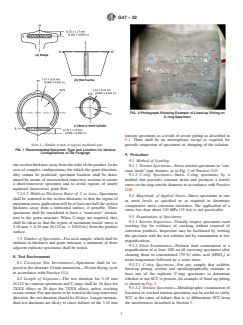
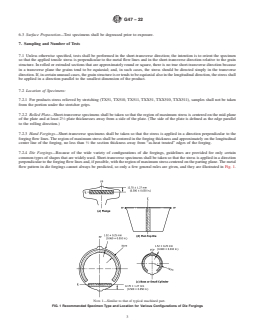
flow pattern in die forgings cannot always be predicted, so only a few general rules are given, and they are illustrated in Fig. 1.
NOTE 1—Similar to that of typical machined part.
FIG. 1 Recommended Specimen Type and Location for Various Configurations of Die Forgings
G47 − 22
Departures from these rules should be made only on the basis of a study of forging flow lines indicating that the intended type of
test would not be obtained. In every case, a diagram should be filed with the test results to illustrate specimen locations and
orientations.
7.2.4.1 Flanges—The centerline of the specimen shall be 12.70 mm 6 1.27 mm (0.500 in. 6 0.050 in.) from the base of the fillet
of the flash except for flanges that are too thin, in which case, the specimen should be centered.
7.2.4.2 Flat-Top Die—The tension specimen should be perpendicular to the parting plane and, if possible, centered in the width.
7.2.4.3 Boss or Small Cylinder—The C-ring specimen should be centered on the parting plane and with the outside diameter of
the ring being 1.52 6 0.25 mm (0.060 6 0.010 in.) from the forging surface (see Fig. 1).
7.2.4.4 Large Cylinder—The centerline of tension specimens shall be 12.70 mm 6 1.27 mm (0.500 in. 6 0.050 in.) from the base
of the flash. If a C-ring is required, its outside diameter shall be 1.52 mm 6 0.25 mm (0.060 in. 6 0.010 in.) from the forging
surface (see Fig. 1).
7.2.5 Extruded, Rolled, or Cold Finished Rod, Bar, and Shapes:
7.2.5.1 Width-to-Thickness Ratio Greater than 2—Short-transverse specimens shall be taken so that the region of maximum stress
is centered in the section thickness, at least one section thickness away from the sides of the product. In the case of complex
configurations for which the grain directionality cannot be predicted, specimen location shall be determined by means of
macroetched transverse sections to ensure a short-transverse specimen and to avoid regions of nearly equiaxial (transverse) grain
flow.
7.2.5.2 Width-to-Thickness Ratio of 2 or Less—Specimens shall be centered in the section thickness so that the region of maximum
stress application will be at least one half the section thickness away from a fabricated surface, if possible. These specimens shall
be considered to have a “transverse” orientation to the grain structure. When C-rings are required, they shall be taken so that the
region of maximum tensile stress is 3.18 mm 6 0.25 mm (0.125 in. 6 0.010 in.) from the product surface.
7.3 Number of Specimens—For each sample, which shall be uniform in thickness and grain structure, a minimum of three adjacent
replicate specimens shall be tested.
8. Test Environment
8.1 Corrosion Test Environment—Specimens shall be exposed to the alternate 10 min immersion—50 min drying cycle in
accordance with Practice G44.
FIG. 2 Photograph Showing Example of Lined-up Pitting on C-ring
...