

ASTM D3276-21
(Guide)Standard Guide for Painting Inspectors (Metal Substrates)
General Information
- Abstract
SIGNIFICANCE AND USE
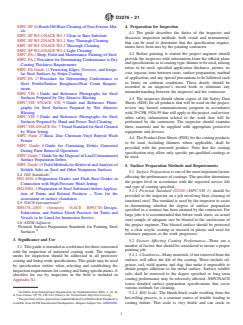
3.1 This guide is intended as a reference for those concerned with the inspection of industrial coating work. The requirements for inspection should be addressed in all protective coating and lining work specifications. This guide may be used by specification writers when selecting and establishing the inspection requirements for coating and lining specifications. A checklist for use by inspectors in the field is included in Appendix X1.
SCOPE
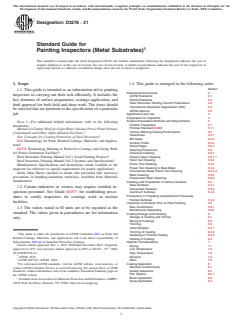
1.1 This guide is intended as an information aid to painting inspectors in carrying out their task efficiently. It includes the key elements of surface preparation, coatings application, and final approval for both field and shop work. The items should be selected that are pertinent to the specification of a particular job.
Note 1: For additional helpful information, refer to the following documents:
Manual of Coating Work for Light-Water Nuclear Power Plant Primary Containment and Other Safety-Related Facilities 2
New Concepts for Coating Protection of Steel Structures3
D16 Terminology for Paint, Related Coatings, Materials, and Applications4
D4538 Terminology Relating to Protective Coatings and Lining Work for Power Generation Facilities4
Steel Structures Painting Manual Vol 1 Good Painting Practice5
Steel Structures Painting Manual Vol 2 Systems and Specifications5
Manufacturers Specifications and Instructions (made available to the inspector for reference to special requirements for proper application)
Safety Data Sheets (needed to ensure that personnel take necessary precautions in handling hazardous materials). Available from Materials manufacturer.
1.2 Certain industries or owners may require certified inspection personnel. See Guide D4537 for establishing procedures to certify inspectors for coatings work in nuclear facilities.
1.3 The values stated in SI units are to be regarded as the standard. The values given in parentheses are for information only.
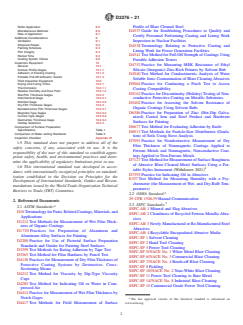
1.4 This guide is arranged in the following order:
Section
Referenced Documents
2
ASTM Standards
2.1
OSHA Standards
2.2
Steel Structures Painting Council Publications
2.3
International Standards Organization (ISO)
2.4
ASTM Adjuncts
2.6
Significance and Use
3
Preparation for Inspection
4
Surface Preparation Methods and Requirements
5
Surface Preparation
5.1
Pictorial Standard D2200
5.1.1
Factors Affecting Coating Performance
5.2
Cleanliness
5.2.1
Mill Scale
5.2.2
Surface Profile
5.2.3
Sharp Edges
5.2.4
Cleaning Procedures
5.3
Chemical Cleaning
5.3.1
Solvent Vapor Cleaning
5.3.1.1
Hand Tool Cleaning
5.3.2
Power Tool Cleaning
5.3.3
Power Tool Cleaning to Bare Metal
5.3.4
Commercial Grade Power Tool Cleaning
5.3.4.4
Blast Cleaning
5.3.5
Pressurized Water Cleaning
5.3.6
Cleaning and Preparation of Various Surfaces
5.4
Steel Surfaces
5.4.1
Galvanized Surfaces
5.4.2
Aluminum Surfaces
5.4.3
Precautions in Preparing Unpainted and Previously
Painted Surfaces
5.4.4
Inspection of Surfaces Prior to Field Painting
5.5
New Construction
5.5.1
Maintenance Repainting
5.5.2
Coating Storage and Handling
6
Storage of Coating and Thinner
6.1
Mixing of Coatings
6.2
Thinning
6.3
Initial Samples
6.3.1
Thinning of Coating
6.3.2
Sampling of Thinned Coating
6.3.3
Heating of Coating
6.4
Weather Considerations
7
Drying
7.1
Low Temperature
7.2
High Temperature
7.3
Moisture
7.4
Wind
7.5
Coating Application
8
Residual Contaminants
8.1
Quality Assurance
8.2
Film Defects
8.2.1
Brush Application
8.3
Spray Application
8.4
Roller Application
8.5...
- Status
- Published
- Publication Date
- 31-Oct-2021
- Technical Committee
- D01 - Paint and Related Coatings, Materials, and Applications
- Drafting Committee
- D01.46 - Industrial Protective Coatings
Overview
ASTM D3276-21: Standard Guide for Painting Inspectors (Metal Substrates) provides comprehensive guidance for professionals responsible for inspecting industrial coating applications on metal surfaces. The standard, developed by ASTM International, serves as a reference for ensuring quality surface preparation, proper coating application, and effective inspection practices for both field and shop painting operations. It is widely used by painting inspectors, specification writers, and project engineers to promote consistent, high-quality protective coatings systems for metal substrates.
Key Topics
ASTM D3276-21 covers key elements essential for thorough industrial coatings inspection:
- Preparation for Inspection: Outlines inspector duties and the importance of reviewing project specifications, safety data sheets, and safety practices before beginning work.
- Surface Preparation Methods: Details various methods including solvent cleaning, hand and power tool cleaning, blast cleaning, and high-pressure water jetting. Highlights standards and practices to achieve required surface conditions.
- Cleaning Procedures: Describes techniques for removing contaminants such as oil, grease, mill scale, and rust to ensure optimal coating performance.
- Surface Profile and Edge Preparation: Discusses the measurement and importance of proper surface roughness and edge treatment to promote adhesion and coating longevity.
- Inspection of New and Existing Surfaces: Provides guidance on inspecting surfaces prior to field painting for both new construction and maintenance repainting projects.
- Coating Storage and Application: Outlines best practices for storage, handling, mixing, thinning, and applying coatings under various environmental conditions.
- Quality Assurance and Inspection Tools: Explains the use of inspection instruments (e.g., thickness gages, adhesion testers, holiday detectors) to verify compliance with project requirements.
Applications
ASTM D3276-21 is highly practical and valuable in multiple industrial scenarios:
- Industrial and Commercial Projects: Used in the inspection of bridges, pipelines, storage tanks, plants, and other steel structures to ensure durability and corrosion protection.
- Specification Development: Assists specification writers in establishing clear, comprehensive inspection requirements in protective coating and lining work specifications.
- Field and Shop Work: Guides painting inspectors in both on-site and shop-coating environments, promoting consistency and adherence to project standards.
- Certification and Training: Supports industries or owners that require certified inspection personnel, referencing related guidelines for inspector qualification.
- Safety and Environmental Compliance: Emphasizes the review of Safety Data Sheets and adherence to OSHA and environmental regulations during inspection and surface preparation.
- Coating System Failure Prevention: Helps identify factors influencing coating failures, including improper surface prep, contaminant presence, inadequate storage, or adverse weather conditions.
Related Standards
ASTM D3276-21 references numerous key documents and standards essential for painting inspection and metal surface preparation, including:
ASTM Standards:
- D16 – Terminology for Paint, Related Coatings, Materials, and Applications
- D2200 – Practice for Use of Pictorial Standards for Painting Steel Surfaces
- D4417 – Test Methods for Measurement of Surface Profile of Blast Cleaned Steel
- D7091 – Nondestructive Measurement of Dry Film Thickness
SSPC (The Society for Protective Coatings) Standards:
- SSPC-SP 1, 2, 3, 5, 6, 7, 10, 11, 15 & related VIS guides
NACE and ISO Standards:
- NACE SP0178 – Design and Surface Finish Practices
- ISO 8501-4, ISO 8502–3 – Preparation Grades and Surface Cleanliness Tests
Safety and Regulatory References:
- OSHA 29 CFR 1926.59 – Hazard Communication
Practical Value
By following ASTM D3276-21, organizations benefit from enhanced coating performance, reduced long-term maintenance costs, improved safety, and consistent compliance with international best practices. This guide is a critical resource for anyone involved in the specification, inspection, or application of protective coatings to metal substrates, supporting quality control and the long-term durability of metallic assets.
Relations
- Effective Date
- 01-Jan-2024
- Effective Date
- 01-Jun-2020
- Effective Date
- 01-Jun-2020
- Effective Date
- 01-May-2020
- Effective Date
- 01-Feb-2020
- Effective Date
- 01-Feb-2020
- Effective Date
- 01-Dec-2019
- Effective Date
- 01-Aug-2018
- Effective Date
- 01-Jul-2016
- Effective Date
- 01-Jul-2016
- Effective Date
- 01-May-2016
- Effective Date
- 01-Jun-2015
- Effective Date
- 01-Dec-2014
- Effective Date
- 01-Dec-2014
- Effective Date
- 01-Nov-2014
Frequently Asked Questions
ASTM D3276-21 is a guide published by ASTM International. Its full title is "Standard Guide for Painting Inspectors (Metal Substrates)". This standard covers: SIGNIFICANCE AND USE 3.1 This guide is intended as a reference for those concerned with the inspection of industrial coating work. The requirements for inspection should be addressed in all protective coating and lining work specifications. This guide may be used by specification writers when selecting and establishing the inspection requirements for coating and lining specifications. A checklist for use by inspectors in the field is included in Appendix X1. SCOPE 1.1 This guide is intended as an information aid to painting inspectors in carrying out their task efficiently. It includes the key elements of surface preparation, coatings application, and final approval for both field and shop work. The items should be selected that are pertinent to the specification of a particular job. Note 1: For additional helpful information, refer to the following documents: Manual of Coating Work for Light-Water Nuclear Power Plant Primary Containment and Other Safety-Related Facilities 2 New Concepts for Coating Protection of Steel Structures3 D16 Terminology for Paint, Related Coatings, Materials, and Applications4 D4538 Terminology Relating to Protective Coatings and Lining Work for Power Generation Facilities4 Steel Structures Painting Manual Vol 1 Good Painting Practice5 Steel Structures Painting Manual Vol 2 Systems and Specifications5 Manufacturers Specifications and Instructions (made available to the inspector for reference to special requirements for proper application) Safety Data Sheets (needed to ensure that personnel take necessary precautions in handling hazardous materials). Available from Materials manufacturer. 1.2 Certain industries or owners may require certified inspection personnel. See Guide D4537 for establishing procedures to certify inspectors for coatings work in nuclear facilities. 1.3 The values stated in SI units are to be regarded as the standard. The values given in parentheses are for information only. 1.4 This guide is arranged in the following order: Section Referenced Documents 2 ASTM Standards 2.1 OSHA Standards 2.2 Steel Structures Painting Council Publications 2.3 International Standards Organization (ISO) 2.4 ASTM Adjuncts 2.6 Significance and Use 3 Preparation for Inspection 4 Surface Preparation Methods and Requirements 5 Surface Preparation 5.1 Pictorial Standard D2200 5.1.1 Factors Affecting Coating Performance 5.2 Cleanliness 5.2.1 Mill Scale 5.2.2 Surface Profile 5.2.3 Sharp Edges 5.2.4 Cleaning Procedures 5.3 Chemical Cleaning 5.3.1 Solvent Vapor Cleaning 5.3.1.1 Hand Tool Cleaning 5.3.2 Power Tool Cleaning 5.3.3 Power Tool Cleaning to Bare Metal 5.3.4 Commercial Grade Power Tool Cleaning 5.3.4.4 Blast Cleaning 5.3.5 Pressurized Water Cleaning 5.3.6 Cleaning and Preparation of Various Surfaces 5.4 Steel Surfaces 5.4.1 Galvanized Surfaces 5.4.2 Aluminum Surfaces 5.4.3 Precautions in Preparing Unpainted and Previously Painted Surfaces 5.4.4 Inspection of Surfaces Prior to Field Painting 5.5 New Construction 5.5.1 Maintenance Repainting 5.5.2 Coating Storage and Handling 6 Storage of Coating and Thinner 6.1 Mixing of Coatings 6.2 Thinning 6.3 Initial Samples 6.3.1 Thinning of Coating 6.3.2 Sampling of Thinned Coating 6.3.3 Heating of Coating 6.4 Weather Considerations 7 Drying 7.1 Low Temperature 7.2 High Temperature 7.3 Moisture 7.4 Wind 7.5 Coating Application 8 Residual Contaminants 8.1 Quality Assurance 8.2 Film Defects 8.2.1 Brush Application 8.3 Spray Application 8.4 Roller Application 8.5...
SIGNIFICANCE AND USE 3.1 This guide is intended as a reference for those concerned with the inspection of industrial coating work. The requirements for inspection should be addressed in all protective coating and lining work specifications. This guide may be used by specification writers when selecting and establishing the inspection requirements for coating and lining specifications. A checklist for use by inspectors in the field is included in Appendix X1. SCOPE 1.1 This guide is intended as an information aid to painting inspectors in carrying out their task efficiently. It includes the key elements of surface preparation, coatings application, and final approval for both field and shop work. The items should be selected that are pertinent to the specification of a particular job. Note 1: For additional helpful information, refer to the following documents: Manual of Coating Work for Light-Water Nuclear Power Plant Primary Containment and Other Safety-Related Facilities 2 New Concepts for Coating Protection of Steel Structures3 D16 Terminology for Paint, Related Coatings, Materials, and Applications4 D4538 Terminology Relating to Protective Coatings and Lining Work for Power Generation Facilities4 Steel Structures Painting Manual Vol 1 Good Painting Practice5 Steel Structures Painting Manual Vol 2 Systems and Specifications5 Manufacturers Specifications and Instructions (made available to the inspector for reference to special requirements for proper application) Safety Data Sheets (needed to ensure that personnel take necessary precautions in handling hazardous materials). Available from Materials manufacturer. 1.2 Certain industries or owners may require certified inspection personnel. See Guide D4537 for establishing procedures to certify inspectors for coatings work in nuclear facilities. 1.3 The values stated in SI units are to be regarded as the standard. The values given in parentheses are for information only. 1.4 This guide is arranged in the following order: Section Referenced Documents 2 ASTM Standards 2.1 OSHA Standards 2.2 Steel Structures Painting Council Publications 2.3 International Standards Organization (ISO) 2.4 ASTM Adjuncts 2.6 Significance and Use 3 Preparation for Inspection 4 Surface Preparation Methods and Requirements 5 Surface Preparation 5.1 Pictorial Standard D2200 5.1.1 Factors Affecting Coating Performance 5.2 Cleanliness 5.2.1 Mill Scale 5.2.2 Surface Profile 5.2.3 Sharp Edges 5.2.4 Cleaning Procedures 5.3 Chemical Cleaning 5.3.1 Solvent Vapor Cleaning 5.3.1.1 Hand Tool Cleaning 5.3.2 Power Tool Cleaning 5.3.3 Power Tool Cleaning to Bare Metal 5.3.4 Commercial Grade Power Tool Cleaning 5.3.4.4 Blast Cleaning 5.3.5 Pressurized Water Cleaning 5.3.6 Cleaning and Preparation of Various Surfaces 5.4 Steel Surfaces 5.4.1 Galvanized Surfaces 5.4.2 Aluminum Surfaces 5.4.3 Precautions in Preparing Unpainted and Previously Painted Surfaces 5.4.4 Inspection of Surfaces Prior to Field Painting 5.5 New Construction 5.5.1 Maintenance Repainting 5.5.2 Coating Storage and Handling 6 Storage of Coating and Thinner 6.1 Mixing of Coatings 6.2 Thinning 6.3 Initial Samples 6.3.1 Thinning of Coating 6.3.2 Sampling of Thinned Coating 6.3.3 Heating of Coating 6.4 Weather Considerations 7 Drying 7.1 Low Temperature 7.2 High Temperature 7.3 Moisture 7.4 Wind 7.5 Coating Application 8 Residual Contaminants 8.1 Quality Assurance 8.2 Film Defects 8.2.1 Brush Application 8.3 Spray Application 8.4 Roller Application 8.5...
ASTM D3276-21 is classified under the following ICS (International Classification for Standards) categories: 87.020 - Paint coating processes. The ICS classification helps identify the subject area and facilitates finding related standards.
ASTM D3276-21 has the following relationships with other standards: It is inter standard links to ASTM D16-24, ASTM D4414-95(2020), ASTM D1212-91(2020), ASTM D1730-09(2020), ASTM D4752-20, ASTM D4940-15(2020), ASTM D4417-19, ASTM D4537-12(2018), ASTM D5064-16, ASTM D16-16, ASTM D6386-16, ASTM D5402-15, ASTM D4212-10(2014), ASTM D16-14, ASTM D1730-09(2014). Understanding these relationships helps ensure you are using the most current and applicable version of the standard.
ASTM D3276-21 is available in PDF format for immediate download after purchase. The document can be added to your cart and obtained through the secure checkout process. Digital delivery ensures instant access to the complete standard document.
Standards Content (Sample)
This international standard was developed in accordance with internationally recognized principles on standardization established in the Decision on Principles for the
Development of International Standards, Guides and Recommendations issued by the World Trade Organization Technical Barriers to Trade (TBT) Committee.
Designation: D3276 − 21
Standard Guide for
Painting Inspectors (Metal Substrates)
This standard is issued under the fixed designation D3276; the number immediately following the designation indicates the year of
original adoption or, in the case of revision, the year of last revision.Anumber in parentheses indicates the year of last reapproval.A
superscript epsilon (´) indicates an editorial change since the last revision or reapproval.
1. Scope 1.4 This guide is arranged in the following order:
Section
1.1 This guide is intended as an information aid to painting
Referenced Documents 2
inspectors in carrying out their task efficiently. It includes the
ASTM Standards 2.1
key elements of surface preparation, coatings application, and OSHA Standards 2.2
Steel Structures Painting Council Publications 2.3
final approval for both field and shop work. The items should
International Standards Organization (ISO) 2.4
beselectedthatarepertinenttothespecificationofaparticular
ASTM Adjuncts 2.6
Significance and Use 3
job.
Preparation for Inspection 4
NOTE 1—For additional helpful information, refer to the following Surface Preparation Methods and Requirements 5
Surface Preparation 5.1
documents:
Pictorial Standard D2200 5.1.1
Manual of Coating Work for Light-Water Nuclear Power Plant Primary
2 Factors Affecting Coating Performance 5.2
Containment and Other Safety-Related Facilities
Cleanliness 5.2.1
New Concepts for Coating Protection of Steel Structures
Mill Scale 5.2.2
D16 Terminology for Paint, Related Coatings, Materials, andApplica-
Surface Profile 5.2.3
tions
Sharp Edges 5.2.4
D4538 Terminology Relating to Protective Coatings and Lining Work
Cleaning Procedures 5.3
for Power Generation Facilities
Chemical Cleaning 5.3.1
Solvent Vapor Cleaning 5.3.1.1
Steel Structures Painting Manual Vol 1 Good Painting Practice
Hand Tool Cleaning 5.3.2
Steel Structures Painting Manual Vol 2 Systems and Specifications
Power Tool Cleaning 5.3.3
Manufacturers Specifications and Instructions (made available to the
Power Tool Cleaning to Bare Metal 5.3.4
inspector for reference to special requirements for proper application)
Commercial Grade Power Tool Cleaning 5.3.4.4
Safety Data Sheets (needed to ensure that personnel take necessary
Blast Cleaning 5.3.5
precautions in handling hazardous materials). Available from Materials
Pressurized Water Cleaning 5.3.6
manufacturer.
Cleaning and Preparation of Various Surfaces 5.4
Steel Surfaces 5.4.1
1.2 Certain industries or owners may require certified in-
Galvanized Surfaces 5.4.2
spection personnel. See Guide D4537 for establishing proce-
Aluminum Surfaces 5.4.3
Precautions in Preparing Unpainted and Previously
dures to certify inspectors for coatings work in nuclear
Painted Surfaces 5.4.4
facilities.
Inspection of Surfaces Prior to Field Painting 5.5
New Construction 5.5.1
1.3 The values stated in SI units are to be regarded as the
Maintenance Repainting 5.5.2
standard. The values given in parentheses are for information
Coating Storage and Handling 6
Storage of Coating and Thinner 6.1
only.
Mixing of Coatings 6.2
Thinning 6.3
Initial Samples 6.3.1
Thinning of Coating 6.3.2
This guide is under the jurisdiction of ASTM Committee D01 on Paint and
Sampling of Thinned Coating 6.3.3
Related Coatings, Materials, and Applications and is the direct responsibility of
Heating of Coating 6.4
Subcommittee D01.46 on Industrial Protective Coatings.
Weather Considerations 7
Current edition approved Nov. 1, 2021. Published December 2021. Originally
Drying 7.1
ɛ1
approved in 1973. Last previous edition approved in 2015 as D3276–15 . DOI:
Low Temperature 7.2
10.1520/D3276-21. High Temperature 7.3
ASTM, 1979. Moisture 7.4
Wind 7.5
ASTM STP 841, ASTM, 1984.
Coating Application 8
For referenced ASTM standards, visit the ASTM website, www.astm.org, or
Residual Contaminants 8.1
contact ASTM Customer Service at service@astm.org. For Annual Book of ASTM
Quality Assurance 8.2
Standards volume information, refer to the standard’s Document Summary page on
Film Defects 8.2.1
the ASTM website.
5 Brush Application 8.3
AvailablefromAssociationforMaterialsProtectionandPerformance(AMPP),
Spray Application 8.4
15835 Park Ten Place, Houston, TX 77084, https://www.ampp.org.
Copyright © ASTM International, 100 Barr Harbor Drive, PO Box C700, West Conshohocken, PA 19428-2959. United States
D3276 − 21
Profile of Blast Cleaned Steel
Roller Application 8.5
Miscellaneous Methods 8.6
D4537Guide for Establishing Procedures to Qualify and
Rate of Application 8.7
Certify Personnel Performing Coating and Lining Work
Additional Considerations 9
Inspection in Nuclear Facilities
Ventilation 9.1
Shopcoat Repair 9.2
D4538Terminology Relating to Protective Coating and
Painting Schedule 9.3
Lining Work for Power Generation Facilities
Film Integrity 9.4
D4541Test Method for Pull-Off Strength of Coatings Using
Recoat Time 9.5
Coating System Failure 9.6
Portable Adhesion Testers
Inspection Equipment 10
D4752Practice for Measuring MEK Resistance of Ethyl
General 10.1
Surface Profile Gages 10.1.1 Silicate (Inorganic) Zinc-Rich Primers by Solvent Rub
Adhesion of Existing Coating 10.1.2
D4940Test Method for Conductimetric Analysis of Water
Portable Pull-Off Adhesion Testers 10.1.3
Soluble Ionic Contamination of Blast CleaningAbrasives
Field Inspection Equipment 10.2
Drying and Curing Times 10.2.1 D5064Practice for Conducting a Patch Test to Assess
Thermometers 10.2.1.1
Coating Compatibility
Relative Humidity and Dew Point 10.2.1.2
D5162Practice for Discontinuity (Holiday) Testing of Non-
Wet-Film Thickness Gages 10.2.2
conductive Protective Coating on Metallic Substrates
Interchemical Gage 10.2.2.1
Notched Gage 10.2.2.2
D5402Practice for Assessing the Solvent Resistance of
Dry-Film Thickness Gages 10.2.3
Organic Coatings Using Solvent Rubs
Nondestructive Film Thickness Gages 10.2.3.1
Magnetic-Type Gages 10.2.3.2 D6386Practice for Preparation of Zinc (Hot-Dip Galva-
Current-Type Gages 10.2.3.3
nized) Coated Iron and Steel Product and Hardware
Destructive Thickness Gage 10.2.3.4
Surfaces for Painting
Holiday Detectors 10.2.4
Comparison of Surface Preparation D6677Test Method for Evaluating Adhesion by Knife
Specifications Table 1
D6913Test Methods for Particle-Size Distribution (Grada-
Comparison of Water Jetting Standards Table 2
tion) of Soils Using Sieve Analysis
Inspection Checklist Appendix X1
D7091Practice for Nondestructive Measurement of Dry
1.5 This standard does not purport to address all of the
Film Thickness of Nonmagnetic Coatings Applied to
safety concerns, if any, associated with its use. It is the
Ferrous Metals and Nonmagnetic, Nonconductive Coat-
responsibility of the user of this standard to establish appro-
ings Applied to Non-Ferrous Metals
priate safety, health, and environmental practices and deter-
D7127Test Method for Measurement of Surface Roughness
mine the applicability of regulatory limitations prior to use.
of Abrasive Blast Cleaned Metal Surfaces Using a Por-
1.6 This international standard was developed in accor-
table Stylus Instrument (Withdrawn 2021)
dance with internationally recognized principles on standard-
D7393Practice for Indicating Oil in Abrasives
ization established in the Decision on Principles for the
E337Test Method for Measuring Humidity with a Psy-
Development of International Standards, Guides and Recom-
chrometer (the Measurement of Wet- and Dry-Bulb Tem-
mendations issued by the World Trade Organization Technical
peratures)
Barriers to Trade (TBT) Committee.
2.2 OSHA Standard:
29 CFR 1926.59Hazard Communication
2. Referenced Documents
2.3 SSPC Standards:
2.1 ASTM Standards:
SSPC-AB 1Mineral and Slag Abrasives
D16TerminologyforPaint,RelatedCoatings,Materials,and
SSPC-AB 2Cleanliness of Recycled Ferrous MetallicAbra-
Applications
sives
D1212Test Methods for Measurement of Wet Film Thick-
SSPC-AB3NewlyManufacturedorRe-ManufacturedSteel
ness of Organic Coatings
Abrasives
D1730 Practices for Preparation of Aluminum and
SSPC-AB 4Recyclable Encapsulated Abrasive Media
Aluminum-Alloy Surfaces for Painting
SSPC-SP 1Solvent Cleaning
D2200Practice for Use of Pictorial Surface Preparation
SSPC-SP 2Hand Tool Cleaning
Standards and Guides for Painting Steel Surfaces
SSPC-SP 3Power Tool Cleaning
D3359Test Methods for Rating Adhesion by Tape Test
SSPC-SP 5/NACE No. 1White Metal Blast Cleaning
D3363Test Method for Film Hardness by Pencil Test
SSPC-SP 6/NACE No. 3Commercial Blast Cleaning
D4138Practices for Measurement of Dry FilmThickness of
SSPC-SP 7/NACE No. 4Brush-off Blast Cleaning
Protective Coating Systems by Destructive, Cross-
SSPC-SP 8Pickling
Sectioning Means
SSPC-SP 10/NACE No. 2Near-White Blast Cleaning
D4212Test Method for Viscosity by Dip-Type Viscosity
SSPC-SP 11Power Tool Cleaning to Bare Metal
Cups
SSPC-SP 14/NACE No. 8Industrial Blast Cleaning
D4285Test Method for Indicating Oil or Water in Com-
SSPC-SP 15Commercial Grade Power Tool Cleaning
pressed Air
D4414Practice for Measurement of Wet Film Thickness by
Notch Gages
The last approved version of this historical standard is referenced on
D4417Test Methods for Field Measurement of Surface www.astm.org.
D3276 − 21
SSPC-SP16Brush-Off Blast Cleaning of Non-Ferrous Met- 4. Preparation for Inspection
als
4.1 The guide describes the duties of the inspector and
SSPC-SP WJ-1/NACE WJ-1Clean to Bare Substrate
discusses inspection methods, both visual and instrumental,
SSPC-SP WJ-2/NACE WJ-2Very Thorough Cleaning
that can be used to determine that the specification require-
SSPC-SP WJ-3/NACE WJ-3Thorough Cleaning
ments have been met by the painting contractor.
SSPC-SP WJ-4/NACE WJ-4Light Cleaning
4.2 Before painting is started the project engineer should
SSPC-PA 1Shop, Field and Maintenance Painting of Steel
provide the inspector with information from the official plans
SSPC-PA2Procedure for Determining Conformance to Dry
andspecificationsastocoatingtype,thinnertobeused,mixing
Coating Thickness Requirements
ratios to be used, specified application thickness, primer, tie
SSPC-PA Guide 11Protecting Edges, Crevices, and Irregu-
coat, topcoat, time between coats, surface preparation, method
lar Steel Surfaces by Stripe Coating
ofapplication,andanyspecialprecautionstobefollowedsuch
SSPC-PA 17Procedure for Determining Conformance to
as limits on ambient conditions. These details should be
Steel Profile/Surface Roughness/Peak Count Require-
recorded in an inspector’s record book to eliminate any
ments
misunderstanding between the inspector and the contractor.
SSPC-VIS 1Guide and Reference Photographs for Steel
Surfaces Prepared by Dry Abrasive Blasting
4.3 The inspector should obtain copies of the Safety Data
SSPC-VIS 5/NACE VIS 9Guide and Reference Photo- Sheets (SDS) for all products that will be used on the project,
graphs for Steel Surfaces Prepared by Wet Abrasive
review any hazard communications program in accordance
Blasting with29CFR1926.59thatwillapplytotheproject,andreview
SSPC-VIS 3Guide and Reference Photographs for Steel
other safety information related to the work that will be
Surfaces Prepared by Hand and Power Tool Cleaning performed by the contractor. The inspector should examine
SSPC-VIS4/NACENo.7VisualStandardforSteelCleaned
these materials and be supplied with appropriate protective
by Water Jetting equipment and devices.
SSPC Paint 27Basic Zinc Chromate-Vinyl Butyral Wash
4.4 TheProductDataSheets(PDS)forthecoatingproducts
Primer
to be used, including thinners where applicable, shall be
SSPC Guide 6Guide for Containing Debris Generated
provided with the procured product. Note that the coating
During Paint Removal Operations
specification may allow only specific pre-qualified coatings to
SSPCGuide7GuidefortheDisposalofLeadContaminated
be used.
Surface Preparation Debris
SSPC Guide 15Field Methods for Retrieval andAnalysis of
5. Surface Preparation Methods and Requirements
Soluble Salts on Steel and Other Nonporous Surfaces
5.1 Surface Preparationisoneofthemostimportantfactors
2.4 ISO Standards:
affectingtheperformanceofcoatings.Thespecifierdetermines
ISO 8501-4Preparation Grades and Flash Rust Grades in
the proper level in accordance with the expected service life
Connection with High-Pressure Water Jetting
and type of coating specified.
ISO 8502–3Preparation of Steel Substrates beforeApplica-
5.1.1 Pictorial Standard D2200 (SSPC-VIS 1) should be
tion of Paints and Related Products – Tests for the
provided to the inspector on a job involving blast cleaning of
assessment of surface cleanliness
structural steel. The standard is used by the inspector to assist
2.5 NACE International:
in determining whether the degree of surface preparation
SP0178–2007 (formerly NACE RP0178) Design,
specified in a contract has been attained by the contractor. For
Fabrication, and Surface Finish Practices for Tanks and
large jobs it is recommended that before work starts, an actual
Vessels to be Lined for Immersion Service
steel sample of adequate size be blasted to the satisfaction of
2.6 ASTM Adjuncts:
the project engineer. This blasted surface should be protected
Pictorial Surface Preparation Standards for Painting Steel
by a clear acrylic coating or encased in plastic and used for
Surfaces
reference purposes as the work progresses.
3. Significance and Use
5.2 Factors Affecting Coating Performance—There are a
number of factors that should be considered to ensure a proper
3.1 Thisguideisintendedasareferenceforthoseconcerned
painting job.
with the inspection of industrial coating work. The require-
5.2.1 Cleanliness—Manymaterials,ifnotremovedfromthe
ments for inspection should be addressed in all protective
surface, will affect the life of the coating. These include oil,
coatingandliningworkspecifications.Thisguidemaybeused
grease, soil, weld spatter, and slag, that make it impossible to
by specification writers when selecting and establishing the
obtain proper adhesion to the metal surface. Surface soluble
inspectionrequirementsforcoatingandliningspecifications.A
salts shall be removed to the degree specified or long term
checklist for use by inspectors in the field is included in
coating performance may be adversely affected. SSPC/NACE
Appendix X1.
issues detailed surface preparation specifications that cover
various methods for cleaning.
Available from International Organization for Standardization (ISO), 1, ch. de
5.2.2 Mill Scale, The bluish-black oxide resulting from the
la Voie-Creuse, CP 56, CH-1211 Geneva 20, Switzerland, http://www.iso.org.
hot-rolling process, is a constant source of trouble leading to
ThepictorialsurfacepreparationstandardMethodA(ISO/SwedishStandard)is
availablefromASTMInternationalHeadquarters.RequestAdjunctNo.ADJD2200. coating failure. This scale is very brittle and can crack or
D3276 − 21
loosen due to temperature changes (both in fabricating and theadvantagesoversolventwipinginthathotsolventsareused
weathering in the field) leading to failure of the coating. and the solvent condensation removes oils without recontami-
nation.
5.2.3 Surface Profile—The texture of the metal surface has
5.3.2 Hand Tool Cleaning is the method used for the
a significant effect on the performance of coatings, since it
removal of loose mill scale, loose rust, loose or otherwise
increases the surface area to which the coating can develop
defective coating, weld flux, slag and spatter from metal
adhesion. In fact, the term “anchor pattern” is sometimes used
surfaces by hand brushing, hand sanding, hand chipping or
to describe the depth of profile. Profile varies both with the
scraping using wire, fiber or bristle brushes, sandpaper, steel
type and size of the abrasive used. Coarser abrasives generally
wool, hand scrapers or chisels, and chipping hammers. Mate-
produce a coarser and deeper profile. Deep profiles are advan-
rial is considered tightly adherent if it cannot be lifted with a
tageous for adhesion, but require more coating to fill in the
dull putty knife. SSPC provides a detailed specification,
valleys and cover the peaks of the profile; they cannot be used
SSPC-SP 2. A visual standard, SSPC-VIS 3, may be used to
with low-build coatings that do not cover the peaks even when
assist in determining compliance.
several coats are applied. The angularity (sharpness) and
5.3.2.1 Handtoolcleaningrequiresthatallweldflux,tar,oil
density of the profile may affect adhesion. Methods for
and grease, and other greasy contaminants be removed first by
measuringsurfaceprofilecanbefoundinTestMethodsD4417
solvent cleaning (5.3.1).
and D7127. Frequency of surface profile measurement and the
5.3.2.2 Wire brushes should be rigid enough to clean the
acceptabilityofthemeasurementsisdescribedinSSPC-PA17.
surfacethoroughly,andshapedtopenetrateintoallcornersand
5.2.4 Sharp Edges—Sharp edges and rough welds can
joints. Brushes should be kept free of all materials that may
compromise coating performance, particularly in immersion clog the wires of the brush.
service. Sharp edges and outside corners should be radiused, 5.3.2.3 Hand scrapers should be made of tool steel, tem-
pered and ground to a sharp edge, and should be of the proper
and rough welds should be smoothed or ground flat. NACE
size and shape to enable cleaning to be done as specified.
SP0178 and SSPC-PA Guide 11 may be used as guides. This
Scrapers should be kept sharp at all times.
operation should be specified during fabrication, but is fre-
5.3.3 Power Tool Cleaningisamethodusedfortheremoval
quently done by the coating contractor. The coating inspector
of loose mill scale, loose rust, loose or otherwise defective
should verify that such work has been done, if required by the
coating, and weld flux from metal surfaces by power wire
coating job specification prior to other steps in surface prepa-
brushes,powerimpacttools,powergrinders,powersanders,or
ration.
by a combination of these methods. Material is considered
5.3 Cleaning Procedures—Safety precautions are not ad-
tightly adherent if it cannot be lifted with a dull putty knife.
dressed separately for each of the following cleaning methods.
SSPC-SP3isthedetailedspecificationforpowertoolcleaning.
Eachhasitsownsafety-relatedhazards,andU.S.Occupational
A visual standard, SSPC-VIS 3, may be used to assist in
Health and Safety Administration regulations should be fol-
determining compliance.
lowed. Safety Data Sheets (SDS) for the solvents and cleaning
5.3.3.1 Power tool cleaning requires that all oil, grease,
compounds provided by the manufacturer should also be
weld flux, and other contaminants be removed first by solvent
consulted for proper worker protection.
cleaning (5.3.1). Hand tool cleaning in accordance with 5.3.2
may be used prior to power tool cleaning.
5.3.1 Chemical Cleaning—Solvents are used to remove oil,
5.3.3.2 All equipment should be suitable for the configura-
grease, and related materials. The solvent is applied to the
tion of the work to be cleaned and maintained free of material
surface by wiping or scrubbing with rags or brushes. The
thatclogsthewireordisksmakingthemineffective.Allimpact
contaminants should be removed (not simply spread out) by a
tools should be kept sharp.
thoroughwipingoftheaffectedareaswithclothssaturatedwith
5.3.4 Power Tool Cleaning to Bare Metal is a method used
clean solvent. Contaminated cloths should not be dipped into
for the total removal of coating, rust, and mill scale. It also
clean solvent.The cleaning should be repeated with clean rags
requires a minimum of 1-mil anchor profile. Surface cleaning,
and fresh clean solvent. Emulsions, cleaning compounds,
power tools, and surface profile producing media are used to
steam cleaning, or similar methods and materials may also be
used. Where emulsion cleaners, soaps, or detergents are used,
they should be removed completely by washing with clean hot
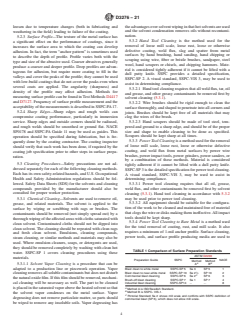
TABLE 1 Comparison of Surface Preparation Standards
water. SSPC-SP 1 covers cleaning procedures using these
ASTM D2200
materials.
Preparation Guide SSPC NACE
Method Method
A B
5.3.1.1 Solvent Vapor Cleaning is a procedure that can be
A B
adapted to a production line or piecework operation. Vapor
Blast clean to white metal SSPC-SP 5 Sa 3 SP 5 1
Blast clean to near-white metal SSPC-SP 10 Sa 2 ⁄2 SP 10 2
cleaningremovesallsolublecontaminantsbutdoesnotdisturb
C
Commercial blast cleaning SSPC-SP 6 Sa 2 SP 6 3
thenaturaloxidefilm.Ifthisfilmshouldberemoved,mechani-
Brush-off blast cleaning SSPC-SP 7 Sa 1 SP 7 4
cal cleaning will be necessary as well. The part to be cleaned Industrial blast cleaning SSPC-SP14 . . 8
A
isplacedinthesaturatedvaporabovetheheatedsolventsothat
Method A is ISO/Swedish Standard.
B
Method B is SSPC- VIS-1.
the solvent vapor condenses on the metal surface. Vapor
C
Pictorial Standard Sa 2 shows mill scale and conflicts with SSPC definition of
degreasing does not remove particulate matter, so parts should
commercial blast (SP 6), which does not allow mill scale.
be wiped to remove any insoluble soils. Vapor degreasing has
D3276 − 21
TABLE 2 Comparison of Water Jetting Standards
D4940, D7393, or the appropriate SSPC abrasive specification
Cleanliness Description SSPC/NACE ISO (AB 1,AB 2,AB 3, orAB 4) for the type of abrasive material.
Clean to Bare Metal SSPC-WJ-1/NACE WJ-1 Wa 3
5.3.5.3 Blast-cleaning operations should be performed so
Very Thorough Cleaning SSPC-WJ-2/NACE WJ-2 Wa 2.5
that no damage is done to the completed portion of the work.
Thorough Cleaning SSPC-WJ-3/NACE WJ-3 Wa 2
Blastcleaningisoftenperformedfromthetoptobottomofthe
Light Cleaning SSPC-WJ-4/NACE WJ-4 Wa 1
structure and should only be carried on downwind from any
recentlypaintedareas.Dryblastcleaningoperationsshouldnot
be conducted on surfaces that will be wet after blasting and
beforepainting.Steeltemperatureshouldbeatleast3°C(5°F)
obtainthespecifiedfinish.Surfacecleaningpowertoolsconsist
above the dew point temperature.
of non-woven abrasive wheels and discs, coated abrasive discs
5.3.5.4 The degree of blast cleaning required should be at
or sanding pads, coated abrasive fly wheels, and coated
least equal to the appropriate surface preparation specification
abrasive bands. Surface profile producing media consist of
and the applicable visual standard. Standards from ASTM,
rotaryimpactflapwheelassembliesandneedleguns.SSPC-SP
SSPC, and National Association of Corrosion Engineers
11 is the detailed specification for power tool cleaning to bare
(NACE) are listed in Table 1. Note that Pictorial Surface
metal.
Preparation Standards D2200 is divided into two methods for
5.3.4.1 Dependingontheinitialconditionofthesurfaceand
abrasive blasting. Method A describes photographic standards
existing profile conditions, it may be necessary to use one or
available from International Standards Organization (ISO)
both of the types of power tools.All oil, grease, weld flux, and
Pictorial Surface Preparation Standards. Method B describes
othercontaminantsshouldberemovedfirstbysolventcleaning
photographic standards available from SSPC. The two sets of
(5.3.1). Hand tool cleaning (5.3.2) or power tool cleaning
photographs are not directly comparable.
(5.3.3) may be used prior to power tool cleaning to bare metal.
5.3.5.5 Blast cleaned surfaces should be examined for any
5.3.4.2 All equipment should be suitable for the configura-
traces of oil, grease, or smudges; where present, the contami-
tion of the work to be cleaned and maintained free of material
nants should be removed by solvent cleaning (5.3.1). Surfaces
that clogs the wire or discs making them ineffective. For
that have been dry blasted should be brushed with clean
example, needle guns require 2mm diameter needles to
brushes,blownwithcompressedairfreeofoilandmoisture,or
produce a suitable surface profile.
vacuum cleaned to eliminate any traces of blast products, dust,
5.3.4.3 The finished surface should be bare, bright metal.
or dirt from the surface. This also serves to remove abrasive
Slight residues of rust and paint may remain in the lower
from pockets and corners.
portions of pits if the original surface was pitted. SSPC-VIS 3
5.3.5.6 Blast cleaned surfaces should be further treated,
is a visual standard to assist in determining compliance.
primed or painted on the same day they are blasted, preferably
Surface profile is determined by procedures in 10.1.1.
within 8 h, or in any event before any visible flash rusting
5.3.4.4 Commercial Grade Power Tool Cleaning, SSPC-SP
occurs. Reblasting will be necessary on any surface if rust
15is performed in a manner similar to SSPC-SP 11. The
bloom forms before coating can be applied.
finished surface should be bare, bright metal. Staining is
5.3.6 Pressurized Water Cleaning—A high-pressure water
allowed on 33 percent of the evaluation unit area, and slight
blast using potable water, either with or without an abrasive
residues of rust and paint may remain in the lower portions of
injected into the stream, is used as an alternative to open
pitsiftheinitialsurfacewaspitted.Italsorequiresaminimum
blasting, since it reduces the release of dust into the atmo-
of 1mil anchor profile.
sphere. Pressures over 137900 KPa (20000 psi) are needed to
5.3.5 Blast Cleaningisusedtoremovecoating,rustandmill
achieve total coating removal when using only water. Pressur-
scale from a metal surface and to provide a roughened surface
ized water alone will not remove mill scale efficiently, or
by striking the surface with a stream of small, hard abrasive
impart an anchor profile. Inhibitors may be added to the water
particles such as (dry) sand, grit, or shot.
topreventflashrusting.Thesurfaceshouldbedriedorallowed
5.3.5.1 One method utilizes compressed air, special blast
to dry before coating. Table 2 contains a comparison of the
nozzles,andabrasive.Watermaybeinjectedintotheairstream
SSPC/NACE water jetting standards to the ISO 8501-4 stan-
to control dust, and a rust inhibitor may be needed (5.3.6). In
dard.SSPC-VIS4/NACENo.7isavisualstandardtoassistin
another method used primarily in fabricating shop, wheels
determining compliance with the SSPC/NACE joint standard.
propel the abrasive centrifugally against the work. The mini-
It includes photographs with three levels of rustback, if
mum and maximum particle size of the abrasive may be
allowed by the specification.
specified as a means of controlling the surface profile. The
particle size can be verified by sieve test in accordance with 5.4 Cleaning and Preparation of Various Surfaces—Before
Test Method D6913. application of any coating, all surfaces to be coated should be
5.3.5.2 Blast cleaning requires that all oil, grease, and weld thoroughly cleaned and properly prepared to the requirements
flux be removed by solvent cleaning (5.3.1). The compressed of the specification. All dust, dirt, oil, grease, moisture, soot,
airusedforblastcleaningshouldbefreeofcondensedwateror tar, or other contaminants should be removed from unpainted
oil by making certain that separators and traps are in working surfaces. Previously painted surfaces should be similarly
order. Test the compressed air supply in accordance with Test cleanedofallforeignmatter;alldeterioratedcoatingshouldbe
MethodD4285.Theabrasivematerialshouldbefreeofsoluble removed as well. Mortar or cement drippings from earlier
contaminants when tested in accordance with Test Methods repairs should be removed by mechanical or chemical means.
D3276 − 21
Tree limbs or other growth obstructing the structure should be environment,andsulfatecontaminationfromairpollutionhave
cut away to provide ready access. been recognized as main factors in premature breakdown of
existing coating systems. High-pressure water blasting is often
5.4.1 Steel Surfaces—Removal of rust and scale should be
used to remove these contaminants.
done in the manner and to the degree specified, that is, hand,
power tool, or blast cleaned. 5.4.4.4 Current regulations require containment and collec-
5.4.1.1 On complex structures, all dirt and debris should be tion of surface preparation debris for disposal. When the
existing coating contains regulated heavy metals such as lead
removed from pockets, crevices, obstructed areas such as
orchromium,orotherregulatedcompoundssuchasorganotin,
gusset plates and connections, and tops of horizontal surfaces.
special precautions and handling of debris may be necessary.
Blasting debris that accumulates on horizontal surfaces should
Inspection of contaminant and disposal requirements, espe-
be removed. Special attention should be placed on examining
cially site storage requirements, are part of a Coating Inspec-
hard to reach areas, the back side of nuts and bolts, sides of
tor’s activities. SSPC Guides 6 and 7 present information
members in close proximity to other members or walls, and
useful to the inspector and sections of these guides may be
undersides of members.
referenced in the specification. On lead removal projects,
5.4.2 Galvanized Surfaces that are to be painted should be
inspectors should be familiar with OSHA requirements for
cleaned and then treated in accordance with the specified
their own health and safety.
method in Practice D6386. Alternatively, the surface may be
allowed to weather a minimum of 6 months before cleaning
5.5 Inspection of Surfaces Prior to Field Painting:
and painting. The method and inspection of brush-off blast
5.5.1 New Construction—It should be emphasized that the
cleaning of galvanized surfaces is presented in SSPC-SP 16.
first coat should be applied to the cleaned surfaces before any
5.4.3 Aluminum Surfaces:
soiling or deterioration can occur. If painting is done outside,
5.4.3.1 Complete removal of oil and grease and, for unan-
the cleaned areas should receive the first protective coat well
odized aluminum, treatment is essential. Vapor degreasing or
before nightfall brings lower temperatures and possible mois-
immersion in an alkaline or acid cleaning solution are com-
ture condensation on the surfaces. When surface preparation
monly used in shop work. In the field, water wash followed by
and painting are carried on indoors, overnight delays between
solvent, steam or detergent cleaning is a good starting point.
coating and painting may be permissible except on blast-
Consult SSPC-SP 16 if brush-off blast cleaning is performed.
cleaned surfaces.
5.4.3.2 Vinyl wash primer is one of the metal pretreatments
5.5.1.1 Shop-coated steel that has been shipped to the
commonly used on unanodized aluminum. The material is
erectionsiteshouldbestoredonblockstopreventcontactwith
describedinPracticesD1730,TypeB,Method8andiscovered
theground,andwhereitisleastlikelytobemarred,scratched,
by SSPC in Paint 27. Lead pigmented primers should never be
or subjected to harmful contamination by grease, oil, salt, etc.
used over aluminum surfaces. The minimum treatment for
Insofar as practicable, the steel should be stored to avoid the
aluminum is Type B, Method 3 of Practices D1730, which
formation of waterholding pockets. If outdoor storage lasts for
describes the use of an alcoholic phosphoric acid cleaner.
several months, the inspector should check the integrity of the
5.4.4 Precautions in Preparing Unpainted and Previously coating from time to time and verify that deficiencies are
Painted Surfaces—Cleaning should proceed by sections, bays,
corrected in accordance with the contract document. The
or other readily identifiable parts of the work. The cleaning of length of time between shop priming and erection and subse-
each section, bay, or part of the work should be entirely
quent topcoating should be kept to a minimum to avoid the
completed, inspected, and accepted before any coating is problem of intercoat adhesion.
applied. The specification should contain limits on the amount
5.5.1.2 Immediately before applying the first field coat, the
orareathatcanbecleanedandpaintedatonetime.Thesystem
shop-coatedsurfacesshouldbecleanedofdust.Ifnecessaryto
of alternately cleaning and painting short sections by one
remove grime and oil substances, they can be wiped, steam
workman is not good practice since this can lead to surface or
cleaned, power washed with detergents or cleaned with sol-
intercoat contamination.
vents selected so as not to soften the film appreciably.
5.4.4.1 Iftraffic,oranyothersource,producesanobjection-
Miscellaneous scratches and breaks in the shop coat, including
ableamountofdust,itiscustomarytocontrolthedustbyusing those occasioned by field welds, bolts, or rivets, should be
tarpaulins, etc., for a sufficient distance around the structure
cleaned, feathered and touched-up as specified before the steel
andtakeanyotherprecautionnecessarytopreventdustanddirt receives the first overall field coat.
from coming into contact with the cleaned or freshly painted
5.5.1.3 The inspector should ensure that field rivets have
surfaces.Itmaysometimesbenecessarytocleannewlycoated
beencleanedofslagandweldspatter.Itisimportantthatevery
surfaces using some of the specified methods between the
coat of the system be applied over dry, soil-free surfaces, and
various coats.
that all previous coats be free of mechanical damage. Great
5.4.4.2 Some areas to be painted or repainted may be care should be exercised to prevent trapping corrosive salts
exposed to chemical fumes and, if so, should be washed with under or between coats.
waterbeforepainting.Washingmayalsobenecessarybetween
5.5.1.4 The inspector should determine whether the speci-
coats of paint. Be aware that standing water on uncured paint
fications are being followed with reference to the painting or
can result in early failure.
prohibition of painting of contact surfaces in bolted or riveted
5.4.4.3 Residual contaminants present on pitted steel can be surfaces of construction. He should ensure that surfaces not in
a problem. Chloride from deicing salts or a marine contact but that will be made inaccessible by assembly or
D3276 − 21
erection, have received the full number of specified coats 6.1.1 Coating containers should remain unopened until
before they become inaccessible. needed,andtheoldestshouldbeusedfirst.Themanufacturer’s
5.5.2 Maintenance Repainting—In most cases, maintenance written instructions should be followed regarding shelf life.
repainting will consist of spot-cleaning and priming of small
Coatings that have livered, gelled, skinned, or otherwise
isolated areas of deterioration, followed by application of one
deteriorated during storage should not be used. If a particular
overall new finish coat to all surfaces of the structure. The
material is in question, do not use it until it has been tested by
inspector of maintenance repainting should be alert for several
the manufacturer or independent laboratory and found to be
conditions not encountered in the painting of new work.
satisfactory.
5.5.2.1 Sound coating not intended to be removed should
6.1.2 Where a skin has formed in the container, the skin
not be damaged by cleaning operations on adjacent areas.This
should be cut loose from the sides of the container, removed,
is particularly important with spot-blast cleaning.
and discarded. If it is felt that the skins are thick enough to
5.5.2.2 The junctions between sound coating and spot-
have a practical effect on the composition, the remaining paint
cleaned areas should present a smooth, feathered appearance.
should not be used until it has been tested and found to be
Theapplicationofcoatingtospot-cleanedareasshouldoverlap
satisfactory.
the old, adjacent coating to a slight extent to ensure full
coverage of the cleaned areas. Before the overall finish coat is 6.2 Mixing of Coatings—All coatings should be thoroughly
and completely mixed in the containers in which they were
applied, the inspector should ensure that oil, grime, dust, and
other contaminants are cleaned from the old coating surfaces. supplied.Whenitisnotpossibletousethesuppliedcontainers
5.5.2.3 Salt contamination of the substrate for both total other clean containers may be used for mixing. Where there is
coating removal and overcoating can be an issue. Some noticeable settling, and mixing is done either by power
specifications put limits on the allowable amount of surface agitators or by hand, most of the vehicle should be poured off
solublesalts.Inspectorsmaybecalledupontomeasuresoluble into a clean container. The pigment is then lifted from the
salt concentrations on the substrate surface. SSPC Guide 15
bottom of the container with a clean, broad, flat paddle, lumps
presents several methods for extracting salts from the surface
broken up and the pigment thoroughly mixed with the vehicle
andseveralmethodsformeasuringthesaltconcentrationinthe
present. The poured-off vehicle should be returned slowly to
extract.Surfacesolublesaltconcentrationsshouldbemeasured
the original container with simultaneous agitation. It is also
in areas where salt would most likely be present such as pitted
useful at this point to mix or pour repeatedly from one
areas.
container to another (boxing) until the composition is uniform.
5.5.2.4 Adhesion of the newly applied coat to the old
The bottom of the original container should be inspected for
coating should be carefully checked. Practice D5064 presents
the unmixed pigment. Two component paints should be mixed
theprocedureforevaluatingadhesionofmaintenancecoatings.
by agitation only, and not with boxing. After the individual
5.5.2.5 Under the direction of the engineer, the inspector
components are homogenous, they are intermixed with agita-
mayexplorebeneaththesurfaceoftheexistingornewcoating
tion in the order stated in the manufacturer’s instructions, that
film for covered-over rust or loosening of the old film, and
is, add Part B to Part A. The coating should not be mixed or
where he discovers such conditions, require that the surface be
kept in suspension by means of an air stream bubbling under
cleaned and repainted.
the coating surface.
5.5.2.6 The effect of the newly applied coating on the old
6.2.1 Some coatings may require straining after mixing, to
underlying coating should be noted. Any coating that shows
ensure homogeneity and to remove skins and foreign matter.
curling,lifting,orwrinklingshouldbereportedtotheengineer
Thestrainersshouldbeofatypetoremoveonlyskins,etc.,but
immediately since it may have to be removed and the area
not to remove pigment. For example, a 297-µm (50-mesh)
repainted. If the defects are general, rather than existing in a
strainerisnormallysatisfactoryformostcoatings,unlesssome
few isolated areas, use of a different type of coating may be
specific size is required in the specification. Containers should
necessary.
be covered when not in use, to reduce volatile losses and
skinning.
6. Coating Storage and Handling
6.2.2 Coatingsshouldbeagitatedenoughduringapplication
6.1 Storage of Coating and Thinner—All coatings and
to ensure homogeneity. Some materials may even require
thinners should be stored in areas or structures that are
constant agitation during use.
well-ventilated and not subject to excessive heat, open flames,
6.2.3 Coating materials which cure by chemical reaction
electricaldischarge,ordirectraysofthesun.Storageshouldbe
may require an induction time to allow the components to
in compliance with applicable regulations and the manufactur-
partially react prior to thinning or application.
er’s written instructions. Materials susceptible to damage at
6.2.4 The components of plural component coatings should
low temperatures should be stored to prevent freezing, such as
be thoroughly mixed as described in 6.2.1 and then pre-heated
in heated areas. Too high a storage temperature reduces the
to the temperature recommended by the coating manufacturer.
shelf life of the coating. If a coating is stocked for a
The two components are subsequently pumped in the required
considerable length of time (several months), it is desirable to
invert the containers at monthly intervals. This will prevent volumeratiobypluralcomponentequipmentthroughheatedor
insulated lines coating lines to specialized mixing equipment
hardsettlingandthusmakemixingquickerandeasierwhenthe
coating is to be used. located immediately before the spray gun.
D3276 − 21
6.3 Thinning—Some specifications permit field thinning of is not permitted, the coating may be heated. Should the
coatings while others do not. This section describes some contractor wish to reduce the viscosity by heating, to make
commonly accepted procedures when thinning is permitted. application easier, the containers may be warmed in hot water,
on steam radiators, by storing in a warm room, or by other
6.3.1 Initial Samples—When thinning on the job site is
acceptable indirect heating processes. In-line heaters are also
permitted unless other arrangements have been made, (for
available for application equipment. Direct application of
example using manufacturer-supplied thinner from unopened
flame to the containers is forbidden by fire regulations. It
containers and complying with the manufacturer’s written
shouldbenoted,however,thatheatingofthecoatingalonewill
thinning instructions), the painting inspector may need to
notcompensateforambientorsurfacetemperatures,orboth,if
submit to an agreed-upon testing laboratory a sample from
they are below the minimum specified for that material. For
each batch to be thinned, together with a sample of the thinner
products to be applied by plural component spray this section
to be used, using clean sample containers in both cases. A
does not apply, see 6.2.4.
request is submitted with these samples for advice on the
proper thinning rate for the conditions prevailing and the
7. Weather Considerations
consistency limits of the thinned coating.
6.3.2 Thinning of Coating—All additions of thinner should
7.1 Drying—Temperature and relative humidity limitations
be made in the presence of the inspector, and only amounts or
presented in the specification or manufacturer’s product data
typesofthinnerpermittedbythespecificationormanufacturer,
sheet are mandatory. Environmental conditions such as tem-
or both, should be added. Thinning is carried out by pouring
perature and relative humidity can affect the cure of most
abouthalfofthethoroughlymixedcoatingintoanempty,clean
coatings.
container. The required thinner is then added and the two
7.2 Low Temperature—Many specifications indicate tem-
portions are remixed to obtain a homogenous mixture.
perature limits between which painting may be undertaken.
6.3.3 Sampling of Thinned Coating—During the work, un-
Thetypicalminimumtemperature(air,materialandsurface)is
less otherwise specified, additional samples need not be sub-
usually 5°C (40°F), but may be as low as −18°C (0°F) for
mitted for testing unless a deviation is noted in the coating
“cold-curing” one or two component systems or 10°C (50°F)
consistency,orifitissuspectedthattherehasbeenachangein
for conventional two component systems. The requirements
the thinner.
may state further that painting should not be undertaken when
6.3.3.1 Whenaninspectorisqualifiedandhasthenecessary
thetemperatureisdroppingandwithin3°C(5°F)ofthelower
equipment available at the field office, arrangements may be
limit. However, some authorities believe that some coatings
made for on-site inspection of thinning and of the thinned
may be applied at (or below) 0°C (32°F) without adverse
coating. This speeds acceptance of a coating. The inspector
effects. Within the limitations of the composition of the
should keep a record of all paint modifications, amount of
coating, this may be satisfactory, depending upon the type of
thinning, weight per gallon, and viscosity. Where dry-film
coating and providing the surface is dry. Painting over ice or
thickness is specified, the inspector should verify the new wet
frost will result in early adhesion failure of the coating.
film thickness necessary to obtain the desired dried thickness
7.3 High Temperature—The maximum reasonable surface
with the thinned coating. Compliance with the specification
temperature for application is 50°C (125°F) unless clearly
should be based on dry-film thickness when specified.
specified otherwise. A surface that is too hot may cause the
6.3.3.2 To estimate the wet-film thickness of the thinned
coatingsolventstoevaporatesofastthatapplicationisdifficult,
coating required to obtain the specified dried-film thickness,
blistering takes place, or a porous film results. To keep the
the percent volume of the nonvolatile (solids) in the original
temperaturedownitmaybedesirable,
...
This document is not an ASTM standard and is intended only to provide the user of an ASTM standard an indication of what changes have been made to the previous version. Because
it may not be technically possible to adequately depict all changes accurately, ASTM recommends that users consult prior editions as appropriate. In all cases only the current version
of the standard as published by ASTM is to be considered the official document.
´1
Designation: D3276 − 15 D3276 − 21
Standard Guide for
Painting Inspectors (Metal Substrates)
This standard is issued under the fixed designation D3276; the number immediately following the designation indicates the year of
original adoption or, in the case of revision, the year of last revision. A number in parentheses indicates the year of last reapproval. A
superscript epsilon (´) indicates an editorial change since the last revision or reapproval.
ε NOTE—Editorial corrections were made in Section 2 and 5.3.5.1 in November 2016.
1. Scope
1.1 This guide is intended as an information aid to painting inspectors in carrying out their task efficiently. It includes the key
elements of surface preparation, coatings application, and final approval for both field and shop work. The items should be selected
that are pertinent to the specification of a particular job.
NOTE 1—For additional helpful information, refer to the following documents:
Manual of Coating Work for Light-Water Nuclear Power Plant Primary Containment and Other Safety-Related Facilities
New Concepts for Coating Protection of Steel Structures
D16 Terminology for Paint, Related Coatings, Materials, and Applications
D4538 Terminology Relating to Protective Coatings and Lining Work for Power Generation Facilities
Steel Structures Painting Manual Vol 1 Good Painting Practice
Steel Structures Painting Manual Vol 2 Systems and Specifications
Manufacturers Specifications and Instructions (made available to the inspector for reference to special requirements for proper application)
Safety Data Sheets (needed to ensure that personnel take necessary precautions in handling hazardous materials). Available from Materials
manufacturer.
1.2 Certain industries or owners may require certified inspection personnel. See Guide D4537 for establishing procedures to
certify inspectors for coatings work in nuclear facilities.
1.3 The values stated in SI units are to be regarded as the standard. The values given in parentheses are for information only.
1.4 This standard does not purport to address all of the safety concerns, if any, associated with its use. It is the responsibility
of the user of this standard to establish appropriate safety and health practices and determine the applicability of regulatory
limitations prior to use.
This guide is under the jurisdiction of ASTM Committee D01 on Paint and Related Coatings, Materials, and Applications and is the direct responsibility of Subcommittee
D01.46 on Industrial Protective Coatings.
Current edition approved July 1, 2015Nov. 1, 2021. Published September 2015December 2021. Originally approved in 1973. Last previous edition approved in 20072015
ɛ1
as D3276 – 07.D3276 – 15 . DOI: 10.1520/D3276-15E01.10.1520/D3276-21.
ASTM, 1979.
ASTM STP 841, ASTM, 1984.
For referenced ASTM standards, visit the ASTM website, www.astm.org, or contact ASTM Customer Service at service@astm.org. For Annual Book of ASTM Standards
volume information, refer to the standard’s Document Summary page on the ASTM website.
Available from Society for Protective Coatings (SSPC), 40 24th St., 6th Floor, Pittsburgh, PA 15222, http://www.sspc.org.Association for Materials Protection and
Performance (AMPP), 15835 Park Ten Place, Houston, TX 77084, https://www.ampp.org.
Copyright © ASTM International, 100 Barr Harbor Drive, PO Box C700, West Conshohocken, PA 19428-2959. United States
D3276 − 21
1.4 This guide is arranged in the following order:
Section
Referenced Documents 2
ASTM Standards 2.1
OSHA Standards 2.2
Steel Structures Painting Council Publications 2.3
International Standards Organization (ISO) 2.4
ASTM Adjuncts 2.6
Significance and Use 3
Preparation for Inspection 4
Surface Preparation Methods and Requirements 5
Surface Preparation 5.1
Pictorial Standard D2200 5.1.1
Factors Affecting Coating Performance 5.2
Cleanliness 5.2.1
Mill Scale 5.2.2
Surface Profile 5.2.3
Sharp Edges 5.2.4
Cleaning Procedures 5.3
Chemical Cleaning 5.3.1
Solvent Vapor Cleaning 5.3.1.1
Hand Tool Cleaning 5.3.2
Power Tool Cleaning 5.3.3
Power Tool Cleaning to Bare Metal 5.3.4
Commercial Grade Power Tool Cleaning 5.3.4.4
Blast Cleaning 5.3.5
Pressurized Water Cleaning 5.3.6
Cleaning and Preparation of Various Surfaces 5.4
Steel Surfaces 5.4.1
Galvanized Surfaces 5.4.2
Aluminum Surfaces 5.4.3
Precautions in Preparing Unpainted and Previously
Painted Surfaces 5.4.4
Inspection of Surfaces Prior to Field Painting 5.5
New Construction 5.5.1
Maintenance Repainting 5.5.2
Coating Storage and Handling 6
Storage of Coating and Thinner 6.1
Mixing of Coatings 6.2
Thinning 6.3
Initial Samples 6.3.1
Thinning of Coating 6.3.2
Sampling of Thinned Coating 6.3.3
Heating of Coating 6.4
Weather Considerations 7
Drying 7.1
Low Temperature 7.2
High Temperature 7.3
Moisture 7.4
Wind 7.5
Coating Application 8
Residual Contaminants 8.1
Quality Assurance 8.2
Film Defects 8.2.1
Brush Application 8.3
Spray Application 8.4
Roller Application 8.5
Miscellaneous Methods 8.6
Rate of Application 8.7
Additional Considerations 9
Ventilation 9.1
Shopcoat Repair 9.2
Painting Schedule 9.3
Film Integrity 9.4
Recoat Time 9.5
Coating System Failure 9.6
Inspection Equipment 10
General 10.1
Surface Profile Gages 10.1.1
Adhesion of Existing Coating 10.1.2
Portable Pull-Off Adhesion Testers 10.1.3
Field Inspection Equipment 10.2
Drying and Curing Times 10.2.1
Thermometers 10.2.1.1
D3276 − 21
Relative Humidity and Dew Point 10.2.1.2
Wet-Film Thickness Gages 10.2.2
Interchemical Gage 10.2.2.1
Notched Gage 10.2.2.2
Dry-Film Thickness Gages 10.2.3
Nondestructive Film Thickness Gages 10.2.3.1
Magnetic-Type Gages 10.2.3.2
Current-Type Gages 10.2.3.3
Destructive Thickness Gage 10.2.3.4
Holiday Detectors 10.2.4
Comparison of Surface Preparation
Specifications Table 1
Comparison of Water Jetting Standards Table 2
Inspection Checklist Appendix X1
1.5 This standard does not purport to address all of the safety concerns, if any, associated with its use. It is the responsibility
of the user of this standard to establish appropriate safety, health, and environmental practices and determine the applicability of
regulatory limitations prior to use.
1.6 This international standard was developed in accordance with internationally recognized principles on standardization
established in the Decision on Principles for the Development of International Standards, Guides and Recommendations issued
by the World Trade Organization Technical Barriers to Trade (TBT) Committee.
2. Referenced Documents
2.1 ASTM Standards:
D16 Terminology for Paint, Related Coatings, Materials, and Applications
D1212 Test Methods for Measurement of Wet Film Thickness of Organic Coatings
D1730 Practices for Preparation of Aluminum and Aluminum-Alloy Surfaces for Painting
D2200 Practice for Use of Pictorial Surface Preparation Standards and Guides for Painting Steel Surfaces
D3359 Test Methods for Rating Adhesion by Tape Test
D3363 Test Method for Film Hardness by Pencil Test
D4138 Practices for Measurement of Dry Film Thickness of Protective Coating Systems by Destructive, Cross-Sectioning
Means
D4212 Test Method for Viscosity by Dip-Type Viscosity Cups
D4285 Test Method for Indicating Oil or Water in Compressed Air
D4414 Practice for Measurement of Wet Film Thickness by Notch Gages
D4417 Test Methods for Field Measurement of Surface Profile of Blast Cleaned Steel
D4537 Guide for Establishing Procedures to Qualify and Certify Personnel Performing Coating and Lining Work Inspection in
Nuclear Facilities
D4538 Terminology Relating to Protective Coating and Lining Work for Power Generation Facilities
D4541 Test Method for Pull-Off Strength of Coatings Using Portable Adhesion Testers
D4752 Practice for Measuring MEK Resistance of Ethyl Silicate (Inorganic) Zinc-Rich Primers by Solvent Rub
D4940 Test Method for Conductimetric Analysis of Water Soluble Ionic Contamination of Blast Cleaning Abrasives
D5064 Practice for Conducting a Patch Test to Assess Coating Compatibility
D5162 Practice for Discontinuity (Holiday) Testing of Nonconductive Protective Coating on Metallic Substrates
D5402 Practice for Assessing the Solvent Resistance of Organic Coatings Using Solvent Rubs
D6386 Practice for Preparation of Zinc (Hot-Dip Galvanized) Coated Iron and Steel Product and Hardware Surfaces for Painting
D6677 Test Method for Evaluating Adhesion by Knife
D6913 Test Methods for Particle-Size Distribution (Gradation) of Soils Using Sieve Analysis
D7091 Practice for Nondestructive Measurement of Dry Film Thickness of Nonmagnetic Coatings Applied to Ferrous Metals
and Nonmagnetic, Nonconductive Coatings Applied to Non-Ferrous Metals
D7127 Test Method for Measurement of Surface Roughness of Abrasive Blast Cleaned Metal Surfaces Using a Portable Stylus
Instrument (Withdrawn 2021)
D7393 Practice for Indicating Oil in Abrasives
E337 Test Method for Measuring Humidity with a Psychrometer (the Measurement of Wet- and Dry-Bulb Temperatures)
2.2 Occupational Safety and Health Administration (OSHA) OSHA Standard:
29 CFR 1926.59 Hazard Communication
2.3 SSPC: The Society for Protective Coatings (SSPC) SSPC Standards:
SSPC-AB 1 Mineral and Slag Abrasives
SSPC-AB 2 Cleanliness of Recycled Ferrous Metallic Abrasives
The last approved version of this historical standard is referenced on www.astm.org.
D3276 − 21
SSPC-AB 3 Newly Manufactured or Re-Manufactured Steel Abrasives
SSPC-AB 4 Recyclable Encapsulated Abrasive Media
SSPC-SP 1 Solvent Cleaning
SSPC-SP 2 Hand Tool Cleaning
SSPC-SP 3 Power Tool Cleaning
SSPC-SP 5/NACE No. 1 White Metal Blast Cleaning
SSPC-SP 6/NACE No. 3 Commercial Blast Cleaning
SSPC-SP 7/NACE No. 4 Brush-off Blast Cleaning
SSPC-SP 8 Pickling
SSPC-SP 10/NACE No. 2 Near-White Blast Cleaning
SSPC-SP 11 Power Tool Cleaning to Bare Metal
SSPC-SP 14/NACE No. 8 Industrial Blast Cleaning
SSPC-SP 15 Commercial Grade Power Tool Cleaning
SSPC-SP 16 Brush-Off Blast Cleaning of Non-Ferrous Metals
SSPC-SP WJ-1/NACE WJ-1 Clean to Bare Substrate
SSPC-SP WJ-2/NACE WJ-2 Very Thorough Cleaning
SSPC-SP WJ-3/NACE WJ-3 Thorough Cleaning
SSPC-SP WJ-4/NACE WJ-4 Light Cleaning
SSPC-PA 1 Shop, Field and Maintenance Painting of Steel
SSPC-PA 2 Procedure for Determining Conformance to Dry Coating Thickness Requirements
SSPC-PA Guide 11 Protecting Edges, Crevices, and Irregular Steel Surfaces by Stripe Coating
SSPC-PA 17 Procedure for Determining Conformance to Steel Profile/Surface Roughness/Peak Count Requirements
SSPC-VIS 1 Guide and Reference Photographs for Steel Surfaces Prepared by Dry Abrasive Blasting
SSPC-VIS 5/NACE VIS 9 Guide and Reference Photographs for Steel Surfaces Prepared by Wet Abrasive Blasting
SSPC-VIS 3 Guide and Reference Photographs for Steel Surfaces Prepared by Hand and Power Tool Cleaning
SSPC-VIS 4/NACE No. 7 Visual Standard for Steel Cleaned by Water Jetting
SSPC Paint 27 Basic Zinc Chromate-Vinyl Butyral Wash Primer
SSPC Guide 6 Guide for Containing Debris Generated During Paint Removal Operations
SSPC Guide 7 Guide for the Disposal of Lead Contaminated Surface Preparation Debris
SSPC Guide 15 Field Methods for Retrieval and Analysis of Soluble Salts on Steel and Other Nonporous Surfaces
2.4 International Standards Organization (ISO):ISO Standards:
ISO 8501-4 Preparation Grades and Flash Rust Grades in Connection with High-Pressure Water Jetting
ISO 8502–3 Preparation of Steel Substrates before Application of Paints and Related Products – Tests for the assessment of
surface cleanliness
2.5 NACE International (NACE):International:
SP0178–2007 (formerly NACE RP0178) Design, Fabrication, and Surface Finish Practices for Tanks and Vessels to be Lined
for Immersion Service
2.6 ASTM Adjuncts:
Pictorial Surface Preparation Standards for Painting Steel Surfaces
3. Significance and Use
3.1 This guide is intended as a reference for those concerned with the inspection of industrial coating work. The requirements for
inspection should be addressed in all protective coating and lining work specifications. This guide may be used by specification
writers when selecting and establishing the inspection requirements for coating and lining specifications. A checklist for use by
inspectors in the field is included in Appendix X1.
4. Preparation for Inspection
4.1 The guide describes the duties of the inspector and discusses inspection methods, both visual and instrumental, that can be used
to determine that the specification requirements have been met by the painting contractor.
4.2 Before painting is started the project engineer should provide the inspector with information from the official plans and
specifications as to coating type, thinner to be used, mixing ratios to be used, specified application thickness, primer, tie coat,
Available from International Organization for Standardization (ISO), 1, ch. de la Voie-Creuse, CP 56, CH-1211 Geneva 20, Switzerland, http://www.iso.org.
The pictorial surface preparation standard Method A (ISO/Swedish Standard) is available from ASTM International Headquarters. Request Adjunct No. ADJD2200.
D3276 − 21
topcoat, time between coats, surface preparation, method of application, and any special precautions to be followed such as limits
on ambient conditions. These details should be recorded in an inspector’s record book to eliminate any misunderstanding between
the inspector and the contractor.
4.3 The inspector should obtain copies of the Safety Data Sheets (SDS) for all products that will be used on the project, review
any hazard communications program in accordance with 29 CFR 1926.59 that will apply to the project, and review other safety
information related to the work that will be performed by the contractor. The inspector should examine these materials and be
supplied with appropriate protective equipment and devices.
4.4 The Product Data Sheets (PDS) for the coating products to be used, including thinners where applicable, shall be provided with
the procured product. Note that the coating specification may allow only specific pre-qualified coatings to be used.
5. Surface Preparation Methods and Requirements
5.1 Surface Preparation is one of the most important factors affecting the performance of coatings. The specifier determines the
proper level in accordance with the expected service life and type of coating specified.
5.1.1 Pictorial Standard D2200 (SSPC-VIS 1) should be provided to the inspector on a job involving blast cleaning of structural
steel. The standard is used by the inspector to assist in determining whether the degree of surface preparation specified in a contract
has been attained by the contractor. For large jobs it is recommended that before work starts, an actual steel sample of adequate
size be blasted to the satisfaction of the project engineer. This blasted surface should be protected by a clear acrylic coating or
encased in plastic and used for reference purposes as the work progresses.
5.2 Factors Affecting Coating Performance—There are a number of factors that should be considered to ensure a proper painting
job.
5.2.1 Cleanliness—Many materials, if not removed from the surface, will affect the life of the coating. These include oil, grease,
soil, weld spatter, and slag, that make it impossible to obtain proper adhesion to the metal surface. Surface soluble salts shall be
removed to the degree specified or long term coating performance may be adversely affected. SSPC/NACE issues detailed surface
preparation specifications that cover various methods for cleaning.
5.2.2 Mill Scale, The bluish-black oxide resulting from the hot-rolling process, is a constant source of trouble leading to coating
failure. This scale is very brittle and can crack or loosen due to temperature changes (both in fabricating and weathering in the
field) leading to failure of the coating.
5.2.3 Surface Profile—The texture of the metal surface has a significant effect on the performance of coatings, since it increases
the surface area to which the coating can develop adhesion. In fact, the term “anchor pattern” is sometimes used to describe the
depth of profile. Profile varies both with the type and size of the abrasive used. Coarser abrasives generally produce a coarser and
deeper profile. Deep profiles are advantageous for adhesion, but require more coating to fill in the valleys and cover the peaks of
the profile; they cannot be used with low-build coatings that do not cover the peaks even when several coats are applied. The
angularity (sharpness) and density of the profile may affect adhesion. Methods for measuring surface profile can be found in Test
Methods D4417 and D7127. Frequency of surface profile measurement and the acceptability of the measurements is described in
SSPC-PA 17.
5.2.4 Sharp Edges—Sharp edges and rough welds can compromise coating performance, particularly in immersion service. Sharp
edges and outside corners should be radiused, and rough welds should be smoothed or ground flat. NACE SP0178 and SSPC-PA
Guide 11 may be used as guides. This operation should be specified during fabrication, but is frequently done by the coating
contractor. The coating inspector should verify that such work has been done, if required by the coating job specification prior to
other steps in surface preparation.
5.3 Cleaning Procedures—Safety precautions are not addressed separately for each of the following cleaning methods. Each has
its own safety-related hazards, and U.S. Occupational Health and Safety Administration regulations should be followed. Safety
Data Sheets (SDS) for the solvents and cleaning compounds provided by the manufacturer should also be consulted for proper
worker protection.
5.3.1 Chemical Cleaning—Solvents are used to remove oil, grease, and related materials. The solvent is applied to the surface by
wiping or scrubbing with rags or brushes. The contaminants should be removed (not simply spread out) by a thorough wiping of
D3276 − 21
the affected areas with cloths saturated with clean solvent. Contaminated cloths should not be dipped into clean solvent. The
cleaning should be repeated with clean rags and fresh clean solvent. Emulsions, cleaning compounds, steam cleaning, or similar
methods and materials may also be used. Where emulsion cleaners, soaps, or detergents are used, they should be removed
completely by washing with clean hot water. SSPC-SP 1 covers cleaning procedures using these materials.
5.3.1.1 Solvent Vapor Cleaning is a procedure that can be adapted to a production line or piecework operation. Vapor cleaning
removes all soluble contaminants but does not disturb the natural oxide film. If this film should be removed, mechanical cleaning
will be necessary as well. The part to be cleaned is placed in the saturated vapor above the heated solvent so that the solvent vapor
condenses on the metal surface. Vapor degreasing does not remove particulate matter, so parts should be wiped to remove any
insoluble soils. Vapor degreasing has the advantages over solvent wiping in that hot solvents are used and the solvent condensation
removes oils without recontamination.
5.3.2 Hand Tool Cleaning is the method used for the removal of loose mill scale, loose rust, loose or otherwise defective coating,
weld flux, slag and spatter from metal surfaces by hand brushing, hand sanding, hand chipping or scraping using wire, fiber or
bristle brushes, sandpaper, steel wool, hand scrapers or chisels, and chipping hammers. Material is considered tightly adherent if
it cannot be lifted with a dull putty knife. SSPC provides a detailed specification, SSPC-SP 2. A visual standard, SSPC-VIS 3, may
be used to assist in determining compliance.
5.3.2.1 Hand tool cleaning requires that all weld flux, tar, oil and grease, and other greasy contaminants be removed first by solvent
cleaning (5.3.1).
5.3.2.2 Wire brushes should be rigid enough to clean the surface thoroughly, and shaped to penetrate into all corners and joints.
Brushes should be kept free of all materials that may clog the wires of the brush.
5.3.2.3 Hand scrapers should be made of tool steel, tempered and ground to a sharp edge, and should be of the proper size and
shape to enable cleaning to be done as specified. Scrapers should be kept sharp at all times.
5.3.3 Power Tool Cleaning is a method used for the removal of loose mill scale, loose rust, loose or otherwise defective coating,
and weld flux from metal surfaces by power wire brushes, power impact tools, power grinders, power sanders, or by a combination
of these methods. Material is considered tightly adherent if it cannot be lifted with a dull putty knife. SSPC-SP 3 is the detailed
specification for power tool cleaning. A visual standard, SSPC-VIS 3, may be used to assist in determining compliance.
5.3.3.1 Power tool cleaning requires that all oil, grease, weld flux, and other contaminants be removed first by solvent cleaning
(5.3.1). Hand tool cleaning in accordance with 5.3.2 may be used prior to power tool cleaning.
5.3.3.2 All equipment should be suitable for the configuration of the work to be cleaned and maintained free of material that clogs
the wire or disks making them ineffective. All impact tools should be kept sharp.
5.3.4 Power Tool Cleaning to Bare Metal is a method used for the total removal of coating, rust, and mill scale. It also requires
a minimum of 1-mil anchor profile. Surface cleaning, power tools, and surface profile producing media are used to obtain the
specified finish. Surface cleaning power tools consist of non-woven abrasive wheels and discs, coated abrasive discs or sanding
pads, coated abrasive fly wheels, and coated abrasive bands. Surface profile producing media consist of rotary impact flap wheel
assemblies and needle guns. SSPC-SP 11 is the detailed specification for power tool cleaning to bare metal.
5.3.4.1 Depending on the initial condition of the surface and existing profile conditions, it may be necessary to use one or both
TABLE 1 Comparison of Surface Preparation Standards
ASTM D2200
Preparation Guide SSPC NACE
Method Method
A B
A B
Blast clean to white metal SSPC-SP 5 Sa 3 SP 5 1
Blast clean to near-white metal SSPC-SP 10 Sa 2 ⁄2 SP 10 2
C
Commercial blast cleaning SSPC-SP 6 Sa 2 SP 6 3
Brush-off blast cleaning SSPC-SP 7 Sa 1 SP 7 4
Industrial blast cleaning SSPC-SP14 . . 8
A
Method A is ISO/Swedish Standard.
B
Method B is SSPC- VIS-1.
C
Pictorial Standard Sa 2 shows mill scale and conflicts with SSPC definition of
commercial blast (SP 6), which does not allow mill scale.
D3276 − 21
TABLE 2 Comparison of Water Jetting Standards
Cleanliness Description SSPC/NACE ISO
Clean to Bare Metal SSPC-WJ-1/NACE WJ-1 Wa 3
Very Thorough Cleaning SSPC-WJ-2/NACE WJ-2 Wa 2.5
Thorough Cleaning SSPC-WJ-3/NACE WJ-3 Wa 2
Light Cleaning SSPC-WJ-4/NACE WJ-4 Wa 1
of the types of power tools. All oil, grease, weld flux, and other contaminants should be removed first by solvent cleaning (5.3.1).
Hand tool cleaning (5.3.2) or power tool cleaning (5.3.3) may be used prior to power tool cleaning to bare metal.
5.3.4.2 All equipment should be suitable for the configuration of the work to be cleaned and maintained free of material that clogs
the wire or discs making them ineffective. For example, needle guns require 2-mm2 mm diameter needles to produce a suitable
surface profile.
5.3.4.3 The finished surface should be bare, bright metal. Slight residues of rust and paint may remain in the lower portions of
pits if the original surface was pitted. SSPC-VIS 3 is a visual standard to assist in determining compliance. Surface profile is
determined by procedures in 10.1.1.
5.3.4.4 Commercial Grade Power Tool Cleaning, SSPC-SP 15is performed in a manner similar to SSPC-SP 11. The finished
surface should be bare, bright metal. Staining is allowed on 33 percent of the evaluation unit area, and slight residues of rust and
paint may remain in the lower portions of pits if the initial surface was pitted. It also requires a minimum of 1-mil1 mil anchor
profile.
5.3.5 Blast Cleaning is used to remove coating, rust and mill scale from a metal surface and to provide a roughened surface by
striking the surface with a stream of small, hard abrasive particles such as (dry) sand, grit, or shot.
5.3.5.1 One method utilizes compressed air, special blast nozzles, and abrasive. Water may be injected into the air stream to control
dust, and a rust inhibitor may be needed (5.3.6). In another method used primarily in fabricating shop, wheels propel the abrasive
centrifugally against the work. The minimum and maximum particle size of the abrasive may be specified as a means of controlling
the surface profile. The particle size can be verified by sieve test in accordance with Test Method D6913.
5.3.5.2 Blast cleaning requires that all oil, grease, and weld flux be removed by solvent cleaning (5.3.1). The compressed air used
for blast cleaning should be free of condensed water or oil by making certain that separators and traps are in working order. Test
the compressed air supply in accordance with Test Method D4285. The abrasive material should be free of soluble contaminants
when tested in accordance with Test Methods D4940, D7393, or the appropriate SSPC abrasive specification (AB 1, AB 2, AB 3,
or AB 4) for the type of abrasive material.
5.3.5.3 Blast-cleaning operations should be performed so that no damage is done to the completed portion of the work. Blast
cleaning is often performed from the top to bottom of the structure and should only be carried on downwind from any recently
painted areas. Dry blast cleaning operations should not be conducted on surfaces that will be wet after blasting and before painting.
Steel temperature should be at least 3°C (5°F)3 °C (5 °F) above the dew point temperature.
5.3.5.4 The degree of blast cleaning required should be at least equal to the appropriate surface preparation specification and the
applicable visual standard. Standards from ASTM, SSPC, and National Association of Corrosion Engineers (NACE) are listed in
Table 1. Note that Pictorial Surface Preparation Standards D2200 is divided into two methods for abrasive blasting. Method A
describes photographic standards available from International Standards Organization (ISO) Pictorial Surface Preparation
Standards. Method B describes photographic standards available from SSPC. The two sets of photographs are not directly
comparable.
5.3.5.5 Blast cleaned surfaces should be examined for any traces of oil, grease, or smudges; where present, the contaminants
should be removed by solvent cleaning (5.3.1). Surfaces that have been dry blasted should be brushed with clean brushes, blown
with compressed air free of oil and moisture, or vacuum cleaned to eliminate any traces of blast products, dust, or dirt from the
surface. This also serves to remove abrasive from pockets and corners.
5.3.5.6 Blast cleaned surfaces should be further treated, primed or painted on the same day they are blasted, preferably within 8
h, or in any event before any visible flash rusting occurs. Reblasting will be necessary on any surface if rust bloom forms before
coating can be applied.
D3276 − 21
5.3.6 Pressurized Water Cleaning—A high-pressure water blast using potable water, either with or without an abrasive injected
into the stream, is used as an alternative to open blasting, since it reduces the release of dust into the atmosphere. Pressures over
137 900 KPa (20 000 psi) are needed to achieve total coating removal when using only water. Pressurized water alone will not
remove mill scale efficiently, or impart an anchor profile. Inhibitors may be added to the water to prevent flash rusting. The surface
should be dried or allowed to dry before coating. Table 2 contains a comparison of the SSPC/NACE water jetting standards to the
ISO 8501-4 standard. SSPC-VIS 4/NACE No. 7 is a visual standard to assist in determining compliance with the SSPC/NACE
joint standard. It includes photographs with three levels of rustback, if allowed by the specification.
5.4 Cleaning and Preparation of Various Surfaces—Before application of any coating, all surfaces to be coated should be
thoroughly cleaned and properly prepared to the requirements of the specification. All dust, dirt, oil, grease, moisture, soot, tar, or
other contaminants should be removed from unpainted surfaces. Previously painted surfaces should be similarly cleaned of all
foreign matter; all deteriorated coating should be removed as well. Mortar or cement drippings from earlier repairs should be
removed by mechanical or chemical means. Tree limbs or other growth obstructing the structure should be cut away to provide
ready access.
5.4.1 Steel Surfaces—Removal of rust and scale should be done in the manner and to the degree specified, that is, hand, power
tool, or blast cleaned.
5.4.1.1 On complex structures, all dirt and debris should be removed from pockets, crevices, obstructed areas such as gusset plates
and connections, and tops of horizontal surfaces. Blasting debris that accumulates on horizontal surfaces should be removed.
Special attention should be placed on examining hard to reach areas, the back side of nuts and bolts, sides of members in close
proximity to other members or walls, and undersides of members.
5.4.2 Galvanized Surfaces that are to be painted should be cleaned and then treated in accordance with the specified method in
Practice D6386. Alternatively, the surface may be allowed to weather a minimum of 6 months before cleaning and painting. The
method and inspection of brush-off blast cleaning of galvanized surfaces is presented in SSPC-SP 16.
5.4.3 Aluminum Surfaces:
5.4.3.1 Complete removal of oil and grease and, for unanodized aluminum, treatment is essential. Vapor degreasing or immersion
in an alkaline or acid cleaning solution are commonly used in shop work. In the field, water wash followed by solvent, steam or
detergent cleaning is a good starting point. Consult SSPC-SP 16 if brush-off blast cleaning is performed.
5.4.3.2 Vinyl wash primer is one of the metal pretreatments commonly used on unanodized aluminum. The material is described
in Practices D1730, Type B, Method 8 and is covered by SSPC in Paint 27. Lead pigmented primers should never be used over
aluminum surfaces. The minimum treatment for aluminum is Type B, Method 3 of Practices D1730, which describes the use of
an alcoholic phosphoric acid cleaner.
5.4.4 Precautions in Preparing Unpainted and Previously Painted Surfaces—Cleaning should proceed by sections, bays, or other
readily identifiable parts of the work. The cleaning of each section, bay, or part of the work should be entirely completed, inspected,
and accepted before any coating is applied. The specification should contain limits on the amount or area that can be cleaned and
painted at one time. The system of alternately cleaning and painting short sections by one workman is not good practice since this
can lead to surface or intercoat contamination.
5.4.4.1 If traffic, or any other source, produces an objectionable amount of dust, it is customary to control the dust by using
tarpaulins, etc., for a sufficient distance around the structure and take any other precaution necessary to prevent dust and dirt from
coming into contact with the cleaned or freshly painted surfaces. It may sometimes be necessary to clean newly coated surfaces
using some of the specified methods between the various coats.
5.4.4.2 Some areas to be painted or repainted may be exposed to chemical fumes and, if so, should be washed with water before
painting. Washing may also be necessary between coats of paint. Be aware that standing water on uncured paint can result in early
failure.
5.4.4.3 Residual contaminants present on pitted steel can be a problem. Chloride from deicing salts or a marine environment, and
sulfate contamination from air pollution have been recognized as main factors in premature breakdown of existing coating systems.
High-pressure water blasting is often used to remove these contaminants.
D3276 − 21
5.4.4.4 Current regulations require containment and collection of surface preparation debris for disposal. When the existing
coating contains regulated heavy metals such as lead or chromium, or other regulated compounds such as organotin, special
precautions and handling of debris may be necessary. Inspection of contaminant and disposal requirements, especially site storage
requirements, are part of a Coating Inspector’s activities. SSPC Guides 6 and 7 present information useful to the inspector and
sections of these guides may be referenced in the specification. On lead removal projects, inspectors should be familiar with OSHA
requirements for their own health and safety.
5.5 Inspection of Surfaces Prior to Field Painting:
5.5.1 New Construction—It should be emphasized that the first coat should be applied to the cleaned surfaces before any soiling
or deterioration can occur. If painting is done outside, the cleaned areas should receive the first protective coat well before nightfall
brings lower temperatures and possible moisture condensation on the surfaces. When surface preparation and painting are carried
on indoors, overnight delays between coating and painting may be permissible except on blast-cleaned surfaces.
5.5.1.1 Shop-coated steel that has been shipped to the erection site should be stored on blocks to prevent contact with the ground,
and where it is least likely to be marred, scratched, or subjected to harmful contamination by grease, oil, salt, etc. Insofar as
practicable, the steel should be stored to avoid the formation of waterholding pockets. If outdoor storage lasts for several months,
the inspector should check the integrity of the coating from time to time and verify that deficiencies are corrected in accordance
with the contract document. The length of time between shop priming and erection and subsequent topcoating should be kept to
a minimum to avoid the problem of intercoat adhesion.
5.5.1.2 Immediately before applying the first field coat, the shop-coated surfaces should be cleaned of dust. If necessary to remove
grime and oil substances, they can be wiped, steam cleaned, power washed with detergents or cleaned with solvents selected so
as not to soften the film appreciably. Miscellaneous scratches and breaks in the shop coat, including those occasioned by field
welds, bolts, or rivets, should be cleaned, feathered and touched-up as specified before the steel receives the first overall field coat.
5.5.1.3 The inspector should ensure that field rivets have been cleaned of slag and weld spatter. It is important that every coat of
the system be applied over dry, soil-free surfaces, and that all previous coats be free of mechanical damage. Great care should be
exercised to prevent trapping corrosive salts under or between coats.
5.5.1.4 The inspector should determine whether the specifications are being followed with reference to the painting or prohibition
of painting of contact surfaces in bolted or riveted surfaces of construction. He should ensure that surfaces not in contact but that
will be made inaccessible by assembly or erection, have received the full number of specified coats before they become
inaccessible.
5.5.2 Maintenance Repainting—In most cases, maintenance repainting will consist of spot-cleaning and priming of small isolated
areas of deterioration, followed by application of one overall new finish coat to all surfaces of the structure. The inspector of
maintenance repainting should be alert for several conditions not encountered in the painting of new work.
5.5.2.1 Sound coating not intended to be removed should not be damaged by cleaning operations on adjacent areas. This is
particularly important with spot-blast cleaning.
5.5.2.2 The junctions between sound coating and spot-cleaned areas should present a smooth, feathered appearance. The
application of coating to spot-cleaned areas should overlap the old, adjacent coating to a slight extent to ensure full coverage of
the cleaned areas. Before the overall finish coat is applied, the inspector should ensure that oil, grime, dust, and other contaminants
are cleaned from the old coating surfaces.
5.5.2.3 Salt contamination of the substrate for both total coating removal and overcoating can be an issue. Some specifications put
limits on the allowable amount of surface soluble salts. Inspectors may be called upon to measure soluble salt concentrations on
the substrate surface. SSPC Guide 15 presents several methods for extracting salts from the surface and several methods for
measuring the salt concentration in the extract. Surface soluble salt concentrations should be measured in areas where salt would
most likely be present such as pitted areas.
5.5.2.4 Adhesion of the newly applied coat to the old coating should be carefully checked. Practice D5064 presents the procedure
for evaluating adhesion of maintenance coatings.
D3276 − 21
5.5.2.5 Under the direction of the engineer, the inspector may explore beneath the surface of the existing or new coating film for
covered-over rust or loosening of the old film, and where he discovers such conditions, require that the surface be cleaned and
repainted.
5.5.2.6 The effect of the newly applied coating on the old underlying coating should be noted. Any coating that shows curling,
lifting, or wrinkling should be reported to the engineer immediately since it may have to be removed and the area repainted. If
the defects are general, rather than existing in a few isolated areas, use of a different type of coating may be necessary.
6. Coating Storage and Handling
6.1 Storage of Coating and Thinner—All coatings and thinners should be stored in areas or structures that are well-ventilated and
not subject to excessive heat, open flames, electrical discharge, or direct rays of the sun. Storage should be in compliance with
applicable regulations and the manufacturer’s written instructions. Materials susceptible to damage at low temperatures should be
stored to prevent freezing, such as in heated areas. Too high a storage temperature reduces the shelf life of the coating. If a coating
is stocked for a considerable length of time (several months), it is desirable to invert the containers at monthly intervals. This will
prevent hard settling and thus make mixing quicker and easier when the coating is to be used.
6.1.1 Coating containers should remain unopened until needed, and the oldest should be used first. The manufacturer’s written
instructions should be followed regarding shelf life. Coatings that have livered, gelled, skinned, or otherwise deteriorated during
storage should not be used. If a particular material is in question, do not use it until it has been tested by the manufacturer or
independent laboratory and found to be satisfactory.
6.1.2 Where a skin has formed in the container, the skin should be cut loose from the sides of the container, removed, and
discarded. If it is felt that the skins are thick enough to have a practical effect on the composition, the remaining paint should not
be used until it has been tested and found to be satisfactory.
6.2 Mixing of Coatings—All coatings should be thoroughly and completely mixed in the containers in which they were supplied.
When it is not possible to use the supplied containers other clean containers may be used for mixing. Where there is noticeable
settling, and mixing is done either by power agitators or by hand, most of the vehicle should be poured off into a clean container.
The pigment is then lifted from the bottom of the container with a clean, broad, flat paddle, lumps broken up and the pigment
thoroughly mixed with the vehicle present. The poured-off vehicle should be returned slowly to the original container with
simultaneous agitation. It is also useful at this point to mix or pour repeatedly from one container to another (boxing) until the
composition is uniform. The bottom of the original container should be inspected for the unmixed pigment. Two component paints
should be mixed by agitation only, and not with boxing. After the individual components are homogenous, they are intermixed with
agitation in the order stated in the manufacturer’s instructions, that is, add Part B to Part A. The coating should not be mixed or
kept in suspension by means of an air stream bubbling under the coating surface.
6.2.1 Some coatings may require straining after mixing, to ensure homogeneity and to remove skins and foreign matter. The
strainers should be of a type to remove only skins, etc., but not to remove pigment. For example, a 297-μm (50-mesh) strainer is
normally satisfactory for most coatings, unless some specific size is required in the specification. Containers should be covered
when not in use, to reduce volatile losses and skinning.
6.2.2 Coatings should be agitated enough during application to ensure homogeneity. Some materials may even require constant
agitation during use.
6.2.3 Coating materials which cure by chemical reaction may require an induction time to allow the components to partially react
prior to thinning or application.
6.2.4 The components of plural component coatings should be thoroughly mixed as described in 6.2.1 and then pre-heated to the
temperature recommended by the coating manufacturer. The two components are subsequently pumped in the required volume
ratio by plural component equipment through heated or insulated lines coating lines to specialized mixing equipment located
immediately before the spray gun.
6.3 Thinning—Some specifications permit field thinning of coatings while others do not. This section describes some commonly
accepted procedures when thinning is permitted.
6.3.1 Initial Samples—When thinning on the job site is permitted unless other arrangements have been made, (for example using
D3276 − 21
manufacturer-supplied thinner from unopened containers and complying with the manufacturer’s written thinning instructions), the
painting inspector may need to submit to an agreed-upon testing laboratory a sample from each batch to be thinned, together with
a sample of the thinner to be used, using clean sample containers in both cases. A request is submitted with these samples for advice
on the proper thinning rate for the conditions prevailing and the consistency limits of the thinned coating.
6.3.2 Thinning of Coating—All additions of thinner should be made in the presence of the inspector, and only amounts or types
of thinner permitted by the specification or manufacturer, or both, should be added. Thinning is carried out by pouring about half
of the thoroughly mixed coating into an empty, clean container. The required thinner is then added and the two portions are remixed
to obtain a homogenous mixture.
6.3.3 Sampling of Thinned Coating—During the work, unless otherwise specified, additional samples need not be submitted for
testing unless a deviation is noted in the coating consistency, or if it is suspected that there has been a change in the thinner.
6.3.3.1 When an inspector is qualified and has the necessary equipment available at the field office, arrangements may be made
for on-site inspection of thinning and of the thinned coating. This speeds acceptance of a coating. The inspector should keep a
record of all paint modifications, amount of thinning, weight per gallon, and viscosity. Where dry-film thickness is specified, the
inspector should verify the new wet film thickness necessary to obtain the desired dried thickness with the thinned coating.
Compliance with the specification should be based on dry-film thickness when specified.
6.3.3.2 To estimate the wet-film thickness of the thinned coating required to obtain the specified dried-film thickness, the percent
volume of the nonvolatile (solids) in the original coating must be known. This figure is readily obtained from the manufacturer.
With this information the calculation may be made as follows:
D~1.01T!
W 5 (1)
S
where:
W = wet-film thickness,
D = desired dry-film thickness,
S = percent by volume (expressed as a fraction) of coating solids, and
T = percent by volume (expressed as a
...