

ASTM C700-18(2022)
(Specification)Standard Specification for Vitrified Clay Pipe, Extra Strength, Standard Strength, and Perforated
General Information
- Abstract
ABSTRACT
This specification covers extra strength and standard strength vitrified clay pipe and fittings to be used for the conveyance of sewage, industrial wastes, and storm water; and extra strength perforated and standard strength perforated vitrified clay pipe to be used for underdrainage, filter fields, leaching fields, and similar subdrainage installations. Vitrified clay pipe shall be manufactured from fire clay, shale, surface clay, or a combination of these materials that, when formed into pipe and fired to suitable temperatures. Pipe shall meet the bearing strength requirements prescribed. The manufacturer shall at his option, apply either a hydrostatic pressure test or an absorption test to all of the test specimens in each size and run of the pipe. The absorption of vitrified clay pipe shall not exceed 8%. The acid resistance test is used to determine the resistance of pipe to the action of acids encountered in sanitary sewers.
SCOPE
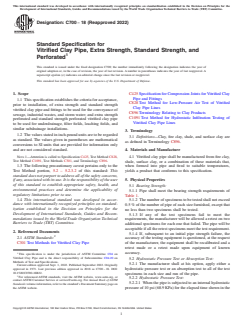
1.1 This specification establishes the criteria for acceptance, prior to installation, of extra strength and standard strength vitrified clay pipe and fittings to be used for the conveyance of sewage, industrial wastes, and storm water; and extra strength perforated and standard strength perforated vitrified clay pipe to be used for underdrainage, filter fields, leaching fields, and similar subdrainage installations.
1.2 The values stated in inch-pound units are to be regarded as standard. The values given in parentheses are mathematical conversions to SI units that are provided for information only and are not considered standard.
Note 1: Attention is called to Specification C425, Test Method C828, Test Method C1091, Test Methods C301, and Terminology C896.
1.3 The following precautionary caveat pertains only to the Test Method portion, 5.2 – 5.2.3.2 of this standard: This standard does not purport to address all of the safety concerns, if any, associated with its use. It is the responsibility of the user of this standard to establish appropriate safety, health, and environmental practices and determine the applicability of regulatory limitations prior to use.
1.4 This international standard was developed in accordance with internationally recognized principles on standardization established in the Decision on Principles for the Development of International Standards, Guides and Recommendations issued by the World Trade Organization Technical Barriers to Trade (TBT) Committee.
- Status
- Published
- Publication Date
- 31-Aug-2022
- Technical Committee
- C04 - Vitrified Clay Pipe
- Drafting Committee
- C04.20 - Methods of Test and Specifications

Overview
ASTM C700-18(2022): Standard Specification for Vitrified Clay Pipe, Extra Strength, Standard Strength, and Perforated is an internationally recognized standard developed by ASTM International. This specification establishes quality criteria for vitrified clay pipe and fittings used in sanitary, industrial, stormwater conveyance, and in various subdrainage applications such as underdrainage, filter fields, and leaching fields. The standard covers both extra strength and standard strength pipe, as well as perforated variants, detailing the manufacturing, physical, and performance requirements necessary to ensure durability, safety, and effective operation in demanding environments.
Key Topics
- Material Requirements: Pipes must be manufactured from fire clay, shale, surface clay, or their combinations and must conform to the absorption, strength, and acid resistance requirements.
- Product Classes: The standard identifies not only extra strength and standard strength pipes but also their perforated counterparts, expanding their utilization in a range of drainage and subdrainage systems.
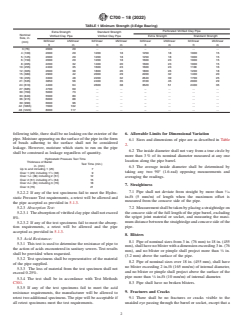
- Physical Performance: Pipes are required to meet minimum bearing strength as defined in the standard, and must not deviate beyond specified dimensional tolerances.
- Testing Procedures: Acceptance before installation is based on hydrostatic pressure or absorption tests for every run and size of pipe. An acid resistance test demonstrates chemical durability for sanitary sewer use.
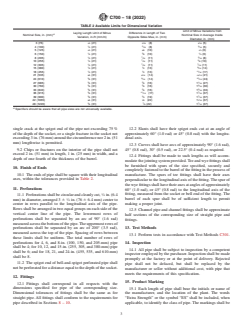
- Dimensional Consistency: Strict tolerances for inside diameters, length, straightness, and finish are stipulated to ensure compatibility and leak-resistant assemblies.
- Visual and Structural Integrity: The standard mandates that pipes be free from fractures, cracks, excessive blisters, or other defects that could compromise their function, with allowances only for minor, non-penetrating imperfections.
- Product Marking: Clear identification of manufacturer, plant location, and strength class is required for traceability and quality control.
Applications
ASTM C700-18(2022) provides critical benchmarks for selecting and installing vitrified clay pipe and fittings in the following practical applications:
- Sanitary and Storm Sewers: Used for reliable gravity-flow conveyance of sewage, stormwater, and industrial wastes due to their corrosion and chemical resistance.
- Subdrainage Systems: Perforated pipe variants are widely applied for underdrainage in areas with high water tables, including sports fields, highways, foundation drainage, leaching fields, and filter fields.
- Industrial and Municipal Projects: Vitrified clay’s natural resistance to acids makes it suitable for installations where aggressive chemical environments are expected.
- Sustainable Infrastructure: Clay pipe is inert, offering long-term performance and environmental compatibility, ideal for infrastructure requiring low long-term maintenance.
The standard is recognized by regulatory agencies for compliance in public works, municipal utilities, military, and federally funded projects, confirming its broad acceptance and reliability.
Related Standards
ASTM C700-18(2022) is closely linked with several other ASTM standards and terminology references, which ensure comprehensive specification and testing protocols:
- ASTM C425: Specification for Compression Joints for Vitrified Clay Pipe and Fittings
- ASTM C828: Test Method for Low-Pressure Air Test of Vitrified Clay Pipe Lines
- ASTM C301: Test Methods for Vitrified Clay Pipe (including acid resistance procedures)
- ASTM C1091: Test Method for Hydrostatic Infiltration Testing of Vitrified Clay Pipe Lines
- ASTM C896: Terminology Relating to Clay Products
These references underscore the importance of standardized installation, joint compatibility, and testing procedures for consistent, high-quality outcomes in clay pipe infrastructure projects.
Keywords: vitrified clay pipe, ASTM C700, extra strength, standard strength, perforated clay pipe, sanitary sewer pipe, subdrainage, filter field, leaching field, absorption test, bearing strength, acid resistance, ASTM standards, sewer pipe specifications, clay pipe fittings, infrastructure standards.
Relations
- Effective Date
- 01-Apr-2024
- Effective Date
- 01-Dec-2017
- Effective Date
- 01-Jun-2017
- Effective Date
- 01-Dec-2015
- Effective Date
- 01-Sep-2014
- Effective Date
- 01-Dec-2013
- Effective Date
- 01-Dec-2013
- Effective Date
- 01-Jan-2013
- Effective Date
- 01-Nov-2011
- Effective Date
- 01-Oct-2009
- Effective Date
- 01-Oct-2009
- Effective Date
- 01-Nov-2008
- Effective Date
- 01-Sep-2006
- Effective Date
- 01-Sep-2006
- Effective Date
- 01-Nov-2004
Get Certified
Connect with accredited certification bodies for this standard

Institut za varilstvo d.o.o. (Welding Institute)
Slovenia's leading welding institute since 1952. ISO 3834, EN 1090, pressure equipment certification, NDT personnel, welder qualification. Only IIW Au
Sponsored listings
Frequently Asked Questions
ASTM C700-18(2022) is a technical specification published by ASTM International. Its full title is "Standard Specification for Vitrified Clay Pipe, Extra Strength, Standard Strength, and Perforated". This standard covers: ABSTRACT This specification covers extra strength and standard strength vitrified clay pipe and fittings to be used for the conveyance of sewage, industrial wastes, and storm water; and extra strength perforated and standard strength perforated vitrified clay pipe to be used for underdrainage, filter fields, leaching fields, and similar subdrainage installations. Vitrified clay pipe shall be manufactured from fire clay, shale, surface clay, or a combination of these materials that, when formed into pipe and fired to suitable temperatures. Pipe shall meet the bearing strength requirements prescribed. The manufacturer shall at his option, apply either a hydrostatic pressure test or an absorption test to all of the test specimens in each size and run of the pipe. The absorption of vitrified clay pipe shall not exceed 8%. The acid resistance test is used to determine the resistance of pipe to the action of acids encountered in sanitary sewers. SCOPE 1.1 This specification establishes the criteria for acceptance, prior to installation, of extra strength and standard strength vitrified clay pipe and fittings to be used for the conveyance of sewage, industrial wastes, and storm water; and extra strength perforated and standard strength perforated vitrified clay pipe to be used for underdrainage, filter fields, leaching fields, and similar subdrainage installations. 1.2 The values stated in inch-pound units are to be regarded as standard. The values given in parentheses are mathematical conversions to SI units that are provided for information only and are not considered standard. Note 1: Attention is called to Specification C425, Test Method C828, Test Method C1091, Test Methods C301, and Terminology C896. 1.3 The following precautionary caveat pertains only to the Test Method portion, 5.2 – 5.2.3.2 of this standard: This standard does not purport to address all of the safety concerns, if any, associated with its use. It is the responsibility of the user of this standard to establish appropriate safety, health, and environmental practices and determine the applicability of regulatory limitations prior to use. 1.4 This international standard was developed in accordance with internationally recognized principles on standardization established in the Decision on Principles for the Development of International Standards, Guides and Recommendations issued by the World Trade Organization Technical Barriers to Trade (TBT) Committee.
ABSTRACT This specification covers extra strength and standard strength vitrified clay pipe and fittings to be used for the conveyance of sewage, industrial wastes, and storm water; and extra strength perforated and standard strength perforated vitrified clay pipe to be used for underdrainage, filter fields, leaching fields, and similar subdrainage installations. Vitrified clay pipe shall be manufactured from fire clay, shale, surface clay, or a combination of these materials that, when formed into pipe and fired to suitable temperatures. Pipe shall meet the bearing strength requirements prescribed. The manufacturer shall at his option, apply either a hydrostatic pressure test or an absorption test to all of the test specimens in each size and run of the pipe. The absorption of vitrified clay pipe shall not exceed 8%. The acid resistance test is used to determine the resistance of pipe to the action of acids encountered in sanitary sewers. SCOPE 1.1 This specification establishes the criteria for acceptance, prior to installation, of extra strength and standard strength vitrified clay pipe and fittings to be used for the conveyance of sewage, industrial wastes, and storm water; and extra strength perforated and standard strength perforated vitrified clay pipe to be used for underdrainage, filter fields, leaching fields, and similar subdrainage installations. 1.2 The values stated in inch-pound units are to be regarded as standard. The values given in parentheses are mathematical conversions to SI units that are provided for information only and are not considered standard. Note 1: Attention is called to Specification C425, Test Method C828, Test Method C1091, Test Methods C301, and Terminology C896. 1.3 The following precautionary caveat pertains only to the Test Method portion, 5.2 – 5.2.3.2 of this standard: This standard does not purport to address all of the safety concerns, if any, associated with its use. It is the responsibility of the user of this standard to establish appropriate safety, health, and environmental practices and determine the applicability of regulatory limitations prior to use. 1.4 This international standard was developed in accordance with internationally recognized principles on standardization established in the Decision on Principles for the Development of International Standards, Guides and Recommendations issued by the World Trade Organization Technical Barriers to Trade (TBT) Committee.
ASTM C700-18(2022) is classified under the following ICS (International Classification for Standards) categories: 23.040.50 - Pipes and fittings of other materials. The ICS classification helps identify the subject area and facilitates finding related standards.
ASTM C700-18(2022) has the following relationships with other standards: It is inter standard links to ASTM C896-24, ASTM C896-17a, ASTM C896-17, ASTM C896-15, ASTM C896-14, ASTM C896-13, ASTM C1091-03a(2013), ASTM C301-13, ASTM C896-11, ASTM C896-04(2009), ASTM C301-04(2009), ASTM C1091-03a(2008), ASTM C828-11, ASTM C828-06, ASTM C896-04. Understanding these relationships helps ensure you are using the most current and applicable version of the standard.
ASTM C700-18(2022) is available in PDF format for immediate download after purchase. The document can be added to your cart and obtained through the secure checkout process. Digital delivery ensures instant access to the complete standard document.
Standards Content (Sample)
This international standard was developed in accordance with internationally recognized principles on standardization established in the Decision on Principles for the
Development of International Standards, Guides and Recommendations issued by the World Trade Organization Technical Barriers to Trade (TBT) Committee.
Designation: C700 −18 (Reapproved 2022)
Standard Specification for
Vitrified Clay Pipe, Extra Strength, Standard Strength, and
Perforated
This standard is issued under the fixed designation C700; the number immediately following the designation indicates the year of
original adoption or, in the case of revision, the year of last revision. A number in parentheses indicates the year of last reapproval. A
superscript epsilon (´) indicates an editorial change since the last revision or reapproval.
This standard has been approved for use by agencies of the U.S. Department of Defense.
1. Scope C425 Specification for Compression Joints forVitrified Clay
Pipe and Fittings
1.1 This specification establishes the criteria for acceptance,
C828 Test Method for Low-Pressure Air Test of Vitrified
prior to installation, of extra strength and standard strength
Clay Pipe Lines
vitrified clay pipe and fittings to be used for the conveyance of
C896 Terminology Relating to Clay Products
sewage, industrial wastes, and storm water; and extra strength
C1091 Test Method for Hydrostatic Infiltration Testing of
perforated and standard strength perforated vitrified clay pipe
Vitrified Clay Pipe Lines
to be used for underdrainage, filter fields, leaching fields, and
similar subdrainage installations.
3. Terminology
1.2 The values stated in inch-pound units are to be regarded
3.1 Definitions—Clay, fire clay, shale, and surface clay are
as standard. The values given in parentheses are mathematical
as defined in Terminology C896.
conversions to SI units that are provided for information only
and are not considered standard.
4. Materials and Manufacture
NOTE 1—Attention is called to Specification C425, Test Method C828, 4.1 Vitrified clay pipe shall be manufactured from fire clay,
Test Method C1091, Test Methods C301, and Terminology C896.
shale, surface clay, or a combination of these materials that,
1.3 The following precautionary caveat pertains only to the when formed into pipe and fired to suitable temperatures,
Test Method portion, 5.2 – 5.2.3.2 of this standard: This
yields a product that conforms to this specification.
standard does not purport to address all of the safety concerns,
5. Physical Properties
if any, associated with its use. It is the responsibility of the user
of this standard to establish appropriate safety, health, and
5.1 Bearing Strength:
environmental practices and determine the applicability of
5.1.1 Pipe shall meet the bearing strength requirements of
regulatory limitations prior to use.
Table 1.
1.4 This international standard was developed in accor-
5.1.2 The number of specimens to be tested shall not exceed
dance with internationally recognized principles on standard-
0.5 % of the number of pipe of each size furnished, except that
ization established in the Decision on Principles for the
no less than two specimens shall be tested.
Development of International Standards, Guides and Recom-
5.1.3 If any of the test specimens fail to meet the
mendations issued by the World Trade Organization Technical
requirements, the manufacturer will be allowed a retest on two
Barriers to Trade (TBT) Committee.
additional specimens for each one that failed. The pipe will be
acceptable if all the retest specimens meet the test requirement.
2. Referenced Documents
5.1.4 If, subsequent to an initial pipe strength failure, the
2.1 ASTM Standards:
accuracy of the testing equipment is questioned, at the request
C301 Test Methods for Vitrified Clay Pipe
of the manufacturer, the equipment shall be recalibrated and a
retest made or a retest made upon equipment of known
accuracy.
This specification is under the jurisdiction of ASTM Committee C04 on
Vitrified Clay Pipe and is the direct responsibility of Subcommittee C04.20 on
5.2 Hydrostatic Pressure Test or Absorption Test:
Methods of Test and Specifications.
5.2.1 The manufacturer shall at his option, apply either a
Current edition approved Sept. 1, 2022. Published September 2022. Originally
hydrostatic pressure test or an absorption test to all of the test
approved in 1971. Last previous edition approved in 2018 as C700 – 18. DOI:
10.1520/C0700-18R22.
specimens in each size and run of the pipe.
For referenced ASTM standards, visit the ASTM website, www.astm.org, or
5.2.2 Hydrostatic Pressure Test:
contact ASTM Customer Service at service@astm.org. For Annual Book of ASTM
5.2.2.1 When the pipe is subjected to an internal hydrostatic
Standards volume information, refer to the standard’s Document Summary page on
the ASTM website. pressure of 10 psi (68.9 KPa) for the elapsed time shown in the
Copyright © ASTM International, 100 Barr Harbor Drive, PO Box C700, West Conshohocken, PA 19428-2959. United States
C700 − 18 (2022)
TABLE 1 Minimum Strength (3-Edge Bearing)
Perforated Vitrified Clay Pipe
Extra Strength Standard Strength
Nominal
Vitrified Clay Pipe Vitrified Clay Pipe
Extra Strength Standard Strength
Size, in.
lbf/linear kN/linear lbf/linear kN/linear lbf/linear kN/linear lbf/linear kN/linear
(mm)
ft m ft m ft m ft m
3 (76) 2000 29 . . . . . .
4 (100) 2000 29 1200 18 1250 18 1000 15
5 (125) 2000 29 1200 18 1250 18 1000 15
6 (150) 2000 29 1200 18 1600 23 1000 15
8 (205) 2200 32 1400 20 1600 23 1000 15
10 (255) 2400 35 1600 23 1600 23 1100 16
12 (305) 2600 38 1800 26 1800 26 1200 18
15 (380) 2900 42 2000 29 2200 32 1400 20
18 (455) 3300 48 2200 32 2640 39 1700 25
21 (535) 3850 56 2400 35 3100 45 2000 29
24 (610) 4400 64 2600 38 3520 51 2400 35
27 (685) 4700 69 . . . . . .
30 (760) 5000 73 . . . . . .
33 (840) 5500 80 . . . . . .
36 (915) 6000 88 . . . . . .
39 (990) 6600 96 . . . . . .
42 (1065) 7000 102 . . . . . .
48 (1220) 8000 117 . . . . . .
following table, there shall be no leaking on the exterior of the 6. Allowable Limits for Dimensional Variation
pipe. Moisture appearing on the surface of the pipe in the form
6.1 Sizes and dimensions of pipe are as described in Table
of beads adhering to the surface shall not be considered
2.
leakage. However, moisture which starts to run on the pipe
6.2 The inside diameter shall not vary from a true circle by
shall be construed as leakage regardless of quantity.
more than 3 % of its nominal diameter measured at any one
Hydrostatic Pressure Test Time
location along the pipe barrel.
Thickness of Barrel
Test Time (min.)
in. (mm)
6.3 The average inside diameter shall be determined by
Up to and including 1 (25) 7
taking any two 90° (1.6-rad) opposing measurements and
Over 1 (25) including 1 ⁄2 (38) 9
Over 1 ⁄2 (38) including 2 (51) 12
averaging the readings.
Over 2 (51) including 2 ⁄2 (64) 15
Over 2 ⁄2 (64) including 3 (76) 18
7. Straightness
Over 3 (76) 21
7.1 Pipe shall not deviate from straight by more than ⁄16
5.2.2.2 If any of the test specimens fail to meet the Hydro-
in./ft (5 mm/m) of length when the maximum offset is
static Pressure Test requirements, a retest will be allowed and
measured from the concave side of the pipe.
the pipe accepted as provided in 5.1.3.
5.2.3 Absorption Test:
7.2 Measurementshallbetakenbyplacingastraightedgeon
the concave side of the full length of the pipe barrel, excluding
5.2.3.1 The absorption of vitrified clay pipe shall not exceed
8%. the spigot joint material or socket, and measuring the maxi-
mumdistancebetweenthestraightedgeandconcavesideofthe
5.2.3.2 If any of the test specimens fail to meet the absorp-
pipe.
tion requirements, a retest will be allowed and the pipe
accepted as provided in 5.1.3.
8. Blisters
5.3 Acid Resistance:
8.1 Pipe of nominal sizes from 3 in. (76 mm) to 18 in. (455
5.3.1 This test is used to determine the resistance of pipe to
mm),shallhavenoblisterwithadimensionexceeding3in.(76
the action of acids encountered in sanitary sewers. Test results
mm), and no blister or pimple shall project more than ⁄8 in.
shall be provided when requested.
(3.2 mm) above the surface of the pipe.
5.3.2 Test specimens shall be representative of the material
8.2 Pipe of nominal sizes over 18 in. (455 mm), shall have
of the pipe supplied.
no blister exceeding 2 in./ft (165 mm/m) of internal diameter,
5.3.3 The loss of material from the test specimen shall not
and no blister or pimple shall project above the surface of the
exceed 0.25%.
pipe more than ⁄8 in./ft (10 mm/m) of internal diameter.
5.
...