

ASTM E200-23
(Practice)Standard Practice for Preparation, Standardization, and Storage of Standard and Reagent Solutions for Chemical Analysis
General Information
- Abstract
SIGNIFICANCE AND USE
4.1 The accuracy of many analytical measurements is dependent upon the manner in which the standard solutions are prepared and stored, and the accuracy with which they are standardized. Combining the methods recommended for the preparation and handling of such solutions into one practice eliminates the necessity for covering such details in all of the methods wherein the solutions are used.
SCOPE
1.1 This practice covers procedures for the preparation, standardization, and storage of the standard volumetric solutions and reagent testing solutions commonly used in chemical analysis.
1.2 The information in this practice is arranged as follows:
Sections
Referenced Documents
2
Terminology
3
Significance and Use
4
Apparatus
5
Temperature effects
6
Measurements
7
Reagents
8
Concentration of solutions
9
Mixing of solutions
10
Storage of solutions
11
Preparation and standardization of solutions
12
Precision and Bias
13
Sodium hydroxide solution, 0.02 to 1.0 meq/mL (N)
14 to 19
Hydrochloric acid, 0.02 to 1.0 meq/mL (N)
20 to 28
Sulfuric acid, 0.02 to 1.0 meq/mL (N)
29 to 33
Hydrochloric acid, special 1 meq/mL (N)
34 to 38
Sulfuric acid, special 1 meq/mL (N)
39 to 43
Silver nitrate solution, 0.1 meq/mL (N)
44 to 48
Ammonium thiocyanate solution, 0.1 meq/mL (N)
49 to 53
Iodine solution, 0.1 meq/mL (N)
54 to 58
Sodium thiosulfate solution, 0.1 meq/mL (N)
59 to 63
Potassium permanganate solution, 0.1 meq/mL (N)
64 to 68
Potassium dichromate solution, 0.1 meq/mL(N)
69 to 73
Methanolic sodium hydroxide solution, 0.5 meq/mL (N)
74 to 79
Ceric sulfate solution, 0.1 meq/mL (N)
80 to 84
Acetous perchloric acid, 0.1 meq/mL (N)
85 to 89
Disodium ethylenediaminetetraacetate solution, 0.05 mol/L(M)
90 to 94
Standard ion solutions
95
Nonstandardized reagent solutions and indicator solutions
96
1.3 The values stated in SI units are to be regarded as standard. The values given in parentheses are for information only.
1.4 This standard does not purport to address all of the safety concerns, if any, associated with its use. It is the responsibility of the user of this standard to establish appropriate safety, health, and environmental practices and determine the applicability of regulatory limitations prior to use. Specific warning statements are given throughout this practice. Consult current OSHA regulations, suppliers’ Safety Data Sheets, and local regulations for all materials used in this specification.
1.5 This international standard was developed in accordance with internationally recognized principles on standardization established in the Decision on Principles for the Development of International Standards, Guides and Recommendations issued by the World Trade Organization Technical Barriers to Trade (TBT) Committee.
- Status
- Published
- Publication Date
- 30-Jun-2023
- Technical Committee
- D16 - Aromatic, Industrial, Specialty and Related Chemicals
- Drafting Committee
- D16.04 - Instrumental Analysis
Buy Documents
ASTM E200-23 - Standard Practice for Preparation, Standardization, and Storage of Standard and Reagent Solutions for Chemical Analysis
REDLINE ASTM E200-23 - Standard Practice for Preparation, Standardization, and Storage of Standard and Reagent Solutions for Chemical Analysis
Overview
ASTM E200-23 is the international standard practice established by ASTM International for the preparation, standardization, and storage of standard and reagent solutions used in chemical analysis. This guideline is essential for laboratories and professionals involved in chemical testing, as the precision and reliability of analytical measurements widely depend on correct solution preparation and maintenance. ASTM E200-23 consolidates best practices for handling volumetric and reagent solutions, thereby facilitating consistency and accuracy across various chemical analysis methods.
Key Topics
ASTM E200-23 provides thorough procedures and recommendations that cover:
- Apparatus: Guidance on selection and calibration of volumetric glassware and burettes, including recommendations for Class A glassware per ASTM E694.
- Temperature Effects: Consideration of temperature fluctuations on volumetric solutions, including correction factors for accurate measurements.
- Measurement Protocols: Instructions for accurate weighing, burette readings, and proper calculation of solution concentrations in SI units such as meq/mL (normality) and mol/L (molarity).
- Reagents and Water Purity: Specifications for reagent quality, water grade (per ASTM D1193), and primary standard materials.
- Solution Preparation: Methodologies for preparing standard concentrations of commonly used solutions (e.g., sodium hydroxide, hydrochloric acid, sulfuric acid, silver nitrate, and others).
- Solution Mixing and Storage: Techniques for effective mixing, including use of specialized stirrers and prevention of contamination, as well as guidelines for storing solutions in appropriate containers.
- Standardization Procedures: Detailed standardization processes for various standard solutions to ensure analytical reliability and accuracy.
- Precision and Bias: Criteria for assessing repeatability, laboratory precision, and interlaboratory reproducibility.
Applications
This practice is widely applied in:
- Chemical Analysis Laboratories: Ensuring uniformity in the preparation and storage of test solutions contributes directly to the reproducibility and comparability of laboratory results.
- Quality Control: Used by industrial laboratories in pharmaceuticals, environmental monitoring, food testing, and chemical manufacturing to guarantee accurate analytical outcomes.
- Accreditation and Compliance: Essential for labs seeking compliance with international standards, including those monitored by regulatory agencies and industry bodies.
- Research and Academic Settings: Supporting accurate and comparable research data across scientific studies and teaching laboratories.
- Development of Analytical Methods: Providing a consistent reference for standardization in the development and validation of new chemical analysis protocols.
Related Standards
For effective implementation, ASTM E200-23 references several related standards, including:
- ASTM D1193: Specification for Reagent Water - provides water purity definitions essential for solution preparation.
- ASTM E694: Specification for Laboratory Glass Volumetric Apparatus - requirements for accuracy and calibration of glassware.
- ASTM E50: Practices for Apparatus, Reagents, and Safety Considerations - supplements safety and reagent specifications.
- ASTM E180: Practice for Determining Precision of Analytical Methods - outlines forms for precision and bias reporting.
- ASTM E203: Test Method for Water Using Volumetric Karl Fischer Titration - applicable for specific solution standardization.
By following ASTM E200-23, laboratories can ensure the precision, reliability, and traceability of their chemical analyses. Standardization of preparation, use of certified reagents, and proper storage all contribute to high-quality and reproducible analytical results, fulfilling industry and regulatory requirements for best practice in chemical testing.
Relations
- Effective Date
- 01-Feb-2024
- Effective Date
- 01-Jan-2024
- Effective Date
- 01-Jan-2018
- Effective Date
- 01-Sep-2017
- Effective Date
- 01-Aug-2016
- Effective Date
- 15-Oct-2011
- Effective Date
- 01-Jul-2010
- Effective Date
- 01-Mar-2006
- Effective Date
- 01-May-2005
- Effective Date
- 01-May-2005
- Effective Date
- 10-Nov-2000
- Effective Date
- 10-Dec-1999
- Effective Date
- 10-Feb-1999
- Effective Date
- 10-Feb-1999
Buy Documents
ASTM E200-23 - Standard Practice for Preparation, Standardization, and Storage of Standard and Reagent Solutions for Chemical Analysis
REDLINE ASTM E200-23 - Standard Practice for Preparation, Standardization, and Storage of Standard and Reagent Solutions for Chemical Analysis
Get Certified
Connect with accredited certification bodies for this standard

ECOCERT
Organic and sustainability certification.

Eurofins Food Testing Global
Global leader in food, environment, and pharmaceutical product testing.

Intertek Bangladesh
Intertek certification and testing services in Bangladesh.
Sponsored listings
Frequently Asked Questions
ASTM E200-23 is a standard published by ASTM International. Its full title is "Standard Practice for Preparation, Standardization, and Storage of Standard and Reagent Solutions for Chemical Analysis". This standard covers: SIGNIFICANCE AND USE 4.1 The accuracy of many analytical measurements is dependent upon the manner in which the standard solutions are prepared and stored, and the accuracy with which they are standardized. Combining the methods recommended for the preparation and handling of such solutions into one practice eliminates the necessity for covering such details in all of the methods wherein the solutions are used. SCOPE 1.1 This practice covers procedures for the preparation, standardization, and storage of the standard volumetric solutions and reagent testing solutions commonly used in chemical analysis. 1.2 The information in this practice is arranged as follows: Sections Referenced Documents 2 Terminology 3 Significance and Use 4 Apparatus 5 Temperature effects 6 Measurements 7 Reagents 8 Concentration of solutions 9 Mixing of solutions 10 Storage of solutions 11 Preparation and standardization of solutions 12 Precision and Bias 13 Sodium hydroxide solution, 0.02 to 1.0 meq/mL (N) 14 to 19 Hydrochloric acid, 0.02 to 1.0 meq/mL (N) 20 to 28 Sulfuric acid, 0.02 to 1.0 meq/mL (N) 29 to 33 Hydrochloric acid, special 1 meq/mL (N) 34 to 38 Sulfuric acid, special 1 meq/mL (N) 39 to 43 Silver nitrate solution, 0.1 meq/mL (N) 44 to 48 Ammonium thiocyanate solution, 0.1 meq/mL (N) 49 to 53 Iodine solution, 0.1 meq/mL (N) 54 to 58 Sodium thiosulfate solution, 0.1 meq/mL (N) 59 to 63 Potassium permanganate solution, 0.1 meq/mL (N) 64 to 68 Potassium dichromate solution, 0.1 meq/mL(N) 69 to 73 Methanolic sodium hydroxide solution, 0.5 meq/mL (N) 74 to 79 Ceric sulfate solution, 0.1 meq/mL (N) 80 to 84 Acetous perchloric acid, 0.1 meq/mL (N) 85 to 89 Disodium ethylenediaminetetraacetate solution, 0.05 mol/L(M) 90 to 94 Standard ion solutions 95 Nonstandardized reagent solutions and indicator solutions 96 1.3 The values stated in SI units are to be regarded as standard. The values given in parentheses are for information only. 1.4 This standard does not purport to address all of the safety concerns, if any, associated with its use. It is the responsibility of the user of this standard to establish appropriate safety, health, and environmental practices and determine the applicability of regulatory limitations prior to use. Specific warning statements are given throughout this practice. Consult current OSHA regulations, suppliers’ Safety Data Sheets, and local regulations for all materials used in this specification. 1.5 This international standard was developed in accordance with internationally recognized principles on standardization established in the Decision on Principles for the Development of International Standards, Guides and Recommendations issued by the World Trade Organization Technical Barriers to Trade (TBT) Committee.
SIGNIFICANCE AND USE 4.1 The accuracy of many analytical measurements is dependent upon the manner in which the standard solutions are prepared and stored, and the accuracy with which they are standardized. Combining the methods recommended for the preparation and handling of such solutions into one practice eliminates the necessity for covering such details in all of the methods wherein the solutions are used. SCOPE 1.1 This practice covers procedures for the preparation, standardization, and storage of the standard volumetric solutions and reagent testing solutions commonly used in chemical analysis. 1.2 The information in this practice is arranged as follows: Sections Referenced Documents 2 Terminology 3 Significance and Use 4 Apparatus 5 Temperature effects 6 Measurements 7 Reagents 8 Concentration of solutions 9 Mixing of solutions 10 Storage of solutions 11 Preparation and standardization of solutions 12 Precision and Bias 13 Sodium hydroxide solution, 0.02 to 1.0 meq/mL (N) 14 to 19 Hydrochloric acid, 0.02 to 1.0 meq/mL (N) 20 to 28 Sulfuric acid, 0.02 to 1.0 meq/mL (N) 29 to 33 Hydrochloric acid, special 1 meq/mL (N) 34 to 38 Sulfuric acid, special 1 meq/mL (N) 39 to 43 Silver nitrate solution, 0.1 meq/mL (N) 44 to 48 Ammonium thiocyanate solution, 0.1 meq/mL (N) 49 to 53 Iodine solution, 0.1 meq/mL (N) 54 to 58 Sodium thiosulfate solution, 0.1 meq/mL (N) 59 to 63 Potassium permanganate solution, 0.1 meq/mL (N) 64 to 68 Potassium dichromate solution, 0.1 meq/mL(N) 69 to 73 Methanolic sodium hydroxide solution, 0.5 meq/mL (N) 74 to 79 Ceric sulfate solution, 0.1 meq/mL (N) 80 to 84 Acetous perchloric acid, 0.1 meq/mL (N) 85 to 89 Disodium ethylenediaminetetraacetate solution, 0.05 mol/L(M) 90 to 94 Standard ion solutions 95 Nonstandardized reagent solutions and indicator solutions 96 1.3 The values stated in SI units are to be regarded as standard. The values given in parentheses are for information only. 1.4 This standard does not purport to address all of the safety concerns, if any, associated with its use. It is the responsibility of the user of this standard to establish appropriate safety, health, and environmental practices and determine the applicability of regulatory limitations prior to use. Specific warning statements are given throughout this practice. Consult current OSHA regulations, suppliers’ Safety Data Sheets, and local regulations for all materials used in this specification. 1.5 This international standard was developed in accordance with internationally recognized principles on standardization established in the Decision on Principles for the Development of International Standards, Guides and Recommendations issued by the World Trade Organization Technical Barriers to Trade (TBT) Committee.
ASTM E200-23 is classified under the following ICS (International Classification for Standards) categories: 71.040.30 - Chemical reagents. The ICS classification helps identify the subject area and facilitates finding related standards.
ASTM E200-23 has the following relationships with other standards: It is inter standard links to ASTM E694-18(2024), ASTM E203-24, ASTM E694-18, ASTM E50-17, ASTM E50-11(2016), ASTM E50-11, ASTM E694-99(2010), ASTM D1193-06, ASTM E694-99(2005), ASTM E50-00(2005), ASTM E50-00, ASTM E694-99, ASTM D1193-99, ASTM D1193-99e1. Understanding these relationships helps ensure you are using the most current and applicable version of the standard.
ASTM E200-23 is available in PDF format for immediate download after purchase. The document can be added to your cart and obtained through the secure checkout process. Digital delivery ensures instant access to the complete standard document.
Standards Content (Sample)
This international standard was developed in accordance with internationally recognized principles on standardization established in the Decision on Principles for the
Development of International Standards, Guides and Recommendations issued by the World Trade Organization Technical Barriers to Trade (TBT) Committee.
Designation: E200 − 23
Standard Practice for
Preparation, Standardization, and Storage of Standard and
Reagent Solutions for Chemical Analysis
This standard is issued under the fixed designation E200; the number immediately following the designation indicates the year of
original adoption or, in the case of revision, the year of last revision. A number in parentheses indicates the year of last reapproval. A
superscript epsilon (´) indicates an editorial change since the last revision or reapproval.
This standard has been approved for use by agencies of the U.S. Department of Defense.
1. Scope* responsibility of the user of this standard to establish appro-
priate safety, health, and environmental practices and deter-
1.1 This practice covers procedures for the preparation,
mine the applicability of regulatory limitations prior to use.
standardization, and storage of the standard volumetric solu-
Specific warning statements are given throughout this practice.
tions and reagent testing solutions commonly used in chemical
Consult current OSHA regulations, suppliers’ Safety Data
analysis.
Sheets, and local regulations for all materials used in this
1.2 The information in this practice is arranged as follows:
specification.
Sections
1.5 This international standard was developed in accor-
Referenced Documents 2
dance with internationally recognized principles on standard-
Terminology 3
ization established in the Decision on Principles for the
Significance and Use 4
Apparatus 5
Development of International Standards, Guides and Recom-
Temperature effects 6
mendations issued by the World Trade Organization Technical
Measurements 7
Barriers to Trade (TBT) Committee.
Reagents 8
Concentration of solutions 9
Mixing of solutions 10
2. Referenced Documents
Storage of solutions 11
Preparation and standardization of solutions 12
2.1 ASTM Standards:
Precision and Bias 13
D1193 Specification for Reagent Water
Sodium hydroxide solution, 0.02 to 1.0 meq/mL (N) 14 to 19
E50 Practices for Apparatus, Reagents, and Safety Consid-
Hydrochloric acid, 0.02 to 1.0 meq/mL (N) 20 to 28
Sulfuric acid, 0.02 to 1.0 meq/mL (N) 29 to 33
erations for Chemical Analysis of Metals, Ores, and
Hydrochloric acid, special 1 meq/mL (N) 34 to 38
Related Materials
Sulfuric acid, special 1 meq/mL (N) 39 to 43
E180 Practice for Determining the Precision of ASTM
Silver nitrate solution, 0.1 meq/mL (N) 44 to 48
Ammonium thiocyanate solution, 0.1 meq/mL (N) 49 to 53
Methods for Analysis and Testing of Industrial and Spe-
Iodine solution, 0.1 meq/mL (N) 54 to 58 3
cialty Chemicals (Withdrawn 2009)
Sodium thiosulfate solution, 0.1 meq/mL (N) 59 to 63
E203 Test Method for Water Using Volumetric Karl Fischer
Potassium permanganate solution, 0.1 meq/mL (N) 64 to 68
Potassium dichromate solution, 0.1 meq/mL(N) 69 to 73
Titration
Methanolic sodium hydroxide solution, 0.5 meq/mL (N) 74 to 79
E694 Specification for Laboratory Glass Volumetric Appa-
Ceric sulfate solution, 0.1 meq/mL (N) 80 to 84
ratus
Acetous perchloric acid, 0.1 meq/mL (N) 85 to 89
Disodium ethylenediaminetetraacetate solution, 0.05 mol/ 90 to 94
2.2 Other Document:
L(M)
Reagent Chemicals American Chemical Society Specifica-
Standard ion solutions 95
Nonstandardized reagent solutions and indicator solutions 96 tions (ACS)
1.3 The values stated in SI units are to be regarded as
3. Terminology
standard. The values given in parentheses are for information
only. 3.1 Definitions:
1.4 This standard does not purport to address all of the
safety concerns, if any, associated with its use. It is the
For referenced ASTM standards, visit the ASTM website, www.astm.org, or
contact ASTM Customer Service at service@astm.org. For Annual Book of ASTM
This practice is under the jurisdiction of ASTM Committee D16 on Aromatic, Standards volume information, refer to the standard’s Document Summary page on
Industrial, Specialty and Related Chemicals and is the direct responsibility of the ASTM website.
Subcommittee D16.04 on Instrumental Analysis. The last approved version of this historical standard is referenced on
Current edition approved July 1, 2023. Published July 2023. Originally approved www.astm.org.
in 1962 as E200 – 62T. Last previous edition approved in 2016 as E200 – 16. DOI: Available from American Chemical Society (ACS), 1155 Sixteenth St., NW,
10.1520/E0200-23. Washington, DC 20036, http://www.acs.org.
*A Summary of Changes section appears at the end of this standard
Copyright © ASTM International, 100 Barr Harbor Drive, PO Box C700, West Conshohocken, PA 19428-2959. United States
E200 − 23
3.1.1 standard volumetric solution—a solution of accurately where:
determined concentration used in the quantitative analysis of
N = meq/mL (N) of solution when standardized,
t1
chemicals and other products. The concentration of such
N = meq/mL (N) of solution when used,
t2
solutions is usually expressed in terms of meq/mL (N) normal- t = temperature of solution during standardization,°C
ity or mol/L (M) molarity. t = temperature of solution during use, °C, and
F = factor to correct for thermal expansion of the solution
(ΔN/°C values from Table 1).
4. Significance and Use
4.1 The accuracy of many analytical measurements is de- 6.2 From the above equation it will be seen that the
correction is to be added to the meq/mL (N) of the solution
pendent upon the manner in which the standard solutions are
prepared and stored, and the accuracy with which they are when standardized if the temperature of use is lower than the
temperature of standardization while the correction is to be
standardized. Combining the methods recommended for the
preparation and handling of such solutions into one practice subtracted if the temperature of use is higher than the tempera-
ture of standardization.
eliminates the necessity for covering such details in all of the
methods wherein the solutions are used.
7. Measurements
5. Apparatus
7.1 Weighings—When it is directed that a chemical should
be “accurately weighed,” the weighing is to be performed in a
5.1 Volumetric Glassware—The use of ordinary volumetric
manner so as to limit the error to 0.1 % or less. Where a
glassware will meet the accuracy requirements of many test
specific weight of substance is designated in a procedure, it is
methods.
intended, unless otherwise specified in the individual
NOTE 1—For dependable accuracy, volumetric glassware meeting the
procedure, that a quantity within 65 % of the designated
requirements for Class A items given in Specification E694 should be
weight be used, and that this quantity be “accurately weighed”
used. While for normal work apparatus meeting these specifications can be
as just defined.
used without calibration corrections, it is preferable that such calibration
corrections be used in standardizing volumetric solutions. Such correc-
NOTE 2—In weighing primary standards to be used in standardizing
tions may be of significance when the volumetric ware is frequently used
volumetric solutions many laboratories customarily weigh to the nearest
with alkali solutions, for the corrosive effect of the alkali upon the glass
0.1 mg even though such increased accuracy of weighing does not
may result in changes in the apparent volume. It is recommended,
improve the accuracy or precision of the standardization.
therefore, that volumetric glassware, particularly burets and transfer
pipets, be recalibrated at 3-month intervals if it is frequently used to
7.2 Buret Readings—When buret readings are specified, or
measure alkali solution volumes.
when the procedure infers that a specific volume be measured
5.2 Buret—A 50 mL buret, or alternatively, a 100 mL buret from a buret, the reading is to be estimated to one fifth of the
with a 50 mL bulb at the top and a 50 mL stem below, may be
smallest volume subdivision marked on the buret. In reading a
used. For use with alkali solutions, burets equipped with 50 mL buret having subdivisions of 0.10 mL, therefore, the
TFE-fluorocarbon stopcock plugs are preferable. reading should be estimated to the nearest 0.02 mL.
7.3 Expression of Results—It is recommended to express the
6. Temperature Effects
concentration of the solutions as the normality in the equivalent
6.1 Volumetric solutions are often used at temperatures
SI units as meq/mL (N) and molarity as mol/L (M).
differing from those at which the standardization was carried
8. Reagents
out. Significant errors may be introduced when the solutions
NOTE 3—Additional information on reagents is given in Practices E50.
are used at these other temperatures. Values for the change of
normality with temperature (ΔN/°C) have been established for 8.1 Purity of Reagents—Reagent grade chemicals shall be
the volumetric solutions described herein, and are listed in
used in all tests. Unless otherwise indicated, it is intended that
Table 1. When warranted by the desired accuracy of the work, all reagents conform to the specifications of the Committee on
normalities of standard solutions may be corrected to the
Analytical Reagents of the American Chemical Society where
temperature at which they are used as follows: such specifications are available. Other grades may be used,
provided it is first ascertained that the reagent is of sufficiently
N 5 N 1 t 2 t ~F! (1)
~ !
t2 t1 1 2
high purity to permit its use without lessening the accuracy of
the determination.
8.2 Purity of Water—Unless otherwise indicated, references
TABLE 1 Temperature Correction Factors (F)
to water shall be understood to mean Type I or Type II reagent
Approximate ΔN/°C for 20
water conforming to Specification D1193. Where specified,
Solute
meq/mL (N) to 30 °C
carbon dioxide-free water is to be prepared by heating Type I
1.0 NaOH, HCl, H SO 0.00035
2 4
0.5 NaOH, HCl, H SO 0.00014
2 4
0.1 all aqueous 0.00002
ACS Reagent Chemicals, Specifications and Procedures for Reagents and
0.05 all aqueous 0.00001
Standard-Grade Reference Materials, American Chemical Society, Washington,
0.01 all aqueous 0.00000
DC. For suggestions on the testing of reagents not listed by the American Chemical
0.5 (in methanol) NaOH 0.00045
Society, see Analar Standards for Laboratory Chemicals, BDH Ltd., Poole, Dorset,
0.1 (in 1 N H SO ) Ce(SO ) 0.000035
2 4 4 2
0.1 (in glacial acetic acid) HClO 0.00011 U.K., and the United States Pharmacopeia and National Formulary, U.S. Pharma-
copeial Convention, Inc. (USPC), Rockville, MD.
E200 − 23
or Type II water to boiling in a conical flask, and boiling for 20 12. Preparation and Standardization of Solutions
min. The boiling water is cooled in the flask which is stoppered
12.1 Methods of standardization are given for each volu-
with a 1-hole rubber stopper fitted to a soda lime-ascarite
metric solution even though the methods of preparation for
drying tube. For larger (10 L to 20 L) volumes of carbon
some of these solutions specify that they be prepared on a
dioxide-free water, the absorbed carbon dioxide may be re-
determinate basis. Since it is not possible to prepare large
moved by inserting a fritted-glass gas-dispersion tube to the
volumes of solutions on a determinate basis, a method of
bottom of the container and bubbling nitrogen through the
standardization is provided for those solutions that are prepared
water for 1 or 2 h.
in such large volumes that accurate measurements of the
solution volumes cannot be made.
8.3 Primary Standards—Use either independently prepared
or commercially available certified reference materials.
13. Precision and Bias
9. Concentration of Solutions
13.1 Precision—Precision for standardizing the volumetric
solutions in this practice was determined in accordance with
9.1 Standard Solutions—Directions are given for the prepa-
Practice E180 – 90 and the forms of the statements conform
ration of the most commonly used concentrations of the
with that suggested in Practice E180 – 90.
standard volumetric solutions. Stronger or weaker solutions are
prepared and standardized in the same general manner as 13.2 Bias—No information concerning the bias of these
described, using proportionate amounts of the reagents. standardization methods is available because certified refer-
Similarly, if quantities larger than 1 L are to be prepared, ence solutions suitable for this practice are not available.
proportionate amounts of the reagents should be used.
STANDARD VOLUMETRIC SOLUTIONS
9.2 Diluted Acids and Ammonium Hydroxide—
SODIUM HYDROXIDE SOLUTION,
Concentrations of diluted acids and ammonium hydroxide,
0.02 TO 1.0 meq/mL N
except when standardized, shall be specified as a ratio stating
the number of volumes of the concentrated reagent to be
14. Preparation of 50 % NaOH Solution and of Standard
diluted with a given number of volumes of water, as in the
Solutions
following example: HCl (5 + 95) means 5 volumes of concen-
14.1 Dissolve 162 g of sodium hydroxide (NaOH) in
trated HCl (sp gr 1.19) diluted with 95 volumes of water.
150 mL of carbon dioxide-free water. Cool the solution to
25 °C and filter through a hardened filter paper or other suitable
10. Mixing of Solutions
medium. Alternatively, commercial 50 % NaOH solution may
be used.
10.1 When quantities of solution larger than 1 L to 2 L are
prepared, special problems are encountered in being sure that
14.2 To prepare a 0.1 meq/mL (N) solution, dilute 5.45 mL
they are well mixed before being standardized. While blade
of the clear solution to 1 L with carbon dioxide-free water, mix
stirrers with glass or metal shafts are suitable for many
well, and store in a tight polyolefin container.
solutions, they are not suitable in every case. In those cases
14.3 For other normalities of NaOH solution, use the
where contact of a glass or metal stirrer with the solution would
requirements given in Table 2.
be undesirable it may be possible to use a sealed polyolefin-
coated stirrer. In those cases where only contact of the solution
with metal must be avoided, the solution can be mixed by
inserting a fritted-glass gas-dispersion tube to the bottom of the
TABLE 2 Sodium Hydroxide Dilution Requirements
container and bubbling nitrogen through the solution for 1 or
2 h. Volume of 50 % NaOH
Desired Grams of NaOH Solution (25°C)
meq/mL (N) Required/1 L of Solution Required/1 L of
11. Storage of Solutions
Solution, mL
0.02 0.8 1.1
11.1 Glass containers are suitable for the storage of most of
0.04 1.6 2.2
the standard solutions, although the use of polyolefin contain-
0.05 2.0 2.7
0.1 4.0 5.4
ers is recommended for alkali solutions.
0.2 8.0 10.9
0.25 10.0 13.6
11.2 When large quantities of solutions are prepared and
0.5 20.0 27.2
standardized, it is necessary to provide protection against
1.0 40.0 54.5
changes in standardization concentration due to absorption of
gases or water vapor from the laboratory air. As volumes of
solution are withdrawn from the container, the replacement air
should be passed through a drying tube filled with equal parts
of 8 to 20-mesh soda lime, oxalic acid, and 4 to 8-mesh
anhydrous calcium chloride, each product being separated
Supporting data have been filed at ASTM International Headquarters and may
from the other by a glass wool plug or use equivalent
be obtained by requesting Research Report RR:E15-1039. Contact ASTM Customer
commercially available absorption tubes. Service at service@astm.org.
E200 − 23
15. Standardization solution must be standardized frequently if there is evidence of
action on the glass container, or if insoluble matter appears in
15.1 Crush 10 g to 20 g of primary standard potassium
the solution.
hydrogen phthalate (KHC H O ) to 100-mesh fineness, and
8 4 4
dry in a glass container at 120 °C for 2 h. Stopper the container
19. Precision and Bias
and cool in a desiccator.
19.1 The following criteria should be used for judging the
15.2 To standardize a 0.1 meq/mL (N) solution, weigh
accurately 0.95 g 6 0.05 g of the dried KHC H O , and acceptability of results:
8 4 4
transfer to a 500 mL conical flask. Add 100 mL of carbon 19.1.1 Sodium Hydroxide (1.0 meq/mL (N)) (See Note 5):
dioxide-free water, stir gently to dissolve the sample, add 3
19.1.1.1 Repeatability (Single Analyst)—The standard de-
drops of a 1.0 % solution of phenolphthalein in alcohol, and
viation for a single determination has been estimated to be
titrate with NaOH solution to a color that matches that of an
0.0007 meq/mL (N) normality units at 36 df. The 95 % limit for
end point color standard.
the difference between two such determinations is 0.0020
15.3 The weights of dried KHC H O suitable for other meq/mL (N) normality units.
8 4 4
normalities of NaOH solution are given in Table 3.
19.1.1.2 Laboratory Precision (Within-Laboratory,
Between-Days Variability)—The standard deviation of results
(each the average of duplicates) obtained by the same analyst
TABLE 3 Weights of Dried Potassium Hydrogen Phthalate
on different days, has been estimated to be 0.0007 meq/mL (N)
Weight of Dried
normality units at 18 df. The 95 % limit for the difference
meq/mL (N) of Solution
A
KHC H O to Be Used, g
8 4 4
between two such averages is 0.0020 meq/mL (N) normality
0.02 0.19 ± 0.005
units.
0.04 0.38 ± 0.005
0.05 0.47 ± 0.005
19.1.1.3 Reproducibility (Multilaboratory)—The standard
0.1 0.95 ± 0.05
deviation of results (each the average of duplicates), obtained
0.2 1.90 ± 0.05
by analysts in different laboratories, has been estimated to be
0.25 2.35 ± 0.05
0.5 4.75 ± 0.05
0.001 meq/mL (N) normality units at 17 df. The 95 % limit for
1.0 9.00 ± 0.05
the difference between two such averages is 0.0028 meq/mL
A
The listed weights are for use when a 50 mL buret is to be used. If a 100 mL buret
(N) normality units.
is to be used, the weights should be doubled.
19.1.2 Sodium Hydroxide (0.1 meql/mL (N)):
19.1.2.1 Repeatability (Single Analyst)—The standard de-
viation for a single determination has been estimated to be
16. pH 8.6 End Point Color Standard
0.00009 meq/mL (N) normality units at 28 df. The 95 % limit
for the difference between two such determinations is 0.0003
16.1 Mix 25 mL of a solution 0.2 mol/L (M) in boric acid
meq/mL (N) normality units.
(H BO ) and 0.2 mol/L (M) in potassium chloride (KCl),
3 3
(1.24 g H BO and 1.49 KCl in 100 mL water) with 12 mL of 19.1.2.2 Laboratory Precision (Within-Laboratory,
3 3
0.1 N NaOH solution, add 3 drops of a 1.0 % solution of
Between-Days Variability)—The standard deviation of results
phenolphthalein in alcohol, and dilute to 100 mL with carbon (each the average of duplicates) obtained by the same analyst
dioxide-free water.
on different days, has been estimated to be 0.00011 meq/mL
(N) normality units at 14 df. The 95 % limit for the difference
17. Calculation
between two such averages is 0.0003 meq/mL (N) normality
units.
17.1 Calculate the meq/mL (N) of the NaOH solution, as
follows:
19.1.2.3 Reproducibility (Multilaboratory)—The standard
deviation of results (each the average of duplicates), obtained
B
A 5 (2)
by analysts in different laboratories, has been estimated to be
0.20423 × C
0.00020 meq/mL (N) at 13 df. The 95 % limit for the difference
where:
between two such averages is 0.0005 meq/mL (N) normality
A = meq/mL (N) of the NaOH solution,
units.
B = grams of KHC H O used, and
8 4 4
C = millilitres of NaOH solution consumed. NOTE 4—Precision data have not been obtained for concentrations other
than those listed.
18. Stability NOTE 5—These precision estimates are based on an interlaboratory
study conducted in 1962. One sample was analyzed. One analyst in each
18.1 The use of polyolefin containers eliminates some of the
of 18 laboratories performed duplicate determinations and repeated them
difficulties attendant upon the use of glass containers, and their
on a second day, for a total of 72 determinations. Practice E180 was used
use is recommended. Should glass containers be used, the in developing these statements.
NOTE 6—These precision estimates are based on an interlaboratory
study conducted in 1962. One sample was analyzed. One analyst in each
of 16 laboratories performed duplicate determinations and repeated them
A primary standard grade of this chemical (and many others) is available from
on a second day, for a total of 64 determinations. Practice E180 was used
the Office of Standard Reference Materials, National Institute of Standards and
Technology, Gaithersburg, MD 20899. in developing these statements.
E200 − 23
TABLE 5 Weights of Dried Sodium Carbonate
HYDROCHLORIC ACID,
0.02 to 1.0 meq/mL (N) Weight of Dried
meq/mL (N) of Solution
Na CO to Be Used, g
2 3
A
20. Preparation
0.02 0.088 ± 0.001
A
0.04 0.176 ± 0.001
B
20.1 To prepare a 0.1 meq/mL (N) solution, measure 8.3 mL
0.1 0.22 ± 0.01
B
of concentrated hydrochloric acid (HCl, sp gr 1.19) into a 0.2 0.44 ± 0.01
B
0.5 1.10 ± 0.01
graduated cylinder and transfer it to a 1 L volumetric flask.
B
1.0 2.20 ± 0.01
Dilute to the mark with water, mix well, and store in a tightly
A
A 100 mL buret should be used for this standardization.
closed glass container. B
The listed weights are for use when a 50 mL buret is used. If a 100 mL buret is
to be used, the weights should be doubled.
20.2 For other normalities of HCl solution, use the require-
ments given in Table 4.
23. Stability
TABLE 4 Hydrochloric Acid Dilution Requirements
23.1 Restandardize monthly.
Volume of HCl to Be
Desired meq/mL (N)
Diluted to 1 L, mL
24. Precision and Bias (See Note 4)
0.02 1.66
0.04 3.32
24.1 The following criteria should be used for judging the
0.1 8.3
acceptability of results:
0.2 16.6
0.5 41.5
24.1.1 Hydrochloric Acid (1.0 meq/mL (N)) (See Note 5):
1.0 83.0
24.1.1.1 Repeatability (Single Analyst)—The standard de-
viation for a single determination has been estimated to be
0.0004 meq/mL (N) normality units at 36 df. The 95 % limit for
21. Standardization with Sodium Carbonate
the difference between two such determinations is 0.0011
21.1 Transfer 2 g to 4 g of primary standard anhydrous
meq/mL (N) normality units.
sodium carbonate (Na CO ) to a platinum dish or crucible, and
2 3 24.1.1.2 Laboratory Precision (Within-Laboratory,
dry at 250 °C for 4 h. Cool in a desiccator.
Between-Days Variability)—The standard deviation of results
(each the average of duplicates) obtained by the same analyst
21.2 To standardize a 0.1 meq/mL (N) solution, weigh
on different days, has been estimated to be 0.0006 meq/mL (N)
accurately 0.22 g 6 0.01 g of the dried Na CO , and transfer to
2 3
normality units at 18 df. The 95 % limit for the difference
a 500 mL conical flask. Add 50 mL of water, swirl to dissolve
between two such averages is 0.0017 meq/mL (N) normality
the carbonate, and add 2 drops of a 0.1 % solution of methyl
units.
red in alcohol. Titrate with the HCl solution to the first
24.1.1.3 Reproducibility (Multilaboratory)—The standard
appearance of a red color, and boil the solution carefully, to
deviation of results (each the average of duplicates), obtained
avoid loss, until the color is discharged. Cool to room
by analysts in different laboratories has been estimated to be
temperature, and continue the titration, alternating the addition
0.0015 meq/mL (N) normality units at 17 df. The 95 % limit for
of HCl solution and the boiling and cooling to the first
the difference between two such averages is 0.0042 meq/mL
appearance of a faint red color that is not discharged on further
(N) normality units.
heating.
24.1.2 Hydrochloric Acid (0.1 meql/mL (N)) (See Note 6):
21.3 The weights of dried Na CO suitable for other nor-
2 3
24.1.2.1 Repeatability (Single Analyst)—The standard de-
malities of HCl solution are given in Table 5.
viation for a single determination has been estimated to be
0.00010 meq/mL (N) normality units at 28 df. The 95 % limit
22. Calculation
for the difference between two such determinations is 0.0003
22.1 Calculate the normality of the HCl solution, as follows:
meq/mL (N) normality units.
B
24.1.2.2 Laboratory Precision (Within-Laboratory,
A 5 (3)
0.053 × C
Between-Days Variability), formerly called Repeatability—The
standard deviation of results (each the average of duplicates)
where:
obtained by the same analyst on different days, has been
A = meq/mL (N) normality of the HCl solution,
estimated to be 0.00007 meq/mL (N) normality units at 14 df.
B = grams of Na CO used, and
2 3
The 95 % limit for the difference between two such averages is
C = millilitres of HCl solution consumed.
0.0002 meq/mL (N) normality units.
24.1.2.3 Reproducibility (Multilaboratory)—The standard
deviation of results (each the average of duplicates), obtained
A buret having a bent delivery tube is helpful in carrying out this standardiza-
tion procedure. by analysts in different laboratories has been estimated to be
E200 − 23
0.00017 meq/mL (N) normality units at 13 df. The 95 % limit normality units at 8 df. The 95 % limit for the difference
for the difference between two such averages is 0.0005 between two such averages is 0.0020 meq/mL (N) normality
meq/mL (N) normality units. units.
28.1.1.3 Reproducibility (Multilaboratory)—The standard
25. Standardization with Tris(hydroxymethyl)-
deviation of results (each the average of duplicates), obtained
Aminomethane
by analysts in different laboratories has been estimated to be
0.0015 meq/mL (N) normality units at 7 df. The 95 % limit for
25.1 Transfer 8 g to 10 g of primary standard tris(hy-
droxymethyl)aminomethane [(HOCH ) CNH ] to a suitable the difference between two such averages is 0.0042 meq/mL
2 3 2
(N) normality units.
dish or crucible, and dry in a vacuum at 70 °C for 24 h. Cool
in a desiccator. 28.1.2 Hydrochloric Acid (0.1 meq/mL (N):
28.1.2.1 Repeatability (Single Analyst)—The standard de-
25.2 To standardize a 0.1 meq/mL (N) solution, weigh
viation for a single determination has been estimated to be
accurately 0.40 g 6 0.02 g of the dried tris(hydroxymethyl)
0.00010 meq/mL (N) normality units at 16 df. The 95 % limit
aminomethane, and transfer to a 250 mL beaker. Dissolve in
for the difference between two such determinations is 0.0003
50 mL of ammonia- and carbon dioxide-free water, and titrate
meq/mL (N) normality units.
with the HCl solution to a pH of 4.70 using a suitable pH meter.
28.1.2.2 Laboratory Precision (Within-Laboratory,
25.3 The weights of dried tris(hydroxymethyl)aminometh-
Between-Days Variability)—The standard deviation of results
ane suitable for other normalities of HCl solution are given in
(each the average of duplicates) obtained by the same analyst
Table 6.
on different days, has been estimated to be 0.00012 meq/mL
(N) normality units at 8 df. The 95 % limit for the difference
26. Calculation
between two such averages is 0.0003 meq/mL (N) normality
26.1 Calculate the meq/mL (N) normality of the HCl
units.
solution, as follows:
28.1.2.3 Reproducibility (Multilaboratory)—The standard
deviation of results (each the average of duplicates) obtained
B
A 5 (4)
by analysts in different laboratories has been estimated to be
0.1211 × C
0.00024 meq/mL (N) normality units at 7 df. The 95 % limit for
where:
the difference between two such averages is 0.0007 meq/mL
A = meq/mL (N) normality of the HCl solution,
(N) normality units.
B = grams of tris(hydroxymethyl)aminomethane used, and
C = millilitres of HCl solution consumed.
TABLE 7 Sulfuric Acid Dilution Requirements
Volume of H SO to Be
27. Stability
2 4
Desired meq/mL (N)
Diluted to 1 L, mL
27.1 Restandardize monthly.
0.02 0.60
0.1 3.0
28. Precision and Bias (See Notes 7 and 8)
0.2 6.0
0.5 15.0
28.1 The following criteria should be used for judging the
1.0 30.0
acceptability of results:
28.1.1 Hydrochloric Acid (1.0 meq/mL (N)):
28.1.1.1 Repeatability (Single Analyst)—The standard de-
NOTE 7—These precision estimates are based on an interlaboratory
viation for a single determination has been estimated to be
study conducted in 1973. One sample of each concentration was analyzed.
One analyst in each of 9 laboratories performed duplicate determinations
0.0006 meq/mL (N) normality units at 16 df. The 95 % limit for
and repeated them on a second day, for a total of 36 determinations for
the difference between two such determinations is 0.0017
each concentration herein. Practice E180 was used in developing these
meq/mL (N) normality units.
statements.
28.1.1.2 Laboratory Precision (Within-Laboratory,
NOTE 8—Precision data have not been obtained for concentrations other
Between-Days Variability)—The standard deviation of results than those listed in Section 28.
(each the average of duplicates) obtained by the same analyst
SULFURIC ACID,
on different days, has been estimated to be 0.0007 meq/mL (N)
0.02 TO 1.0 meq/mL (N)
TABLE 6 Weights of Dried Tris(Hydroxymethyl)Aminomethane
29. Preparation
Weight of Dried
meq/mL (N) of Solution
29.1 To prepare a 0.1 meq/mL (N) solution, measure 3.0 mL
(HOCH ) CNH to be Used, g
2 3 2
A of concentrated sulfuric acid (H SO , sp gr 1.84) into a
2 4
0.02 0.16 ± 0.008
A
graduated cylinder and slowly add it to 400 mL of water in a
0.04 0.32 ± 0.016
B
0.1 0.40 ± 0.02
600 mL beaker. Rinse the cylinder into the beaker with water.
B
0.2 0.80 ± 0.04
Mix the acid-water mixture, allow it to cool, and transfer to a
B
0.5 2.0 ± 0.1
B
1.0 4.0 ± 0.2 1 L volumetric flask. Dilute to the mark with water, mix well,
A
and store in a tightly closed glass container.
A 100 mL buret should be used for this standardization.
B
The listed weights are for use when a 50 mL buret is used. If a 100 mL buret is
29.2 For other meq/mL (N) normalities of the H SO
2 4
to be used, the weights should be doubled.
solution, use the requirements given in Table 7.
E200 − 23
30. Standardization 1 L volumetric flask. Dilute to the mark with water, mix well,
and store in a tightly closed glass container.
30.1 Transfer 2 g to 4 g of primary standard anhydrous
sodium carbonate (Na CO ) to a platinum dish or crucible, and
2 3
35. Standardization
dry at 250 °C for 4 h. Cool in a desiccator.
35.1 Transfer 5 g of primary standard anhydrous sodium
30.2 For standardization of a 0.1 meq/mL (N) solution,
carbonate (Na CO ) to a platinum dish or crucible, and dry at
weigh accurately 0.22 g 6 0.01 g of the dried Na CO and
2 3
2 3
250 °C for 4 h (see Table 5). Cool in a desiccator. Weigh
transfer to a 500 mL conical flask. Add 50 mL of water, swirl
accurately 2.2 g 6 0.1 g of the dried Na CO , and transfer to
to dissolve the Na CO , and add 2 drops of a 0.1 % solution of
2 3
2 3
a 500 mL conical flask. Add 75 mL of water, swirl to dissolve
methyl red in alcohol. Titrate with the H SO solution to the
2 4
the Na CO , and add 3 drops of a 0.1 % solution of methyl
first appearance of a red color, and boil the solution carefully,
2 3
orange indicator. Titrate with HCl solution to a pink color.
to avoid loss, until the color is discharged. Cool to room
temperature and continue the titration alternating the addition
35.2 Methyl orange indicator solution modified with xylene
of H SO solution and the boiling and cooling, to the first
2 4
cyanole FF, suitable for use as an alternative indicator in this
appearance of a faint red color that is not discharged on further
procedure, is described in 96.17. Titrate with HCl solution to a
heating.
magenta color.
30.3 The weights of dried Na CO suitable for other
2 3
meq/mL (N) normalities of H SO solution are given in Table
2 4 36. Calculation
5.
36.1 Calculate the meq/mL (N) normality of the HCl
solution, as follows:
31. Calculation
B
31.1 Calculate the meq/mL (N) normality of the H SO
2 4
A 5 (6)
0.053 × C
solution, as follows:
B where:
A 5 (5)
0.053 × C
A = meq/mL (N) normality of the HCl solution,
B = grams of Na CO used, and
2 3
where:
C = millilitres of HCl solution consumed.
A = meq/mL (N) normality of the H SO solution,
2 4
B = grams of Na CO used, and
2 3
37. Stability
C = millilitres of H SO solution consumed.
2 4
37.1 Restandardize monthly.
32. Stability
38. Precision and Bias (See Note 11)
32.1 Restandardize monthly.
38.1 The following criteria should be used for judging the
NOTE 9—A solution of 0.1 meq/mL (N) sulfuric acid may be standard-
acceptability of results:
ized using dried tris(hydroxymethyl)aminomethane by the same procedure
used to standardize 0.1 meq/mL (N) hydrochloric acid in Section 25.
38.1.1 Repeatability (Single Analyst)—The standard devia-
tion for a single determination has been estimated to be
33. Precision and Bias
0.00064 meq/mL (N) normality units at 34 df. The 95 % limit
33.1 The following criteria should be used for judging the
for the difference between two such determinations is 0.0018
acceptability of results:
meq/mL (N) normality units.
33.1.1 Sulfuric Acid (1.0 meq/mL (N)):
38.1.2 Laboratory Precision (Within-Laboratory, Between-
33.1.1.1 Repeatability (Single Analyst)—See 24.1.1.1.
Days Variability)—The standard deviation of results (each the
33.1.1.2 Laboratory Precision (Within-Laboratory,
average of duplicates) obtained by the same analyst on
Between-Days Variability)—See 24.1.1.2.
different days, has been estimated to be 0.00081 meq/mL (N)
33.1.1.3 Reproducibility (Multilaboratory)—See 24.1.1.3.
normality units at 18 df. The 95 % limit for the difference
33.1.2 Sulfuric Acid (0.1 meq/mL (N)):
between two such averages is 0.0023 meq/mL (N) normality
33.1.2.1 Repeatability (Singly Analyst)—See 24.1.2.1.
units.
33.1.2.2 Laboratory Precision (Within-Laboratory,
38.1.3 Reproducibility (Multilaboratory)—The standard de-
Between-Days Variability)—See 24.1.2.2.
viation of results (each the average of duplicates), obtained by
33.1.2.3 Reproducibility (Multilaboratory)—See 24.1.2.3.
analysts in different laboratories has been estimated to be
0.0022 meq/mL (N) normality units at 16 df. The 95 % limit for
HYDROCHLORIC ACID, SPECIAL 1 meq/mL (N)
the difference between two such averages is 0.0062 meq/mL
NOTE 10—This solution is not for general use but is designed to satisfy
the special requirements of ASTM Committee E15, Subcommittee E15.52 (N) normality units.
on Alkalies.
NOTE 11—These precision estimates are based on an interlaboratory
study conducted in 1962. One sample was analyzed. One analyst in each
34. Preparation
of 18 laboratories performed duplicate determinations and repeated them
34.1 Measure 83.0 mL of concentrated hydrochloric acid
on a second day, for a total of 72 determinations. Practice E180 was used
(HCl, sp gr 1.19) into a graduated cylinder and transfer it to a in developing these statements.
E200 − 23
solution carefully to volume.
SULFURIC ACID, SPECIAL 1 meq/mL (N)
(See Note 10)
45. Standardization
39. Preparation
45.1 Warning—Nitrobenzene, used in this section, is ex-
39.1 Measure 30.0 mL of concentrated sulfuric acid
tremely hazardous when absorbed through the skin or when its
(H SO , sp gr 1.84) into a graduated cylinder, and slowly add vapor is inhaled. Such exposure may cause cyanosis; pro-
2 4
it to one half the desired volume of water in a 600 mL beaker.
longed exposure may cause anemia. Do not get in eyes, on
Rinse the cylinder into the beaker with water. Mix the skin, or on clothing. Avoid breathing vapor. Use only with
acid-water mixture, allow it to cool, and transfer to a 1 L
adequate ventilation.
volumetric flask. Dilute to the mark with water, mix well, and
45.2 Dry 0.3 g of sodium chloride (NaCl) at 105 °C for 2 h.
store in a tightly closed glass container.
Cool in a desiccator. Weigh accurately 0.28 g 6 0.01 g of the
dried NaCl and transfer to a 250 mL glass-stoppered conical
40. Standardization
flask. Add 25 mL of water, swirl to dissolve the NaCl, and add
40.1 Transfer 5 g of primary standard anhydrous sodium
2 mL of nitric acid (HNO ). Add from a volumetric pipet,
carbonate (Na CO ) to a platinum dish or crucible, and dry at
2 3
50 mL of the AgNO solution, while mixing thoroughly, add
250 °C for 4 h (see Table 5). Cool in a desiccator. Weigh
1 mL of ferric ammonium sulfate solution
accurately 2.2 g 6 0.1 g of the dried Na CO , and transfer to
2 3
(FeNH (SO ) ·12H O, 80 g ⁄L) and 5 mL of nitrobenzene
4 4 2 2
a 500 mL conical flask. Add 75 mL of water, swirl to dissolve
(Warning—see 45.1). Stopper the flask and shake vigorously
the Na CO , and add 3 drops of a 0.1 % solution of methyl
2 3
to coagulate the precipitate. Rinse the stopper into the flask
orange. Titrate with H SO solution to a pink color.
2 4
with a few millilitres of water and titrate the excess of AgNO
40.2 Methyl orange indicator solution modified with xylene with ammonium thiocyanate solution (NH SCN) until the first
permanent reddish-brown color appears and persists after
cyanole FF, suitable for use as an alternative indicator in this
vigorous shaking for 1 min. See 49.1 for preparation of
procedure, is described in 96.17. Titrate with H SO solution to
2 4
ammonium thiocyanate. Solution does not need to be standard-
a magenta color.
ized for use here. (See Note 13.) Designate the volume of
41. Calculation
NH SCN solution required for the titration as Volume I.
41.1 Calculate the meq/mL (N) normality of the H SO
45.3 Using the same volumetric pipet used in 45.2, transfer
2 4
solution, as follows:
50 mL of the AgNO solution to a clean, dry, 250 mL,
glass-stoppered conical flask. Add 25 mL of water, 2 mL of
B
A 5 (7)
HNO , 1 mL of FeNH (SO ) ·12H O solution, stopper the
0.053 × C 3 4 4 2 2
flask, and shake vigorously. Rinse the stopper into the flask
where:
with a few millilitres of water and titrate the AgNO solution
A = meq/mL (N) normality of the H SO solution,
2 4 with NH SCN solution until the first permanent reddish-brown
B = grams of Na CO used, and
2 3
color appears and persists after vigorous shaking for 1 min.
C = millilitres of H SO solution consumed.
2 4
Designate the volume of NH SCN solution consumed as
Volume II.
42. Stability
45.4 Measure accurately, from either a buret or a volumetric
42.1 Restandardize monthly.
pipet, 2.0 mL of the AgNO solution, designate the exact
volume as Volume III, and transfer to a 100 mL, glass-
43. Precision and Bias
stoppered conical flask. Add 25 mL of water, 2 mL of HNO ,
43.1 The following criteria should be used for judging the
1 mL of FeNH (SO ) ·12H O solution, and 5 mL of
4 4 2 2
acceptability of results:
nitrobenzene, (Warning—see 45.1) stopper the flask, and
43.1.1 Repeatability (Single Analyst)—See 38.1.1.
shake vigorously. Rinse the stopper into the flask with a few
43.1.2 Laboratory Precision (Within-Laboratory, Between-
millilitres of water and titrate the AgNO solution with
Days Variability)—See 38.1.2.
NH SCN solution until the first permanent reddish-brown
43.1.3 Reproducibility (Multilaboratory)—See 38.1.3.
color appears and persists after vigorous shaking for 1 min.
Designate the volume of NH SCN solution consumed as
SILVER NITRATE SOLUTION,
Volume IV.
0.1 meq/mL (N)
NOTE 13—The ammonium thiocyanate titrant used in the three titrations
44. Preparation
must be from the same, well-mixed solution. The nitrobenzene used in
each titration must also be from the same, well-mixed container.
44.1 Dry 17.5 g of silver nitrate (AgNO ) at 105 °C for 1 h.
Cool in a desiccator. Transfer 16.99 g of the dried AgNO to a
46. Calculation
1 L volumetric flask. Add 500 mL of water, swirl to dissolve
46.1 Calculate the meq/mL (N) normality of the AgNO
the AgNO , dilute to the mark with water, and mix. Store the
solution as follows:
solution in a tightly stoppered amber-glass bottle.
B
NOTE 12—If desired the solution may also be prepared on a determinate
A 5 (8)
basis by weighing the dried silver nitrate accurately and diluting the 0.05844 × C 2 D
~ !
E200 − 23
where: 51. Calculation
A = meq/mL (N) normality of the AgNO solution,
3 51.1 Calculate the meq/mL (N) normality of the NH SCN
B = grams of NaCl used,
solution, as follows:
C = volume of AgNO solution consumed by the total
B × C
chloride = 50 − [Volume I × (50 ⁄Volume II)], an
A 5 (9)
D
D = volume of AgNO solution consumed by any chloride
ion in the nitrobenzene = Volume III − [Volume
where:
IV × (50 ⁄Volume II)].
A = meq/mL (N) normality of the NH SCN solution,
B = millilitres of AgNO used,
47. Stability
C = meq/mL (N) normality of the AgNO solution, and
47.1 Restandardize monthly. D = millilitres of NH SCN solution required for titration of
the solution.
48. Precision and Bias (See Note 14)
52. Stability
48.1 The following criteria should be used for judging the
acceptability of results:
52.1 Restandardize monthly.
48.1.1 Repeatability (Single Analyst)—The standard devia-
53. Precision and Bias (See Note 14)
tion for a single determination has been estimated to be
0.00010 meq/mL (N) normality units at 34 df. The 95 % limit
53.1 The following criteria should be used for judging the
for the difference between two such determinations is 0.0003
acceptability of results:
meq/mL (N) normality units.
53.1.1 Repeatability (Single Analyst)—The standard devia-
48.1.2 Laboratory Precision (Within-Laboratory, Between-
tion for a single determination has been estimated to be
Days Variability)—The standard deviation of results (each the
0.00010 meq/mL (N) normality units at 38 df. The 95 % limit
average of duplicates) obtained by the same analyst on
for the difference between two such determinations is 0.00028
different days, has been estimated to be 0.00017 meq/mL (N)
meq/mL (N) normality units.
normality units at 17 df. The 95 % limit for the difference
53.1.2 Laboratory Precision (Within-Laboratory, Between-
between two such averages is 0.0005 meq/mL (N) normality
Days Variability)—The standard deviation of results (each the
units.
average of duplicates) obtained by the same analyst on
48.1.3 Reproducibility (Multilaboratory)—The standard de-
different days, has been estimated to be 0.00035 meq/mL (N)
viation of results (each the average of duplicates) obtained by
normality units at 19 df. The 95 % limit for the difference
analysts in different laboratories has been estimated to be
between two such averages is 0.00099 meq/mL (N) normality
0.00035 meq/mL (N) normality units at 16 df. The 95 % limit
units.
for the difference between two such averages is 0.0010
53.1.3 Reproducibility (Multilaboratory)—The standard de-
meq/mL (N) normality units.
viation of results (each the average of duplicates), obtained by
analysts in different laboratories has been estimated to be
NOTE 14—These precision estimates are based on an interlaboratory
0.00046 meq/mL (N) normality units at 18 df. The 95 % limit
study conducted in 1963. One sample was analyzed. One analyst in each
of 19 laboratories performed duplicate determinations and repeated them
for the difference between two such averages is 0.00130
on a second day, for a total of 76 determinations. Practice E180 was used
meq/mL (N) normality units.
in developing these statements.
IODINE SOLUTION,
AMMONIUM THIOCYANATE SOLUTION,
0.1 meq/mL (N)
0.1 meq/mL (N)
54. Preparation
49. Preparation
54.1 Transfer 12.7 g of iodine and 60 g of potassium iodide
49.1 Transfer 7.8 g of ammonium thiocyanate (NH SCN) to
(KI) to an 800 mL beaker, add 30 mL of water, and stir until
a flask, add 100 mL of water, and swirl to dissolve the
solution is complete. Dilute with water to 500 mL, and filter
NH SCN. When solution is complete, filter through a hardened
through a sintered-glass filter. Wash the filter with about 15 mL
filter paper, or other suitable medium. Dilute the clear filtrate to
of water, transfer the combined filtrate and washing to a 1 L
1 L with water and mix. Store the solution in a tightly
volumetric flask, dilute to the mark with water, and mix. Store
stoppered glass bottle.
the solution in a glass-stoppered, amber-glass bottle in a cool
place.
50. Standardization
50.1 Measure accurately about 40 mL of freshly standard-
55. Standardization
ized 0.1 meq/mL (N) silver nitrate (AgNO ) solution and
55.1 Warning—Arsenic trioxide is extremely toxic, avoid
transfer to a 250 mL conical flask. Add 50 mL of water, swirl
ingestion.
to mix the solution, and add 2 mL of nitric acid (HNO ) and
1 mL ferric ammonium sulfate solution (FeNH (SO ) ·12H O, 55.2 Transfer 1 g of primary standard arsenic trioxide
4 4 2 2
80 g/L). Titrate the AgNO solution with the NH SCN solution (As O ) (Warning—see 55.1) to a platinum dish, and dry at
3 4 2 3
until the first permanent reddish-brown color appears and 105 °C for 1 h. Cool in a desiccator. Weigh accurately 0.20 g 6
persists after vigorous shaking for 1 min. 0.01 g of the dried As O and t
...
This document is not an ASTM standard and is intended only to provide the user of an ASTM standard an indication of what changes have been made to the previous version. Because
it may not be technically possible to adequately depict all changes accurately, ASTM recommends that users consult prior editions as appropriate. In all cases only the current version
of the standard as published by ASTM is to be considered the official document.
Designation: E200 − 16 E200 − 23
Standard Practice for
Preparation, Standardization, and Storage of Standard and
Reagent Solutions for Chemical Analysis
This standard is issued under the fixed designation E200; the number immediately following the designation indicates the year of
original adoption or, in the case of revision, the year of last revision. A number in parentheses indicates the year of last reapproval. A
superscript epsilon (´) indicates an editorial change since the last revision or reapproval.
This standard has been approved for use by agencies of the U.S. Department of Defense.
1. Scope*
1.1 This practice covers procedures for the preparation, standardization, and storage of the standard volumetric solutions and
reagent testing solutions commonly used in chemical analysis.
1.2 The information in this practice is arranged as follows:
Sections
Referenced Documents 2
Terminology 3
Significance and Use 4
Apparatus 5
Temperature effects 6
Measurements 7
Reagents 8
Concentration of solutions 9
Mixing of solutions 10
Storage of solutions 11
Preparation and standardization of solutions 12
Precision and Bias 13
Sodium hydroxide solution, 0.02 to 1.0 meq/mL (N) 14 to 19
Hydrochloric acid, 0.02 to 1.0 meq/mL (N) 20 to 28
Sulfuric acid, 0.02 to 1.0 meq/mL (N) 29 to 33
Hydrochloric acid, special 1 meq/mL (N) 34 to 38
Sulfuric acid, special 1 meq/mL (N) 39 to 43
Silver nitrate solution, 0.1 meq/mL (N) 44 to 48
Ammonium thiocyanate solution, 0.1 meq/mL (N) 49 to 53
Iodine solution, 0.1 meq/mL (N) 54 to 58
Sodium thiosulfate solution, 0.1 meq/mL (N) 59 to 63
Potassium permanganate solution, 0.1 meq/mL (N) 64 to 68
Potassium dichromate solution, 0.1 meq/mL(N) 69 to 73
Methanolic sodium hydroxide solution, 0.5 meq/mL (N) 74 to 79
Ceric sulfate solution, 0.1 meq/mL (N) 80 to 84
Acetous perchloric acid, 0.1 meq/mL (N) 85 to 89
Disodium ethylenediaminetetraacetate solution, 0.05 mol/ 90 to 94
L(M)
Standard ion solutions 95
Nonstandardized reagent solutions and indicator solutions 96
This practice is under the jurisdiction of ASTM Committee D16 on Aromatic, Industrial, Specialty and Related Chemicals and is the direct responsibility of Subcommittee
D16.04 on Instrumental Analysis.
Current edition approved April 1, 2016July 1, 2023. Published May 2016July 2023. Originally approved in 1962 as E200 – 62T. Last previous edition approved in
20082016 as E200 – 08.E200 – 16. DOI: 10.1520/E0200-16.10.1520/E0200-23.
*A Summary of Changes section appears at the end of this standard
Copyright © ASTM International, 100 Barr Harbor Drive, PO Box C700, West Conshohocken, PA 19428-2959. United States
E200 − 23
1.3 The values stated in SI units are to be regarded as standard. The values given in parentheses are for information only.
1.4 This standard does not purport to address all of the safety concerns, if any, associated with its use. It is the responsibility
of the user of this standard to establish appropriate safety, health, and environmental practices and determine the applicability of
regulatory limitations prior to use. Specific warning statements are given throughout this practice. Consult current OSHA
regulations, suppliers’ Safety Data Sheets, and local regulations for all materials used in this specification.
1.5 This international standard was developed in accordance with internationally recognized principles on standardization
established in the Decision on Principles for the Development of International Standards, Guides and Recommendations issued
by the World Trade Organization Technical Barriers to Trade (TBT) Committee.
2. Referenced Documents
2.1 ASTM Standards:
D1193 Specification for Reagent Water
E50 Practices for Apparatus, Reagents, and Safety Considerations for Chemical Analysis of Metals, Ores, and Related Materials
E180 Practice for Determining the Precision of ASTM Methods for Analysis and Testing of Industrial and Specialty Chemicals
(Withdrawn 2009)
E203 Test Method for Water Using Volumetric Karl Fischer Titration
E694 Specification for Laboratory Glass Volumetric Apparatus
2.2 Other Document:
Reagent Chemicals American Chemical Society Specifications (ACS)
3. Terminology
3.1 Definitions:
3.1.1 standard volumetric solution—a solution of accurately determined concentration used in the quantitative analysis of
chemicals and other products. The concentration of such solutions is usually expressed in terms of meq/mL (N) normality or mol/L
(M) molarity.
4. Significance and Use
4.1 The accuracy of many analytical measurements is dependent upon the manner in which the standard solutions are prepared
and stored, and the accuracy with which they are standardized. Combining the methods recommended for the preparation and
handling of such solutions into one practice eliminates the necessity for covering such details in all of the methods wherein the
solutions are used.
5. Apparatus
5.1 Volumetric Glassware—The use of ordinary volumetric glassware will meet the accuracy requirements of many test methods.
NOTE 1—For dependable accuracy, volumetric glassware meeting the requirements for Class A items given in Specification E694 should be used. While
for normal work apparatus meeting these specifications can be used without calibration corrections, it is preferable that such calibration corrections be
used in standardizing volumetric solutions. Such corrections may be of significance when the volumetric ware is frequently used with alkali solutions,
for the corrosive effect of the alkali upon the glass may result in changes in the apparent volume. It is recommended, therefore, that volumetric glassware,
particularly burets and transfer pipets, be recalibrated at 3-month intervals if it is frequently used to measure alkali solution volumes.
5.2 Buret—A 50-mL50 mL buret, or alternatively, a 100-mL100 mL buret with a 50-mL50 mL bulb at the top and a 50-mL50 mL
stem below, may be used. For use with alkali solutions, burets equipped with TFE-fluorocarbon stopcock plugs are preferable.
6. Temperature Effects
6.1 Volumetric solutions are often used at temperatures differing from those at which the standardization was carried out.
Significant errors may be introduced when the solutions are used at these other temperatures. Values for the change of normality
For referenced ASTM standards, visit the ASTM website, www.astm.org, or contact ASTM Customer Service at service@astm.org. For Annual Book of ASTM Standards
volume information, refer to the standard’s Document Summary page on the ASTM website.
The last approved version of this historical standard is referenced on www.astm.org.
Available from American Chemical Society (ACS), 1155 Sixteenth St., NW, Washington, DC 20036, http://www.acs.org.
E200 − 23
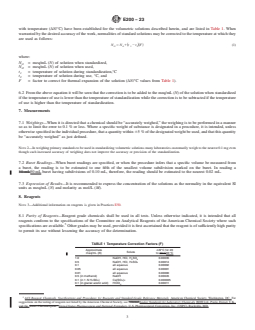
with temperature (ΔN/°C) have been established for the volumetric solutions described herein, and are listed in Table 1. When
warranted by the desired accuracy of the work, normalities of standard solutions may be corrected to the temperature at which they
are used as follows:
N 5 N 1 t 2 t ~F! (1)
~ !
t2 t1 1 2
where:
N = meq/mL (N) of solution when standardized,
t1
N = meq/mL (N) of solution when used,
t2
t = temperature of solution during standardization,°C
t = temperature of solution during use, °C, and
F = factor to correct for thermal expansion of the solution (ΔN/°C values from Table 1).
6.2 From the above equation it will be seen that the correction is to be added to the meq/mL (N) of the solution when standardized
if the temperature of use is lower than the temperature of standardization while the correction is to be subtracted if the temperature
of use is higher than the temperature of standardization.
7. Measurements
7.1 Weighings—When it is directed that a chemical should be “accurately weighed,” the weighing is to be performed in a manner
so as to limit the error to 0.1 % or less. Where a specific weight of substance is designated in a procedure, it is intended, unless
otherwise specified in the individual procedure, that a quantity within 65 % of the designated weight be used, and that this quantity
be “accurately weighed” as just defined.
NOTE 2—In weighing primary standards to be used in standardizing volumetric solutions many laboratories customarily weigh to the nearest 0.1 mg even
though such increased accuracy of weighing does not improve the accuracy or precision of the standardization.
7.2 Buret Readings—When buret readings are specified, or when the procedure infers that a specific volume be measured from
a buret, the reading is to be estimated to one fifth of the smallest volume subdivision marked on the buret. In reading a
50-mL50 mL buret having subdivisions of 0.10 mL, therefore, the reading should be estimated to the nearest 0.02 mL.
7.3 Expression of Results—It is recommended to express the concentration of the solutions as the normality in the equivalent SI
units as meq/mL (N) and molarity as mol/L (M).
8. Reagents
NOTE 3—Additional information on reagents is given in Practices E50.
8.1 Purity of Reagents—Reagent grade chemicals shall be used in all tests. Unless otherwise indicated, it is intended that all
reagents conform to the specifications of the Committee on Analytical Reagents of the American Chemical Society where such
specifications are available. Other grades may be used, provided it is first ascertained that the reagent is of sufficiently high purity
to permit its use without lessening the accuracy of the determination.
TABLE 1 Temperature Correction Factors (F)
Approximate ΔN/°C for 20
Solute
meq/mL (N) to 30°C30 °C
1.0 NaOH, HCl, H SO 0.00035
2 4
0.5 NaOH, HCl, H SO 0.00014
2 4
0.1 all aqueous 0.00002
0.05 all aqueous 0.00001
0.01 all aqueous 0.00000
0.5 (in methanol) NaOH 0.00045
0.1 (in 1 N H SO ) Ce(SO ) 0.000035
2 4 4 2
0.1 (in glacial acetic acid) HClO 0.00011
ACS Reagent Chemicals, Specifications and Procedures for Reagents and Standard-Grade Reference Materials, American Chemical Society, Washington, DC. For
suggestions on the testing of reagents not listed by the American Chemical Society, see “United Analar Standards for Laboratory Chemicals, BDH Ltd., Poole, Dorset, U.K.,
and the States Pharmacopeia.”United States Pharmacopeia and National Formulary, U.S. Pharmacopeial Convention, Inc. (USPC), Rockville, MD.
E200 − 23
8.2 Purity of Water—Unless otherwise indicated, references to water shall be understood to mean Type III or Type IIIII reagent
water conforming to Specification D1193. Where specified, carbon dioxide-free water is to be prepared by heating distilled Type
I or Type II water to boiling in a conical flask, and boiling for 20 min. The boiling water is cooled in the flask which is stoppered
with a 1-hole rubber stopper fitted to a soda lime-ascarite drying tube. For larger (10 to 20-L)(10 L to 20 L) volumes of carbon
dioxide-free water, the absorbed carbon dioxide may be removed by inserting a fritted-glass gas-dispersion tube to the bottom of
the container and bubbling nitrogen through the water for 1 or 2 h.
8.3 Primary Standards—The National Institute of Standards and Technology offers for sale certified standard samples of arsenic
trioxide, benzoic acid, potassium hydrogen phthalate, potassium dichromate, sodium oxalate, and tris(hydroxymethyl)aminometh-
ane. Where specified, these samples, or samples of commercially available primary standards, are to be used in standardizing the
volumetric solutions.Use either independently prepared or commercially available certified reference materials.
9. Concentration of Solutions
9.1 Standard Solutions—Directions are given for the preparation of the most commonly used concentrations of the standard
volumetric solutions. Stronger or weaker solutions are prepared and standardized in the same general manner as described, using
proportionate amounts of the reagents. Similarly, if quantities larger than 1 L are to be prepared, proportionate amounts of the
reagents should be used.
9.2 Diluted Acids and Ammonium Hydroxide—Concentrations of diluted acids and ammonium hydroxide, except when
standardized, shall be specified as a ratio stating the number of volumes of the concentrated reagent to be diluted with a given
number of volumes of water, as in the following example: HCl (5 + 95) means 5 volumes of concentrated HCl (sp gr 1.19) diluted
with 95 volumes of water.
10. Mixing of Solutions
10.1 When quantities of solution larger than 11 L to 2 L are prepared, special problems are encountered in being sure that they
are well mixed before being standardized. While blade stirrers with glass or metal shafts are suitable for many solutions, they are
not suitable in every case. In those cases where contact of a glass or metal stirrer with the solution would be undesirable it may
be possible to use a sealed polyolefin-coated stirrer. In those cases where only contact of the solution with metal must be avoided,
the solution can be mixed by inserting a fritted-glass gas-dispersion tube to the bottom of the container and bubbling nitrogen
through the solution for 1 or 2 h.
11. Storage of Solutions
11.1 Glass containers are suitable for the storage of most of the standard solutions, although the use of polyolefin containers is
recommended for alkali solutions.
11.2 When large quantities of solutions are prepared and standardized, it is necessary to provide protection against changes in
standardization concentration due to absorption of gases or water vapor from the laboratory air. As volumes of solution are
withdrawn from the container, the replacement air should be passed through a drying tube filled with equal parts of 8 to 20-mesh
soda lime, oxalic acid, and 4 to 8-mesh anhydrous calcium chloride, each product being separated from the other by a glass wool
plug or use equivalent commercially available absorption tubes.
12. Preparation and Standardization of Solutions
12.1 Methods of standardization are given for each volumetric solution even though the methods of preparation for some of these
solutions specify that they be prepared on a determinate basis. Since it is not possible to prepare large volumes of solutions on a
determinate basis, a method of standardization is provided for those solutions that are prepared in such large volumes that accurate
measurements of the solution volumes cannot be made.
E200 − 23
13. Precision and Bias
13.1 Precision—Precision for standardizing the volumetric solutions in this practice was determined in accordance with Practice
E180 – 90 and the forms of the statements conform with that suggested in Practice E180 – 90.
13.2 Bias—No information concerning the bias of these standardization methods is available because certified reference solutions
suitable for this practice are not available.
STANDARD VOLUMETRIC SOLUTIONS
SODIUM HYDROXIDE SOLUTION,
0.02 TO 1.0 meq/mL N
14. Preparation of 50 % NaOH Solution and of Standard Solutions
14.1 Dissolve 162 g of sodium hydroxide (NaOH) in 150 mL of carbon dioxide-free water. Cool the solution to 25°C25 °C and
filter through a hardened filter paper or other suitable medium. Alternatively, commercial 50 % NaOH solution may be used.
14.2 To prepare a 0.1 meq/mL (N) solution, dilute 5.45 mL of the clear solution to 1 L with carbon dioxide-free water, mix well,
and store in a tight polyolefin container.
14.3 For other normalities of NaOH solution, use the requirements given in Table 2.
TABLE 2 Sodium Hydroxide Dilution Requirements
Volume of 50 % NaOH
Desired Grams of NaOH Solution (25°C)
meq/mL (N) Required/1 L of Solution Required/1 L of
Solution, mL
0.02 0.8 1.1
0.04 1.6 2.2
0.05 2.0 2.7
0.1 4.0 5.4
0.2 8.0 10.9
0.25 10.0 13.6
0.5 20.0 27.2
1.0 40.0 54.5
15. Standardization
15.1 Crush 1010 g to 20 g of primary standard potassium hydrogen phthalate (KHC H O ) to 100-mesh fineness, and dry in a
8 4 4
glass container at 120°C120 °C for 2 h. Stopper the container and cool in a desiccator.
15.2 To standardize a 0.1 meq/mL (N) solution, weigh accurately 0.950.95 g 6 0.05 g of the dried KHC H O , and transfer to
8 4 4
a 500-mL500 mL conical flask. Add 100 mL of carbon dioxide-free water, stir gently to dissolve the sample, add 3 drops of a 1.0 %
solution of phenolphthalein in alcohol, and titrate with NaOH solution to a color that matches that of an end point color standard.
15.3 The weights of dried KHC H O suitable for other normalities of NaOH solution are given in Table 3.
8 4 4
16. pH 8.6 End Point Color Standard
16.1 Mix 25 mL of a solution 0.2 mol/L (M) in boric acid (H BO ) and 0.2 mol/L (M) in potassium chloride (KCl), (1.24 g H BO
3 3 3 3
and 1.49 KCl in 100 mL water) with 12 mL of 0.1 N NaOH solution, add 3 drops of a 1.0 % solution of phenolphthalein in alcohol,
and dilute to 100 mL with carbon dioxide-free water.
Supporting data have been filed at ASTM International Headquarters and may be obtained by requesting Research Report RR:E15-1039. Contact ASTM Customer
Service at service@astm.org.
A primary standard grade of this chemical (and many others) is available from the Office of Standard Reference Materials, National Institute of Standards and Technology,
Gaithersburg, MD 20899.
E200 − 23
TABLE 3 Weights of Dried Potassium Hydrogen Phthalate
Weight of Dried
meq/mL (N) of Solution
A
KHC H O to Be Used, g
8 4 4
0.02 0.19 ± 0.005
0.04 0.38 ± 0.005
0.05 0.47 ± 0.005
0.1 0.95 ± 0.05
0.2 1.90 ± 0.05
0.25 2.35 ± 0.05
0.5 4.75 ± 0.05
1.0 9.00 ± 0.05
A
The listed weights are for use when a 50-mL50 mL buret is to be used. If a
100-mL100 mL buret is to be used, the weights should be doubled.
17. Calculation
17.1 Calculate the meq/mL (N) of the NaOH solution, as follows:
B
A 5 (2)
0.20423 ×C
where:
A = meq/mL (N) of the NaOH solution,
B = grams of KHC H O used, and
8 4 4
C = millilitres of NaOH solution consumed.
18. Stability
18.1 The use of polyolefin containers eliminates some of the difficulties attendant upon the use of glass containers, and their use
is recommended. Should glass containers be used, the solution must be standardized frequently if there is evidence of action on
the glass container, or if insoluble matter appears in the solution.
19. Precision and Bias
19.1 The following criteria should be used for judging the acceptability of results:
19.1.1 Sodium Hydroxide (1.0 meq/mL (N)) (See Note 5):
19.1.1.1 Repeatability (Single Analyst)—The standard deviation for a single determination has been estimated to be 0.0007
meq/mL (N) normality units at 36 df. The 95 % limit for the difference between two such determinations is 0.0020 meq/mL (N)
normality units.
19.1.1.2 Laboratory Precision (Within-Laboratory, Between-Days Variability)—The standard deviation of results (each the
average of duplicates) obtained by the same analyst on different days, has been estimated to be 0.0007 meq/mL (N) normality units
at 18 df. The 95 % limit for the difference between two such averages is 0.0020 meq/mL (N) normality units.
19.1.1.3 Reproducibility (Multilaboratory)—The standard deviation of results (each the average of duplicates), obtained by
analysts in different laboratories, has been estimated to be 0.001 meq/mL (N) normality units at 17 df. The 95 % limit for the
difference between two such averages is 0.0028 meq/mL (N) normality units.
19.1.2 Sodium Hydroxide (0.1 meql/mL (N)):
19.1.2.1 Repeatability (Single Analyst)—The standard deviation for a single determination has been estimated to be 0.00009
meq/mL (N) normality units at 28 df. The 95 % limit for the difference between two such determinations is 0.0003 meq/mL (N)
normality units.
19.1.2.2 Laboratory Precision (Within-Laboratory, Between-Days Variability)—The standard deviation of results (each the
average of duplicates) obtained by the same analyst on different days, has been estimated to be 0.00011 meq/mL (N) normality
units at 14 df. The 95 % limit for the difference between two such averages is 0.0003 meq/mL (N) normality units.
E200 − 23
19.1.2.3 Reproducibility (Multilaboratory)—The standard deviation of results (each the average of duplicates), obtained by
analysts in different laboratories, has been estimated to be 0.00020 meq/mL (N) at 13 df. The 95 % limit for the difference between
two such averages is 0.0005 meq/mL (N) normality units.
NOTE 4—Precision data have not been obtained for concentrations other than those listed.
NOTE 5—These precision estimates are based on an interlaboratory study conducted in 1962. One sample was analyzed. One analyst in each of 18
laboratories performed duplicate determinations and repeated them on a second day, for a total of 72 determinations. Practice E180 was used in developing
these statements.
NOTE 6—These precision estimates are based on an interlaboratory study conducted in 1962. One sample was analyzed. One analyst in each of 16
laboratories performed duplicate determinations and repeated them on a second day, for a total of 64 determinations. Practice E180 was used in developing
these statements.
HYDROCHLORIC ACID,
0.02 to 1.0 meq/mL (N)
20. Preparation
20.1 To prepare a 0.1 meq/mL (N) solution, measure 8.3 mL of concentrated hydrochloric acid (HCl, sp gr 1.19) into a graduated
cylinder and transfer it to a 1-L1 L volumetric flask. Dilute to the mark with water, mix well, and store in a tightly closed glass
container.
20.2 For other normalities of HCl solution, use the requirements given in Table 4.
TABLE 4 Hydrochloric Acid Dilution Requirements
Volume of HCl to Be
Desired meq/mL (N)
Diluted to 1 L, mL
0.02 1.66
0.04 3.32
0.1 8.3
0.2 16.6
0.5 41.5
1.0 83.0
21. Standardization with Sodium Carbonate
21.1 Transfer 22 g to 4 g of primary standard anhydrous sodium carbonate (Na CO ) to a platinum dish or crucible, and dry at
2 3
250°C250 °C for 4 h. Cool in a desiccator.
21.2 To standardize a 0.1 meq/mL (N) solution, weigh accurately 0.220.22 g 6 0.01 g of the dried Na CO , and transfer to a
2 3
500-mL500 mL conical flask. Add 50 mL of water, swirl to dissolve the carbonate, and add 2 drops of a 0.1 % solution of methyl
red in alcohol. Titrate with the HCl solution to the first appearance of a red color, and boil the solution carefully, to avoid loss,
until the color is discharged. Cool to room temperature, and continue the titration, alternating the addition of HCl solution and the
boiling and cooling to the first appearance of a faint red color that is not discharged on further heating.
21.3 The weights of dried Na CO suitable for other normalities of HCl solution are given in Table 5.
2 3
22. Calculation
22.1 Calculate the normality of the HCl solution, as follows:
B
A 5 (3)
0.053 ×C
A buret having a bent delivery tube is helpful in carrying out this standardization procedure.
E200 − 23
TABLE 5 Weights of Dried Sodium Carbonate
Weight of Dried
meq/mL (N) of Solution
Na CO to Be Used, g
2 3
A
0.02 0.088 ± 0.001
A
0.04 0.176 ± 0.001
B
0.1 0.22 ± 0.01
B
0.2 0.44 ± 0.01
B
0.5 1.10 ± 0.01
B
1.0 2.20 ± 0.01
A
A 100-mL100 mL buret should be used for this standardization.
B
The listed weights are for use when a 50-mL50 mL buret is used. If a
100-mL100 mL buret is to be used, the weights should be doubled.
where:
A = meq/mL (N) normality of the HCl solution,
B = grams of Na CO used, and
2 3
C = millilitres of HCl solution consumed.
23. Stability
23.1 Restandardize monthly.
24. Precision and Bias (See Note 4)
24.1 The following criteria should be used for judging the acceptability of results:
24.1.1 Hydrochloric Acid (1.0 meq/mL (N)) (See Note 5):
24.1.1.1 Repeatability (Single Analyst)—The standard deviation for a single determination has been estimated to be 0.0004
meq/mL (N) normality units at 36 df. The 95 % limit for the difference between two such determinations is 0.0011 meq/mL (N)
normality units.
24.1.1.2 Laboratory Precision (Within-Laboratory, Between-Days Variability)—The standard deviation of results (each the
average of duplicates) obtained by the same analyst on different days, has been estimated to be 0.0006 meq/mL (N) normality units
at 18 df. The 95 % limit for the difference between two such averages is 0.0017 meq/mL (N) normality units.
24.1.1.3 Reproducibility (Multilaboratory)—The standard deviation of results (each the average of duplicates), obtained by
analysts in different laboratories has been estimated to be 0.0015 meq/mL (N) normality units at 17 df. The 95 % limit for the
difference between two such averages is 0.0042 meq/mL (N) normality units.
24.1.2 Hydrochloric Acid (0.1 meql/mL (N)) (See Note 6):
24.1.2.1 Repeatability (Single Analyst)—The standard deviation for a single determination has been estimated to be 0.00010
meq/mL (N) normality units at 28 df. The 95 % limit for the difference between two such determinations is 0.0003 meq/mL (N)
normality units.
24.1.2.2 Laboratory Precision (Within-Laboratory, Between-Days Variability), formerly called Repeatability—The standard
deviation of results (each the average of duplicates) obtained by the same analyst on different days, has been estimated to be
0.00007 meq/mL (N) normality units at 14 df. The 95 % limit for the difference between two such averages is 0.0002 meq/mL (N)
normality units.
24.1.2.3 Reproducibility (Multilaboratory)—The standard deviation of results (each the average of duplicates), obtained by
analysts in different laboratories has been estimated to be 0.00017 meq/mL (N) normality units at 13 df. The 95 % limit for the
difference between two such averages is 0.0005 meq/mL (N) normality units.
25. Standardization with Tris(hydroxymethyl)-Aminomethane
25.1 Transfer 88 g to 10 g of primary standard tris(hydroxymethyl)aminomethane [(HOCH ) CNH ] to a suitable dish or
2 3 2
crucible, and dry in a vacuum at 70°C70 °C for 24 h. Cool in a desiccator.
E200 − 23
25.2 To standardize a 0.1 meq/mL (N) solution, weigh accurately 0.400.40 g 6 0.02 g of the dried tris(hydroxymethyl)
aminomethane, and transfer to a 250-mL250 mL beaker. Dissolve in 50 mL of ammonia- and carbon dioxide-free water, and titrate
with the HCl solution to a pH of 4.70 using a suitable pH meter.
25.3 The weights of dried tris(hydroxymethyl)aminomethane suitable for other normalities of HCl solution are given in Table 6.
26. Calculation
26.1 Calculate the meq/mL (N) normality of the HCl solution, as follows:
B
A 5 (4)
0.1211 ×C
where:
A = meq/mL (N) normality of the HCl solution,
B = grams of tris(hydroxymethyl)aminomethane used, and
C = millilitres of HCl solution consumed.
27. Stability
27.1 Restandardize monthly.
28. Precision and Bias (See Notes 7 and 8)
28.1 The following criteria should be used for judging the acceptability of results:
28.1.1 Hydrochloric Acid (1.0 meq/mL (N)):
28.1.1.1 Repeatability (Single Analyst)—The standard deviation for a single determination has been estimated to be 0.0006
meq/mL (N) normality units at 16 df. The 95 % limit for the difference between two such determinations is 0.0017 meq/mL (N)
normality units.
28.1.1.2 Laboratory Precision (Within-Laboratory, Between-Days Variability)—The standard deviation of results (each the
average of duplicates) obtained by the same analyst on different days, has been estimated to be 0.0007 meq/mL (N) normality units
at 8 df. The 95 % limit for the difference between two such averages is 0.0020 meq/mL (N) normality units.
28.1.1.3 Reproducibility (Multilaboratory)—The standard deviation of results (each the average of duplicates), obtained by
analysts in different laboratories has been estimated to be 0.0015 meq/mL (N) normality units at 7 df. The 95 % limit for the
difference between two such averages is 0.0042 meq/mL (N) normality units.
28.1.2 Hydrochloric Acid (0.1 meq/mL (N):
28.1.2.1 Repeatability (Single Analyst)—The standard deviation for a single determination has been estimated to be 0.00010
meq/mL (N) normality units at 16 df. The 95 % limit for the difference between two such determinations is 0.0003 meq/mL (N)
normality units.
TABLE 6 Weights of Dried Tris(Hydroxymethyl)Aminomethane
Weight of Dried
meq/mL (N) of Solution
(HOCH ) CNH to be Used, g
2 3 2
A
0.02 0.16 ± 0.008
A
0.04 0.32 ± 0.016
B
0.1 0.40 ± 0.02
B
0.2 0.80 ± 0.04
B
0.5 2.0 ± 0.1
B
1.0 4.0 ± 0.2
A
A 100-mL100 mL buret should be used for this standardization.
B
The listed weights are for use when a 50-mL50 mL buret is used. If a
100-mL100 mL buret is to be used, the weights should be doubled.
E200 − 23
28.1.2.2 Laboratory Precision (Within-Laboratory, Between-Days Variability)—The standard deviation of results (each the
average of duplicates) obtained by the same analyst on different days, has been estimated to be 0.00012 meq/mL (N) normality
units at 8 df. The 95 % limit for the difference between two such averages is 0.0003 meq/mL (N) normality units.
28.1.2.3 Reproducibility (Multilaboratory)—The standard deviation of results (each the average of duplicates) obtained by
analysts in different laboratories has been estimated to be 0.00024 meq/mL (N) normality units at 7 df. The 95 % limit for the
difference between two such averages is 0.0007 meq/mL (N) normality units.
TABLE 7 Sulfuric Acid Dilution Requirements
Volume of H SO to Be
2 4
Desired meq/mL (N)
Diluted to 1 L, mL
0.02 0.60
0.1 3.0
0.2 6.0
0.5 15.0
1.0 30.0
NOTE 7—These precision estimates are based on an interlaboratory study conducted in 1973. One sample of each concentration was analyzed. One analyst
in each of 9 laboratories performed duplicate determinations and repeated them on a second day, for a total of 36 determinations for each concentration
herein. Practice E180 was used in developing these statements.
NOTE 8—Precision data have not been obtained for concentrations other than those listed in Section 28.
SULFURIC ACID,
0.02 TO 1.0 meq/mL (N)
29. Preparation
29.1 To prepare a 0.1 meq/mL (N) solution, measure 3.0 mL of concentrated sulfuric acid (H SO , sp gr 1.84) into a graduated
2 4
cylinder and slowly add it to 400 mL of water in a 600-mL600 mL beaker. Rinse the cylinder into the beaker with water. Mix the
acid-water mixture, allow it to cool, and transfer to a 1-L1 L volumetric flask. Dilute to the mark with water, mix well, and store
in a tightly closed glass container.
29.2 For other meq/mL (N) normalities of the H SO solution, use the requirements given in Table 7.
2 4
30. Standardization
30.1 Transfer 22 g to 4 g of primary standard anhydrous sodium carbonate (Na CO ) to a platinum dish or crucible, and dry at
2 3
250°C250 °C for 4 h. Cool in a desiccator.
30.2 For standardization of a 0.1 meq/mL (N) solution, weigh accurately 0.220.22 g 6 0.01 g of the dried Na CO and transfer
2 3
to a 500-mL500 mL conical flask. Add 50 mL of water, swirl to dissolve the Na CO , and add 2 drops of a 0.1 % solution of methyl
2 3
red in alcohol. Titrate with the H SO solution to the first appearance of a red color, and boil the solution carefully, to avoid loss,
2 4
until the color is discharged. Cool to room temperature and continue the titration alternating the addition of H SO solution and
2 4
the boiling and cooling, to the first appearance of a faint red color that is not discharged on further heating.
30.3 The weights of dried Na CO suitable for other meq/mL (N) normalities of H SO solution are given in Table 5.
2 3 2 4
31. Calculation
31.1 Calculate the meq/mL (N) normality of the H SO solution, as follows:
2 4
B
A 5 (5)
0.053 ×C
E200 − 23
where:
A = meq/mL (N) normality of the H SO solution,
2 4
B = grams of Na CO used, and
2 3
C = millilitres of H SO solution consumed.
2 4
32. Stability
32.1 Restandardize monthly.
NOTE 9—A solution of 0.1 meq/mL (N) sulfuric acid may be standardized using dried tris(hydroxymethyl)aminomethane by the same procedure used to
standardize 0.1 meq/mL (N) hydrochloric acid in Section 25.
33. Precision and Bias
33.1 The following criteria should be used for judging the acceptability of results:
33.1.1 Sulfuric Acid (1.0 meq/mL (N)):
33.1.1.1 Repeatability (Single Analyst)—See 24.1.1.1.
33.1.1.2 Laboratory Precision (Within-Laboratory, Between-Days Variability)—See 24.1.1.2.
33.1.1.3 Reproducibility (Multilaboratory)—See 24.1.1.3.
33.1.2 Sulfuric Acid (0.1 meq/mL (N)):
33.1.2.1 Repeatability (Singly Analyst)—See 24.1.2.1.
33.1.2.2 Laboratory Precision (Within-Laboratory, Between-Days Variability)—See 24.1.2.2.
33.1.2.3 Reproducibility (Multilaboratory)—See 24.1.2.3.
HYDROCHLORIC ACID, SPECIAL 1 meq/mL (N)
NOTE 10—This solution is not for general use but is designed to satisfy the special requirements of ASTM Committee E15, Subcommittee E15.52 on
Alkalies.
34. Preparation
34.1 Measure 83.0 mL of concentrated hydrochloric acid (HCl, sp gr 1.19) into a graduated cylinder and transfer it to a 1-L1 L
volumetric flask. Dilute to the mark with water, mix well, and store in a tightly closed glass container.
35. Standardization
35.1 Transfer 5 g of primary standard anhydrous sodium carbonate (Na CO ) to a platinum dish or crucible, and dry at
2 3
250°C250 °C for 4 h (see Table 5). Cool in a desiccator. Weigh accurately 2.22.2 g 6 0.1 g of the dried Na CO , and transfer to
2 3
a 500-mL500 mL conical flask. Add 75 mL of water, swirl to dissolve the Na CO , and add 3 drops of a 0.1 % solution of methyl
2 3
orange indicator. Titrate with HCl solution to a pink color.
35.2 Methyl orange indicator solution modified with xylene cyanole FF, suitable for use as an alternative indicator in this
procedure, is described in 96.17. Titrate with HCl solution to a magenta color.
36. Calculation
36.1 Calculate the meq/mL (N) normality of the HCl solution, as follows:
B
A 5 (6)
0.053 ×C
E200 − 23
where:
A = meq/mL (N) normality of the HCl solution,
B = grams of Na CO used, and
2 3
C = millilitres of HCl solution consumed.
37. Stability
37.1 Restandardize monthly.
38. Precision and Bias (See Note 11)
38.1 The following criteria should be used for judging the acceptability of results:
38.1.1 Repeatability (Single Analyst)—The standard deviation for a single determination has been estimated to be 0.00064
meq/mL (N) normality units at 34 df. The 95 % limit for the difference between two such determinations is 0.0018 meq/mL (N)
normality units.
38.1.2 Laboratory Precision (Within-Laboratory, Between-Days Variability)—The standard deviation of results (each the average
of duplicates) obtained by the same analyst on different days, has been estimated to be 0.00081 meq/mL (N) normality units at 18
df. The 95 % limit for the difference between two such averages is 0.0023 meq/mL (N) normality units.
38.1.3 Reproducibility (Multilaboratory)—The standard deviation of results (each the average of duplicates), obtained by analysts
in different laboratories has been estimated to be 0.0022 meq/mL (N) normality units at 16 df. The 95 % limit for the difference
between two such averages is 0.0062 meq/mL (N) normality units.
NOTE 11—These precision estimates are based on an interlaboratory study conducted in 1962. One sample was analyzed. One analyst in each of 18
laboratories performed duplicate determinations and repeated them on a second day, for a total of 72 determinations. Practice E180 was used in developing
these statements.
SULFURIC ACID, SPECIAL 1 meq/mL (N)
(See Note 10)
39. Preparation
39.1 Measure 30.0 mL of concentrated sulfuric acid (H SO , sp gr 1.84) into a graduated cylinder, and slowly add it to one half
2 4
the desired volume of water in a 600-mL600 mL beaker. Rinse the cylinder into the beaker with water. Mix the acid-water mixture,
allow it to cool, and transfer to a 1-L1 L volumetric flask. Dilute to the mark with water, mix well, and store in a tightly closed
glass container.
40. Standardization
40.1 Transfer 5 g of primary standard anhydrous sodium carbonate (Na CO ) to a platinum dish or crucible, and dry at
2 3
250°C250 °C for 4 h (see Table 5). Cool in a desiccator. Weigh accurately 2.2 6 2.2 g 6 0.1 g of the dried Na CO , and transfer
2 3
to a 500-mL500 mL conical flask. Add 75 mL of water, swirl to dissolve the Na CO , and add 3 drops of a 0.1 % solution of methyl
2 3
orange. Titrate with H SO solution to a pink color.
2 4
40.2 Methyl orange indicator solution modified with xylene cyanole FF, suitable for use as an alternative indicator in this
procedure, is described in 96.17. Titrate with H SO solution to a magenta color.
2 4
41. Calculation
41.1 Calculate the meq/mL (N) normality of the H SO solution, as follows:
2 4
B
A 5 (7)
0.053 ×C
E200 − 23
where:
A = meq/mL (N) normality of the H SO solution,
2 4
B = grams of Na CO used, and
2 3
C = millilitres of H SO solution consumed.
2 4
42. Stability
42.1 Restandardize monthly.
43. Precision and Bias
43.1 The following criteria should be used for judging the acceptability of results:
43.1.1 Repeatability (Single Analyst)—See 38.1.1.
43.1.2 Laboratory Precision (Within-Laboratory, Between-Days Variability)—See 38.1.2.
43.1.3 Reproducibility (Multilaboratory)—See 38.1.3.
SILVER NITRATE SOLUTION,
0.1 meq/mL (N)
44. Preparation
44.1 Dry 17.5 g of silver nitrate (AgNO ) at 105°C105 °C for 1 h. Cool in a desiccator. Transfer 16.99 g of the dried AgNO to
3 3
a 1-L1 L volumetric flask. Add 500 mL of water, swirl to dissolve the AgNO , dilute to the mark with water, and mix. Store the
solution in a tightly stoppered amber-glass bottle.
NOTE 12—If desired the solution may also be prepared on a determinate basis by weighing the dried silver nitrate accurately and diluting the solution
carefully to volume.
45. Standardization
45.1 Warning—Nitrobenzene, used in this section, is extremely hazardous when absorbed through the skin or when its vapor is
inhaled. Such exposure may cause cyanosis; prolonged exposure may cause anemia. Do not get in eyes, on skin, or on clothing.
Avoid breathing vapor. Use only with adequate ventilation.
45.2 Dry 0.3 g of sodium chloride (NaCl) at 105°C105 °C for 2 h. Cool in a desiccator. Weigh accurately 0.280.28 g 6 0.01 g
of the dried NaCl and transfer to a 250-mL250 mL glass-stoppered conical flask. Add 25 mL of water, swirl to dissolve the NaCl,
and add 2 mL of nitric acid (HNO ). Add from a volumetric pipet, 50 mL of the AgNO solution, while mixing thoroughly, add
3 3
1 mL of ferric ammonium sulfate solution (FeNH (SO ) ·12H O, 80 g ⁄L) and 5 mL of nitrobenzene (Warning—see 45.1). Stopper
4 4 2 2
the flask and shake vigorously to coagulate the precipitate. Rinse the stopper into the flask with a few millilitres of water and titrate
the excess of AgNO with ammonium thiocyanate solution (NH SCN) until the first permanent reddish-brown color appears and
3 4
persists after vigorous shaking for 1 min. See 49.1 for preparation of ammonium thiocyanate. Solution does not need to be
standardized for use here. (See Note 13.) Designate the volume of NH SCN solution required for the titration as Volume I.
45.3 Using the same volumetric pipet used in 45.2, transfer 50 mL of the AgNO solution to a clean, dry, 250-mL,250 mL,
glass-stoppered conical flask. Add 25 mL of water, 2 mL of HNO , 1 mL of FeNH (SO ) ·12H O solution, stopper the flask, and
3 4 4 2 2
shake vigorously. Rinse the stopper into the flask with a few millilitres of water and titrate the AgNO solution with NH SCN
3 4
solution until the first permanent reddish-brown color appears and persists after vigorous shaking for 1 min. Designate the volume
of NH SCN solution consumed as Volume II.
45.4 Measure accurately, from either a buret or a volumetric pipet, 2.0 mL of the AgNO solution, designate the exact volume as
Volume III, and transfer to a 100-mL,100 mL, glass-stoppered conical flask. Add 25 mL of water, 2 mL of HNO , 1 mL of
FeNH (SO ) ·12H O solution, and 5 mL of nitrobenzene, (Warning—see 45.1) stopper the flask, and shake vigorously. Rinse the
4 4 2 2
E200 − 23
stopper into the flask with a few millilitres of water and titrate the AgNO solution with NH SCN solution until the first permanent
3 4
reddish-brown color appears and persists after vigorous shaking for 1 min. Designate the volume of NH SCN solution consumed
as Volume IV.
NOTE 13—The ammonium thiocyanate titrant used in the three titrations must be from the same, well-mixed solution. The nitrobenzene used in each
titration must also be from the same, well-mixed container.
46. Calculation
46.1 Calculate the meq/mL (N) normality of the AgNO solution as follows:
B
A 5 (8)
0.05844 × C 2 D
~ !
where:
A = meq/mL (N) normality of the AgNO solution,
B = grams of NaCl used,
C = volume of AgNO solution consumed by the total chloride = 50 − [Volume I × (50 ⁄Volume II)], an
D = volume of AgNO solution consumed by any chloride ion in the nitrobenzene = Volume III − [Volume IV × (50 ⁄Volume
II)].
47. Stability
47.1 Restandardize monthly.
48. Precision and Bias (See Note 14)
48.1 The following criteria should be used for judging the acceptability of results:
48.1.1 Repeatability (Single Analyst)—The standard deviation for a single determination has been estimated to be 0.00010
meq/mL (N) normality units at 34 df. The 95 % limit for the difference between two such determinations is 0.0003 meq/mL (N)
normality units.
48.1.2 Laboratory Precision (Within-Laboratory, Between-Days Variability)—The standard deviation of results (each the average
of duplicates) obtained by the same analyst on different days, has been estimated to be 0.00017 meq/mL (N) normality units at 17
df. The 95 % limit for the difference between two such averages is 0.0005 meq/mL (N) normality units.
48.1.3 Reproducibility (Multilaboratory)—The standard deviation of results (each the average of duplicates) obtained by analysts
in different laboratories has been estimated to be 0.00035 meq/mL (N) normality units at 16 df. The 95 % limit for the difference
between two such averages is 0.0010 meq/mL (N) normality units.
NOTE 14—These precision estimates are based on an interlaboratory study conducted in 1963. One sample was analyzed. One analyst in each of 19
laboratories performed duplicate determinations and repeated them on a second day, for a total of 76 determinations. Practice E180 was used in developing
these statements.
AMMONIUM THIOCYANATE SOLUTION,
0.1 meq/mL (N)
49. Preparation
49.1 Transfer 7.8 g of ammonium thiocyanate (NH SCN) to a flask, add 100 mL of water, and swirl to dissolve the NH SCN.
4 4
When solution is complete, filter through a hardened filter paper, or other suitable medium. Dilute the clear filtrate to 1 L with water
and mix. Store the solution in a tightly stoppered glass bottle.
50. Standardization
50.1 Measure accurately about 40 mL of freshly standardized 0.1 meq/mL (N) silver nitrate (AgNO ) solution and transfer to a
250-mL250 mL conical flask. Add 50 mL of water, swirl to mix the solution, and add 2 mL of nitric acid (HNO ) and 1 mL ferric
E200 − 23
ammonium sulfate solution (FeNH (SO ) ·12H O, 80 g/L). Titrate the AgNO solution with the NH SCN solution until the first
4 4 2 2 3 4
permanent reddish-brown color appears and persists after vigorous shaking for 1 min.
51. Calculation
51.1 Calculate the meq/mL (N) normality of the NH SCN solution, as follows:
B ×C
A 5 (9)
D
where:
A = meq/mL (N) normality of the NH SCN solution,
B = millilitres of AgNO used,
C = meq/mL (N) normality of the AgNO solution, and
D = millilitres of NH SCN solution required for titration of the solution.
52. Stability
52.1 Restandardize monthly.
53. Precision and Bias (See Note 14)
53.1 The following criteria should be used for judging the acceptability of results:
53.1.1 Repeatability (Single Analyst)—The standard deviation for a single determination has been estimated to be 0.00010
meq/mL (N) normality units at 38 df. The 95 % limit for the difference between two such determinations is 0.00028 meq/mL (N)
normality units.
53.1.2 Laboratory Precision (Within-Laboratory, Between-Days Variability)—The standard deviation of results (each the average
of duplicates) obtained by the same analyst on different days, has been estimated to be 0.00035 meq/mL (N) normality units at 19
df. The 95 % limit for the
...