

ASTM B427-21
(Specification)Standard Specification for Gear Bronze Alloy Castings
General Information
- Abstract
ABSTRACT
This specification establishes requirements for gear bronze alloy castings with Copper Alloy No. C90800, C91700, C90700, C91600, and C92900. The castings may be furnished as one of three types: static chill, centrifugal chill, or sand cast. The alloys shall be subject to tensile strength, yield strength, elongation, and Brinell hardness tests. The Brinell readings shall be taken on the grip end of the tension test bar as described in the specification.
SCOPE
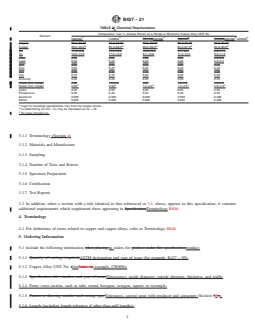
1.1 This specification2 establishes requirements for alloys whose copper alloy numbers and compositions are shown in Table 1. The castings may be furnished as one of three types: static chill, centrifugal chill, or sand cast.
1.2 The values stated in inch-pound units are to be regarded as standard. The values given in parentheses are mathematical conversions to SI units that are provided for information only and are not considered standard.
1.3 This standard does not purport to address all of the safety concerns, if any, associated with its use. It is the responsibility of the user of this standard to establish appropriate safety, health, and environmental practices and determine the applicability of regulatory limitations prior to use.
1.4 This international standard was developed in accordance with internationally recognized principles on standardization established in the Decision on Principles for the Development of International Standards, Guides and Recommendations issued by the World Trade Organization Technical Barriers to Trade (TBT) Committee.
- Status
- Published
- Publication Date
- 31-Mar-2021
- Technical Committee
- B05 - Copper and Copper Alloys
- Drafting Committee
- B05.05 - Castings and Ingots for Remelting

Overview
ASTM B427-21: Standard Specification for Gear Bronze Alloy Castings is an internationally recognized standard developed by ASTM International. This specification provides comprehensive requirements for gear bronze alloy castings, specifically covering Copper Alloy Nos. C90800, C91700, C90700, C91600, and C92900. The standard outlines acceptable manufacturing methods, chemical compositions, mechanical properties, and testing protocols to ensure the quality and performance of bronze gear castings used in various industries.
ASTM B427-21 is essential for manufacturers, suppliers, and end-users who require reliable bronze cast components, especially in demanding applications where material properties and consistency are critical. The specification supports compliance with international trade and regulatory requirements, facilitating interoperability and quality assurance in supply chains.
Key Topics
- Material Scope: Covers copper alloy castings with specified UNS numbers (C90800, C91700, C90700, C91600, C92900).
- Casting Methods: Permits three primary casting processes:
- Static chill casting
- Centrifugal chill casting
- Sand casting
- Chemical Composition: Prescribes chemical limits for copper, tin, nickel, lead, zinc, iron, antimony, and other elements, ensuring alloy consistency.
- Mechanical Properties: Defines required mechanical characteristics such as tensile strength, yield strength, elongation, and Brinell hardness.
- Testing Requirements: Specifies procedures for specimen preparation, tensile and hardness testing (using ASTM E8/E8M and E10), and chemical analysis.
- Ordering Information: Outlines the essential details purchasers should provide, including quantity, alloy number, dimensions, form, tolerances, and requirements for certification or test reports.
- General Requirements: Incorporates associated standards for terminology, general copper alloy casting requirements, and procedures for sampling and product marking.
Applications
Gear bronze alloy castings specified by ASTM B427-21 are widely used in applications where durability, machinability, and load-carrying capability are paramount. Typical uses include:
- Industrial Gear Sets: Components for heavy-duty gear systems in manufacturing, power transmission, and mining equipment, where resistance to wear and fatigue is critical.
- Machinery Bushings and Bearings: Bronze alloys with controlled composition and uniform properties aid in reducing friction and extending the service life of moving parts.
- Marine Hardware: Gear bronze castings are valued in marine and offshore settings for their corrosion resistance and strength under load.
- Automotive and Railway Components: Employed for gears, connectors, and couplings requiring high strength and reliable performance.
- Precision Tools and Instrumentation: Used in specialized machinery where predictable mechanical properties and dimensional accuracy are necessary.
Compliance with ASTM B427-21 ensures castings meet rigorous industry standards, enhancing safety, equipment longevity, and operational reliability.
Related Standards
To guarantee comprehensive quality management and compatibility, ASTM B427-21 references several additional standards, including:
- ASTM B208 – Practice for Preparing Tension Test Specimens for Copper Alloy Sand, Permanent Mold, Centrifugal, and Continuous Castings
- ASTM B824 – Specification for General Requirements for Copper Alloy Castings
- ASTM B846 – Terminology for Copper and Copper Alloys
- ASTM B950 – Guide for Editorial Procedures and Form of Product Specifications for Copper and Copper Alloys
- ASTM E8/E8M – Test Methods for Tension Testing of Metallic Materials
- ASTM E10 – Test Method for Brinell Hardness of Metallic Materials
- ASTM E255 – Practice for Sampling Copper and Copper Alloys for the Determination of Chemical Composition
- ASTM E527 – Practice for Numbering Metals and Alloys in the Unified Numbering System (UNS)
Keywords: ASTM B427-21, gear bronze alloy castings, copper alloy castings, mechanical properties, bronze gears, foundry standards, bronze casting specification, UNS C90800, UNS C90700, UNS C91700, UNS C91600, UNS C92900, ASTM bronze standard.
Relations
- Effective Date
- 01-Jan-2024
- Effective Date
- 01-Oct-2023
- Effective Date
- 01-Aug-2019
- Effective Date
- 01-Jan-2019
- Effective Date
- 01-Oct-2017
- Effective Date
- 01-Apr-2017
- Effective Date
- 15-Oct-2016
- Effective Date
- 15-Jul-2016
- Effective Date
- 01-Apr-2016
- Effective Date
- 15-Mar-2015
- Effective Date
- 01-Feb-2015
- Effective Date
- 01-May-2014
- Effective Date
- 01-Apr-2014
- Effective Date
- 01-Oct-2013
- Effective Date
- 01-Jun-2013
Get Certified
Connect with accredited certification bodies for this standard

Element Materials Technology
Materials testing and product certification.

Inštitut za kovinske materiale in tehnologije
Institute of Metals and Technology. Materials testing, metallurgical analysis, NDT.
Sponsored listings
Frequently Asked Questions
ASTM B427-21 is a technical specification published by ASTM International. Its full title is "Standard Specification for Gear Bronze Alloy Castings". This standard covers: ABSTRACT This specification establishes requirements for gear bronze alloy castings with Copper Alloy No. C90800, C91700, C90700, C91600, and C92900. The castings may be furnished as one of three types: static chill, centrifugal chill, or sand cast. The alloys shall be subject to tensile strength, yield strength, elongation, and Brinell hardness tests. The Brinell readings shall be taken on the grip end of the tension test bar as described in the specification. SCOPE 1.1 This specification2 establishes requirements for alloys whose copper alloy numbers and compositions are shown in Table 1. The castings may be furnished as one of three types: static chill, centrifugal chill, or sand cast. 1.2 The values stated in inch-pound units are to be regarded as standard. The values given in parentheses are mathematical conversions to SI units that are provided for information only and are not considered standard. 1.3 This standard does not purport to address all of the safety concerns, if any, associated with its use. It is the responsibility of the user of this standard to establish appropriate safety, health, and environmental practices and determine the applicability of regulatory limitations prior to use. 1.4 This international standard was developed in accordance with internationally recognized principles on standardization established in the Decision on Principles for the Development of International Standards, Guides and Recommendations issued by the World Trade Organization Technical Barriers to Trade (TBT) Committee.
ABSTRACT This specification establishes requirements for gear bronze alloy castings with Copper Alloy No. C90800, C91700, C90700, C91600, and C92900. The castings may be furnished as one of three types: static chill, centrifugal chill, or sand cast. The alloys shall be subject to tensile strength, yield strength, elongation, and Brinell hardness tests. The Brinell readings shall be taken on the grip end of the tension test bar as described in the specification. SCOPE 1.1 This specification2 establishes requirements for alloys whose copper alloy numbers and compositions are shown in Table 1. The castings may be furnished as one of three types: static chill, centrifugal chill, or sand cast. 1.2 The values stated in inch-pound units are to be regarded as standard. The values given in parentheses are mathematical conversions to SI units that are provided for information only and are not considered standard. 1.3 This standard does not purport to address all of the safety concerns, if any, associated with its use. It is the responsibility of the user of this standard to establish appropriate safety, health, and environmental practices and determine the applicability of regulatory limitations prior to use. 1.4 This international standard was developed in accordance with internationally recognized principles on standardization established in the Decision on Principles for the Development of International Standards, Guides and Recommendations issued by the World Trade Organization Technical Barriers to Trade (TBT) Committee.
ASTM B427-21 is classified under the following ICS (International Classification for Standards) categories: 77.150.30 - Copper products. The ICS classification helps identify the subject area and facilitates finding related standards.
ASTM B427-21 has the following relationships with other standards: It is inter standard links to ASTM E8/E8M-24, ASTM B950-23, ASTM B846-19a, ASTM B846-19, ASTM B950-17, ASTM B824-17, ASTM B824-16, ASTM E8/E8M-16, ASTM B950-16, ASTM B950-15, ASTM E8/E8M-15, ASTM E10-14, ASTM B824-14, ASTM B950-13, ASTM E8/E8M-13. Understanding these relationships helps ensure you are using the most current and applicable version of the standard.
ASTM B427-21 is available in PDF format for immediate download after purchase. The document can be added to your cart and obtained through the secure checkout process. Digital delivery ensures instant access to the complete standard document.
Standards Content (Sample)
This international standard was developed in accordance with internationally recognized principles on standardization established in the Decision on Principles for the
Development of International Standards, Guides and Recommendations issued by the World Trade Organization Technical Barriers to Trade (TBT) Committee.
Designation:B427 −21
Standard Specification for
Gear Bronze Alloy Castings
This standard is issued under the fixed designation B427; the number immediately following the designation indicates the year of
original adoption or, in the case of revision, the year of last revision. A number in parentheses indicates the year of last reapproval. A
superscript epsilon (´) indicates an editorial change since the last revision or reapproval.
This standard has been approved for use by agencies of the U.S. Department of Defense.
1. Scope* B950 Guide for Editorial Procedures and Form of Product
2 Specifications for Copper and Copper Alloys
1.1 This specification establishes requirements for alloys
E8/E8M Test Methods for Tension Testing of Metallic Ma-
whose copper alloy numbers and compositions are shown in
terials
Table 1. The castings may be furnished as one of three types:
E10 Test Method for Brinell Hardness of Metallic Materials
static chill, centrifugal chill, or sand cast.
E255 Practice for Sampling Copper and Copper Alloys for
1.2 The values stated in inch-pound units are to be regarded
the Determination of Chemical Composition
as standard. The values given in parentheses are mathematical
E527 Practice for Numbering Metals and Alloys in the
conversions to SI units that are provided for information only
Unified Numbering System (UNS)
and are not considered standard.
3. General Requirements
1.3 This standard does not purport to address all of the
safety concerns, if any, associated with its use. It is the
3.1 The following sections of Specification B824 constitute
responsibility of the user of this standard to establish appro-
a part of this specification.
priate safety, health, and environmental practices and deter-
3.1.1 Terminology (Section 4)
mine the applicability of regulatory limitations prior to use.
3.1.2 Materials and Manufacture
1.4 This international standard was developed in accor-
3.1.3 Sampling
dance with internationally recognized principles on standard-
3.1.4 Number of Tests and Retests
ization established in the Decision on Principles for the
3.1.5 Specimen Preparation
Development of International Standards, Guides and Recom-
3.1.6 Certification
mendations issued by the World Trade Organization Technical
3.1.7 Test Reports
Barriers to Trade (TBT) Committee.
3.2 In addition, when a section with a title identical to that
referenced in 3.1, above, appears in this specification, it
2. Referenced Documents
contains additional requirements which supplement those ap-
2.1 ASTM Standards:
pearing in Terminology B846.
B208 Practice for Preparing Tension Test Specimens for
Copper Alloy Sand, Permanent Mold, Centrifugal, and
4. Terminology
Continuous Castings
4.1 For definitions of terms related to copper and copper
B824 Specification for General Requirements for Copper
alloys, refer to Terminology B846.
Alloy Castings
B846 Terminology for Copper and Copper Alloys
5. Ordering Information
5.1 Include the following information in orders for product:
This specification is under the jurisdiction ofASTM Committee B05 on Copper
5.1.1 ASTM designation and year of issue (for example,
and Copper Alloys and is the direct responsibility of Subcommittee B05.05 on
B427 – 09);
Castings and Ingots for Remelting.
5.1.2 Copper Alloy UNS No. (for example, C90800);
Current edition approved April 1, 2021. Published April 2021. Originally
approved in 1965. Last previous edition approved in 2015 as B427 – 09 (2015).
5.1.3 Dimensions: inside diameter, outside diameter,
DOI: 10.1520/B0427-21.
thickness, and width;
The UNS system for copper and copper alloys (see Practice E527) is a simple
5.1.4 Form: cross-section, such as tube, round, hexagon,
expansion of the former standard designation system accomplished by the addition
octagon, square, or rectangle;
of a prefix “C” and a suffix “00.” The suffix can be used to accommodate
composition variations of the base alloy.
5.1.5 Tolerances, agreed upon with producer and consumer
For referenced ASTM standards, visit the ASTM website, www.astm.org, or
(Section 8);
contact ASTM Customer Service at service@astm.org. For Annual Book of ASTM
5.1.6 Length (including length tolerance if other than mill
Standards volume information, refer to the standard’s Document Summary page on
the ASTM website. lengths);
*A Summary of Changes section appears at the end of this standard
Copyright © ASTM International, 100 Barr Harbor Drive, PO Box C700, West Conshohocken, PA 19428-2959. United States
B427−21
TABLE 1 Chemical Requirements
Composition, max % (Unless Shown as a Range or Minimum) Copper Alloy UNS No.
Element
A A A A A
C90700 C90800 C91600 C91700 C92900
B B B B B
Copper 88.0–90.0 85.0–89.0 86.0–89.0 84.0–87.0 82.0–86.0
Tin 10.0–12.0 11.0–13.0 9.7–10.8 11.3–12.5 9.0–11.0
Lead 0.50 0.25 0.25 0.25 2.0–3.2
Zinc 0.50 0.25 0.25 0.25 0.25
Iron 0.15 0.15 0.20 0.20 0.20
Antimony 0.20 0.20 0.20 0.20 0.25
C C C C C
Nickel (incl. cobalt) 0.50 0.50 1.2–2.0 1.2–2.0 2.8–4.0
Sulfur 0.05 0.05 0.05 0.05 0.05
Phosphorus 0.30 0.30 0.30 0.30 0.50
Aluminum 0.005 0.005 0.005 0.005 0.005
Silicon 0.005 0.005 0.005 0.005 0.005
A
Ingot for remelting specifications vary from the ranges shown.
B
In determining Cu min., Cu may be calculated as Cu + Ni.
C
Ni value includes Co.
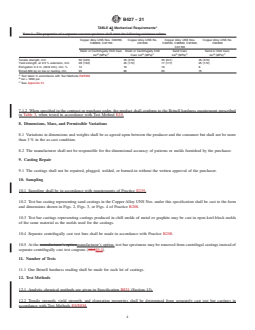
5.1.7 Number of castings or total weight for each size and 7.1.1 When specified in the contract or purchase order, the
form; and product shall conform to the tensile, yield, and elongation
5.1.8 When castings are purchased for agencies of the U.S. requirements prescribed in Table 3, when tested in accordance
government, the Supplementary Requirements of Specification with Test Methods E8/E8M.
B824 may be specified.
7.1.2 When specified in the contract or purchase order, the
product shall conform to the Brinell hardness requirement
5.2 The following requirements are optional and should be
prescribed in Table 3, when tested in accordance with Test
specified in the purchase order, when required:
Method E10.
5.2.1 Chemical analysis of residual elements (Section 6 and
Specification B824),
8. Dimensions, Mass, and Permissible Variations
5.2.2 Mechanical requirements (Section 7 andTest Methods
E8/E8M),
8.1 Variations in dimensions and weights shall be as agreed
5.2.3 Witness inspection (Specification B824).
upon between the producer and the consumer but shall not be
5.2.4 Certification (Specification B824),
more than 3 % in the as-cast condition.
5.2.5 Foundry test report (Specification B824),
8.2 The manufacturer shall not be responsible for the
5.2.6 Product marking (Specification B824), and
dimensional accuracy of patterns or molds furnished by the
5.2.7 Approval of weld repair and records of repair (Section
purchaser.
9).
6. Chemical Composition 9. Casting Repair
6.1 The castings shall conform to the requirements as to 9.1 The castings shall not be r
...
This document is not an ASTM standard and is intended only to provide the user of an ASTM standard an indication of what changes have been made to the previous version. Because
it may not be technically possible to adequately depict all changes accurately, ASTM recommends that users consult prior editions as appropriate. In all cases only the current version
of the standard as published by ASTM is to be considered the official document.
Designation: B427 − 09 (Reapproved 2015) B427 − 21
Standard Specification for
Gear Bronze Alloy Castings
This standard is issued under the fixed designation B427; the number immediately following the designation indicates the year of
original adoption or, in the case of revision, the year of last revision. A number in parentheses indicates the year of last reapproval. A
superscript epsilon (´) indicates an editorial change since the last revision or reapproval.
This standard has been approved for use by agencies of the U.S. Department of Defense.
1. Scope*
1.1 This specification establishes requirements for alloys whose copper alloy numbers and nominal compositions are shown in
Table 1. The castings may be furnished as one of three types: static chill, centrifugal chill, or sand cast.
1.2 The values stated in inch-pound units are to be regarded as standard. The values given in parentheses are mathematical
conversions to SI units that are provided for information only and are not considered standard.
1.3 This standard does not purport to address all of the safety concerns, if any, associated with its use. It is the responsibility
of the user of this standard to establish appropriate safety, health, and environmental practices and determine the applicability of
regulatory limitations prior to use.
1.4 This international standard was developed in accordance with internationally recognized principles on standardization
established in the Decision on Principles for the Development of International Standards, Guides and Recommendations issued
by the World Trade Organization Technical Barriers to Trade (TBT) Committee.
2. Referenced Documents
2.1 ASTM Standards:
B208 Practice for Preparing Tension Test Specimens for Copper Alloy Sand, Permanent Mold, Centrifugal, and Continuous
Castings
B824 Specification for General Requirements for Copper Alloy Castings
B846 Terminology for Copper and Copper Alloys
B950 Guide for Editorial Procedures and Form of Product Specifications for Copper and Copper Alloys
E8/E8M Test Methods for Tension Testing of Metallic Materials
E10 Test Method for Brinell Hardness of Metallic Materials
E255 Practice for Sampling Copper and Copper Alloys for the Determination of Chemical Composition
E527 Practice for Numbering Metals and Alloys in the Unified Numbering System (UNS)
3. General Requirements
3.1 The following sections of Specification B824 constitute a part of this specification.
This specification is under the jurisdiction of ASTM Committee B05 on Copper and Copper Alloys and is the direct responsibility of Subcommittee B05.05 on Castings
and Ingots for Remelting.
Current edition approved May 1, 2015April 1, 2021. Published June 2015April 2021. Originally approved in 1965. Last previous edition approved in 20092015 as
B427 – 09.B427 – 09 (2015). DOI: 10.1520/B0427-09R15.10.1520/B0427-21.
The UNS system for copper and copper alloys (see Practice E527) is a simple expansion of the former standard designation system accomplished by the addition of a
prefix “C” and a suffix “00.” The suffix can be used to accommodate composition variations of the base alloy.
For referenced ASTM standards, visit the ASTM website, www.astm.org, or contact ASTM Customer Service at service@astm.org. For Annual Book of ASTM Standards
volume information, refer to the standard’sstandard’s Document Summary page on the ASTM website.
*A Summary of Changes section appears at the end of this standard
Copyright © ASTM International, 100 Barr Harbor Drive, PO Box C700, West Conshohocken, PA 19428-2959. United States
B427 − 21
TABLE 21 Chemical Requirements
Composition, max % (Unless Shown as a Range or Minimum) Copper Alloy UNS No.
Element
A A A A A A
C90700 C90800 C91700C91600 C90700 C91600C91700 C92900
B B B B B
Copper 85.0–89.0 84.0–87.0 88.0–90.0 86.0–89.0 82.0–86.0
B B B B B
Copper 88.0–90.0 85.0–89.0 86.0–89.0 84.0–87.0 82.0–86.0
Tin 11.0–13.0 11.3–12.5 10.0–12.0 9.7–10.8 9.0–11.0
Tin 10.0–12.0 11.0–13.0 9.7–10.8 11.3–12.5 9.0–11.0
Lead 0.25 0.25 0.50 0.25 2.0–3.2
Lead 0.50 0.25 0.25 0.25 2.0–3.2
Zinc 0.25 0.25 0.50 0.25 0.25
Zinc 0.50 0.25 0.25 0.25 0.25
Iron 0.15 0.20 0.15 0.20 0.20
Iron 0.15 0.15 0.20 0.20 0.20
Antimony 0.20 0.20 0.20 0.20 0.25
Nickel (incl. cobalt) 0.50 1.2–2.0 0.50 1.2–2.0 2.8–4.0
C C C C C
Nickel (incl. cobalt) 0.50 0.50 1.2–2.0 1.2–2.0 2.8–4.0
Sulfur 0.05 0.05 0.05 0.05 0.05
Phosphorus 0.30 0.30 0.30 0.30 0.50
Aluminum 0.005 0.005 0.005 0.005 0.005
Silicon 0.005 0.005 0.005 0.005 0.005
A
Ingot for remelting specifications vary from the ranges shown.
B
In determining Cu min., Cu may be calculated as Cu + Ni.
C
Ni value includes Co.
3.1.1 Terminology (Section 4)
3.1.2 Materials and Manufacture
3.1.3 Sampling
3.1.4 Number of Tests and Retests
3.1.5 Specimen Preparation
3.1.6 Certification
3.1.7 Test Reports
3.2 In addition, when a section with a title identical to that referenced in 3.1, above, appears in this specification, it contains
additional requirements which supplement those appearing in SpecificationTerminology B846.
4. Terminology
4.1 For definitions of terms related to copper and copper alloys, refer to Terminology B846.
5. Ordering Information
5.1 Include the following information when placing in orders for product under this specification:product:
5.1.1 Quantity of castings required,ASTM designation and year of issue (for example, B427 – 09);
5.1.2 Copper Alloy UNS No. ((forTable 1), example, C90800);
5.1.3 Specification title, number, and year of issue,Dimensions: inside diameter, outside diameter, thickness, and width;
5.1.4 Form: cross-section, such as tube, round, hexagon, octagon, square, or rectangle;
5.1.5 Pattern or drawing number and casting type Tolerances, agreed upon with producer and consumer (Section 18),);
5.1.6 Length (including length tolerance if other than mill lengths);
B427 − 21
5.1.7 RepairNumber of castings (Sectionor 9),total weight for each size and form; and
5.1.8 Certification, if specified in the purchase order (Specification When castings are purchased for agencies of the U.S.
government, the Supplementary Requirements of Specification B824), may be specified.
5.1.7 Foundry test report, if specified in the purchase order (Specification B824), and
5.1.8 Witness inspection, if specified in the purchase order (Specification B824).
5.2 When product is purchased for agencies of the U.S. Government, the Supplementary Requirements of Specification The
following requirements are optional and should be specified in the purchase order, when required:B824 may be specified.
5.2.1 Chemical analysis of residual elements (Section 6 and Specification B824),
5.2.2 Mechanical requirements (Section 7 and Test Methods E8/E8M),
5.2.3 Witness inspection (Specification B824).
5.2.4 Certification (Specification B824),
5.2.5 Foundry test report (Specification B824),
5.2.6 Product marking (Specification B824), and
5.2.7 Approval of weld repair and records of repair (Section 9).
6. Chemical Composition
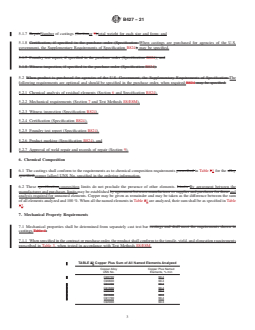
6.1 The castings shall conform to the requirements as to chemical composition requirements prescribed in Table 21 for the alloy
specified.copper [alloy] UNS No. specified in the ordering information.
6.2 These specificationcomposition limits do not preclude the presence of other elements. Limits By agreement between the
manufacturer and purchaser, limits may be established by agreement between manufacturer or supplier and purchaser for these and
analysis required for unnamed elements. Copper may be given as remainder and may be taken as the difference between the sum
of all elements analyzed and 100 %. When all the named elements in Table 21 are analyzed, their sum shall be as specified in Table
32.
7. Mec
...