


ASTM E2099-23
(Practice)Standard Practice for Specification and Evaluation of Pre-Construction Laboratory Mockups of Exterior Wall Systems
Standard Practice for Specification and Evaluation of Pre-Construction Laboratory Mockups of Exterior Wall Systems
SIGNIFICANCE AND USE
4.1 Exterior wall systems require time to design, fabricate, construct and test. Mockups are generally a full-size representative portion of the proposed exterior wall system built to study proposed construction details, test for performance, and in some cases judge appearance of the exterior wall system. The project schedule shall allow time to design, construct, and test the pre-construction mockup and to implement any design changes, fabrication changes, or modifications of planned construction procedures, before construction of the exterior wall system commences.
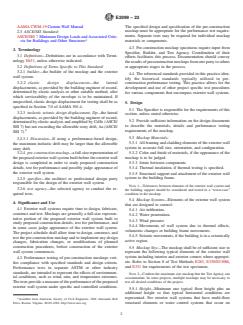
4.2 Performance testing of pre-construction mockups verifies compliance with specified standards and design criteria. Performance tests in separate ASTM or other industry standards, are intended to represent the effects of environmental conditions, such as wind, rain, and temperature extremes. The tests provide a measure of the performance of the proposed exterior wall system under specific and controlled conditions. The specified design and specification of the pre-construction mockup must be appropriate for the performance test requirements. Separate tests may be required for individual mockup materials or components.
4.3 Pre-construction mockup specimens require input from Specifier, Builder, and Test Agency. Coordination of their efforts facilitates this process. Documentation should convey the results of preconstruction mockups from one party to others at appropriate stages in the process.
4.4 The referenced standards provided in this practice identify the historical standards typically utilized in pre-construction performance testing. This practice allows for the development and use of other project specific test procedures for various components that encompass exterior wall systems.
SCOPE
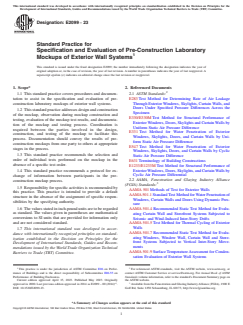
1.1 This standard practice covers procedures and documentation to assist in the specification and evaluation of pre-construction laboratory mockups of exterior wall systems.
1.2 This standard practice addresses design and construction of the mockup, observation during mockup construction and testing, evaluation of the mockup test results, and documentation of the mockup and testing process. Coordination is required between the parties involved in the design, construction, and testing of the mockup to facilitate this process. Documentation should convey the results of pre-construction mockups from one party to others at appropriate stages in the process.
1.3 This standard practice recommends the selection and order of individual tests performed on the mockup in the absence of a specific test order.
1.4 This standard practice recommends a protocol for exchange of information between participants in the pre-construction mockup process.
1.5 Responsibility for specific activities is recommended by this practice. This practice is intended to provide a default structure in the absence of the assignment of specific responsibilities by the specifying authority.
1.6 The values stated in inch-pound units are to be regarded as standard. The values given in parentheses are mathematical conversions to SI units that are provided for information only and are not considered standard.
1.7 This international standard was developed in accordance with internationally recognized principles on standardization established in the Decision on Principles for the Development of International Standards, Guides and Recommendations issued by the World Trade Organization Technical Barriers to Trade (TBT) Committee.
General Information
- Status
- Published
- Publication Date
- 14-Apr-2023
- Technical Committee
- E06 - Performance of Buildings
- Drafting Committee
- E06.55 - Performance of Building Enclosures
Relations
- Effective Date
- 01-Aug-2016
- Effective Date
- 01-Mar-2015
- Effective Date
- 01-Nov-2014
- Effective Date
- 01-Apr-2012
- Effective Date
- 01-Feb-2009
- Effective Date
- 01-Feb-2009
- Effective Date
- 01-Jun-2006
- Effective Date
- 01-Mar-2004
- Effective Date
- 10-Oct-2000
- Effective Date
- 10-Oct-2000
- Effective Date
- 28-Jul-2000
- Effective Date
- 10-Apr-1999
Overview
ASTM E2099-23: Standard Practice for Specification and Evaluation of Pre-Construction Laboratory Mockups of Exterior Wall Systems is a key international standard that outlines procedures and documentation for designing, constructing, and testing full-scale laboratory mockups of exterior wall systems prior to construction. Developed by ASTM International, this standard guides project stakeholders through the comprehensive process of evaluating the performance and quality of exterior wall assemblies-playing a pivotal role in risk management, quality assurance, and regulatory compliance for building projects.
Pre-construction laboratory mockups simulate real project conditions and serve as tangible reference points for assessing critical aspects such as air infiltration, water penetration, structural performance, thermal performance, and constructability. Compliance with ASTM E2099-23 is essential for architects, specifiers, builders, and testing agencies who strive to ensure that exterior wall systems meet project requirements and industry benchmarks.
Key Topics
Design and Fabrication of Mockups
- Detailed specifications for creating full-size mockups
- Inclusion of all framing, cladding, joints, insulation, and structural connections
- Representation of typical project elements: floor heights, wall sections, and unique conditions
Performance Testing
- Verification of compliance with relevant standards and project-specific criteria
- Testing for environmental effects including wind, rain, thermal fluctuations, and seismic events
- Use of referenced ASTM and FGIA (AAMA) test methods covering air, water, structural, and movement responses
Project Coordination
- Defined roles for Specifier, Builder, and Test Agency
- Protocols for information exchange and documentation through all phases
- Record-keeping of modifications, test results, and as-built conditions
Reporting and Evaluation
- Structured reporting requirements for documenting test results and observations
- Visual assessment protocols (e.g., color and finish acceptance)
- Certification of incorporation of modifications to construction, based on findings
Applications
The practical application of ASTM E2099-23 spans the entire lifecycle of building projects involving exterior wall systems, including:
- Design Validation: Ensuring that wall assemblies, materials, and details meet performance objectives before field application.
- Quality Assurance: Identifying and resolving constructability or performance issues prior to large-scale installation, reducing costly changes during construction.
- Risk Management: Verifying performance under controlled conditions to avoid failures related to water ingress, air leakage, or structural inadequacy.
- Regulatory Compliance: Demonstrating adherence to applicable building codes and international standards for exterior wall systems.
- Project Communication: Establishing clear modes for documentation and information sharing among architects, consultants, contractors, and third-party laboratories.
Mockups are especially valuable for complex façade systems (e.g., curtain walls, window wall systems), high-rise buildings, and projects subject to stringent environmental or seismic requirements.
Related Standards
The ASTM E2099-23 standard practice references and is utilized alongside several important industry standards, including:
- ASTM E283 - Test Method for Air Leakage of Exterior Windows, Doors, and Walls
- ASTM E330/E330M - Test Method for Structural Performance of Exterior Windows, Doors, Skylights, and Curtain Walls
- ASTM E331 - Test Method for Water Penetration of Exterior Windows, Doors, and Curtain Walls
- ASTM E547 - Test Method for Water Penetration Using Cyclic Static Air Pressure
- ASTM E1233/E1233M - Test Method for Structural Performance by Cyclic Air Pressure
- FGIA/AAMA 501, 501.1, 501.4, 501.5, 501.7, 501.9 - Standards for testing of curtain walls, windows, thermal cycling, seismic and wind responses
- ASCE/SEI 7 - Minimum Design Loads for Buildings and Other Structures
- ASTM E631 - Terminology for Building Constructions
Summary
ASTM E2099-23 is an essential standard for the specification and evaluation of pre-construction laboratory mockups of exterior wall systems, supporting effective quality management, risk mitigation, and performance validation in modern building projects. Using laboratory mockups according to this standard significantly improves decision-making and documentation throughout the construction process, enhancing building envelope reliability and stakeholder confidence.
Keywords: ASTM E2099-23, exterior wall systems, laboratory mockups, façade testing, building envelope, air leakage, water penetration, structural performance, quality assurance, performance testing, pre-construction evaluation.
Buy Documents
ASTM E2099-23 - Standard Practice for Specification and Evaluation of Pre-Construction Laboratory Mockups of Exterior Wall Systems
REDLINE ASTM E2099-23 - Standard Practice for Specification and Evaluation of Pre-Construction Laboratory Mockups of Exterior Wall Systems
Get Certified
Connect with accredited certification bodies for this standard

ICC Evaluation Service
Building products evaluation and certification.

QAI Laboratories
Building and construction product testing and certification.

Aboma Certification B.V.
Specialized in construction, metal, and transport sectors.
Sponsored listings
Frequently Asked Questions
ASTM E2099-23 is a standard published by ASTM International. Its full title is "Standard Practice for Specification and Evaluation of Pre-Construction Laboratory Mockups of Exterior Wall Systems". This standard covers: SIGNIFICANCE AND USE 4.1 Exterior wall systems require time to design, fabricate, construct and test. Mockups are generally a full-size representative portion of the proposed exterior wall system built to study proposed construction details, test for performance, and in some cases judge appearance of the exterior wall system. The project schedule shall allow time to design, construct, and test the pre-construction mockup and to implement any design changes, fabrication changes, or modifications of planned construction procedures, before construction of the exterior wall system commences. 4.2 Performance testing of pre-construction mockups verifies compliance with specified standards and design criteria. Performance tests in separate ASTM or other industry standards, are intended to represent the effects of environmental conditions, such as wind, rain, and temperature extremes. The tests provide a measure of the performance of the proposed exterior wall system under specific and controlled conditions. The specified design and specification of the pre-construction mockup must be appropriate for the performance test requirements. Separate tests may be required for individual mockup materials or components. 4.3 Pre-construction mockup specimens require input from Specifier, Builder, and Test Agency. Coordination of their efforts facilitates this process. Documentation should convey the results of preconstruction mockups from one party to others at appropriate stages in the process. 4.4 The referenced standards provided in this practice identify the historical standards typically utilized in pre-construction performance testing. This practice allows for the development and use of other project specific test procedures for various components that encompass exterior wall systems. SCOPE 1.1 This standard practice covers procedures and documentation to assist in the specification and evaluation of pre-construction laboratory mockups of exterior wall systems. 1.2 This standard practice addresses design and construction of the mockup, observation during mockup construction and testing, evaluation of the mockup test results, and documentation of the mockup and testing process. Coordination is required between the parties involved in the design, construction, and testing of the mockup to facilitate this process. Documentation should convey the results of pre-construction mockups from one party to others at appropriate stages in the process. 1.3 This standard practice recommends the selection and order of individual tests performed on the mockup in the absence of a specific test order. 1.4 This standard practice recommends a protocol for exchange of information between participants in the pre-construction mockup process. 1.5 Responsibility for specific activities is recommended by this practice. This practice is intended to provide a default structure in the absence of the assignment of specific responsibilities by the specifying authority. 1.6 The values stated in inch-pound units are to be regarded as standard. The values given in parentheses are mathematical conversions to SI units that are provided for information only and are not considered standard. 1.7 This international standard was developed in accordance with internationally recognized principles on standardization established in the Decision on Principles for the Development of International Standards, Guides and Recommendations issued by the World Trade Organization Technical Barriers to Trade (TBT) Committee.
SIGNIFICANCE AND USE 4.1 Exterior wall systems require time to design, fabricate, construct and test. Mockups are generally a full-size representative portion of the proposed exterior wall system built to study proposed construction details, test for performance, and in some cases judge appearance of the exterior wall system. The project schedule shall allow time to design, construct, and test the pre-construction mockup and to implement any design changes, fabrication changes, or modifications of planned construction procedures, before construction of the exterior wall system commences. 4.2 Performance testing of pre-construction mockups verifies compliance with specified standards and design criteria. Performance tests in separate ASTM or other industry standards, are intended to represent the effects of environmental conditions, such as wind, rain, and temperature extremes. The tests provide a measure of the performance of the proposed exterior wall system under specific and controlled conditions. The specified design and specification of the pre-construction mockup must be appropriate for the performance test requirements. Separate tests may be required for individual mockup materials or components. 4.3 Pre-construction mockup specimens require input from Specifier, Builder, and Test Agency. Coordination of their efforts facilitates this process. Documentation should convey the results of preconstruction mockups from one party to others at appropriate stages in the process. 4.4 The referenced standards provided in this practice identify the historical standards typically utilized in pre-construction performance testing. This practice allows for the development and use of other project specific test procedures for various components that encompass exterior wall systems. SCOPE 1.1 This standard practice covers procedures and documentation to assist in the specification and evaluation of pre-construction laboratory mockups of exterior wall systems. 1.2 This standard practice addresses design and construction of the mockup, observation during mockup construction and testing, evaluation of the mockup test results, and documentation of the mockup and testing process. Coordination is required between the parties involved in the design, construction, and testing of the mockup to facilitate this process. Documentation should convey the results of pre-construction mockups from one party to others at appropriate stages in the process. 1.3 This standard practice recommends the selection and order of individual tests performed on the mockup in the absence of a specific test order. 1.4 This standard practice recommends a protocol for exchange of information between participants in the pre-construction mockup process. 1.5 Responsibility for specific activities is recommended by this practice. This practice is intended to provide a default structure in the absence of the assignment of specific responsibilities by the specifying authority. 1.6 The values stated in inch-pound units are to be regarded as standard. The values given in parentheses are mathematical conversions to SI units that are provided for information only and are not considered standard. 1.7 This international standard was developed in accordance with internationally recognized principles on standardization established in the Decision on Principles for the Development of International Standards, Guides and Recommendations issued by the World Trade Organization Technical Barriers to Trade (TBT) Committee.
ASTM E2099-23 is classified under the following ICS (International Classification for Standards) categories: 91.120.99 - Other standards related to protection of and in buildings. The ICS classification helps identify the subject area and facilitates finding related standards.
ASTM E2099-23 has the following relationships with other standards: It is inter standard links to ASTM E547-00(2016), ASTM E631-15, ASTM E631-14, ASTM E283-04(2012), ASTM E547-00(2009), ASTM E331-00(2009), ASTM E631-06, ASTM E283-04, ASTM E547-00, ASTM E331-00, ASTM E631-93a(1998)e1, ASTM E283-91(1999). Understanding these relationships helps ensure you are using the most current and applicable version of the standard.
ASTM E2099-23 is available in PDF format for immediate download after purchase. The document can be added to your cart and obtained through the secure checkout process. Digital delivery ensures instant access to the complete standard document.
Standards Content (Sample)
This international standard was developed in accordance with internationally recognized principles on standardization established in the Decision on Principles for the
Development of International Standards, Guides and Recommendations issued by the World Trade Organization Technical Barriers to Trade (TBT) Committee.
Designation: E2099 − 23
Standard Practice for
Specification and Evaluation of Pre-Construction Laboratory
Mockups of Exterior Wall Systems
This standard is issued under the fixed designation E2099; the number immediately following the designation indicates the year of
original adoption or, in the case of revision, the year of last revision. A number in parentheses indicates the year of last reapproval. A
superscript epsilon (´) indicates an editorial change since the last revision or reapproval.
1. Scope* 2. Referenced Documents
2.1 ASTM Standards:
1.1 This standard practice covers procedures and documen-
tation to assist in the specification and evaluation of pre- E283 Test Method for Determining Rate of Air Leakage
Through Exterior Windows, Skylights, Curtain Walls, and
construction laboratory mockups of exterior wall systems.
Doors Under Specified Pressure Differences Across the
1.2 This standard practice addresses design and construction
Specimen
of the mockup, observation during mockup construction and
E330/E330M Test Method for Structural Performance of
testing, evaluation of the mockup test results, and documenta-
Exterior Windows, Doors, Skylights and Curtain Walls by
tion of the mockup and testing process. Coordination is
Uniform Static Air Pressure Difference
required between the parties involved in the design,
E331 Test Method for Water Penetration of Exterior
construction, and testing of the mockup to facilitate this
Windows, Skylights, Doors, and Curtain Walls by Uni-
process. Documentation should convey the results of pre-
form Static Air Pressure Difference
construction mockups from one party to others at appropriate
E547 Test Method for Water Penetration of Exterior
stages in the process.
Windows, Skylights, Doors, and Curtain Walls by Cyclic
1.3 This standard practice recommends the selection and
Static Air Pressure Difference
order of individual tests performed on the mockup in the
E631 Terminology of Building Constructions
absence of a specific test order.
E1233/E1233M Test Method for Structural Performance of
Exterior Windows, Doors, Skylights, and Curtain Walls by
1.4 This standard practice recommends a protocol for ex-
Cyclic Air Pressure Differential
change of information between participants in the pre-
2.2 AAMA, Fenestration and Glazing Industry Alliance
construction mockup process.
(FGIA) Standards:
1.5 Responsibility for specific activities is recommended by
AAMA 501 Methods of Test for Exterior Walls
this practice. This practice is intended to provide a default
AAMA 501.1 Standard Test Method for Water Penetration of
structure in the absence of the assignment of specific respon-
Windows, Curtain Walls and Doors Using Dynamic Pres-
sibilities by the specifying authority.
sure
1.6 The values stated in inch-pound units are to be regarded
AAMA 501.4 Recommended Static Test Method for Evalu-
as standard. The values given in parentheses are mathematical
ating Curtain Wall and Storefront Systems Subjected to
conversions to SI units that are provided for information only
Seismic and Wind-Induced Inter-Story Drifts
and are not considered standard.
AAMA 501.5 Test Method for Thermal Cycling of Exterior
Walls
1.7 This international standard was developed in accor-
AAMA 501.7 Recommended Static Test Method for Evalu-
dance with internationally recognized principles on standard-
ating Windows, Window Wall, Curtain Wall and Store-
ization established in the Decision on Principles for the
front Systems Subjected to Vertical Inter-Story Move-
Development of International Standards, Guides and Recom-
ments
mendations issued by the World Trade Organization Technical
AAMA 501.9 Surface Temperature Assessment for Conden-
Barriers to Trade (TBT) Committee.
sation Evaluation of Exterior Wall Systems
1 2
This practice is under the jurisdiction of ASTM Committee E06 on Perfor- For referenced ASTM standards, visit the ASTM website, www.astm.org, or
mance of Buildings and is the direct responsibility of Subcommittee E06.55 on contact ASTM Customer Service at service@astm.org. For Annual Book of ASTM
Performance of Building Enclosures. Standards volume information, refer to the standard’s Document Summary page on
Current edition approved April 15, 2023. Published May 2023. Originally the ASTM website.
ε1 3
approved in 2000. Last previous edition approved in 2014 as E2099 – 00 (2014) . Available from the Fenestration and Glazing Industry Alliance (FGIA), 1900 E
DOI: 10.1520/E2099-23. Golf Rd, Suite 1250 Schaumburg, IL 60173, http://www.fgiaonline.org.
*A Summary of Changes section appears at the end of this standard
Copyright © ASTM International, 100 Barr Harbor Drive, PO Box C700, West Conshohocken, PA 19428-2959. United States
E2099 − 23
AAMA CWM-19 Curtain Wall Manual The specified design and specification of the pre-construction
mockup must be appropriate for the performance test require-
2.3 ASCE/SEI Standard:
ments. Separate tests may be required for individual mockup
ASCE/SEI 7 Minimum Design Loads and Associated Crite-
ria for Buildings and Other Structures materials or components.
4.3 Pre-construction mockup specimens require input from
3. Terminology
Specifier, Builder, and Test Agency. Coordination of their
3.1 Definitions—Definitions are in accordance with Termi-
efforts facilitates this process. Documentation should convey
nology E631, unless otherwise indicated.
the results of preconstruction mockups from one party to others
at appropriate stages in the process.
3.2 Definitions of Terms Specific to This Standard:
3.2.1 builder—the builder of the mockup and the exterior
4.4 The referenced standards provided in this practice iden-
wall system.
tify the historical standards typically utilized in pre-
3.2.2 elastic design displacement—the lateral
construction performance testing. This practice allows for the
displacements, as provided by the building engineer of record,
development and use of other project specific test procedures
determined by elastic analysis or other suitable method, after
for various components that encompass exterior wall systems.
which serviceability of the envelope is to be maintained. If
unspecified, elastic design displacement for testing shall be as
5. Design
specified in Section 7.0 of AAMA 501.4.
5.1 The Specifier is responsible for the requirements of this
3.2.3 inelastic seismic design displacement, Dp—the lateral
section, unless stated otherwise.
displacements, as provided by the building engineer of record,
5.2 Provide sufficient information on the design documents
determined by elastic analysis and amplified by Cd/Ie (ASCE/
to describe the materials, details and performance testing
SEI 7) but not exceeding the allowable story drift, ∆a (ASCE/
requirements of the mockup.
SEI 7).
5.3 Mockup Materials:
3.2.3.1 Discussion—If using a performance-based design,
5.3.1 All framing and cladding elements of the exterior wall
the maximum inelastic drift may be larger than the allowable
system in accurate full size, orientation, and configuration.
story drift.
5.3.2 Color and finish of materials, if the appearance of the
3.2.4 pre-construction mockup—a full-size representation of
mockup is to be judged.
the proposed exterior wall system built before the exterior wall
design is completed in order to study proposed construction 5.3.3 Joints between components.
details, test for performance and possibly judge appearance of
5.3.4 Thermal insulation, if thermal testing is specified.
the exterior wall system.
5.3.5 Structural support and attachment of the exterior wall
3.2.5 specifier—the architect or professional design party system to the building frame.
responsible for the design of the exterior wall system.
NOTE 1—Tolerances between elements of the exterior wail system and
3.2.6 test agency—the selected agency to conduct the re-
the building support should be considered and tested in a “worst-case”
condition in the mockup.
quired tests.
5.4 Mockup Systems—Elements of the exterior wall system
4. Significance and Use
that are designed to control:
4.1 Exterior wall systems require time to design, fabricate,
5.4.1 Air infiltration.
construct and test. Mockups are generally a full-size represen-
5.4.2 Water penetration.
tative portion of the proposed exterior wall system built to
5.4.3 Wind pressure.
study proposed construction details, test for performance, and
5.4.4 Movements of wall system due to thermal effects,
in some cases judge appearance of the exterior wall system.
volumetric changes or building frame movements.
The project schedule shall allow time to design, construct, and
5.4.5 Seismic movements, if the building is in a seismically
test the pre-construction mockup and to implement any design
active region.
changes, fabrication changes, or modifications of planned
construction procedures, before construction of the exterior
5.5 Mockup Size—The mockup shall be of sufficient size to
wall system commences.
represent the following typical elements of the exterior wall
system including interior and exterior comers where appropri-
4.2 Performance testing of pre-construction mockups veri-
ate. Refer to Section 8 of Test Methods E283, E330/E330M,
fies compliance with specified standards and design criteria.
and E331 for requirements of the test specimens.
Performance tests in separate ASTM or other industry
standards, are intended to represent the effects of environmen-
NOTE 2—Confirm the maximum size mockup that the Test Agency can
tal conditions, such as wind, rain, and temperature extremes.
accommodate. In some projects, multiple mockups may be necessary to
test all desired conditions of the project.
The tests provide a measure of the performance of the proposed
exterior wall system under specific and controlled conditions.
5.5.1 Height—Minimum one typical floor height plus an
additional height so that typical horizontal conditions are
represented. For exterior wall systems that have multi-floor
Available from American Society of Civil Engineers, 1801 Alexander Bell
Drive, Reston, Virginia, 20191-4382, http://www.asce.org structural elements or water control systems that occur on
E2099 − 23
alternate floors, the mockup shall include the height of the 5.7.2.2 Test Method E283—The test pressure difference and
minimum number of floors to represent one repetition of the direction of air flow, unless the default requirements are
exterior wall design. acceptable, and the allowable air leakage rate, as required in
Section 10 of E283.
NOTE 3—Typical details that occur adjacent to floor level, such as
5.7.2.3 Test Method E331—The test pressure difference and
horizontal gutters and anchorage to the building, should not be located
failure criteria for Test Method E331, unless the default
immediately adjacent to the mockup edge, since this creates a “non-job”
condition that can lead to misinterpretation of mockup test results. requirements of Section 10 of E331 are acceptable.
5.5.2 Width—Minimum two repetitive widths of the exterior
NOTE 5—Selection of test-pressure differences is subject to the Speci-
fier’s judgement. Values of 20 % of maximum positive wind pressures in
wall system plus an additional width so that typical vertical
2 2
a range between about 5.2 lbf/ft (0.25 kPa) to 15.0 lbf/ft (0.70 kPa) are
conditions are represented. Other conditions, such as corners,
commonly used. (See AAMA 501.)
end conditions and projecting bays shall be included, if
5.7.2.4 AAMA 501.1—The peak test pressure developed by
practical.
the wind generator shall be equivalent to the test pressure
5.6 Mockup Details—Provide the following details in
stipulated for Test Method E331 (5.7.2.3), unless specified
mockup design drawings:
otherwise.
5.6.1 Illustrate the elevation view of the mockup in one of
5.7.2.5 Test Methods E547 and E1233/E1233M in lieu of
the two following ways:
Test Methods E331 and E330/E330M, respectively, can be
5.6.1.1 Designate an area of the elevation drawings which
selected if appropriate to the requirements of the exterior wall
represents the materials, height and width of the mockup.
system.
5.6.1.2 Provide a separate mockup elevation drawing that
5.7.2.6 AAMA 501.4—If required to perform optional
represents the materials, height and width of the mockup. The
AAMA 501.4 tests, the elastic and inelastic design
mockup need not be an actual representation of one area of the
displacement, unless the defaul
...
This document is not an ASTM standard and is intended only to provide the user of an ASTM standard an indication of what changes have been made to the previous version. Because
it may not be technically possible to adequately depict all changes accurately, ASTM recommends that users consult prior editions as appropriate. In all cases only the current version
of the standard as published by ASTM is to be considered the official document.
´1
Designation: E2099 − 00 (Reapproved 2014) E2099 − 23
Standard Practice for
the Specification and Evaluation of Pre-Construction
Laboratory Mockups of Exterior Wall Systems
This standard is issued under the fixed designation E2099; the number immediately following the designation indicates the year of
original adoption or, in the case of revision, the year of last revision. A number in parentheses indicates the year of last reapproval. A
superscript epsilon (´) indicates an editorial change since the last revision or reapproval.
ε NOTE—Units statement was inserted in Section 1.6, units information was corrected, and editorial changes were made
throughout in June 2014.
1. Scope Scope*
1.1 This standard practice covers procedures and documentation to assist in the specification and evaluation of pre-construction
laboratory mockups of exterior wall systems.
1.2 This standard practice addresses design and construction of the mockup;mockup, observation during mockup construction and
testing;testing, evaluation of the mockup test results;results, and documentation of the mockup and testing process. Coordination
is required between the parties involved in the design, construction, and testing of the mockup to facilitate this process.
Documentation should convey the results of pre-construction mockups from one party to others at appropriate stages in the process.
1.3 This standard practice recommends the selection and order of individual tests performed on the mockup in the absence of a
specific test order.
1.4 This standard practice recommends a protocol for exchange of information between participants in the pre-construction
mockup process.
1.5 Responsibility for specific activities is recommended by this practice. This practice is intended to provide a default structure
in the absence of the assignment of specific responsibilities by the specifying authority.
1.6 The values stated in inch-pound units are to be regarded as standard. The values given in parentheses are mathematical
conversions to SI units that are provided for information only and are not considered standard.
1.7 This international standard was developed in accordance with internationally recognized principles on standardization
established in the Decision on Principles for the Development of International Standards, Guides and Recommendations issued
by the World Trade Organization Technical Barriers to Trade (TBT) Committee.
2. Referenced Documents
2.1 ASTM Standards:
This practice is under the jurisdiction of ASTM Committee E06 on Performance of Buildings and is the direct responsibility of Subcommittee E06.55 on Performance
of Building Enclosures.
Current edition approved April 1, 2014April 15, 2023. Published June 2014May 2023. Originally approved in 2000. Last previous edition approved in 20072014 as
ε1
E2099 – 00 (2014) (2007). DOI: 10.1520/E2099-00R14E01. DOI: 10.1520/E2099-23.
For referenced ASTM standards, visit the ASTM website, www.astm.org, or contact ASTM Customer Service at service@astm.org. For Annual Book of ASTM Standards
volume information, refer to the standard’s Document Summary page on the ASTM website.
*A Summary of Changes section appears at the end of this standard
Copyright © ASTM International, 100 Barr Harbor Drive, PO Box C700, West Conshohocken, PA 19428-2959. United States
E2099 − 23
E283 Test Method for Determining Rate of Air Leakage Through Exterior Windows, Skylights, Curtain Walls, and Doors Under
Specified Pressure Differences Across the Specimen
E330/E330M Test Method for Structural Performance of Exterior Windows, Doors, Skylights and Curtain Walls by Uniform
Static Air Pressure Difference
E331 Test Method for Water Penetration of Exterior Windows, Skylights, Doors, and Curtain Walls by Uniform Static Air
Pressure Difference
E547 Test Method for Water Penetration of Exterior Windows, Skylights, Doors, and Curtain Walls by Cyclic Static Air Pressure
Difference
E631 Terminology of Building Constructions
E1233/E1233M Test Method for Structural Performance of Exterior Windows, Doors, Skylights, and Curtain Walls by Cyclic
Air Pressure Differential
2.2 AAMA AAMA, Fenestration and Glazing Industry Alliance (FGIA) Standards:
AAMA 501,501 Methods of Test for Exterior Walls
AAMA 501.1,501.1 Standard Test Method for Exterior Water Penetration of Windows, Curtain Walls and Doors for Water
Penetration using Using Dynamic Pressure
AAMA 501.4,501.4 Recommended Static Test Method for Evaluating Curtain Wall and Storefront Systems Subjected to Seismic
and Wind Induced Interstory Wind-Induced Inter-Story Drifts
AAMA 501.5, 501.5 Test Method for Thermal Cycling of Exterior Walls
AAMA 501.7 Recommended Static Test Method for Evaluating Windows, Window Wall, Curtain Wall and Storefront Systems
Subjected to Vertical Inter-Story Movements
AAMA CW-DG-1, 501.9 Testing of Aluminum Curtain Walls,Surface Temperature Assessment for Condensation Curtain Wall
Design Guide ManualEvaluation of Exterior Wall Systems
AAMA CWM-19 Curtain Wall Manual
2.3 ASCE/SEI Standard:
ASCE/SEI 7 Minimum Design Loads and Associated Criteria for Buildings and Other Structures
3. Terminology
3.1 Definitions—Definitions are in accordance with Terminology E631, unless otherwise indicated.
3.2 Definitions of Terms Specific to This Standard:
3.2.1 builder—the builder of the mockup and the exterior wall system.
3.2.2 elastic design displacement—the lateral displacements, as provided by the building engineer of record, determined by elastic
analysis or other suitable method, after which serviceability of the envelope is to be maintained. If unspecified, elastic design
displacement for testing shall be as specified in Section 7.0 of AAMA 501.4.
3.2.3 inelastic seismic design displacement, Dp—the lateral displacements, as provided by the building engineer of record,
determined by elastic analysis and amplified by Cd/Ie (ASCE/SEI 7) but not exceeding the allowable story drift, ∆a (ASCE/SEI
7).
3.2.3.1 Discussion—
If using a performance-based design, the maximum inelastic drift may be larger than the allowable story drift.
3.2.4 pre-construction mockup—a full-size representation of the proposed exterior wall system built before the exterior wall design
is completed in order to study proposed construction details, test for performance and possibly judge appearance of the exterior
wall system.
3.2.5 specifier—the architect or professional design party responsible for the design of the exterior wall system.
3.2.6 test agency—the selected agency to conduct the required tests.
Available from American Architectural Manufacturers Association (AAMA), 1827 Walden Office Square, Suite 550, Schaumburg, IL 60173-4268, http://
www.aamanet.org.the Fenestration and Glazing Industry Alliance (FGIA), 1900 E Golf Rd, Suite 1250 Schaumburg, IL 60173, http://www.fgiaonline.org.
Available from American Society of Civil Engineers, 1801 Alexander Bell Drive, Reston, Virginia, 20191-4382, http://www.asce.org
E2099 − 23
4. Significance and Use
4.1 Exterior wall systems require time to design, fabricate, construct and test. Mockups are generally a fullsizefull-size
representative portion of the proposed exterior wall system built to study proposed construction details, test for performance and
may be used to performance, and in some cases judge appearance of the exterior wall system. The project schedule shall allow
time to design, construct, and test the pre-construction mockup and to implement any design changes, fabrication changes, or
modifications of planned construction procedures, before construction of the exterior wall system commences.
4.2 Performance testing of pre-construction mockups veritiesverifies compliance with specified standards and design criteria.
Performance tests in separate ASTM or other industry standards, are intended to represent the effects of environmental conditions,
such as wind, rain, and temperature extremes. The tests provide a measure of the performance of the proposed exterior wall system
under specific and controlled conditions. The specified design and specification of the pre-construction mockup must be
appropriate for the performance test requirements. Separate tests may be required for individual mockup materials or components.
4.3 Pre-construction mockup specimens require input from Specifier, Builder, and Test Agency. Coordination of their efforts
facilitates this process. Documentation should convey the results of preconstruction mockups from one party to others at
appropriate stages in the process.
4.4 The referenced standards provided in this practice identify the historical standards typically utilized in pre-construction
performance testing. This practice allows for the development and use of other project specific test procedures for various
components that encompass exterior wall systems.
5. Design
5.1 The Specifier is responsible for the requirements of this section, unless stated otherwise.
5.2 Provide sufficient information on the design documents to describe the materials, details and performance testing requirements
of the mockup.
5.3 Mockup Materials:
5.3.1 All framing and cladding elements of the exterior wall system in accurate full size, orientation, and configuration.
5.3.2 Color and finish of materials, if the appearance of the mockup is to be judged.
5.3.3 Joints between components.
5.3.4 Thermal insulation, if thermal testing is specified.
5.3.5 Structural support and attachment of the exterior wall system to the building frame.
NOTE 1—Tolerances between elements of the exterior wail system and the building support should be considered and tested in a “worst-case” condition
in the mockup.
5.4 Mockup Systems—Elements of the exterior wall system that are designed to control:
5.4.1 Air infiltration.
5.4.2 Water penetration.
5.4.3 Wind pressure.
5.4.4 Movements of wall system due to thermal effects, volumetric changes or building frame movements.
5.4.5 Seismic movements, if the building is in a seismically active region.
E2099 − 23
5.5 Mockup Size—The mockup shall be of sufficient size to represent the following typical elements of the exterior wall system
including interior and exterior comers where appropriate. Refer to Section 8 of Test Methods E283, E330/E330M, and E331 for
requirements of the test specimens.
NOTE 2—Confirm the maximum size mockup that the Test Agency can accommodate. In some projects, multiple mockups may be necessary to test all
desired conditions of the project.
5.5.1 Height—Minimum one typical floor height plus an additional height so that typical horizontal conditions are represented. For
exterior wall systems that have multi-floor structural elements or water control systems that occur on alternate floors, the mockup
shall include the height of the minimum number of floors to represent one repetition of the exterior wall design.
NOTE 3—Typical details that occur adjacent to floor level, such as horizontal gutters and anchorage to the building, should not be located immediately
adjacent to the mockup edge, since this creates a “non-job” condition that can lead to misinterpretation of mockup test results.
5.5.2 Width—Minimum two repetitive widths of the exterior wall system plus an additional width so that typical vertical
conditions are represented. Other conditions, such as corners, end conditions and projecting bays shall be included, if practical.
5.6 Mockup Details—Provide the following details in mockup design drawings:
5.6.1 Illustrate the elevation view of the mockup in one of the two following ways:
5.6.1.1 Designate an area of the elevation drawings which represents the materials, height and width of the mockup.
5.6.1.2 Provide a separate mockup elevation drawing that represents the materials, height and width of the mockup. The mockup
need not be an actual representation of one area of the exterior wall system, but instead can combine the parts of the exterior wall
system in a manner that represents typical conditions.
5.6.2 Illustrate the mockup in section and detail views sufficient to describe the details of the mockup construction.
5.7 Mockup Testing Requirements—Specify the following testing requirements:
5.7.1 Test Load—Designate test loads for the mockup based on design wind pressures that are consistent with the corresponding
area of the actual building.
NOTE 4—Mockup design wind pressures are the typical highest wind pressures for the building although not necessarily the highest “hot spot” wind
pressures. Since the longest spans or largest units may not occur in the highest wind pressure zone, the specifier should exercise judgment in coordinating
test specimen size with test loads to arrive at a test plan representative of the project as a whole. Refer to the requirements of Test Method E330/E330M
for specific direction on appropriate wind loads and load factor
...
Questions, Comments and Discussion
Ask us and Technical Secretary will try to provide an answer. You can facilitate discussion about the standard in here.
Loading comments...