

ASTM F1427-21e1
(Specification)Standard Consumer Safety Specification for Bunk Beds
General Information
- Abstract
SCOPE
1.1 This consumer safety specification establishes minimum requirements for the design and performance of bunk beds. It also contains requirements for labeling and instructional material.
1.2 This consumer safety specification is intended to minimize accidents to children resulting from normal use and reasonably foreseeable misuse or abuse of bunk beds. This consumer safety specification is written within the current state of the art of bunk bed technology and does not address bunk beds that are blatantly misused or are used in a careless manner that disregards warning statements and safety instructions provided with each bunk bed.
1.3 For the purpose of this consumer safety specification, a bunk bed (hereinafter referred to as a bed) is defined as any structure that includes at least one sleeping surface in which the underside of any of its foundations is over 30 in. (762 mm) from the floor.
1.4 This consumer safety specification does not address bunk beds for institutional use (for example, in prisons, military facilities, dormitories, and so forth).
1.5 The values stated in inch-pound units, as well as any specified ISO/ANSI standard hardware, are to be regarded as the standard. The values given in parentheses are for information only.
1.6 The following safety hazards caveat pertains only to the test methods portion, Section 5, of this specification: This standard does not purport to address all of the safety concerns, if any, associated with its use. It is the responsibility of the user of this standard to establish appropriate safety, health, and environmental practices and determine the applicability of regulatory limitations prior to use.
1.7 This international standard was developed in accordance with internationally recognized principles on standardization established in the Decision on Principles for the Development of International Standards, Guides and Recommendations issued by the World Trade Organization Technical Barriers to Trade (TBT) Committee.
- Status
- Published
- Publication Date
- 31-Mar-2021
- Technical Committee
- F15 - Consumer Products
- Drafting Committee
- F15.30 - Bunk Beds
Overview
ASTM F1427-21e1: Standard Consumer Safety Specification for Bunk Beds is a critical safety standard developed by ASTM International. The standard establishes minimum requirements for the design, performance, labeling, and instructional materials for consumer bunk beds. Its primary aim is to help minimize accidents involving children during normal use and foreseeable misuse or abuse of bunk beds in home environments. This standard is not intended for bunk beds used in institutional settings such as dormitories, prisons, or military facilities.
Bunk beds pose unique safety risks, particularly to children under 15. According to data cited by the U.S. Consumer Product Safety Commission (CPSC), thousands of injuries and several fatalities have occurred due to falls, entrapment, and structural failures. ASTM F1427 addresses these hazards through comprehensive requirements on design, manufacturing, and consumer information, promoting safer use in households.
Key Topics
Minimum Design and Performance Requirements
- Specifications for critical components such as guardrails, ladders, bed ends, side rails, and foundation support systems.
- Requirements to prevent dangerous vertical protrusions and to ensure secure attachment methods.
Entrapment and Fall Prevention
- Restrictions on gap sizes and opening dimensions to reduce risks of entrapment and falls from both the upper and lower bunks.
- Specific testing methods using wedge blocks and rigid spheres to verify safe dimensions.
Labeling and Warning Requirements
- Permanent labels for product identification and warnings, including manufacturer details and date of production.
- Clear, durable warning labels and markings specifying hazards, proper assembly, and safe use-especially concerning appropriate mattress sizes and correct guardrail placement.
Instructional Literature
- Mandatory inclusion of detailed, illustrated assembly instructions.
- Safety guidelines for users and caregivers, emphasizing proper use and maintenance.
Testing and Compliance
- Defined test methods to evaluate structural integrity, side rail performance, guardrail efficacy, and labeling permanency, consistent with referenced ASTM and federal standards.
Applications
Manufacturers and Designers of Residential Bunk Beds
- Use ASTM F1427 to guide the development and quality assurance of bunk beds for the consumer market.
- Ensure products meet contemporary safety expectations and regulatory requirements before market launch.
Importers and Retailers
- Verify that supplied bunk beds comply with ASTM F1427 to mitigate liability and meet consumer protection obligations.
- Use compliance as a selling point to reassure customers about product safety.
Safety Inspectors and Regulatory Bodies
- Reference this standard during inspections, product certification, and in the event of product recalls or accident investigations.
Consumers and Caregivers
- Benefit from improved safety and clear instructions, reducing the risk of accidents involving children.
Related Standards
- ASTM D3359 - Test Methods for Rating Adhesion by Tape Test, used for evaluating labeling permanence.
- 16 CFR Part 1303 - Federal ban of lead-containing paint and certain consumer products.
- 16 CFR Part 1500 - Hazardous Substances Act Regulations, including sharp edge and small parts tests.
- 16 CFR Part 1632 - Federal flammability requirements for mattresses and mattress pads.
- ISPA Voluntary Dimensional Guideline for Bedding Products and Components - Provides mattress size dimensions referenced by this standard.
ASTM F1427-21e1 provides a comprehensive safety framework that manufacturers, retailers, and consumers rely on to ensure bunk beds are designed and used in a way that minimizes risks to children. Adhering to this bunk bed safety specification not only supports compliance with industry and federal regulations, but also visibly demonstrates a commitment to child safety and responsible product stewardship.
Relations
- Effective Date
- 01-Jun-2009
- Effective Date
- 01-Nov-2007
- Effective Date
- 10-Aug-2002
Get Certified
Connect with accredited certification bodies for this standard

DNV
DNV is an independent assurance and risk management provider.

Lloyd's Register
Lloyd's Register is a global professional services organisation specialising in engineering and technology.

FSC International
Forest Stewardship Council certification.
Sponsored listings
Frequently Asked Questions
ASTM F1427-21e1 is a technical specification published by ASTM International. Its full title is "Standard Consumer Safety Specification for Bunk Beds". This standard covers: SCOPE 1.1 This consumer safety specification establishes minimum requirements for the design and performance of bunk beds. It also contains requirements for labeling and instructional material. 1.2 This consumer safety specification is intended to minimize accidents to children resulting from normal use and reasonably foreseeable misuse or abuse of bunk beds. This consumer safety specification is written within the current state of the art of bunk bed technology and does not address bunk beds that are blatantly misused or are used in a careless manner that disregards warning statements and safety instructions provided with each bunk bed. 1.3 For the purpose of this consumer safety specification, a bunk bed (hereinafter referred to as a bed) is defined as any structure that includes at least one sleeping surface in which the underside of any of its foundations is over 30 in. (762 mm) from the floor. 1.4 This consumer safety specification does not address bunk beds for institutional use (for example, in prisons, military facilities, dormitories, and so forth). 1.5 The values stated in inch-pound units, as well as any specified ISO/ANSI standard hardware, are to be regarded as the standard. The values given in parentheses are for information only. 1.6 The following safety hazards caveat pertains only to the test methods portion, Section 5, of this specification: This standard does not purport to address all of the safety concerns, if any, associated with its use. It is the responsibility of the user of this standard to establish appropriate safety, health, and environmental practices and determine the applicability of regulatory limitations prior to use. 1.7 This international standard was developed in accordance with internationally recognized principles on standardization established in the Decision on Principles for the Development of International Standards, Guides and Recommendations issued by the World Trade Organization Technical Barriers to Trade (TBT) Committee.
SCOPE 1.1 This consumer safety specification establishes minimum requirements for the design and performance of bunk beds. It also contains requirements for labeling and instructional material. 1.2 This consumer safety specification is intended to minimize accidents to children resulting from normal use and reasonably foreseeable misuse or abuse of bunk beds. This consumer safety specification is written within the current state of the art of bunk bed technology and does not address bunk beds that are blatantly misused or are used in a careless manner that disregards warning statements and safety instructions provided with each bunk bed. 1.3 For the purpose of this consumer safety specification, a bunk bed (hereinafter referred to as a bed) is defined as any structure that includes at least one sleeping surface in which the underside of any of its foundations is over 30 in. (762 mm) from the floor. 1.4 This consumer safety specification does not address bunk beds for institutional use (for example, in prisons, military facilities, dormitories, and so forth). 1.5 The values stated in inch-pound units, as well as any specified ISO/ANSI standard hardware, are to be regarded as the standard. The values given in parentheses are for information only. 1.6 The following safety hazards caveat pertains only to the test methods portion, Section 5, of this specification: This standard does not purport to address all of the safety concerns, if any, associated with its use. It is the responsibility of the user of this standard to establish appropriate safety, health, and environmental practices and determine the applicability of regulatory limitations prior to use. 1.7 This international standard was developed in accordance with internationally recognized principles on standardization established in the Decision on Principles for the Development of International Standards, Guides and Recommendations issued by the World Trade Organization Technical Barriers to Trade (TBT) Committee.
ASTM F1427-21e1 is classified under the following ICS (International Classification for Standards) categories: 47.020.80 - Accommodation spaces. The ICS classification helps identify the subject area and facilitates finding related standards.
ASTM F1427-21e1 has the following relationships with other standards: It is inter standard links to ASTM D3359-09e1, ASTM D3359-07, ASTM D3359-02. Understanding these relationships helps ensure you are using the most current and applicable version of the standard.
ASTM F1427-21e1 is available in PDF format for immediate download after purchase. The document can be added to your cart and obtained through the secure checkout process. Digital delivery ensures instant access to the complete standard document.
Standards Content (Sample)
This international standard was developed in accordance with internationally recognized principles on standardization established in the Decision on Principles for the
Development of International Standards, Guides and Recommendations issued by the World Trade Organization Technical Barriers to Trade (TBT) Committee.
´1
Designation:F1427 −21
Standard Consumer Safety Specification for
Bunk Beds
This standard is issued under the fixed designation F1427; the number immediately following the designation indicates the year of
original adoption or, in the case of revision, the year of last revision. A number in parentheses indicates the year of last reapproval. A
superscript epsilon (´) indicates an editorial change since the last revision or reapproval.
ε NOTE—Fig. 10 was updated editorially in October 2021.
INTRODUCTION
This consumer safety specification addresses bunk bed accidents that were identified by the U.S.
Consumer Product Safety Commission (CPSC).
The CPSC estimates that in 1989, about 34 000 bunk bed-related injuries were treated in U.S.
hospital emergency rooms, and about three fourths of those injured were under the age of 15. Most
of these injuries were minor and were associated with victims who fell from, bumped into, or jumped
from bunk beds. However, there are other less-obvious potentially serious hazards associated with
bunkbeds.Forexample,from1973throughNovember1990,CPSCalsoreceivedreportsof83deaths
ofchildrenlessthan15yearsofageinvolvingbunkbeds.Seventy-fourincidents,including17deaths,
involved children who reportedly became entrapped between the mattress and guardrail; 24 incidents,
including five deaths, involved children who reportedly became entrapped either between the mattress
and bed structure or in the bed end structure; and 18 incidents, including 16 deaths, involved young
children who reportedly became entrapped between the bed and the wall. The CPSC also received
reports of four deaths due to failure of the mattress support, 19 deaths due to falls from bunk beds,
twelve deaths due to strangulation when a belt, rope, or clothing became caught on the bed structure,
and ten deaths due to other or unknown causes.
1. Scope structurethatincludesatleastonesleepingsurfaceinwhichthe
underside of any of its foundations is over 30 in. (762 mm)
1.1 Thisconsumersafetyspecificationestablishesminimum
from the floor.
requirements for the design and performance of bunk beds. It
also contains requirements for labeling and instructional ma-
1.4 This consumer safety specification does not address
terial.
bunk beds for institutional use (for example, in prisons,
1.2 This consumer safety specification is intended to mini- military facilities, dormitories, and so forth).
mize accidents to children resulting from normal use and
1.5 The values stated in inch-pound units, as well as any
reasonably foreseeable misuse or abuse of bunk beds. This
specified ISO/ANSI standard hardware, are to be regarded as
consumer safety specification is written within the current state
the standard. The values given in parentheses are for informa-
of the art of bunk bed technology and does not address bunk
tion only.
bedsthatareblatantlymisusedorareusedinacarelessmanner
that disregards warning statements and safety instructions
1.6 The following safety hazards caveat pertains only to the
provided with each bunk bed.
test methods portion, Section 5, of this specification: This
standard does not purport to address all of the safety concerns,
1.3 For the purpose of this consumer safety specification, a
if any, associated with its use. It is the responsibility of the user
bunk bed (hereinafter referred to as a bed) is defined as any
of this standard to establish appropriate safety, health, and
environmental practices and determine the applicability of
This consumer safety specification is under the jurisdiction ofASTM Commit-
regulatory limitations prior to use.
tee F15 on Consumer Products and is the direct responsibility of Subcommittee
F15.30 on Bunk Beds.
1.7 This international standard was developed in accor-
Current edition approved April 1, 2021. Published April 2021. Originally
dance with internationally recognized principles on standard-
approved in 1992. Last previous edition approved in 2019 as F1427 – 19. DOI:
10.1520/F1427-21E01. ization established in the Decision on Principles for the
Copyright © ASTM International, 100 Barr Harbor Drive, PO Box C700, West Conshohocken, PA 19428-2959. United States
´1
F1427−21
Development of International Standards, Guides and Recom- 3. Terminology
mendations issued by the World Trade Organization Technical
3.1 Definitions of Terms Specific to This Standard:
Barriers to Trade (TBT) Committee.
3.1.1 bed, n—for the purpose of this specification, a bunk
bed, as described in 3.1.5.
2. Referenced Documents
3.1.2 bed end structure, n—upright unit at the head and foot
2.1 ASTM Standards:
of the bed, to which the side rails attach.
D3359 Test Methods for Rating Adhesion by Tape Test
2.2 Federal Standards:
3.1.3 bed post, n—upright post at each corner of the bed
16CFRPart1303 BanofLead-ContainingPaintandCertain
structure.
Consumer Products Bearing Lead-Containing Paint
3.1.4 bed structure, n—furniture parts assembled for the
16 CFR Part 1500 Hazardous Substances Act Regulations,
purpose of providing a sleeping environment.
including sections:
1500.48 Technical Requirements for Determining a Sharp
3.1.5 bunk bed, n—any structure that includes at least one
Point in Toys and Other Articles Intended for Use by
sleeping surface in which the underside of any of its founda-
Children Under 8 Years of Age
tions is over 30 in. (762 mm) from the floor.
1500.49 Technical Requirements for Determining a Sharp
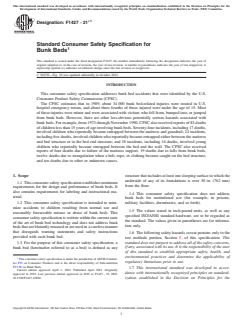
3.1.6 cap, n—device used to plug holes in the top of the
Metal or Glass Edge in Toys and Other Articles Intended
corner post. (See Fig. 1.)
for Use by Children Under 8 Years of Age
3.1.6.1 Discussion—The holes are used for corner post
16 CFR Part 1501 Method for Identifying Toys and Other
extensions when a bunk bed is converted into single use beds.
Articles Intended for Use by Children Under 3 Years of
Age Which Present Choking, Aspiration or Ingestion
3.1.7 foundation,n—ofabed,baseorsupportforamattress.
Hazards Because of Small Parts
3.1.7.1 Discussion—The foundation may be independent
16 CFR Part 1632 Standard for the Flammability of Mat-
from or incorporated with the sleeping surface.
tresses and Mattress Pads
3.1.8 foundation support system, n—of a bed, those compo-
nents of the bed structure that support the foundation.
For referenced ASTM standards, visit the ASTM website, www.astm.org, or
3.1.9 guardrail, n—of a bed, rail attached to each long side
contact ASTM Customer Service at service@astm.org. For Annual Book of ASTM
Standards volume information, refer to the standard’s Document Summary page on
of the bed to help prevent a sleeping occupant from rolling or
the ASTM website.
sliding out of the bed.
Federal regulations 16 CFR Part 1303, 16 CFR Section 1500.48, 16 CFR
Section 1500.49, 16 CFR Part 1501, and 16 CFR Part 1632 are in effect and are
3.1.10 interior bed structure, n—interior faces of the side
administered by the CPSC. These federal regulations are not a part of this safety
rails and bed end structures.
specification. This information is offered to all parties so that they know that these
federal regulations must be adhered to outside the scope of this safety specification.
3.1.11 mattress, n—manufactured product intended to be
Copies of the regulations may be obtained from The Office of the Secretary, U.S.
slept on, consisting of various resilient materials covered with
Consumer Product Safety Commission, Washington, DC 20207.
an outer ticking.
If beds are accompanied by mattresses.
FIG. 1Examples of Caps
´1
F1427−21
3.1.12 side rail, n—of a bed structure, rail attached to the
bed end structures to which the foundation support system is
fastened.
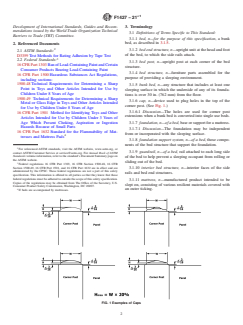
3.1.13 vertical protrusion, n—projection which, at the edge,
is vertical or near vertical to the inside adjacent surface along
the top of the component. (See Fig. 2.)
3.1.13.1 Discussion—Vertical protrusions may be remov-
able or permanent.
4. Performance Requirements
4.1 Vertical Protrusions:
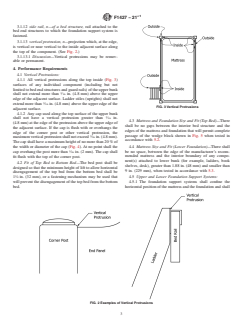
4.1.1 All vertical protrusions along the top inside (Fig. 3)
surfaces of any individual component (including but not
limited to bed end structures and guard rails) of the upper bunk
shall not extend more than ⁄16 in. (4.8 mm) above the upper
edge of the adjacent surface. Ladder stiles (uprights) shall not
extend more than ⁄16 in. (4.8 mm) above the upper edge of the
FIG. 3Vertical Protrusions
adjacent surface.
4.1.2 Any cap used along the top surface of the upper bunk
shall not have a vertical protrusion greater than ⁄16 in.
4.3 Mattress and Foundation Size and Fit (Top Bed)—There
(4.8 mm) at the edge of the protrusion above the upper edge of
shall be no gaps between the interior bed structure and the
the adjacent surface. If the cap is flush with or overhangs the
edges of the mattress and foundation that will permit complete
edge of the corner post or other vertical protrusion, the
passage of the wedge block shown in Fig. 5 when tested in
maximumverticalprotrusionshallnotexceed ⁄16in.(4.8mm).
accordance with 5.2.
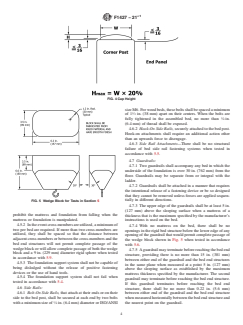
The cap shall have a maximum height of no more than 20 % of
the width or diameter of the cap (Fig. 4).At no point shall the 4.4 Mattress Size and Fit (Lower Foundation)—There shall
cap overhang the post more than ⁄16 in. (2 mm). The cap shall be no space, between the edge of the manufacturer’s recom-
fit flush with the top of the corner post. mended mattress and the interior boundary of any compo-
nent(s) attached to lower bunk (for example, ladders, book
4.2 Fit of Top Bed to Bottom Bed—The bed post shall be
shelves, desk), greater than 1.88 in. (48 mm) and smaller than
designed so that the minimum height of lift to allow horizontal
9 in. (229 mm), when tested in accordance with 5.3.
disengagement of the top bed from the bottom bed shall be
1 ⁄4 in. (32 mm), or a fastening mechanism may be used that 4.5 Upper and Lower Foundation Support Systems:
will prevent the disengagement of the top bed from the bottom 4.5.1 The foundation support systems shall confine the
bed. horizontal position of the mattress and the foundation and shall
FIG. 2Examples of Vertical Protrusions
´1
F1427−21
FIG. 4Cap Height
sizeM6.Forwoodbeds,theseboltsshallbespacedaminimum
of 1 ⁄2 in. (38 mm) apart on their centers. When the bolts are
fully tightened in the assembled bed, no more than ⁄4 in.
(6.4 mm) of thread shall be exposed.
4.6.2 Hook-On Side Rails, securely attached to the bed post.
Hook-on attachments shall require an additional action other
than an upwards force to disengage.
4.6.3 Side Rail Attachments—There shall be no structural
failure of bed side rail fastening systems when tested in
accordance with 5.5.
4.7 Guardrails:
4.7.1 Two guardrails shall accompany any bed in which the
underside of the foundation is over 30 in. (762 mm) from the
floor. Guardrails may be separate from or integral with the
ladder.
4.7.2 Guardrails shall be attached in a manner that requires
the intentional release of a fastening device or be so designed
that they cannot be removed unless forces are applied sequen-
tially in different directions.
FIG. 5 Wedge Block for Tests in Section 5
4.7.3 The upper edge of the guardrails shall be at least 5 in.
(127 mm) above the sleeping surface when a mattress of a
prohibit the mattress and foundation from falling when the thickness that is the maximum specified by the manufacturer’s
mattress or foundation is manipulated.
instructions is used on the bed.
4.5.2 Intheeventcross-membersareutilized,aminimumof
4.7.4 With no mattress on the bed, there shall be no
two per bed are required. If more than two cross-members are
openings in the rigid bed structure below the lower edge of any
utilized, they shall be spaced so that the distance between
openingoftheguardrailthatwouldpermitcompletepassageof
adjacent cross-members or between the cross-members and the
the wedge block shown in Fig. 5 when tested in accordance
bed end structures will not permit complete passage of the
with 5.6.
wedge block or will allow complete passage of both the wedge
4.7.5 Aguardrailmayterminatebeforereachingthebedend
block and a 9 in. (229 mm) diameter rigid sphere when tested
structure, providing there is no more than 15 in. (381 mm)
in accordance with 5.9.
between either end of the guardrail and the bed end structures
4.5.3 The foundation support system shall not be capable of
in the same plane when measured at a point 5 in. (127 mm)
being dislodged without the release of positive fastening
above the sleeping surface as established by the maximum
devices or the use of hand tools.
mattress thickness specified by the manufacturer. The second
4.5.4 The foundation support system shall not fail when
guardrail may terminate before reaching the bed end structure.
tested in accordance with 5.4.
If this guardrail terminates before reaching the bed end
4.6 Side Rails: structure, there shall be no more than 0.22 in. (5.6 mm)
4.6.1 Bolt-On Side Rails, that attach at their ends or on their between either end of the guardrail and the bed end structure
side to the bed post, shall be secured at each end by two bolts when measured horizontally between the bed end structure and
with a minimum size of ⁄4 in. (6.4 mm) diameter or ISO/ANSI the nearest point on the guardrail.
´1
F1427−21
4.8 Bed Structure: no gaps between the edge of the manufacturers recommended
4.8.1 The upper edge of the upper bunk end structures for at mattressandtheinteriorverticalstilebetween1.88in.(48mm)
least 50 % of the distance between the two posts at the head and 9 in. (229 mm) when tested in accordance with 5.3.
and foot of the upper bunk shall be at least 5 in. (127 mm)
4.10 Metal Beds: Frame and Fastenings—There shall be no
above the sleeping surface when a mattress and foundation of
separation of any of the attachments of the foundation support
the maximum size and thickness specified by the manufactur-
system to the end structures of the bed when tested in
er’s instructional literature is used on the upper bunk.
accordance with 5.8.1.1 and 5.8.2.
4.8.2 There shall be no openings in the rigid end structures
oftheupperbunk/bunksthatwillpermitthefreepassageofthe
5. Test Methods
wedge block shown in Fig. 5 when tested in accordance with
5.1 Assemble the bed in accordance with the provided
5.7.1.Thisrequirementshallapplyonlytothoseportionsofthe
instructions.
bed end structure that are above the foundation support system
of the upper bunk/bunks.
5.2 Mattress and Foundation Size and Fit (see 4.3)—Upper
4.8.3 When tested in accordance with 5.7.2, there shall be Foundation:
no openings within the entire boundary of the lower bunk that
5.2.1 Place the intended mattress and foundation, as speci-
will permit free passage of the wedge block shown in Fig. 5,
fied by the instructions, on the upper foundation support.
unless they are large enough to permit the free passage of a
5.2.2 Move the mattress and foundation horizontally to
9 in. (229 mm) diameter rigid sphere. This requirement does
obtainthelargestgapbetweentheinteriorbedstructureandthe
notapplytoopeningsthatarebelowthelevelofthelowerbunk
edge of the mattress and foundation.
foundationsupportsystem.Thisrequirementshallapplytothat
5.2.3 Insert the wedge block shown in Fig. 5, tapered side
portion of the bed structure that is between the level of the
downwards, and in the most adverse orientation, into any gap
lower bunk foundation support system and the level of the
and gradually apply a 45 lbf (200 N) vertically downwards
upper bunk foundation support system. Such openings include,
force. Sustain the force for a period of 1 min.
but are not limited to, bed end structures, foundation, ladders,
5.3 Mattress Size and Fit (see 4.4)—Lower Foundation:
desks, or bookshelf components, or a combination thereof, as
5.3.1 Place the intended mattress and foundation, as speci-
offered with the bed for purchase and designed to be attached
fied by the manufacturer, on the lower mattress support.
to the bed structure.
5.3.2 For components attached to the side of the lower bed,
4.8.4 Whentestedinaccordancewith5.7.2.3and5.7
...