

ASTM C878/C878M-22
(Test Method)Standard Test Method for Restrained Expansion of Shrinkage-Compensating Concrete
General Information
- Abstract
SIGNIFICANCE AND USE
4.1 Since the potential for expansion, under conditions of controlled restraint, of concrete made with shrinkage-compensating cement cannot always be satisfactorily predicted from tests of mortars made in accordance with Test Method C806, a need has been recognized for a test method in which concrete specimens are tested.
4.2 This test method can also be adapted readily to studies of expansion involving degrees of restraint, comparisons of cements, effects of cement contents, mixture proportions, schedules, or environmental treatments that differ from the standard procedures prescribed by this test method.
SCOPE
1.1 This test method covers the determination of the expansion of concrete made with shrinkage-compensating cement.
1.2 The values stated in either SI units or inch-pound units are to be regarded separately as standard. The values stated in each system may not be exact equivalents; therefore, each system shall be used independently of the other. Combining values from the two systems may result in non-conformance with the standard.
1.3 This standard does not purport to address all of the safety concerns, if any, associated with its use. It is the responsibility of the user of this standard to establish appropriate safety, health, and environmental practices and determine the applicability of regulatory limitations prior to use.
1.4 This international standard was developed in accordance with internationally recognized principles on standardization established in the Decision on Principles for the Development of International Standards, Guides and Recommendations issued by the World Trade Organization Technical Barriers to Trade (TBT) Committee.
- Status
- Published
- Publication Date
- 14-Oct-2022
- Technical Committee
- C09 - Concrete and Concrete Aggregates
- Drafting Committee
- C09.68 - Volume Change
Buy Documents
ASTM C878/C878M-22 - Standard Test Method for Restrained Expansion of Shrinkage-Compensating Concrete
REDLINE ASTM C878/C878M-22 - Standard Test Method for Restrained Expansion of Shrinkage-Compensating Concrete
Overview
ASTM C878/C878M-22, titled “Standard Test Method for Restrained Expansion of Shrinkage-Compensating Concrete,” is an internationally recognized standard developed by ASTM for assessing the expansion properties of concrete made with shrinkage-compensating cement under controlled restraint. This test method addresses the need for directly evaluating concrete specimens, rather than relying solely on predictive mortar tests, to ensure accurate performance data crucial for structural concrete applications. The standard applies to both SI and inch-pound units, with each system used independently, supporting global use and compliance.
Key Topics
- Restrained Expansion Testing: The method evaluates how much concrete containing shrinkage-compensating cement can expand when subjected to controlled restraint conditions, simulating real-world construction scenarios.
- Concrete Specimen Preparation: Procedures are defined for the preparation and assembly of concrete prisms, including dimensions, composition, proper consolidation, and curing processes.
- Measurement and Reporting: The standard outlines how expansion is measured with comparators and reported as a percentage change in length, ensuring uniformity and reproducibility between laboratories.
- Precision and Bias: Statements regarding the standard’s precision underscore its reliability when assessing expansion characteristics across various laboratories and conditions.
- Adaptability: This method is adaptable for studies comparing cements, mixture proportions, cement contents, environmental conditions, or customized schedules, making it valuable for research and specification validation.
Applications
- Quality Control in Construction: Specifiers, engineers, and contractors use ASTM C878/C878M-22 to verify that shrinkage-compensating concrete mixes expand as intended, minimizing the risk of cracking and dimensional instability in buildings, pavements, bridges, and industrial floors.
- Material Comparisons: The method is crucial for evaluating and comparing the performance of different expansive cements (Type K, Type S, or Type M) under restrained conditions.
- Research and Development: Researchers employ this standard in the study of material behavior, the effects of various mixture designs, and the impact of different curing or environmental conditions.
- Compliance and Specification: Concrete suppliers and construction stakeholders reference this test method within project specifications to ensure materials comply with project requirements and industry standards for shrinkage control.
Related Standards
The effectiveness and proper execution of ASTM C878/C878M-22 are supported by several referenced standards and guides, which include:
- ASTM C806 - Test Method for Restrained Expansion of Expansive Cement Mortar
- ASTM C845/C845M - Specification for Expansive Hydraulic Cement
- ASTM C490/C490M - Practice for Use of Apparatus for Determination of Length Change of Hardened Cement Paste, Mortar, and Concrete
- ASTM C192/C192M - Practice for Making and Curing Concrete Test Specimens in the Laboratory
- ASTM C125 - Terminology Relating to Concrete and Concrete Aggregates
- ASTM C219 - Terminology Relating to Hydraulic and Other Inorganic Cements
- ACI 223R - Guide for the Use of Shrinkage-Compensating Concrete
Practical Value
Adoption of ASTM C878/C878M-22 ensures standardized, reliable assessment of shrinkage-compensating concrete performance, directly supporting quality control, material optimization, and long-term durability in construction projects globally. Using this standard enhances the predictability and control of early-age concrete expansion, reducing structural defects and maintenance costs associated with shrinkage-related cracking.
Keywords: ASTM C878, restrained expansion, shrinkage-compensating concrete, expansive cement, concrete testing, concrete expansion, construction materials standards
Relations
- Effective Date
- 01-Apr-2024
- Effective Date
- 01-Feb-2024
- Effective Date
- 01-Jan-2024
- Effective Date
- 15-Dec-2023
- Effective Date
- 01-Aug-2020
- Effective Date
- 01-Apr-2020
- Effective Date
- 15-Dec-2019
- Effective Date
- 15-Nov-2019
- Effective Date
- 01-Jun-2019
- Effective Date
- 01-Jan-2019
- Effective Date
- 01-Oct-2018
- Effective Date
- 01-Jul-2018
- Effective Date
- 01-Jul-2018
- Effective Date
- 01-Jan-2018
- Effective Date
- 15-Dec-2016
Buy Documents
ASTM C878/C878M-22 - Standard Test Method for Restrained Expansion of Shrinkage-Compensating Concrete
REDLINE ASTM C878/C878M-22 - Standard Test Method for Restrained Expansion of Shrinkage-Compensating Concrete
Get Certified
Connect with accredited certification bodies for this standard

DIBt (Deutsches Institut für Bautechnik)
German Institute for Building Technology.
DIN CERTCO
DIN Group product certification.

Aboma Certification B.V.
Specialized in construction, metal, and transport sectors.
Sponsored listings
Frequently Asked Questions
ASTM C878/C878M-22 is a standard published by ASTM International. Its full title is "Standard Test Method for Restrained Expansion of Shrinkage-Compensating Concrete". This standard covers: SIGNIFICANCE AND USE 4.1 Since the potential for expansion, under conditions of controlled restraint, of concrete made with shrinkage-compensating cement cannot always be satisfactorily predicted from tests of mortars made in accordance with Test Method C806, a need has been recognized for a test method in which concrete specimens are tested. 4.2 This test method can also be adapted readily to studies of expansion involving degrees of restraint, comparisons of cements, effects of cement contents, mixture proportions, schedules, or environmental treatments that differ from the standard procedures prescribed by this test method. SCOPE 1.1 This test method covers the determination of the expansion of concrete made with shrinkage-compensating cement. 1.2 The values stated in either SI units or inch-pound units are to be regarded separately as standard. The values stated in each system may not be exact equivalents; therefore, each system shall be used independently of the other. Combining values from the two systems may result in non-conformance with the standard. 1.3 This standard does not purport to address all of the safety concerns, if any, associated with its use. It is the responsibility of the user of this standard to establish appropriate safety, health, and environmental practices and determine the applicability of regulatory limitations prior to use. 1.4 This international standard was developed in accordance with internationally recognized principles on standardization established in the Decision on Principles for the Development of International Standards, Guides and Recommendations issued by the World Trade Organization Technical Barriers to Trade (TBT) Committee.
SIGNIFICANCE AND USE 4.1 Since the potential for expansion, under conditions of controlled restraint, of concrete made with shrinkage-compensating cement cannot always be satisfactorily predicted from tests of mortars made in accordance with Test Method C806, a need has been recognized for a test method in which concrete specimens are tested. 4.2 This test method can also be adapted readily to studies of expansion involving degrees of restraint, comparisons of cements, effects of cement contents, mixture proportions, schedules, or environmental treatments that differ from the standard procedures prescribed by this test method. SCOPE 1.1 This test method covers the determination of the expansion of concrete made with shrinkage-compensating cement. 1.2 The values stated in either SI units or inch-pound units are to be regarded separately as standard. The values stated in each system may not be exact equivalents; therefore, each system shall be used independently of the other. Combining values from the two systems may result in non-conformance with the standard. 1.3 This standard does not purport to address all of the safety concerns, if any, associated with its use. It is the responsibility of the user of this standard to establish appropriate safety, health, and environmental practices and determine the applicability of regulatory limitations prior to use. 1.4 This international standard was developed in accordance with internationally recognized principles on standardization established in the Decision on Principles for the Development of International Standards, Guides and Recommendations issued by the World Trade Organization Technical Barriers to Trade (TBT) Committee.
ASTM C878/C878M-22 is classified under the following ICS (International Classification for Standards) categories: 91.100.30 - Concrete and concrete products. The ICS classification helps identify the subject area and facilitates finding related standards.
ASTM C878/C878M-22 has the following relationships with other standards: It is inter standard links to ASTM C219-24, ASTM C670-24a, ASTM C670-24, ASTM C806-23, ASTM C219-20a, ASTM C219-20, ASTM C125-19a, ASTM C219-19a, ASTM C219-19, ASTM C125-19, ASTM C125-18b, ASTM C125-18a, ASTM C806-18, ASTM C125-18, ASTM C125-16. Understanding these relationships helps ensure you are using the most current and applicable version of the standard.
ASTM C878/C878M-22 is available in PDF format for immediate download after purchase. The document can be added to your cart and obtained through the secure checkout process. Digital delivery ensures instant access to the complete standard document.
Standards Content (Sample)
This international standard was developed in accordance with internationally recognized principles on standardization established in the Decision on Principles for the
Development of International Standards, Guides and Recommendations issued by the World Trade Organization Technical Barriers to Trade (TBT) Committee.
Designation: C878/C878M − 22
Standard Test Method for
Restrained Expansion of Shrinkage-Compensating
Concrete
This standard is issued under the fixed designation C878/C878M; the number immediately following the designation indicates the year
of original adoption or, in the case of revision, the year of last revision. A number in parentheses indicates the year of last reapproval.
A superscript epsilon (´) indicates an editorial change since the last revision or reapproval.
1. Scope* C670 Practice for Preparing Precision and Bias Statements
for Test Methods for Construction Materials
1.1 This test method covers the determination of the expan-
C806 Test Method for Restrained Expansion of Expansive
sion of concrete made with shrinkage-compensating cement.
Cement Mortar
1.2 The values stated in either SI units or inch-pound units
C845/C845M Specification for Expansive Hydraulic Ce-
are to be regarded separately as standard. The values stated in
ment
each system may not be exact equivalents; therefore, each
2.2 ACI Standards and Committee Reports:
system shall be used independently of the other. Combining
CT ACI Concrete Terminology
values from the two systems may result in non-conformance
223R Guide for the Use of Shrinkage-Compensating Con-
with the standard.
crete
1.3 This standard does not purport to address all of the
safety concerns, if any, associated with its use. It is the
3. Terminology
responsibility of the user of this standard to establish appro-
3.1 Terms used in this test method are defined inTerminolo-
priate safety, health, and environmental practices and deter-
gies C219 and C125.
mine the applicability of regulatory limitations prior to use.
NOTE 1—Additional terms not found in Terminologies C219 or C125
1.4 This international standard was developed in accor-
may be found in ACI CT.
dance with internationally recognized principles on standard-
ization established in the Decision on Principles for the
4. Significance and Use
Development of International Standards, Guides and Recom-
4.1 Since the potential for expansion, under conditions of
mendations issued by the World Trade Organization Technical
controlled restraint, of concrete made with shrinkage-
Barriers to Trade (TBT) Committee.
compensating cement cannot always be satisfactorily predicted
2. Referenced Documents from tests of mortars made in accordance with Test Method
2 C806, a need has been recognized for a test method in which
2.1 ASTM Standards:
concrete specimens are tested.
C125 Terminology Relating to Concrete and Concrete Ag-
gregates 4.2 This test method can also be adapted readily to studies
C192/C192M Practice for Making and Curing Concrete Test of expansion involving degrees of restraint, comparisons of
Specimens in the Laboratory cements, effects of cement contents, mixture proportions,
schedules, or environmental treatments that differ from the
C219 Terminology Relating to Hydraulic and Other Inor-
ganic Cements standard procedures prescribed by this test method.
C490/C490M Practice for Use of Apparatus for the Deter-
5. Apparatus
mination of Length Change of Hardened Cement Paste,
Mortar, and Concrete
5.1 Molds, for casting test specimens, when used in con-
junction with the restraining cage described in 4.2, shall
provide for forming prisms 76 mm [3 in.] square with a gage
This method is under the jurisdiction of ASTM Committee C09 on Concrete
length of 250 mm [10 in.]. The molds shall otherwise conform
and Concrete Aggregates and is the direct responsibility of Subcommittee C09.68
to the requirements for molds in Practice C490/C490M, except
on Volume Change.
Current edition approved Oct. 15, 2022. Published December 2022. Originally
that the stud holder, gage studs, and spacer screws described in
approved in 1978. Last previous edition approved in 2014 as C878/C878M – 14a.
that practice will not be used.
DOI: 10.1520/C0878_C0878M-22.
For referenced ASTM standards, visit the ASTM website, www.astm.org, or
contact ASTM Customer Service at service@astm.org. For Annual Book of ASTM
Standards volume information, refer to the standard’s Document Summary page on Available fromAmerican Concrete Institute (ACI), P.O. Box 9094, Farmington
the ASTM website. Hills, MI 48333-9094, http://www.concrete.org.
*A Summary of Changes section appears at the end of this standard
Copyright © ASTM International, 100 Barr Harbor Drive, PO Box C700, West Conshohocken, PA 19428-2959. United States
C878/C878M − 22
exercise judgment as to whether or not all must be tested.The designation
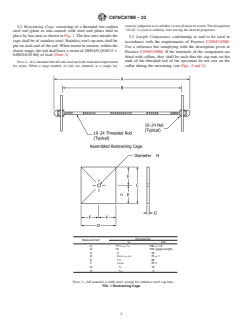
5.2 Restraining Cage, consisting of a threaded low-carbon
“10-24” is used in ordinary rods having the desired properties.
steel rod (plain or zinc-coated) with steel end plates held in
place by hex nuts as shown in Fig. 1. The hex nuts outside the
5.3 Length Comparator, conforming to and to be used in
cage shall be of stainless steel. Stainless steel cap nuts shall be
accordance with the requirements of Practice C490/C490M.
put on each end of the rod. When tested in tension, within the
Use a reference bar complying with the description given in
elastic range, the rod shall have a strain of 2800 kN [0.0012 6
Practice C490/C490M. If the terminals of the comparator are
0.0001/630 lbf] of load (Note 2).
fitted with collars, they shall be such that the cap nuts on the
ends of the threaded rod of the specimen do not rest on the
NOTE2—Itisintendedthatallrodsusedmeettheindicatedrequirement
for strain. When a large number of rods are obtained as a single lot, collar during the measuring (see Figs. 2 and 3).
Dimensions
Measurement
in. mm
9 1
A11 ⁄16 ± ⁄16 294±1.6
B 10 254 (gage length)
C3 76
31 1
D2 ⁄32 ± ⁄32 75±1
E1 ⁄2 38
F1 ⁄64 37.7
G ⁄8 10
H ⁄16 5
NOTE 1—All material is mild steel, except for stainless steel cap nuts.
FIG. 1 Restraining Cage
C878/C878M − 22
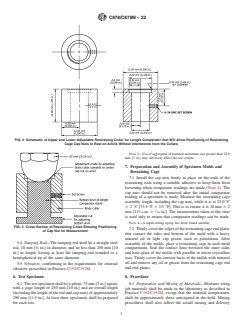
FIG. 2 Schematic of Upper and Lower Adjustable Restraining Collar for Length Comparator that Will Allow Positioning of Restraining
Cage Cap Nuts to Rest on Anvils Without Interference from the Collars
NOTE 3—Use of aggregates of nominal maximum size greater than 25.0
mm [1 in.] may adversely affect the test results.
7. Preparation and Assembly of Specimen Molds and
Restaining Cage
7.1 Install the cap nuts firmly in place on the ends of the
restraining rods using a suitable adhesive to keep them from
loosening when comparator readings are made (Note 4). The
cap nuts should not be removed after the initial comparator
reading of a specimen is made. Measure the restraining cage
assembly length, including the cap nuts, while it is at 23.0 °C
6 2 °C [73.5 °F 6 3.5 °F]. This is to ensure it is 30 mm 6 2
9 1
mm [11 ⁄16 in. 6 ⁄16 in.]. The measurement taken at this time
is used only to ensure that comparator readings can be made.
NOTE 4—A rapid-setting epoxy has been found suitable.
FIG. 3 Cross Section of Restraining Collar Showing Positioning
7.2 Thinly cover the edges of the restraining cage end plates
of Cap Nut for Measurement
that contact the sides and bottom of the mold with a heavy
mineral oil or light cup grease such as petrolatum. After
5.4 Tamping Rod—The tamping rod shall be a straight steel
assembly of the molds, place a restraining cage in each mold
rod, 10 mm [ ⁄8 in.] in diameter, and no less than 250 mm [10 compartment. Seal the contact lines between the outer sides
in.] in length, having at least the tamping end rounded to a
and base plate of the molds with paraffin or micro-crystalline
hemispherical tip of the same diameter. wax. Thinly cover the interior faces of the molds with mineral
oil and remove any oil
...
This document is not an ASTM standard and is intended only to provide the user of an ASTM standard an indication of what changes have been made to the previous version. Because
it may not be technically possible to adequately depict all changes accurately, ASTM recommends that users consult prior editions as appropriate. In all cases only the current version
of the standard as published by ASTM is to be considered the official document.
Designation: C878/C878M − 14a C878/C878M − 22
Standard Test Method for
Restrained Expansion of Shrinkage-Compensating
Concrete
This standard is issued under the fixed designation C878/C878M; the number immediately following the designation indicates the year
of original adoption or, in the case of revision, the year of last revision. A number in parentheses indicates the year of last reapproval.
A superscript epsilon (´) indicates an editorial change since the last revision or reapproval.
1. Scope*
1.1 This test method covers the determination of the expansion of concrete made with shrinkage-compensating cement.
1.2 The values stated in either SI units or inch-pound units are to be regarded separately as standard. The values stated in each
system may not be exact equivalents; therefore, each system shall be used independently of the other. Combining values from the
two systems may result in non-conformance with the standard.
1.3 This standard does not purport to address all of the safety concerns, if any, associated with its use. It is the responsibility
of the user of this standard to establish appropriate safety safety, health, and healthenvironmental practices and determine the
applicability of regulatory limitations prior to use.(Warning—Fresh hydraulic cementitious mixtures are caustic and may cause
chemical burns to skin and tissue upon prolonged exposure. )
1.4 This international standard was developed in accordance with internationally recognized principles on standardization
established in the Decision on Principles for the Development of International Standards, Guides and Recommendations issued
by the World Trade Organization Technical Barriers to Trade (TBT) Committee.
2. Referenced Documents
2.1 ASTM Standards:
C125 Terminology Relating to Concrete and Concrete Aggregates
C192/C192M Practice for Making and Curing Concrete Test Specimens in the Laboratory
C219 Terminology Relating to Hydraulic and Other Inorganic Cements
C490C490/C490M Practice for Use of Apparatus for the Determination of Length Change of Hardened Cement Paste, Mortar,
and Concrete
C670 Practice for Preparing Precision and Bias Statements for Test Methods for Construction Materials
C806 Test Method for Restrained Expansion of Expansive Cement Mortar
C845C845/C845M Specification for Expansive Hydraulic Cement
2.2 ACI Standards and Committee Reports:
CT ACI Concrete Terminology
223R Guide for the Use of Shrinkage-Compensating Concrete
This method is under the jurisdiction of ASTM Committee C09 on Concrete and Concrete Aggregates and is the direct responsibility of Subcommittee C09.68 on Volume
Change.
Current edition approved July 1, 2014Oct. 15, 2022. Published July 2014December 2022. Originally approved in 1978. Last previous edition approved in 2014 as
C878C878/C878M – 14.14a. DOI: 10.1520/C0878_C0878M-14A.10.1520/C0878_C0878M-22.
For referenced ASTM standards, visit the ASTM website, www.astm.org, or contact ASTM Customer Service at service@astm.org. For Annual Book of ASTM Standards
volume information, refer to the standard’s Document Summary page on the ASTM website.
Available from American Concrete Institute (ACI), P.O. Box 9094, Farmington Hills, MI 48333-9094, http://www.concrete.org.
*A Summary of Changes section appears at the end of this standard
Copyright © ASTM International, 100 Barr Harbor Drive, PO Box C700, West Conshohocken, PA 19428-2959. United States
C878/C878M − 22
3. Terminology
3.1 Terms used in this test method are defined in Terminologies C219 and C125.
NOTE 1—Additional terms not found in Terminologies C219 or C125 may be found in ACI CT.
4. Significance and Use
4.1 Since the potential for expansion, under conditions of controlled restraint, of concrete made with shrinkage-compensating
cement cannot always be satisfactorily predicted from tests of mortars made in accordance with Test Method C806, a need has been
recognized for a test method in which concrete specimens are tested.
4.2 This test method can also be adapted readily to studies of expansion involving degrees of restraint, comparisons of cements,
effects of cement contents, mixture proportions, schedules, or environmental treatments that differ from the standard procedures
prescribed by this test method.
5. Apparatus
5.1 Molds, for casting test specimens, when used in conjunction with the restraining cage described in 4.2, shall provide for
forming prisms 76 mm [3 in.] square with a gage length of 250 mm [10 in.]. The molds shall otherwise conform to the requirements
for molds in Practice C490C490/C490M, except that the stud holder, gage studs, and spacer screws described in that practice will
not be used.
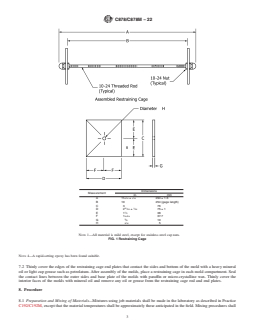
5.2 Restraining Cage, consisting of a threaded low-carbon steel rod (plain or zinc-coated) with steel end plates held in place by
hex nuts as shown in Fig. 1. The hex nuts outside the cage shall be of stainless steel. Stainless steel cap nuts shall be put on each
end of the rod. When tested in tension, within the elastic range, the rod shall have a strain of 2800 kN [0.0012 6 0.0001/630 lbf]
of load (Note 2).
NOTE 2—It is intended that all rods used meet the indicated requirement for strain. When a large number of rods are obtained as a single lot, exercise
judgment as to whether or not all must be tested. The designation “10-24” is used in ordinary rods having the desired properties.
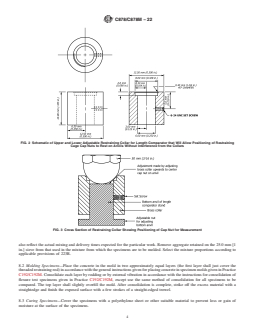
5.3 Length Comparator, conforming to and to be used in accordance with the requirements of Practice C490C490/C490M. Use
a reference bar complying with the description given in Practice C490C490/C490M. If the terminals of the comparator are fitted
with collars, they shall be such that the cap nuts on the ends of the threaded rod of the specimen do not rest on the collar during
the measuring (see Figs. 2 and 3).
5.4 Tamping Rod—The tamping rod shall be a straight steel rod, 10 mm [ ⁄8 in.] in diameter, and no less than 250 mm [10 in.]
in length, having at least the tamping end rounded to a hemispherical tip of the same diameter.
5.5 Vibrators, conforming to the requirements for external vibrators prescribed in Practice C192/C192M.
6. Test Specimen
6.1 The test specimen shall be a prism: 75 mm [3 in.] square with a gage length of 250 mm [10 in.] and an overall length (including
the length of the rod and cap nuts) of approximately 290 mm [11.5 in.]. At least three specimens shall be prepared for each test.
NOTE 3—Use of aggregates of nominal maximum size greater than 25.0 mm [1 in.] may adversely affect the test results.
7. Preparation and Assembly of Specimen Molds and Restaining Cage
7.1 Install the cap nuts firmly in place on the ends of the restraining rods using a suitable adhesive to keep them from loosening
when comparator readings are made (Note 4). The cap nuts should not be removed after the initial comparator reading of a
specimen is made. Measure the restraining cage assembly length, including the cap nuts, while it is at 23.023.0 °C 6 2 °C
9 1
[73.5[73.5 °F 6 3.5 °F]. This is to ensure it is 3030 mm 6 2 mm [11 ⁄16 in. 6 ⁄16 in.]. The measurement taken at this time is used
only to ensure that comparator readings can be made.
C878/C878M − 22
Dimensions
Measurement
in. mm
9 1
A 11 ⁄16 ± ⁄16 294 ± 1.6
B 10 254 (gage length)
C 3 76
31 1
D 2 ⁄32 ± ⁄32 75 ± 1
E 1 ⁄2 38
F 1 ⁄64 37.7
G ⁄8 10
H ⁄16 5
NOTE 1—All material is mild steel, except for stainless steel cap nuts.
FIG. 1 Restraining Cage
NOTE 4—A rapid-setting epoxy has been found suitable.
7.2 Thinly cover the edges of the restraining cage end plates that contact the sides and bottom of the mold with a heavy mineral
oil or light cup grease such as petrolatum. After assembly of the molds, place a restraining cage in each mold compartment. Seal
the contact lines between the outer sides and base plate of the molds with paraffin or micro-crystalline wax. Thinly cover the
interior faces of the molds with mineral oil and remove any oil or grease from the restraining cage rod and end plates.
8. Procedure
...