


ASTM E120-00
(Test Method)Standard Test Methods for Chemical Analysis of Titanium and Titanium Alloys (Withdrawn 2003)
Standard Test Methods for Chemical Analysis of Titanium and Titanium Alloys (Withdrawn 2003)
SCOPE
1.1 These test methods cover procedures for the chemical analysis of titanium and titanium alloys containing the following elements in the concentration ranges listed: Element Concentration Range, % Aluminum 1 to 10 Chloride 0.02 to 1.0 Chromium 0.005 to 20 Columbium 0.25 to 5.0 Copper 0.001 to 1.1 Iron 0.005 to 20 Magnesium 0.02 to 1.0 Manganese 0.005 to 20 Molybdenum 0.005 to 5 Nitrogen 0.005 to 0.20 Oxygen 0.03 to 0.50 Palladium 0.10 to 0.25 Silicon 0.005 to 5.0 Tantalum 0.25 to 5.0 Tin 0.25 to 10 Tungsten 0.005 to 1.0 Vanadium 0.5 to 20 Zirconium 1.0 to 20
1.2 The test methods in this standard are contained in the sections indicated as follows: Sections Aluminum: 8-Quinolinol (Gravimetric) Test Method 2 8 to 14 Chloride by the Gravimetric Test Method 2 15 to 22 Copper: Cuprizone (Photometric) Test Method 23 to 32 Diethyldithiocarbamate (Photometric) Test Method 33 to 42 Manganese: Periodate (Photometric) Test Method 43 to 52 Molybdenum Thiocyanate-Extraction (Photometric) Test Method 53 to 62 Thiocyanate 2-(2-Butoxyethoxy) Ethanol (Photometric) Test Method 63 to 72 Nitrogen by the Distillation-Titration Test Method 2 73 to 80 Palladium by the 1-Nitroso-2-Naphthol (Photometric) Test 81 to 90 Method Vanadium by the Potassium Permanganate (Titrimetric) Test 91 to 97 Method Zirconium by the Mandelic Acid (Gravimetric) Test Method 98 to 104
1.3 This standard does not purport to address all of the safety concerns, if any, associated with its use. It is the responsibility of the user of this standard to establish appropriate safety and health practices and determine the applicability of regulatory limitations prior to use.
General Information
Relations

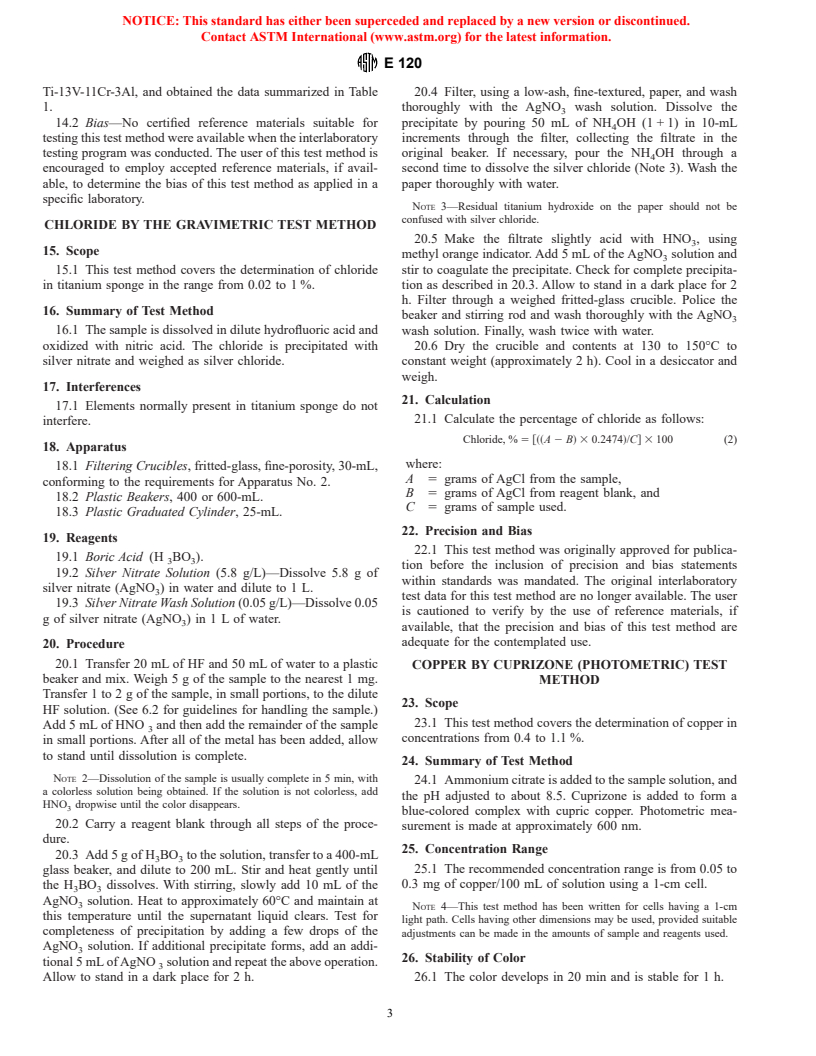
Standards Content (Sample)
NOTICE: This standard has either been superceded and replaced by a new version or discontinued.
Contact ASTM International (www.astm.org) for the latest information.
Designation: E 120 – 00
Standard Test Methods for
Chemical Analysis of Titanium and Titanium Alloys
This standard is issued under the fixed designation E 120; the number immediately following the designation indicates the year of
original adoption or, in the case of revision, the year of last revision. A number in parentheses indicates the year of last reapproval. A
superscript epsilon (e) indicates an editorial change since the last revision or reapproval.
This standard has been approved for use by agencies of the Department of Defense.
1. Scope 1.3 This standard does not purport to address all of the
safety concerns, if any, associated with its use. It is the
1.1 These test methods cover procedures for the chemical
responsibility of the user of this standard to establish appro-
analysis of titanium and titanium alloys containing the follow-
priate safety and health practices and determine the applica-
ing elements in the concentration ranges listed:
bility of regulatory limitations prior to use.
Element Concentration Range,%
Aluminum 1 to 10
2. Referenced Documents
Chloride 0.02 to 1.0
Chromium 0.005 to 20
2.1 ASTM Standards:
Columbium 0.25 to 5.0
E 29 Practice for Using Significant Digits in Test Data to
Copper 0.001 to 1.1
Iron 0.005 to 20
Determine Conformance With Specifications
Magnesium 0.02 to 1.0
E 50 Practices for Apparatus, Reagents, and Safety Precau-
Manganese 0.005 to 20
tions for Chemical Analysis of Metals
Molybdenum 0.005 to 5
Nitrogen 0.005 to 0.20
E 59 Practice for Sampling Steel and Iron for Determination
Oxygen 0.03 to 0.50
of Chemical Composition
Palladium 0.10 to 0.25
E 60 Practice for Photometric and Spectrophotometric
Silicon 0.005 to 5.0
Tantalum 0.25 to 5.0
Methods for Chemical Analysis of Metals
Tin 0.25 to 10
E 173 Practice for Conducting Interlaboratory Studies of
Tungsten 0.005 to 1.0
Methods for Chemical Analysis of Metals
Vanadium 0.5 to 20
Zirconium 1.0 to 20
3. Significance and Use
1.2 The test methods in this standard are contained in the
3.1 These test methods for the chemical analysis of metals
sections indicated as follows:
and alloys are primarily intended for referee purposes. It is
Sections
assumed that all who use these test methods will be trained
Aluminum:
analysts capable of performing common laboratory procedures
8-Quinolinol (Gravimetric) Test Method 8-14
2 skillfully and safely. It is expected that work will be performed
Chloride by the Gravimetric Test Method 15-22
in a properly equipped laboratory.
Copper:
Cuprizone (Photometric) Test Method 23-32
Diethyldithiocarbamate (Photometric) Test Method 33-42
4. Apparatus, Reagents, and Photometric Practice
Manganese:
4.1 Apparatus and reagents required for each determination
Periodate (Photometric) Test Method 43-52
Molybdenum
are listed in separate sections preceding the procedure. The
Thiocyanate-Extraction (Photometric) Test Method 53-62
apparatus, standard solutions, and certain reagents used in
Thiocyanate 2-(2-Butoxyethoxy) Ethanol (Photometric) Test 63-72
more than one procedure are referred to by number and shall
Method
Nitrogen by the Distillation-Titration Test Method 73-80
conform to the requirements prescribed in Practices E 50,
Palladium by the 1-Nitroso-2-Naphthol (Photometric) Test 81-90
except that photometers shall conform to the requirements
Method
Vanadium by the Potassium Permanganate (Titrimetric) Test 91-97 prescribed in Practice E 60.
Method
Zirconium by the Mandelic Acid (Gravimetric) Test Method 98-104
5. Hazards
5.1 For hazards to be observed in these test methods,
1 2
These test methods are under the jurisdiction of ASTM Committee E-1 on These test methods are based on the methods developed by the Panel on
Analytical Chemistry for Metals, Ores, and Related Materials and are the direct Methods of Analysis of the Metallurgical Advisory Committee on Titanium,
responsibility of Subcommittee E01.06 on Ti, Zr, W, Mo, Ta, Nb, Hf. Ordnance Corps, U. S. Army, and published in their Bulletin T8.
Current edition approved June 10, 2000. Published July 2000. Originally Annual Book of ASTM Standards, Vol 14.02.
published as E 120 – 56. Last previous edition E 120 – 96. Annual Book of ASTM Standards, Vol 03.05.
Copyright © ASTM, 100 Barr Harbor Drive, West Conshohocken, PA 19428-2959, United States.
NOTICE: This standard has either been superceded and replaced by a new version or discontinued.
Contact ASTM International (www.astm.org) for the latest information.
E 120
reference shall be made to Practices E 50. 12. Procedure
12.1 Transfer a 1.0-g sample, weighed to the nearest 1 mg,
6. Sampling
to a 400-mL beaker.
6.1 No standardized sampling procedures are available, but
12.2 Carry a reagent blank through the entire procedure,
the principles of Practice E 59 should be used as a guide to
using the same amounts of all reagents with the sample
obtain representative samples, bearing in mind that with
omitted.
present melting practices titanium metal and titanium-base
12.3 Add 100 mL of HCl (1 + 1), and heat gently until
alloys may show greater inhomogeneities than are usually
dissolution is complete. Add HNO dropwise until the titanium
found in steels.
is oxidized, and then boil gently to expel oxides of nitrogen.
6.2 The sample used for the chloride determination shall not
12.4 Cool, nearly neutralize (Note 1) with NaOH Solution
be subjected to any physical or mechanical process that breaks
A, and pour the solution slowly, with stirring, into a 600-mL
down or opens up significant portions of cells of the titanium
beaker containing 150 mL of hot NaOH Solution B. Boil for 1
sponge, or causes a localized heating of the sponge sample.
min while stirring constantly, and cool to room temperature in
Avoid briquetting, compacting, drilling, or combination
a running water bath.
thereof, of the titanium sponge to obtain a laboratory sample
NOTE 1—Once the solution is made alkaline, it must be carried through
for analysis of chloride.
the procedure without delay until it is acidified to litmus as directed in
12.6.
7. Rounding Calculated Values
12.5 Transfer to a 500-mL volumetric flask, dilute to vol-
7.1 Calculated values shall be rounded to the desired num-
ume, and mix. Immediately transfer, without rinsing, to a dry
ber of places in accordance with the rounding test method
600-mL beaker. Filter through a dry 18.5-cm fluted filter paper
given in 3.4 and 3.5 of Practice E 29.
into a dry 250-mL volumetric flask, discard the first 50 mL, and
ALUMINUM BY THE 8-QUINOLINOL collect 250 mL of the filtrate.
(GRAVIMETRIC) TEST METHOD 12.6 Transfer to a 600-mL beaker and acidify to litmus with
HCl (1 + 1). Add 25 mL of tartaric acid solution and adjust to
8. Scope
pH 8.0 using NH OH and pH test paper. Add 10 mL of H O
4 2
8.1 This test method covers the determination of aluminum 2(30 %) and heat to 50 to 60°C. While mechanically stirring,
add 3.5 mL of 8-quinolinol solution for each 5 mg of aluminum
in titanium and titanium alloys in concentrations from 1 to 8 %.
present, plus 5 mL in excess. Add 5 mL of NH OH and
9. Summary of Test Method
continue stirring for 10 min.
12.7 Allow the precipitate to settle. Filter through a weighed
9.1 The sample is dissolved in hydrochloric and nitric acids
medium-porosity fritted-glass crucible. Test for completeness
and treated with sodium hydroxide to precipitate titanium and
of precipitation by the addition of 5 mL of 8-quinolinol
other metals. Aluminum in the filtrate is precipitated with
solution to the filtrate. Wash the precipitate four times with
8-quinolinol in the presence of hydrogen peroxide, dried, and
warm NH OH (1 + 99). Dry at 135°C for 1 ⁄2 h. Cool in a
weighed.
desiccator and weigh as aluminum quinolinate.
10. Interferences
13. Calculation
10.1 The elements ordinarily present do not interfere if their
concentrations are under the maximum limits shown in 1.1.
13.1 Calculate the percentage of aluminum as follows:
Aluminum, % 5 ~A 2 B! 3 0.0587 3 100/C (1)
11. Reagents
where:
11.1 8-Quinolinol Solution (25 g/L)—Reagent No. 130.
A 5 grams of aluminum quinolinate found in the aliquot
11.2 Sodium Hydroxide Solution A (300 g/L)—Prepare a
used,
solution as described for Reagent No. 146, but use 300 g
B 5 grams of aluminum quinolinate in the blank, and
instead of the specified weight.
C 5 grams of sample represented in the 250-mL aliquot.
11.3 Sodium Hydroxide Solution B (100 g/L)—Reagent No.
146.
14. Precision and Bias
11.4 Tartaric Acid Solution (250 g/L)—Prepare a solution as
described for Reagent No. 116, but use 250 g instead of the 14.1 Precision—Seven laboratories cooperated in testing
specified weight. this test method on samples of Ti-6A1-2Sn-4Zr-2Mo and
TABLE 1 Precision Data for Aluminum by the 8-Quinolinol (Gavimetric) Method
A
Test Material Aluminum Found, % by Laboratory No.
(1) Titanium-base alloy, 2Sn-4Zr-2Mo 6.01 6.20 6.04 6.01 6.07 6.04 6.10
6.00 6.16 6.01 6.02 6.13 6.05 5.95
(2) Titanium-base alloy, 13V-11Cr 3.11 3.19 3.27 3.09 2.91 3.22 3.06
3.01 3.19 3.23 3.07 3.09 3.23 3.12
A
Each sample analyzed once on each of two days in each laboratory.
NOTICE: This standard has either been superceded and replaced by a new version or discontinued.
Contact ASTM International (www.astm.org) for the latest information.
E 120
Ti-13V-11Cr-3Al, and obtained the data summarized in Table 20.4 Filter, using a low-ash, fine-textured, paper, and wash
1. thoroughly with the AgNO wash solution. Dissolve the
14.2 Bias—No certified reference materials suitable for precipitate by pouring 50 mL of NH OH (1 + 1) in 10-mL
testing this test method were available when the interlaboratory increments through the filter, collecting the filtrate in the
testing program was conducted. The user of this test method is original beaker. If necessary, pour the NH OH through a
encouraged to employ accepted reference materials, if avail- second time to dissolve the silver chloride (Note 3). Wash the
able, to determine the bias of this test method as applied in a paper thoroughly with water.
specific laboratory.
NOTE 3—Residual titanium hydroxide on the paper should not be
confused with silver chloride.
CHLORIDE BY THE GRAVIMETRIC TEST METHOD
20.5 Make the filtrate slightly acid with HNO , using
15. Scope
methyl orange indicator. Add 5 mL of the AgNO solution and
15.1 This test method covers the determination of chloride stir to coagulate the precipitate. Check for complete precipita-
in titanium sponge in the range from 0.02 to 1 %. tion as described in 20.3. Allow to stand in a dark place for 2
h. Filter through a weighed fritted-glass crucible. Police the
16. Summary of Test Method
beaker and stirring rod and wash thoroughly with the AgNO
16.1 The sample is dissolved in dilute hydrofluoric acid and
wash solution. Finally, wash twice with water.
oxidized with nitric acid. The chloride is precipitated with 20.6 Dry the crucible and contents at 130 to 150°C to
silver nitrate and weighed as silver chloride.
constant weight (approximately 2 h). Cool in a desiccator and
weigh.
17. Interferences
21. Calculation
17.1 Elements normally present in titanium sponge do not
21.1 Calculate the percentage of chloride as follows:
interfere.
Chloride, % 5 @~~A 2 B! 3 0.2474!/C# 3 100 (2)
18. Apparatus
where:
18.1 Filtering Crucibles, fritted-glass, fine-porosity, 30-mL,
A 5 grams of AgCl from the sample,
conforming to the requirements for Apparatus No. 2.
B 5 grams of AgCl from reagent blank, and
18.2 Plastic Beakers, 400 or 600-mL.
C 5 grams of sample used.
18.3 Plastic Graduated Cylinder, 25-mL.
22. Precision and Bias
19. Reagents
22.1 This test method was originally approved for publica-
19.1 Boric Acid (H BO ).
3 3
tion before the inclusion of precision and bias statements
19.2 Silver Nitrate Solution (5.8 g/L)—Dissolve 5.8 g of
within standards was mandated. The original interlaboratory
silver nitrate (AgNO ) in water and dilute to 1 L.
test data for this test method are no longer available. The user
19.3 Silver Nitrate Wash Solution (0.05 g/L)—Dissolve 0.05
is cautioned to verify by the use of reference materials, if
g of silver nitrate (AgNO ) in 1 L of water.
available, that the precision and bias of this test method are
adequate for the contemplated use.
20. Procedure
20.1 Transfer 20 mL of HF and 50 mL of water to a plastic
COPPER BY CUPRIZONE (PHOTOMETRIC) TEST
beaker and mix. Weigh5gofthe sample to the nearest 1 mg.
METHOD
Transfer 1 to2gofthe sample, in small portions, to the dilute
23. Scope
HF solution. (See 6.2 for guidelines for handling the sample.)
23.1 This test method covers the determination of copper in
Add 5 mL of HNO and then add the remainder of the sample
concentrations from 0.4 to 1.1 %.
in small portions. After all of the metal has been added, allow
to stand until dissolution is complete.
24. Summary of Test Method
NOTE 2—Dissolution of the sample is usually complete in 5 min, with
24.1 Ammonium citrate is added to the sample solution, and
a colorless solution being obtained. If the solution is not colorless, add
the pH adjusted to about 8.5. Cuprizone is added to form a
HNO dropwise until the color disappears.
blue-colored complex with cupric copper. Photometric mea-
20.2 Carry a reagent blank through all steps of the proce-
surement is made at approximately 600 nm.
dure.
25. Concentration Range
20.3 Add5gofH BO to the solution, transfer to a 400-mL
3 3
25.1 The recommended concentration range is from 0.05 to
glass beaker, and dilute to 200 mL. Stir and heat gently until
the H BO dissolves. With stirring, slowly add 10 mL of the 0.3 mg of copper/100 mL of solution using a 1-cm cell.
3 3
AgNO solution. Heat to approximately 60°C and maintain at
NOTE 4—This test method has been written for cells having a 1-cm
this temperature until the supernatant liquid clears. Test for
light path. Cells having other dimensions may be used, provided suitable
completeness of precipitation by adding a few drops of the
adjustments can be made in the amounts of sample and reagents used.
AgNO solution. If additional precipitate forms, add an addi-
26. Stability of Color
tional 5 mL of AgNO solution and repeat the above operation.
Allow to stand in a dark place for 2 h. 26.1 The color develops in 20 min and is stable for 1 h.
NOTICE: This standard has either been superceded and replaced by a new version or discontinued.
Contact ASTM International (www.astm.org) for the latest information.
E 120
27. Interferences 30. Procedure
27.1 The elements ordinarily present do not interfere. When 30.1 Test Solution:
more than 1 % of nickel or cobalt is present, the addition of 30.1.1 Transfer 0.100 g of the sample, weighed to the
ethanol stabil
...
Questions, Comments and Discussion
Ask us and Technical Secretary will try to provide an answer. You can facilitate discussion about the standard in here.