

ASTM E797/E797M-21
(Practice)Standard Practice for Measuring Thickness by Manual Ultrasonic Pulse-Echo Contact Method
General Information
- Abstract
SIGNIFICANCE AND USE
5.1 The techniques described provide indirect measurement of thickness of sections of materials not exceeding temperatures of 93 °C [200 °F]. Measurements are made from one side of the object, without requiring access to the rear surface.
5.2 Ultrasonic thickness measurements are used extensively on basic shapes and products of many materials, on precision machined parts, and to determine wall thinning in process equipment caused by corrosion and erosion.
5.3 Recommendations for determining the capabilities and limitations of ultrasonic thickness gages for specific applications can be found in the cited references.7,8
SCOPE
1.1 This practice2 provides guidelines for measuring the thickness of materials using the contact pulse-echo method at temperatures not to exceed 93 °C [200 °F].
1.2 This practice is applicable to any material in which ultrasonic waves will propagate at a constant velocity throughout the part, and from which back wall reflections can be obtained and resolved.
1.3 This practice is primarily for flat components with parallel surfaces and has limited applicability for components with non-parallel or concentric surfaces per 1.2.
1.4 Units—The values stated in either SI units or inch-pound units are to be regarded separately as standard. The values stated in each system are not necessarily exact equivalents; therefore, to ensure conformance with the standard, each system shall be used independently of the other, and values from the two systems shall not be combined.
1.5 This standard does not purport to address all of the safety concerns, if any, associated with its use. It is the responsibility of the user of this standard to establish appropriate safety, health, and environmental practices and determine the applicability of regulatory limitations prior to use.
1.6 This international standard was developed in accordance with internationally recognized principles on standardization established in the Decision on Principles for the Development of International Standards, Guides and Recommendations issued by the World Trade Organization Technical Barriers to Trade (TBT) Committee.
- Status
- Published
- Publication Date
- 31-May-2021
- Technical Committee
- E07 - Nondestructive Testing
- Drafting Committee
- E07.06 - Ultrasonic Method
Buy Documents
ASTM E797/E797M-21 - Standard Practice for Measuring Thickness by Manual Ultrasonic Pulse-Echo Contact Method
REDLINE ASTM E797/E797M-21 - Standard Practice for Measuring Thickness by Manual Ultrasonic Pulse-Echo Contact Method
Overview
ASTM E797/E797M-21: Standard Practice for Measuring Thickness by Manual Ultrasonic Pulse-Echo Contact Method is an internationally recognized ASTM standard that establishes guidelines for nondestructive measurement of material thickness. Using the manual ultrasonic pulse-echo technique, this practice enables accurate thickness measurements from one side of a test object without the need for rear surface access. This standard is applicable to a wide range of materials and is an essential tool in quality control, manufacturing, and maintenance, especially in scenarios where direct measurement is not feasible.
The practice is suitable for materials at service temperatures up to 93 °C [200 °F] and is most effective with components featuring flat, parallel surfaces. ASTM E797/E797M-21 ensures repeatable results by outlining procedures for calibration, apparatus selection, and personnel qualification, making it a key reference in the field of ultrasonic nondestructive testing (NDT).
Keywords: ultrasonic thickness measurement, pulse-echo method, nondestructive testing, ASTM E797/E797M-21, manual ultrasonic contact
Key Topics
- Ultrasonic Pulse-Echo Method: Describes the technique of sending ultrasonic pulses into a material and measuring the time taken for the echo to return from the back wall to calculate thickness.
- Single-Side Access: Enables thickness measurements where rear access is not possible, such as in pipes, tanks, or structural components.
- Material Applicability: Applies to metals, plastics, and other homogeneous materials where ultrasonic waves propagate at a constant velocity and back wall reflections are obtainable.
- Temperature Limitations: Suitable for use up to 93 °C [200 °F], with specialized techniques required for higher temperatures.
- Surface Preparation & Geometry: Emphasizes the need for proper surface preparation and discusses complications with non-parallel or curved surfaces.
- Calibration & Standardization: Requires standardization blocks of known thickness and material velocity to calibrate instruments.
- Reporting & Procedure: Recommends documentation of measurement procedure, equipment details, standardized blocks, scanning method, results, and personnel qualifications.
- Safety & Regulatory Compliance: Advises users to establish proper safety and environmental practices, and to observe regulatory constraints.
Applications
The ASTM E797/E797M-21 standard delivers significant practical value across a variety of industries:
- Corrosion & Erosion Monitoring: Widely used for evaluating wall thinning in pipelines, tanks, and pressure vessels due to corrosion or erosion.
- Manufacturing Quality Control: Assures the integrity of machined parts, sheets, and plates by verifying thickness without destructive testing.
- Asset Integrity Management: Provides crucial data in maintenance and inspection programs for petrochemical, energy, and transportation sectors.
- Aerospace and Automotive: Assesses thickness of critical components where weight and strength are tightly controlled.
- On-site and Field Inspections: Offers a portable and effective means to inspect in-service equipment without disabling operation or requiring part removal.
By enabling reliable, contact-based ultrasonic thickness measurement without the need for access to both sides, the standard supports efficiency, safety, and cost-effectiveness in industrial inspections and maintenance.
Related Standards
ASTM E797/E797M-21 references and complements several other international standards relevant to ultrasonic NDT and personnel qualification, including:
- ASTM E317 - Evaluating Performance Characteristics of Ultrasonic Pulse-Echo Testing Instruments and Systems
- ASTM E494 - Measuring Ultrasonic Velocity in Materials by Comparative Pulse-Echo Method
- ASTM E543 - Specification for Agencies Performing Nondestructive Testing
- ASTM E1316 - Terminology for Nondestructive Examinations
- ISO 9712 - Non-Destructive Testing – Qualification and Certification of NDT Personnel
- ASNT SNT-TC-1A and ANSI/ASNT CP-189 - Recommended Practices for NDT Personnel Qualification
- NAS-410 - Certification and Qualification of Nondestructive Testing Personnel
These related documents ensure comprehensive guidance for ultrasonic test methods, equipment calibration, agency competence, and NDT personnel certification.
Relations
- Effective Date
- 01-Feb-2024
- Effective Date
- 01-Dec-2019
- Effective Date
- 01-Mar-2019
- Effective Date
- 01-Jan-2018
- Effective Date
- 15-Jun-2017
- Effective Date
- 01-Feb-2017
- Effective Date
- 01-Aug-2016
- Effective Date
- 01-Feb-2016
- Effective Date
- 01-Dec-2015
- Effective Date
- 01-Sep-2015
- Effective Date
- 01-Jun-2014
- Effective Date
- 01-Jun-2014
- Effective Date
- 01-Dec-2013
- Effective Date
- 15-Jun-2013
- Effective Date
- 01-Jun-2013
Buy Documents
ASTM E797/E797M-21 - Standard Practice for Measuring Thickness by Manual Ultrasonic Pulse-Echo Contact Method
REDLINE ASTM E797/E797M-21 - Standard Practice for Measuring Thickness by Manual Ultrasonic Pulse-Echo Contact Method
Get Certified
Connect with accredited certification bodies for this standard

BSMI (Bureau of Standards, Metrology and Inspection)
Taiwan's standards and inspection authority.
Sponsored listings
Frequently Asked Questions
ASTM E797/E797M-21 is a standard published by ASTM International. Its full title is "Standard Practice for Measuring Thickness by Manual Ultrasonic Pulse-Echo Contact Method". This standard covers: SIGNIFICANCE AND USE 5.1 The techniques described provide indirect measurement of thickness of sections of materials not exceeding temperatures of 93 °C [200 °F]. Measurements are made from one side of the object, without requiring access to the rear surface. 5.2 Ultrasonic thickness measurements are used extensively on basic shapes and products of many materials, on precision machined parts, and to determine wall thinning in process equipment caused by corrosion and erosion. 5.3 Recommendations for determining the capabilities and limitations of ultrasonic thickness gages for specific applications can be found in the cited references.7,8 SCOPE 1.1 This practice2 provides guidelines for measuring the thickness of materials using the contact pulse-echo method at temperatures not to exceed 93 °C [200 °F]. 1.2 This practice is applicable to any material in which ultrasonic waves will propagate at a constant velocity throughout the part, and from which back wall reflections can be obtained and resolved. 1.3 This practice is primarily for flat components with parallel surfaces and has limited applicability for components with non-parallel or concentric surfaces per 1.2. 1.4 Units—The values stated in either SI units or inch-pound units are to be regarded separately as standard. The values stated in each system are not necessarily exact equivalents; therefore, to ensure conformance with the standard, each system shall be used independently of the other, and values from the two systems shall not be combined. 1.5 This standard does not purport to address all of the safety concerns, if any, associated with its use. It is the responsibility of the user of this standard to establish appropriate safety, health, and environmental practices and determine the applicability of regulatory limitations prior to use. 1.6 This international standard was developed in accordance with internationally recognized principles on standardization established in the Decision on Principles for the Development of International Standards, Guides and Recommendations issued by the World Trade Organization Technical Barriers to Trade (TBT) Committee.
SIGNIFICANCE AND USE 5.1 The techniques described provide indirect measurement of thickness of sections of materials not exceeding temperatures of 93 °C [200 °F]. Measurements are made from one side of the object, without requiring access to the rear surface. 5.2 Ultrasonic thickness measurements are used extensively on basic shapes and products of many materials, on precision machined parts, and to determine wall thinning in process equipment caused by corrosion and erosion. 5.3 Recommendations for determining the capabilities and limitations of ultrasonic thickness gages for specific applications can be found in the cited references.7,8 SCOPE 1.1 This practice2 provides guidelines for measuring the thickness of materials using the contact pulse-echo method at temperatures not to exceed 93 °C [200 °F]. 1.2 This practice is applicable to any material in which ultrasonic waves will propagate at a constant velocity throughout the part, and from which back wall reflections can be obtained and resolved. 1.3 This practice is primarily for flat components with parallel surfaces and has limited applicability for components with non-parallel or concentric surfaces per 1.2. 1.4 Units—The values stated in either SI units or inch-pound units are to be regarded separately as standard. The values stated in each system are not necessarily exact equivalents; therefore, to ensure conformance with the standard, each system shall be used independently of the other, and values from the two systems shall not be combined. 1.5 This standard does not purport to address all of the safety concerns, if any, associated with its use. It is the responsibility of the user of this standard to establish appropriate safety, health, and environmental practices and determine the applicability of regulatory limitations prior to use. 1.6 This international standard was developed in accordance with internationally recognized principles on standardization established in the Decision on Principles for the Development of International Standards, Guides and Recommendations issued by the World Trade Organization Technical Barriers to Trade (TBT) Committee.
ASTM E797/E797M-21 is classified under the following ICS (International Classification for Standards) categories: 17.040.20 - Properties of surfaces. The ICS classification helps identify the subject area and facilitates finding related standards.
ASTM E797/E797M-21 has the following relationships with other standards: It is inter standard links to ASTM E1316-24, ASTM E1316-19b, ASTM E1316-19, ASTM E1316-18, ASTM E1316-17a, ASTM E1316-17, ASTM E1316-16a, ASTM E1316-16, ASTM E1316-15a, ASTM E1316-15, ASTM E1316-14e1, ASTM E1316-14, ASTM E1316-13d, ASTM E1316-13c, ASTM E1316-13b. Understanding these relationships helps ensure you are using the most current and applicable version of the standard.
ASTM E797/E797M-21 is available in PDF format for immediate download after purchase. The document can be added to your cart and obtained through the secure checkout process. Digital delivery ensures instant access to the complete standard document.
Standards Content (Sample)
This international standard was developed in accordance with internationally recognized principles on standardization established in the Decision on Principles for the
Development of International Standards, Guides and Recommendations issued by the World Trade Organization Technical Barriers to Trade (TBT) Committee.
Designation: E797/E797M − 21
Standard Practice for
Measuring Thickness by Manual Ultrasonic Pulse-Echo
Contact Method
This standard is issued under the fixed designation E797/E797M; the number immediately following the designation indicates the year
of original adoption or, in the case of revision, the year of last revision. A number in parentheses indicates the year of last reapproval.
A superscript epsilon (´) indicates an editorial change since the last revision or reapproval.
1. Scope* 2. Referenced Documents
1.1 This practice provides guidelines for measuring the 2.1 ASTM Standards:
thickness of materials using the contact pulse-echo method at
E317 Practice for Evaluating Performance Characteristics of
temperatures not to exceed 93 °C [200 °F].
Ultrasonic Pulse-Echo Testing Instruments and Systems
without the Use of Electronic Measurement Instruments
1.2 This practice is applicable to any material in which
E494 Practice for Measuring Ultrasonic Velocity in Materi-
ultrasonic waves will propagate at a constant velocity through-
als by Comparative Pulse-Echo Method
out the part, and from which back wall reflections can be
E543 Specification for Agencies Performing Nondestructive
obtained and resolved.
Testing
1.3 This practice is primarily for flat components with
E1316 Terminology for Nondestructive Examinations
parallel surfaces and has limited applicability for components
2.2 ASNT Documents:
with non-parallel or concentric surfaces per 1.2.
Nondestructive Testing Handbook, 2nd Edition, Vol 7
1.4 Units—The values stated in either SI units or inch- SNT-TC-1A Recommended Practice for Personnel Qualifi-
pound units are to be regarded separately as standard. The cation and Certification in Nondestructive Testing
values stated in each system are not necessarily exact equiva- ANSI/ASNT CP-189 Standard for Qualification and Certifi-
lents; therefore, to ensure conformance with the standard, each cation of Nondestructive Testing Personnel
system shall be used independently of the other, and values 5
2.3 AIA Document:
from the two systems shall not be combined.
NAS-410 Certification and Qualification of Nondestructive
1.5 This standard does not purport to address all of the Testing Personnel
safety concerns, if any, associated with its use. It is the
2.4 ISO Standard:
responsibility of the user of this standard to establish appro-
ISO 9712 Non-Destructive Testing—Qualification and Cer-
priate safety, health, and environmental practices and deter-
tification of NDT Personnel
mine the applicability of regulatory limitations prior to use.
1.6 This international standard was developed in accor-
3. Terminology
dance with internationally recognized principles on standard-
3.1 Definitions—For definitions of terms used in this
ization established in the Decision on Principles for the
practice, refer to Terminology E1316.
Development of International Standards, Guides and Recom-
mendations issued by the World Trade Organization Technical
Barriers to Trade (TBT) Committee.
For referenced ASTM standards, visit the ASTM website, www.astm.org, or
contact ASTM Customer Service at service@astm.org. For Annual Book of ASTM
Standards volume information, refer to the standard’s Document Summary page on
This practice is under the jurisdiction of ASTM Committee E07 on Nonde- the ASTM website.
structive Testing and is the direct responsibility of Subcommittee E07.06 on AvailablefromAmericanSocietyforNondestructiveTesting(ASNT),P.O.Box
Ultrasonic Method. 28518, 1711 Arlingate Ln., Columbus, OH 43228-0518, http://www.asnt.org.
Current edition approved June 1, 2021. Published September 2021. Originally Available fromAerospace IndustriesAssociation ofAmerica, Inc. (AIA), 1000
approved in 1981. Last previous edition approved in 2015 as E797/E797M – 15. WilsonBlvd.,Suite1700,Arlington,VA22209-3928,http://www.aia-aerospace.org.
DOI: 10.1520/E0797_E0797M-21. Available from International Organization for Standardization (ISO), ISO
For ASME Boiler and Pressure Vessel Code applications, see related Practice Central Secretariat, BIBC II, Chemin de Blandonnet 8, CP 401, 1214 Vernier,
SE-797 in Section II of that Code. Geneva, Switzerland, http://www.iso.org.
*A Summary of Changes section appears at the end of this standard
Copyright © ASTM International, 100 Barr Harbor Drive, PO Box C700, West Conshohocken, PA 19428-2959. United States
E797/E797M − 21
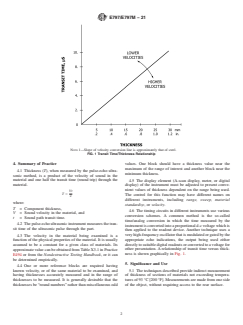
NOTE 1—Slope of velocity conversion line is approximately that of steel.
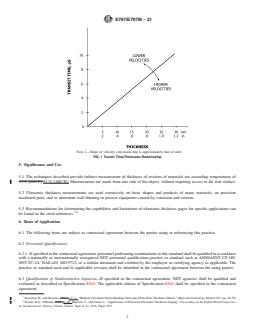
FIG. 1 Transit Time/Thickness Relationship
4. Summary of Practice values. One block should have a thickness value near the
maximum of the range of interest and another block near the
4.1 Thickness (T), when measured by the pulse-echo ultra-
minimum thickness.
sonic method, is a product of the velocity of sound in the
material and one half the transit time (round trip) through the 4.5 The display element (A-scan display, meter, or digital
material.
display) of the instrument must be adjusted to present conve-
nient values of thickness dependent on the range being used.
Vt
T 5
The control for this function may have different names on
different instruments, including range, sweep, material
where:
standardize,or velocity.
T = Component thickness,
4.6 The timing circuits in different instruments use various
V = Sound velocity in the material, and
conversion schemes. A common method is the so-called
t = Sound path transit time.
time/analog conversion in which the time measured by the
4.2 The pulse-echo ultrasonic instrument measures the tran-
instrumentisconvertedintoaproportionald-cvoltagewhichis
sit time of the ultrasonic pulse through the part.
then applied to the readout device. Another technique uses a
veryhigh-frequencyoscillatorthatismodulatedorgatedbythe
4.3 The velocity in the material being examined is a
appropriate echo indications, the output being used either
function of the physical properties of the material. It is usually
directlytosuitabledigitalreadoutsorconvertedtoavoltagefor
assumed to be a constant for a given class of materials. Its
other presentation. A relationship of transit time versus thick-
approximate value can be obtained fromTable X3.1 in Practice
ness is shown graphically in Fig. 1.
E494 or from the Nondestructive Testing Handbook,oritcan
be determined empirically.
5. Significance and Use
4.4 One or more reference blocks are required having
known velocity, or of the same material to be examined, and 5.1 The techniques described provide indirect measurement
having thicknesses accurately measured and in the range of of thickness of sections of materials not exceeding tempera-
thicknesses to be measured. It is generally desirable that the tures of 93 °C [200 °F]. Measurements are made from one side
thicknesses be “round numbers” rather than miscellaneous odd of the object, without requiring access to the rear surface.
E797/E797M − 21
5.2 Ultrasonic thickness measurements are used extensively measured and presented on a digital readout. The A-scan
on basic shapes and products of many materials, on precision display provides a check on the validity of the electronic
machined parts, and to determine wall thinning in process measurement by revealing measurement variables, such as
equipment caused by corrosion and erosion. internal discontinuities, or echo-strength variations, which
might result in inaccurate readings.
5.3 Recommendations for determining the capabilities and
7.1.3 Thickness readout instruments are modified versions
limitations of ultrasonic thickness gages for specific applica-
7,8
of the pulse-echo instrument. The elapsed time between the
tions can be found in the cited references.
initial pulse and the first echo or between multiple echoes is
6. Basis of Application converted into a meter or digital readout. The instruments are
designed for measurement and direct numerical readout of
6.1 The following items are subject to contractual agree-
specific ranges of thickness and materials.
ment between the parties using or referencing this practice.
7.1.4 Time-base linearity is required so that a change in the
6.2 Personnel Qualification:
thickness of material will produce a corresponding change of
6.2.1 If specified in the contractual agreement, personnel
indicated thickness. If an A-Scan display is used as a readout,
performing examinations to this standard shall be qualified in
its horizontal linearity can be checked by using Practice E317.
accordance with a nationally or internationally recognized
7.2 Search Units—Most pulse-echo type search units
NDT personnel qualification practice or standard such as
(straight-beam contact, delay line, and dual element) are
ANSI/ASNT CP-189, SNT-TC-1A, NAS-410, ISO 9712, or a
applicable if flaw detector instruments are used. If a thickness
similar document and certified by the employer or certifying
readout instrument has the capability to read thin sections, a
agency, as applicable. The practice or standard used and its
highly damped, high-frequency search unit is generally used.
applicable revision shall be identified in the contractual agree-
High-frequency (10 MHz or higher) delay line search units are
ment between the using parties.
generally required for thicknesses less than about 0.6 mm
6.3 Qualification of Nondestructive Agencies—If specified
[0.025 in.]. Measurements of materials at high temperatures
in the contractual agreement, NDT agencies shall be qualified
require search units specially designed for the application.
and evaluated as described in Specification E543. The appli-
When dual element search units are used, their inherent
cable edition of Specification E543 shall be specified in the
nonlinearity usually requires special corrections for thin sec-
contractual agreement.
tions. (See Fig. 2 and Fig. X2.1.) For optimum performance, it
6.4 Procedures and Techniques—The procedures and tech-
is often necessary that the instrument and search units be
niques to be utilized shall be as specified in the contractual
matched.
agreement.
7.3 Standardization Blocks—The general requirements for
6.5 Surface Preparation—The pre-examination surface
appropriate standardization blocks are given in 4.4, 8.1.3,
preparation criteria shall be specified in the contractual agree-
8.2.2.1, 8.3.2, and 8.4.3. Multi-step blocks that may be useful
ment.
for these standardization procedures are described in Appendix
X1 (Figs. X1.1 and X1.2).
7. Apparatus
7.1 Instruments—Thickness-measurement instruments are
8. Standardization of Apparatus
divided into three groups: (1) flaw detectors with an A-scan
8.1 Case I—Direct Contact, Single-Element Search Unit:
display readout, (2) flaw detectors with an A-scan display and
8.1.1 Conditions—The display start is synchronized to the
direct thickness readout, and (3) direct thickness readout.
initial pulse. All display elements are linear. Full thickness is
7.1.1 Flaw detectors with A-scan display readouts display
displayed on the A-scan display.
time/amplitude information. Thickness determinations are
8.1.2 Under these conditions, we can assume that the
madebyreadingthedistancebetweenthezero-corrected(pulse
velocity conversion line effectively pivots about the origin
triggered or delay controlled) initial pulse and first-returned
(Fig. 1). It may be necessary to subtract the wear-plate time,
echo (back wall reflection), or between multiple-back wall
requiring minor use of delay control. It is recommended that
reflections, on a standardized base line of the A-scan display.
standardization blocks providing a minimum of two thick-
The base line of the A-scan display should be adjusted for the
nesses that span the thickness range be used to check the
desired thickness increments.
full-range accuracy.
7.1.2 Flaw detectors with numeric readout are a combina-
tion pulse ultrasound flaw detection instrument with anA-scan
8.1.3 Place the search unit on a standardization block of
display and additional circuitry that provides digital thickness
known thickness with suitable couplant and adjust the instru-
information. The material thickness can be electronically
ment controls (material standardization, range, sweep, or
velocity) until the display presents the appropriate thickness
reading.
Bosselaar, H., and Goosens, J. C. J., “Method to Evaluate Direct-Reading
8.1.4 The readings should then be checked and adjusted on
Ultrasonic Pulse-Echo Thickness Meters,” Materials Evaluation, March 1971, pp.
standardization blocks with thickness of lesser value to verify
45–50.
Fowler, K.A., Elfbaum, G. M., Husarek, V., and Castel, J., “Applications of
the overall accuracy of the system.
Precision Ultrasonic Thickness Gaging,” Proceedings of the Eighth World Confer-
ence on Nondestructive Testing, Cannes, France, Sept. 6–11, 1976, Paper 3F.5. 8.2 Case II—Delay Line Single-Element Search Unit:
E797/E797M − 21
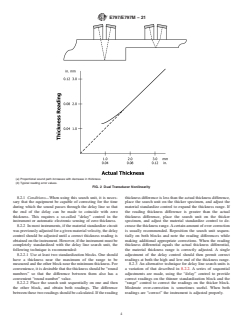
(a) Proportional sound path increases with decrease in thickness.
(b) Typical reading error values.
FIG. 2 Dual Transducer Nonlinearity
8.2.1 Conditions—When using this search unit, it is neces- thickness difference is less than the actual thickness difference,
sary that the equipment be capable of correcting for the time place the search unit on the thicker specimen, and adjust the
during which the sound passes through the delay line so that material standardize control to expand the thickness range. If
the end of the delay can be made to coincide with zero the reading thickness difference is greater than the actual
thickness. This requires a so-called “delay” control in the thickness difference, place the search unit on the thicker
instrument or automatic electronic sensing of zero thickness. specimen, and adjust the material standardize control to de-
8.2.2 In most instruments, if the material standardize circuit crease the thickness range.Acertain amount of over correction
was previously adjusted for a given material velocity, the delay is usually recommended. Reposition the search unit sequen-
control should be adjusted until a correct thickness reading is tially on both blocks and note the reading differences while
obtainedontheinstrument.However,iftheinstrumentmustbe making additional appropriate corrections. When the reading
completely standardized with the delay line search unit, the thickness differential equals the actual thickness differential,
following technique is recommended: the material thickness range is correctly adjusted. A single
8.2.2.1 Use at least two standardization blocks. One should adjustment of the delay control s
...
This document is not an ASTM standard and is intended only to provide the user of an ASTM standard an indication of what changes have been made to the previous version. Because
it may not be technically possible to adequately depict all changes accurately, ASTM recommends that users consult prior editions as appropriate. In all cases only the current version
of the standard as published by ASTM is to be considered the official document.
Designation: E797/E797M − 15 E797/E797M − 21
Standard Practice for
Measuring Thickness by Manual Ultrasonic Pulse-Echo
Contact Method
This standard is issued under the fixed designation E797/E797M; the number immediately following the designation indicates the year
of original adoption or, in the case of revision, the year of last revision. A number in parentheses indicates the year of last reapproval.
A superscript epsilon (´) indicates an editorial change since the last revision or reapproval.
1. Scope*
1.1 This practice provides guidelines for measuring the thickness of materials using the contact pulse-echo method at
temperatures not to exceed 93°C [200°F].93 °C [200 °F].
1.2 This practice is applicable to any material in which ultrasonic waves will propagate at a constant velocity throughout the part,
and from which back wall reflections can be obtained and resolved.
1.3 This practice is primarily for flat components with parallel surfaces and has limited applicability for components with
non-parallel or concentric surfaces per 1.2.
1.4 Units—The values stated in either SI units or inch-pound units are to be regarded separately as standard. The values stated in
each system mayare not benecessarily exact equivalents; therefore, to ensure conformance with the standard, each system shall be
used independently of the other. Combiningother, and values from the two systems may result in non-conformance with the
standard.shall not be combined.
1.5 This standard does not purport to address all of the safety concerns, if any, associated with its use. It is the responsibility
of the user of this standard to establish appropriate safety safety, health, and healthenvironmental practices and determine the
applicability of regulatory limitations prior to use.
1.6 This international standard was developed in accordance with internationally recognized principles on standardization
established in the Decision on Principles for the Development of International Standards, Guides and Recommendations issued
by the World Trade Organization Technical Barriers to Trade (TBT) Committee.
2. Referenced Documents
2.1 ASTM Standards:
E317 Practice for Evaluating Performance Characteristics of Ultrasonic Pulse-Echo Testing Instruments and Systems without the
Use of Electronic Measurement Instruments
E494 Practice for Measuring Ultrasonic Velocity in Materials by Comparative Pulse-Echo Method
E543 Specification for Agencies Performing Nondestructive Testing
E1316 Terminology for Nondestructive Examinations
This practice is under the jurisdiction of ASTM Committee E07 on Nondestructive Testing and is the direct responsibility of Subcommittee E07.06 on Ultrasonic Method.
Current edition approved Dec. 1, 2015June 1, 2021. Published December 2015September 2021. Originally approved in 1981. Last previous edition approved in 20102015
as E797 - 10.E797/E797M – 15. DOI: 10.1520/E0797_E0797M-15.10.1520/E0797_E0797M-21.
For ASME Boiler and Pressure Vessel Code applications, see related Practice SE-797 in Section II of that Code.
For referenced ASTM standards, visit the ASTM website, www.astm.org, or contact ASTM Customer Service at service@astm.org. For Annual Book of ASTM Standards
volume information, refer to the standard’s Document Summary page on the ASTM website.
*A Summary of Changes section appears at the end of this standard
Copyright © ASTM International, 100 Barr Harbor Drive, PO Box C700, West Conshohocken, PA 19428-2959. United States
E797/E797M − 21
2.2 ASNT Documents:
Nondestructive Testing Handbook, 2nd Edition, Vol 7
SNT-TC-1A Recommended Practice for Personnel Qualification and Certification in Nondestructive Testing
ANSI/ASNT CP-189 Standard for Qualification and Certification of Nondestructive Testing Personnel
2.3 Aerospace Industries Association AIA Document:
NAS-410 Certification and Qualification of Nondestructive Testing Personnel
2.4 ISO Standard:
ISO 9712 Non-Destructive Testing—Qualification and Certification of NDT Personnel
3. Terminology
3.1 Definitions: Definitions—For definitions of terms used in this practice, refer to Terminology E1316.
3.1 Definitions—For definitions of terms used in this practice, refer to Terminology E1316.
4. Summary of Practice
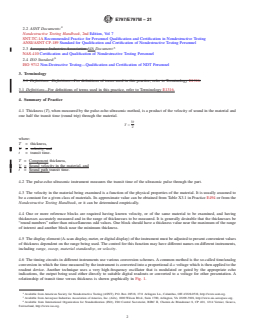
4.1 Thickness (T), when measured by the pulse-echo ultrasonic method, is a product of the velocity of sound in the material and
one half the transit time (round trip) through the material.
Vt
T 5
where:
T = thickness,
V = velocity, and
t = transit time.
T = Component thickness,
V = Sound velocity in the material, and
t = Sound path transit time.
4.2 The pulse-echo ultrasonic instrument measures the transit time of the ultrasonic pulse through the part.
4.3 The velocity in the material being examined is a function of the physical properties of the material. It is usually assumed to
be a constant for a given class of materials. Its approximate value can be obtained from Table X3.1 in Practice E494 or from the
Nondestructive Testing Handbook, or it can be determined empirically.
4.4 One or more reference blocks are required having known velocity, or of the same material to be examined, and having
thicknesses accurately measured and in the range of thicknesses to be measured. It is generally desirable that the thicknesses be
“round numbers” rather than miscellaneous odd values. One block should have a thickness value near the maximum of the range
of interest and another block near the minimum thickness.
4.5 The display element (A-scan display, meter, or digital display) of the instrument must be adjusted to present convenient values
of thickness dependent on the range being used. The control for this function may have different names on different instruments,
including range, sweep, material standardize, or velocity.
4.6 The timing circuits in different instruments use various conversion schemes. A common method is the so-called time/analog
conversion in which the time measured by the instrument is converted into a proportional d-c voltage which is then applied to the
readout device. Another technique uses a very high-frequency oscillator that is modulated or gated by the appropriate echo
indications, the output being used either directly to suitable digital readouts or converted to a voltage for other presentation. A
relationship of transit time versus thickness is shown graphically in Fig. 1.
Available from American Society for Nondestructive Testing (ASNT), P.O. Box 28518, 1711 Arlingate Ln., Columbus, OH 43228-0518, http://www.asnt.org.
Available from Aerospace Industries Association of America, Inc. (AIA), 1000 Wilson Blvd., Suite 1700, Arlington, VA 22209-3928, http://www.aia-aerospace.org.
Available from International Organization for Standardization (ISO), ISO Central Secretariat, BIBC II, Chemin de Blandonnet 8, CP 401, 1214 Vernier, Geneva,
Switzerland, http://www.iso.org.
E797/E797M − 21
NOTE 1—Slope of velocity conversion line is approximately that of steel.
FIG. 1 Transit Time/Thickness Relationship
5. Significance and Use
5.1 The techniques described provide indirect measurement of thickness of sections of materials not exceeding temperatures of
93°C [200°F].93 °C [200 °F]. Measurements are made from one side of the object, without requiring access to the rear surface.
5.2 Ultrasonic thickness measurements are used extensively on basic shapes and products of many materials, on precision
machined parts, and to determine wall thinning in process equipment caused by corrosion and erosion.
5.3 Recommendations for determining the capabilities and limitations of ultrasonic thickness gages for specific applications can
7,8
be found in the cited references.
6. Basis of Application
6.1 The following items are subject to contractual agreement between the parties using or referencing this practice.
6.2 Personnel Qualification:
6.2.1 If specified in the contractual agreement, personnel performing examinations to this standard shall be qualified in accordance
with a nationally or internationally recognized NDT personnel qualification practice or standard such as ANSI/ASNT CP-189,
SNT-TC-1A, NAS-410, ISO 9712, or a similar document and certified by the employer or certifying agency, as applicable. The
practice or standard used and its applicable revision shall be identified in the contractual agreement between the using parties.
6.3 Qualification of Nondestructive Agencies—If specified in the contractual agreement, NDT agencies shall be qualified and
evaluated as described in Specification E543. The applicable edition of Specification E543 shall be specified in the contractual
agreement.
Bosselaar, H., and Goosens, J.C.J., J. C. J., “Method to Evaluate Direct-Reading Ultrasonic Pulse-Echo Thickness Meters,” Materials Evaluation, March 1971, pp. 45–50.
Fowler, K.A., Elfbaum, G.M., G. M., Husarek, V., and Castel, J., “Applications of Precision Ultrasonic Thickness Gaging,” Proceedings of the Eighth World Conference
on Nondestructive Testing, Cannes, France, Sept. 6–11, 1976, Paper 3F.5.
E797/E797M − 21
6.4 Procedures and Techniques—The procedures and techniques to be utilized shall be as specified in the contractual agreement.
6.5 Surface Preparation—The pre-examination surface preparation criteria shall be specified in the contractual agreement.
7. Apparatus
7.1 Instruments—Thickness-measurement instruments are divided into three groups: (1) Flawflaw detectors with an A-scan
display readout, (2) Flawflaw detectors with an A-scan display and direct thickness readout, and (3) Directdirect thickness readout.
7.1.1 Flaw detectors with A-scan display readouts display time/amplitude information. Thickness determinations are made by
reading the distance between the zero-corrected (pulse triggered or delay controlled) initial pulse and first-returned echo (back wall
reflection), or between multiple-back reflection echoes,wall reflections, on a standardized base line of the A-scan display. The base
line of the A-scan display should be adjusted for the desired thickness increments.
7.1.2 Flaw detectors with numeric readout are a combination pulse ultrasound flaw detection instrument with an A-scan display
and additional circuitry that provides digital thickness information. The material thickness can be electronically measured and
presented on a digital readout. The A-scan display provides a check on the validity of the electronic measurement by revealing
measurement variables, such as internal discontinuities, or echo-strength variations, which might result in inaccurate readings.
7.1.3 Thickness readout instruments are modified versions of the pulse-echo instrument. The elapsed time between the initial pulse
and the first echo or between multiple echoes is converted into a meter or digital readout. The instruments are designed for
measurement and direct numerical readout of specific ranges of thickness and materials.
7.1.4 Time-base linearity is required so that a change in the thickness of material will produce a corresponding change of indicated
thickness. If an A-Scan display is used as a readout, its horizontal linearity can be checked by using Practice E317.
7.2 Search Units—Most pulse-echo type search units (straight-beam contact, delay line, and dual element) are applicable if flaw
detector instruments are used. If a thickness readout instrument has the capability to read thin sections, a highly damped,
high-frequency search unit is generally used. High-frequency (10 MHz or higher) delay line search units are generally required
for thicknesses less than about 0.6 mm [0.025 in.]. Measurements of materials at high temperatures require search units specially
designed for the application. When dual element search units are used, their inherent nonlinearity usually requires special
corrections for thin sections. (See Fig. 2 and Fig. X2.1.) For optimum performance, it is often necessary that the instrument and
search units be matched.
7.3 Standardization Blocks—The general requirements for appropriate standardization blocks are given in 4.4, 8.1.3, 8.2.2.1, 8.3.2,
and 8.4.3. Multi-step blocks that may be useful for these standardization procedures are described in Appendix X1 (Figs. X1.1 and
X1.2).
8. Standardization of Apparatus
8.1 Case I—Direct Contact, Single-Element Search Unit:
8.1.1 Conditions—The display start is synchronized to the initial pulse. All display elements are linear. Full thickness is displayed
on the A-scan display.
8.1.2 Under these conditions, we can assume that the velocity conversion line effectively pivots about the origin (Fig. 1). It may
be necessary to subtract the wear-plate time, requiring minor use of delay control. It is recommended that standardization blocks
providing a minimum of two thicknesses that span the thickness range be used to check the full-range accuracy.
8.1.3 Place the search unit on a standardization block of known thickness with suitable couplant and adjust the instrument controls
(material standardization, range, sweep, or velocity) until the display presents the appropriate thickness reading.
8.1.4 The readings should then be checked and adjusted on standardization blocks with thickness of lesser value to improveverify
the overall accuracy of the system.
8.2 Case II—Delay Line Single-Element Search Unit:
E797/E797M − 21
(a) Proportional sound path increases with decrease in thickness.
(b) Typical reading error values.
FIG. 2 Dual Transducer Nonlinearity
8.2.1 Conditions—When using this search unit, it is necessary that the equipment be capable of correcting for the time during
which the sound passes through the delay line so that the end of the delay can be made to coincide with zero thickness. This
requires a so-called “delay” control in the instrument or automatic electronic sensing of zero thickness.
8.2.2 In most instruments, if the material standardize circuit was previously adjusted for a given material velocity, the delay
control should be adjusted until a correct thickness reading is obtained on the instrument. However, if the instrument must be
completely standardized with the delay line search unit, the following technique is recommended:
8.2.2.1 Use at least two standardization blocks. One should have a thickness near the maximum of the range to be measured and
the other block near the minimum thickness. For convenience, it is desirable that the thickness should be “round numbers” so that
the difference between them also has a convenient “round number” value.
8.2.2.2 Place the search unit sequentially on one and then the other block, and obtain both readings. The difference between these
two readings should be calculated. If the reading thickness difference is less than the actual thickness difference, place the search
unit on the thicker specimen, and adjust the material standardize control to expand the thickness range. If the reading thickness
difference is greater than the actual thickness difference, place the search unit on the thicker specimen, and adjust the material
standardize control to decrease the thickness range. A certain amount of over correction is usually recommended. Reposition the
search unit sequentially on both blocks,blocks and note the reading differences while making additional appropriate corrections.
When the reading thickness differential equals the actual thickness differential, the material
...