

ASTM F2147-01(2016)
(Practice)Standard Practice for Guinea Pig: Split Adjuvant and Closed Patch Testing for Contact Allergens
General Information
- Abstract
ABSTRACT
This practice is intended to determine the potential for a substance, or material extract, to elicit contact dermal allergenicity. It is intended as an alternative to the Guinea Pig Maximization Test (GPMT), given the limitations on dosage form and tendency for false positives associated with the latter test. The split adjuvant method is used when topical application is considered relevant, and the dosage form is a solid, liquid, extract, paste, or gel. The method includes four induction doses applied over a period of time to the same shaved or depilated site on guinea pigs, followed by occlusive patching. Freund's Complete Adjuvant (FCA) is injected near the dose site on a specific time, (second induction dose). Following a rest period, animals are challenged at a previously unexposed site, and the reaction evaluated at regular intervals. The closed patch method is used when topical application is relevant, but the preferred dosage form does not permit injection under the skin or intradermally, and the discomfort involved with extended occlusive patching and adjuvant use is to be avoided. It involves repeated induction doses over a period of time at the same shaved/depilated site, followed each time by occlusive wrapping. After a rest period, animals are challenged at previously untreated sites, and their reactions evaluated after a period of time.
SIGNIFICANCE AND USE
5.1 In selecting a material for human contact in medical applications, it is important to ensure that the material will not stimulate the immune system to produce an allergic reaction under relevant exposure conditions. Extractable chemicals produced by skin contact or during physiological exposures may cause allergic reactions. Therefore, this practice provides for evaluations of solid or semisolid dosage forms using material extracts or direct evaluation of the test article. The rationale for this animal model is based on the fact that the guinea pig has been shown to be an appropriate animal model for predicting human contact dermatitis. Its tractable nature, its availability from reputable suppliers, the historical database of information already acquired using this species, and the correlation of such results to data on known human allergens, all contribute to its widespread use for allergenicity studies (1-5).4
5.2 The need for sensitization procedures other than the maximization test (Practice F720) is based on: (1) the need for a route of exposure more similar to use conditions; (2) concern over the use of adjuvant because of its recruitment of cell types to the test site which are not typically involved in immunologic reactions, and because of the discomfort this causes in the animals; (3) absence of a proper FCA-irritant control group in the traditional maximization design; and (4) the frequency of false positives often encountered with the GPMT. Both of these tests are internationally accepted (1).
SCOPE
1.1 This practice is intended to determine the potential for a substance, or material extract, to elicit contact dermal allergenicity.
1.2 This practice is intended as an alternative to the Guinea Pig Maximization Test (GPMT), given the limitations on dosage form and tendency for false positives associated with the latter test. See Rationale and References.
1.3 The values stated in SI units are to be regarded as standard. No other units of measurement are included in this standard.
1.4 This standard does not purport to address all of the safety concerns, if any, associated with its use. It is the responsibility of the user of this standard to establish appropriate safety and health practices and determine the applicability of regulatory limitations prior to use.
- Status
- Published
- Publication Date
- 31-Mar-2016
- Technical Committee
- F04 - Medical and Surgical Materials and Devices
- Drafting Committee
- F04.16 - Biocompatibility Test Methods
Overview
ASTM F2147-01(2016) - Standard Practice for Guinea Pig: Split Adjuvant and Closed Patch Testing for Contact Allergens provides an internationally recognized procedure to evaluate the potential of a material or its extract to cause contact dermal allergenicity. Developed by ASTM International, this standard is designed as an alternative to the Guinea Pig Maximization Test (GPMT) and aims to more accurately reflect conditions relevant to human contact, particularly in medical and biocompatibility testing. The document outlines both the split adjuvant and closed patch test methods, which are widely accepted and utilized for the sensitization assessment of materials expected to come into contact with skin.
Key Topics
- Purpose: To determine the sensitization potential of substances or material extracts that may come into contact with human skin, particularly in medical device applications.
- Alternative to GPMT: Offers improved relevance in dosage forms and reduces the rate of false positives associated with GPMT.
- Test Methods:
- Split Adjuvant Method: Suitable for solids, liquids, pastes, gels, and extracts; involves topical induction doses and the injection of Freund’s Complete Adjuvant around the site with subsequent patching and challenge testing.
- Closed Patch Method: Designed for cases where injection is not feasible; incorporates repeated, occlusive topical applications followed by challenge and evaluation at new, untreated sites, minimizing animal discomfort.
- Animal Models: Utilizes guinea pigs due to their predictive value for human contact dermatitis, historical data, and availability.
- Evaluation Criteria: Standardized scoring for skin reactions, including erythema and edema, to enable reproducible assessment of allergic responses.
Applications
ASTM F2147-01(2016) is highly relevant for:
- Medical Device Testing: Ensuring biocompatibility and allergenic safety for new materials in contact with skin, such as implantable and external medical devices.
- Pharmaceuticals: Assessment of topical formulations, creams, gels, or ointments for sensitization risk before human use.
- Cosmetic and Personal Care Products: Screening of ingredients or finished products for allergenic potential during product safety evaluations.
- Regulatory Submissions: Supporting data for FDA or international regulatory filings that require demonstration of low allergenicity in medical and consumer products that come in contact with skin.
- Material Selection: Guiding manufacturers in material selection and risk assessment in product design and development to avoid materials likely to induce allergic reactions.
Related Standards
Utilization and interpretation of ASTM F2147-01(2016) are often complemented by the following standards:
- ASTM F619: Practice for Extraction of Medical Plastics, which outlines extraction methods for preparing samples.
- ASTM F720: Practice for Testing Guinea Pigs for Contact Allergens: Guinea Pig Maximization Test, widely known as the GPMT, now frequently supplemented by F2147 for improved relevance.
- ISO 10993-10: International standard for tests for irritation and skin sensitization, referenced for biocompatibility requirements in medical devices.
Practical Value
Implementing ASTM F2147-01(2016) ensures a scientifically robust and internationally accepted protocol for assessing contact allergenicity. By providing alternative methods to traditional approaches, this standard helps laboratories and manufacturers reduce the frequency of false positives, better mimic real-world use conditions, and enhance animal welfare. Consistent use supports product safety, regulatory compliance, and the development of safe, biocompatible materials for use in medical and consumer goods.
Keywords: ASTM F2147, guinea pig allergenicity testing, split adjuvant, closed patch, biocompatibility, sensitization, contact dermatitis, medical device safety, material testing, regulatory compliance.
Relations
- Effective Date
- 01-Apr-2016
- Effective Date
- 01-Sep-2017
- Effective Date
- 01-Jun-2013
- Effective Date
- 01-Oct-2012
- Effective Date
- 01-Aug-2008
- Effective Date
- 01-Feb-2007
- Effective Date
- 01-Feb-2007
- Effective Date
- 01-Nov-2003
- Effective Date
- 10-Apr-2002
- Effective Date
- 10-Dec-1997
- Effective Date
- 24-Apr-1981
- Effective Date
- 01-Apr-2016
Get Certified
Connect with accredited certification bodies for this standard

BSI Group
BSI (British Standards Institution) is the business standards company that helps organizations make excellence a habit.

TÜV Rheinland
TÜV Rheinland is a leading international provider of technical services.

TÜV SÜD
TÜV SÜD is a trusted partner of choice for safety, security and sustainability solutions.
Sponsored listings
Frequently Asked Questions
ASTM F2147-01(2016) is a standard published by ASTM International. Its full title is "Standard Practice for Guinea Pig: Split Adjuvant and Closed Patch Testing for Contact Allergens". This standard covers: ABSTRACT This practice is intended to determine the potential for a substance, or material extract, to elicit contact dermal allergenicity. It is intended as an alternative to the Guinea Pig Maximization Test (GPMT), given the limitations on dosage form and tendency for false positives associated with the latter test. The split adjuvant method is used when topical application is considered relevant, and the dosage form is a solid, liquid, extract, paste, or gel. The method includes four induction doses applied over a period of time to the same shaved or depilated site on guinea pigs, followed by occlusive patching. Freund's Complete Adjuvant (FCA) is injected near the dose site on a specific time, (second induction dose). Following a rest period, animals are challenged at a previously unexposed site, and the reaction evaluated at regular intervals. The closed patch method is used when topical application is relevant, but the preferred dosage form does not permit injection under the skin or intradermally, and the discomfort involved with extended occlusive patching and adjuvant use is to be avoided. It involves repeated induction doses over a period of time at the same shaved/depilated site, followed each time by occlusive wrapping. After a rest period, animals are challenged at previously untreated sites, and their reactions evaluated after a period of time. SIGNIFICANCE AND USE 5.1 In selecting a material for human contact in medical applications, it is important to ensure that the material will not stimulate the immune system to produce an allergic reaction under relevant exposure conditions. Extractable chemicals produced by skin contact or during physiological exposures may cause allergic reactions. Therefore, this practice provides for evaluations of solid or semisolid dosage forms using material extracts or direct evaluation of the test article. The rationale for this animal model is based on the fact that the guinea pig has been shown to be an appropriate animal model for predicting human contact dermatitis. Its tractable nature, its availability from reputable suppliers, the historical database of information already acquired using this species, and the correlation of such results to data on known human allergens, all contribute to its widespread use for allergenicity studies (1-5).4 5.2 The need for sensitization procedures other than the maximization test (Practice F720) is based on: (1) the need for a route of exposure more similar to use conditions; (2) concern over the use of adjuvant because of its recruitment of cell types to the test site which are not typically involved in immunologic reactions, and because of the discomfort this causes in the animals; (3) absence of a proper FCA-irritant control group in the traditional maximization design; and (4) the frequency of false positives often encountered with the GPMT. Both of these tests are internationally accepted (1). SCOPE 1.1 This practice is intended to determine the potential for a substance, or material extract, to elicit contact dermal allergenicity. 1.2 This practice is intended as an alternative to the Guinea Pig Maximization Test (GPMT), given the limitations on dosage form and tendency for false positives associated with the latter test. See Rationale and References. 1.3 The values stated in SI units are to be regarded as standard. No other units of measurement are included in this standard. 1.4 This standard does not purport to address all of the safety concerns, if any, associated with its use. It is the responsibility of the user of this standard to establish appropriate safety and health practices and determine the applicability of regulatory limitations prior to use.
ABSTRACT This practice is intended to determine the potential for a substance, or material extract, to elicit contact dermal allergenicity. It is intended as an alternative to the Guinea Pig Maximization Test (GPMT), given the limitations on dosage form and tendency for false positives associated with the latter test. The split adjuvant method is used when topical application is considered relevant, and the dosage form is a solid, liquid, extract, paste, or gel. The method includes four induction doses applied over a period of time to the same shaved or depilated site on guinea pigs, followed by occlusive patching. Freund's Complete Adjuvant (FCA) is injected near the dose site on a specific time, (second induction dose). Following a rest period, animals are challenged at a previously unexposed site, and the reaction evaluated at regular intervals. The closed patch method is used when topical application is relevant, but the preferred dosage form does not permit injection under the skin or intradermally, and the discomfort involved with extended occlusive patching and adjuvant use is to be avoided. It involves repeated induction doses over a period of time at the same shaved/depilated site, followed each time by occlusive wrapping. After a rest period, animals are challenged at previously untreated sites, and their reactions evaluated after a period of time. SIGNIFICANCE AND USE 5.1 In selecting a material for human contact in medical applications, it is important to ensure that the material will not stimulate the immune system to produce an allergic reaction under relevant exposure conditions. Extractable chemicals produced by skin contact or during physiological exposures may cause allergic reactions. Therefore, this practice provides for evaluations of solid or semisolid dosage forms using material extracts or direct evaluation of the test article. The rationale for this animal model is based on the fact that the guinea pig has been shown to be an appropriate animal model for predicting human contact dermatitis. Its tractable nature, its availability from reputable suppliers, the historical database of information already acquired using this species, and the correlation of such results to data on known human allergens, all contribute to its widespread use for allergenicity studies (1-5).4 5.2 The need for sensitization procedures other than the maximization test (Practice F720) is based on: (1) the need for a route of exposure more similar to use conditions; (2) concern over the use of adjuvant because of its recruitment of cell types to the test site which are not typically involved in immunologic reactions, and because of the discomfort this causes in the animals; (3) absence of a proper FCA-irritant control group in the traditional maximization design; and (4) the frequency of false positives often encountered with the GPMT. Both of these tests are internationally accepted (1). SCOPE 1.1 This practice is intended to determine the potential for a substance, or material extract, to elicit contact dermal allergenicity. 1.2 This practice is intended as an alternative to the Guinea Pig Maximization Test (GPMT), given the limitations on dosage form and tendency for false positives associated with the latter test. See Rationale and References. 1.3 The values stated in SI units are to be regarded as standard. No other units of measurement are included in this standard. 1.4 This standard does not purport to address all of the safety concerns, if any, associated with its use. It is the responsibility of the user of this standard to establish appropriate safety and health practices and determine the applicability of regulatory limitations prior to use.
ASTM F2147-01(2016) is classified under the following ICS (International Classification for Standards) categories: 11.100 - Laboratory medicine. The ICS classification helps identify the subject area and facilitates finding related standards.
ASTM F2147-01(2016) has the following relationships with other standards: It is inter standard links to ASTM F2147-01(2010), ASTM F720-17, ASTM F720-13, ASTM F720-81(2012), ASTM F619-03(2008), ASTM F720-81(2007)e1, ASTM F720-81(2007), ASTM F619-03, ASTM F619-02, ASTM F619-79(1997)e1, ASTM F720-81(2002)e1, ASTM F748-16. Understanding these relationships helps ensure you are using the most current and applicable version of the standard.
ASTM F2147-01(2016) is available in PDF format for immediate download after purchase. The document can be added to your cart and obtained through the secure checkout process. Digital delivery ensures instant access to the complete standard document.
Standards Content (Sample)
This international standard was developed in accordance with internationally recognized principles on standardization established in the Decision on Principles for the
Development of International Standards, Guides and Recommendations issued by the World Trade Organization Technical Barriers to Trade (TBT) Committee.
Designation: F2147 − 01 (Reapproved 2016)
Standard Practice for
Guinea Pig: Split Adjuvant and Closed Patch Testing for
Contact Allergens
This standard is issued under the fixed designation F2147; the number immediately following the designation indicates the year of
original adoption or, in the case of revision, the year of last revision. A number in parentheses indicates the year of last reapproval. A
superscript epsilon (´) indicates an editorial change since the last revision or reapproval.
1. Scope 3.1.2 Freund’s CompleteAdjuvant(FCA)—acommercially-
available mixture of oil and Mycobacterium that is known to
1.1 This practice is intended to determine the potential for a
elicit an immune response.
substance, or material extract, to elicit contact dermal allerge-
nicity.
3.1.3 Guinea Pig Maximization Test (GPMT)—procedure
describedinPracticeF720acceptedasa“worstcase”assayfor
1.2 This practice is intended as an alternative to the Guinea
allergenic potential.
Pig Maximization Test (GPMT), given the limitations on
dosage form and tendency for false positives associated with
the latter test. See Rationale and References. 4. Summary of Practice
1.3 The values stated in SI units are to be regarded as
4.1 The split adjuvant method is used when topical appli-
standard. No other units of measurement are included in this
cation is considered relevant, and the dosage form is a solid,
standard.
liquid, extract, paste, or gel. The method includes four induc-
1.4 This standard does not purport to address all of the tion doses applied over ten days to the same shaved or
depilated site on guinea pigs, followed by occlusive patching.
safety concerns, if any, associated with its use. It is the
responsibility of the user of this standard to establish appro- Freund’s Complete Adjuvant (FCA) is injected near the dose
priate safety and health practices and determine the applica- siteonthefourthday(secondinductiondose).Followingarest
bility of regulatory limitations prior to use.
period, animals are challenged at a previously unexposed site,
and the reaction evaluated at 24, 48, and 72 h.
2. Referenced Documents
4.2 The closed patch method is used when topical applica-
2.1 ASTM Standards:
tion is relevant, but the preferred dosage form does not permit
F619 Practice for Extraction of Medical Plastics
injection under the skin or intradermally, and the discomfort
F720 PracticeforTestingGuineaPigsforContactAllergens:
involved with extended occlusive patching and adjuvant use is
Guinea Pig Maximization Test
tobeavoided.Itinvolvesrepeatedinductiondoses(3to6)over
2.2 ISO Document:
14 days at the same shaved/depilated site, followed each time
ISO 10993-10, 1995 Tests for Irritation and Sensitization
by6hof occlusive wrapping. After a rest period, animals are
challenged at previously untreated sites, and their reactions
3. Terminology
evaluated at least 24 and 48 h later.
3.1 Definitions:
3.1.1 2,4 dinitrochlorobenzene (DNCB)—strong sensitizer, 5. Significance and Use
used as a positive control.
5.1 In selecting a material for human contact in medical
applications, it is important to ensure that the material will not
stimulate the immune system to produce an allergic reaction
ThispracticeisunderthejurisdictionofASTMCommitteeF04onMedicaland
under relevant exposure conditions. Extractable chemicals
Surgical Materials and Devices and is the direct responsibility of Subcommittee
produced by skin contact or during physiological exposures
F04.16 on Biocompatibility Test Methods.
Current edition approved April 1, 2016. Published June 2016. Originally
may cause allergic reactions. Therefore, this practice provides
approved in 2001. Last previous edition approved in 2010 as F2147 – 01 (2010).
for evaluations of solid or semisolid dosage forms using
DOI: 10.1520/F2147-01R16.
2 material extracts or direct evaluation of the test article. The
For referenced ASTM standards, visit the ASTM website, www.astm.org, or
contact ASTM Customer Service at service@astm.org. For Annual Book of ASTM
rationale for this animal model is based on the fact that the
Standards volume information, refer to the standard’s Document Summary page on
guinea pig has been shown to be an appropriate animal model
the ASTM website.
3 for predicting human contact dermatitis. Its tractable nature, its
Available fromAmerican National Standards Institute (ANSI), 25 W. 43rd St.,
4th Floor, New York, NY 10036, http://www.ansi.org. availability from reputable suppliers, the historical database of
Copyright © ASTM International, 100 Barr Harbor Drive, PO Box C700, West Conshohocken, PA 19428-2959. United States
F2147 − 01 (2016)
information already acquired using this species, and the corre- 7.4 Negative Controls—Prepare solvent sham controls
lation of such results to data on known human allergens, all (“blanks”) under the same conditions as test article extracts.
contribute to its widespread use for allergenicity studies (1-5). Saline controls may be eliminated if sufficient data to predict
their results are available.
5.2 The need for sensitization procedures other than the
maximization test (Practice F720) is based on: (1) the need for
7.5 Positive Controls—Positive controls should be prepared
a route of exposure more similar to use conditions; (2) concern
fresh before induction in the same solvent used for extraction
over the use of adjuvant because of its recruitment of cell types
if possible. If the solvent is volatile, a fresh solution may be
tothetestsitewhicharenottypicallyinvolvedinimmunologic
needed for challenge. The use of amber bottles with minimum
reactions, and because of the discomfort this causes in the
headspace should also be considered. Alternatively, positive
animals; (3) absence of a proper FCA-irritant control group in
control testing may be performed quarterly or at another
the traditional maximization design; and (4) the frequency of
reasonable frequency if the laboratory performs significant
falsepositivesoftenencounteredwiththeGPMT.Bothofthese
numbers of these tests and results are consistent. The latter
tests are internationally accepted (1).
practice reduces animal usage.
6. Materials and Manufacturers
8. Trial and Naive Challenge Tests
6.1 Hartley strain guinea pigs, either sex (but all in the test
8.1 It is recommended that at least two guinea pigs be used
of the same sex), 300 to 500 g at the start of the test, should be
to assess the ability of the test article or undiluted extract to
from the same shipment and supplier, and should be healthy.
irritate. Each flank of each animal can be used to patch two
6.2 At least ten animals are used for each test material and
sites (upper and lower) of samples such as the test article,
five for each control group.
100 % extract, 75 % extract, and 50 % extract.Animals should
be shaved and wrapped as in the complete test (see Section 9),
6.3 Freund’s Complete Adjuvant (FCA) (split adjuvant test
and the sites evaluated after 24 to 72 h. Scoring should also be
only).
performed as in the complete test.
6.4 Cotton gauze and occlusive bandage (examples, Elasto-
8.2 It is also advisable to determine the difference between
pore from 3M) or Hilltop chambers (Hilltop, Cincinnati, OH)
irritation and sensitization under full test conditions for the
(optional for solid samples) and Vet wrap.
positive control by including in at least one test per laboratory
6.5 Positive control substance (0.1 to 1 % 2,4 DNCB is a
a“naivechallenge”groupwhichisexposedtocontrolsonlyfor
strong sensitizer; to test method sensitivity, it may be advisable
the challenge period. DNCB, for example, can be an irritant,
to use cinnamaldehyde (10 % induction, 1 % challenge) as a
and it is important that erythema and edema reactions seen
positive control. (2)
after challenge be true sensitization responses.
7. Preparation of Test Samples
9. Procedure
NOTE 1—All steps are applicable to both methods.
NOTE 3—This procedure is applicable to both methods except as noted.
7.1 Solid Samples—Cut flat sheet-like samples into 1- by
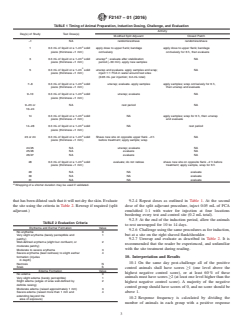
1-cm squares. These can be used for direct contact testing as 9.1 Table 1 shows the timing of animal preparation, induc-
long as the sample thickness does not exceed 1.0 mm. tion dosing, challenge, and evaluation.
NOTE 2—Pressure exerted by bandaging thick samples causes mechani-
9.2 Animal Preparation:
cal irritation. The cotton pad may be removed from the Hilltop chamber
9.2.1 Weigh and shave or depilate animals within 24 h of
(or the chamber need not be used) to reduce pressure on thick solid test
test start. Depilatories should be used carefully and tested
articles. Further cutting should be considered if test articles are still
beforehand to understand proper use regimen so as not to
causing pressure without the chamber or chamber pad.
produce background irritation. Shave or depilate a site on the
7.2 Gels, Pastes, Ointments—Semisolid test articles can be
left flank or shoulder area (use one or the other consistently)
used directly, applied at 0.2 mL/site.
approximately a 2-in. square to expose bare skin, avoiding any
7.3 Extracts—Prepare extracts in accordance with Practice
abrasions or other abnormalities. Check animal health daily
F619, at the highest temperature tolerated by the material
throughout the test.
without physical melting or decomposition. Both aqueous and
9.2.2 Apply 0.3 mL of extract or semisolid (or less, if the
nonaqueous extracts are recommended. Extracts should be 2
amount has been validated, or 1 cm of a solid sample (less
decanted upon cooling, stored at room temperature (22 to
than 1.0 mm thick) to the cotton pad of a Hilltop chamber. (A
30°C), and used within 24 h. Extracts should be prepared fresh
padless chamber can be used to dose gels or thicker samples).
for each treatment, preferably using a solvent which does not
Stick the chamber to the skin and wrap with an appropriate
give background reactions (ethanol is sometimes a problem in
elastic bandage. If a Hilltop chamber is not used, apply the test
this regard), and is known to produce measurable extractables
sample to gauze and cover with occlusive wrap. Follow the
(determined by a technique such as a nonvolatile residue test)
unwrap/evaluate schedule for the particular procedure as in
with
...