

ASTM C1493-19
(Test Method)Standard Test Method for Non-Destructive Assay of Nuclear Material in Waste by Passive and Active Neutron Counting Using a Differential Die-Away System
General Information
- Abstract
SIGNIFICANCE AND USE
5.1 This test method is useful for quantifying fissile (for example, 233U, 235U, 239Pu and 241Pu) and spontaneously-fissioning nuclei (for example, 238Pu, 240Pu, 242Pu, 244Cm,
248Cm, and 252Cf) in waste and scrap drums. Total elemental mass of the radioactive materials can be calculated if the relative abundances of each radionuclide are known.
5.1.1 Typically, this test method is used to measure one fissile isotope (for example, 235U or 239Pu).
5.2 This test method can be used to segregate low level and transuranic waste at the 100 nCi/g concentration level currently required to meet the DOE Waste Isolation Pilot Plant (WIPP) waste acceptance criterion (5, 8, 9).
5.3 This test method can be used for waste characterization to demonstrate compliance with the radioactivity levels specified in waste, disposal, and environmental regulations (See NRC regulatory guides, DOE Order 435.1, 10 CFR Part 71, 40 CFR Part 191, and DOE /WIPP-069).
5.3.1 In the active mode, the DDT system can measure the 235U content in the range from 100 g and the 239Pu content, nominally between 20 g.
5.3.2 In the passive mode, the DDT system is capable of assaying spontaneously-fissioning nuclei, over a nominal range from 0.05 to 15 g of 240Pu, or equivalent (5, 10, 11, 12, 13).
5.4 This test method should be used in conjunction with a waste management plan that segregates the contents of assay items into material categories according to some or all of the following criteria: bulk density of the waste, chemical forms of the plutonium or uranium and matrix, (α, n) neutron intensity, hydrogen (moderator) and absorber content, thickness of fissile mass(es), and the assay item container size and composition. Each matrix may require a different set of calibration standards and may have different mass calibration limits. The effect on the quality of the assay (that is, minimizing precision and bias) can significantly depend on the degree of adherence to this waste management pl...
SCOPE
1.1 This test method covers a system that performs nondestructive assay (NDA) of uranium or plutonium, or both, using the active, differential die-away technique (DDT), and passive neutron coincidence counting. Results from the active and passive measurements are combined to determine the total amount of fissile and spontaneously-fissioning material in drums of scrap or waste. Corrections are made to the measurements for the effects of neutron moderation and absorption, assuming that the effects are averaged over the volume of the drum and that no significant lumps of nuclear material are present. These systems are most widely used to assay low-level and transuranic waste, but may also be used for the measurement of scrap materials. The examples given within this test method are specific to the second-generation Los Alamos National Laboratory (LANL) passive-active neutron assay system.
1.1.1 In the active mode, the system measures fissile isotopes such as 235U and 239Pu. The neutrons from a pulsed, 14-MeV neutron generator are thermalized to induce fission in the assay item. Between generator pulses, the system detects prompt-fission neutrons emitted from the fissile material. The number of detected neutrons between pulses is proportional to the mass of fissile material. This method is called the differential die-away technique.
1.1.2 In the passive mode, the system detects time-coincident neutrons emitted from spontaneously fissioning isotopes. The primary isotopes measured are 238Pu, 240 Pu, and 242Pu; however, the system may be adapted for use on other spontaneously-fissioning isotopes as well, such as kilogram quantities of 238U. The number of coincident neutrons detected is proportional to the mass of spontaneously-fissioning material.
1.2 The active mode is used to assay fissile material in the following ranges.
1.2.1 For uranium-only bearing items, the DDT can measure the 235U content in the range from...
- Status
- Published
- Publication Date
- 14-Mar-2019
- Technical Committee
- C26 - Nuclear Fuel Cycle
- Drafting Committee
- C26.10 - Non Destructive Assay
Overview
ASTM C1493-19 is a standard test method developed by ASTM International for the non-destructive assay (NDA) of nuclear materials in waste and scrap drums. Using passive and active neutron counting with a differential die-away technique (DDT), this method enables laboratories and waste management facilities to quantify both fissile (e.g., U-235, Pu-239) and spontaneously-fissioning isotopes (e.g., Pu-238, Pu-240, Cf-252) in bulk waste materials without opening the containers. By combining results from both types of neutron measurements, this standard supports accurate radioactive waste characterization, complying with regulatory limits and optimizing waste segregation.
Key Topics
- Non-destructive assay (NDA): Utilizes both active (neutron generator-induced) and passive (naturally emitting) neutron counting to assess nuclear content without damaging the waste container.
- Differential die-away technique (DDT): In active mode, a pulsed neutron generator induces fission, and the resulting neutron emissions are measured to determine the mass of fissile material.
- Passive neutron coincidence counting: Detects neutrons emitted from spontaneous fission within the waste to assess isotopic composition and quantity.
- Matrix correction factors: Ensures accurate measurement by accounting for variations in waste composition, density, neutron moderation, and absorption qualities.
- Calibration requirements: Emphasizes the necessity for material-specific calibration and quality control to minimize precision errors and measurement bias.
- Compliance and safety: Aligns with U.S. Department of Energy (DOE) Waste Isolation Pilot Plant (WIPP) criteria and other regulatory limits (e.g., NRC guides, 10 CFR, 40 CFR).
Applications
The ASTM C1493-19 standard is primarily used in:
- Low-level and transuranic waste segregation: Enables facilities to distinguish between waste types at the 100 nCi/g threshold for DOE WIPP acceptance.
- Regulatory compliance demonstration: Assists waste handlers in proving conformance to waste acceptance, storage, and disposal regulations, including NRC, DOE, and EPA standards.
- Quantification of specific isotopes: Allows for targeted measurement, typically focusing on a single fissile isotope such as U-235 or Pu-239.
- Assay of various radioactive waste forms: Applicable to scrap materials, low-level waste, transuranic waste, and other radioactive debris stored in drums.
- Calibration and routine quality control: Establishes procedures for site-specific calibration and continued performance checks to ensure reliable results.
Related Standards
This method references and complements several other key ASTM, ANSI, and regulatory documents essential for implementation and cross-checking of results:
- ASTM C1207: Test Method for Nondestructive Assay of Plutonium in Scrap and Waste by Passive Neutron Coincidence Counting
- ASTM C1030: Test Method for Determination of Plutonium Isotopic Composition by Gamma-Ray Spectrometry
- ASTM C1592: Guide for Making Quality Nondestructive Assay Measurements
- ANSI N15.20: Guide to Calibrating Nondestructive Assay Systems
- DOE Order 435.1: Radioactive Waste Management
- U.S. NRC and EPA regulations: 10 CFR Part 71, 40 CFR Part 191
- USNRC Regulatory Guides: Guides 5.11 and 5.53 for NDA of special nuclear materials
Practical Value
Implementing ASTM C1493-19 ensures non-invasive, accurate nuclear material quantification in complex waste streams, enhancing safety, improving regulatory compliance, and promoting cost-effective waste management. Use of active and passive neutron counting reduces the risks of radiation exposure, supports quality control, and optimizes the management of diverse nuclear waste forms. Facilities using this method benefit from standardized procedures that are recognized internationally, streamlining their operations and ensuring the dependable segregation, characterization, and certification of radioactive waste.
Keywords: ASTM C1493-19, non-destructive assay, neutron counting, active mode, passive mode, differential die-away, nuclear waste characterization, radioactive waste management, fissile material quantification, regulatory compliance, WIPP acceptance, transuranic waste.
Relations
- Effective Date
- 15-Mar-2019
- Effective Date
- 01-Jul-2018
- Effective Date
- 01-Apr-2018
- Effective Date
- 01-Apr-2018
- Effective Date
- 01-Apr-2018
- Effective Date
- 01-Jun-2012
- Effective Date
- 01-Nov-2010
- Effective Date
- 01-Nov-2010
- Effective Date
- 01-Oct-2010
- Effective Date
- 01-Jun-2010
- Effective Date
- 01-Jun-2010
- Effective Date
- 01-Jun-2007
- Effective Date
- 01-Jun-2007
- Effective Date
- 01-Jan-2006
- Effective Date
- 01-Feb-2004
Get Certified
Connect with accredited certification bodies for this standard

DNV
DNV is an independent assurance and risk management provider.

Lloyd's Register
Lloyd's Register is a global professional services organisation specialising in engineering and technology.
DNV Energy Systems
Energy and renewable energy certification.
Sponsored listings
Frequently Asked Questions
ASTM C1493-19 is a standard published by ASTM International. Its full title is "Standard Test Method for Non-Destructive Assay of Nuclear Material in Waste by Passive and Active Neutron Counting Using a Differential Die-Away System". This standard covers: SIGNIFICANCE AND USE 5.1 This test method is useful for quantifying fissile (for example, 233U, 235U, 239Pu and 241Pu) and spontaneously-fissioning nuclei (for example, 238Pu, 240Pu, 242Pu, 244Cm, 248Cm, and 252Cf) in waste and scrap drums. Total elemental mass of the radioactive materials can be calculated if the relative abundances of each radionuclide are known. 5.1.1 Typically, this test method is used to measure one fissile isotope (for example, 235U or 239Pu). 5.2 This test method can be used to segregate low level and transuranic waste at the 100 nCi/g concentration level currently required to meet the DOE Waste Isolation Pilot Plant (WIPP) waste acceptance criterion (5, 8, 9). 5.3 This test method can be used for waste characterization to demonstrate compliance with the radioactivity levels specified in waste, disposal, and environmental regulations (See NRC regulatory guides, DOE Order 435.1, 10 CFR Part 71, 40 CFR Part 191, and DOE /WIPP-069). 5.3.1 In the active mode, the DDT system can measure the 235U content in the range from 100 g and the 239Pu content, nominally between 20 g. 5.3.2 In the passive mode, the DDT system is capable of assaying spontaneously-fissioning nuclei, over a nominal range from 0.05 to 15 g of 240Pu, or equivalent (5, 10, 11, 12, 13). 5.4 This test method should be used in conjunction with a waste management plan that segregates the contents of assay items into material categories according to some or all of the following criteria: bulk density of the waste, chemical forms of the plutonium or uranium and matrix, (α, n) neutron intensity, hydrogen (moderator) and absorber content, thickness of fissile mass(es), and the assay item container size and composition. Each matrix may require a different set of calibration standards and may have different mass calibration limits. The effect on the quality of the assay (that is, minimizing precision and bias) can significantly depend on the degree of adherence to this waste management pl... SCOPE 1.1 This test method covers a system that performs nondestructive assay (NDA) of uranium or plutonium, or both, using the active, differential die-away technique (DDT), and passive neutron coincidence counting. Results from the active and passive measurements are combined to determine the total amount of fissile and spontaneously-fissioning material in drums of scrap or waste. Corrections are made to the measurements for the effects of neutron moderation and absorption, assuming that the effects are averaged over the volume of the drum and that no significant lumps of nuclear material are present. These systems are most widely used to assay low-level and transuranic waste, but may also be used for the measurement of scrap materials. The examples given within this test method are specific to the second-generation Los Alamos National Laboratory (LANL) passive-active neutron assay system. 1.1.1 In the active mode, the system measures fissile isotopes such as 235U and 239Pu. The neutrons from a pulsed, 14-MeV neutron generator are thermalized to induce fission in the assay item. Between generator pulses, the system detects prompt-fission neutrons emitted from the fissile material. The number of detected neutrons between pulses is proportional to the mass of fissile material. This method is called the differential die-away technique. 1.1.2 In the passive mode, the system detects time-coincident neutrons emitted from spontaneously fissioning isotopes. The primary isotopes measured are 238Pu, 240 Pu, and 242Pu; however, the system may be adapted for use on other spontaneously-fissioning isotopes as well, such as kilogram quantities of 238U. The number of coincident neutrons detected is proportional to the mass of spontaneously-fissioning material. 1.2 The active mode is used to assay fissile material in the following ranges. 1.2.1 For uranium-only bearing items, the DDT can measure the 235U content in the range from...
SIGNIFICANCE AND USE 5.1 This test method is useful for quantifying fissile (for example, 233U, 235U, 239Pu and 241Pu) and spontaneously-fissioning nuclei (for example, 238Pu, 240Pu, 242Pu, 244Cm, 248Cm, and 252Cf) in waste and scrap drums. Total elemental mass of the radioactive materials can be calculated if the relative abundances of each radionuclide are known. 5.1.1 Typically, this test method is used to measure one fissile isotope (for example, 235U or 239Pu). 5.2 This test method can be used to segregate low level and transuranic waste at the 100 nCi/g concentration level currently required to meet the DOE Waste Isolation Pilot Plant (WIPP) waste acceptance criterion (5, 8, 9). 5.3 This test method can be used for waste characterization to demonstrate compliance with the radioactivity levels specified in waste, disposal, and environmental regulations (See NRC regulatory guides, DOE Order 435.1, 10 CFR Part 71, 40 CFR Part 191, and DOE /WIPP-069). 5.3.1 In the active mode, the DDT system can measure the 235U content in the range from 100 g and the 239Pu content, nominally between 20 g. 5.3.2 In the passive mode, the DDT system is capable of assaying spontaneously-fissioning nuclei, over a nominal range from 0.05 to 15 g of 240Pu, or equivalent (5, 10, 11, 12, 13). 5.4 This test method should be used in conjunction with a waste management plan that segregates the contents of assay items into material categories according to some or all of the following criteria: bulk density of the waste, chemical forms of the plutonium or uranium and matrix, (α, n) neutron intensity, hydrogen (moderator) and absorber content, thickness of fissile mass(es), and the assay item container size and composition. Each matrix may require a different set of calibration standards and may have different mass calibration limits. The effect on the quality of the assay (that is, minimizing precision and bias) can significantly depend on the degree of adherence to this waste management pl... SCOPE 1.1 This test method covers a system that performs nondestructive assay (NDA) of uranium or plutonium, or both, using the active, differential die-away technique (DDT), and passive neutron coincidence counting. Results from the active and passive measurements are combined to determine the total amount of fissile and spontaneously-fissioning material in drums of scrap or waste. Corrections are made to the measurements for the effects of neutron moderation and absorption, assuming that the effects are averaged over the volume of the drum and that no significant lumps of nuclear material are present. These systems are most widely used to assay low-level and transuranic waste, but may also be used for the measurement of scrap materials. The examples given within this test method are specific to the second-generation Los Alamos National Laboratory (LANL) passive-active neutron assay system. 1.1.1 In the active mode, the system measures fissile isotopes such as 235U and 239Pu. The neutrons from a pulsed, 14-MeV neutron generator are thermalized to induce fission in the assay item. Between generator pulses, the system detects prompt-fission neutrons emitted from the fissile material. The number of detected neutrons between pulses is proportional to the mass of fissile material. This method is called the differential die-away technique. 1.1.2 In the passive mode, the system detects time-coincident neutrons emitted from spontaneously fissioning isotopes. The primary isotopes measured are 238Pu, 240 Pu, and 242Pu; however, the system may be adapted for use on other spontaneously-fissioning isotopes as well, such as kilogram quantities of 238U. The number of coincident neutrons detected is proportional to the mass of spontaneously-fissioning material. 1.2 The active mode is used to assay fissile material in the following ranges. 1.2.1 For uranium-only bearing items, the DDT can measure the 235U content in the range from...
ASTM C1493-19 is classified under the following ICS (International Classification for Standards) categories: 27.120.30 - Fissile materials and nuclear fuel technology. The ICS classification helps identify the subject area and facilitates finding related standards.
ASTM C1493-19 has the following relationships with other standards: It is inter standard links to ASTM C1493-09, ASTM C1215-18, ASTM C1673-10a(2018), ASTM C1030-10(2018), ASTM C1207-10(2018), ASTM C1215-92(2012)e1, ASTM C1673-10ae1, ASTM C1673-10a, ASTM C1490-04(2010), ASTM C1673-10, ASTM C1207-10, ASTM C1673-07e1, ASTM C1673-07, ASTM C1215-92(2006), ASTM C1490-04. Understanding these relationships helps ensure you are using the most current and applicable version of the standard.
ASTM C1493-19 is available in PDF format for immediate download after purchase. The document can be added to your cart and obtained through the secure checkout process. Digital delivery ensures instant access to the complete standard document.
Standards Content (Sample)
This international standard was developed in accordance with internationally recognized principles on standardization established in the Decision on Principles for the
Development of International Standards, Guides and Recommendations issued by the World Trade Organization Technical Barriers to Trade (TBT) Committee.
Designation: C1493 − 19
Standard Test Method for
Non-Destructive Assay of Nuclear Material in Waste by
Passive and Active Neutron Counting Using a Differential
Die-Away System
This standard is issued under the fixed designation C1493; the number immediately following the designation indicates the year of
original adoption or, in the case of revision, the year of last revision.Anumber in parentheses indicates the year of last reapproval.A
superscript epsilon (´) indicates an editorial change since the last revision or reapproval.
1. Scope 1.2.1 For uranium-only bearing items, the DDT can mea-
sure the U content in the range from about 0.02 to over 100
1.1 This test method covers a system that performs nonde-
g. Small mass uranium-bearing items are typically measured
structiveassay(NDA)ofuraniumorplutonium,orboth,using
using the active mode and only large mass items are measured
the active, differential die-away technique (DDT), and passive
in passive mode.
neutron coincidence counting. Results from the active and
1.2.2 For plutonium-only bearing items, the DDT method
passive measurements are combined to determine the total
measures the Pu content in the range between about 0.01
amount of fissile and spontaneously-fissioning material in
and 20 g.
drums of scrap or waste. Corrections are made to the measure-
ments for the effects of neutron moderation and absorption,
1.3 Thepassivemodeiscapableofassayingspontaneously-
assuming that the effects are averaged over the volume of the
fissioningnuclei,overanominalrangefrom0.05to15g Pu
drum and that no significant lumps of nuclear material are
equivalent.
present.Thesesystemsaremostwidelyusedtoassaylow-level
1.4 This test method requires knowledge of the relative
and transuranic waste, but may also be used for the measure-
abundances of the plutonium or uranium isotopes to determine
ment of scrap materials. The examples given within this test
the total plutonium or uranium mass.
method are specific to the second-generation Los Alamos
National Laboratory (LANL) passive-active neutron assay
1.5 Thistestmethodwillgivebiasedresultswhenthewaste
system.
form does not meet the calibration specifications and the
1.1.1 In the active mode, the system measures fissile iso-
measurementassumptionspresentedinthistestmethodregard-
235 239
topes such as U and Pu. The neutrons from a pulsed,
ing the requirements for a homogeneous matrix, uniform
14-MeVneutron generator are thermalized to induce fission in
source distribution, and the absence of nuclear material lumps,
the assay item. Between generator pulses, the system detects
to the extent that they effect the measurement.
prompt-fission neutrons emitted from the fissile material. The
1.6 The complete active and passive assay of a 208 Ldrum
number of detected neutrons between pulses is proportional to
isnominally10minorlessbuteithermodecanbeextendedto
the mass of fissile material. This method is called the differ-
meet data quality objectives.
ential die-away technique.
1.1.2 In the passive mode, the system detects time-
1.7 Some improvements to this test method have been
coincident neutrons emitted from spontaneously fissioning
reported (1, 2, 3, 4). Discussions of these improvements are
238 240
isotopes. The primary isotopes measured are Pu, Pu,
not included in this test method although improvements
and Pu; however, the system may be adapted for use on
continue to occur.
other spontaneously-fissioning isotopes as well, such as kilo-
238 1.8 The values stated in SI units are to be regarded as
gram quantities of U. The number of coincident neutrons
standard. No other units of measurement are included in this
detected is proportional to the mass of spontaneously-
standard.
fissioning material.
1.9 This standard may involve hazardous materials,
1.2 The active mode is used to assay fissile material in the
operations, and equipment. This standard does not purport to
following ranges.
address all of the safety concerns, if any, associated with its
use. It is the responsibility of the user of this standard to
ThistestmethodisunderthejurisdictionofASTMCommitteeC26onNuclear
Fuel Cycle and is the direct responsibility of Subcommittee C26.10 on Non
Destructive Assay.
Current edition approved March 15, 2019. Published April 2019. Originally
approvedin2001.Lastpreviouseditionapprovedin2009asC1493–09,whichwas The boldface numbers given in parentheses refer to a list of references at the
withdrawn January 2018 and reinstated in March 2019. DOI: 10.1520/C1493-19. end of the text.
Copyright © ASTM International, 100 Barr Harbor Drive, PO Box C700, West Conshohocken, PA 19428-2959. United States
C1493 − 19
establish appropriate safety, health, and environmental prac- 3. Terminology
tices and determine the applicability of regulatory limitations
3.1 Definitions:
prior to use. Specific precautionary statements are given in
3.1.1 The following definitions are needed in addition to
Section 8.
those presented in C26.10 Terminology C1673.
1.10 This international standard was developed in accor-
3.1.2 active mode, n—determines total fissile mass of the
dance with internationally recognized principles on standard-
assayed item through thermal neutron interrogation and sub-
ization established in the Decision on Principles for the
sequent detection of prompt-fission neutrons released from
Development of International Standards, Guides and Recom-
induced fission. A 14-MeV neutron generator is pulsed at a
mendations issued by the World Trade Organization Technical
nominal rate of 50 Hz.The pulsed neutrons rapidly thermalize
Barriers to Trade (TBT) Committee.
in the chamber and in the assay item. Thermal neutrons are
captured by fissile material which then fissions and immedi-
2. Referenced Documents
ately releases more neutrons which are detected prior to the
2.1 ASTM Standards:
initiation of the next pulse. The prompt-neutron count rate is
C1030TestMethodforDeterminationofPlutoniumIsotopic
proportionaltothemassoffissilematerial.Thismodeiscalled
Composition by Gamma-Ray Spectrometry
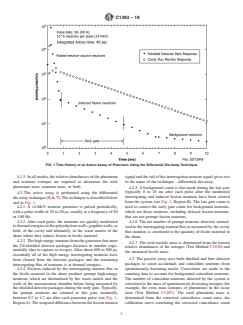
the differential die-away technique (DDT). Refer to Fig. 1.
C1207Test Method for NondestructiveAssay of Plutonium
3.1.3 bare detector package, n—neutron detectors sur-
in Scrap and Waste by Passive Neutron Coincidence
rounded by polyethylene, but not shielded with cadmium.
Counting
These packages provide a better efficiency for thermal
C1215Guide for Preparing and Interpreting Precision and
neutrons, thus providing a better passive sensitivity when a
Bias Statements in Test Method Standards Used in the
small amount of nuclear material is present.
Nuclear Industry
C1490GuidefortheSelection,TrainingandQualificationof
3.1.3.1 bare totals, n—is the sum of neutrons detected from
Nondestructive Assay (NDA) Personnel
all bare detector packages.
C1592Guide for Making Quality Nondestructive Assay
3.1.4 early gate, n—the time interval during which the
Measurements
thermal-neutron induced prompt-fission neutrons are mea-
C1673Terminology of C26.10 NondestructiveAssay Meth-
sured.
ods
3.1.4.1 Discussion—Typically, this time interval begins 0.4
2.2 ANSI Standard:
to0.9msaftertheinitiatingneutrongeneratorpulseandis2to
ANSI N15.20Guide to Calibrating Nondestructive Assay
4msinduration.Thisgateisusedonlyduringtheactivemode.
Systems
Fig. 1 indicates the approximate delay and length of the early
2.3 U.S. Government Documents:
gate in reference to a generator pulse.
DOE Order 435.1(supersedes DOE Order 5820.2A) Radio-
3.1.5 late gate, n—the time interval during which the active
active Waste Management
neutron background is measured. Typically, this time interval
DOE Order 474.1 (supersedes DOE Order 5633.3B) Con-
begins 8 to 18 ms after the initiating neutron generator pulse.
trol and Accountability of Nuclear Materials
Refer to Fig. 1.
DOE Order 5630.2Control and Accountability of Nuclear
Materials, Basic Principles
4. Summary of Test Method
DOE /WIPP-069Waste Acceptance Criteria for the Waste
Isolation Pilot Plant
4.1 Thistestmethodaddressesasystemthatperformsactive
10 CFR Part 71Packaging and Transport of Radioactive
differential die-away and passive neutron coincidence count-
Materials
ing. Examples of the apparatus, data acquisition, and calcula-
40 CFR Part 191Environmental Radiation Protection Stan-
tions contained in this test method are specific to the second-
dards for Management and Disposal of Spent Nuclear
generation LANL passive-active neutron assay system (
5) but
Fuel, High-Level, and Transuranic Radioactive Waste
the principle applies to other DDT systems.
USNRC Regulatory Guide 5.11Nondestructive Assay of
4.1.1 Typically, the active mode is performed prior to the
Special Nuclear Materials Contained in Scrap and Waste
passive mode.A208 Ldrum is placed inside the chamber and
USNRC Regulatory Guide 5.53Qualification, Calibration,
rotatedcontinuouslyduringthemeasurement.Theactivemode
and Error Estimation Methods for Nondestructive Assay
is performed by interrogating the drum with neutrons from a
pulsed neutron generator for 40 to 200 s. The passive mode is
performed using a counting interval of 200 to 1000 s (5, 6, 7).
For referenced ASTM standards, visit the ASTM website, www.astm.org, or
Iftheisotopicratiosaswellastherelativeresponsesareknown
contact ASTM Customer Service at service@astm.org. For Annual Book of ASTM
for individual radionuclides, the active and passive modes can
Standardsvolumeinformation,refertothestandard’sDocumentSummarypageon
be used to give independent measurements of the total pluto-
the ASTM website.
Available fromAmerican National Standards Institute (ANSI), 25 W. 43rd St., nium mass.
4th Floor, New York, NY 10036, http://www.ansi.org.
4.1.2 The system can also be operated only in the passive
AvailablefromU.S.GovernmentPrintingOfficeSuperintendentofDocuments,
mode to measure the plutonium content of scrap or waste, or
732 N. Capitol St., NW, Mail Stop: SDE, Washington, DC 20401, http://
www.access.gpo.gov. only in the active mode for measurement of uranium.
C1493 − 19
FIG. 1 Time History of an Active Assay of Plutonium Using the Differential Die-Away Technique
4.1.3 Inallmodes,therelativeabundancesoftheplutonium signalandthetailoftheinterrogationneutronsignalgivesrise
and uranium isotopes are required to determine the total to the name of the technique - differential die-away.
plutonium mass, uranium mass, or both.
4.2.5 Abackground count is also made during the late gate
(typically 8 to 18 ms after each pulse after the moderated
4.2 The active assay is performed using the differential
interrogating and induced fission neutrons have been cleared
die-awaytechnique (5, 6, 7).Thetechniqueisdescribedbelow
from the system (see Fig. 1, Region B). The late gate count is
and in Fig. 1.
used to correct the early gate count for background neutrons,
4.2.1 A 14-MeV neutron generator is pulsed periodically,
which are those neutrons, including delayed fission neutrons,
with a pulse width of 10 to 20 µs, usually at a frequency of 50
that are not prompt fission neutrons.
or 100 Hz.
4.2.2 After each pulse, the neutrons are quickly moderated
4.2.6 The net number of prompt neutrons detected, normal-
tothermalenergiesinthepolyethylenewalls,graphitewalls,or
izedtotheinterrogatingneutronfluxasmeasuredbythecavity
both, of the cavity and ultimately, in the waste matrix of the
flux monitor, is correlated to the quantity of fissile material in
drum where they induce fission in fissile material.
the drum.
4.2.3 Thehighenergyneutronsfromthegeneratorthatenter
4.2.7 The total nuclide mass is determined from the known
the Cd-shielded detector packages decrease in number expo-
relative abundances of the isotopes (Test Method C1030) and
nentially(duetocaptureorescape).Afterabout600to900µs,
the measured fissile mass.
essentially all of the high energy interrogating neutrons have
4.3 The passive assay uses both shielded and bare detector
been cleared from the detector packages and the remaining
interrogating flux of neutrons is at thermal energies. packages to count accidentals and coincident neutrons from
spontaneously-fissioning nuclei. Corrections are made to the
4.2.4 Fissions induced by the interrogating neutron flux in
the fissile material in the drum produce prompt high-energy counting data to account for background coincident neutrons.
The number of coincident neutrons detected by the system is
neutrons, which are thermalized by the waste matrix and the
walls of the measurement chamber before being measured by correlatedtothemassofspontaneously-fissioningisotopes(for
example, the even mass isotopes of plutonium) in the assay
theshieldeddetectorpackagesduringtheearlygate.Typically,
the prompt neutrons are counted in this gate, nominally item (Test Method C1207). The total plutonium mass is
between 0.7 to 4.7 ms after each generator pulse (see Fig. 1, determined from the corrected coincidence count rates, the
RegionA).Thetemporaldifferencebetweenthefissionneutron calibration curve correlating the corrected coincidence count
C1493 − 19
rateswiththe Pu-effectivemass,andtheknownormeasured quantityofthenuclearmaterial,thebackground,andthecount
plutonium isotopic ratios (Test Method C1030). time of the measurement.
5.5.1 For both matrix-specific and wide-range calibrations,
4.4 Correction factors that account for matrix effects in the
this test method assumes the calibration material matches the
observed count rates may be calculated using the ratios of
items to be measured with respect to homogeneity and com-
counts from the cavity flux monitor and drum flux monitor
position of the matrix, the neutron moderator and absorber
(obtained during the active measurement), and from the
content, and the quantity, distribution, and form of nuclear
shielded and bare detector packages (obtained during the
material, to the extent they affect the measurement.
passive measurement).
5.5.2 The algorithms for this test method assume homoge-
4.4.1 Generally,bothratioscanbeusedtocorrecttheactive
neity. Heterogeneity in the distribution of nuclear material,
and passive assay results.
neutron moderators, and neutron absorbers has the potential to
4.4.2 If there is no passive result, or if the passive count
cause biased results (14).
rates are very low (resulting in very poor counting statistics),
5.5.3 This test method assumes that the distribution of the
thecorrectionfactorobtainedfromtheratiooftheshieldedand
contributing radioisotopes is uniform throughout the container
bare detector packages is not useful. For this case, the active
and that lumps of nuclear material are not present.
moderesultsusingmatrix-specificcalibrationfactorsshouldbe
used.
5.6 Reliable results from the application of this test method
require waste to be packaged so the conditions of Section 5.5
5. Significance and Use
can be met. In some cases, site-specific requirements will
5.1 This test method is useful for quantifying fissile (for dictate the packaging requirements with possible detrimental
233 235 239 241
effects to the measurement results.
example, U, U, Pu and Pu) and spontaneously-
238 240 242 244
fissioning nuclei (for example, Pu, Pu, Pu, Cm,
5.7 Both the active mode and the passive mode provide
248 252
Cm, and Cf) in waste and scrap drums. Total elemental
assay values for plutonium. During the calibration process, the
mass of the radioactive materials can be calculated if the
operator should determine the applicable mass ranges for both
relative abundances of each radionuclide are known.
modes of operation.
5.1.1 Typically, this test method is used to measure one
235 239
fissile isotope (for example, Uor Pu).
6. Interferences
5.2 This test method can be used to segregate low level and
6.1 Potential sources of measurement interference include:
transuranicwasteatthe100nCi/gconcentrationlevelcurrently
6.1.1 self-shielding by lumps of fissile material,
required to meet the DOE Waste Isolation Pilot Plant (WIPP)
6.1.2 unexpected nuclear material contributing to the active
waste acceptance criterion (5, 8, 9).
or passive neutron signal,
5.3 This test method can be used for waste characterization
6.1.3 non-uniform nuclear material distributions within a
to demonstrate compliance with the radioactivity levels speci-
moderating matrix,
fied in waste, disposal, and environmental regulations (See
6.1.4 heterogeneity of the matrix,
NRCregulatoryguides,DOEOrder435.1,10CFRPart71,40
6.1.5 excessive quantities of moderators or absorbers in the
CFR Part 191, and DOE /WIPP-069).
matrix,
5.3.1 In the active mode, the DDT system can measure
6.1.6 multiplication, high (α, n) rates,
the U content in the range from <0.02 to >100 g and
6.1.7 high count rates, cosmic rays, and
the Pu content, nominally between <0.01 and >20 g.
6.1.8 high neutron backgrounds.
5.3.2 In the passive mode, the DDT system is capable of
6.2 The techniques used in this test method cannot distin-
assayingspontaneously-fissioningnuclei,overanominalrange
240 guish which isotope is generating the measured response. If
from 0.05 to 15 g of Pu, or equivalent (5, 10, 11, 12, 13).
more than one neutron-producing nuclide is present, the
5.4 This test method should be used in conjunction with a
relative abundances and relative responses of those radionu-
waste management plan that segregates the contents of assay
clides must be known.
items into material categories according to some or all of the
6.2.1 Active Mode—The presence of other fissile radionu-
followingcriteria:bulkdensityofthewaste,chemicalformsof
clides will increase the induced fission neutron count rate,
235 239
the plutonium or uranium and matrix, (α, n) neutron intensity,
causinganover-estimationofthe Uor Pucontent,unless
hydrogen(moderator)andabsorbercontent,thicknessoffissile 235 239
acorrectionismade.Inducedfissionneutronsfrom U, Pu
mass(es), and the assay item container size and composition.
and Pu are indistinguishable and, therefore, the relative
Eachmatrixmayrequireadifferentsetofcalibrationstandards
contributions from each of these radionuclides cannot be
and may have different mass calibration limits. The effect on
determined from the active assay alone. Since the calibration
thequalityoftheassay(thatis,minimizingprecisionandbias)
factor used in the calculation is isotope specific, the resulting
can significantly depend on the degree of adherence to this
fissile mass will be inaccurate if the relative isotopic abun-
waste management plan.
dances of these isotopes are unknown (15).
5.5 The bias of the measurement results is related to the fill 6.2.2 Passive Mode—Other spontaneously-fissioning nu-
height, the homogeneity and composition of the matrix, the clides (for example, curium and californium) will increase the
quantity and distribution of the nuclear material, and the item coincidentneutroncountrate,causinganoverestimatingofthe
size.The precision of the measurement results is related to the plutonium content, unless their relative isotopic abundances
C1493 − 19
are known.Their presence cannot be inferred from the passive neous matrices. In general, passive counts are less affected by
data, but discrepancies between the passive and active results these effects than are active measurements (5, 18, 19).
may indicate their presence. Knowledge of the waste stream
6.6 Background neutron count rates from cosmic-ray in-
may also provide information on whether such interfering
duced spallation can degrade the measurement sensitivity and
isotopes might be present.
themeasurementprecision.High-backgroundcountratesmask
the instrument response.
6.3 Lumps of nuclear material can exhibit self-shielding or
6.6.1 Active Mode—Since the neutron background is mea-
multiplication. This effect is generally larger for highly mod-
sured for the active assay during the same irradiation cycles as
erating matrices.
the fissile signal is observed, sudden changes in background
6.3.1 Active Mode (Self-Shielding)—The nuclear material
levelsmayaffecttheprecisionofthemeasurement,butwillnot
on the surface of the lump shields the inside of the lump from
result in measurement bias since the change will be accurately
the interrogating neutrons. Self-shielding in lumps of fissile
determined. Such rapid changes might result, for example,
materialcanleadtosevereunderestimatesofthefissilecontent
from movements of neutron emitting materials near the instru-
derived from active assays. In principle, self-shielding effects
ment. Contributions from cosmic rays and room background
can be significant for lumps with masses containing less than
neutrons are generally only important at very low fissile
100 mg of Pu (16, 17).
loadings.Spontaneousfissionand(α,n)neutronsoriginatingin
6.3.2 Passive Mode (Multiplication)—Four factors that
the waste drum are usually the primary contributors to the
strongly affect the degree of multiplication are the mass of the
background for active assays.
fissilematerial,(α,n),lumpdensityandlumpshape.Lumpsof
6.6.2 Passive Mode:
nuclear material are likely to cause unknown changes in
6.6.2.1 Neutron background levels should be kept as low as
multiplication and measurement bias. This effect will be
feasible,andshouldnotbeallowedtovarysignificantlydueto
negligible unless the lumps contain a few tens of grams, or
movementsofneutronsourcesinthevicinityoftheinstrument.
more, of fissile material (17).
High background neutron count rates from external sources
6.4 Assay results for waste that is inhomogeneous or has a
(for example, items staged on a conveyor system) adversely
non-uniform distribution of fissile material, can have signifi-
affect measurement precision and detection limits.
cant errors.
6.6.2.2 Cosmic rays can produce coincident neutrons. Cos-
6.4.1 Active Mode—The largest errors are likely to occur in mic ray effects become more significant for small amounts of
highly moderating or absorbing matrices. Generally, non- plutonium in the presence of large quantities of high atomic
uniform distributions of fissile material can result in larger
number materials such as iron or lead. Cosmic-ray induced
assay errors than those resulting from heterogeneous waste neutrons increase in intensity as the atmospheric pressure
matrices (6, 18).
decreases. It is possible to continuously monitor atmospheric
pressure for purposes of adjusting the background count rate
6.4.2 Passive Mode—The largest source of inhomogeneity
(20).
errors are likely to occur in highly moderating matrices (14,
16). Generally, it is difficult to compensate for these effects.
6.7 If count rates are so high that there is a large overlap
between neutrons from different coincidence events, between
6.5 Neutron moderators and absorbers in the matrix can
random neutrons, or between coincidence-event neutrons and
cause a bias in the measurement results, unless a correction is
random neutrons, precision will be poor and results may be
made. The magnitude and direction of this bias depend on the
biasedforthepassivemode.Theshieldedcoincidenceratemay
quantity of moderator present, the distribution of the fissile
provide a more precise and accurate result than the totals
material, and the size of the item. The instrument produces a
coincidence rate.
non-uniform response for large containers with unknown
quantitiesofhydrogeninthematrix.Inthesecases,asourceat
6.8 Random neutrons from (α, n) reactions, generally have
thecenterofthecontainercanproduceeitherahigherorlower
little, if any, effect on coincidence counting.
response than the same source located at the surface of the
6.8.1 If the random neutron count rate is very high com-
container.
pared to the coincident neutron count rate, induced multiplica-
tion effects affect the bias of the assay (21).
6.5.1 Active Mode:
6.8.2 Random neutrons from (α, n) reactions can increase
6.5.1.1 Moderation and absorption of neutrons in the waste
theaccidentalsratetherebyaffectingthestatisticalprecisionof
matrix can have a large effect on the active signal, generally
the assay.
larger than the effects on the passive assay.
6.5.1.2 Correction factors for these effects can be obtained
7. Apparatus
from calibrations using matrix-specific waste drums (see Sec-
tion 9). These calibrations are usually based on homogeneous
7.1 Theapparatusaddressedinthistestmethodisspecificto
waste matrices and uniform distributions of fissile materials
the second-generation LANL passive-active neutron assay
throughout the matrix.
system (5).
6.5.2 Passive Mode—Neutron moderation and absorption 7.1.1 The following components are included in all second
effects can affect passive neutron count rates. The correction generation DDT systems. Other components, such as convey-
factorsusedinthetechniquegenerallyaccountfortheseeffects ors for drum transport and additional flux monitors, have been
satisfactorily for uniform fissile distributions and homoge- incorporated into some systems.
C1493 − 19
7.2 Counting Assembly—See Figs. 2 and 3 for a typical 7.2.2 The neutron detectors are embedded in polyethylene.
counting assembly configuration. The major components are The detection efficiency for system totals neutrons is generally
the assay chamber (polyethylene, graphite, and structural between 10 and 15% for second generation DDT systems.
support); rotating platform; pulsed neutron source; shielded 7.2.3 Provision for reproducible positioning of the item in
and bare neutron detector packages; cavity flux monitor; and the chamber is important for reducing measurement bias. The
drum flux monitor and collimator. same counting geometry should be maintained for the mea-
7.2.1 Shielded and bare neutron detector packages are surement of all calibration materials and assay items.
positioned in the chamber walls (including the chamber door), 7.2.4 A 14-MeV neutron generator pulsed at 50 Hz and
ceiling, and floor and are used to quantify the fissioning producing about 10 neutrons per pulse is generally adequate
materials in the waste (see Fig. 2). for active assays of 208 L waste drums (22). The neutron
FIG. 2 Side View of DDT Counter Configuration
C1493 − 19
FIG. 3 Overhead View of DDT Counter Configuration
generator is positioned inside the assay chamber. It provides 8. Hazards
the fast-neutron pulse which is then thermalized and used as
8.1 Safety Hazards—Consult qualified professionals as
the interrogating flux for active assays.
needed.
7.2.5 One cavity flux monitor is positioned within the assay
8.1.1 Precautions should be taken to prevent inhalation,
chambertomeasuretheinterrogatingthermalneutronflux(See
ingestion, or the spread of radioactive contamination during
Fig. 3).
waste handling operations. All containers should be surveyed
7.2.6 Oneormoredrumfluxmonitorsarepositionedwithin
on a regular basis with an appropriate monitoring device to
the assay chamber and in close proximity to the assay item to
verify their continued integrity.
measure the neutron flux which has elastically scattered in the
8.1.2 Do not override mechanical and electrical safety
assay item matrix material (see Fig. 3).
systems. Precautions should be taken to minimize exposure to
7.3 Electronics—Nuclear electronics convert analog pulses
radiation during operation of the assay system. Plutonium,
fromthe Heproportionalcounterstodigitalsignalswhichare
other transuranics, or fission products contained in the waste
processed by the data acquisition system. Separate sets of
packages and the deuterium-tritium (D-T) neutron generator
preamplifiers, amplifiers, and discriminators may be provided
canproduceionizingradiation.Appropriatehealthphysicsand
for each detector package. The output of a discriminator is
safety considerations should be instituted to reduce potential
processed by scalers. The scaler outputs are manipulated by
worker exposures.
logic circuitry modules which sum the individual detector
8.1.3 Facility specific guidelines for handling and loading
package counts (7, 23).
drumsintoassaysystemshouldbefollowedregardingcritical-
7.3.1 Coincidence counting electronics are utilized, includ-
ity control.
ing a correction for accidental coincidence rates (for example,
8.1.4 The Zetaron D-T neutron generator contains between
from (α, n) reaction neutrons and delayed fission neutrons).
9 and 12 Ci of H in the form of a tritiated solid.Appropriate
7.4 Automated data acquisition and reduction are accom-
healthphysicsandsafetyconsiderationsshouldbeinstitutedto
plished by interfacing the instrument to a computer.
reduce potential worker exposures.
8.1.5 Shielded detector packages contain a cadmium liner.
7.5 Shielding—Theassaychambershouldbesurroundedby
Appropriate safety considerations should be followed.
layers of hydrogenous (for example, polyethylene, borated
polyethylene, etc.) material to reduce neutron background 8.1.6 The system uses high-voltage electrical components.
caused by extraneous neutron sources and cosmic rays. Appropriate safety considerations should be followed.
C1493 − 19
8.1.7 The neutron generator produces approximately 10 manufacturer, using appropriate scaling factors to account for
neutrons per second when it is operating. Although at least 5 differences in the strengths of the check sources.
cm of polyethylene surround the generator and shields nearby
9.3 Preparation of Calibration Materials—Additional
personnel from exposure to this source of radiation, appropri-
sources of information include Guide C1215 and ANSI
ate safety cautions should be observed (see C1592).
N15.20.
8.1.8 As low as reasonably achievable (ALARA) should be
9.3.1 Calibration matrices should be made from materials
practiced with regard to the DDA neutron generating source
that will simulate the neutron moderation and absorption
and stored waste items staged to be measured.
propertiesofthewastebeingassayed.Insomecases,itmaybe
8.2 Technical Hazards:
possible to use uncontaminated material exactly the same as
8.2.1 Uniform neutron moderator, neutron absorber, and
the waste material. Real-time Radiography (RTR) results can
source distributions are assumed. Deviations may lead to
provide information on waste materials for mock-up drums.
biased results.
Often, however, it is necessary to simulate the waste matrices
8.2.2 Locate the instrument in an area with the lowest
using a benign (non-moderating and non-absorbing) matrix
practical neutron background. Prohibit the external movement
material such as vermiculite, and adding various amounts of
of neutron emitters in the vicinity of the instrument while
neutron moderators and absorbers, such as polyethylene beads
measurements are in progress.
and borax powder, respectively. The amount of moderator and
8.2.3 Utilizationofameasurementresultwhichfallsoutside
absorber added to the barrels can be adjusted to approximate
of the range of the calibration curve is not recommended.
the properties of the real waste for which the calibration is to
8.2.4 Utilization of a result which is based on an inappro-
be used.
priate material category calibration is not recommended.
9.3.2 The material in the calibration drums should be
8.2.5 Correct operation of the neutron generator is deter-
uniform throughout the barrel. Care should be exercised to
minedbycomparingthefluxmonitorreadingswithsitecontrol
avoid differential settling of components of the calibration
values. Some slow decrease in output is expected as the
matrices. If this is suspected to have occurred, remixing of the
neutron generator tube ages, and does not affect the assay
matrix material is recommended.
results since the shielded detector counts are normalized to the
9.3.3 Because much real waste will not be composed of
flux monitor count. Adjustment of the neutron generator may
uniformly distributed fissile material in homogeneous waste
provide some compensation for this decreased output.
matrices, appropriate care in the assignment of overall assay
errors is required to account for differences between the
9. Instrument Preparation and Calibration
calibrationbarrelsandtheactualwastecomposition.Whileitis
9.1 The initial preparation of the DDTapparatus is outlined
not generally feasible to use calibration drums containing
in the following sections, which discuss the initial setup,
non-uniformities in matrix composition, such drums may be
calibration, and initialization of measurement control. The
useful in determining the potential magnitude of errors asso-
details of preparation are site specific, depend on the material
ciated with non-uniformities (14).
categories, and are generally performed by experts.
9.3.4 Calibration sources for both the passive and active
9.2 Initial Preparation: assays should span the range of loadings found in the waste
barrels for which the calibration is being used.Any use of the
9.2.1 The apparatus weight may exceed typical industrial
systemoutsidethemassrangeofthecalibrationsourcesshould
floor load capacities. Check for adequate floor load capacity
becarefullyevaluated.Plutoniumsourcescanbeusedforboth
before installation.
the passive and active calibrations.
9.2.2 The instrument should be located in a room where
temperatures can be maintained within acceptable limits.
9.3.5 Sources which provide both a known active and
9.2.3 Perform the initial setup recommended by the system passiveresponsearerequiredforthecalibrationmeasurements.
manufacturer, obtaining assistance as needed.
These may be working standards. Sources of fissile material
9.2.3.1 The use of an oscilloscope to look for electronic ranging in size from nominally 10 mg to 200 g are generally
noise during the initial setup or trouble shooting of the required to perform a complete calibration, covering the range
equipment is strongly recommended. An oscilloscope is rou- typicallyfoundinwastebarrelsandextendingfromclosetothe
tinely used to monitor the neutron generator source strike instrumental limit to close to the permissible limit per
voltage during active counting (22).
container, respectively. Uranium sources can be used for the
9.2.3.2 The output of the neutron generator should be active calibrations for both uranium and plutonium wastes
checked by comparing the cavity flux monitor counts with sincetherelativeresponseofthesematerialstothermalneutron
those obtained by the manufacturer for a specified number of interrogation is well known (24) or may be directly cross
neutron generator pulses and specified neutron generator op- calibrated.A Cf source can be used for the passive calibra-
erating conditions (target and source voltages).
tion since the relative response of the passive system to
9.2.3.3 The proper operation of the instrument should be differentspontaneousfissionisotopescanbecalculated (25)or
assured by performing passive and active measurements on may be directly cross calibrated. When using surrogate mate-
items containing known quantities of fissioning material. rials the additional uncertainty introduced by the relative
Counts and count rates of individual detectors and detector responsefactorshouldbepropagatedintotheuncertaintyofthe
packages should be compared to those specified by the final results.
C1493 − 19
9.3.5.1 For the passive mode calibrations the preferred evaluate whether the neutron emission characteristics of the
calibration material would be plutonium (unless the detector is calibration material match those of the assay item. Reasonable
being calibrated for active mode uranium only), californium agreementbetweentheindicesforthecalibrationmaterialsand
would be next choice if appropriate plutonium standards are assay items suggests that the calibration constants are appro-
not available, and Monte Carlo calculations would be consid- priate.Afacility-dependentevaluationforeachmatrixcategory
ered last.Acombination of any two or all three methods may is required in order to make the individual assessments.
also be used. In the case of Monte Carlo methods benchmark- 9.4.4 Matrix-Specific Calibration Using Volume Weighted
ing to at least one well specified measured point is essential to Average Response (5, 8, 14, 27):
establish the absolute response.
9.4.4.1 If the waste being measured is made up entirely of
9.3.5.2 For active mode calibrations the preferred calibra- one matrix type, such as from a waste stream where items are
tion material would be uranium first (unless the detector is
filled with a sludge of fixed composition, a calibration can be
beingcalibratedforplutoniumonly)becauseofitsrelativeease established for that specific material.
ofavailabilityindiluteformandlowintrinsicneutronemission
9.4.4.2 Determine the volume weighted average response,
rate. If suitable quantities of uranium are not available then an estimate of the count rate that would be obtained from an
plutoniumor Cfshouldbeused,ifadequatequantitiesofthe
item containing a uniform distribution of radionuclide(s), for
listed radionuclides are not available Monte Carlo calculations
each matrix/material type.
appropriately benchmarked can be used.
9.4.4.3 Perform both active and passive measurements of a
9.3.6 Both plutonium and uranium sources may exhibit
representativecalibrationsourcewithinauniformmatrixatthe
significant self-shielding that must be accounted for when
centroid of each voxel.
making an absolute calibration measurement. Self-shielding
9.4.4.4 Perform a spatial mapping of response, weighted by
may occur in sources of very small size (mg quantities, or
the size of the corresponding voxel, and form the average by
larger, of plutonium or enriched uranium) and multiplication
numerical integration to obtain volume-weighted average cor-
can be significant in sources of 30 g, or more. These effects
rection factors for passive and active measurements.
must be accounted for in order to properly calibrate the
9.4.4.5 Determine the passive and active responses of the
instrument. Typically the amount of self-shielding or multipli-
instrument as a function of mass using a series of sources that
cation is calculated using Monte Carlo techniques (26).
span the mass range of the waste to be assayed. This informa-
tion can be used to verify the linearity of the calibration. The
9.4 Calibration:
count rates for individual detector packages and shielded and
9.4.1 Thecalibrationoftheinstrumentcanbealengthyand
bare combinations should be recorded. This should be per-
involved process (ANSI N15.20 and USNRC Regulatory
formed in one fixed position in the drum.
Guide 5.11 and USNRC Regulatory Guide 5.53). Generally,
9.4.4.6 Use a calculation tool such as Monte Carlo simula-
numerous measurements are made with a single source in a
tion benchmarked to experiment to extend the response from
varietyoflocationsinbarrelscontainingdifferentwastematrix
experimentally determined responses.
materials. Additionally, several sources of different SNM
9.4.4.7 Another approach is to determine volume-weighted
masses are counted to verify the linearity, or determine the
responses using Monte Carlo neutron simulations (28). Mod-
degree of non-linearity, of the system.
eling should be used in combination with experimental mea-
9.4.2 The instrument calibration may be a matrix-specific
surements.
calibration,orawide-rangecalibration,thatisvalidforarange
9.4.5 Wide-Range Calibration:
ofmatrixmaterialsandfissileloadings.Theusermustestablish
groundstosupportonecalibrationmethodoveranothertomeet 9.4.5.1 This calibration procedure may be used to assay
items containing materials whose neutron moderating and
individual circumstances. The wide-range calibration is nor-
mally performed by the manufacturer. If adjustments are absorbing characteristics vary widely, as is typical of many
waste streams. The objective is a calibration that will account
required to electronics components, or replacements of detec-
tors or electronics are required, the user should verify that the for changes in counting efficiency and interrogation flux
intensity due to varying amounts of moderators and absorbers
calibration of the system is still valid. Changes to the system
electronics(forexample,gatelengthorcomponents)shouldbe in the waste, over a concentration range that is likely to be
encountered in the waste items being assayed.
evaluated for their effect on the calibration.
9.4.3 Calibrations for specific matrices identified through a 9.4.5.2 To perform this calibration, a number of calibration
waste management plan described in 5.4 may lead to better items containing representative homogeneous mock waste
resultsthanareavailableinthewide-rangecalibration.Inorder materials must be prepared. Provision must be made to place
to obtain the best results, packaging of the waste in each testitemsoffissilematerialandspontaneousneutronsourcesat
defined waste matrix category must be uniform. Each matrix representative locations throughout the matrix-filled container.
category will require a set of representative calibration mate- Thematrixcharacteristicsshouldspantherangeofmoderation
rials (physical standards). The effectiveness of the waste and absorption found in the waste to be assayed using the
management plan and the validity of the resulting calibrations calibration (5, 14).Any use of the system outside the range of
may be evaluated by monitoring the absorption and moderator moderation and absorption found in the calibration items
indices defined below. These factors can be used to help should be carefully evaluated.
C1493 − 19
9.4.5.3 For each calibration matrix, make both passive and should be consulted to determine the cause of the change and
active measurements at each representative location in the perform corrective actions. In addition, all measurements of
barrel. Combine the data for each barrel to obtain a volume- unknown items that have been performed since the last
weighted average, which represents a uniform distribution of successfulmeasurementcontroltest,aresuspectandmayneed
fissile material in the waste matrix.
to be repeated.
9.4.5.4 The volume weighted system responses should then
10.1.1 Background Measurements—Background measure-
be analyzed for various parameters, such as the cavity flux
mentsshouldbemadeinaccordancewiththesitemeasurement
monitor-to-barrel flux monitor ratio and the shielded totals to
control plan. This can be accomplished by performing, at a
bare totals ratio, and fit to one of several mathematical
minimum, a passive count on an empty drum. Each detector
functions using a fitting procedure such as the method of least
package count or count rate can be compared with the normal
squares, as described in (5) and (14).
background values for the package. Significant differences
9.4.5.5 These fitted functions are then used to obtain matrix
betweenbackgroundmeasurementsmaybeduetosuchcauses
correctionfactorswhicharefunctionsofmeasurement-derived
as electronic noise, detector or electronics failure, or to
parameters (5, 14). Typically, for active measurements, one
increases in neutron background count rates. Any significant
correction factor is primarily dependent on the moderating
discrepancyshouldberesolvedbyanNDAtechnicalspecialist
propertiesofthematrix,andanotherisprimarilydependenton
or higher (as defined in Guide C1490).
the matrix absorption properties. The two factors may be
10.1.2 Bias Measurement—Perform periodic measurements
combined to obtain an overall active correction factor. The
ofitemscontainingfissilematerialtoverifythereproducibility
passive correction factor is primarily dependent on the mod-
of the instrument response in accordance with the site mea-
eration properties of the matrix.
surement control plan. Typical practice is to perform an active
9.4.5.6 Determine the response of the instrument as a
and passive count on the drum containing a measurement
function of mass as described in 9.4.4.5 if it has not been done
controlitematthebeginningandendofashiftforinstruments
previously. This check may be done with any matrix, if a
used daily. For instruments that undergo intermittent use, this
suitable range of count rates can be obtained.
check is recommended before and after each use. Counts or
9.4.6 Monte Carlo neutron transport calculations may be
count rates for individual detector packages, for the shielded
useful in supplementing the calibration data. Such calculations
andshieldedplusbaretotals,andthecavityfluxmonitor/drum
may provide insight regarding the effect of matrix inhomoge-
flux mo
...