

ASTM D4171-22
(Specification)Standard Specification for Fuel System Icing Inhibitors
General Information
- Abstract
ABSTRACT
This specification covers additives for aviation fuels used to inhibit ice formation in aircraft fuel systems. Three types of fuel system icing inhibitors are provided as follows: type I - ethylene glycol monomethyl ether, type II - anhydrous isopropanol, and type III - diethylene glycol monomethyl ether. The relative density, color, distillation range, non-volatile matter, and odor shall be tested to meet the requirements prescribed. The water properties, heptanes miscibility, acidity, water miscibility, and flash point shall be tested to meet the requirements prescribed.
SCOPE
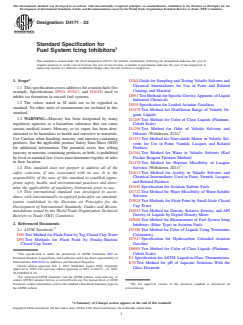
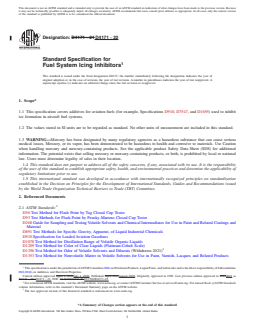
1.1 This specification covers additives for aviation fuels (for example, Specifications D910, D7547, and D1655) used to inhibit ice formation in aircraft fuel systems.
1.2 The values stated in SI units are to be regarded as standard. No other units of measurement are included in this standard.
1.3 WARNING—Mercury has been designated by many regulatory agencies as a hazardous substance that can cause serious medical issues. Mercury, or its vapor, has been demonstrated to be hazardous to health and corrosive to materials. Use Caution when handling mercury and mercury-containing products. See the applicable product Safety Data Sheet (SDS) for additional information. The potential exists that selling mercury or mercury-containing products, or both, is prohibited by local or national law. Users must determine legality of sales in their location.
1.4 This standard does not purport to address all of the safety concerns, if any, associated with its use. It is the responsibility of the user of this standard to establish appropriate safety, health, and environmental practices and determine the applicability of regulatory limitations prior to use.
1.5 This international standard was developed in accordance with internationally recognized principles on standardization established in the Decision on Principles for the Development of International Standards, Guides and Recommendations issued by the World Trade Organization Technical Barriers to Trade (TBT) Committee.
- Status
- Published
- Publication Date
- 30-Jun-2022
- Technical Committee
- D02 - Petroleum Products, Liquid Fuels, and Lubricants
- Drafting Committee
- D02.J0.04 - Additives and Electrical Properties
Overview
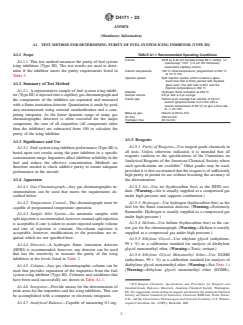
ASTM D4171-22 is the internationally recognized standard specification for fuel system icing inhibitors (FSII) used as additives in aviation fuels. These additives are critical for preventing the formation of ice within aircraft fuel systems, which can lead to fuel line blockages and potential engine failures, especially in cold weather or high-altitude conditions. The standard details the requirements for two primary FSII types: Type II (anhydrous isopropanol) and Type III (diethylene glycol monomethyl ether or DiEGME), including their physical and chemical properties, test methods, and quality criteria.
Key Topics
Types of Fuel System Icing Inhibitors:
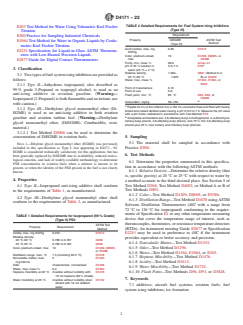
- Type II: Anhydrous isopropanol, primarily used in aviation gasoline. It is both flammable and an irritant, so appropriate handling is critical.
- Type III: Diethylene glycol monomethyl ether (DiEGME), suitable for both aviation gasoline and turbine fuels. It must have high purity and controlled levels of water content and acidity.
Physical and Chemical Property Requirements:
- Relative density
- Color (platinum-cobalt scale)
- Distillation range
- Non-volatile matter
- Odor
- Water content
- Miscibility with heptane and water
- Acidity
- Flash point
- Antioxidant content (for Type III)
Test Methods:
- Standardized ASTM test methods are referenced for each property, ensuring consistent assessment of FSII performance and quality.
Safety Considerations:
- FSII substances such as isopropanol and DiEGME are flammable, toxic, or irritant, requiring safe handling.
- Use of mercury and mercury-containing products is discouraged and may be regulated.
Applications
Aviation Fuel Additives:
- FSII are blended into aviation fuels to prevent ice formation in fuel systems, enhancing aircraft safety and reliability, particularly in cold-weather and high-altitude operations.
Commercial and Military Aircraft:
- Both types (II and III) are utilized across various aircraft, depending on specific engine and fuel requirements.
Aviation Fuel Suppliers and Operators:
- Compliance with ASTM D4171-22 ensures quality control for aviation fuel providers and operators, meeting industry and regulatory expectations.
Fuel Quality Testing Laboratories:
- Laboratories utilize the designated ASTM test methods to verify FSII compliance, crucial for maintaining fuel safety standards.
Related Standards
- ASTM D910 - Specification for Leaded Aviation Gasolines
- ASTM D7547 - Specification for Hydrocarbon Unleaded Aviation Gasoline
- ASTM D1655 - Specification for Aviation Turbine Fuels
- ASTM D4052 - Test Method for Density, Relative Density, and API Gravity of Liquids
- ASTM D1209/D8005/D5386 - Test Methods for Color of Clear Liquids
- ASTM D1364/E1064/E203 - Test Methods for Water Content
- ASTM D1078 - Distillation Range
- ASTM D1613 - Acidity in Volatile Solvents
- ASTM D93/D56/D3828 - Flash Point Test Methods
Practical Value
Implementing ASTM D4171-22 enables stakeholders across the aviation industry to select and verify effective fuel system icing inhibitors, minimizing operational risks and ensuring compliance with international safety and fuel quality standards. By following this specification, manufacturers, suppliers, and testing laboratories contribute to safer, more reliable aircraft operations.
Relations
- Effective Date
- 15-Mar-2024
- Effective Date
- 01-Mar-2024
- Effective Date
- 01-Jan-2024
- Effective Date
- 01-Jan-2024
- Effective Date
- 01-Jan-2024
- Effective Date
- 01-Oct-2023
- Effective Date
- 01-Aug-2020
- Effective Date
- 01-Dec-2019
- Effective Date
- 01-May-2019
- Effective Date
- 01-May-2018
- Effective Date
- 01-Jan-2018
- Effective Date
- 01-Dec-2017
- Effective Date
- 01-Oct-2017
- Effective Date
- 01-Oct-2017
- Effective Date
- 01-May-2017
Get Certified
Connect with accredited certification bodies for this standard

Element Materials Technology
Materials testing and product certification.

ABS Group Brazil
ABS Group certification services in Brazil.

ABS Quality Evaluations Inc.
American Bureau of Shipping quality certification.
Sponsored listings
Frequently Asked Questions
ASTM D4171-22 is a technical specification published by ASTM International. Its full title is "Standard Specification for Fuel System Icing Inhibitors". This standard covers: ABSTRACT This specification covers additives for aviation fuels used to inhibit ice formation in aircraft fuel systems. Three types of fuel system icing inhibitors are provided as follows: type I - ethylene glycol monomethyl ether, type II - anhydrous isopropanol, and type III - diethylene glycol monomethyl ether. The relative density, color, distillation range, non-volatile matter, and odor shall be tested to meet the requirements prescribed. The water properties, heptanes miscibility, acidity, water miscibility, and flash point shall be tested to meet the requirements prescribed. SCOPE 1.1 This specification covers additives for aviation fuels (for example, Specifications D910, D7547, and D1655) used to inhibit ice formation in aircraft fuel systems. 1.2 The values stated in SI units are to be regarded as standard. No other units of measurement are included in this standard. 1.3 WARNING—Mercury has been designated by many regulatory agencies as a hazardous substance that can cause serious medical issues. Mercury, or its vapor, has been demonstrated to be hazardous to health and corrosive to materials. Use Caution when handling mercury and mercury-containing products. See the applicable product Safety Data Sheet (SDS) for additional information. The potential exists that selling mercury or mercury-containing products, or both, is prohibited by local or national law. Users must determine legality of sales in their location. 1.4 This standard does not purport to address all of the safety concerns, if any, associated with its use. It is the responsibility of the user of this standard to establish appropriate safety, health, and environmental practices and determine the applicability of regulatory limitations prior to use. 1.5 This international standard was developed in accordance with internationally recognized principles on standardization established in the Decision on Principles for the Development of International Standards, Guides and Recommendations issued by the World Trade Organization Technical Barriers to Trade (TBT) Committee.
ABSTRACT This specification covers additives for aviation fuels used to inhibit ice formation in aircraft fuel systems. Three types of fuel system icing inhibitors are provided as follows: type I - ethylene glycol monomethyl ether, type II - anhydrous isopropanol, and type III - diethylene glycol monomethyl ether. The relative density, color, distillation range, non-volatile matter, and odor shall be tested to meet the requirements prescribed. The water properties, heptanes miscibility, acidity, water miscibility, and flash point shall be tested to meet the requirements prescribed. SCOPE 1.1 This specification covers additives for aviation fuels (for example, Specifications D910, D7547, and D1655) used to inhibit ice formation in aircraft fuel systems. 1.2 The values stated in SI units are to be regarded as standard. No other units of measurement are included in this standard. 1.3 WARNING—Mercury has been designated by many regulatory agencies as a hazardous substance that can cause serious medical issues. Mercury, or its vapor, has been demonstrated to be hazardous to health and corrosive to materials. Use Caution when handling mercury and mercury-containing products. See the applicable product Safety Data Sheet (SDS) for additional information. The potential exists that selling mercury or mercury-containing products, or both, is prohibited by local or national law. Users must determine legality of sales in their location. 1.4 This standard does not purport to address all of the safety concerns, if any, associated with its use. It is the responsibility of the user of this standard to establish appropriate safety, health, and environmental practices and determine the applicability of regulatory limitations prior to use. 1.5 This international standard was developed in accordance with internationally recognized principles on standardization established in the Decision on Principles for the Development of International Standards, Guides and Recommendations issued by the World Trade Organization Technical Barriers to Trade (TBT) Committee.
ASTM D4171-22 is classified under the following ICS (International Classification for Standards) categories: 75.160.20 - Liquid fuels. The ICS classification helps identify the subject area and facilitates finding related standards.
ASTM D4171-22 has the following relationships with other standards: It is inter standard links to ASTM D1655-24, ASTM D910-24, ASTM E1064-24, ASTM E203-24, ASTM E70-24, ASTM D1655-23a, ASTM D93-20, ASTM D910-19, ASTM E2877-12(2019), ASTM D7547-18, ASTM D1655-18, ASTM D1655-17a, ASTM D7547-17a, ASTM D910-17a, ASTM D910-17. Understanding these relationships helps ensure you are using the most current and applicable version of the standard.
ASTM D4171-22 is available in PDF format for immediate download after purchase. The document can be added to your cart and obtained through the secure checkout process. Digital delivery ensures instant access to the complete standard document.
Standards Content (Sample)
This international standard was developed in accordance with internationally recognized principles on standardization established in the Decision on Principles for the
Development of International Standards, Guides and Recommendations issued by the World Trade Organization Technical Barriers to Trade (TBT) Committee.
Designation:D4171 −22
Standard Specification for
Fuel System Icing Inhibitors
This standard is issued under the fixed designation D4171; the number immediately following the designation indicates the year of
original adoption or, in the case of revision, the year of last revision. A number in parentheses indicates the year of last reapproval. A
superscript epsilon (´) indicates an editorial change since the last revision or reapproval.
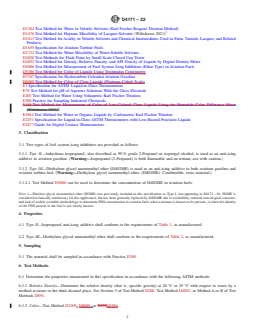
1. Scope* D268 Guide for Sampling and Testing Volatile Solvents and
Chemical Intermediates for Use in Paint and Related
1.1 Thisspecificationcoversadditivesforaviationfuels(for
Coatings and Material
example, Specifications D910, D7547, and D1655) used to
D891 TestMethodsforSpecificGravity,Apparent,ofLiquid
inhibit ice formation in aircraft fuel systems.
Industrial Chemicals
1.2 The values stated in SI units are to be regarded as
D910 Specification for Leaded Aviation Gasolines
standard. No other units of measurement are included in this
D1078 Test Method for Distillation Range of Volatile Or-
standard.
ganic Liquids
1.3 WARNING—Mercury has been designated by many
D1209 Test Method for Color of Clear Liquids (Platinum-
regulatory agencies as a hazardous substance that can cause Cobalt Scale)
serious medical issues. Mercury, or its vapor, has been dem-
D1296 Test Method for Odor of Volatile Solvents and
onstrated to be hazardous to health and corrosive to materials. Diluents (Withdrawn 2021)
Use Caution when handling mercury and mercury-containing
D1353 Test Method for Nonvolatile Matter in Volatile Sol-
products. See the applicable product Safety Data Sheet (SDS)
vents for Use in Paint, Varnish, Lacquer, and Related
for additional information. The potential exists that selling
Products
mercury or mercury-containing products, or both, is prohibited
D1364 Test Method for Water in Volatile Solvents (Karl
by local or national law. Users must determine legality of sales
Fischer Reagent Titration Method)
in their location.
D1476 Test Method for Heptane Miscibility of Lacquer
Solvents (Withdrawn 2021)
1.4 This standard does not purport to address all of the
D1613 Test Method for Acidity in Volatile Solvents and
safety concerns, if any, associated with its use. It is the
Chemical Intermediates Used in Paint, Varnish, Lacquer,
responsibility of the user of this standard to establish appro-
and Related Products
priate safety, health, and environmental practices and deter-
D1655 Specification for Aviation Turbine Fuels
mine the applicability of regulatory limitations prior to use.
D1722 Test Method for Water Miscibility of Water-Soluble
1.5 This international standard was developed in accor-
Solvents
dance with internationally recognized principles on standard-
D3828 Test Methods for Flash Point by Small Scale Closed
ization established in the Decision on Principles for the
Cup Tester
Development of International Standards, Guides and Recom-
D4052 Test Method for Density, Relative Density, and API
mendations issued by the World Trade Organization Technical
Gravity of Liquids by Digital Density Meter
Barriers to Trade (TBT) Committee.
D5006 Test Method for Measurement of Fuel System Icing
2. Referenced Documents
Inhibitors (Ether Type) in Aviation Fuels
2.1 ASTM Standards: D5386 Test Method for Color of Liquids Using Tristimulus
Colorimetry
D56 Test Method for Flash Point by Tag Closed Cup Tester
D93 Test Methods for Flash Point by Pensky-Martens D7547 Specification for Hydrocarbon Unleaded Aviation
Gasoline
Closed Cup Tester
D8005 Test Method for Color of Clear Liquids (Platinum-
Cobalt Scale)
This specification is under the jurisdiction of ASTM Committee D02 on
Petroleum Products, Liquid Fuels, and Lubricants and is the direct responsibility of
E1 Specification for ASTM Liquid-in-Glass Thermometers
Subcommittee D02.J0.04 on Additives and Electrical Properties.
E70 Test Method for pH of Aqueous Solutions With the
Current edition approved July 1, 2022. Published August 2022. Originally
Glass Electrode
approved in 1982. Last previous edition approved in 2021 as D4171 – 21. DOI:
10.1520/D4171-22.
For referenced ASTM standards, visit the ASTM website, www.astm.org, or
contact ASTM Customer Service at service@astm.org. For Annual Book of ASTM
Standards volume information, refer to the standard’s Document Summary page on The last approved version of this historical standard is referenced on
the ASTM website. www.astm.org.
*A Summary of Changes section appears at the end of this standard
Copyright © ASTM International, 100 Barr Harbor Drive, PO Box C700, West Conshohocken, PA 19428-2959. United States
D4171−22
TABLE 2 Detailed Requirements for Fuel System Icing Inhibitors
E203 Test Method for Water Using Volumetric Karl Fischer
(Type III)
Titration
Requirement
E300 Practice for Sampling Industrial Chemicals
Property ASTM Test
DiEGME
E1064 Test Method for Water in Organic Liquids by Coulo-
Method
(Type III)
metric Karl Fischer Titration
Acid number, max, mg 0.09 D1613
E2251 Specification for Liquid-in-Glass ASTM Thermom-
KOH/g
eters with Low-Hazard Precision Liquids
Color, platinum-cobalt, 10 D1209, D8005,or
max D5386
E2877 Guide for Digital Contact Thermometers
Purity, min, mass % 99.0 Annex A1
A
pH of 25 % solution in 5.5–7.5 E70
3. Classification
water (25 °C ± 2 °C)
Relative density, 1.020– D891 (Method A or
3.1 Twotypesoffuelsystemicinginhibitorsareprovidedas
20 °C ⁄20 °C 1.025 B) or D4052
follows:
Water, max, mass % D1364, E1064,or
E203
3.1.1 Type II—Anhydrous isopropanol, also described as
Point of manufacture 0.10
99 % grade 2-Propanol or isopropyl alcohol, is used as an
Point of use 0.8
anti-icing additive in aviation gasoline. (Warning—
Flash point, min, °C 85 °C D93, D56,or
D3828
Isopropanol (2-Propanol) is both flammable and an irritant; use
B
Antioxidant, mg/kg 50–150
with caution.)
A
Pipette 25 mL of the inhibitor into a 100 mL volumetric flask and filled with freshly
3.1.2 Type III—Diethylene glycol monomethyl ether (Di-
boiled and cooled distilled water having a pH of 6.5 to 7.5. Measure the pH value
EGME) is used as an anti-icing additive in both aviation
with a pH meter calibrated in accordance with Test Method E70.
B
Acceptable antioxidants are: 2,6-ditertiary-butyl-4-methylphenol, 2,4-dimethyl-6-
gasoline and aviation turbine fuel. (Warning—Diethylene
tertiary-butyl phenol, 2,6-ditertiary-butyl phenol, and 75 % min 2,6-ditertiary-butyl
glycol monomethyl ether, (DiEGME). Combustible, toxic
phenol plus 25 % max tertiary and tritertiary butyl phenols.
material.)
3.1.2.1 Test Method D5006 can be used to determine the
5. Sampling
concentration of DiEGME in aviation fuels.
5.1 The material shall be sampled in accordance with
NOTE 1—Ethylene glycol monomethyl ether (EGME) was previously
included in this specification as Type I, last appearing in D4171 – 94. Practice E300.
EGME is considered technically satisfactory for this application, but has
6. Test Methods
been generally replaced by DiEGME due to availability, reduced toxico-
logical concerns, and lack of widely available methodology to determine
6.1 Determine the properties enumerated in this specifica-
FSII concentration in aviation fuels when a mixture is known to be
tion in accordance with the following ASTM methods:
present, or when the identity of the FSII present in the fuel is not clearly
6.1.1 Relative Density—Determine the relative density (that
known.
is, specific gravity) at 20 °C or 25 °C with respect to water by
4. Properties
a method accurate to the third decimal place. See Section 5 of
Test Method D268, Test Method D4052, or Method A or B of
4.1 Type II—Isopropanol anti-icing additive shall conform
Test Methods D891.
to the requirements of Table 1, as manufactured.
6.1.2 Color—Test Method D1209, D8005,or D5386.
4.2 Type III—Diethylene glycol monomethyl ether shall
6.1.3 Distillation Range—Test Method D1078 usingASTM
conform to the requirements of Table 2, as manufactured.
Solvents Distillation Thermometers (40C with a range from
72 °C to 126 °C for isopropanol) conforming to the require-
ments of Specification E1 or any other temperature measuring
TABLE 1 Detailed Requirements for Isopropanol (99% Grade)
device that cover the temperature range of interest, such as
(Type II) FSII
thermocouples,thermistors,orresistancetemperaturedetectors
ASTM Test
Property Requirement
Method (RTDs). An instrument meeting Guide E2877 or Specification
Acidity, max, mg KOH/g 0.019 D1613 E2251 may be used in preference to 40C if the instrument
Relative density:
provides equivalent or better accuracy and precision.
20 °C ⁄20 °C 0.785 to 0.787 D268
6.1.4 Nonvolatile Matter—Test Method D1353.
25 °C ⁄25 °C 0.782 to 0.784 D268
Color, platinum-cobalt, max 10 D1209, D8005,
6.1.5 Odor—Test Method D1296.
or D5386
6.1.6 Water—Test Method D1364, E1064,or E203.
Distillation range, max, °C 1.5 (including 82.3 °C) D1078
6.1.7 Heptane Miscibility—Test Method D1476.
Nonvolatile matter, max, 5 D1353
mg/100 mL
6.1.8 Acidity—Test Method D1613.
Odor characteristic, nonresidual D1296
6.1.9 Water Miscibility—Test Method D1722.
Water, max, mass % 0.2 D1364
6.1.10 Flash Point—Test Methods D56, D93,or D3828.
Heptane miscibility at 20 °C miscible without turbidity with D1476
19 vol heptane (99 % Grade)
7. Keywords
Water miscibility at 25 °C miscible without turbidity when D1722
diluted with 10 vol distilled
7.1 additives; aircraft fuel systems; aviation fuels; fuel
water
system icing inhibitors; ice formation
D4171−22
ANNEX
(Mandatory Information)
A1. TEST METHOD FOR DETERMINING PURITY OF FUEL SYSTEM ICING INHIBITOR (TYPE III)
TABLE A1.1 Recommended Operating Conditions
A1.1 Scope
Column 30 M by 0.32 mm bonded phase 86 % methyl, 14
A1.1.1 This test method measures the purity of fuel system
cyanopropyl ’1701’ (1.0 µm film thickness)
icing inhibitors (Type III). The test results are used to deter-
fused-silica capillary column
Column temperature 100 °C initial temperature, programmed to 250 °C
mine if the inhibitor meets the purity requirements listed in
at 12 °C ⁄min
Table 2.
Injection system Split injection system which contains a glass
insert liner that is firmly packed with silylated
A1.2 Summary of Test Method
glass wool. The split ratio is 50:1 and the
injection temperature is 250 °C
A1.2.1 A representative sample of fuel system icing inhibi-
Detector Hydrogen flame ionization at 250 °C
Sample volume 0.5 µL with a 5 µL syringe
tor(TypeIII)isinjectedintoacapillarygaschromatographand
Carrier gas Helium at an average flow velocity of 20 cm/
the components of the inhibitor are separated and measured
second (propane elutes in 2.5 min with a
with a flame ionization detector. Quantitation is made by peak
column temperature of 60 °C) to give a flow rate
of −1 mL ⁄min
area measurement using external standardization and a com-
Make-up gas Helium at 20 mL ⁄min
puting integrator. As the linear dynamic range of many gas
Air flow 350 mL/min
chromatographic detectors is often exceeded for the major
Hydrogen flow 30 mL/min
component, the sum of all impurities (all components other
than the inhibitor) are subtracted from 100 to calculate the
purity of the icing inhibitor.
A1.5 Reagents
A1.3 Significance and Use
A1.5.1 Purity of Reagents—Use reagent grade ch
...
This document is not an ASTM standard and is intended only to provide the user of an ASTM standard an indication of what changes have been made to the previous version. Because
it may not be technically possible to adequately depict all changes accurately, ASTM recommends that users consult prior editions as appropriate. In all cases only the current version
of the standard as published by ASTM is to be considered the official document.
Designation: D4171 − 21 D4171 − 22
Standard Specification for
Fuel System Icing Inhibitors
This standard is issued under the fixed designation D4171; the number immediately following the designation indicates the year of
original adoption or, in the case of revision, the year of last revision. A number in parentheses indicates the year of last reapproval. A
superscript epsilon (´) indicates an editorial change since the last revision or reapproval.
1. Scope*
1.1 This specification covers additives for aviation fuels (for example, Specifications D910, D7547, and D1655) used to inhibit
ice formation in aircraft fuel systems.
1.2 The values stated in SI units are to be regarded as standard. No other units of measurement are included in this standard.
1.3 WARNING—Mercury has been designated by many regulatory agencies as a hazardous substance that can cause serious
medical issues. Mercury, or its vapor, has been demonstrated to be hazardous to health and corrosive to materials. Use Caution
when handling mercury and mercury-containing products. See the applicable product Safety Data Sheet (SDS) for additional
information. The potential exists that selling mercury or mercury-containing products, or both, is prohibited by local or national
law. Users must determine legality of sales in their location.
1.4 This standard does not purport to address all of the safety concerns, if any, associated with its use. It is the responsibility
of the user of this standard to establish appropriate safety, health, and environmental practices and determine the applicability of
regulatory limitations prior to use.
1.5 This international standard was developed in accordance with internationally recognized principles on standardization
established in the Decision on Principles for the Development of International Standards, Guides and Recommendations issued
by the World Trade Organization Technical Barriers to Trade (TBT) Committee.
2. Referenced Documents
2.1 ASTM Standards:
D56 Test Method for Flash Point by Tag Closed Cup Tester
D93 Test Methods for Flash Point by Pensky-Martens Closed Cup Tester
D268 Guide for Sampling and Testing Volatile Solvents and Chemical Intermediates for Use in Paint and Related Coatings and
Material
D891 Test Methods for Specific Gravity, Apparent, of Liquid Industrial Chemicals
D910 Specification for Leaded Aviation Gasolines
D1078 Test Method for Distillation Range of Volatile Organic Liquids
D1209 Test Method for Color of Clear Liquids (Platinum-Cobalt Scale)
D1296 Test Method for Odor of Volatile Solvents and Diluents (Withdrawn 2021)
D1353 Test Method for Nonvolatile Matter in Volatile Solvents for Use in Paint, Varnish, Lacquer, and Related Products
This specification is under the jurisdiction of ASTM Committee D02 on Petroleum Products, Liquid Fuels, and Lubricants and is the direct responsibility of Subcommittee
D02.J0.04 on Additives and Electrical Properties.
Current edition approved April 1, 2021July 1, 2022. Published April 2021August 2022. Originally approved in 1982. Last previous edition approved in 20162021 as
D4171 – 16a.D4171 – 21. DOI: 10.1520/D4171-21.10.1520/D4171-22.
For referenced ASTM standards, visit the ASTM website, www.astm.org, or contact ASTM Customer Service at service@astm.org. For Annual Book of ASTM Standards
volume information, refer to the standard’s Document Summary page on the ASTM website.
The last approved version of this historical standard is referenced on www.astm.org.
*A Summary of Changes section appears at the end of this standard
Copyright © ASTM International, 100 Barr Harbor Drive, PO Box C700, West Conshohocken, PA 19428-2959. United States
D4171 − 22
D1364 Test Method for Water in Volatile Solvents (Karl Fischer Reagent Titration Method)
D1476 Test Method for Heptane Miscibility of Lacquer Solvents (Withdrawn 2021)
D1613 Test Method for Acidity in Volatile Solvents and Chemical Intermediates Used in Paint, Varnish, Lacquer, and Related
Products
D1655 Specification for Aviation Turbine Fuels
D1722 Test Method for Water Miscibility of Water-Soluble Solvents
D3828 Test Methods for Flash Point by Small Scale Closed Cup Tester
D4052 Test Method for Density, Relative Density, and API Gravity of Liquids by Digital Density Meter
D5006 Test Method for Measurement of Fuel System Icing Inhibitors (Ether Type) in Aviation Fuels
D5386 Test Method for Color of Liquids Using Tristimulus Colorimetry
D7547 Specification for Hydrocarbon Unleaded Aviation Gasoline
D8005 Test Method for Color of Clear Liquids (Platinum-Cobalt Scale)
E1 Specification for ASTM Liquid-in-Glass Thermometers
E70 Test Method for pH of Aqueous Solutions With the Glass Electrode
E203 Test Method for Water Using Volumetric Karl Fischer Titration
E300 Practice for Sampling Industrial Chemicals
E450 Test Method for Measurement of Color of Low-Colored Clear Liquids Using the Hunterlab Color Difference Meter
(Withdrawn 1993)
E1064 Test Method for Water in Organic Liquids by Coulometric Karl Fischer Titration
E2251 Specification for Liquid-in-Glass ASTM Thermometers with Low-Hazard Precision Liquids
E2877 Guide for Digital Contact Thermometers
3. Classification
3.1 Two types of fuel system icing inhibitors are provided as follows:
3.1.1 Type II—Anhydrous isopropanol, also described as 99 % grade 2-Propanol or isopropyl alcohol, is used as an anti-icing
additive in aviation gasoline. (Warning—Isopropanol (2-Propanol) is both flammable and an irritant; use with caution.)
3.1.2 Type III—Diethylene glycol monomethyl ether (DiEGME) is used as an anti-icing additive in both aviation gasoline and
aviation turbine fuel. (Warning—Diethylene glycol monomethyl ether, (DiEGME). Combustible, toxic material.)
3.1.2.1 Test Method D5006 can be used to determine the concentration of DiEGME in aviation fuels.
NOTE 1—Ethylene glycol monomethyl ether (EGME) was previously included in this specification as Type I, last appearing in D4171 – 94. EGME is
considered technically satisfactory for this application, but has been generally replaced by DiEGME due to availability, reduced toxicological concerns,
and lack of widely available methodology to determine FSII concentration in aviation fuels when a mixture is known to be present, or when the identity
of the FSII present in the fuel is not clearly known.
4. Properties
4.1 Type II—Isopropanol anti-icing additive shall conform to the requirements of Table 1, as manufactured.
4.2 Type III—Diethylene glycol monomethyl ether shall conform to the requirements of Table 2, as manufactured.
5. Sampling
5.1 The material shall be sampled in accordance with Practice E300.
6. Test Methods
6.1 Determine the properties enumerated in this specification in accordance with the following ASTM methods:
6.1.1 Relative Density—Determine the relative density (that is, specific gravity) at 20 °C or 25 °C with respect to water by a
method accurate to the third decimal place. See Section 5 of Test Method D268, Test Method D4052, or Method A or B of Test
Methods D891.
6.1.2 Color—Test Method D1209, D8005, or E450D5386.
D4171 − 22
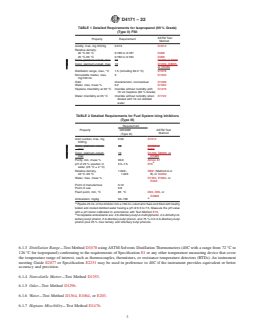
TABLE 1 Detailed Requirements for Isopropanol (99 % Grade)
(Type II) FSII
ASTM Test
Property Requirement
Method
Acidity, max, mg KOH/g 0.019 D1613
Relative density:
20 °C ⁄20 °C 0.785 to 0.787 D268
25 °C ⁄25 °C 0.782 to 0.784 D268
Color, platinum-cobalt, max 10 D1209 or E450
Color, platinum-cobalt, max 10 D1209, D8005,
or D5386
Distillation range, max, °C 1.5 (including 82.3 °C) D1078
Nonvolatile matter, max, 5 D1353
mg/100 mL
Odor characteristic, nonresidual D1296
Water, max, mass % 0.2 D1364
Heptane miscibility at 20 °C miscible without turbidity with D1476
19 vol heptane (99 % Grade)
Water miscibility at 25 °C miscible without turbidity when D1722
diluted with 10 vol distilled
water
TABLE 2 Detailed Requirements for Fuel System Icing Inhibitors
(Type III)
Requirement
Property ASTM Test
DiEGME
Method
(Type III)
Acid number, max, mg 0.09 D1613
KOH/g
Color, platinum-cobalt, 10 D1209 or
max E450
Color, platinum-cobalt, 10 D1209, D8005, or
max D5386
Purity, min, mass % 99.0 Annex A1
A
pH of 25 % solution in 5.5–7.5 E70
water (25 °C ± 2 °C)
Relative density, 1.020– D891 (Method A or
20 °C ⁄20 °C 1.025 B) or D4052
Water, max, mass % D1364, E1064, or
E203
Point of manufacture 0.10
Point of use 0.8
Flash point, min, °C 85 °C D93, D56, or
D3828
B
Antioxidant, mg/kg 50–150
A
Pipette 25 mL of the inhibitor into a 100 mL volumetric flask and filled with freshly
boiled and cooled distilled water having a pH of 6.5 to 7.5. Measure the pH value
with a pH meter calibrated in accordance with Test Method E70.
B
Acceptable antioxidants are: 2,6-ditertiary-butyl-4-methylphenol, 2,4-dimethyl-6-
tertiary-butyl phenol, 2,6-ditertiary-butyl phenol, and 75 % min 2,6-ditertiary-butyl
phenol plus 25 % max tertiary and tritertiary butyl phenols.
6.1.3 Distillation Range—Test Method D1078 using ASTM Solvents Distillation Thermometers (40C with a range from 72 °C to
126 °C for isopropanol) conforming to the requirements of Specification E1 or any other temperature measuring device that cover
the temperature range of interest, such as thermocouples, thermistors, or resistance temperature detectors (RTDs). An instrument
meeting Guide E2877 or Specification E2251 may be used in preference to 40C if the instrument provides equivalent or better
accuracy and precision.
6.1.4 Nonvolatile Matter—Test Method D1353.
6.1.5 Odor—Test Method D1296.
6.1.6 Water—Test Method D1364, E1064, or E203.
6.1.7 Heptane Miscibility—Test Method D1476.
D4171 − 22
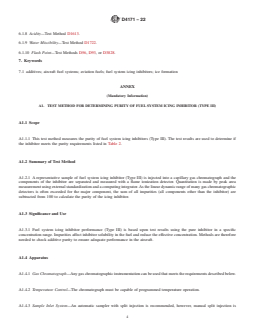
6.1.8 Acidity—Test Method D1613.
6.1.9 Water Miscibility—Test Method D1722.
6.1.10 Flash Point—Test Methods D56, D93, or D3828.
7. Keywords
7.1 additives; aircraft fuel systems; aviation fuels; fuel system icing inhibitors; ice formation
ANNEX
(Mandatory Information)
A1. TEST METHOD FOR DETERMINING PURITY OF FUEL SYSTEM ICING INHIBITOR (TYPE III)
A1.1 Scope
A1.1.1 This test method measures the purity of fuel system icing inhibitors (Type III). The test results are used to determine if
the inhibitor meets the purity requirements listed in Table 2.
A1.2 Summary of Test Method
A1.2.1 A representative sample of fuel system icing inhibitor (Type III) is injected into a capillary gas chromatograph and the
components of the inhibitor are separated and measured with a flame ionization detector. Quantitation is made by peak area
measurement using external standardization and a computing integrator. As the linear dynamic range of many gas chromatographic
detectors is often exceeded for the major component, the sum of all impurities (all components other than the inhibitor) are
subtracted from 100 to calculate the purity of the icing inhibitor.
A1.3 Significance and Use
A1.3.1 Fuel system icing inhibitor performance (Type III) is based upon test results using the pure inhibitor in a specific
concentration range. Impurities affect inhibitor solubility in the fuel and reduce the effective concentration. Methods are therefore
needed to check additive purity to ensure adequate performance in the aircraft.
A1.4 Apparatus
A1.4.1 Gas Chromatograph—Any gas chromatographic instrumentation can be used that meets the requirements described below.
A1.4.2 Temperature Control—The chromatograph must be capable of programmed temperature operation.
A1.4.3 Sample Inlet System—An automatic sampler with split injection is recommended, however, manual split injection is
-------
...