

ASTM A530/A530M-18
(Specification)Standard Specification for General Requirements for Specialized Carbon and Alloy Steel Pipe
General Information
- Abstract
ABSTRACT
This specification covers a general requirements for specialized carbon and alloy steel pipe. Tensile tests, tension tests, flattening tests, hydrostatic tests and ultrasonic tests shall be made to conform to the requirements specified. If the mechanical results do not conform to the requirements specified, retests shall be made. Defects in seamless pipe shall be repaired by welding.
SCOPE
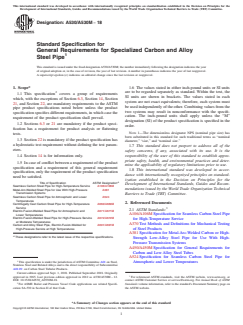
1.1 This specification2 covers a group of requirements which, with the exceptions of Section 6.3, Section 14, Section 21, and Section 22, are mandatory requirements to the ASTM pipe product specifications noted below unless the product specification specifies different requirements, in which case the requirement of the product specification shall prevail.
1.2 Sections 6.3 or 21 are mandatory if the product specification has a requirement for product analysis or flattening tests.
1.3 Section 22 is mandatory if the product specification has a hydrostatic test requirement without defining the test parameters.
1.4 Section 14 is for information only.
1.5 In case of conflict between a requirement of the product specification and a requirement of this general requirement specification, only the requirement of the product specification need be satisfied.
Title of Specification
ASTM DesignationA
Seamless Carbon Steel Pipe for High-Temperature Service
A106/A106M
Metal-Arc-Welded Steel Pipe for Use With High-Pressure
Transmission Systems
A381
Seamless Carbon Steel Pipe for Atmospheric and Lower
Temperatures
A524
Centrifugally Cast Carbon Steel Pipe for High-Temperature
Service
A660/A660M
Electric-Fusion-Welded Steel Pipe for Atmospheric and
Lower Temperatures
A671/A671M
Electric-Fusion-Welded Steel Pipe for High-Pressure Service
at Moderate Temperatures
A672/A672M
Carbon and Alloy Steel Pipe, Electric-Fusion-Welded for
High-Pressure Service at High Temperatures
A691/A691M
1.6 The values stated in either inch-pound units or SI units are to be regarded separately as standard. Within the text, the SI units are shown in brackets. The values stated in each system are not exact equivalents; therefore, each system must be used independently of the other. Combining values from the two systems may result in nonconformance with the specification. The inch-pound units shall apply unless the “M” designation (SI) of the product specification is specified in the order.
Note 1: The dimensionless designator NPS (nominal pipe size) has been substituted in this standard for such traditional terms as “nominal diameter,” “size,” and “nominal size.”
1.7 This standard does not purport to address all of the safety concerns, if any, associated with its use. It is the responsibility of the user of this standard to establish appropriate safety, health, and environmental practices and determine the applicability of regulatory limitations prior to use.
1.8 This international standard was developed in accordance with internationally recognized principles on standardization established in the Decision on Principles for the Development of International Standards, Guides and Recommendations issued by the World Trade Organization Technical Barriers to Trade (TBT) Committee.
- Status
- Published
- Publication Date
- 31-Aug-2018
- Technical Committee
- A01 - Steel, Stainless Steel and Related Alloys
- Drafting Committee
- A01.09 - Carbon Steel Tubular Products
Buy Documents
ASTM A530/A530M-18 - Standard Specification for General Requirements for Specialized Carbon and Alloy Steel Pipe

REDLINE ASTM A530/A530M-18 - Standard Specification for General Requirements for Specialized Carbon and Alloy Steel Pipe
Overview
ASTM A530/A530M-18 is the globally recognized standard specification for the general requirements of specialized carbon and alloy steel pipe. Published by ASTM International, this standard establishes a unified set of minimum requirements that apply to carbon and alloy steel pipes covered by various specific ASTM product specifications, unless otherwise directed within those individual standards. ASTM A530/A530M ensures consistency and reliability in pipe manufacturing, mechanical testing, dimensional tolerances, marking, inspection, and certification.
This standard is widely referenced in the manufacturing, procurement, and use of steel pipe across industries such as oil and gas, energy, construction, and infrastructure. ASTM A530/A530M is an essential baseline for ensuring quality, safety, and compliance for seamless, welded, and cast steel pipe used in specialized applications.
Key Topics
Essential provisions covered by ASTM A530/A530M-18 include:
- Mandatory General Requirements: Applies to various ASTM pipe product specifications unless those specification dictate otherwise.
- Testing Requirements:
- Mechanical testing (including tensile and tension tests)
- Flattening and hydrostatic tests
- Ultrasonic and nondestructive tests
- Provisions for retesting and retreatment if initial results are nonconforming.
- Repair and Workmanship: Defects in seamless pipes may be repaired by welding, provided repairs adhere to specified requirements and are appropriately marked.
- Dimensional Tolerances:
- Specifies permissible variations in weight, wall thickness, inside and outside diameter, and length.
- Defines ovality and straightness allowances.
- Product Marking and Traceability: Each pipe must be clearly and durably marked for easy identification and traceability.
- Material Certification: Requires documentation certifying compliance with all relevant requirements, including specifics such as heat number, analysis, mechanical properties, and test results.
Applications
ASTM A530/A530M-18 serves as a foundational standard for a variety of steel pipe products used in:
- High-temperature and High-pressure Environments: Commonly used in power plants, refineries, and petrochemical facilities.
- Oil and Gas Transmission: Carbon and alloy steel pipes manufactured to this standard are vital in pipelines designed for the transmission of petroleum, natural gas, and other fluids.
- Industrial and Structural Uses: The specification supports the consistent production and quality control needed for infrastructure, mechanical, and construction applications.
- Compliance and Procurement: Frequently cited in manufacturing contracts and procurement documents to ensure pipe quality, performance, and traceability.
By adhering to ASTM A530/A530M, manufacturers and purchasers promote product uniformity, safety, and standardized acceptance criteria across global supply chains.
Related Standards
ASTM A530/A530M supports and references multiple product-specific standards for carbon and alloy steel pipe manufacture. Notable related standards include:
- ASTM A106/A106M - For seamless carbon steel pipe for high-temperature service
- ASTM A381 - For metal-arc-welded steel pipe used in high-pressure transmission systems
- ASTM A524 - For seamless carbon steel pipe for atmospheric and lower temperatures
- ASTM A660/A660M - For centrifugally cast carbon steel pipe for high-temperature service
- ASTM A671/A671M - For electric-fusion-welded steel pipe, atmospheric and lower temperatures
- ASTM A672/A672M - For electric-fusion-welded steel pipe for high-pressure service at moderate temperatures
- ASTM A691/A691M - For carbon and alloy steel pipe, electric-fusion-welded for high-pressure, high-temperature service
In addition, the standard cites important testing and terminology documents such as ASTM A370, A751, and A941, and aligns with ANSI/ASME B36.10 and B36.19 for pipe dimensions.
Keywords: ASTM A530, steel pipe standard, general requirements for steel pipe, carbon and alloy steel pipe, pipe testing, pipe tolerances, pipe marking, pipe certification, ASTM pipe standards.
Relations
- Effective Date
- 01-Mar-2024
- Effective Date
- 01-Mar-2024
- Effective Date
- 01-Nov-2023
- Effective Date
- 01-Oct-2023
- Effective Date
- 01-Mar-2020
- Effective Date
- 01-Nov-2019
- Effective Date
- 01-Nov-2019
- Effective Date
- 01-Nov-2019
- Effective Date
- 01-Nov-2019
- Effective Date
- 01-Nov-2019
- Effective Date
- 01-Jul-2019
- Effective Date
- 01-Nov-2018
- Effective Date
- 01-Sep-2018
- Effective Date
- 01-May-2018
- Effective Date
- 01-Mar-2018
Buy Documents
ASTM A530/A530M-18 - Standard Specification for General Requirements for Specialized Carbon and Alloy Steel Pipe
REDLINE ASTM A530/A530M-18 - Standard Specification for General Requirements for Specialized Carbon and Alloy Steel Pipe
Get Certified
Connect with accredited certification bodies for this standard

Institut za varilstvo d.o.o. (Welding Institute)
Slovenia's leading welding institute since 1952. ISO 3834, EN 1090, pressure equipment certification, NDT personnel, welder qualification. Only IIW Au
Sponsored listings
Frequently Asked Questions
ASTM A530/A530M-18 is a technical specification published by ASTM International. Its full title is "Standard Specification for General Requirements for Specialized Carbon and Alloy Steel Pipe". This standard covers: ABSTRACT This specification covers a general requirements for specialized carbon and alloy steel pipe. Tensile tests, tension tests, flattening tests, hydrostatic tests and ultrasonic tests shall be made to conform to the requirements specified. If the mechanical results do not conform to the requirements specified, retests shall be made. Defects in seamless pipe shall be repaired by welding. SCOPE 1.1 This specification2 covers a group of requirements which, with the exceptions of Section 6.3, Section 14, Section 21, and Section 22, are mandatory requirements to the ASTM pipe product specifications noted below unless the product specification specifies different requirements, in which case the requirement of the product specification shall prevail. 1.2 Sections 6.3 or 21 are mandatory if the product specification has a requirement for product analysis or flattening tests. 1.3 Section 22 is mandatory if the product specification has a hydrostatic test requirement without defining the test parameters. 1.4 Section 14 is for information only. 1.5 In case of conflict between a requirement of the product specification and a requirement of this general requirement specification, only the requirement of the product specification need be satisfied. Title of Specification ASTM DesignationA Seamless Carbon Steel Pipe for High-Temperature Service A106/A106M Metal-Arc-Welded Steel Pipe for Use With High-Pressure Transmission Systems A381 Seamless Carbon Steel Pipe for Atmospheric and Lower Temperatures A524 Centrifugally Cast Carbon Steel Pipe for High-Temperature Service A660/A660M Electric-Fusion-Welded Steel Pipe for Atmospheric and Lower Temperatures A671/A671M Electric-Fusion-Welded Steel Pipe for High-Pressure Service at Moderate Temperatures A672/A672M Carbon and Alloy Steel Pipe, Electric-Fusion-Welded for High-Pressure Service at High Temperatures A691/A691M 1.6 The values stated in either inch-pound units or SI units are to be regarded separately as standard. Within the text, the SI units are shown in brackets. The values stated in each system are not exact equivalents; therefore, each system must be used independently of the other. Combining values from the two systems may result in nonconformance with the specification. The inch-pound units shall apply unless the “M” designation (SI) of the product specification is specified in the order. Note 1: The dimensionless designator NPS (nominal pipe size) has been substituted in this standard for such traditional terms as “nominal diameter,” “size,” and “nominal size.” 1.7 This standard does not purport to address all of the safety concerns, if any, associated with its use. It is the responsibility of the user of this standard to establish appropriate safety, health, and environmental practices and determine the applicability of regulatory limitations prior to use. 1.8 This international standard was developed in accordance with internationally recognized principles on standardization established in the Decision on Principles for the Development of International Standards, Guides and Recommendations issued by the World Trade Organization Technical Barriers to Trade (TBT) Committee.
ABSTRACT This specification covers a general requirements for specialized carbon and alloy steel pipe. Tensile tests, tension tests, flattening tests, hydrostatic tests and ultrasonic tests shall be made to conform to the requirements specified. If the mechanical results do not conform to the requirements specified, retests shall be made. Defects in seamless pipe shall be repaired by welding. SCOPE 1.1 This specification2 covers a group of requirements which, with the exceptions of Section 6.3, Section 14, Section 21, and Section 22, are mandatory requirements to the ASTM pipe product specifications noted below unless the product specification specifies different requirements, in which case the requirement of the product specification shall prevail. 1.2 Sections 6.3 or 21 are mandatory if the product specification has a requirement for product analysis or flattening tests. 1.3 Section 22 is mandatory if the product specification has a hydrostatic test requirement without defining the test parameters. 1.4 Section 14 is for information only. 1.5 In case of conflict between a requirement of the product specification and a requirement of this general requirement specification, only the requirement of the product specification need be satisfied. Title of Specification ASTM DesignationA Seamless Carbon Steel Pipe for High-Temperature Service A106/A106M Metal-Arc-Welded Steel Pipe for Use With High-Pressure Transmission Systems A381 Seamless Carbon Steel Pipe for Atmospheric and Lower Temperatures A524 Centrifugally Cast Carbon Steel Pipe for High-Temperature Service A660/A660M Electric-Fusion-Welded Steel Pipe for Atmospheric and Lower Temperatures A671/A671M Electric-Fusion-Welded Steel Pipe for High-Pressure Service at Moderate Temperatures A672/A672M Carbon and Alloy Steel Pipe, Electric-Fusion-Welded for High-Pressure Service at High Temperatures A691/A691M 1.6 The values stated in either inch-pound units or SI units are to be regarded separately as standard. Within the text, the SI units are shown in brackets. The values stated in each system are not exact equivalents; therefore, each system must be used independently of the other. Combining values from the two systems may result in nonconformance with the specification. The inch-pound units shall apply unless the “M” designation (SI) of the product specification is specified in the order. Note 1: The dimensionless designator NPS (nominal pipe size) has been substituted in this standard for such traditional terms as “nominal diameter,” “size,” and “nominal size.” 1.7 This standard does not purport to address all of the safety concerns, if any, associated with its use. It is the responsibility of the user of this standard to establish appropriate safety, health, and environmental practices and determine the applicability of regulatory limitations prior to use. 1.8 This international standard was developed in accordance with internationally recognized principles on standardization established in the Decision on Principles for the Development of International Standards, Guides and Recommendations issued by the World Trade Organization Technical Barriers to Trade (TBT) Committee.
ASTM A530/A530M-18 is classified under the following ICS (International Classification for Standards) categories: 23.040.10 - Iron and steel pipes. The ICS classification helps identify the subject area and facilitates finding related standards.
ASTM A530/A530M-18 has the following relationships with other standards: It is inter standard links to ASTM A941-24, ASTM A370-24, ASTM A450/A450M-23, ASTM D3951-18(2023), ASTM A671/A671M-20, ASTM A672/A672M-19, ASTM A106/A106M-19a, ASTM A671/A671M-19, ASTM A700-14(2019), ASTM A691/A691M-19, ASTM A370-19, ASTM A691/A691M-18a, ASTM A450/A450M-18, ASTM D3951-18, ASTM A691/A691M-18. Understanding these relationships helps ensure you are using the most current and applicable version of the standard.
ASTM A530/A530M-18 is available in PDF format for immediate download after purchase. The document can be added to your cart and obtained through the secure checkout process. Digital delivery ensures instant access to the complete standard document.
Standards Content (Sample)
This international standard was developed in accordance with internationally recognized principles on standardization established in the Decision on Principles for the
Development of International Standards, Guides and Recommendations issued by the World Trade Organization Technical Barriers to Trade (TBT) Committee.
Designation:A530/A530M −18
Standard Specification for
General Requirements for Specialized Carbon and Alloy
Steel Pipe
This standard is issued under the fixed designationA530/A530M; the number immediately following the designation indicates the year
of original adoption or, in the case of revision, the year of last revision.Anumber in parentheses indicates the year of last reapproval.
A superscript epsilon (´) indicates an editorial change since the last revision or reapproval.
1. Scope* 1.6 The values stated in either inch-pound units or SI units
2 are to be regarded separately as standard. Within the text, the
1.1 This specification covers a group of requirements
SI units are shown in brackets. The values stated in each
which, with the exceptions of Section 6.3, Section 14, Section
system are not exact equivalents; therefore, each system must
21, and Section 22, are mandatory requirements to theASTM
beusedindependentlyoftheother.Combiningvaluesfromthe
pipe product specifications noted below unless the product
two systems may result in nonconformance with the specifi-
specificationspecifiesdifferentrequirements,inwhichcasethe
cation. The inch-pound units shall apply unless the “M”
requirement of the product specification shall prevail.
designation (SI) of the product specification is specified in the
1.2 Sections 6.3 or 21 are mandatory if the product speci-
order.
fication has a requirement for product analysis or flattening
NOTE 1—The dimensionless designator NPS (nominal pipe size) has
tests.
been substituted in this standard for such traditional terms as “nominal
1.3 Section 22 is mandatory if the product specification has diameter,” “size,” and “nominal size.”
a hydrostatic test requirement without defining the test param-
1.7 This standard does not purport to address all of the
eters.
safety concerns, if any, associated with its use. It is the
responsibility of the user of this standard to establish appro-
1.4 Section 14 is for information only.
priate safety, health, and environmental practices and deter-
1.5 In case of conflict between a requirement of the product
mine the applicability of regulatory limitations prior to use.
specification and a requirement of this general requirement
1.8 This international standard was developed in accor-
specification, only the requirement of the product specification
dance with internationally recognized principles on standard-
need be satisfied.
ization established in the Decision on Principles for the
A
Title of Specification ASTM Designation
Development of International Standards, Guides and Recom-
Seamless Carbon Steel Pipe for High-Temperature Service A106/A106M
mendations issued by the World Trade Organization Technical
Metal-Arc-Welded Steel Pipe for Use With High-Pressure A381
Transmission Systems
Barriers to Trade (TBT) Committee.
Seamless Carbon Steel Pipe for Atmospheric and Lower A524
Temperatures
2. Referenced Documents
Centrifugally Cast Carbon Steel Pipe for High-Temperature A660/A660M
Service
2.1 ASTM Standards:
Electric-Fusion-Welded Steel Pipe for Atmospheric and A671/A671M
Lower Temperatures A106/A106MSpecification for Seamless Carbon Steel Pipe
Electric-Fusion-Welded Steel Pipe for High-Pressure Service A672/A672M
for High-Temperature Service
at Moderate Temperatures
A370Test Methods and Definitions for Mechanical Testing
Carbon and Alloy Steel Pipe, Electric-Fusion-Welded for A691/A691M
High-Pressure Service at High Temperatures of Steel Products
A381Specification for Metal-Arc-Welded Carbon or High-
A
These designations refer to the latest issue of the respective specifications.
Strength Low-Alloy Steel Pipe for Use With High-
Pressure Transmission Systems
A450/A450MSpecification for General Requirements for
Carbon and Low Alloy Steel Tubes
A524Specification for Seamless Carbon Steel Pipe for
This specification is under the jurisdiction ofASTM Committee A01 on Steel,
Atmospheric and Lower Temperatures
Stainless Steel and RelatedAlloysand is the direct responsibility of Subcommittee
A01.09 on Carbon Steel Tubular Products.
Current edition approved Sept. 1, 2018. Published September 2018. Originally
approved in 1965. Last previous edition approved in 2012 as A530/A530M–12. For referenced ASTM standards, visit the ASTM website, www.astm.org, or
DOI: 10.1520/A0530_A0530M-18. contact ASTM Customer Service at service@astm.org. For Annual Book of ASTM
For ASME Boiler and Pressure Vessel Code applications see related Specifi- Standards volume information, refer to the standard’s Document Summary page on
cation SA-530 in Section II of that Code. the ASTM website.
*A Summary of Changes section appears at the end of this standard
Copyright © ASTM International, 100 Barr Harbor Drive, PO Box C700, West Conshohocken, PA 19428-2959. United States
A530/A530M−18
A660/A660MSpecification for Centrifugally Cast Carbon 4. Ordering Information
Steel Pipe for High-Temperature Service
4.1 It shall be the responsibility of the purchaser to specify
A671/A671M Specification for Electric-Fusion-Welded
all requirements necessary for product under this specification.
Steel Pipe for Atmospheric and Lower Temperatures
Suchrequirementstobeconsideredinclude,butarenotlimited
A672/A672M Specification for Electric-Fusion-Welded
to, the following:
Steel Pipe for High-Pressure Service at Moderate Tem-
4.1.1 Quantity (feet, meters, or number of lengths),
peratures
4.1.2 Specification number with grade or class, or both, as
A691/A691MSpecificationforCarbonandAlloySteelPipe,
applicable and year date,
Electric-Fusion-WeldedforHigh-PressureServiceatHigh
4.1.3 Manufacture (hot-finished or cold drawn),
Temperatures
4.1.4 Size(NPS[DN]andweightclassorschedulenumber,
A700Guide for Packaging, Marking, and Loading Methods
orboth;outsidediameterandnominalwallthickness;orinside
for Steel Products for Shipment
diameter and nominal wall thickness),
A751Test Methods, Practices, and Terminology for Chemi-
4.1.5 Length (specific or random),
cal Analysis of Steel Products
4.1.6 Choice of testing track from the options listed in Test
A941TerminologyRelatingtoSteel,StainlessSteel,Related
Methods A1058 when material is ordered to an M suffix (SI
Alloys, and Ferroalloys
units) product standard. If the choice of test track is not
A1058 Test Methods for Mechanical Testing of Steel
specifiedintheorder,thenthedefaultASTMtesttrackshallbe
Products—Metric
used as noted in Test Methods A1058,
D3951Practice for Commercial Packaging
4.1.7 Supplementary Requirements, and
E29Practice for Using Significant Digits in Test Data to
4.1.8 Additional requirements.
Determine Conformance with Specifications
2.2 ASME Standards:
5. Process
B36.10 Welded and Seamless Wrought Steel Pipe
5.1 The steel shall be made from any process.
B36.19 Stainless Steel Pipe
5.2 Ifaspecifictypeofmeltingisrequiredbythepurchaser,
2.3 Military Standards:
it shall be stated on the purchase order.
MIL-STD-163 Steel Mill Products Preparation for Ship-
ment and Storage
5.3 The primary melting may incorporate separate degas-
MIL-STD-271 Nondestructive Testing Requirements for
sing or refining and may be followed by secondary melting,
Metals
using electroslag remelting or vacuum remelting.
MIL-STD-792 Identification Marking Requirements for
5.4 Steel may be cast in ingots or may be strand cast.When
Special Purpose Components
steel of different grades is sequentially strand cast, identifica-
2.4 Federal Standards:
tion of the resultant transition material is required. The
Fed.Std.No.183ContinuousIdentificationMarkingofIron
producer shall remove the transition material by an established
and Steel Products
procedure that positively separates the grades.
2.5 Steel Structures Painting Council:
SSPC-SP6Surface Preparation Specification No. 6 Com-
6. Chemical Composition
mercial Blast Cleaning
6.1 Chemical Analysis—Samples for chemical analysis and
method of analysis shall be in accordance with Test Methods,
3. Terminology
Practices, and Terminology A751.
3.1 Definitions of Terms Specific to This Standard:
6.2 Heat Analysis—If the heat analysis reported by the steel
3.1.1 remelted heat, n—in secondary melting, all of the
producer is not sufficiently complete for conformance with the
ingots remelted from a single primary heat.
heat analysis requirements of the applicable product specifica-
3.1.2 jointer, n—a length of pipe created by welding two or
tion to be fully assessed, the manufacturer may complete the
more shorter lengths of pipe, end-to-end.
assessment of conformance with such heat analysis require-
3.1.3 thin-wall pipe, n—a pipe having a wall thickness of
ments by using a product analysis for the specified elements
3% or less of the outside diameter.
that were not reported by the steel producer, provided that
product analysis tolerances are not applied and the heat
3.2 Other defined terms—The definitions in Test Methods
analysis is not altered.
and Definitions A370, Test Methods, Practices, and Terminol-
6.2.1 For steels ordered under product specifications refer-
ogy A751, and Terminology A941 are applicable to this
encingthisspecificationofgeneralrequirements,thesteelshall
specification and to those listed in 1.5.
not contain an unspecified element for the ordered grade to the
extent that the steel conforms to the requirements of another
Available from American Society of Mechanical Engineers (ASME), ASME
grade for which that element is a specified element having a
International Headquarters, Two Park Ave., New York, NY 10016-5990, http://
required minimum content. For this requirement, a grade is
www.asme.org.
Available from Standardization Documents Order Desk, DODSSP, Bldg. 4,
defined as an alloy described individually and identified by its
Section D, 700 Robbins Ave., Philadelphia, PA 19111-5098, http://
own UNS designation in a table of chemical requirements
dodssp.daps.dla.mil.
within any specification listed within the scope as being
Available from Society for Protective Coatings (SSPC), 40 24th St., 6th Floor,
Pittsburgh, PA 15222-4656, http://www.sspc.org. covered by this specification.
A530/A530M−18
6.3 Product Analysis—Product analysis requirements and weld area shall not be limited by the over tolerance. The
options, if any, are contained in the product specification. minimum wall thickness on inspection for – 12.5% is shown
in Table X1.1.
7. Mechanical Requirements
10.2 Forged and Bored—The wall thickness shall not vary
7.1 Method of Mechanical Tests—The specimens and the 1
overthatspecifiedbymorethan ⁄8in.[3.2mm].Thereshallbe
mechanical tests required shall be made in accordance with
no variation under the specified wall thickness.
AnnexA2ofTestMethodsandDefinitionsA370ifinch-pound
10.3 Cast—The wall thickness shall not vary over that
units are specified, or to the requirements described in the
specified by more than ⁄16in. [1.6 mm]. There shall be no
applicable track of Test Methods A1058, if SI units are
variation under the specified wall thickness.
specified.
7.2 Specimens shall be tested at room temperature.
11. Permissible Variations in Inside Diameter
7.3 Small or subsize specimens as described in Test Meth-
11.1 Forged and Bored, and Cast—The inside diameter
odsandDefinitionsA370orTestMethodsA1058maybeused
shall not vary under that specified by more than ⁄16 in. [1.6
only when there is insufficient material to prepare one of the
mm]. There shall be no variation over the specified inside
standard specimens. When using small or subsize specimens,
diameter.
the largest one possible shall be used.
12. Permissible Variations in Outside Diameter
8. Tensile Requirements
12.1 Variations in outside diameter, unless otherwise
8.1 The material shall conform to the requirements as to
specified,shallnotexceedthelimitsprescribedinTable2.The
tensile properties prescribed in the individual specifications.
tolerances on outside diameter include ovality except as
provided for in 12.2.
8.2 The yield strength corresponding to a permanent offset
of 0.2% of the gage length or to a total extension of 0.5% of
12.2 Thin-wall pipe usually develops significant ovality
the gage length under load shall be determined.
(out-of-roundness) during final annealing, straightening, or
both. The diameter tolerances of Table 2 are not sufficient to
8.3 If the percentage of elongation of any test specimen is
provide for additional ovality expected in thin-wall pipe and
lessthanthatspecifiedandanypartofthefractureismorethan
are applicable only to the mean of the extreme (maximum and
⁄4in. [19.0 mm] from the center of the gage length, as
minimum) outside diameter readings in any one cross-section.
indicated by scribe marks on the specimen before testing, a
However, for thin-wall pipe the difference in extreme outside
retest shall be allowed.
diameter readings (ovality) in any one cross-section shall not
9. Permissible Variation in Weight
exceed 1.5% of the specified outside diameter.
9.1 The weight of any length of pipe NPS 12 [DN 300] and
13. Permissible Variations in Length
under shall not vary more than 10% over or 3.5% under that
13.1 Seamless and Welded (no filler metal added)—If defi-
specified. For sizes over NPS 12 [DN 300], the weight of any
nitecutlengthsareordered,nolengthofpipeshallbeunderthe
lengthofpipeshallnotvarymorethan10%overor5%under
length specified and not more than ⁄4 in. [6 mm] over that
that specified. Unless otherwise specified, pipe of NPS 4 [DN
specified.
100] and smaller may be weighed in convenient lots; pipe in
sizes larger than NPS 4 [DN 100] shall be weighed separately.
13.2 Forged and Bored, Cast, and Cast Cold-Wrought—If
definite cut lengths are ordered, no length of pipe shall be
10. Permissible Variations in Wall Thickness
underthelengthspecifiedandnotmorethan ⁄8in.[3mm]over
10.1 Seamless and Welded (no filler metal added)—The
that specified.
minimum wall thickness at any point shall be within the
13.3 For pipe ordered to random lengths, the lengths and
tolerances specified in Table 1, except that for welded pipe the
variations shall be agreed upon between the manufacturer and
purchaser.
TABLE 1 Permissible Variations in Wall Thickness
NPS Designator Tolerance, % from
TABLE 2 Permissible Variations in Outside Diameter
Nominal
NPS Designator Permissible Variations In Outside Diameter
Over Under
Over Under
A,B
1 1
⁄8 to 2 ⁄2, incl., all t / D ratios 20.0 12.5
in. mm in. mm
3to18incl., t / D up to 5 % incl. 22.5 12.5
3to18incl., t / D > 5 % 15.0 12.5
1 1 1 1
⁄8 to 1 ⁄2, incl ⁄64 (0.015) 0.4 ⁄32 (0.031) 0.8
20 and larger, welded, all t / D ratios 17.5 12.5
1 1 1
Over 1 ⁄2 to 4, incl ⁄32 (0.031) 0.8 ⁄32 (0.031) 0.8
20 and larger, seamless, t / D up to 22.5 12.5
1 1
Over 4 to 8, incl ⁄16 (0.062) 1.6 ⁄32 (0.031) 0.8
5 % incl.
3 1
Over 8 to 18, incl ⁄32 (0.093) 2.4 ⁄32 (0.031) 0.8
20 and larger, seamless, t / D > 5 % 15.0 12.5
1 1
Over 18 to 26, incl ⁄8 (0.125) 3.2 ⁄32 (0.031) 0.8
A
5 1
t = Nominal wall thickness. Over 26 to 34, incl ⁄32 (0.156) 4.0 ⁄32 (0.031) 0.8
B
3 1
Over 34 ⁄16 (0.187) 4.8 ⁄32 (0.031) 0.8
D = Ordered outside diameter.
A530/A530M−18
13.4 No jointers are permitted unless otherwise agreed 18. Retests
upon.
18.1 Iftheresultsofthemechanicaltestsofanygrouporlot
do not conform to the requirements specified in the individual
14. Standard Weight
specification,retestsmaybemadeonadditionallengthsofpipe
ofdoubletheoriginalnumberfromthesamegrouporlot,each
14.1 Asystem of standard pipe sizes has been approved by
ofwhichshallconformtotherequirementsspecified.Onlyone
the American National Standards Institute as ASME B36.10
retest of any group or lot will be permitted. Nonconformance
and B36.19. These standard sizes do not prohibit the produc-
will be cause for the rejection of the group or lot.
tion and use of other sizes of pipe produced to the various
specifications referenced to this Specification.
18.2 Any individual length of pipe that meets the test
requirements is acceptable. Individual lengths that do not
14.2 For nonstandard sizes of pipe, the calculated weight
conform to the test requirements may be resubmitted for test
per foot, shall be determined from the following equation:
provided the reason for nonconformance is established and the
W 5 C~D 2 t!t (1)
nonconforming portion removed.
where:
19. Retreatment
C = 10.69 [0.0246615],
W = weight, lb/ft [kg/m], 19.1 If individual lengths of pipe selected to represent any
D = specified or calculated (from specified inside diameter
group or lot fail to conform to the test requirements, the group
and wall thickness) outside diameter, in. [mm], and
or lot represented may be reheat treated and resubmitted for
t = specified wall thickness, in. (to 3 decimal places) [mm
test. The manufacturer may reheat treat the pipe, but not more
to 2 decimal places].
than twice, except with the approval of the purchaser on the
NOTE 2—The weights given in the American National Standards and
basis of satisfactory metallurgical evidence that the cause of
the calculated weights given by Eq 1 are based on the weights for carbon
failure of the test is curable and the quality of the material is
steel pipe. The weight of pipe made of ferritic stainless steels may be
satisfactory.
about 5% less, and that made of austenitic stainless steel about 2%
greater than the values given.
20. Test Specimens
15. Ends 20.1 Test specimens shall be taken from the ends of as-heat
treated finished pipe prior to any forming operations, or being
15.1 Unless otherwise specified, the pipe shall be furnished
cut to length. They shall be smooth on the ends and free from
with plain ends. All burrs at the ends of the pipe shall be
burrs and flaws, except for specimens for the flattening test
removed.
when made from crop ends.
20.2 Specimens cut either longitudinally or transversely
16. Straightness
shall be acceptable for the tension test.
16.1 The finished pipe shall be reasonably straight.
20.3 If any test specimen shows flaws or defective
16.2 For metal-arc welded pipe, the maximum deviation
machining, the specimen may be discarded and another sub-
from a 10-ft [3.0-m] straightedge placed so that both ends are
stituted.
in contact with the pipe shall be ⁄8in. [3.2 mm]. For metal-arc
welded pipe with lengths shorter than 10 ft [3.0 m], this
21. Flattening Test Requirements
maximum deviation shall be pro-rated with respect to the ratio
21.1 Seamless and Centrifugally Cast Pipe—A section of
of the actual length to 10 ft [3.0 m].
pipe not less than 2 ⁄2in. [63 mm] in length shall be flattened
cold between parallel plates in two steps. During the first step,
17. Repair by Welding
which is a test for ductility, no cracks or breaks on the inside,
17.1 Repair by welding of defects in seamless pipe (includ-
outside, or end surfaces, except as provided for in 21.3.4, shall
ing centrifugally cast and forged and bored) and of plate
occuruntilthedistancebetweentheplatesislessthanthevalue
defects in welded pipe and, when specifically stated by the
of H calculated as follows:
product specification weld seam defects in welded pipe, shall
H 5 ~1 1 e!t⁄~e 1 t ⁄ D! (2)
be permitted subject to the approval of the purchaser and with
thefurtherunderstandingthatthecompositionofthedeposited where:
filler metal shall be suitable for the composition being welded.
H = distance between flattening plates, in. [mm],
Defects shall be thoroughly chipped or ground out before
t = specified wall thickness, in. [mm],
welding and each repaired length shall be reheat treated or
D = specified or calculated (from the specified inside diam-
stressrelievedasrequiredbytheapplicablespecification.Each eterandwallthickness)outsidediameter,in.[mm],and
length of repaired pipe shall be tested hydrostatically as e = deformation per unit length (constant for a given grade
of steel; 0.07 for medium carbon steel (maximum
required by the product specification.
specified carbon 0.19% or greater), 0.08 for ferritic
17.2 Repair welding shall be performed using procedures
alloy steel, 0.09 for austenitic steel, and 0.09 for
and welders or welding operators that have been qualified in
low-carbonsteel(maximumspecifiedcarbon0.18%or
accordance with the ASME Boiler and Pressure Vessel Code,
less)).
Section IX.
A530/A530M−18
During the second step, which is a test for soundness, the 22.2 Regardless of pipe-wall stress-level determined by Eq
flattening shall be continued until the specimen
...
This document is not an ASTM standard and is intended only to provide the user of an ASTM standard an indication of what changes have been made to the previous version. Because
it may not be technically possible to adequately depict all changes accurately, ASTM recommends that users consult prior editions as appropriate. In all cases only the current version
of the standard as published by ASTM is to be considered the official document.
Designation: A530/A530M − 12 A530/A530M − 18
Standard Specification for
General Requirements for Specialized Carbon and Alloy
Steel Pipe
This standard is issued under the fixed designation A530/A530M; the number immediately following the designation indicates the year
of original adoption or, in the case of revision, the year of last revision. A number in parentheses indicates the year of last reapproval.
A superscript epsilon (´) indicates an editorial change since the last revision or reapproval.
This standard has been approved for use by agencies of the U.S. Department of Defense.
1. Scope*
1.1 This specification covers a group of requirements which, with the exceptions of Section 6.3, Section 14, Section 21, and
Section 22, are mandatory requirements to the ASTM pipe product specifications noted below unless the product specification
specifies different requirements, in which case the requirement of the product specification shall prevail.
1.2 Sections 6.3 or 21 are mandatory if the product specification has a requirement for product analysis or flattening tests.
1.3 Section 22 is mandatory if the product specification has a hydrostatic test requirement without defining the test parameters.
1.4 Section 14 is for information only.
1.5 In case of conflict between a requirement of the product specification and a requirement of this general requirement
specification, only the requirement of the product specification need be satisfied.
A
Title of Specification ASTM Designation
Seamless Carbon Steel Pipe for High-Temperature A106/A106M
Service
Seamless Carbon Steel Pipe for High-Temperature A106/A106M
Service
Metal-Arc-Welded Steel Pipe for Use With High- A381
Pressure Transmission Systems
Metal-Arc-Welded Steel Pipe for Use With High-Pressure A381
Transmission Systems
Seamless Carbon Steel Pipe for Atmospheric and A524
Lower
Temperatures
Seamless Carbon Steel Pipe for Atmospheric and A524
Lower
Temperatures
Centrifugally Cast Carbon Steel Pipe for High- A660
Temperature Service
Centrifugally Cast Carbon Steel Pipe for High-Temperature A660/A660M
Service
Electric-Fusion-Welded Steel Pipe for Atmospheric A671/A671M
and
Lower Temperatures
Electric-Fusion-Welded Steel Pipe for Atmospheric A671/A671M
and
Lower Temperatures
Electric-Fusion-Welded Steel Pipe for High-Pressure Service A672/A672M
at Moderate Temperatures
Carbon and Alloy Steel Pipe, Electric-Fusion-Welded for A691/A691M
High-Pressure Service at High Temperatures
Electric-Fusion-Welded Steel Pipe for High-Pressure A672/A672M
Service at Moderate Temperatures
Carbon and Alloy Steel Pipe, Electric-Fusion-Welded A691/A691M
for High-Pressure Service at High Temperatures
This specification is under the jurisdiction of ASTM Committee A01 on Steel, Stainless Steel and Related Alloys and is the direct responsibility of Subcommittee A01.09
on Carbon Steel Tubular Products.
Current edition approved May 1, 2012Sept. 1, 2018. Published June 2012September 2018. Originally approved in 1965. Last previous edition approved in 20102012 as
A530/A530M–04a(2010).A530/A530M – 12. DOI: 10.1520/A0530_A0530M-12.10.1520/A0530_A0530M-18.
For ASME Boiler and Pressure Vessel Code applications see related Specification SA-530 in Section II of that Code.
*A Summary of Changes section appears at the end of this standard
Copyright © ASTM International, 100 Barr Harbor Drive, PO Box C700, West Conshohocken, PA 19428-2959. United States
A530/A530M − 18
A
These designations refer to the latest issue of the respective specifications.
A530/A530M − 18
1.6 The values stated in either inch-pound units or SI units are to be regarded separately as standard. Within the text, the SI units
are shown in brackets. The values stated in each system are not exact equivalents; therefore, each system must be used
independently of the other. Combining values from the two systems may result in nonconformance with the specification. The
inch-pound units shall apply unless the “M” designation (SI) of the product specification is specified in the order.
NOTE 1—The dimensionless designator NPS (nominal pipe size) has been substituted in this standard for such traditional terms as “nominal diameter,”
“size,” and “nominal size.”
1.7 This standard does not purport to address all of the safety concerns, if any, associated with its use. It is the responsibility
of the user of this standard to establish appropriate safety safety, health, and healthenvironmental practices and determine the
applicability of regulatory limitations prior to use.
1.8 This international standard was developed in accordance with internationally recognized principles on standardization
established in the Decision on Principles for the Development of International Standards, Guides and Recommendations issued
by the World Trade Organization Technical Barriers to Trade (TBT) Committee.
2. Referenced Documents
2.1 ASTM Standards:
A106/A106M Specification for Seamless Carbon Steel Pipe for High-Temperature Service
A370 Test Methods and Definitions for Mechanical Testing of Steel Products
A381 Specification for Metal-Arc-Welded Steel Pipe for Use With High-Pressure Transmission Systems
A450/A450M Specification for General Requirements for Carbon and Low Alloy Steel Tubes
A524 Specification for Seamless Carbon Steel Pipe for Atmospheric and Lower Temperatures
A660A660/A660M Specification for Centrifugally Cast Carbon Steel Pipe for High-Temperature Service
A671/A671M Specification for Electric-Fusion-Welded Steel Pipe for Atmospheric and Lower Temperatures
A672/A672M Specification for Electric-Fusion-Welded Steel Pipe for High-Pressure Service at Moderate Temperatures
A691/A691M Specification for Carbon and Alloy Steel Pipe, Electric-Fusion-Welded for High-Pressure Service at High
Temperatures
A700 Guide for Packaging, Marking, and Loading Methods for Steel Products for Shipment
A751 Test Methods, Practices, and Terminology for Chemical Analysis of Steel Products
A941 Terminology Relating to Steel, Stainless Steel, Related Alloys, and Ferroalloys
A1058 Test Methods for Mechanical Testing of Steel Products—Metric
D3951 Practice for Commercial Packaging
E29 Practice for Using Significant Digits in Test Data to Determine Conformance with Specifications
2.2 ANSIASME Standards:
B 36.10B36.10 Welded and Seamless Wrought Steel Pipe
B 36.19B36.19 Stainless Steel Pipe
2.3 Military Standards:
MIL-STD-163 Steel Mill Products Preparation for Shipment and Storage
MIL-STD-271 Nondestructive Testing Requirements for Metals
MIL-STD-792 Identification Marking Requirements for Special Purpose Components
2.4 Federal Standards:
Fed. Std. No. 183 Continuous Identification Marking of Iron and Steel Products
2.5 Steel Structures Painting Council:
SSPC-SP 6 Surface Preparation Specification No. 6 Commercial Blast Cleaning
3. Terminology
3.1 Definitions of Terms Specific to This Standard:
3.1.1 remelted heat, n—in secondary melting, all of the ingots remelted from a single primary heat.
3.1.2 jointer, n—a length of pipe created by welding two or more shorter lengths of pipe, end-to-end.
3.1.3 thin-wall pipe, n—a pipe having a wall thickness of 3 % or less of the outside diameter.
3.2 Other defined terms—The definitions in Test Methods and Definitions A370, Test Methods, Practices, and Terminology
A751, and Terminology A941 are applicable to this specification and to those listed in 1.5.
For referenced ASTM standards, visit the ASTM website, www.astm.org, or contact ASTM Customer Service at service@astm.org. For Annual Book of ASTM Standards
volume information, refer to the standard’s Document Summary page on the ASTM website.
Available from American National Standards Institute (ANSI), 25 W. 43rd St., 4th Floor, Society of Mechanical Engineers (ASME), ASME International Headquarters,
Two Park Ave., New York, NY 10036, http://www.ansi.org.10016-5990, http://www.asme.org.
Available from Standardization Documents Order Desk, DODSSP, Bldg. 4, Section D, 700 Robbins Ave., Philadelphia, PA 19111-5098, http://dodssp.daps.dla.mil.
Available from Society for Protective Coatings (SSPC), 40 24th St., 6th Floor, Pittsburgh, PA 15222-4656, http://www.sspc.org.
A530/A530M − 18
4. Ordering Information
4.1 It shall be the responsibility of the purchaser to specify all requirements necessary for product under this specification. Such
requirements to be considered include, but are not limited to, the following:
4.1.1 Quantity (feet, meters, or number of lengths),
4.1.2 Specification number with grade or class, or both, as applicable and year date,
4.1.3 Manufacture (hot-finished or cold drawn),
4.1.4 Size (NPS [DN] and weight class or schedule number, or both; outside diameter and nominal wall thickness; or inside
diameter and nominal wall thickness),
4.1.5 Length (specific or random),
4.1.6 Test report required (see Section 23),
4.1.6 Choice of testing track from the options listed in Test Methods A1058 when material is ordered to an M suffix (SI units)
product standard. If the choice of test track is not specified in the order, then the default ASTM test track shall be used as noted
in Test Methods A1058,
4.1.7 Supplementary Requirements, and
4.1.8 Additional requirements.
5. Process
5.1 The steel shall be made from any process.
5.2 If a specific type of melting is required by the purchaser, it shall be stated on the purchase order.
5.3 The primary melting may incorporate separate degassing or refining and may be followed by secondary melting, using
electroslag remelting or vacuum remelting.
5.4 Steel may be cast in ingots or may be strand cast. When steel of different grades is sequentially strand cast, identification
of the resultant transition material is required. The producer shall remove the transition material by an established procedure that
positively separates the grades.
6. Chemical Composition
6.1 Chemical Analysis—Samples for chemical analysis and method of analysis shall be in accordance with Test Methods,
Practices, and Terminology A751.
6.2 Heat Analysis—If the heat analysis reported by the steel producer is not sufficiently complete for conformance with the heat
analysis requirements of the applicable product specification to be fully assessed, the manufacturer may complete the assessment
of conformance with such heat analysis requirements by using a product analysis for the specified elements that were not reported
by the steel producer, provided that product analysis tolerances are not applied and the heat analysis is not altered.
6.2.1 For steels ordered under product specifications referencing this specification of general requirements, the steel shall not
contain an unspecified element for the ordered grade to the extent that the steel conforms to the requirements of another grade for
which that element is a specified element having a required minimum content. For this requirement, a grade is defined as an alloy
described individually and identified by its own UNS designation in a table of chemical requirements within any specification listed
within the scope as being covered by this specification.
6.3 Product Analysis—Product analysis requirements and options, if any, are contained in the product specification.
7. Mechanical Requirements
7.1 Method of Mechanical Tests—The specimens and the mechanical tests required shall be made in accordance with Annex A2
of Test Methods and Definitions A370 if inch-pound units are specified, or to the requirements described in the applicable track
of estTest Methods A1058, if SI units are specified.
7.2 Specimens shall be tested at room temperature.
7.3 Small or subsize specimens as described in Test Methods and Definitions A370 or Test Methods A1058 may be used only
when there is insufficient material to prepare one of the standard specimens. When using small or subsize specimens, the largest
one possible shall be used.
8. Tensile Requirements
8.1 The material shall conform to the requirements as to tensile properties prescribed in the individual specifications.
8.2 The yield strength corresponding to a permanent offset of 0.2 % of the gage length or to a total extension of 0.5 % of the
gage length under load shall be determined.
8.3 If the percentage of elongation of any test specimen is less than that specified and any part of the fracture is more than ⁄4 in.
[19.0 mm] from the center of the gage length, as indicated by scribe marks on the specimen before testing, a retest shall be allowed.
A530/A530M − 18
9. Permissible Variation in Weight
9.1 The weight of any length of pipe NPS 12 [DN 300] and under shall not vary more than 10 % over or 3.5 % under that
specified. For sizes over NPS 12 [DN 300], the weight of any length of pipe shall not vary more than 10 % over or 5 % under that
specified. Unless otherwise specified, pipe of NPS 4 [DN 100] and smaller may be weighed in convenient lots; pipe in sizes larger
than NPS 4 [DN 100] shall be weighed separately.
10. Permissible Variations in Wall Thickness
10.1 Seamless and Welded (no filler metal added)—The minimum wall thickness at any point shall be within the tolerances
specified in Table 1, except that for welded pipe the weld area shall not be limited by the over tolerance. The minimum wall
thickness on inspection for – 12.5 % is shown in Table X1.1.
10.2 Forged and Bored—The wall thickness shall not vary over that specified by more than ⁄8 in. [3.2 mm]. There shall be no
variation under the specified wall thickness.
10.3 Cast—The wall thickness shall not vary over that specified by more than ⁄16 in. [1.6 mm]. There shall be no variation under
the specified wall thickness.
11. Permissible Variations in Inside Diameter
11.1 Forged and Bored, and Cast—The inside diameter shall not vary under that specified by more than ⁄16 in. [1.6 mm]. There
shall be no variation over the specified inside diameter.
12. Permissible Variations in Outside Diameter
12.1 Variations in outside diameter, unless otherwise specified, shall not exceed the limits prescribed in Table 2. The tolerances
on outside diameter include ovality except as provided for in 12.2.
12.2 Thin-wall pipe usually develops significant ovality (out-of-roundness) during final annealing, straightening, or both. The
diameter tolerances of Table 2 are not sufficient to provide for additional ovality expected in thin-wall pipe and are applicable only
to the mean of the extreme (maximum and minimum) outside diameter readings in any one cross-section. However, for thin-wall
pipe the difference in extreme outside diameter readings (ovality) in any one cross-section shall not exceed 1.5 % of the specified
outside diameter.
13. Permissible Variations in Length
13.1 Seamless and Welded (no filler metal added)—If definite cut lengths are ordered, no length of pipe shall be under the length
specified and not more than ⁄4 in. [6 mm] over that specified.
13.2 Forged and Bored, Cast, and Cast Cold-Wrought—If definite cut lengths are ordered, no length of pipe shall be under the
length specified and not more than ⁄8 in. [3 mm] over that specified.
13.3 For pipe ordered to random lengths, the lengths and variations shall be agreed upon between the manufacturer and
purchaser.
13.4 No jointers are permitted unless otherwise agreed upon.
14. Standard Weight
14.1 A system of standard pipe sizes has been approved by the American National Standards Institute as ANSI B 36.10ASME
B36.10 and B 36.19.B36.19. These standard sizes do not prohibit the production and use of other sizes of pipe produced to the
various specifications referenced to this Specification.
TABLE 1 Permissible Variations in Wall Thickness
NPS Designator Tolerance, % from
Nominal
Over Under
1 1 A,B
⁄8 to 2 ⁄2, incl., all t / D ratios 20.0 12.5
3 to 18 incl., t / D up to 5 % incl. 22.5 12.5
3 to 18 incl., t / D > 5 % 15.0 12.5
20 and larger, welded, all t / D ratios 17.5 12.5
20 and larger, seamless, t / D up to 22.5 12.5
5 % incl.
20 and larger, seamless, t / D > 5 % 15.0 12.5
A
t = Nominal wall thickness.
B
D = Ordered outside diameter.
A530/A530M − 18
TABLE 2 Permissible Variations in Outside Diameter
NPS Designator Permissible Variations In Outside Diameter
Over Under
in. mm in. mm
1 1 1 1
⁄8 to 1 ⁄2, incl ⁄64 (0.015) 0.4 ⁄32 (0.031) 0.8
1 1 1
Over 1 ⁄2 to 4, incl ⁄32 (0.031) 0.8 ⁄32 (0.031) 0.8
1 1
Over 4 to 8, incl ⁄16 (0.062) 1.6 ⁄32 (0.031) 0.8
3 1
Over 8 to 18, incl ⁄32 (0.093) 2.4 ⁄32 (0.031) 0.8
1 1
Over 18 to 26, incl ⁄8 (0.125) 3.2 ⁄32 (0.031) 0.8
5 1
Over 26 to 34, incl ⁄32 (0.156) 4.0 ⁄32 (0.031) 0.8
3 1
Over 34 ⁄16 (0.187) 4.8 ⁄32 (0.031) 0.8
14.2 For nonstandard sizes of pipe, the calculated weight per foot, shall be determined from the following equation:
W 5 C D 2 t t (1)
~ !
where:
C = 10.69 [0.0246615],
W = weight, lb/ft [kg/m],
D = specified or calculated (from specified inside diameter and wall thickness) outside diameter, in. [mm], and
t = specified wall thickness, in. (to 3 decimal places) [mm to 2 decimal places].
NOTE 2—The weights given in the American National Standards and the calculated weights given by Eq 1 are based on the weights for carbon steel
pipe. The weight of pipe made of ferritic stainless steels may be about 5 % less, and that made of austenitic stainless steel about 2 % greater than the
values given.
15. Ends
15.1 Unless otherwise specified, the pipe shall be furnished with plain ends. All burrs at the ends of the pipe shall be removed.
16. Straightness
16.1 The finished pipe shall be reasonably straight.
16.2 For metal-arc welded pipe, the maximum deviation from a 10-ft [3.0-m] straightedge placed so that both ends are in contact
with the pipe shall be ⁄8 in. [3.2 mm]. For metal-arc welded pipe with lengths shorter than 10 ft [3.0 m], this maximum deviation
shall be pro-rated with respect to the ratio of the actual length to 10 ft [3.0 m].
17. Repair by Welding
17.1 Repair by welding of defects in seamless pipe (including centrifugally cast and forged and bored) and of plate defects in
welded pipe and, when specifically stated by the product specification weld seam defects in welded pipe, shall be permitted subject
to the approval of the purchaser and with the further understanding that the composition of the deposited filler metal shall be
suitable for the composition being welded. Defects shall be thoroughly chipped or ground out before welding and each repaired
length shall be reheat treated or stress relieved as required by the applicable specification. Each length of repaired pipe shall be
tested hydrostatically as required by the product specification.
17.2 Repair welding shall be performed using procedures and welders or welding operators that have been qualified in
accordance with the ASME Boiler and Pressure Vessel Code, Section IX.
18. Retests
18.1 If the results of the mechanical tests of any group or lot do not conform to the requirements specified in the individual
specification, retests may be made on additional lengths of pipe of double the original number from the same group or lot, each
of which shall conform to the requirements specified. Only one retest of any group or lot will be permitted. Nonconformance will
be cause for the rejection of the group or lot.
18.2 Any individual length of pipe that meets the test requirements is acceptable. Individual lengths that do not conform to the
test requirements may be resubmitted for test provided the reason for nonconformance is established and the nonconforming
portion removed.
19. Retreatment
19.1 If individual lengths of pipe selected to represent any group or lot fail to conform to the test requirements, the group or
lot represented may be reheat treated and resubmitted for test. The manufacturer may reheat treat the pipe, but not more than twice,
except with the approval of the purchaser on the basis of satisfactory metallurgical evidence that the cause of failure of the test
is curable and the quality of the material is satisfactory.
A530/A530M − 18
20. Test Specimens
20.1 Test specimens shall be taken from the ends of as-heat treated finished pipe prior to any forming operations, or being cut
to length. They shall be smooth on the ends and free from burrs and flaws, except for specimens for the flattening test when made
from crop ends.
20.2 Specimens cut either longitudinally or transversely shall be acceptable for the tension test.
20.3 If any test specimen shows flaws or defective machining, the specimen may be discarded and another substituted.
21. Flattening Test Requirements
21.1 Seamless and Centrifugally Cast Pipe—A section of pipe not less than 2 ⁄2 in. [63 mm] in length shall be flattened cold
between parallel plates in two steps. During the first step, which is a test for ductility, no cracks or breaks on the inside, outside,
or end surfaces, except as provided for in 21.3.4, shall occur until the distance between the plates is less than the value of H
calculated as follows:
H 5 1 1 e t⁄ e 1 t ⁄ D (2)
~ ! ~ !
where:
H = distance between flattening plates, in. [mm],
t = specified wall thickness, in. [mm],
D = specified or calculated (from the specified inside diameter and wall thickness) outside diameter, in. [mm], and
e = deformation per unit length (constant for a given grade of steel; 0.07 for medium carbon steel (maximum specified carbon
0.19 % or greater), 0.08 for ferritic alloy steel, 0.09 for austenitic steel, and 0.09 for low-carbon steel (maximum specified
carbon 0.18 % or less)).
During the second step, which is a test for soundness, the flatteni
...