

ASTM D8011-19
(Specification)Standard Specification for Natural Gasoline as a Blendstock in Ethanol Fuel Blends or as a Denaturant for Fuel Ethanol
General Information
- Abstract
ABSTRACT
This specification prescribes performance and regulatory requirements as well as the corresponding test methods for natural gasoline to be used as a hydrocarbon blendstock in ethanol fuel blends for flexible-fuel automotive spark-ignition engines. In the United States, these blends are known commercially as Ethanol Flex Fuel.
This specification also covers natural gasoline intended for use as a denaturant in denatured fuel ethanol for blending with gasoline to be used as automotive spark-ignition engine fuel. The products shall conform to specified requirements for workmanship, distillation, corrosion (for silver), sulfur, vapor pressure, solvent-washed gum content, and benzene.
SCOPE
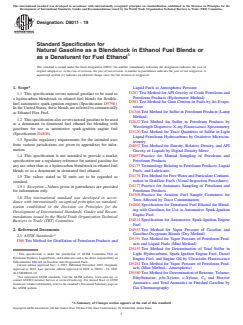
1.1 This specification covers natural gasoline to be used as a hydrocarbon blendstock in ethanol fuel blends for flexible-fuel automotive spark-ignition engines (Specification D5798). In the United States, these blends are referred to commercially as Ethanol Flex Fuel.
1.2 This specification also covers natural gasoline to be used as a denaturant in denatured fuel ethanol for blending with gasolines for use as automotive spark-ignition engine fuel (Specification D4806).
1.3 Specific regulatory requirements for the intended uses from various jurisdictions are given in appendixes for information.
1.4 This specification is not intended to provide a market specification nor a regulatory reference for natural gasoline for any use other than as a hydrocarbon blendstock in ethanol fuel blends or as a denaturant in denatured fuel ethanol.
1.5 The values stated in SI units are to be regarded as standard.
1.5.1 Exception—Values given in parentheses are provided for information only.
1.6 This international standard was developed in accordance with internationally recognized principles on standardization established in the Decision on Principles for the Development of International Standards, Guides and Recommendations issued by the World Trade Organization Technical Barriers to Trade (TBT) Committee.
- Status
- Published
- Publication Date
- 31-Oct-2019
- Technical Committee
- D02 - Petroleum Products, Liquid Fuels, and Lubricants
- Drafting Committee
- D02.A0 - Gasoline and Oxygenated Fuels
Buy Documents
ASTM D8011-19 - Standard Specification for Natural Gasoline as a Blendstock in Ethanol Fuel Blends or as a Denaturant for Fuel Ethanol
REDLINE ASTM D8011-19 - Standard Specification for Natural Gasoline as a Blendstock in Ethanol Fuel Blends or as a Denaturant for Fuel Ethanol
Overview
ASTM D8011-19 is a key standard specification developed by ASTM International for natural gasoline when used as either a blendstock in ethanol fuel blends or as a denaturant for fuel ethanol. Natural gasoline, a hydrocarbon blend primarily containing C5 to C8 molecules, plays a significant role in the U.S. fuel market, especially for flexible-fuel vehicles reliant on Ethanol Flex Fuel (E85) and for the denaturing of fuel ethanol.
This specification sets out comprehensive performance requirements, appropriate test methods, and references essential regulatory compliance for natural gasoline's use in automotive spark-ignition engine fuels. The document ensures that natural gasoline blends meet stringent standards for quality, safety, and environmental impact, thereby supporting industry reliability and regulatory compliance.
Key Topics
- Performance & Quality Requirements:
The standard defines minimum performance criteria for natural gasoline, such as limits for vapor pressure, distillation range, corrosion properties, sulfur content, gum content, and benzene levels. - Test Methods:
ASTM D8011-19 references a variety of ASTM standard test methods for accurate measurement and assurance of compliance, covering distillation, sulfur analysis, vapor pressure, and gum content (e.g., ASTM D86, D4052, D4953, D5191, D7667, D381). - Regulatory Compliance:
The standard provides guidance on meeting federal and state regulations, including U.S. EPA requirements and specific provisions for California and Canada. - Workmanship & Contamination Prevention:
Emphasis is placed on product appearance and the exclusion of contaminants, such as silicon and non-CHONS elements, which can negatively affect fuel system components or emissions performance. - Terminology & Reporting:
Standardized terminology and reporting guidelines ensure clarity and consistency across the fuel and ethanol industries.
Applications
Natural gasoline specified by ASTM D8011-19 is primarily used for two key purposes:
- Blendstock for Ethanol Fuel Blends:
Natural gasoline is blended with ethanol to produce fuels for flexible-fuel vehicles capable of running on Ethanol Flex Fuel (commonly E85), a popular alternative fuel in the United States. Blending ensures regulatory compliance for automotive spark-ignition engine fuels, including proper volatility and emission characteristics. - Denaturant for Fuel Ethanol:
When ethanol is produced for fuel purposes, natural gasoline is used as a denaturant, making the ethanol unfit for consumption and compliant with federal regulations for denatured fuel ethanol. This process is essential for blending ethanol with gasoline for widespread automotive use.
Meeting ASTM D8011-19 ensures producers, blenders, and distributors deliver a reliable and regulatory-compliant product suitable for use in commercial fuel systems, helping to optimize engine performance, minimize environmental impact, and support ethanol fuel adoption.
Related Standards
Comprehensive compliance with ASTM D8011-19 often requires reference to related national and international standards and regulations, including:
- ASTM D5798 - Specification for Ethanol Fuel Blends for Flexible-Fuel Automotive Spark-Ignition Engines
- ASTM D4806 - Specification for Denatured Fuel Ethanol for Blending with Gasolines
- ASTM D4814 - Specification for Automotive Spark-Ignition Engine Fuel
- ASTM D86, D4052, D4953, D5191, D7667, D381 - Referenced test methods for performance evaluation
- U.S. EPA Regulations - 40 CFR Parts 79 & 80
- CAN/CGSB Standards - Canadian fuel blend and denaturing requirements
- California Air Resources Board (CARB) Regulations - Title 13 CCR
These related standards ensure harmonization and mutual recognition of testing and regulatory procedures within the ethanol and natural gasoline fuel sectors.
Keywords: ASTM D8011-19, natural gasoline, blendstock, ethanol fuel blends, denaturant, flexible-fuel vehicles, E85, fuel ethanol, ASTM standard, regulatory compliance, vapor pressure, corrosion, sulfur, automotive spark-ignition engines.
Relations
- Effective Date
- 01-Nov-2019
- Effective Date
- 01-Jan-2024
- Refers
ASTM D4175-23a - Standard Terminology Relating to Petroleum Products, Liquid Fuels, and Lubricants - Effective Date
- 15-Dec-2023
- Effective Date
- 01-Dec-2023
- Effective Date
- 01-Dec-2023
- Effective Date
- 01-Dec-2023
- Refers
ASTM D5842-23 - Standard Practice for Sampling and Handling of Fuels for Volatility Measurement - Effective Date
- 01-Oct-2023
- Refers
ASTM D4175-23e1 - Standard Terminology Relating to Petroleum Products, Liquid Fuels, and Lubricants - Effective Date
- 01-Jul-2023
- Effective Date
- 01-May-2020
- Effective Date
- 01-May-2020
- Effective Date
- 01-Feb-2020
- Effective Date
- 01-Dec-2019
- Refers
ASTM D5842-19 - Standard Practice for Sampling and Handling of Fuels for Volatility Measurement - Effective Date
- 01-Nov-2019
- Effective Date
- 15-Sep-2019
- Effective Date
- 01-Jul-2019
Buy Documents
ASTM D8011-19 - Standard Specification for Natural Gasoline as a Blendstock in Ethanol Fuel Blends or as a Denaturant for Fuel Ethanol
REDLINE ASTM D8011-19 - Standard Specification for Natural Gasoline as a Blendstock in Ethanol Fuel Blends or as a Denaturant for Fuel Ethanol
Get Certified
Connect with accredited certification bodies for this standard

Element Materials Technology
Materials testing and product certification.

ABS Group Brazil
ABS Group certification services in Brazil.

ABS Quality Evaluations Inc.
American Bureau of Shipping quality certification.
Sponsored listings
Frequently Asked Questions
ASTM D8011-19 is a technical specification published by ASTM International. Its full title is "Standard Specification for Natural Gasoline as a Blendstock in Ethanol Fuel Blends or as a Denaturant for Fuel Ethanol". This standard covers: ABSTRACT This specification prescribes performance and regulatory requirements as well as the corresponding test methods for natural gasoline to be used as a hydrocarbon blendstock in ethanol fuel blends for flexible-fuel automotive spark-ignition engines. In the United States, these blends are known commercially as Ethanol Flex Fuel. This specification also covers natural gasoline intended for use as a denaturant in denatured fuel ethanol for blending with gasoline to be used as automotive spark-ignition engine fuel. The products shall conform to specified requirements for workmanship, distillation, corrosion (for silver), sulfur, vapor pressure, solvent-washed gum content, and benzene. SCOPE 1.1 This specification covers natural gasoline to be used as a hydrocarbon blendstock in ethanol fuel blends for flexible-fuel automotive spark-ignition engines (Specification D5798). In the United States, these blends are referred to commercially as Ethanol Flex Fuel. 1.2 This specification also covers natural gasoline to be used as a denaturant in denatured fuel ethanol for blending with gasolines for use as automotive spark-ignition engine fuel (Specification D4806). 1.3 Specific regulatory requirements for the intended uses from various jurisdictions are given in appendixes for information. 1.4 This specification is not intended to provide a market specification nor a regulatory reference for natural gasoline for any use other than as a hydrocarbon blendstock in ethanol fuel blends or as a denaturant in denatured fuel ethanol. 1.5 The values stated in SI units are to be regarded as standard. 1.5.1 Exception—Values given in parentheses are provided for information only. 1.6 This international standard was developed in accordance with internationally recognized principles on standardization established in the Decision on Principles for the Development of International Standards, Guides and Recommendations issued by the World Trade Organization Technical Barriers to Trade (TBT) Committee.
ABSTRACT This specification prescribes performance and regulatory requirements as well as the corresponding test methods for natural gasoline to be used as a hydrocarbon blendstock in ethanol fuel blends for flexible-fuel automotive spark-ignition engines. In the United States, these blends are known commercially as Ethanol Flex Fuel. This specification also covers natural gasoline intended for use as a denaturant in denatured fuel ethanol for blending with gasoline to be used as automotive spark-ignition engine fuel. The products shall conform to specified requirements for workmanship, distillation, corrosion (for silver), sulfur, vapor pressure, solvent-washed gum content, and benzene. SCOPE 1.1 This specification covers natural gasoline to be used as a hydrocarbon blendstock in ethanol fuel blends for flexible-fuel automotive spark-ignition engines (Specification D5798). In the United States, these blends are referred to commercially as Ethanol Flex Fuel. 1.2 This specification also covers natural gasoline to be used as a denaturant in denatured fuel ethanol for blending with gasolines for use as automotive spark-ignition engine fuel (Specification D4806). 1.3 Specific regulatory requirements for the intended uses from various jurisdictions are given in appendixes for information. 1.4 This specification is not intended to provide a market specification nor a regulatory reference for natural gasoline for any use other than as a hydrocarbon blendstock in ethanol fuel blends or as a denaturant in denatured fuel ethanol. 1.5 The values stated in SI units are to be regarded as standard. 1.5.1 Exception—Values given in parentheses are provided for information only. 1.6 This international standard was developed in accordance with internationally recognized principles on standardization established in the Decision on Principles for the Development of International Standards, Guides and Recommendations issued by the World Trade Organization Technical Barriers to Trade (TBT) Committee.
ASTM D8011-19 is classified under the following ICS (International Classification for Standards) categories: 75.160.20 - Liquid fuels. The ICS classification helps identify the subject area and facilitates finding related standards.
ASTM D8011-19 has the following relationships with other standards: It is inter standard links to ASTM D8011-18, ASTM D4814-24, ASTM D4175-23a, ASTM D86-23ae1, ASTM D4814-23a, ASTM D86-23a, ASTM D5842-23, ASTM D4175-23e1, ASTM D5482-20, ASTM D4953-20, ASTM D4814-20, ASTM D4814-19a, ASTM D5842-19, ASTM D4806-19a, ASTM D5798-19b. Understanding these relationships helps ensure you are using the most current and applicable version of the standard.
ASTM D8011-19 is available in PDF format for immediate download after purchase. The document can be added to your cart and obtained through the secure checkout process. Digital delivery ensures instant access to the complete standard document.
Standards Content (Sample)
This international standard was developed in accordance with internationally recognized principles on standardization established in the Decision on Principles for the
Development of International Standards, Guides and Recommendations issued by the World Trade Organization Technical Barriers to Trade (TBT) Committee.
Designation:D8011 −19
Standard Specification for
Natural Gasoline as a Blendstock in Ethanol Fuel Blends or
as a Denaturant for Fuel Ethanol
This standard is issued under the fixed designation D8011; the number immediately following the designation indicates the year of
original adoption or, in the case of revision, the year of last revision. A number in parentheses indicates the year of last reapproval. A
superscript epsilon (´) indicates an editorial change since the last revision or reapproval.
1. Scope* Liquid Fuels at Atmospheric Pressure
D287 Test Method for API Gravity of Crude Petroleum and
1.1 This specification covers natural gasoline to be used as
Petroleum Products (Hydrometer Method)
a hydrocarbon blendstock in ethanol fuel blends for flexible-
D381 Test Method for Gum Content in Fuels by Jet Evapo-
fuel automotive spark-ignition engines (Specification D5798).
ration
In the United States, these blends are referred to commercially
D1266 Test Method for Sulfur in Petroleum Products (Lamp
as Ethanol Flex Fuel.
Method)
1.2 Thisspecificationalsocoversnaturalgasolinetobeused
D2622 Test Method for Sulfur in Petroleum Products by
as a denaturant in denatured fuel ethanol for blending with
Wavelength Dispersive X-ray Fluorescence Spectrometry
gasolines for use as automotive spark-ignition engine fuel
D3120 Test Method for Trace Quantities of Sulfur in Light
(Specification D4806).
Liquid Petroleum Hydrocarbons by Oxidative Microcou-
1.3 Specific regulatory requirements for the intended uses
lometry
from various jurisdictions are given in appendixes for infor-
D4052 Test Method for Density, Relative Density, and API
mation.
Gravity of Liquids by Digital Density Meter
1.4 This specification is not intended to provide a market D4057 Practice for Manual Sampling of Petroleum and
specification nor a regulatory reference for natural gasoline for Petroleum Products
any use other than as a hydrocarbon blendstock in ethanol fuel D4175 Terminology Relating to Petroleum Products, Liquid
blends or as a denaturant in denatured fuel ethanol. Fuels, and Lubricants
D4176 Test Method for FreeWater and Particulate Contami-
1.5 The values stated in SI units are to be regarded as
nation in Distillate Fuels (Visual Inspection Procedures)
standard.
D4177 Practice for Automatic Sampling of Petroleum and
1.5.1 Exception—Values given in parentheses are provided
Petroleum Products
for information only.
D4306 Practice for Aviation Fuel Sample Containers for
1.6 This international standard was developed in accor-
Tests Affected by Trace Contamination
dance with internationally recognized principles on standard-
D4806 Specification for Denatured Fuel Ethanol for Blend-
ization established in the Decision on Principles for the
ing with Gasolines for Use as Automotive Spark-Ignition
Development of International Standards, Guides and Recom-
Engine Fuel
mendations issued by the World Trade Organization Technical
D4814 Specification for Automotive Spark-Ignition Engine
Barriers to Trade (TBT) Committee.
Fuel
D4953 Test Method for Vapor Pressure of Gasoline and
2. Referenced Documents
2 Gasoline-Oxygenate Blends (Dry Method)
2.1 ASTM Standards:
D5191 Test Method for Vapor Pressure of Petroleum Prod-
D86 Test Method for Distillation of Petroleum Products and
ucts and Liquid Fuels (Mini Method)
D5453 Test Method for Determination of Total Sulfur in
Light Hydrocarbons, Spark Ignition Engine Fuel, Diesel
This specification is under the jurisdiction of ASTM Committee D02 on
Petroleum Products, Liquid Fuels, and Lubricants and is the direct responsibility of
Engine Fuel, and Engine Oil by Ultraviolet Fluorescence
Subcommittee D02.A0 on Gasoline and Oxygenated Fuels.
D5482 Test Method for Vapor Pressure of Petroleum Prod-
Current edition approved Nov. 1, 2019. Published November 2019. Originally
ucts (Mini Method—Atmospheric)
approved in 2016. Last previous edition approved in 2018 as D8011 – 18. DOI:
10.1520/D8011-19.
D5580 Test Method for Determination of Benzene, Toluene,
For referenced ASTM standards, visit the ASTM website, www.astm.org, or
Ethylbenzene, p/m-Xylene, o-Xylene, C and Heavier
contact ASTM Customer Service at service@astm.org. For Annual Book of ASTM
Aromatics, and Total Aromatics in Finished Gasoline by
Standards volume information, refer to the standard’s Document Summary page on
the ASTM website. Gas Chromatography
*A Summary of Changes section appears at the end of this standard
Copyright © ASTM International, 100 Barr Harbor Drive, PO Box C700, West Conshohocken, PA 19428-2959. United States
D8011−19
D5798 Specification for Ethanol Fuel Blends for Flexible- 2.3 Government Regulations:
Fuel Automotive Spark-Ignition Engines CFR Title 40, Part 79 Registration of Fuels and Fuel
D5842 Practice for Sampling and Handling of Fuels for Additives
Volatility Measurement CFR Title 40, Part 80 Regulation of Fuels and Fuel Addi-
D5854 Practice for Mixing and Handling of Liquid Samples tives
of Petroleum and Petroleum Products CFR Title 27, Part 19 Distilled Spirits Plants
D6378 Test Method for Determination of Vapor Pressure CFR Title 27, Part 20 Distribution and Use of Denatured
(VP ) of Petroleum Products, Hydrocarbons, and Alcohol and Rum
X
Hydrocarbon-Oxygenate Mixtures (Triple Expansion CFR Title 27, Part 21 Formulas for Denatured Alcohol and
Method) Rum
D6469 GuideforMicrobialContaminationinFuelsandFuel CCR Title 13 § 2260-§2298, California Code of Regula-
Systems tions
D6550 Test Method for Determination of Olefin Content of
3. Terminology
Gasolines by Supercritical-Fluid Chromatography
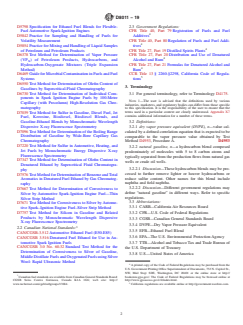
D6730 Test Method for Determination of Individual Com- 3.1 For general terminology, refer to Terminology D4175.
ponents in Spark Ignition Engine Fuels by 100-Metre
NOTE 1—The user is advised that the definitions used by various
Capillary (with Precolumn) High-Resolution Gas Chro-
industries, marketers, and regulatory bodies can differ from those specific
matography
to this specification. It is the responsibility of the user to ensure that the
terms used in a particular context are clearly understood. Appendix X7
D7039 Test Method for Sulfur in Gasoline, Diesel Fuel, Jet
contains additional information for a number of these terms.
Fuel, Kerosine, Biodiesel, Biodiesel Blends, and
Gasoline-Ethanol Blends by Monochromatic Wavelength 3.2 Definitions:
Dispersive X-ray Fluorescence Spectrometry
3.2.1 dry vapor pressure equivalent (DVPE), n—value cal-
D7096 Test Method for Determination of the Boiling Range culated by a defined correlation equation that is expected to be
Distribution of Gasoline by Wide-Bore Capillary Gas
comparable to the vapor pressure value obtained by Test
Chromatography Method D4953, Procedure A. D4953
D7220 Test Method for Sulfur in Automotive, Heating, and
3.2.2 natural gasoline, n—a hydrocarbon blend composed
Jet Fuels by Monochromatic Energy Dispersive X-ray
predominately of molecules with 5 to 8 carbon atoms and
Fluorescence Spectrometry
typically separated from the production flows from natural gas
D7347 Test Method for Determination of Olefin Content in
wells or crude oil wells.
Denatured Ethanol by Supercritical Fluid Chromatogra-
3.2.2.1 Discussion—These hydrocarbon blends may be pro-
phy
cessed to further remove lighter or heaver hydrocarbons or
D7576 Test Method for Determination of Benzene and Total
reduce sulfur content. Other names for this blend include
Aromatics in Denatured Fuel Ethanol by Gas Chromatog-
naphtha and field naphtha.
raphy
3.2.2.2 Discussion—Different government regulations may
D7667 Test Method for Determination of Corrosiveness to
define “natural gasoline” in different ways. Refer to specific
Silver by Automotive Spark-Ignition Engine Fuel—Thin
regulations.
Silver Strip Method
3.3 Abbreviations:
D7671 Test Method for Corrosiveness to Silver byAutomo-
3.3.1 CARB—California Air Resources Board
tive Spark–Ignition Engine Fuel–Silver Strip Method
D7757 Test Method for Silicon in Gasoline and Related
3.3.2 CFR—U.S. Code of Federal Regulations
Products by Monochromatic Wavelength Dispersive
3.3.3 CGSB—Canadian General Standards Board
X-ray Fluorescence Spectrometry
3.3.4 DVPE—Dry Vapor Pressure Equivalent
2.2 Canadian National Standards:
3.3.5 EFB—Ethanol Fuel Blend
CAN/CGSB-3.512 Automotive Ethanol Fuel (E50-E85)
3.3.6 EPA—The U.S. Environmental Protection Agency
CAN/CGSB 3.516 Denatured Fuel Ethanol for Use in Au-
tomotive Spark Ignition Fuels
3.3.7 TTB—Alcohol and Tobacco Tax and Trade Bureau of
CAN/CGSB 3.0 No. 60.32 Standard Test Method for the
the U.S. Department of Treasury
Determination of Corrosiveness to Silver of Gasoline,
3.3.8 U.S.—United States of America
MiddleDistillateFuelsandOxygenatedFuelsusingSilver
Wool: Rapid Ultrasonic Method
Aprinted copy of the Code of Federal Regulations may be purchased from the
U.S. Government Printing Office Superintendent of Documents, 732 N. Capitol St.,
NW, Mail Stop: SDE, Washington, DC 20401 or the online store at http://
Canadian fuel standards are available from Canadian General Standards Board: bookstore.gpo.gov/. The Code of Federal Regulations may be browsed online at
CGSB Sales Centre Gatineau, Canada K1A 1G6; web site: http:// http://www.gpoaccess.gov/cfr/index.html.
www.techstreet.com/cgsb/subgroups/13684. California regulations are available online at http://government.westlaw.com.
D8011−19
4. Performance Requirements of hydrocarbons other than natural gasoline can result in
parameter limits other than the values in these tables to
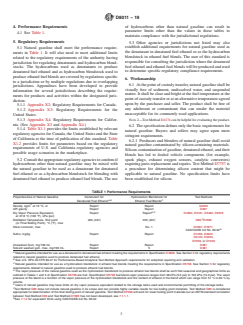
4.1 See Table 1.
maintain compliance with the jurisdictional regulations.
5. Regulatory Requirements
5.3 Other agencies or jurisdictions not listed may also
establish additional requirements for natural gasoline used as
5.1 Natural gasoline shall meet the performance require-
the denaturant in denatured fuel ethanol or as the hydrocarbon
ments in Table 1. It will also need to meet additional limits
blendstock in ethanol fuel blends. The user of this standard is
related to the regulatory requirements of the authority having
responsible for consulting the jurisdiction where the denatured
jurisdiction for regulating denaturants and hydrocarbon blend-
fuel ethanol and ethanol fuel blends will be produced and used
stocks. The hydrocarbons used as denaturants to produce
to determine specific regulatory compliance requirements.
denatured fuel ethanol and as hydrocarbon blendstock used to
produce ethanol fuel blends are covered by regulations specific
6. Workmanship
to a jurisdiction or by multiple regulations due to overlapping
6.1 Atthepointofcustodytransfer,naturalgasolineshallbe
jurisdictions. Appendixes have been developed to provide
visually free of sediment, undissolved water, and suspended
information for several jurisdictions describing the require-
matter. It shall be clear and bright at the fuel temperature at the
ments for products and activities within the designated juris-
pointofcustodytransferoratanalternativetemperatureagreed
diction:
upon by the purchaser and seller. The product shall be free of
5.1.1 Appendix X2: Regulatory Requirements for Canada.
any adulterant or contaminant that can render the material
5.1.2 Appendix X3: Regulatory Requirements for the
unacceptable for its commonly used applications.
United States.
5.1.3 Appendix X4: Regulatory Requirements for Califor-
NOTE 2—Test Method D4176 can be helpful for evaluating the product.
nia. (See Appendix X3 and Appendix X4.)
6.2 Thespecificationdefinesonlythebasicrequirementsfor
5.1.4 Table X1.1 provides the limits established by relevant
natural gasoline. Buyers and sellers may agree upon more
regulatory agencies for Canada, the United States and the State
stringent requirements.
of California at the time of publication of this standard. Table
6.2.1 Producers and blenders of natural gasoline shall avoid
X1.2 provides limits for parameters based on the regulatory
natural gasoline contaminated by silicon-containing materials.
requirements of U.S. and California regulatory agencies and
Silicon contamination of gasoline, denatured ethanol, and their
possible usage scenarios in the marketplace.
blends has led to fouled vehicle components (for example,
5.2 Consulttheappropriateregulatoryagenciestoconfirmif spark plugs, exhaust oxygen sensors, catalytic converters)
hydrocarbons other than natural gasoline may be mixed with
requiring parts replacement and repairs. Test Method D7757 is
the natural gasoline to be used as a denaturant for denatured a procedure for determining silicon content that might be
fuel ethanol or as a hydrocarbon blendstock for blending with applicable to natural gasoline. No specification limits have
denatured fuel ethanol to produce ethanol fuel blends. The use been established for silicon.
TABLE 1 Performance Requirements
Properties/Use of Natural Gasoline Denaturant for Hydrocarbon Blendstock for Test Methods
A,B C
Denatured Fuel Ethanol Ethanol Fuel Blends
Density, kg/m at 15 °C, or Report Report D4052
API gravity Report Report D287
D,E
Dry Vapor Pressure Equivalent, Report Report D4953, D5191, D5482, D6378
at 37.8 °C (100 °F), kPa (psi)
F
Distillation Temperature, End point 225 (437) 225 (437) D86, D7096
(or Final Boiling Point), °C (°F), max
Silver corrosion, max No. 1 D7667, D7671,
G
CAN/CGSB 3.0 No. 60.32
Sulfur, mg/kg Report Report D1266, D2622,
D3120, D5453,
D7039,or D7220
Unwashed Gum, mg/100 mL Report Report D381
Solvent washed gum, max, mg/100 mL Report 5 D381
A
Natural gasoline intended for use as a denaturant in denatured fuel ethanol meeting the requirements in Specification D4806. See Section 5 for regulatory requirements
related to natural gasoline used to produce denatured fuel ethanol.
B
See U.S. EPA 40 CFR 80.47 for Performance-Based Analytical Test Method Approach requirements for analytical reporting and validation.
C
Natural gasoline intended for use as a hydrocarbon blendstock in ethanol fuel blends meeting the requirements in Specification D5798. See Section 5 for regulatory
requirements related to natural gasoline used to produce ethanol fuel blends.
D
The vapor pressure of the natural gasoline used as the hydrocarbon blendstock to produce ethanol fuel blends shall be such that seasonal and geographical limits as
outlined in Tables 1 and 3 of Specification D5798 are met. Specification D5798 fuel blend vapor pressure ranges from 38 kPa (5.5 psi) to 103 kPa (15.0 psi). The vapor
pressure of the blend is a function of the vapor pressure of the hydrocarbon blendstock and the content of ethanol in the blend which can range from 51 % to 83%by
volume.
E
Users of natural gasoline may have limits on dry vapor pressure equivalent related to the storage tanks used and environmental permitting of the storage tanks.
F
Test Method D86 does not include natural gasoline in its scope and can provide highly variable results for low boiling point materials. Test Method D86 is considered
appropriate for determination of the final boiling point of natural gasoline. Test Method D7096 will work for lower boiling point materials but an ASTM standard correlation
between Test Method D86 and Test Method D7096 has not been developed, see 7.1.1.1.
G
See 7.1.2 for equivalent limits using CAN/CGSB-3.0 No. 60.32.
D8011−19
6.2.2 Producers and blenders of natural gasoline shall avoid D7667 or D7671. Since silver is more susceptible to corrosion
natural gasoline contaminated by any materials not composed by aggressive sulfur species than copper, a passing result in a
of carbon, hydrogen, oxygen, nitrogen and sulfur (non- silver corrosion test is indicative that the sample would also
CHONS).Thereisconcernthatthelimitedprocessingreceived pass a copper strip corrosion test.
by some natural gasoline (in comparison to the processing 7.1.3 Sulfur—Test Methods D1266, D2622, D3120, D5453,
received by gasoline blending components in conventional D7039,or D7220. With Test Method D3120, fuels with sulfur
refining) could result in trace contaminants (for example, content greater than 100 mg/kg (0.0100 % by mass) shall be
phosphorus, mercury, cyanides, and a long list of metallic diluted with isooctane. The dilution of the sample can result in
elements) being present in natural gasoline that could deacti- a loss of precision.
vate catalytic converters on vehicles, resulting in undesirable 7.1.4 Vapor Pressure (Dry Vapor Pressure Equivalent)—
emissions. Work is underway to identify possible non-CHONS Test Methods D4953, D5191, D5482,or D6378.
contaminants in natural gasoline, and to determine if a suitable 7.1.4.1 When using Test Method D6378, determine VP at
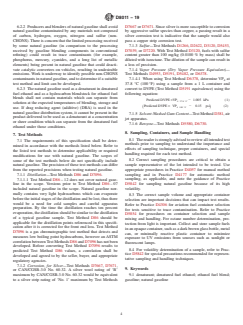
test method and limit can be developed. 37.8 °C (100 °F) using a sample froma1L container and
6.2.3 The natural gasoline used as a denaturant in denatured convert to DVPE (Test Method D5191 equivalence) using the
fuel ethanol and as a hydrocarbon blendstock for ethanol fuel following equation:
blends shall not contain materials which can separate from
Predicted DVPE =VP 2 1.005 kPa (1)
4 37.8 °C
solution at the expected temperatures of blending, storage and
Predicted DVPE = VP 2 0.15 psi (2)
~ !
4 100 °F
use. If drag reducing agent (additive) (DRA) is used in the
natural gasoline distribution system, it cannot be present in the
7.1.5 Solvent-Washed Gum Content—TestMethodD381,air
product delivered to be used as a denaturant at a concentration
jet apparatus.
or sheer condition which can separate from the denatured fuel
7.1.6 Benzene—Test Methods D5580, D6730.
ethanol under those conditions.
8. Sampling, Containers, and Sample Handling
7. Test Methods
8.1 Thereaderisstronglyadvisedtoreviewallintendedtest
7.1 The requirements of this specification shall be deter-
methods prior to sampling to understand the importance and
mined in accordance with the methods listed below. Refer to
effects of sampling technique, proper containers, and special
the listed test methods to determine applicability or required
handling required for each test method.
modifications for use with natural gasoline. The scopes of
8.2 Correct sampling procedures are critical to obtain a
some of the test methods below do not specifically include
sample representative of the lot intended to be tested. Use
natural gasoline. The precision of these test methods can differ
appropriate procedures in Practice D4057 for manual method
from the reported precisions when testing natural gasoline.
sampling and in Practice D4177 for automatic method
7.1.1 Distillation—Test Methods D86 and D7096.
sampling, as applicable, and note the guidance of Practice
7.1.1.1 Test Method D86 – 12 does not cover natural gaso-
D5842 for sampling natural gasoline because of its high
line in the scope. Versions prior to Test Method D86–07
volatility.
included natural gasoline in the scope. Natural gasoline nor-
mally contains very light hydrocarbons which can evaporate
8.3 The correct sample volume and appropriate container
beforetheinitialstagesofthedistillationandbelost,thusthere
selection are important decisions that can impact test results.
would be a need for cold samples and careful apparatus
Refer to Practice D4306 for aviation fuel container selection
preparation. By the time the distillation reaches ten percent
for tests sensitive to trace contamination. Refer to Practice
evaporation, the distillation should be similar to the distillation
D5854 for procedures on container selection and sample
of a typical gasoline sample. Test Method D86 should be
mixing and handling. For octane number determination, pro-
applicable for the distillation points referenced in this specifi-
tection from light is important. Collect and store sample fuels
cation after it is corrected for the front end loss. Test Method
inanopaquecontainer,suchasadarkbrownglassbottle,metal
D7096 is a gas chromatographic test method that detects and
can, or minimally reactive plastic container to minimize
measures low boiling point hydrocarbons, however an ASTM
exposure to UV emissions from sources such as sunlight or
correlationbetweenTestMethodsD86andD7096hasnotbeen
fluorescent lamps.
developed. Before converting Test Method D7096 results to
8.4 For volatility determination of a sample, refer to Prac-
predicted Test Method D86 values, a correlation shall be
tice D5842 for special precautions recommended for represen-
developed and agreed to by the seller, buyer, and appropriate
tative sampling and handling techniques.
regulatory agencies.
7.1.2 Corrosion, for Silver—Test Methods D7667, D7671,
9. Keywords
or CAN/CGSB-3.0 No. 60.32. A silver wool rating of ‘B’
maximum by CAN/CGSB-3.0 No. 60.32 would be equivalent 9.1 denaturant; denatured fuel ethanol; ethanol fuel blend;
to a silver strip rating of ‘No. 1’ maximum by Test Methods gasoline; natural gasoline
D8011−19
APPENDIXES
(Nonmandatory Information)
X1. REGULATORY AND RELATED REQUIREMENTS
X1.1 Appendix X1 contains both regulatory requirements regulatory requirements for Canada, the United States, and the
and calculated values based on regulatory requirements for
State of California at the time of publication of this standard.
natural gasoline to be used as a denaturant in denatured fuel
X1.1.2 Table X1.2 provides limits for parameters based on
ethanol and as the hydrocarbon blendstock in ethanol fuel
the regulatory requirements of U.S. and California regulatory
blends. While the following requirements are believed to be
agencies and possible usage scenarios in the marketplace.
accurate at the time of publication, users should consult the
These calculated values assume that only natural gasoline is
relevant authority to confirm the current regulations and
being used as the denaturant or as the hydrocarbon blendstock.
requirements. The information provided about the regulations
If other hydrocarbons are included, the values may no longer
is for information only. In case of conflict, the text of current
be appropriate.
regulations takes precedence.
X1.1.1 Table X1.1 contains information about relevant
TABLE X1.1 Regulatory Requirements Pertaining to Natural Gasoline Used as a Denaturant and Hydrocarbon Blendstock for Ethanol
Fuel Blends
Properties Denaturant Hydrocarbon Blendstock for Ethanol
Fuel Blends
Applicability For use For use in the For use in For use in For use For use in
A
in U.S. California Canada in the California Test Methods
Canada U.S.
Reference See X2.2 See X3.2 See X3.2 and See X2.3 See See X3.3 and
X4.2 X3.3 X4.3
Distillation Temperatures, D86, D7096
°C, (°F), at % Evaporated
B B
10 % by volume, min 35 (95) 36 (97)
B C
50 % by volume, max 69 (156) 100 (213)
B C
90 % by volume, max 98 (209) 152 (305)
D
Sulfur, mg/kg, max 330 D1266, D2622,
D3120, D5453,
D7039,or D7220
E F
Benzene, % by volume, max 1.1 1.10 D5580
E F
Olefins, % by volume, max 10.0 10.0 D6550
E F
Aromatics, % by volume, max 35.0 35.0 D5580
A
See U.S. EPA 40 CFR 80.47 for Performance-Based Analytical Test Method Approach requirements for analytical reporting and validation.
B
No specific test method is referenced in the Alcohol and Tobacco Tax and Trade Bureau (TTB) of the U.S. Treasury Department and Revenue Canada regulations. At
the time the TTB and Revenue Canada limits were created, Test Method D86 was the standard test method for these parameters.
C
Limits set by the California Air Resources Board (CARB) utilize Test Method D86 – 99.
D
The U.S. EPA, effective January 1, 2017, establishes a limit of 330 ppm sulfur in denaturant. See X3.4.2.
E
California regulations (Title 13 CCR 2262.9) establish limits of 1.10 % by volume benzene, 10.0 % by volume olefins, and 35.0 % by volume aromatics for the denaturant
used to produce denatured fuel ethanol. The regulatory limits assume the maximum denaturant content of 5.00 % by volume is contained in the denatured fuel alcohol.
The regulations allow the limits to be adjusted if lower denaturant concentrations are used.
F
California regulations (Title 13 CCR 2292.4) sets a maximum content of benzene, olefins, and aromatics for the hydrocarbon blendstock used to produce ethanol fuel
blends.
D8011−19
TABLE X1.2 Calculated Requirements Pertaining to Natural Gasoline Based on U.S. and California Regulations
Properties Denaturant for Denatured Fuel Ethanol Hydrocarbon Blendstock for Ethanol Fuel Blends (EFB)
Applicability For use in the U.S. For use in California For use in the U.S. For use in U.S. For use in California
outside of California (CARB grade) outside of California outside of California
A
(U.S. grade)
Grade of Denatured U.S. CARB CARB
Fuel Ethanol Test Methods
Grade of Natural D1 D2 EFB1 EFB2 EFB3
Gasoline
Assumption Denaturant content, Denaturant content,
2.5 % by volume, 2.5 % by volume,
max max
B C D E F
Sulfur, mg/kg, max 330 400 30 53 86 D1266, D2622,
D3120, D5453,
D7039,or D7220
G H I J
Benzene, % by 24.8 2.2 0.62 1.2 D5580 or D6730
volume, max
H
Olefins, % by 20.0 D6550 or D6730
volume, max
H
Aromatics, % by 70.0 D5580 or D6730
volume, max
A
See U.S. EPA 40 CFR 80.47 for Performance-Based Analytical Test Method Approach requirements for analytical reporting and validation.
B
Effective January 1, 2017 the maximum sulfur content of certified denaturant will be 330 mg/kg (see X3.4.2).
C
The California regulations set a sulfur limit of 10 mg/kg in the denatured fuel ethanol (Title 13 CCR 2262.9). Assume all sulfur originates with the denaturant, at a maximum
denaturant content of 2.5 % by volume the limit for sulfur content in the denaturant would be 400 mg/kg.
D
To compensate for the denaturant content in the denatured fuel ethanol, assume 53 % by volume denatured fuel ethanol is needed to obtain 51 % by volume ethanol.
The ethanol fuel blend would contain a maximum of 47 % by volume natural gasoline. The current U.S. EPA annual average sulfur limit in spark-ignition engine fuels defined
in Specification D4814 is 30 mg/kg. The current limit in Specification D4806 is 30 mg/kg (ppm by mass). The maximum sulfur content of the natural gasoline used as the
hydrocarbon blendstock to produce et
...
This document is not an ASTM standard and is intended only to provide the user of an ASTM standard an indication of what changes have been made to the previous version. Because
it may not be technically possible to adequately depict all changes accurately, ASTM recommends that users consult prior editions as appropriate. In all cases only the current version
of the standard as published by ASTM is to be considered the official document.
Designation: D8011 − 18 D8011 − 19
Standard Specification for
Natural Gasoline as a Blendstock in Ethanol Fuel Blends or
as a Denaturant for Fuel Ethanol
This standard is issued under the fixed designation D8011; the number immediately following the designation indicates the year of
original adoption or, in the case of revision, the year of last revision. A number in parentheses indicates the year of last reapproval. A
superscript epsilon (´) indicates an editorial change since the last revision or reapproval.
1. Scope*
1.1 This specification covers natural gasoline to be used as a hydrocarbon blendstock in ethanol fuel blends for flexible-fuel
automotive spark-ignition engines (Specification D5798). In the United States, these blends are referred to commercially as
Ethanol Flex Fuel.
1.2 This specification also covers natural gasoline to be used as a denaturant in denatured fuel ethanol for blending with
gasolines for use as automotive spark-ignition engine fuel (Specification D4806).
1.3 Specific regulatory requirements for the intended uses from various jurisdictions are given in appendixes for information.
1.4 This specification is not intended to provide a market specification nor a regulatory reference for natural gasoline for any
use other than as a hydrocarbon blendstock in ethanol fuel blends or as a denaturant in denatured fuel ethanol.
1.5 The values stated in SI units are to be regarded as standard.
1.5.1 Exception—Values given in parentheses are provided for information only.
1.6 This international standard was developed in accordance with internationally recognized principles on standardization
established in the Decision on Principles for the Development of International Standards, Guides and Recommendations issued
by the World Trade Organization Technical Barriers to Trade (TBT) Committee.
2. Referenced Documents
2.1 ASTM Standards:
D86 Test Method for Distillation of Petroleum Products and Liquid Fuels at Atmospheric Pressure
D287 Test Method for API Gravity of Crude Petroleum and Petroleum Products (Hydrometer Method)
D381 Test Method for Gum Content in Fuels by Jet Evaporation
D1266 Test Method for Sulfur in Petroleum Products (Lamp Method)
D2622 Test Method for Sulfur in Petroleum Products by Wavelength Dispersive X-ray Fluorescence Spectrometry
D3120 Test Method for Trace Quantities of Sulfur in Light Liquid Petroleum Hydrocarbons by Oxidative Microcoulometry
D4052 Test Method for Density, Relative Density, and API Gravity of Liquids by Digital Density Meter
D4057 Practice for Manual Sampling of Petroleum and Petroleum Products
D4175 Terminology Relating to Petroleum Products, Liquid Fuels, and Lubricants
D4176 Test Method for Free Water and Particulate Contamination in Distillate Fuels (Visual Inspection Procedures)
D4177 Practice for Automatic Sampling of Petroleum and Petroleum Products
D4306 Practice for Aviation Fuel Sample Containers for Tests Affected by Trace Contamination
D4806 Specification for Denatured Fuel Ethanol for Blending with Gasolines for Use as Automotive Spark-Ignition Engine Fuel
D4814 Specification for Automotive Spark-Ignition Engine Fuel
D4953 Test Method for Vapor Pressure of Gasoline and Gasoline-Oxygenate Blends (Dry Method)
D5191 Test Method for Vapor Pressure of Petroleum Products and Liquid Fuels (Mini Method)
D5453 Test Method for Determination of Total Sulfur in Light Hydrocarbons, Spark Ignition Engine Fuel, Diesel Engine Fuel,
and Engine Oil by Ultraviolet Fluorescence
This specification is under the jurisdiction of ASTM Committee D02 on Petroleum Products, Liquid Fuels, and Lubricants and is the direct responsibility of Subcommittee
D02.A0 on Gasoline and Oxygenated Fuels.
Current edition approved Oct. 1, 2018Nov. 1, 2019. Published October 2018November 2019. Originally approved in 2016. Last previous edition approved in 20172018
as D8011 – 17.D8011 – 18. DOI: 10.1520/D8011-18.10.1520/D8011-19.
For referenced ASTM standards, visit the ASTM website, www.astm.org, or contact ASTM Customer Service at service@astm.org. For Annual Book of ASTM Standards
volume information, refer to the standard’s Document Summary page on the ASTM website.
*A Summary of Changes section appears at the end of this standard
Copyright © ASTM International, 100 Barr Harbor Drive, PO Box C700, West Conshohocken, PA 19428-2959. United States
D8011 − 19
D5482 Test Method for Vapor Pressure of Petroleum Products (Mini Method—Atmospheric)
D5580 Test Method for Determination of Benzene, Toluene, Ethylbenzene, p/m-Xylene, o-Xylene, C and Heavier Aromatics,
and Total Aromatics in Finished Gasoline by Gas Chromatography
D5798 Specification for Ethanol Fuel Blends for Flexible-Fuel Automotive Spark-Ignition Engines
D5842 Practice for Sampling and Handling of Fuels for Volatility Measurement
D5854 Practice for Mixing and Handling of Liquid Samples of Petroleum and Petroleum Products
D6378 Test Method for Determination of Vapor Pressure (VP ) of Petroleum Products, Hydrocarbons, and Hydrocarbon-
X
Oxygenate Mixtures (Triple Expansion Method)
D6469 Guide for Microbial Contamination in Fuels and Fuel Systems
D6550 Test Method for Determination of Olefin Content of Gasolines by Supercritical-Fluid Chromatography
D6730 Test Method for Determination of Individual Components in Spark Ignition Engine Fuels by 100-Metre Capillary (with
Precolumn) High-Resolution Gas Chromatography
D6920 Test Method for Total Sulfur in Naphthas, Distillates, Reformulated Gasolines, Diesels, Biodiesels, and Motor Fuels by
Oxidative Combustion and Electrochemical Detection (Withdrawn 2018)
D7039 Test Method for Sulfur in Gasoline, Diesel Fuel, Jet Fuel, Kerosine, Biodiesel, Biodiesel Blends, and Gasoline-Ethanol
Blends by Monochromatic Wavelength Dispersive X-ray Fluorescence Spectrometry
D7096 Test Method for Determination of the Boiling Range Distribution of Gasoline by Wide-Bore Capillary Gas
Chromatography
D7220 Test Method for Sulfur in Automotive, Heating, and Jet Fuels by Monochromatic Energy Dispersive X-ray Fluorescence
Spectrometry
D7347 Test Method for Determination of Olefin Content in Denatured Ethanol by Supercritical Fluid Chromatography
D7576 Test Method for Determination of Benzene and Total Aromatics in Denatured Fuel Ethanol by Gas Chromatography
D7667 Test Method for Determination of Corrosiveness to Silver by Automotive Spark-Ignition Engine Fuel—Thin Silver Strip
Method
D7671 Test Method for Corrosiveness to Silver by Automotive Spark–Ignition Engine Fuel–Silver Strip Method
D7757 Test Method for Silicon in Gasoline and Related Products by Monochromatic Wavelength Dispersive X-ray Fluorescence
Spectrometry
2.2 Canadian National Standards:
CAN/CGSB-3.512 Automotive Ethanol Fuel (E50-E85)
CAN/CGSB 3.516 Denatured Fuel Ethanol for Use in Automotive Spark Ignition Fuels
CAN/CGSB 3.0 No. 60.32 Standard Test Method for the Determination of Corrosiveness to Silver of Gasoline, Middle Distillate
Fuels and Oxygenated Fuels using Silver Wool: Rapid Ultrasonic Method
2.3 Government Regulations:
CFR Title 40, Part 79 Registration of Fuels and Fuel Additives
CFR Title 40, Part 80 Regulation of Fuels and Fuel Additives
CFR Title 27, Part 19 Distilled Spirits Plants
CFR Title 27, Part 20 Distribution and Use of Denatured Alcohol and Rum
CFR Title 27, Part 21 Formulas for Denatured Alcohol and Rum
CCR Title 13 § 2260-§2298, California Code of Regulations
3. Terminology
3.1 For general terminology, refer to Terminology D4175.
NOTE 1—The user is advised that the definitions used by various industries, marketers, and regulatory bodies can differ from those specific to this
specification. It is the responsibility of the user to ensure that the terms used in a particular context are clearly understood. Appendix X7 contains
additional information for a number of these terms.
3.2 Definitions:
3.2.1 dry vapor pressure equivalent (DVPE), n—value calculated by a defined correlation equation that is expected to be
comparable to the vapor pressure value obtained by Test Method D4953, Procedure A. D4953
3.2.2 natural gasoline, n—a hydrocarbon blend composed predominately of molecules with 5 to 8 carbon atoms and typically
separated from the production flows from natural gas wells or crude oil wells.
Canadian fuel standards are available from Canadian General Standards Board: CGSB Sales Centre Gatineau, Canada K1A 1G6; web site: http://www.techstreet.com/
cgsb/subgroups/13684.
A printed copy of the Code of Federal Regulations may be purchased from the U.S. Government Printing Office Superintendent of Documents, 732 N. Capitol St., NW,
Mail Stop: SDE, Washington, DC 20401 or the online store at http://bookstore.gpo.gov/. The Code of Federal Regulations may be browsed online at http://
www.gpoaccess.gov/cfr/index.html.
California regulations are available online at http://government.westlaw.com.
D8011 − 19
3.2.2.1 Discussion—
These hydrocarbon blends may be processed to further remove lighter or heaver hydrocarbons or reduce sulfur content. Other
names for this blend include naphtha and field naphtha.
3.2.2.2 Discussion—
Different government regulations may define “natural gasoline” in different ways. Refer to specific regulations.
3.3 Abbreviations:
3.3.1 CARB—California Air Resources Board
3.3.2 CFR—U.S. Code of Federal Regulations
3.3.3 CGSB—Canadian General Standards Board
3.3.4 DVPE—Dry Vapor Pressure Equivalent
3.3.5 EFB—Ethanol Fuel Blend
3.3.6 EPA—The U.S. Environmental Protection Agency
3.3.7 TTB—Alcohol and Tobacco Tax and Trade Bureau of the U.S. Department of Treasury
3.3.8 U.S.—United States of America
4. Performance Requirements
4.1 See Table 1.
5. Regulatory Requirements
5.1 Natural gasoline shall meet the performance requirements in Table 1. It will also need to meet additional limits related to
the regulatory requirements of the authority having jurisdiction for regulating denaturants and hydrocarbon blendstocks. The
hydrocarbons used as denaturants to produce denatured fuel ethanol and as hydrocarbon blendstock used to produce ethanol fuel
TABLE 1 Performance Requirements
Properties/Use of Natural Gasoline Denaturant for Hydrocarbon Blendstock for Test Methods
A,B C
Denatured Fuel Ethanol Ethanol Fuel Blends
Density, kg/m at 15 °C, or Report Report D4052
API gravity Report Report D287
D,E
Dry Vapor Pressure Equivalent, Report Report D4953, D5191, D5482, D6378
at 37.8 °C (100 °F), kPa (psi)
F
Distillation Temperature, End point 225 (437) 225 (437) D86, D7096
(or Final Boiling Point), °C (°F), max
Silver corrosion, max No. 1 D7667, D7671,
G
CAN/CGSB 3.0 No. 60.32
Sulfur, mg/kg Report Report D1266, D2622,
D3120, D5453,
D6920, D7039,
or D7220
Sulfur, mg/kg Report Report D1266, D2622,
D3120, D5453,
D7039,
or D7220
Unwashed Gum, mg/100 mL Report Report D381
Solvent washed gum, max, mg/100 mL Report 5 D381
A
Natural gasoline intended for use as a denaturant in denatured fuel ethanol meeting the requirements in Specification D4806. See Section 5 for regulatory requirements
related to natural gasoline used to produce denatured fuel ethanol.
B
See U.S. EPA 40 CFR 80.47 for Performance-Based Analytical Test Method Approach requirements for analytical reporting and validation.
C
Natural gasoline intended for use as a hydrocarbon blendstock in ethanol fuel blends meeting the requirements in Specification D5798. See Section 5 for regulatory
requirements related to natural gasoline used to produce ethanol fuel blends.
D
The vapor pressure of the natural gasoline used as the hydrocarbon blendstock to produce ethanol fuel blends shall be such that seasonal and geographical limits as
outlined in Tables 1 and 3 of Specification D5798 are met. Specification D5798 fuel blend vapor pressure ranges from 38 kPa (5.5 psi) to 103 kPa (15.0 psi). The vapor
pressure of the blend is a function of the vapor pressure of the hydrocarbon blendstock and the content of ethanol in the blend which can range from 51 % to 83 % by
volume.
E
Users of natural gasoline may have limits on dry vapor pressure equivalent related to the storage tanks used and environmental permitting of the storage tanks.
F
Test Method D86 does not include natural gasoline in its scope and can provide highly variable results for low boiling point materials. Test Method D86 is considered
appropriate for determination of the final boiling point of natural gasoline. Test Method D7096 will work for lower boiling point materials but an ASTM standard correlation
between Test Method D86 and Test Method D7096 has not been developed, see 7.1.1.1.
G
See 7.1.2 for equivalent limits using CAN/CGSB-3.0 No. 60.32.
D8011 − 19
blends are covered by regulations specific to a jurisdiction or by multiple regulations due to overlapping jurisdictions. Appendixes
have been developed to provide information for several jurisdictions describing the requirements for products and activities within
the designated jurisdiction:
5.1.1 Appendix X2: Regulatory Requirements for Canada.
5.1.2 Appendix X3: Regulatory Requirements for the United States.
5.1.3 Appendix X4: Regulatory Requirements for California. (See Appendix X3 and Appendix X4.)
5.1.4 Table X1.1 provides the limits established by relevant regulatory agencies for Canada, the United States and the State of
California at the time of publication of this standard. Table X1.2 provides limits for parameters based on the regulatory
requirements of U.S. and California regulatory agencies and possible usage scenarios in the marketplace.
5.2 Consult the appropriate regulatory agencies to confirm if hydrocarbons other than natural gasoline may be mixed with the
natural gasoline to be used as a denaturant for denatured fuel ethanol or as a hydrocarbon blendstock for blending with denatured
fuel ethanol to produce ethanol fuel blends. The use of hydrocarbons other than natural gasoline can result in parameter limits other
than the values in these tables to maintain compliance with the jurisdictional regulations.
5.3 Other agencies or jurisdictions not listed may also establish additional requirements for natural gasoline used as the
denaturant in denatured fuel ethanol or as the hydrocarbon blendstock in ethanol fuel blends. The user of this standard is
responsible for consulting the jurisdiction where the denatured fuel ethanol and ethanol fuel blends will be produced and used to
determine specific regulatory compliance requirements.
6. Workmanship
6.1 At the point of custody transfer, natural gasoline shall be visually free of sediment, undissolved water, and suspended matter.
It shall be clear and bright at the fuel temperature at the point of custody transfer or at an alternative temperature agreed upon by
the purchaser and seller. The product shall be free of any adulterant or contaminant that can render the material unacceptable for
its commonly used applications.
NOTE 2—Test Method D4176 can be helpful for evaluating the product.
6.2 The specification defines only the basic requirements for natural gasoline. Buyers and sellers may agree upon more stringent
requirements.
6.2.1 Producers and blenders of natural gasoline shall avoid natural gasoline contaminated by silicon-containing materials.
Silicon contamination of gasoline, denatured ethanol, and their blends has led to fouled vehicle components (for example, spark
plugs, exhaust oxygen sensors, catalytic converters) requiring parts replacement and repairs. Test Method D7757 is a procedure
for determining silicon content that might be applicable to natural gasoline. No specification limits have been established for
silicon.
6.2.2 Producers and blenders of natural gasoline shall avoid natural gasoline contaminated by any materials not composed of
carbon, hydrogen, oxygen, nitrogen and sulfur (non-CHONS). There is concern that the limited processing received by some
natural gasoline (in comparison to the processing received by gasoline blending components in conventional refining) could result
in trace contaminants (for example, phosphorus, mercury, cyanides, and a long list of metallic elements) being present in natural
gasoline that could deactivate catalytic converters on vehicles, resulting in undesirable emissions. Work is underway to identify
possible non-CHONS contaminants in natural gasoline, and to determine if a suitable test method and limit can be developed.
6.2.3 The natural gasoline used as a denaturant in denatured fuel ethanol and as a hydrocarbon blendstock for ethanol fuel
blends shall not contain materials which can separate from solution at the expected temperatures of blending, storage and use. If
drag reducing agent (additive) (DRA) is used in the natural gasoline distribution system, it cannot be present in the product
delivered to be used as a denaturant at a concentration or sheer condition which can separate from the denatured fuel ethanol under
those conditions.
7. Test Methods
7.1 The requirements of this specification shall be determined in accordance with the methods listed below. Refer to the listed
test methods to determine applicability or required modifications for use with natural gasoline. The scopes of some of the test
methods below do not specifically include natural gasoline. The precision of these test methods can differ from the reported
precisions when testing natural gasoline.
7.1.1 Distillation—Test Methods D86 and D7096.
7.1.1.1 Test Method D86 – 12 does not cover natural gasoline in the scope. Versions prior to Test Method D86 – 07 included
natural gasoline in the scope. Natural gasoline normally contains very light hydrocarbons which can evaporate before the initial
stages of the distillation and be lost, thus there would be a need for cold samples and careful apparatus preparation. By the time
the distillation reaches ten percent evaporation, the distillation should be similar to the distillation of a typical gasoline sample.
Test Method D86 should be applicable for the distillation points referenced in this specification after it is corrected for the front
end loss. Test Method D7096 is a gas chromatographic test method that detects and measures low boiling point hydrocarbons,
D8011 − 19
however an ASTM correlation between Test Methods D86 and D7096 has not been developed. Before converting Test Method
D7096 results to predicted Test Method D86 values, a correlation shall be developed and agreed to by the seller, buyer, and
appropriate regulatory agencies.
7.1.2 Corrosion, for Silver—Test Methods D7667, D7671, or CAN/CGSB-3.0 No. 60.32. A silver wool rating of ‘B’ maximum
by CAN/CGSB-3.0 No. 60.32 would be equivalent to a silver strip rating of ‘No. 1’ maximum by Test Methods D7667 or D7671.
Since silver is more susceptible to corrosion by aggressive sulfur species than copper, a passing result in a silver corrosion test is
indicative that the sample would also pass a copper strip corrosion test.
7.1.3 Sulfur—Test Methods D1266, D2622, D3120, D5453, D6920, D7039, or D7220. With Test Method D3120, fuels with
sulfur content greater than 100 mg/kg (0.0100 % by mass) shall be diluted with isooctane. The dilution of the sample can result
in a loss of precision.
7.1.4 Vapor Pressure (Dry Vapor Pressure Equivalent)—Test Methods D4953, D5191, D5482, or D6378.
7.1.4.1 When using Test Method D6378, determine VP at 37.8 °C (100 °F) using a sample from a 1 L container and convert
to DVPE (Test Method D5191 equivalence) using the following equation:
Predicted DVPE =VP 2 1.005 kPa (1)
4 37.8 °C
Predicted DVPE = VP 2 0.15 psi (2)
~ 4 100 °F !
7.1.5 Solvent-Washed Gum Content—Test Method D381, air jet apparatus.
7.1.6 Benzene—Test Methods D5580, D6730.
8. Sampling, Containers, and Sample Handling
8.1 The reader is strongly advised to review all intended test methods prior to sampling to understand the importance and effects
of sampling technique, proper containers, and special handling required for each test method.
8.2 Correct sampling procedures are critical to obtain a sample representative of the lot intended to be tested. Use appropriate
procedures in Practice D4057 for manual method sampling and in Practice D4177 for automatic method sampling, as applicable,
and note the guidance of Practice D5842 for sampling natural gasoline because of its high volatility.
8.3 The correct sample volume and appropriate container selection are important decisions that can impact test results. Refer
to Practice D4306 for aviation fuel container selection for tests sensitive to trace contamination. Refer to Practice D5854 for
procedures on container selection and sample mixing and handling. For octane number determination, protection from light is
important. Collect and store sample fuels in an opaque container, such as a dark brown glass bottle, metal can, or minimally
reactive plastic container to minimize exposure to UV emissions from sources such as sunlight or fluorescent lamps.
8.4 For volatility determination of a sample, refer to Practice D5842 for special precautions recommended for representative
sampling and handling techniques.
9. Keywords
9.1 denaturant; denatured fuel ethanol; ethanol fuel blend; gasoline; natural gasoline
APPENDIXES
(Nonmandatory Information)
X1. REGULATORY AND RELATED REQUIREMENTS
X1.1 Appendix X1 contains both regulatory requirements and calculated values based on regulatory requirements for natural
gasoline to be used as a denaturant in denatured fuel ethanol and as the hydrocarbon blendstock in ethanol fuel blends. While the
following requirements are believed to be accurate at the time of publication, users should consult the relevant authority to confirm
the current regulations and requirements. The information provided about the regulations is for information only. In case of
conflict, the text of current regulations takes precedence.
X1.1.1 Table X1.1 contains information about relevant regulatory requirements for Canada, the United States, and the State of
California at the time of publication of this standard.
X1.1.2 Table X1.2 provides limits for parameters based on the regulatory requirements of U.S. and California regulatory agencies
and possible usage scenarios in the marketplace. These calculated values assume that only natural gasoline is being used as the
denaturant or as the hydrocarbon blendstock. If other hydrocarbons are included, the values may no longer be appropriate.
D8011 − 19
TABLE X1.1 Regulatory Requirements Pertaining to Natural Gasoline Used as a Denaturant and Hydrocarbon Blendstock for Ethanol
Fuel Blends
Properties Denaturant Hydrocarbon Blendstock for Ethanol
Fuel Blends
Applicability For use For use in the For use in For use in For use For use in
A
in U.S. California Canada in the California Test Methods
Canada U.S.
Reference See X2.2 See X3.2 See X3.2 and See X2.3 See See X3.3 and
X4.2 X3.3 X4.3
Distillation Temperatures, D86, D7096
°C, (°F), at % Evaporated
B B
10 % by volume, min 35 (95) 36 (97)
B C
50 % by volume, max 69 (156) 100 (213)
B C
90 % by volume, max 98 (209) 152 (305)
D
Sulfur, mg/kg, max 330 D1266, D2622,
D3120,D5453,
D6920, D7039,
or D7220
D
Sulfur, mg/kg, max 330 D1266, D2622,
D3120, D5453,
D7039,
or D7220
E F
Benzene, % by volume, max 1.1 1.10 D5580
E F
Olefins, % by volume, max 10.0 10.0 D6550
E F
Aromatics, % by volume, max 35.0 35.0 D5580
A
See U.S. EPA 40 CFR 80.47 for Performance-Based Analytical Test Method Approach requirements for analytical reporting and validation.
B
No specific test method is referenced in the Alcohol and Tobacco Tax and Trade Bureau (TTB) of the U.S. Treasury Department and Revenue Canada regulations. At
the time the TTB and Revenue Canada limits were created, Test Method D86 was the standard test method for these parameters.
C
Limits set by the California Air Resources Board (CARB) utilize Test Method D86 – 99.
D
The U.S. EPA, effective January 1, 2017, establishes a limit of 330 ppm sulfur in denaturant. See X3.4.2.
E
California regulations (Title 13 CCR 2262.9) establish limits of 1.10 % by volume benzene, 10.0 % by volume olefins, and 35.0 % by volume aromatics for the denaturant
used to produce denatured fuel ethanol. The regulatory limits assume the maximum denaturant content of 5.00 % by volume is contained in the denatured fuel alcohol.
The regulations allow the limits to be adjusted if lower denaturant concentrations are used.
F
California regulations (Title 13 CCR 2292.4) sets a maximum content of benzene, olefins, and aromatics for the hydrocarbon blendstock used to produce ethanol fuel
blends.
D8011 − 19
TABLE X1.2 Calculated Requirements Pertaining to Natural Gasoline Based on U.S. and California Regulations
Properties Denaturant for Denatured Fuel Ethanol Hydrocarbon Blendstock for Ethanol Fuel Blends (EFB)
Applicability For use in the U.S. For use in California For use in the U.S. For use in U.S. For use in California
outside of California (CARB grade) outside of California outside of California
A
(U.S. grade)
Grade of Denatured U.S. CARB CARB
Fuel Ethanol Test Methods
Grade of Natural D1 D2 EFB1 EFB2 EFB3
Gasoline
Assumption Denaturant content, Denaturant content,
2.5 % by volume, 2.5 % by volume,
max max
B C D E F
Sulfur, mg/kg, max 330 400 30 53 86 D1266, D2622,
D3120, D5453,
D6920, D7039,
or D7220
B C D E F
Sulfur, mg/kg, max 330 400 30 53 86 D1266, D2622,
D3120, D5453,
D7039,
or D7220
G H I J
Benzene, % by 24.8 2.2 0.62 1.2 D5580 or D6730
volume, max
H
Olefins, % by 20.0 D6550 or D6730
volume, max
H
Aromatics, % by 70.0 D5580 or D6730
volume, max
A
See U.S. EPA 40 CFR 80.47 for Performance-Based Analytical Test Method Approach requirements for analytical reporting and validation.
B
Effective January 1, 2017 the maximum sulfur content of certified denaturant will be 330 mg/kg (see X3.4.2).
C
The California regulations set a sulfur limit of 10 mg/kg in the denatured fuel ethanol (Title 13 CCR 2262.9). Assume all sulfur originates with the denaturant, at a maximum
denaturant content of 2.5 % by volume the limit for sulfur content in the denaturant would be 400 mg/kg.
D
To compensate for the denaturant content in the denatured fuel ethanol, assume 53 % by volume denatured fuel ethanol is needed to obtain 51 % by volume ethanol.
The ethanol fuel blend would contain a maximum of 47 % by volume natural gasoline. The current U.S. EPA annual average sulfur limit in spark-ignition engine fuels defined
in Specification D4814 is 30 mg/kg. The current limit in Specificati
...