

ASTM D3343-22
(Test Method)Standard Test Method for Estimation of Hydrogen Content of Aviation Fuels
General Information
- Abstract
SIGNIFICANCE AND USE
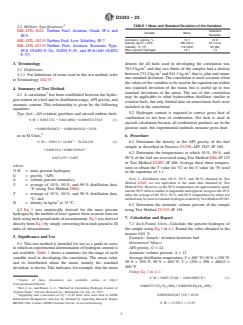
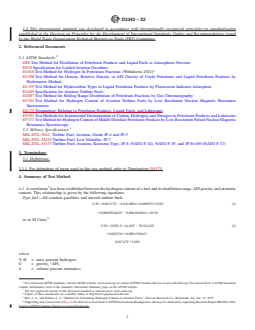
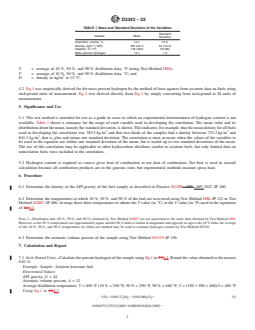
5.1 This test method is intended for use as a guide in cases in which an experimental determination of hydrogen content is not available. Table 1 shows a summary for the range of each variable used in developing the correlation. The mean value and its distribution about the mean, namely the standard deviation, is shown. This indicates, for example, that the mean density for all fuels used in developing the correlation was 783.5 kg/m3 and that two thirds of the samples had a density between 733.2 kg/m3 and 841.3 kg/m3, that is, plus and minus one standard deviation. The correlation is most accurate when the values of the variables to be used in the equation are within one standard deviation of the mean, but is useful up to two standard deviations of the mean. The use of this correlation may be applicable to other hydrocarbon distillates similar to aviation fuels, but only limited data on nonaviation fuels were included in the correlation.
5.2 Hydrogen content is required to correct gross heat of combustion to net heat of combustion. Net heat is used in aircraft calculation because all combustion products are in the gaseous state, but experimental methods measure gross heat.
SCOPE
1.1 This test method covers the estimation of the hydrogen content (mass percent) of aviation gasolines and aircraft turbine and jet engine fuels.
1.2 This test method is empirical and is applicable to liquid hydrocarbon fuels that conform to the requirements of specifications for aviation gasolines or aircraft turbine and jet engine fuels of types Jet A, Jet A-1, Jet B, JP-4, JP-5, JP-7, and JP-8.
Note 1: The procedure for the experimental determination of hydrogen in petroleum fractions is described in Test Methods D1018, D3701, D5291, and D7171.
Note 2: The estimation of the hydrogen content of a hydrocarbon fuel is justifiable only when the fuel belongs to a well-defined class for which a relationship among the hydrogen content and the distillation range, density, and aromatic content has been derived from accurate experimental measurements on representative samples of that class. Even in this case, the possibility that the estimates may be in error by large amounts for individual fuels should be recognized. The fuels used to establish the correlation presented in this test method are defined by the following specifications:
Fuel
Specification
Aviation gasolines
D910
Aircraft turbine and jet engine fuels
JP-4 and JP-5
MIL-DTL-5624
JP-7
MIL-DTL-38219
JP-8
MIL-DTL-83133
Jet A and Jet A-1
D1655
Miscellaneous hydrocarbons
No. 2 Diesel fuel
Kerosene distillates (similar to Jet A)
Miscellaneous (includes thinners, gasoline fractions, and unidentified blends)
Special production fuels (commercial products of nearly pure hydrocarbons
and special high-temperature fuels (HTF) produced for Air Force tests.
Pure hydrocarbons
1.3 The values stated in SI units are to be regarded as the standard.
1.3.1 Exception—The values given in parentheses are for information only.
1.4 This standard does not purport to address all of the safety concerns, if any, associated with its use. It is the responsibility of the user of this standard to establish appropriate safety, health, and environmental practices and determine the applicability of regulatory limitations prior to use.
1.5 This international standard was developed in accordance with internationally recognized principles on standardization established in the Decision on Principles for the Development of International Standards, Guides and Recommendations issued by the World Trade Organization Technical Barriers to Trade (TBT) Committee.
- Status
- Published
- Publication Date
- 31-Oct-2022
- Technical Committee
- D02 - Petroleum Products, Liquid Fuels, and Lubricants
- Drafting Committee
- D02.04.0K - Correlative Methods
Overview
ASTM D3343-22: Standard Test Method for Estimation of Hydrogen Content of Aviation Fuels is an internationally recognized method developed by ASTM International. This empirical standard provides a procedure for estimating the hydrogen content (by mass percent) in aviation gasolines and aircraft turbine and jet engine fuels, specifically when experimental hydrogen determination is not available.
The test method applies to liquid hydrocarbon fuels, including those that comply with aviation fuel specifications (such as Jet A, Jet A-1, Jet B, JP-4, JP-5, JP-7, JP-8), and may be applicable to certain similar hydrocarbon distillates. Its estimations are based on a correlation involving the fuel's density, distillation range, and aromatic content, parameters that are commonly measured and essential for understanding fuel combustion properties.
Key Topics
- Purpose of Estimation: Knowing the hydrogen content of aviation fuels is critical for correcting gross heat of combustion to net heat of combustion, which is required for accurate aircraft performance calculations. Net heat values are necessary because they reflect conditions in which all combustion products are gaseous, aligning with real-world aircraft engine operations.
- Empirical Approach: The standard offers an empirical approach, relying on established correlations from data on representative aviation fuel samples. This estimation is most accurate when fuel properties fall within one standard deviation of the means used in the method's development.
- Applicable Fuel Types: The method is recommended for aviation fuels defined under established standards (including D910, D1655, MIL-DTL-5624, MIL-DTL-38219, and MIL-DTL-83133), and can be cautiously applied to other hydrocarbon distillates with similar characteristics.
- Required Measurements: The estimation process uses:
- Density/API Gravity: Determined via ASTM D1298.
- Distillation Temperatures: Average of 10%, 50%, and 90% recovery, measured using ASTM D86 or D2887.
- Aromatic Content: Volume percent, ascertained by ASTM D1319.
- Precision and Repeatability: The standard specifies repeatability and reproducibility limits, with results considered suspect if duplicate estimations differ by more than 0.03% (same operator) or 0.10% (different laboratories).
Applications
- Aviation Industry: Used by fuel suppliers, laboratories, and aircraft manufacturers to provide necessary hydrogen content data for fuel certification, performance modeling, and safety analyses.
- Fuel Procurement and Quality Control: Estimates can guide procurement decisions and facilitate compliance with performance specifications in cases where direct measurement of hydrogen content is impractical.
- Research and Development: Useful in fuel research for the development of new aviation fuel formulations, especially during preliminary evaluation stages.
- Environmental Reporting: Hydrogen content estimation assists in emission calculations and environmental impact assessments related to aviation fuel combustion.
- Alternate Hydrocabon Distillates: While designed for aviation fuels, the method may offer useful estimates for certain similar distillate hydrocarbons (e.g., kerosene, diesel), though caution and professional judgment are advised due to limited supporting data.
Related Standards
To ensure correct and comparable results, ASTM D3343-22 references several other ASTM and military standards:
- ASTM D86: Distillation of Petroleum Products
- ASTM D1298: Density, Relative Density, or API Gravity by Hydrometer Method
- ASTM D1319: Hydrocarbon Types by Fluorescent Indicator Adsorption
- ASTM D1655: Aviation Turbine Fuels
- ASTM D2887: Boiling Range Distribution by Gas Chromatography
- ASTM D3701, D5291, D7171: Experimental hydrogen determination methods
- D910, MIL-DTL-5624, MIL-DTL-38219, MIL-DTL-83133: Specifications for aviation fuels
Keywords: ASTM D3343-22, hydrogen content, aviation fuels, jet fuel, aviation gasoline, standard test method, fuel analysis, distillation range, net heat of combustion, aromatics, fuel density.
Relations
- Effective Date
- 15-Mar-2024
- Effective Date
- 01-Mar-2024
- Refers
ASTM D4175-23a - Standard Terminology Relating to Petroleum Products, Liquid Fuels, and Lubricants - Effective Date
- 15-Dec-2023
- Effective Date
- 01-Dec-2023
- Effective Date
- 01-Dec-2023
- Effective Date
- 01-Nov-2023
- Effective Date
- 01-Oct-2023
- Effective Date
- 01-Jul-2023
- Refers
ASTM D4175-23e1 - Standard Terminology Relating to Petroleum Products, Liquid Fuels, and Lubricants - Effective Date
- 01-Jul-2023
- Effective Date
- 01-May-2020
- Effective Date
- 01-Dec-2019
- Effective Date
- 01-Jul-2019
- Effective Date
- 01-Jan-2018
- Effective Date
- 01-Dec-2017
- Effective Date
- 01-Oct-2017
Get Certified
Connect with accredited certification bodies for this standard

Element Materials Technology
Materials testing and product certification.

ABS Group Brazil
ABS Group certification services in Brazil.

ABS Quality Evaluations Inc.
American Bureau of Shipping quality certification.
Sponsored listings
Frequently Asked Questions
ASTM D3343-22 is a standard published by ASTM International. Its full title is "Standard Test Method for Estimation of Hydrogen Content of Aviation Fuels". This standard covers: SIGNIFICANCE AND USE 5.1 This test method is intended for use as a guide in cases in which an experimental determination of hydrogen content is not available. Table 1 shows a summary for the range of each variable used in developing the correlation. The mean value and its distribution about the mean, namely the standard deviation, is shown. This indicates, for example, that the mean density for all fuels used in developing the correlation was 783.5 kg/m3 and that two thirds of the samples had a density between 733.2 kg/m3 and 841.3 kg/m3, that is, plus and minus one standard deviation. The correlation is most accurate when the values of the variables to be used in the equation are within one standard deviation of the mean, but is useful up to two standard deviations of the mean. The use of this correlation may be applicable to other hydrocarbon distillates similar to aviation fuels, but only limited data on nonaviation fuels were included in the correlation. 5.2 Hydrogen content is required to correct gross heat of combustion to net heat of combustion. Net heat is used in aircraft calculation because all combustion products are in the gaseous state, but experimental methods measure gross heat. SCOPE 1.1 This test method covers the estimation of the hydrogen content (mass percent) of aviation gasolines and aircraft turbine and jet engine fuels. 1.2 This test method is empirical and is applicable to liquid hydrocarbon fuels that conform to the requirements of specifications for aviation gasolines or aircraft turbine and jet engine fuels of types Jet A, Jet A-1, Jet B, JP-4, JP-5, JP-7, and JP-8. Note 1: The procedure for the experimental determination of hydrogen in petroleum fractions is described in Test Methods D1018, D3701, D5291, and D7171. Note 2: The estimation of the hydrogen content of a hydrocarbon fuel is justifiable only when the fuel belongs to a well-defined class for which a relationship among the hydrogen content and the distillation range, density, and aromatic content has been derived from accurate experimental measurements on representative samples of that class. Even in this case, the possibility that the estimates may be in error by large amounts for individual fuels should be recognized. The fuels used to establish the correlation presented in this test method are defined by the following specifications: Fuel Specification Aviation gasolines D910 Aircraft turbine and jet engine fuels JP-4 and JP-5 MIL-DTL-5624 JP-7 MIL-DTL-38219 JP-8 MIL-DTL-83133 Jet A and Jet A-1 D1655 Miscellaneous hydrocarbons No. 2 Diesel fuel Kerosene distillates (similar to Jet A) Miscellaneous (includes thinners, gasoline fractions, and unidentified blends) Special production fuels (commercial products of nearly pure hydrocarbons and special high-temperature fuels (HTF) produced for Air Force tests. Pure hydrocarbons 1.3 The values stated in SI units are to be regarded as the standard. 1.3.1 Exception—The values given in parentheses are for information only. 1.4 This standard does not purport to address all of the safety concerns, if any, associated with its use. It is the responsibility of the user of this standard to establish appropriate safety, health, and environmental practices and determine the applicability of regulatory limitations prior to use. 1.5 This international standard was developed in accordance with internationally recognized principles on standardization established in the Decision on Principles for the Development of International Standards, Guides and Recommendations issued by the World Trade Organization Technical Barriers to Trade (TBT) Committee.
SIGNIFICANCE AND USE 5.1 This test method is intended for use as a guide in cases in which an experimental determination of hydrogen content is not available. Table 1 shows a summary for the range of each variable used in developing the correlation. The mean value and its distribution about the mean, namely the standard deviation, is shown. This indicates, for example, that the mean density for all fuels used in developing the correlation was 783.5 kg/m3 and that two thirds of the samples had a density between 733.2 kg/m3 and 841.3 kg/m3, that is, plus and minus one standard deviation. The correlation is most accurate when the values of the variables to be used in the equation are within one standard deviation of the mean, but is useful up to two standard deviations of the mean. The use of this correlation may be applicable to other hydrocarbon distillates similar to aviation fuels, but only limited data on nonaviation fuels were included in the correlation. 5.2 Hydrogen content is required to correct gross heat of combustion to net heat of combustion. Net heat is used in aircraft calculation because all combustion products are in the gaseous state, but experimental methods measure gross heat. SCOPE 1.1 This test method covers the estimation of the hydrogen content (mass percent) of aviation gasolines and aircraft turbine and jet engine fuels. 1.2 This test method is empirical and is applicable to liquid hydrocarbon fuels that conform to the requirements of specifications for aviation gasolines or aircraft turbine and jet engine fuels of types Jet A, Jet A-1, Jet B, JP-4, JP-5, JP-7, and JP-8. Note 1: The procedure for the experimental determination of hydrogen in petroleum fractions is described in Test Methods D1018, D3701, D5291, and D7171. Note 2: The estimation of the hydrogen content of a hydrocarbon fuel is justifiable only when the fuel belongs to a well-defined class for which a relationship among the hydrogen content and the distillation range, density, and aromatic content has been derived from accurate experimental measurements on representative samples of that class. Even in this case, the possibility that the estimates may be in error by large amounts for individual fuels should be recognized. The fuels used to establish the correlation presented in this test method are defined by the following specifications: Fuel Specification Aviation gasolines D910 Aircraft turbine and jet engine fuels JP-4 and JP-5 MIL-DTL-5624 JP-7 MIL-DTL-38219 JP-8 MIL-DTL-83133 Jet A and Jet A-1 D1655 Miscellaneous hydrocarbons No. 2 Diesel fuel Kerosene distillates (similar to Jet A) Miscellaneous (includes thinners, gasoline fractions, and unidentified blends) Special production fuels (commercial products of nearly pure hydrocarbons and special high-temperature fuels (HTF) produced for Air Force tests. Pure hydrocarbons 1.3 The values stated in SI units are to be regarded as the standard. 1.3.1 Exception—The values given in parentheses are for information only. 1.4 This standard does not purport to address all of the safety concerns, if any, associated with its use. It is the responsibility of the user of this standard to establish appropriate safety, health, and environmental practices and determine the applicability of regulatory limitations prior to use. 1.5 This international standard was developed in accordance with internationally recognized principles on standardization established in the Decision on Principles for the Development of International Standards, Guides and Recommendations issued by the World Trade Organization Technical Barriers to Trade (TBT) Committee.
ASTM D3343-22 is classified under the following ICS (International Classification for Standards) categories: 75.160.20 - Liquid fuels. The ICS classification helps identify the subject area and facilitates finding related standards.
ASTM D3343-22 has the following relationships with other standards: It is inter standard links to ASTM D1655-24, ASTM D910-24, ASTM D4175-23a, ASTM D86-23ae1, ASTM D86-23a, ASTM D3701-23, ASTM D1655-23a, ASTM D2887-23, ASTM D4175-23e1, ASTM D7171-20, ASTM D910-19, ASTM D2887-19, ASTM D1655-18, ASTM D1655-17a, ASTM D910-17a. Understanding these relationships helps ensure you are using the most current and applicable version of the standard.
ASTM D3343-22 is available in PDF format for immediate download after purchase. The document can be added to your cart and obtained through the secure checkout process. Digital delivery ensures instant access to the complete standard document.
Standards Content (Sample)
This international standard was developed in accordance with internationally recognized principles on standardization established in the Decision on Principles for the
Development of International Standards, Guides and Recommendations issued by the World Trade Organization Technical Barriers to Trade (TBT) Committee.
Designation: D3343 − 22
Standard Test Method for
Estimation of Hydrogen Content of Aviation Fuels
This standard is issued under the fixed designation D3343; the number immediately following the designation indicates the year of
original adoption or, in the case of revision, the year of last revision. A number in parentheses indicates the year of last reapproval. A
superscript epsilon (´) indicates an editorial change since the last revision or reapproval.
This standard has been approved for use by agencies of the U.S. Department of Defense.
1. Scope* responsibility of the user of this standard to establish appro-
priate safety, health, and environmental practices and deter-
1.1 This test method covers the estimation of the hydrogen
mine the applicability of regulatory limitations prior to use.
content (mass percent) of aviation gasolines and aircraft
1.5 This international standard was developed in accor-
turbine and jet engine fuels.
dance with internationally recognized principles on standard-
1.2 This test method is empirical and is applicable to liquid
ization established in the Decision on Principles for the
hydrocarbon fuels that conform to the requirements of speci-
Development of International Standards, Guides and Recom-
ficationsforaviationgasolinesoraircraftturbineandjetengine
mendations issued by the World Trade Organization Technical
fuels of types Jet A, Jet A-1, Jet B, JP-4, JP-5, JP-7, and JP-8.
Barriers to Trade (TBT) Committee.
NOTE 1—The procedure for the experimental determination of hydro-
2. Referenced Documents
gen in petroleum fractions is described in Test Methods D1018, D3701,
D5291, and D7171. 2
2.1 ASTM Standards:
NOTE 2—The estimation of the hydrogen content of a hydrocarbon fuel
D86 Test Method for Distillation of Petroleum Products and
is justifiable only when the fuel belongs to a well-defined class for which
a relationship among the hydrogen content and the distillation range, Liquid Fuels at Atmospheric Pressure
density, and aromatic content has been derived from accurate experimen-
D910 Specification for Leaded Aviation Gasolines
tal measurements on representative samples of that class. Even in this
D1018 Test Method for Hydrogen In Petroleum Fractions
case,thepossibilitythattheestimatesmaybeinerrorbylargeamountsfor
(Withdrawn 2021)
individual fuels should be recognized. The fuels used to establish the
D1298 Test Method for Density, Relative Density, or API
correlation presented in this test method are defined by the following
specifications: Gravity of Crude Petroleum and Liquid Petroleum Prod-
ucts by Hydrometer Method
Fuel Specification
Aviation gasolines D910
D1319 Test Method for Hydrocarbon Types in Liquid Petro-
Aircraft turbine and jet engine fuels
leum Products by Fluorescent Indicator Adsorption
JP-4 and JP-5 MIL-DTL-5624
D1655 Specification for Aviation Turbine Fuels
JP-7 MIL-DTL-38219
JP-8 MIL-DTL-83133
D2887 Test Method for Boiling Range Distribution of Pe-
Jet A and Jet A-1 D1655
troleum Fractions by Gas Chromatography
Miscellaneous hydrocarbons
D3701 Test Method for Hydrogen Content of Aviation
No. 2 Diesel fuel
Kerosene distillates (similar to Jet A)
Turbine Fuels by Low Resolution Nuclear Magnetic
Miscellaneous (includes thinners, gasoline fractions, and unidentified blends)
Resonance Spectrometry
Special production fuels (commercial products of nearly pure hydrocarbons
and special high-temperature fuels (HTF) produced for Air Force tests. D4175 Terminology Relating to Petroleum Products, Liquid
Pure hydrocarbons
Fuels, and Lubricants
1.3 The values stated in SI units are to be regarded as the
D5291 Test Methods for Instrumental Determination of
standard. Carbon, Hydrogen, and Nitrogen in Petroleum Products
1.3.1 Exception—The values given in parentheses are for
and Lubricants
information only. D7171 Test Method for Hydrogen Content of Middle Dis-
tillate Petroleum Products by Low-Resolution Pulsed
1.4 This standard does not purport to address all of the
Nuclear Magnetic Resonance Spectroscopy
safety concerns, if any, associated with its use. It is the
1 2
This test method is under the jurisdiction of ASTM Committee D02 on For referenced ASTM standards, visit the ASTM website, www.astm.org, or
Petroleum Products, Liquid Fuels, and Lubricants and is the direct responsibility of contact ASTM Customer Service at service@astm.org. For Annual Book of ASTM
Subcommittee D02.04.0K on Correlative Methods. Standards volume information, refer to the standard’s Document Summary page on
Current edition approved Nov. 1, 2022. Published November 2022. Originally the ASTM website.
approved in 1974. Last previous edition approved in 2016 as D3343 – 16. DOI: The last approved version of this historical standard is referenced on
10.1520/D3343-22. www.astm.org.
*A Summary of Changes section appears at the end of this standard
Copyright © ASTM International, 100 Barr Harbor Drive, PO Box C700, West Conshohocken, PA 19428-2959. United States
D3343 − 22
TABLE 1 Mean and Standard Deviation of the Variables
2.2 Military Specifications:
MIL-DTL-5624 Turbine Fuel, Aviation, Grade JP-4 and Standard
Variable Mean
Deviation
JP-5
Aromatics, volume, % 14.1 21.6
MIL-DTL-38219 Turbine Fuel, Low Volatility, JP-7
Density, kg/m (°API) 783 (49.1) 54 (12.4)
MIL-DTL-83133 Turbine Fuel, Aviation, Kerosene Type,
Volatility, °C (°F) 178 (352) 53 (96)
JP-8 (NATO F-34), NATO F-35, and JP-8+100 (NATO Mass percent hydrogen 14.1 1.3
F-37)
3. Terminology density for all fuels used in developing the correlation was
783.5 kg⁄m and that two thirds of the samples had a density
3.1 Definitions:
3 3
between 733.2 kg⁄m and 841.3 kg⁄m , that is, plus and minus
3.1.1 For definitions of terms used in this test method, refer
one standard deviation. The correlation is most accurate when
to Terminology D4175.
the values of the variables to be used in the equation are within
one standard deviation of the mean, but is useful up to two
4. Summary of Test Method
standard deviations of the mean. The use of this correlation
4.1 A correlation has been established between the hydro-
may be applicable to other hydrocarbon distillates similar to
gen content of a fuel and its distillation range,API gravity, and
aviation fuels, but only limited data on nonaviation fuels were
aromatic content. This relationship is given by the following
included in the correlation.
equations:
5.2 Hydrogen content is required to correct gross heat of
Type fuel—All aviation gasolines and aircraft turbine fuels
combustion to net heat of combustion. Net heat is used in
%H 5 0.06317G 2 0.041089A10.000072135AV (1)
aircraft calculation because all combustion products are in the
gaseous state, but experimental methods measure gross heat.
10.00005684GV 2 0.0004960GA110.56
or in SI Units, 6. Procedure
%H 5 ~9201.2114.49T 2 70.22A!/D (2) 6.1 Determine the density or the API gravity of the fuel
sample as described in Practice D1298–API 2547–IP 160.
10.02652A10.0001298AT2
6.2 Determine the temperatures at which 10 %, 50 %, and
90 % of the fuel are recovered using Test Method D86–IP 123
0.01347T12.003
or Test Method D2887–IP 406. Average these three tempera-
where:
tures to obtain the T value (in °C) or the V value (in °F) used
% H = mass percent hydrogen;
in the equations of 4.1.
G = gravity, °API;
NOTE 3—Distillation data (10 %, 50 %, and 90 %) obtained by Test
A = volume percent aromatics;
Method D2887 are not equi
...
This document is not an ASTM standard and is intended only to provide the user of an ASTM standard an indication of what changes have been made to the previous version. Because
it may not be technically possible to adequately depict all changes accurately, ASTM recommends that users consult prior editions as appropriate. In all cases only the current version
of the standard as published by ASTM is to be considered the official document.
Designation: D3343 − 16 D3343 − 22
Standard Test Method for
Estimation of Hydrogen Content of Aviation Fuels
This standard is issued under the fixed designation D3343; the number immediately following the designation indicates the year of
original adoption or, in the case of revision, the year of last revision. A number in parentheses indicates the year of last reapproval. A
superscript epsilon (´) indicates an editorial change since the last revision or reapproval.
This standard has been approved for use by agencies of the U.S. Department of Defense.
1. Scope*
1.1 This test method covers the estimation of the hydrogen content (mass percent) of aviation gasolines and aircraft turbine and
jet engine fuels.
1.2 This test method is empirical and is applicable to liquid hydrocarbon fuels that conform to the requirements of specifications
for aviation gasolines or aircraft turbine and jet engine fuels of types Jet A, Jet A-1, Jet B, JP-4, JP-5, JP-7, and JP-8.
NOTE 1—The procedure for the experimental determination of hydrogen in petroleum fractions is described in Test Methods D1018, D3701, D5291, and
D7171.
NOTE 2—The estimation of the hydrogen content of a hydrocarbon fuel is justifiable only when the fuel belongs to a well-defined class for which a
relationship among the hydrogen content and the distillation range, density, and aromatic content has been derived from accurate experimental
measurements on representative samples of that class. Even in this case, the possibility that the estimates may be in error by large amounts for individual
fuels should be recognized. The fuels used to establish the correlation presented in this test method are defined by the following specifications:
Fuel Specification
Aviation gasolines D910
Aircraft turbine and jet engine fuels
JP-4 and JP-5 MIL-DTL-5624
JP-7 MIL-DTL-38219
JP-8 MIL-DTL-83133
Jet A and Jet A-1 D1655
Miscellaneous hydrocarbons
No. 2 Diesel fuel
Kerosene distillates (similar to Jet A)
Miscellaneous (includes thinners, gasoline fractions, and unidentified blends)
Special production fuels (commercial products of nearly pure hydrocarbons
and special high-temperature fuels (HTF) produced for Air Force tests.
Pure hydrocarbons
1.3 The values stated in SI units are to be regarded as the standard.
1.3.1 Exception—The values given in parentheses are for information only.
1.4 This standard does not purport to address all of the safety concerns, if any, associated with its use. It is the responsibility
of the user of this standard to establish appropriate safety safety, health, and healthenvironmental practices and determine the
applicability of regulatory limitations prior to use.
This test method is under the jurisdiction of ASTM Committee D02 on Petroleum Products, Liquid Fuels, and Lubricants and is the direct responsibility of Subcommittee
D02.04.0K on Correlative Methods.
Current edition approved Jan. 1, 2016Nov. 1, 2022. Published February 2016November 2022. Originally approved in 1974. Last previous edition approved in 20152016
as D3343 – 05 (2015).D3343 – 16. DOI: 10.1520/D3343-16.10.1520/D3343-22.
*A Summary of Changes section appears at the end of this standard
Copyright © ASTM International, 100 Barr Harbor Drive, PO Box C700, West Conshohocken, PA 19428-2959. United States
D3343 − 22
1.5 This international standard was developed in accordance with internationally recognized principles on standardization
established in the Decision on Principles for the Development of International Standards, Guides and Recommendations issued
by the World Trade Organization Technical Barriers to Trade (TBT) Committee.
2. Referenced Documents
2.1 ASTM Standards:
D86 Test Method for Distillation of Petroleum Products and Liquid Fuels at Atmospheric Pressure
D910 Specification for Leaded Aviation Gasolines
D1018 Test Method for Hydrogen In Petroleum Fractions (Withdrawn 2021)
D1298 Test Method for Density, Relative Density, or API Gravity of Crude Petroleum and Liquid Petroleum Products by
Hydrometer Method
D1319 Test Method for Hydrocarbon Types in Liquid Petroleum Products by Fluorescent Indicator Adsorption
D1655 Specification for Aviation Turbine Fuels
D2887 Test Method for Boiling Range Distribution of Petroleum Fractions by Gas Chromatography
D3701 Test Method for Hydrogen Content of Aviation Turbine Fuels by Low Resolution Nuclear Magnetic Resonance
Spectrometry
D4175 Terminology Relating to Petroleum Products, Liquid Fuels, and Lubricants
D5291 Test Methods for Instrumental Determination of Carbon, Hydrogen, and Nitrogen in Petroleum Products and Lubricants
D7171 Test Method for Hydrogen Content of Middle Distillate Petroleum Products by Low-Resolution Pulsed Nuclear Magnetic
Resonance Spectroscopy
2.2 Military Specifications:
MIL-DTL-5624 Turbine Fuel, Aviation, Grade JP-4 and JP-5
MIL-DTL-38219 Turbine Fuel, Low Volatility, JP-7
MIL-DTL-83133 Turbine Fuel, Aviation, Kerosene Type, JP-8 (NATO F-34), NATO F-35, and JP-8+100 (NATO F-37)
3. Terminology
3.1 Definitions:
3.1.1 For definitions of terms used in this test method, refer to Terminology D4175.
4. Summary of Test Method
4.1 A correlation has been established between the hydrogen content of a fuel and its distillation range, API gravity, and aromatic
content. This relationship is given by the following equations:
Type fuel—All aviation gasolines and aircraft turbine fuels
% H5 0.063 17G 2 0.041 089A10.000 072 135AV (1)
10.000 056 84GV 2 0.000 496 0GA110.56
or in SI Units,
% H5 9201.2114.49T 2 70.22A /D (2)
~ !
10.026 52A10.000 129 8AT2
0.01347T12.003
where:
% H = mass percent hydrogen;
G = gravity, °API;
A = volume percent aromatics;
For referenced ASTM standards, visit the ASTM website, www.astm.org, or contact ASTM Customer Service at service@astm.org. For Annual Book of ASTM Standards
volume information, refer to the standard’s Document Summary page on the ASTM website.
The last approved version of this historical standard is referenced on www.astm.org.
Copies of these documents are available online at http://www.quicksearch.dla.mil.
Bert, J. A., and Painter, L. J., “Method for Calculating Hydrogen Content of Aviation Fuels,” Chevron Research Co., Richmond, CA, Jan. 12, 1973.
Supporting data (conversion of Eq 1 to SI units) have been filed at ASTM International Headquarters and may be obtained by requesting Research Report RR:D02-1266.
Contact ASTM Customer Service at service@astm.org.
D3343 − 22
TABLE 1 Mean and Standard Deviation of the Variables
Standard
Variable Mean
Deviation
Aromatics, volume, % 14.1 21.6
Density, kg/m (°API) 783 (49.1) 54 (12.4)
Volatility, °C (°F) 178 (352) 53 (96)
Mass percent hydrogen 14.1 1.3
V = average of 10 %, 50 %, and 90 % distillation data, °F (using Test Method D86);
T = average of 10 %, 50 %, and 90 % distillation data, °C; and
D = density in kg/m at 15 °C.
4.2 Eq 1 was empirically derived for the mass percent hydrogen by the method of least squares from accurate data on fuels using
inch-pound units of measurement. Eq 2 was derived directly from Eq 1 by simply converting from inch-pound to SI units of
measurement.
5. Significance and Use
5.1 This test method is intended for use as a guide in cases in which an experimental determination of hydrogen content is not
available. Table 1 shows a summary for the range of each variable used in developing the correlation. The mean value and its
distribution about the mean, namely the standard deviation, is shown. This indicates, for example, that the mean density for all fuels
3 3
used in developing the correlation was 783.5 kg ⁄m and that
...